Exhibition | Titian to Canaletto: Drawing in Venice
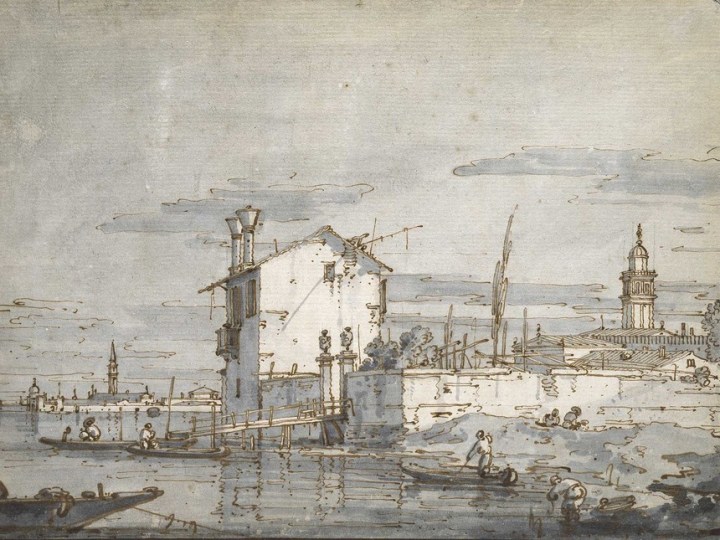
Giovanni Antonio Canal, known as Canaletto (1697‒1768), An Island in the Lagoon, pen, brown ink with grey wash over ruled pencil lines on blue paper, 20 x 27.9 cm (Ashmolean Museum, University of Oxford).
◊ ◊ ◊ ◊ ◊
Press release (28 August 2015) for the exhibition opening this week at the Ashmolean:
Titian to Canaletto: Drawing in Venice
Ashmolean Museum of Art and Archaeology, Oxford, 15 October 2015 — 10 January 2016
Curated by Catherine Whistler
Featuring a hundred drawings from the Uffizi, the Ashmolean, and Christ Church, Oxford, Titian to Canaletto is a groundbreaking exhibition based on new research. Venetian art has long been associated with brilliant colours and free brushwork, but drawing has been written out of its history. This exhibition highlights the significance of drawing as a concept and as a practice in the artistic life of Venice. It reveals the variety of purposes and techniques in drawing from Bellini, Titian and Tintoretto to Tiepolo and Canaletto. In a parallel exhibition, Jenny Saville Drawing, one of the UK’s most celebrated contemporary artists, Jenny Saville, has produced new work on paper and canvas in response to the Venetian Old Masters.
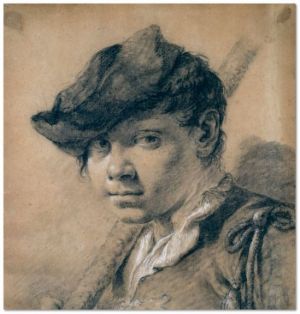
Giovanni Battista Piazzetta (1682‒1754), Head of a Youth, black and white chalks on brownish paper, 31.5 x 29.9 cm (Ashmolean Museum, University of Oxford)
Putting the words ‘drawing’ and ‘Venice’ together seems paradoxical. Writing on Venetian art has located creativity and artistic ambition in painting above all, emphasizing the materiality and sensuous effects achieved by Venetian artists. The intellectual and reflective qualities encapsulated in drawing are seen as irrelevant in the artistic world of Venice. The idea that Venetian artists did not use or value drawing was articulated in Florence, in Giorgio Vasari’s Lives of the Artists of 1568. Vasari’s influential statements were repeated and elaborated by later writers, so that in 1770s London, Joshua Reynolds confidently asserted that artists in Venice did not care about drawing with all of its virtues of discrimination and judgement, and that they went straight to working with brushes on canvas. This potent literary tradition had a major impact on the survival of drawings.
Titian to Canaletto presents new research which traces continuities in Venetian drawing over three centuries, from around 1500 to the foundation of the first academy of art in Venice in 1750. The exhibition emphasizes the role of drawing from sculpture and from life in the education and identities of Venetian artists, and it reveals tensions between theory and practice in the activities of artists and of collectors. Venetian artists used drawing for innovating and experimenting, or as a tool for research and observation; a variety of drawings were made and admired as works of art in their own right. The exhibition poses questions about the survival and value of drawings: does the fact that we have so few by Titian mean that he did not draw? Why were many Venetian drawings thought unworthy of collecting?
Ironically, while the story that Venetian artists did not respect drawing was first told in Florence, one of the world’s great collections of Venetian drawings is held at the Uffizi where many drawings were acquired in the mid-seventeenth century for Leopoldo de’Medici. Not only are there masterpieces by Carpaccio, Bassano, Titian and Tintoretto, and high-quality works by lesser-known seventeenth- century artists, there are also drawings that reveal early attitudes to collecting and connoisseurship. The Uffizi will also lend drawings by Tiepolo that have never been shown before, to be grouped with the Ashmolean’s own superb collection. Pioneering collectors in England owned Venetian drawings, and loans of important works by Veronese and Tintoretto will come from the intact early eighteenth-century collection at Christ Church, Oxford, together with the extraordinary Portrait of a man, by Giovanni Bellini.
Dr Catherine Whistler, Keeper of the Department of Western Art, Ashmolean Museum, and curator of the exhibition, says: “The beauty and visual impact of these drawings speak eloquently of the importance of drawing in Venice. We hope this exhibition will challenge traditional views of Venetian art and provoke new thinking on some of the greatest names in Italian art from the Renaissance to the eighteenth century.”
Dr Alexander Sturgis, Director of the Ashmolean, says: “The Ashmolean is bringing to a close its year of drawings exhibitions with this landmark show. Titian to Canaletto includes some of the Ashmolean’s greatest treasures, brought together with examples from two of the world’s finest collections of Old Master drawings—that of the Uffizi and the Christ Church Picture Gallery. Many of the works in the exhibition have not been displayed in public since the 1950s. The captivating beauty of these drawings is evident in the response they have elicited from one of this country’s most distinguished contemporary artists, Jenny Saville, who has produced a new body of work inspired by pieces in the exhibition and her enduring love of Venetian art.”
In Jenny Saville Drawing, Jenny Saville will present a body of drawings, including several new and unseen works in a dedicated exhibition space that accompanies Titian to Canaletto: Drawing in Venice. The rich material and gestural qualities of Venetian drawings have been an inspiration for the thoughtful yet visceral works on paper and canvas that will be on view. For Jenny Saville, the blurred or grainy charcoal marks and the agile, robust pen lines of Venetian artists such as Titian or Palma Giovane become catalysts for exploring the nature and power of drawing, in new, highly charged works of art.
◊ ◊ ◊ ◊ ◊
The catalogue is distributed by ACC:
Catherine Whistler, ed., Drawing in Venice: Titian to Canaletto (Oxford: Ashmolean Museum/ Woodstocker Books, 2015), 256 pages, ISBN: 978-1854442994, $45.
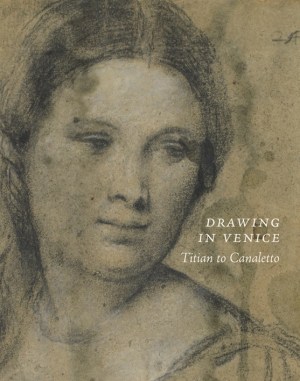 Featuring over a hundred drawings from the outstanding collections of graphic art at the Uffizi, Florence, and the Ashmolean, and Christ Church, Oxford, Drawing in Venice is based on ground-breaking new research and accompanies an Ashmolean-Uffizi collaborative exhibition (2015–16) which traces continuities in Venetian drawing over three centuries, from around 1500 down to the foundation of the first academy of art in Venice in 1750.
Venetian art has long been associated with brilliant colours and free brushwork, but drawing has been written out of its history. This book highlights the significance of drawing as a concept and as a practice in the artistic life of Venice. It reveals the variety of aims, purposes, and techniques in drawing through the works of the Venetian Renaissance masters Giovanni Bellini, Titian, and Tintoretto to those of the great eighteenth-century artists, Giovanni Battista Tiepolo and Canaletto.
Dr Catherine Whistler is Keeper of the Western Art Department at the Ashmolean Museum, University of Oxford. Her previous publications include Michelangelo and Raphael Drawings (1990); Drawings by the Carracci from British Collections (joint author, 1996); Opulence and Devotion: Brazilian Baroque Art (2001); and Graceful and True: Drawings in Florence c.1600 (joint author, 2003).
C O N T E N T S
Essays
1 Catherine Whistler, Drawing in Venice from Titian to Canaletto: Practice and Perception
2 Giorgio Marini, Disegni a stampa: Drawing Practice and Printmaking in Venice from the Sixteenth to the Eighteenth Centuries
3 Marzia Faietti, Giorgio Vasari’s ‘Life of Titian’: Critical Misinterpretations and Preconceptions Concerning Venetian Drawing
4 Jacqueline Thalmann, General John Guise and His Collection of Venetian Drawings
Catalogue Entries
Glossary of Materials and Techniques of Drawing
Artists’ Biographies
Bibliography
Exhibition | Collecting the Arts of Mexico
Now on view at The Met:
Collecting the Arts of Mexico
The Metropolitan Museum of Art, New York, 17 July 2015 — 7 August 2016

Nicolás Enríquez, The Virgin of Guadalupe with the Four Apparitions (detail), 1773, oil on copper, 56.5 x 41.9 cm (New York: The Metropolitan Museum of Art, New York, 2014.173)
In 1911, Emily Johnston de Forest gave her collection of pottery from Mexico to the Metropolitan Museum. Calling it ‘Mexican maiolica’, she highlighted its importance as a North American artistic achievement. De Forest was the daughter of the Museum’s first president and, with her husband, Robert, a founder of The American Wing. The De Forests envisioned building a collection of Mexican art, and, even though their ambitions were frustrated at the time, the foundational gift of more than one hundred pieces of pottery anchors the Met’s holdings. Today, more than a century later, their vision resonates as the Museum commits to collecting and exhibiting not just the arts of Mexico, but all of Latin America. This exhibition highlights the early contributions of the De Forests and others, and presents recent additions to the collection for the first time.
Learn more about five paintings by Nicolas Enriquez (1704–1790) featured in this exhibition on MetCollects.
Exhibition | The Edible Monument: The Art of Food for Festivals

Marcantonio Chiarini and Giacomo-Maria Giovannini, Disegni del convito fatto dall’illustrissimo signor senatore Francesco Ratta all’illustrissimo publico, eccelsi signori anziani and altra nobilità: terminando il svo confalonierato li 28. febraro 1693 (The Getty Museum). More information is available here.
◊ ◊ ◊ ◊ ◊
The Edible Monument revisits the exhibition mounted at the Getty in 2000, with the publication this fall of an accompanying catalogue.
The Edible Monument: The Art of Food for Festivals
The Getty Research Institute, Los Angeles, 13 October 2015 — 23 March 2016
Detroit Institute of Arts, 16 December 2016 — 16 April 2017
Curated by Marica Reed
Elaborate artworks made of food were created for royal court and civic celebrations in early modern Europe. Like today’s Rose Bowl Parade on New Year’s Day or Mardi Gras just before Lent, festivals were times for exuberant parties. Public celebrations and street parades featured large-scale edible monuments made of breads, cheeses, and meats. At court festivals, banquet settings and dessert buffets displayed magnificent table monuments with heraldic and emblematic themes made of sugar, flowers, and fruit. This exhibition, drawn from the Getty Research Institute’s Festival Collection, features rare books and prints, including early cookbooks and serving manuals that illustrate the methods and materials for making edible monuments.
Edited by Marcia Reed with contributions by Charissa Bremer-David, Joseph Imorde, Marcia Reed, and Anne Willan, The Edible Monument: The Art of Food for Festivals (Los Angeles: Getty Publications, 2015), 192 pages, ISBN 978-1-60606-454-2, $35.
 The Edible Monument considers the elaborate architecture, sculpture, and floats made of food that were designed for court and civic celebrations in early modern Europe. These include popular festivals such as Carnival and the Italian Cuccagna. Like illuminations and fireworks, ephemeral artworks made of food were not well documented and were challenging to describe because they were perishable and thus quickly consumed or destroyed. In times before photography and cookbooks, there were neither literary models nor a repertoire of conventional images for how food and its preparation should be explained or depicted. Although made for consumption, food could also be a work of art, both as a special attraction and as an expression of power. Formal occasions and spontaneous celebrations drew communities together, while special foods and seasonal menus revived ancient legends, evoking memories and recalling shared histories, values, and tastes. Drawing on books, prints, and scrolls that document festival arts, elaborate banquets, and street feasts, the essays in this volume examine the mythic themes and personas employed to honor and celebrate rulers; the methods, materials, and wares used to prepare, depict, and serve food; and how foods such as sugar were transformed to express political goals or accomplishments.
Marcia Reed is chief curator at the Getty Research Institute. She is coeditor of China on Paper (Getty Publications, 2007).
◊ ◊ ◊ ◊ ◊
C O N T E N T S
Acknowledgments
1 Marcia Reed—Food, Memory, and Taste
2 Marica Reed—Court and Civic Festivals
3 Marcia Reed—Feasting in the Streets: Carnivals and the Cuccagna
4 Joseph Imorde—Edible Prestige
5 Charissa Bremer-David—Of Cauliflower and Crayfish: Serving Vessels to Awaken the Palate
6 Anne Willan—Behind the Scenes
Contributors
Illustration Credits
Index
◊ ◊ ◊ ◊ ◊
Note (added 2 November 2016) — The DIA venue was not included in the original posting.
Exhibition | In Pursuit of Antiquity

William Chambers, Presentation drawing showing a perspective view of an unexecuted design for a Mausoleum
for Frederick, Prince of Wales, initialed and dated 1751, Pencil, pen and ink, and watercolour, 490 x 705 mm
(London: Sir John Soane’s Museum)
◊ ◊ ◊ ◊ ◊
Press release (17 August 2015) from Berlin’s Museum for Architectural Drawing:
In Pursuit of Antiquity: Drawings by the Giants of British Neo-Classicism
Auf den Spuren der Antike: Meisterzeichnungen des britischen Neoklassizismus
Sir John Soane’s Museum, London, 1 February — 1 June 2008
Museum für Architekturzeichnung, Berlin, 3 October 2015 — 14 February 2016
Curated by Jeremy Musson
Important architectural drawings held by Sir John Soane’s Museum, one of the most significant collections of its kind in Great Britain, form a new temporary exhibition at the Museum for Architectural Drawing in Berlin. In Pursuit of Antiquity: Drawings from the Giants of British Neo-Classicism illustrates the ambition of leading British architects of the late 18th century who strove to create new architecture in the Classical tradition that could compete—in terms of public works, private houses, mausolea, interior detail and even furnishings—with the glories of the ancient world. Illustrating this central theme, some of the finest drawings and designs by Sir John Soane himself, Robert Adam, George Dance the Younger, Sir William Chambers, and James Wyatt are being shown for the first time in Germany.
In Pursuit of Antiquity is curated by architectural historian and author Jeremy Musson and was originally shown at Sir John Soane’s Museum in 2008. Musson’s selection from the Museum’s unrivalled collection includes an astonishingly detailed cutaway drawing of Holy Trinity Marylebone, one of Soane’s three neo-classical churches. Such designs are a reminder of the passionate belief held by Soane and his architectural contemporaries that the quality of a society could be judged by its public buildings. London was then the centre of the largest empire since Rome, and the exhibition includes Soane’s design for two huge triumphal arches (celebrating Waterloo and Trafalgar) at each end of Downing Street. The deliberate association of ancient and modern empires is clear.
Alongside designs for monumental public architecture, In Pursuit of Antiquity also includes more intimate details, such as chimneypieces and domestic furniture, whose Egyptian, Grecian, and Roman nuances reflect aspirations for the birth of a new golden age. The exhibition focuses on ancient Rome and its great monuments as a source of inspiration to the architectural students of the 18th and 19th centuries who exhaustively measured, studied, surveyed, and, above all, drew these structures as part of their education. The exhibition also explores the idea of an architectural drawing—from sketch to final presentation. Drawings by French and Italian artists such as Percier, Clérisseau, and the great Piranesi, all represented in Soane’s collection, illustrate the links between these architects and British architects.
Often described as ‘the father of modern architecture’, Sir John Soane (1753–1837) brought together a magnificent collection of architectural drawings intended to provide exemplars for himself, his sons, and his assistants. It was to be a source of reference, inspiration, ideas, and comparison and later became a key aspect of his conscious creation of a museum collection. Today, the outstanding drawings held at Sir John Soane’s Museum stand alongside the collection of the Royal Institute of British Architects as the two pre-eminent collections of architectural drawings in the country.
Jeremy Musson is an architectural historian, broadcaster and author. He is the author of The Drawing Room: Country House Design and Decoration (2014), English Country House Interiors (2011), How to Read a Country House (2006), and series editor of books published from the archive of Country Life, including The Regency Country House and The Country Houses of Adam. He also contributes to The British Art Journal and The Georgian Group Journal . He lectures regularly, including for the University of Cambridge, the Attingham Summer School, and the Royal Oak. Born in London in 1965, Musson lives in Cambridge with his family.
Exhibition | The Fabric of India
I noted this exhibition last fall, but it’s worth following up now that the show is on view at the V&A (3 October 2015 — 10 January 2016). The press release is available as a PDF file here, with information on the catalogue included below. –CH
◊ ◊ ◊ ◊ ◊
From the V&A shop:
Rosemary Crill, The Fabric of India (London: V&A Publishing, 2015), 240 pages, ISBN: 978-1851778539, £30 / $60.
 This is the first truly comprehensive book on Indian textiles, featuring stunning examples from all over the country. Lavishly illustrated, it begins with an in-depth exploration of the different materials, techniques, and dyeing processes used in the creation of these sumptuous fabrics before exploring the central importance of cloth to Indian life and culture from ancient times to the present day. Special features focus on objects of historical importance, including a Kashmir map shawl, Tipu Sultan’s tent, and a remarkable 18th-century temple hanging from South India.
While many are familiar with Mughal velvets, western-market chintzes, or rural embroideries, for example, this book will surprise, inspire, delight, and inform with an extraordinary range of material, much of it new. Along with presenting great historical masterpieces, the importance and variety of the basic fibers—silk, cotton, wool—from which Indian textiles are traditionally made is emphasized, and the remarkable techniques of weaving, printing, dyeing, and embroidery that have made them prized across the world are illustrated in specially taken photographs.
Exhibition | Woven Gold: Tapestries of Louis XIV
Press release (30 April 2015) from The Getty:
Woven Gold: Tapestries of Louis XIV
The Getty Center, Los Angeles, 15 December 2015 — 1 May 2016
Curated by Charissa Bremer-David
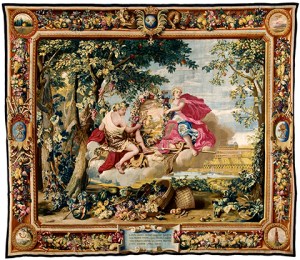
Autumn, after 1664, tapestry, wool, silk and gilt-metal wrapped thread, Gobelins Manufactory, cartoon attributed to Beaudrin Yvart (French, 1611–1690), after Charles Le Brun (French, 1619–1690), The Mobilier National, France. Photo by Lawrence Perquis.
It was during the reign of the Sun King, Louis XIV (r. 1643– 1715), that the art of tapestry weaving in France blossomed. Three hundred years after his death, the Getty Museum will showcase 15 monumental tapestries—from the French royal collection during the reign of Louis XIV. Woven Gold: Tapestries of Louis XIV will be the first major museum exhibition of tapestries in the Western United States in four decades.
During Louis XIV’s time, colorful and glittering tapestries, handwoven after designs by the most renowned artists, were the ultimate expression of status, power, taste, and wealth. The exhibition will feature 15 larger-than-life tapestries ranging in date from about 1540 to 1715 and created in weaving workshops across northern Europe. In an exclusive loan from the French nation, most of the tapestries are from the collection of the Mobilier National, which preserves the former royal collection. Eleven have never before been exhibited in the Unites States. The Getty Museum is supporting the conservation of two of the tapestries.
At the Getty, preparatory drawings, related prints and a life-sized cartoon (oil) will accompany the immense hangings. The tapestries in the exhibition are after works of art by Raphael (Raffaello Sanzio, Italian, 1483–1520), Peter Paul Rubens (Flemish, 1577–1640), Charles Le Brun (French, 1619–1690), and others. They come from the most notable workshops in Europe, including the Gobelins, which rose to preeminence under Louis XIV’s patronage. Several of the best-preserved and most famous examples of Gobelins weaving will be on view in the exhibition.
Woven Gold: Tapestries of Louis XIV is curated by Charissa Bremer-David, curator of sculpture and decorative arts at the Getty, and was organized by the J. Paul Getty Museum in association with the Mobilier National et les Manufactures Nationales des Gobelins, de Beauvais et de la Savonnerie.
◊ ◊ ◊ ◊ ◊
Charissa Bremer-David, with essays by Pascal-François Bertrand, Arnauld Brejon de Lavergnée, and Jean Vittet, Woven Gold: Tapestries of Louis XIV (Los Angeles: Getty Publications, 2015), 168 pages, ISBN: 978-1606064610, $50.
 Meticulously woven by hand with wool, silk, and gilt-metal thread, the tapestry collection of the Sun King, Louis XIV of France, represents the highest achievements of the art form. Intended to enhance the king’s reputation by visualizing his manifest glory and to promote the kingdom’s nascent mercantile economy, the royal collection of tapestries included antique and contemporary sets that followed the designs of the greatest artists of the Renaissance and Baroque periods, including Raphael, Giulio Romano, Rubens, Vouet, and Le Brun. Ranging in date from about 1540 to 1715 and coming from weaving workshops across northern Europe, these remarkable works portray scenes from the bible, history, and mythology. As treasured textiles, the works were traditionally displayed in the royal palaces when the court was in residence and in public on special occasions and feast days. They are still little known, even in France, as they are mostly reserved for the decoration of elite state residences and ministerial offices. This catalogue accompanies an exhibition of fourteen marvelous examples of the former royal collection that will be displayed exclusively at the J. Paul Getty Museum at the Getty Center from December 15, 2015, to May 1, 2016. Lavishly illustrated, the volume presents for the first time in English the latest scholarship of the foremost authorities working in the field.
Charissa Bremer-David is curator in the Department of Sculpture and Decorative Arts at the J. Paul Getty Museum. She is author of French Tapestries and Textiles in the J. Paul Getty Museum (Getty Publications, 1997) and has published extensively on French tapestries.
◊ ◊ ◊ ◊ ◊
Also on view at the Getty
As 2015 is the tercentenary of the death of Louis XIV, several exhibitions at the Getty Center will explore the Sun King’s tremendous influence on Western Art and his distinctive role as collector, heir, and patron of the art of tapestry and other arts.
• A Kingdom of Images: French Prints in the Age of Louis XIV, 1660–1715
16 June to 6 September 2015
• Louis XIV at the Getty
9 June 2015 to 31 July 2016
• Louis Style: French Frames, 1610–1792
15 September 2015 – 3 January 2016
Exhibition | Louis Style: French Frames, 1610–1792
◊ ◊ ◊ ◊ ◊
Press release for the exhibition now on view at The Getty:
Louis Style: French Frames, 1610–1792
The Getty Center, Los Angeles, 15 September 2015 — 3 January 2016
Curated by Davide Gasparotto, Anne Woollett, and Gene Karraker
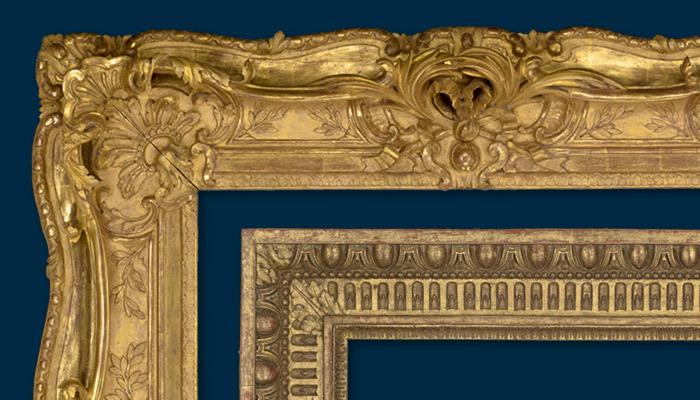
Louis Style: French Frames, 1610–1792 celebrates the dramatic stylistic transformation and technical skill of French frame making in the 17th and 18th centuries. Drawn from the J. Paul Getty Museum’s collection of antique frames, this exhibition presents an array of French design in wall furniture under four kings—from the simple moldings and Italian-inspired ornaments in the time of Louis XIII (1610–1643), to the opulent carved and gilded masterpieces in the age of Louis XIV (1643–1715), to the sculptural forms and rich finishes of the transitional period of the Régence (1715–1723) and Louis XV (1723–1774), and concluding with the restrained treatments preferred during the reign of Louis XVI (1774–1792).
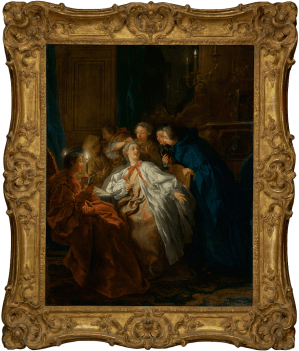
Jean-François de Troy, Before the Ball, 1735, oil on canvas, in a Louis XV frame, carved and gilded oak (The J. Paul Getty Museum)
Louis Style: French Frames, 1610–1792 will be the first exhibition devoted to frames at the Getty Museum. Featuring more than forty frames and framed paintings, Louis Style offers visitors the rare opportunity to consider in depth the types and function of this art form. The installation provides a rich compendium of French design and craftsmanship, along with practical tools, such as the vocabulary of ornament needed to identify the period of a frame, as well as insight into the construction and gilding techniques specific to frames made in France. By addressing the important relationship between a painting and its frame (which sometimes date from different periods and regions), visitors to the exhibition will also gain an awareness of the significance and use of frames in museums.
During the early 1600s through the 1700s—a golden age for frame-making in Paris—the functional surrounds for paintings became expressions of artistry, innovation, taste, and wealth. The primary stylistic trendsetters were the kings of France, whose desire for increasingly opulent forms of display spurred the creative efforts of brilliant designers and craftsmen to magnificent expressions of their personal styles. French frames of this period are distinguished by the use of oak and gold leaf as materials, and techniques of water gilding, elaborate carved ornamentation and varied finishes.
Over the course of several decades, the Museum has assembled a substantial group of period frames to enhance and appropriately display its paintings collection, resulting in a rich and varied assemblage of moldings. Enduring visitor interest in frames and framing led to the publication of D. Gene Karraker’s Looking at European Frames: A Guide to Terms, Styles and Techniques (J. Paul Getty Museum, 2009), illustrated exclusively by works in the collection. The celebration of the 300th anniversary of the death of Louis XIV this year, marked by two major loan exhibitions at the Getty Center, provides the opportunity to present one of the largest and most beautiful areas of the frame collection.
Louis Style: French Frames, 1610–1792 was organized by Senior Curator of Paintings and Department Head, Davide Gasparotto, Curator of Paintings, Anne Woollett, and Associate Conservator of Frames, Gene Karraker.
Exhibition | La Fibre des héros, l’Histoire racontée par la Toile de Jouy
Now on view at the Musée Lambinet:
La Fibre des héros, l’Histoire racontée par la Toile de Jouy
Musée Lambinet, Versailles, 19 September — 20 December 2015
 Dans le cadre des commémorations nationales du bicentenaire de la disparition de Christophe-Philippe Oberkampf (1738–1815), fondateur de la manufacture de Jouy, le musée Lambinet présente l’exposition La fibre des héros. Celle-ci propose de retrouver, grâce à la toile imprimée, le reflet des idéaux et des événements qui ont intéressé la société à la fin du XVIIIe siècle et dans la première moitié du XIXe siècle. Les toiles à personnages, fidèles aux canons néo-classiques en vogue à leur époque, représentent souvent des héros antiques. D’autres toiles mettent en scène des épisodes et héros du monde littéraire, militaire ou scientifique contemporain. Reflets de l’actualité, elles montrent aussi le vol des premiers aérostats ou encore des combats navals marquants. Ces décors ultra-narratifs ont été principalement produits par la manufacture de Jouy-en-Josas, mais aussi les manufactures de Rouen, de Nantes ou de Mulhouse. Empruntées majoritairement au musée de la toile de Jouy, à Jouy-en-Josas, les toiles exposées forment un complément de l’exposition Christophe-Philippe Oberkampf, 1738–1815: Les toiles de Jouy, une aventure humaine, industrielle et artistique, qui se tient à Jouy du 15 septembre au 27 décembre 2015.
Exhibition | Oberkampf: Les Toiles de Jouy
Now on view at the Musée de la Toile de Jouy:
Christophe Phillipe Oberkampf. Les toiles de Jouy: Une aventure humaine, industrielle et artistique
Musée de la Toile de Jouy, Jouy-en-Josas, 15 September — 27 December 2015
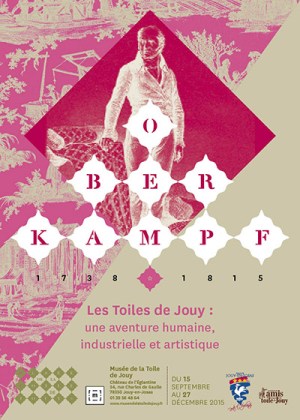 Pour tout savoir sur l’histoire de Christophe-Philippe Oberkampf et la façon dont il a fait de la Toile de Jouy un produit mondialement connu, le musée propose un parcours chronologique qui relate l’ascension de ce fils d’un teinturier allemand, né en 1738 et devenu un des pionniers de la révolution industrielle. Arrivé à Paris comme simple ouvrier, peu instruit (il le déplorera toute sa vie) mais visionnaire, Oberkampf fit de la manufacture qu’il fonda à Jouy-en-Josas la deuxième entreprise de France à la fin de l’Ancien Régime. Toujours à l’avant-garde des progrès techniques, il sut par ailleurs s’entourer de peintres talentueux, comme Horace Vernet ou Jean-Baptiste Huet, pour imaginer les motifs de ses toiles. L’exposition raconte cette histoire, ou comment les Toiles de Jouy ont supplanté les ‘palampores’, ces toiles indiennes importées des lointains comptoirs et comment elles ont conquis toutes les couches de la société, participant à une démocratisation de la mode et de la décoration, grâce à l’industrialisation des procédés inventée par Oberkampf.
Exhibition | Simeon De Witt: Mapping the Revolution
From the exhibition press release (23 September 2015). . .
Simeon De Witt: Mapping the Revolution
Zimmerli Art Museum, Rutgers, New Brunswick, New Jersey, 1 September 2015 — 31 July 2016
Curated by Jenevieve DeLosSantos with Donna Gustafson

Ezra Ames, Portrait of Simeon De Witt, 1804 (Zimmerli Art Museum at Rutgers, photo by Jack Abraham)
When General George Washington led troops into colonial New Jersey during the early months of the Revolutionary War, he did not have access to an app—or even adequate drawings on paper—to guide him across the region. But in 1776, Simeon De Witt (1756–1834), the sole graduate that year from Rutgers (then known as Queen’s College), joined the Continental Army to fight the British. As a signature project of Rutgers 250, the year-long celebration of the university’s founding in 1766, the Zimmerli Art Museum presents Simeon De Witt: Mapping the Revolution, on view through July 31, 2016. The exhibition honors De Witt’s crucial role during the Revolutionary War and, throughout the rest of his life, documenting the geography of New York State (he was a native of Ulster County). It also explores the practice of 18th-century cartography through his original maps and tools.
“As we get ready to celebrate the 250th anniversary of Rutgers in 2016, this exhibition reminds us of the important role that New Jersey and its citizens played in the colonies’ efforts to win their independence and form a new democracy,” observed Jenevieve DeLosSantos, who organized the exhibition while working as a graduate curatorial assistant at the Zimmerli and recently received her PhD in Art History from Rutgers. By 1780, De Witt was named surveyor general and sketched maps of New Jersey’s uncharted land, working directly under George Washington. His topographic renderings were a valuable resource to the Commander-in-Chief as he navigated the terrain and evaded British forces.
After the successful conclusion of the war, De Witt built a career with accomplishments that aided new Americans who were instrumental in the early stages of westward expansion. In 1784, De Witt was appointed Surveyor General of the State of New York, a post he held for 50 years. In 1802, he drafted the first large-scale map of the state to be printed. It was the most detailed to date—depicting newly established cities, towns, and county lines—and distributed to salons and offices as an accurate reference of the Empire State’s geography. An 1804 version of this map is on view, on loan from Special Collections and University Archives at Rutgers University Libraries. The map is accompanied by several of De Witt’s original drafting tools, on loan from the Albany Institute of History and Art, and a field compass commonly used during the era, also from Special Collections. These historical objects provide insight into the resources available to De Witt at the time.
The Zimmerli’s 1804 three-quarter length portrait of De Witt in a stately interior captures him in the prime of his life. He thoughtfully gazes beyond the frame of the image, surrounded by the tools of his profession: a telescope, a globe. De Witt’s hand rests on a table, with the top portion of the aforementioned map of New York State visible. That it was painted by the prominent portrait artist Ezra Ames (1768–1836), who lived in Albany, New York, indicates De Witt’s status as an accomplished and respected member of society. More than 700 portraits have been attributed to Ames; among them, Founding Father Alexander Hamilton and the first governor of New York, George Clinton.
The selection includes other items that indicate the popularity of Revolution-era subjects in fine art and popular culture during the nation’s early decades. The Zimmerli’s recently cleaned and conserved portrait of George Washington was painted by Jane Stuart around 1840. The daughter of the renowned portraitist Gilbert Stuart, she opened her own studio after his death in 1828 and sold her work; especially popular were replicas of her father’s portrait of the country’s first president. Also on view are prints that depict important battles in New Jersey during America’s War for Independence, including a map by English engraver William Faden that depicts the positions of Washington’s troops in New Jersey and Pennsylvania at the beginning of the war.
Simeon De Witt: Mapping the Revolution is organized by Jenevieve DeLosSantos, PhD Art History, Rutgers University and Graduate Curatorial Assistant, 2013–2015, with the assistance of Donna Gustafson, Curator of American Art and Mellon Director for Academic Programs. The exhibition is a signature project of Rutgers 250, a yearlong celebration beginning November 10, 2015, to mark the university’s 250th anniversary. Complete information and a list of related events can be found at 250.rutgers.edu.
The Jane Voorhees Zimmerli Art Museum houses more than 60,000 works of art, ranging from ancient to contemporary art. The permanent collection features particularly rich holdings in 19th-century French art; Russian art from icons to the avant-garde; Soviet nonconformist art from the Dodge Collection; and American art with notable holdings of prints. In addition, small groups of antiquities, old master paintings, as well as art inspired by Japan and original illustrations for children’s books, provide representative examples of the museum’s research and teaching message at Rutgers. One of the largest and most distinguished university-based art museums in the nation, the Zimmerli is located on the New Brunswick campus of Rutgers, The State University of New Jersey. Established in 1766, Rutgers is America’s eighth oldest institution of higher learning and a premier public research university.










leave a comment