Exhibition | George Morland: In the Margins
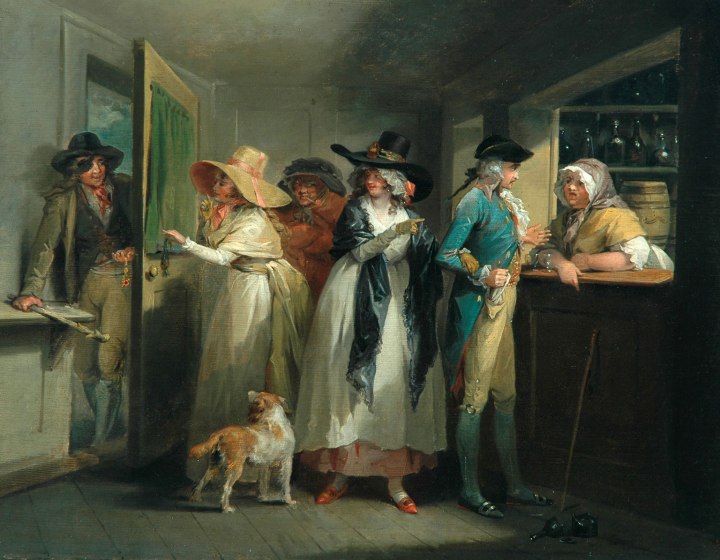
George Morland, Easy Money, 1788 (Huddersfield Art Gallery)
◊ ◊ ◊ ◊ ◊
Now on view at the University of Leeds:
George Morland: In the Margins
The Stanley & Audrey Burton Gallery, University of Leeds, 18 March — 11 July 2015
Curated by Nicholas Grindle
This exhibition looks at migrants and margins in the work of the painter George Morland (1763–1804), a popular painter whose lifestyle and early death earned him lasting notoriety. Over 250 of his works are held by public collections in the UK and US alone. His paintings of smugglers, gypsies, pedlars, soldiers, and families, which represent some of his best compositions, as well as how they mirrored his own life, raise compelling questions about who, and where, is ‘marginal’ in society. There has been no exhibition of his work since a small show in Reading in 1975 and no substantial discussion of his work since a thesis written in Stanford in 1977 and a chapter in John Barrell’s book Dark Side of the Landscape in 1980. His pictures resonate with contemporary issues such as migration and marginality in a way that was not evident thirty years ago.
The exhibition will run at The Stanley & Audrey Burton Gallery from 18 March 2015 until 11 July 2015, with a possible UK tour from August 2015 onwards.
◊ ◊ ◊ ◊ ◊
A symposium is scheduled for the end of May:
Bohemians and Marginal Communities in the 18th Century: George Morland in Context
The Stanley & Audrey Burton Gallery, University of Leeds, 29 May 2015
The Stanley & Audrey Burton Gallery presents a free symposium, bringing together academic discussion of the work of late 18th-century English painter George Morland. To coincide with our current exhibition George Morland: In the Margins, the Gallery is delighted to welcome experts and academics from a range of fields, to discuss the wider context of Morland’s work. These speakers will include the exhibition’s guest-curator Dr Nick Grindle (UCL); Professor of History of Art at Oxford Brookes University, Christiana Payne; social geographer, Dr Martin Purvis; independent art historian, Dr Anthony Lynch; and UEA MPhil student Francesca Bove.
The speakers will address representations of social margins in Morland’s artistic output and look at the parallels between his life and works. What can his representation of gypsies, smugglers, pedlars and families tell us about the societal conditions of the late 1800s and how do they reflect our own times? Morland was living on the brink of industrialisation, witnessing an increasingly capitalist culture and significant, sudden movements of people around the country; conditions which are still relevant to modern-day Britain. The worries of Morland’s contemporaries about the moral character and palatability of his works raises questions surrounding class relations and art’s role as social commentary and criticism.
Friday, 29 May 2015, 9:00–17:00. Free, though booking is essential. This event is kindly supported by the Paul Mellon Centre for Studies in British Art.
More information about programming for the exhibition is available here»
◊ ◊ ◊ ◊ ◊
The catalogue is available from the University of Leeds online bookstore:
Nicholas Grindle, ed., with essays by David Alexander, Kerry Bristol, Sue Ecclestone, Nicholas Grindle, and Martin Purvis, George Morland: Art, Traffic and Society in Late Eighteenth-Century England (Leeds: The Stanley & Audrey Burton Gallery, 2015), 99 pages, ISBN: 978-1874331544, £12.
 George Morland: Art, Traffic and Society in Late Eighteenth-Century England looks at the life and work of popular painter George Morland (1763–1804), whose remarkable talent, prodigious output, bohemian lifestyle and early death earned him lasting notoriety. Morland was the most infamous artist in Britain at the time of his death in 1804. His paintings enjoyed a stellar reputation, which was enhanced by stories about his fabulous earnings, prodigal spending, legendary drinking, and staggering debt. He was renowned for his associations with smugglers, gypsies and pugilists, as well as his constant attempts to evade his creditors. His best work is breathtaking in its ambition and execution, while the popularity of his drawings, paintings, and the prints after his work rose throughout his lifetime. Within months of his death, no fewer than four books had been published packed with anecdotes—many apocryphal—about his life and work. No other artist of the late eighteenth and early nineteenth centuries commanded such a profile.
Morland was reputed to have painted thousands of canvases and made hundreds of drawings. But in spite of his immense popular and critical stature, recent scholarly attention has been patchy, and this is the first publication to seriously review the artist in over thirty years. It includes five new essays which use recent perspectives in historical geography and studies of print and exhibition culture to help us look in new ways at his work and practice, as well as catalogue entries that bring scholarship on his paintings up to date.
Exhibition | El Retrato en las Colecciones Reales

◊ ◊ ◊ ◊ ◊
Now in its final weeks, this portrait exhibition contains over 100 objects spanning the past five hundred years. Rocío Martínez provides an extremely useful review (in English) for the Royal Studies Journal Blog. The exhibition website provides one of the finest virtual experiences I’ve ever encountered in terms of documenting an exhibition visually. Finally, thanks to Jennifer Germann for pointing all of this out to me (my apologies that it didn’t appear back in December!). –CH
El Retrato en las Colecciones Reales: De Juan de Flandes a Antonio López
The Portrait in the Royal Collections: from Juan de Flandes to Antonio López
Royal Palace, Madrid, 4 December 2014 — 19 April 2015
Curated by Carmen García-Frías Checa and Javier Jordán de Urríes
La exposición El Retrato en las Colecciones Reales. De Juan de Flandes a Antonio López ofrece una visión general del retrato de corte en España, tanto en tiempos de la Casa de Austria como de la Casa de Borbón, desde el siglo XV al XXI, trazando un recorrido por la evolución de la imagen de los monarcas en ese largo medio milenio. Un itinerario jalonado por obras maestras de la pintura y del género del retrato, con los mejores ejemplos conservados en las colecciones de Patrimonio Nacional, que se exponen en doce salas de la planta baja del Palacio Real de Madrid, con el acompañamiento de algunas esculturas, pequeños bronces, varios dibujos y grabados, y un par de tapices-retrato. La exposición se estructura en dos grandes secciones, Casa de Austria y Casa de Borbón, con diferentes apartados que siguen un orden cronológico por reinados.
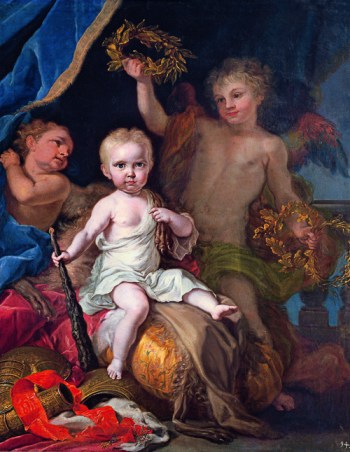
Giuseppe Bonito, Carlos Antonio de Borbón as the Child Hercules, 1748, oil on canvas, 128.5 x 102.5 cm (Madrid: Royal Palace)
La primera sección abre con los inicios de la dinastía habsbúrgica en España, mostrando como antecedentes retratos fundamentales de sus antepasados, el Retrato del duque de Felipe el Bueno del taller de Rogier Van der Weyden (de la Casa de Borgoña) y la imagen más fidedigna de la reina Isabel la Católica de Juan de Flandes (de la Casa de los Trastámara). A los grandes retratos oficiales de Carlos V de Jakob Seisenegger y de Felipe II en versión pictórica de Antonio Moro y escultórica de Pompeo Leoni, se une una importantísima muestra de retratos familiares por los pintores más famosos de la corte española de los siglos XVI y principios del siglo XVII, como Alonso Sánchez Coello, Joris Van der Straeten, Juan Pantoja de la Cruz, Bartolomé González o Rodrigo de Villandrando, así como de otras cortes europeas, como Frans Pourbus el Joven o Marcin Kover. Ya en pleno siglo XVII, la magnífica miniatura del conde-duque de Olivares de Diego Velázquez, o el grandioso retrato ecuestre de Juan José de Ribera, sin olvidar a los dos grandes retratistas del reinado de Carlos II, con varios ejemplares de Juan Carreño de
Miranda y Claudio Coello.
En la segunda sección dedicada a la Casa de Borbón desde el siglo XVIII hasta el presente, se exponen los mejores ejemplos del retrato borbónico en Patrimonio Nacional, como el monumental retrato ecuestre de Felipe V, por Louis-Michel van Loo; el de Carlos III con el hábito de su Orden, por Mariano Salvador Maella, también retratos de Giuseppe Bonito y Anton Raphael Mengs; una de las parejas de Carlos IV y María Luisa de Parma, por Francisco de Goya, la espléndida del rey de cazador y la reina con mantilla; destacados ejemplos del retrato decimonónico, con obras de Vicente López, Federico de Madrazo o Franz Xaver Winterhalter, y, finalmente, retratos de Alfonso XIII por Ramón Casas y Joaquín Sorolla para llegar al reinado de Juan Carlos I con El Príncipe de ensueño de Salvador Dalí y el retrato de La familia de Juan Carlos I pintado por Antonio López, que se presenta al público con motivo de esta exposición.
Junto a esas obras maestras de la pintura se exhiben, como complemento, algunos pequeños bronces, un par de tapices-retrato y destacadas esculturas, desde un Felipe II por Pompeo Leoni hasta el retrato doble de los reyes Alfonso XIII y Victoria Eugenia, por Mariano Benlliure. Esas piezas entran así en relación con la pretensión de tridimensionalidad de la pintura.
◊ ◊ ◊ ◊ ◊
The catalogue is available from ArtBooks.com:
Carmen García-Frías Checa and Javier Jordán de Urríes, eds., El Retrato en las Colecciones Reales: De Juan de Flandes a Antonio López (Madrid: Patrimonio Nacional, 2014), 536 pages, ISBN: 978-8471204981, $85.
 Fundación Banco Santander colabora con Patrimonio Nacional en la preparación de esta muestra títulada El retrato en las Colecciones Reales. De Juan de Flandes a Antonio López. La importancia del género retratístico en las Colecciones Reales se comprende fácilmente, teniendo en cuenta que los mejores artistas de cada momento, han sido grandes retratistas de la Monarquía Española, por lo que las grandes obras de estos excelentes pintores forman parte de los fondos de Patrimonio Nacional. En este exposición contaremos con artistas de la talla de Juan de Flandes, Sánchez Coello, Rubens, Velázquez, Goya, Sorolla, Dalí o Antonio López.
Exhibition | Landscapes of the Mind: British Landscapes

Joseph Wright of Derby, Sir Brooke Boothby, 1781 (London: Tate)
◊ ◊ ◊ ◊ ◊
As noted at ArtDaily:
Landscapes of the Mind: British Landscapes from the Tate Collection, 1690–2007 / Paisajismo británico. Colección Tate, 1690–2007
Museo Nacional de Arte, Mexico City, 25 March — 21 June 2015
On March 25th Landscapes of the Mind: British Landscape Painting, Tate Collection, 1690–2007 was presented for the first time ever in Mexico City, an exhibition organized by Tate in association with Museo Nacional de Arte, as part of the celebrations of the Dual Year between Mexico and the United Kingdom. The exhibition presents 111 artworks by British and European artists, with a plurality of techniques (painting, drawing, printmaking, photography, sculpture/installation, etc.) which ponder the evolution of British landscape in art history. The term ‘Britain’ is understood as the geographical entity of the British Isles, i.e., the archipelago that includes England, Wales, Scotland and Ireland, before the independence of the latter in 1921.
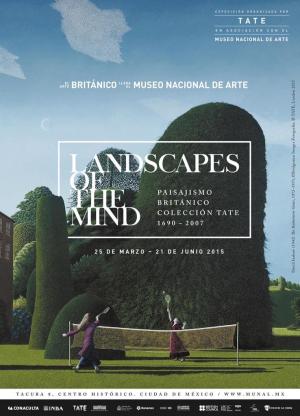 This genre was explored in Britain during the 16th century with the use of documents describing the topography, geology, history, and legends of the said land. It gained popularity throughout the 17th century, with the discoveries of explorers, naturalists, and merchants who helped expand the limits of the British nation to the four parts of the world. By the late 18th century, the landscape genre had become a dominant trend in Britain.
According to Nicholas Serota, Director of Tate, “the reasons for the predominance of landscape in British visual culture are many and varied: the extraordinary diversity of physical landscapes in such a relatively small geographic area; acute sense of loss of a pastoral and rural ideal world because of rapid industrialization during the 18th and 19th centuries; identification of the aristocracy of classical culture field; the immense impact of the natural sciences, and at the same time, the belief that close observation revealed both the moral and the hidden spiritual truth behind appearances”.
The nine topics developed by curator Richard Humphreys aim to introduce British culture through great classical painters of the 18th century such as Thomas Gainsborough; continuing with artworks of romantic and impressionist artists of the 19th century, like John Constable, J.M.W. Turner, John Martin, John Singer Sargent and James Tissot; and finally addressing modern and contemporary landscapes by artists such as David Inshaw, Sir Stanley Spencer, and Paul Nash.
Considering the importance of a current view on the history of landscape and the need for a continued dialogue between the ages; in addition to meeting the great interest of a younger generation in discovering the artistic production of its own time, Dr. Agustín Arteaga, Director of the Museo Nacional de Arte, managed the incorporation of David Hockney’s Bigger Trees Near Warter or /ou Peinture sur le Motif pour le Nouvel Age Post- Photographique. In 1984, Museo Tamayo presented the traveling exhibition Hockney Paints the Stage, an exhibit shown after the failed attempt to include a graphic series of nudes during the Cultural Olympiad in 1968, which were eventually censored. After visiting Mexico City in 1984, Hockney traveled to the state of Oaxaca, where he produced a series of paintings and graphics inspired by a hotel in Acatlán. Tate preserves in its collection some works from this series. Nearly 30 years after, Hockney returns to Mexico with his biggest artwork accomplished so far: a picture of monumental proportions, more than 4.5 by 12 meters, consisting of 50 paintings, done in six weeks in 2007 for the Summer Exhibition of the Royal Academy of London, and donated to Tate the following year, along with two digital reproductions. The image depicts a landscape of East Yorkshire, a region where the artist lived, shortly before the arrival of spring when the trees begin to sprout.
Alongside Landscapes of the Mind, a comparative exercise linking landscape tradition in Britain and Mexico is included, this latter is exhibited as a dialogue with the newly renovated galleries of the Museo Nacional de Arte in the permanent exhibit. The relationship was established through the canvas Mexico Valley (1837) of the London traveler artist Daniel Thomas Egerton. His work coexists with a selection of paintings by the Mexican artist José María Velasco.
The exhibition is accompanied by a bilingual catalog print run of 2,000 copies, consisting of 142 black/white and color images, with texts by curator Richard Humphreys and edited by Museo Nacional de Arte. As part of the show, Museo Nacional de Arte offers an Academic Program aimed at a wide audience, including a lecture every Thursday at 17:00 with varied presentations including one by the curator Richard Humphreys; a commented film series of the best of British cinematography; weekend and specialized workshops; interpretive materials downloadable via the website, as well as guided tours.
Display | Canaletto’s ‘Regatta on the Grand Canal’

Canaletto, A Regatta on the Grand Canal, ca. 1740
(London: National Gallery)
◊ ◊ ◊ ◊ ◊
Compton Verney press release for the display now on view at the Victoria Art Gallery:
Canaletto’s A Regatta on the Grand Canal
Victoria Art Gallery, Bath, 7 March — 3 May 2015
Compton Verney, Warwickshire, 9 May — 21 June 2015
Sunderland Museums and Winter Gardens, 11 July — 13 September 2015
Canaletto’s masterpiece A Regatta on the Grand Canal (about 1740) is on loan from the National Gallery to promote the understanding, knowledge and appreciation of Old Master paintings to as wide an audience as possible. This large-scale work depicts the annual carnival regatta in Venice. Some of the figures in the foreground wear the bauta, a costume of white mask and black cape which was typically worn during the carnival. The painting shows the one-oared light gondola race. The arms of the Doge Alvise Pisani, who ruled from 1735 to 1741, are visible on the macchina della regatta or floating pavilion on the left, from which coloured flags were presented to the winners. The painting is a companion piece to Canaletto’s Venice: The Basin of San Marco on Ascension Day of the same date.
The Masterpiece Tour is part of the National Gallery’s commitment to promote the understanding, knowledge and appreciation of Old Master paintings to as wide an audience as possible. This opportunity to bring hugely popular National Gallery paintings to the public’s doorstep is made possible by the generous support of Christie’s.
◊ ◊ ◊ ◊ ◊
This year Compton Verney and Bath’s Holburne Museum are also hosting a major exhibition addressing the Venetian artist: Canaletto: Celebrating Britain.
Exhibition | Canaletto: Celebrating Britain

Canaletto (Giovanni Antonio Canal), London: The Thames from Somerset House Terrace towards the City
(Royal Collection Trust/© Her Majesty Queen Elizabeth II 2014)
◊ ◊ ◊ ◊ ◊
News of this exhibition appeared here at Enfilade in January, but the posting addressed only the Kendal venue (where it will have a slightly different title). Here’s the expanded version:
Press release from Compton Verney:
Canaletto: Celebrating Britain
Compton Verney, Warwickshire, 14 March — 7 June 2015
Holburne Museum, Bath, 27 June — 4 October 2015
Abbot Hall Art Gallery, Kendal, Cumbria, 22 October 2015 — 14 February 2016
This is the first time that these magnificent paintings and drawings by Canaletto have been brought together to provide an overview of Canaletto’s work created between 1746 and 1755, whilst he was visiting Britain. During his nine-year stay in Britain he documented not just traditional or established views and landmarks but also his (and his patrons’) latest achievements in architecture and engineering. The depictions of these new building works and projects, whether couched in Palladian, Baroque or Gothic styles, celebrate the new-found wealth and assurance of the British nation, reflecting contemporary developments in popular culture such as the rediscovery of Shakespeare; the success of Handel’s Messiah and the cult of King Alfred—which in turn spawned Arne’s immortal Rule Britannia.
Set into context, by 1750 the first generation of Palladian architects and patrons (Burlington, Campbell and Kent) were dead, and the nation was ready for a more liberal attitude to architectural design. Britain itself was a more stable and confident place than it had been even thirty years before. During the recent War of the Austrian Succession, the nation had held onto its new colonial gains and had succeeded in forcing Spain to open up South America to its traders. The economy was booming and the Jacobite threat had evaporated. Accordingly, a new, more confident generation, profiting from the ‘Georgian Revolution’ and increasingly assured by Britain’s status as a major world power, was prepared to be less regimented by Palladian rules and more eclectic in its architectural patronage seeking cultural inspiration not just from the Mediterranean but also from their own history.
This new found confidence signalled through the architecture of Baroque masters such as Wren (at St Paul’s and St Mary’s, Warwick), Hawksmoor (at Westminster Abbey’s west towers) and the Gothic revival marks Britain out as the new Venice, which was the real subject of Canaletto’s great canvases on display in this exhibition.
Information regarding programming at Compton Verney is included in the press release.
◊ ◊ ◊ ◊ ◊
From Paul Holberton:
Steven Parissien, Pat Hardy, Jacqueline Riding and Oliver Cox, Celebrating Britain: Canaletto, Hogarth, and Patriotism (London: Paul Holberton Publishing, 2015), 128 pages, ISBN: 978-1907372780, £25.
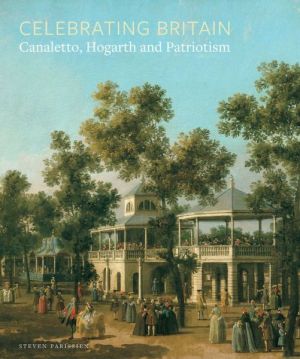 By 1750 Britain was—as Jacqueline Riding shows—at peace with her traditional enemy, France, and had finally extinguished the threat from the Catholic Jacobites. The art of William Hogarth—particularly his great canvas O The Roast Beef of Old England of 1749—duly reflected this new sense of security and pride in being British. The economy was booming. Trade was expanding. And newly-confident Britons were no longer looking to Italy or France for their cultural exemplars, particularly in the field of architectural design.
It was the ferment of activity, the eclectic building boom which underlines Britain’s wealth and optimism and which marks the nation out as the new Venice, which is the real subject of Canaletto’s great canvases. Almost all of Canaletto’s views focused on a new architectural commission or a recent urban development, and were specifically designed to celebrate the latest achievements of British architecture and engineering. The Italian master was not alone. The vigorous and infectious patriotism of his works mirrored emerging nationalistic trends in popular culture during the 1740s, a decade which witnessed the canonization of William Shakespeare as a British hero, the creation of Handel’s Messiah and Arne’s immortal Rule Britannia, and, as Oliver Cox shows, the propagation of the nationalistic cult of King Alfred—and, more bizarrely, of the ‘flying king’ Bladud in Bath.
As Pat Hardy explains, the presence of a significant group of artists working in London prior to Canaletto’s arrival, led by Samuel Scott, along with the strength of existing artistic practices and traditions and the vibrant print market for maps and surveys of London, suggests that the impact of the arrival of Canaletto was more complicated than may have previously been perceived. At the same time, Canaletto’s legacy survived throughout the eighteenth century, in the hands of native artists such as William Marlow.
◊ ◊ ◊ ◊ ◊
Press release (November 2014) from Abbot Hall:
Abbot Hall was built in the Palladian style just three years after Canaletto left England for the last time. In 1746, by then in his late 40s, he first arrived for a prolonged stay in London. He was to remain for most of the following 10 years.
Already a well established artist, his work had proved very popular with aristocratic Englishmen doing their Grand Tour of Europe. In the 1720s, having started his career as a theatrical scene painter, Canaletto started painting his distinctive views of Venice, frequently featuring the many major churches designed for it by Palladio. One of his clients was Joseph Smith, an English merchant banker who lived in Venice for 70 years, for 16 of which he was the British consul there. Smith bought many Canaletto works for himself, and also helped arrange commissions from wealthy English collectors—by the late 1720s his works were already in the collections of Goodwood, Chatsworth, Woburn and of the Prime Minister, Sir Robert Walpole. Smith himself owned by far the largest collection of works, including 52 oil paintings and over 140 drawings, which he eventually sold to George III in 1762 for £10,000—half the sum the latter paid the previous year for Buckingham Palace.

Canaletto (Giovanni Antonio Canal), Portrait of Canaletto with St Paul’s in the Background at Anglesey Abbey, Cambridgeshire (National Trust Images/Hamilton Kerr Inst/Chris Titmus)
Canaletto came to London as an indirect result of the War of the Austrian Succession, which started in 1741. This had made continental travelling difficult for his wealthy English patrons, severely reducing his income. He therefore decided to move himself to London, setting up his studio near Golden Square. He arrived a month after Culloden, the last pitched battle fought on British soil, and at the beginning of a period of unprecedented domestic peace and prosperity, which saw London turning into the world’s richest and largest city.
Although the bulk of the works with English subjects were of London scenes, with the Thames a frequent presence, he was also a regular visitor to the countryside, often at the invitation of his rich patrons, and painted several views of Warwick Castle, as well as of Alnwick, Badminton, Eton and Walton.
The rapid change of London’s architecture during his time here is also documented. In The Old Horse Guards from St James’ Park of 1749, he caught the Horse Guards Parade ground, complete with parading soldiers, as well as men peeing against the wall of Downing Street, and dozens of people promenading, showing the artist’s interest in depicting scenes of daily life. Within a couple of years, from almost exactly the same spot, he was back painting the new Horse Guards parade, the one that is still there today—it can be dated very precisely to 1752–53, as the clock tower still has scaffolding on it, while the south wing had yet to be constructed.
Canaletto is often accused of depicting London whilst using bright Venetian lighting. However, in both his pictures of the Horse Guards, the light is soft and diffused. In A View of Walton Bridge the sky is even more typically ‘English’—and un-Venetian—with the sun competing with storm clouds brewing overhead. The picture also includes a portrait of Thomas Hollis, who commissioned 5 works from Canaletto, as well as a rare self-portrait of the artist, shown painting the scene. The bridge was regarded at the time as an advanced feat of engineering. The contrasting stately bulk of Westminster Bridge and the views from it was evidently something that fascinated Canaletto, who clearly would have agreed with Wordsworth’s later opinion that “earth hath not anything to show more fair.” The bridge was under construction during his time here, and he painted and sketched it repeatedly. In one of the pictures from the Royal Collection, he frames a view of the Thames, St Paul’s and the City as if he had drawn the scene from under one of the new arches of the bridge, while others show it still under construction.
It is easy to forget that Canaletto continued to paint Venetian scenes throughout his time in London. Worked up from his sketches, or done from memory, these provided him with a significant proportion of his income whilst in London, as his more conservative patrons demanded work that they were familiar with, rather than venturing into the new views that the artist was confronting. For example, his Bucintoro at the Molo on Ascension Day, showing the state barge after the annual ‘marriage’ of Venice with the sea—which, when it sold for $20,000,000 in 2005, was briefly his most expensive painting sold at auction—was painted in London in 1754.
Ruskin had a particular down on Canaletto. It is, however, unclear quite how familiar the ascerbic critic was with genuine works by the Venetian. As a hugely popular artist, his work was widely forged and copied both during his lifetime and afterwards. It is possible that Ruskin was sometimes writing about Canaletto pupils and assistants, when he thought he was writing about Canaletto himself. In “Notes on the Louvre”, writing about a picture of the Salute and the entrance to the Grand Canal, he said that it is “cold and utterly lifeless—truth is made contemptible” and that “boats and water he could not paint at all.” The picture has since been re-attributed to Canaletto’s pupil Michele Marieschi. Similarly the “bad landscape” he saw in Turin is almost certainly a work by Bernardo Bellotto, Canaletto’s nephew. Writing about Canaletto’s “vacancy and falsehood” in Modern Painters, he refers to a painting in the Palazzo Manfrin—Augustus Hare, who visited it at about the same time, noted that the palazzo “has a picture gallery which is open daily, but contains nothing worth seeing, all the good pictures having been sold.” It is unclear which work Ruskin was referring to when he said that Canaletto’s depiction of architecture was “less to be trusted in its renderings of details than the rudest and most ignorant painter of the 13th century.” Certainly that is not the view of most modern critics of most properly authenticated works by Canaletto, but Ruskin was never one to allow the facts to affect his pet prejudices.
Exhibition | Treasured Possessions

Unidentified English maker, Trompe l’oeil folding fan, 1757
(Cambridge: The Fitzwilliam Museum)
◊ ◊ ◊ ◊ ◊
Assiduous readers of Enfilade may recall my fascination with puzzle jugs. And so in the spirit of April Foolishness, it’s the object from the exhibition I’m especially excited about—at least for today. There are more serious sorts of things from the eighteenth century also included (samples of which are available here), and the catalogue looks wonderful. -CH
From The Fitzwilliam:
Treasured Possessions from the Renaissance to the Enlightenment
The Fitzwilliam, Cambridge, 24 March — 6 September 2015
A dazzling journey through the decorative arts: from the hand-crafted luxuries of the Renaissance to the first stirrings of mass commerce in the Enlightenment. Each of the 300 beautiful and engaging objects was once a treasured possession, revealing the personal tastes and aspirations of its owner, and preserving precious memories. Witness the impact of global trade on European tastes: the lust for goods imported from the East, the revolutions caused by New World products like chocolate and sugar. European shoppers were lured by dazzling colours, intricate designs, constant technological innovation and the glamour of the exotic.
 This show is all about desire and possession. It explores how beautiful, curious and engaging objects were made, marketed, acquired, personalized and valued. Some objects shown here are undoubtedly masterpieces: works of dazzling design and innovative skill, long-prized as highlights of the Museum’s collection; others are more ordinary. The purpose of this exhibition is to move beyond conventional appraisals of artistic or monetary worth to appreciate how objects were crafted and what they were made from, and how possessions took on changing meanings for individual owners.
The Renaissance to the Enlightenment period is a long one (about 1400 to about 1800), which saw profound changes in the production and availability of goods. Over this time, we can chart the emergence of new luxuries and technological innovations, the importation and imitation of foreign artefacts such as porcelain or calico, the domestication of new world substances like chocolate or tobacco, and the first stirrings of mass production that
would transform the European home.
The objects in this new material world created new visual realities, and changed how people felt about themselves and others. Despite the rapid increase in the availability of non-essential goods, objects from this period were often charged with emotional significance and inscribed with sentimental value. Some of the things on display are named and dated so as to commemorate an important event such as a marriage or a death. Others show signs of persistent wear and tear and deliberate mending. There are home-made items, painstakingly created and handed down from one generation to the next. And there are showy pieces which flaunt the tastes, aspirations and fantasies of their past owners. Of course, we cannot always reconstruct the hidden history of an object; many of these treasures still hold their secrets tight.
I. A New World of Goods
The Renaissance witnessed an explosion of goods. Lists of household possessions, carefully recorded by scribes and preserved to this day, give a sense of the accumulated clutter in prosperous homes. Such inventories describe elaborate dinner services, glassware, furniture, linen, clothes, jewellery, ornaments and books. Equally striking is the presence of highly specialized items, such as hand-warmers or flower vases, often created to be beautiful as well as functional.
The great variety of objects in European homes testifies to new expectations of comfort, convenience, pleasure and taste. Here we find the new world of goods that Europeans discovered throughout the period: the age before industrialization and mass production, when non-essential commodities nevertheless became widely available across the social spectrum. While local craftsmen honed their skills to produce the innovative and intricate objects demanded by their clients, exotic foreign goods also entered the market. In turn, high-quality objects made at home were influenced, formally and stylistically, by global imports. The treasures displayed in this section give a taste of this astonishing period of innovation and experimentation.
II. Desiring and Acquiring Things

Trade card of James Wade, “Tea, Coffee, Chocolate and Snuff Seller”, Bristol, 1754 (Cambridge: The Fitzwilliam)
The Renaissance to Enlightenment period is often seen as an age of acquisitiveness, when Europeans tasted the pleasures of shopping for the first time. The reality of that experience was, however, a far cry from the sanitized world of today’s supermarkets and department stores. Buying and selling were activities subject to stern moral judgment and anxiety; fears of cheating and deception abound in literary accounts. Nor was it necessary to go to a shop in order to shop. Some of the treasured possessions exhibited here were commissioned directly from the maker; others were acquired from street vendors or markets.
In the eighteenth century, shopping became more than simply acquiring goods. It was a pastime and leisure activity, especially for the rising middling classes. Shops appeared in many British and continental European cities. They replaced market stalls and itinerant pedlars, offering a new experience for consumers increasingly allured by the goods displayed in their windows. At the same time, street sellers were the subjects of printed illustrations and expensive porcelain figures. Shopkeepers were also at the forefront of marketing innovation. They advertised their wares and services in newspapers and through trade cards and bill heads on customer receipts.
III. The Irresistible

Puzzle jug, English, probably London (either Lambeth Pottery or Rotherhithe Pottery), 1686. Tin-glazed earthenware, with pierced body containing a two-headed bird (Cambridge: The Fitzwilliam).
Antonio de Pereda’s painting Still Life with an Ebony Chest shows a mid-seventeenth-century Spanish vision of the irresistible: ebony from Africa, porcelain from China, chocolate and sugar from America, and lustreware from Valencia. The value of these enticing commodities lay not only with their rarity but also with their potential to generate pleasure. While ongoing anxieties about luxury and consumption did not disappear, Pereda’s image offers a meditation on the joys of living in ‘the here and now’.
The irresistible was inextricably linked to the expansion of Europe and the idea of the exotic, which changed constantly in response to the exploration of ‘new’ worlds. The Medici court in early Renaissance Florence desired the colourful and stylized designs of Iznik pottery and was, later on, the first European connoisseur of Chinese porcelain. Contact with America not only brought chocolate and sugar but also encouraged a new interest in the natural wonders of the New World. By the end of the eighteenth century, tobacco, chocolate, tea and coffee had all been ‘domesticated’ by Europeans. New objects, new behaviours and new social spaces were created for and
by the consumption of these novel stimulants.
IV. The Fashionable Body

Pair of shoes, English, c.1700–30. Yellow silk taffeta, bound with ribbon; floss silk embroidery in French knots, tied with ribbon. Design of scrolling stems with leaves and flowers (Cambridge: The Fitzwilliam)
The visual arts often dominate our sense of the Renaissance. Yet this cultural movement became visible to many through a new world of fashion. Tailoring was transformed by new materials and refined techniques of cutting and sewing, as well as by the demand for a tighter fit, particularly for men’s clothing. Enterprising merchants created larger markets for fashion innovations and ‘chic’ accessories. Artistic representations of the clothed body proliferated as never before. Mirrors enticed people to experiment with their appearance, as they caught sight of their reflections in looking-glasses on walls, or in small portable mirrors designed to be carried on the body.
This new type of consumption and aesthetic appreciation depended on the assemblage of a panoply of wearable goods from clothing and armour to accessories like hats, hair-pieces, feathers, toothpicks, rings, gloves, purses and shoes, which brought self-display to life. The tiny honestone portrait from the 1520s shows a woman at the height of fashion with a bonnet perched on her head. In turn, the earthenware male figure of 1606 sports an expensive modish slashed suit with belt, buttons and a flamboyant feathered hat. Even the style of facial hair could codify people and establish identities.
V. At Home and On Display
As Renaissance shoppers acquired more ‘stuff’, even ordinary homes became places of display, and new types of furniture evolved to store and show off the family treasures. During the period covered by this exhibition, traditional chests were replaced with front-opening cupboards, dressers and sideboards—versatile props on which ornamental items could be positioned. Meanwhile, cabinets containing small drawers allowed collectors to order their most precious objects, keep them safe under lock and key, and then draw them out to show selected visitors.
By the eighteenth century, technological changes, the expansion of global trade networks, and the growth of European markets had broadened the opportunities for buying and displaying goods in the home to a much wider group of people. Tea services were laid out and admired on sideboards, inkstands on desks, vases on mantelpieces, and scent-bottles and patch boxes on dressers. A whole range of ornamental porcelain items was available as well as equally coveted imitations in cheaper earthenware. The sub-division of interiors into specialized spaces resulted in new kinds of furniture such as the tea-table or secrétaire (‘writing desk for ladies’) used both to display fashionable objects and to hide its owner’s secrets.
◊ ◊ ◊ ◊ ◊
The catalogue is published by Philip Wilson:
Victoria Avery, Melissa Calaresu, Mary Laven, eds., Treasured Possessions from the Renaissance to the Enlightenment (London: Philip Wilson Publishers, 2015), 288 pages, hardback, ISBN: 978-1781300336, £40 / paperback £25.
This book is all about possession. It explores the significance of beautiful and engaging objects—chosen, acquired, personalised and treasured—to the people who once owned them. With over 300 works discussed, the book takes us on a dazzling visual adventure through the decorative arts, from Renaissance luxuries wrought in glass, bronze and maiolica to the elaborate tablewares and personal adornments available to shoppers in the Age of Enlightenment. En route the authors consider the impact of global trade on European habits and expectations: the glamour of the exotic, as witnessed in the lust for objects imported from the East, the ubiquity of New World products like chocolate and sugar, and the obsession with Chinoiserie decoration. They ask what decorative objects meant to their owners before the age of industrial mass production, and explore how technological innovation and the proliferation of goods from the sixteenth century onwards transformed the attitude of Europeans to their personal possessions.
Victoria Avery, FSA is Keeper of Applied Arts at The Fitzwilliam Museum, University of Cambridge. She has published extensively on Italian Renaissance sculpture, and was awarded the Premio Salimbeni 2012 for her monograph, Vulcan’s Forge in Venus’ City: The Story of Bronze in Venice, 1350–1650 (2011).
Melissa Calaresu is the Neil McKendrick Lecturer in History at Gonville and Caius College, Cambridge. She has written on the Grand Tour, autobiographical writing, urban space, political reform and, most recently the making and eating of ice cream in eighteenth-century Naples.
Mary Laven is Reader in Early Modern History at the University of Cambridge. She has written extensively about aspects of religion in Renaissance and Counter-Reformation Italy and is now working on ‘Domestic Devotions’, an interdisciplinary, collaborative project, funded by the European Research Council.
◊ ◊ ◊ ◊ ◊
From The Fitzwilliam:
Treasured Possessions Conference
St John’s College, Divinity School, Cambridge, 11 May 2015
Join scholars, curators and conservators for this day long event inspired by objects that once lay close to their owner’s hearts. Learn about the historical context of the exhibition, and the opportunity it provided for collaboration between curators, academics and makers. Key speakers include Peter Burke, Ludmilla Jordanova, Giorgio Riello and Evelyn Welch. The day closes with an early evening private view of the exhibition and drinks reception.
Monday, 11 May 2015, 9:00–17:00. Free but booking essential, tel: 01223 332904 or email: education@fitzmuseum.cam.ac.uk.
Exhibition | Diana Thater: Life is a Time-Based Medium
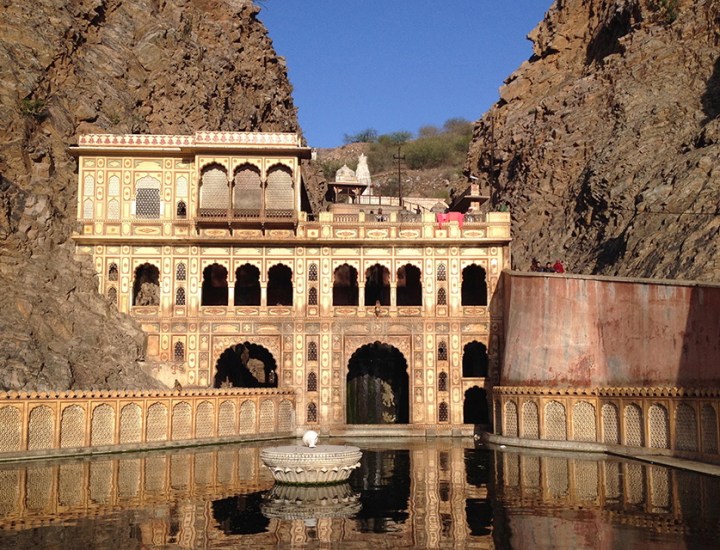
Galtaji Temple, near Jaipur, India, from the video installation Diana Thater: Life is a Time-Based Medium, 2015, 3-channel projection, 3 lenses, 1 media player, and watchout system.
◊ ◊ ◊ ◊ ◊
Press release from Hauser & Wirth:
Diana Thater | Life is a Time-Based Medium
Hauser & Wirth, London, 26 March — 16 May 2015
Hauser & Wirth is pleased to present a new video installation by Diana Thater. The work comprises footage from the Hindu pilgrimage site, the Galtaji Temple, near Jaipur in India. Thater projects images of the 18th-century pavilions and pillars onto the walls and floor of the gallery to create an immersive environment depicting the many monkeys that inhabit the temple in their architectural habitat. The installation will be included in Thater’s mid-career retrospective, opening at LACMA in Autumn 2015. This year, Thater will also present exhibitions at the Aspen Art Museum in Colorado and at San Jose Museum of Art in California.
 Thater’s experiential video installations investigate the space between documentation and abstraction, sculpture and architecture, by presenting a mediated reality. In this new work, Thater choreographs an architectural reconstruction of the Galtaji Temple. Built by Diwan Rao Kriparam in the 18th century, in pink sandstone, amidst low hills, the temple is structured to look more like a palace or ‘haveli’ than a traditional place of worship. The buildings are positioned around a natural fresh water spring and seven holy ‘kunds’—or water tanks—and waterfalls that create two tiered pools. Within the gallery, projections of the lower pool onto the floor foreground the architectural structure and evoke a tranquil setting. Appearing blurred and faded as they are diffused from the wall, the pools of water occupy a liminal state between reality and imagination. Thater works with the existing architecture of the gallery, dividing the space into two halves and employing projections to suggest the physical structure of the temple’s domed ceilings, carved pillars and painted walls. In the second space, Thater recreates an area of the temple that is inaccessible to humans, using close-up video footage to bring the viewer into greater proximity with the monkeys. As in previous works, Thater herself features in the footage in order to make manifest an encounter between humans and animals.
The ancient Galtaji Temple is still an important pilgrimage site. Thater examines the reverence with which humans approach the location, in direct contrast to the informal, rampant activity of the monkeys. Thater explores both the tame and wild aspects of the monkeys’ lives and the co- existence of animals and humans. The work is inspired by the Hindu god Hanuman, who often takes the form of a monkey and is worshipped as a symbol of physical strength, perseverance and devotion. Through Hanuman, Thater layers historical, natural and religious references to explore the potentially spiritual relationship between humans and animals.
Thater is one of the most significant contemporary artists working in new media. Drawing on issues of conservation, natural and manmade ecosystems, and socially-engineered environments, she explores tensions between mankind and the animal kingdom. Her formal interest straddles both the spatial and temporal aspects of video. She presents non-linear footage that explores animal behaviour with what she describes as a ‘neo-narrative’ approach. The exhibition’s title, Life is a Time-Based Medium, draws attention to the parallels between reality and the construction of reality that Thater’s videos present.
Diana Thater was born in 1962 in San Francisco. She studied at New York University and Art Center College of Design, Pasadena, and lives and works in Los Angeles. Thater’s work has featured in numerous significant international exhibitions. Solo shows at major institutions include: Diana Thater: Delphine, Église Saint-Philibert Church, Dijon, France (2014); Peonies, Wexner Center for the Arts, Columbus, Ohio (2011); Diana Thater: Chernobyl, Institute of Modern Art, Brisbane, Australia (2011); Diana Thater: Between Science and Magic, Santa Monica Museum of Art, Santa Monica, California (2010); gorillagorillagorilla, Kunsthaus Graz, Austria (2009); Keep the Faith: A Survey Exhibition, Museum für Gegenwartskunst Siegen, Siegen, Germany and Kunsthalle Bremen, Bremen, Germany (2004); Knots + Surfaces, DIA Center for the Arts, New York (2001); Projects 64: Diana Thater: The best animals are the flat animals, Museum of Modern Art, New York (1998); Diana Thater: Orchids in the Land of Technology at Walker Art Center, Minneapolis (1997); and China, The Renaissance Society at the University of Chicago (1995). Thater has been the recipient of a number of awards. In 2014, she was awarded a California Community Foundation Fellowship for Visual Artists. She received the Award for Artistic Innovation from the Center for Cultural Innovation, Los Angeles in 2011 and a John Simon Guggenheim Memorial Foundation Fellowship in 2005.
The Burlington Magazine, March 2015
The eighteenth century in The Burlington:
The Burlington Magazine 157 (March 2015)
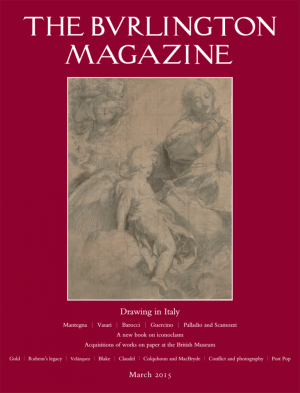 A R T I C L E S
• Veronica Maria White, “Guercino’s Beggar Holding a Broken Jug: A Drawing from the Gennari Inventory of 1719,” pp. 169–71.
• Andrew Hopkins, “Palladio and Scamozzi Drawings in England and Their Talman Marks,” pp. 172–80.
• Andrea Tomezzoli, “From Venice to Newport: A Painting by Giambettino Cignaroli Lost and Found,” pp. 181–85.
R E V I E W S
• Simon Watney, Review of Stacy Boldrick, Leslie Brubaker, and Richard Clay, eds., Striking Images: Iconoclasms Past and Present (Ashgate Publishing, 2013), pp. 186–89. Available at The Burlington website for free.
• David Scrase, Review of Laura Giles, Lia Markey, and Claire Van Cleave, eds., Italian Master Drawings from the Princeton University Art Museum (Yale University Press, 2014), pp. 197–98.
• Frances Parton, Review of the exhibition Gold (London: Queen’s Gallery, 2014–15), p. 202.
• David Scrase, Review of the exhibition William Blake: Apprentice and Master (Oxford, Ashmolean, 2014–15), pp. 206–07.
Display | The Curious Neoclassical Vision of Ennemond-Alexandre Petitot
Now on at the V&A:
The Curious Neoclassical Vision of Ennemond-Alexandre Petitot
Victoria and Albert Museum, London, 25 March — 6 December 2015
Curated by Sarah Grant
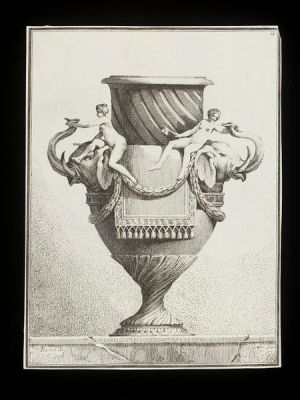
Ennemond-Alexandre Petitot, Suite de Vases (1 of 30 designs), etching by Benigno Bossi, 1770s (London: V&A)
This display showcases 24 prints and drawings by French-born architect and designer, Ennemond-Alexandre Petitot (1727–1801) who was responsible for some of the most captivating and eccentric neoclassical ornamental designs ever produced.
Petitot received a classical training in Lyons, Paris and Rome and won the prestigious post of court architect to the Duke of Parma in 1753. He executed a diverse range of commissions for the ducal palace and other important interiors, bringing a distinctly French aesthetic to the architecture and gardens of Parma. In two famous suites of ornament prints published in the 1770s Petitot gave full reign to his imagination and ensured his legacy as one of the most original exponents of Neoclassicism. These prints and a number of Petitot’s drawings and works by other influential architects and designers form the focus of this display.
Display | Blue and White: British Printed Ceramics
Now on at the V&A:
Blue and White: British Printed Ceramics
Victoria and Albert Museum, London, 31 January 2015 — 3 January 2016
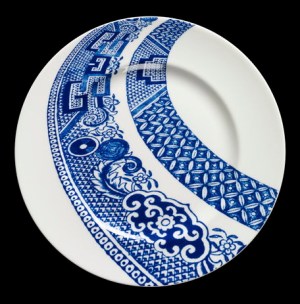
Plate, transfer-printed in enamel, ‘Border’ designed by Robert Dawson. Made by Josiah Wedgwood & Sons, Stoke-on-Trent, 2005 © Victoria and Albert Museum/WWRD United Kingdom Ltd/Robert Dawson
Blue-and-white printed ceramics are a pronounced British phenomenon with continued appeal for potters, artists and consumers. At its very best ceramic printing in blue results in a high-quality, technically precise and aesthetically pleasing decoration, enabling a rapid design response to society and culture.
This display features the wide variety of designs and decoration used in blue-and-white printed ceramics in Britain from the 1750s to present day, in both industrial and art production, demonstrating how these objects reflect British society, culture and interpret the wider world.
The display has been generously supported by The Headley Trust and includes loans from The Potteries Museum and Art Gallery, The Spode Museum Trust, The Wedgwood Museum and private collections.










 Enfilade
leave a comment