Exhibition | Enlightenment: Carte Blanche of Christian Lacroix
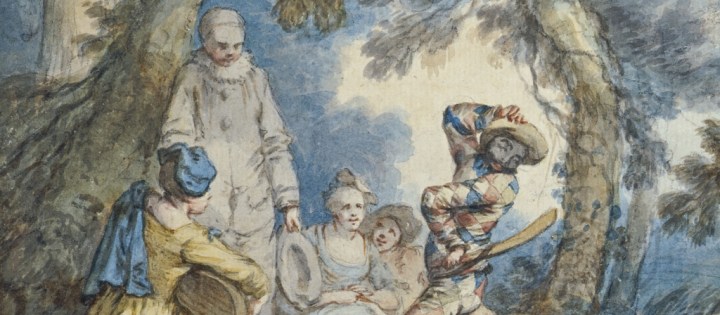
◊ ◊ ◊ ◊ ◊
Press release from the Musée Cognacq-Jay:
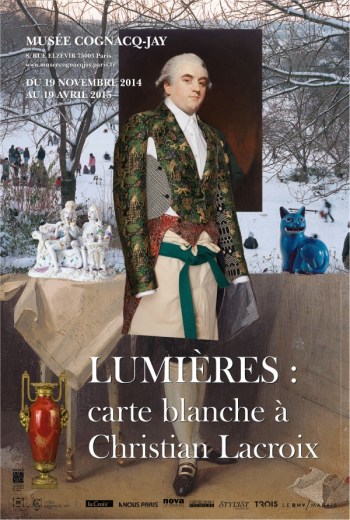
Lumières: Carte Blanche à Christian Lacroix
Musée Cognacq-Jay, Paris, 19 November 2014 — 19 April 2015
Curated by Christian Lacroix and Rose-Marie Mousseaux
In celebration of its grand reopening, the Musée Cognac-Jay has offered Christian Lacroix a creative carte blanche.
Established in 1928 by the founder of the La Samaritaine department store, Ernest Cognacq, in 1990 the museum was transferred to the Hôtel Donon, a recently-renovated sixteenth-century townhouse in the Marais district. The Musée Cognacq-Jay is home to a collection of emblematic eighteenth-century artworks, selected by its founder to be displayed in wood-panelled rooms representative of “the artistic décor of French life.”
Renowned for his creative collaborations with museums, Christian Lacroix has accepted the dual challenge of reimagining the ‘guiding narrative’ of the exhibition spaces while exploring a concept which has shaped his own approach to his art—the fascination exerted by the eighteenth century. He has curated contributions from over 40 contemporary artists, invited to reflect upon ten key themes identified in Ernest Cognacq’s collections with a view to enhancing our understanding of the Age of Enlightenment and its continued relevance in our own era.
◊ ◊ ◊ ◊ ◊
Christian Lacroix
Visions of the Enlightenment
 My perspective on the Age of Enlightenment is simply that of someone who is passionate about that era. It is an indirect perspective of the late 19th and early 20th century, when the Cognacqs built up their collection in consultation with ‘enlightened’ art historians. However, I admit that its influence on my work is less clear, as I see myself as more Dionysian than Apollinian. I can only gratefully advocate everything that the Enlightenment brought about in terms of social progress, political thinking, the fight against obscurantism, tolerance and a thirst for knowledge, as demonstrated by the encyclopaedists. All the more so given that, paradoxically, this seemingly unshakeable knowledge, these foundations that were thought to be the definitive basis of modern societies were suddenly undermined, disputed and denied in the early 21st century. If only for these reasons, it is interesting to make these connections between the 18th century and our own times. However, in my opinion we should also consider 19th-century taste—the ‘century of the pastiche’—when almost nothing new was created. Post-Napoleon III, decorative arts did nothing but ‘sample’ previous centuries, just as the Romantic period revived the medieval troubadour. There was no sign of pure, ex nihilo ‘contemporary creativity’, unlike what was emerging in England and the northern countries. From 1880 to 1910, people were expected to live in accordance with good taste—that is, past tastes—as the middle class post-Napoleon III adopted the style of the pre-Revolution enlightened aristocracy. I must confess that, beyond my appreciation and respect for the Age of Enlightenment, I am not impervious to all the rococo froth it created and inspired in the second half of the 19th century and beyond, with the somewhat risqué ‘marquise’, ‘shepherdess’ style, which was basically bourgeois and borderline kitsch. Contemporary artists often look back upon the 18th century from this angle.
◊ ◊ ◊ ◊ ◊
Rose-Marie Mousseaux, Director of the Musée Cognacq-Jay
A Return to the Museum’s Founding Vision
The Musée Cognacq-Jay is more than just a general collection of 18th-century art. It is an evocation of the taste in the 1900s for the Age of Enlightenment. The artistic collaboration with Christian Lacroix happened at exactly the same time as we were rethinking our vision of the Musée Cognacq-Jay, its place among Paris’s museums today, and what it has to offer in terms of revealing the appeal of the 18th century. To develop our 21st-century perspective, we had to go back to the founding vision of Ernest Cognacq, philanthropist and founder of the La Samaritaine department store who bequeathed the works to the City of Paris.
The exhibition design had not been reviewed since the museum moved premises in 1990, although the thematic display of the works had changed over time. This resulted in the creation of a temporary exhibition space but also led to an imbalance between the number of exhibits and the space in the rooms to display them. The empty galleries detracted from the ‘charm’ of the tour through the wood-panelled rooms. Finally, when the exhibits in the collection underwent the statutory inspection of their condition and physical integrity, we were able to look at each item in greater detail and consider its importance and meaning in the context of the collection as whole.
Today, the challenge is to make the museum’s layout clearer by structuring it around better defined themes. By giving Christian Lacroix carte blanche, we were able to identify ten recurring themes within the collection and structure them around two key aspects of 18th-century society—the importance of social occasions and the emergence of the individual. The layout has therefore been designed to go beyond the chronological limits of the temporary exhibition and incorporate several of the themes explored in the museum’s future permanent exhibition spaces. We adopted the same approach when deciding how to present each theme.
Christian Lacroix played a key role in presenting the collections in a way that was both physical and conceptual. The carte blanche that we gave him marks a highlight in the history of the Musée Cognacq-Jay. The temporary exhibition that he has curated combines contemporary works with historical exhibits and is an opportunity to reconsider our perspective of the Age of Enlightenment, its promises, and disappointments by inviting visitors to explore and reflect upon its legacy.
◊ ◊ ◊ ◊ ◊
The New Museum Layout
Thanks to Christian Lacroix’s input, we have been able to rethink how the museum’s collections are displayed and show the exhibits in a new light by presenting them in a more structured way that reflects the personalities of Ernest Cognacq and Marie-Louise Jay. The themes explored as part of this new layout reflect the different motifs found in the collection, which were influenced by the choices made by Ernest Cognacq and Marie-Louise Jay as collectors and by the major artistic movements of the 18th century.
The tour begins in the introductory room, which explains the history of the collection and its founders. After that, the exhibition is structured around ten different themes:
• Sensory experience and knowledge in the 18th century (room 2)
• Shows, balls, and sociability (rooms 3 and 4)
• Paris, capital of the Enlightenment (room 5)
• Europe’s artistic economy (rooms 6 and 7)
• 18th-century exoticism (room 8)
• The classical model (room 9)
• Childhood and education (rooms 10 and 11)
• Portraits and the emergence of the individual (rooms 12, 13 and 15)
• The age of Boucher (room 14)
• Fables, stories, and novels (room 17)
Throughout the exhibition, Christian Lacroix draws links between the museum’s collections and photographs, textiles, design pieces, and installations by contemporary artists. In doing so, he encourages visitors to reflect on how the Age of Enlightenment has influenced today’s society and gain a better understanding of its cultural legacy.
Details are available from the press kit, available as a PDF file here»
◊ ◊ ◊ ◊ ◊
It seems to me that the historiographical layers involved with the new presentation of the museum are also playing out in curious ways with the fate of La Samaritaine, the department store founded by Ernest Cognacq; Adan Gopnik provides commentary in “The View from a Bridge: Shopping, Tourism, and the Changing Face of Luxury,” The New Yorker (8 December 2014), pp. 42–47. –CH
Display | Prud’hon: Napoleon’s Draughtsman
Looking ahead to the summer at Dulwich:
Prud’hon: Napoleon’s Draughtsman
Dulwich Picture Gallery, London, 23 June — 15 November 2015
In coordination with London’s celebrations surrounding the 200th anniversary of the Battle of Waterloo, Dulwich Picture Gallery presents Prud’hon: Napoleon’s Draughtsman, the first UK exhibition devoted to Pierre-Paul Prud’hon (1758–1823), a painter and draughtsman who, through his distinctive and unconventional vision, emerged as one of the most exceptional talents working in post-Revolutionary Paris.

Pierre-Paul Prud’hon, Seated Nude with Arm Extended, black and white chalk on blue-tinted (Gray: Le Musée Baron Martin)
A selection of 13 works on paper will celebrate Prud’hon as court artist to Napoleon and Joséphine Bonaparte and as one of France’s greatest draughtsmen. The display will focus on the artist’s extraordinary life studies in white and black chalk, remarkable for their ethereal forms, subtlety of light and shade, and mastery of expression. Whether sketched quickly or finished to perfection, the drawings reveal Prud’hon’s working processes, exploring the constant experimentation that led to the unique blend of Romantic expression and Neoclassical forms that marked him out amongst his contemporaries.
Prud’hon, unlike many of his contemporaries, drew from the live model throughout his career giving him the freedom to focus on certain forms or details without the confines of specific commissions. His drawings, which range from preparatory studies for interior decoration to allegorical compositions (conveying meaning through symbolic figures, actions, imagery, and events) not only demonstrate his incredible skill but also provide a sense of contact with the heart and mind of the artist. On his preferred medium of thick blue paper you can catch a glimpse of his ideas unfolding beneath his chalk, an expression of his thoughts at the moment of creation.
◊ ◊ ◊ ◊ ◊
Known for its outstanding collection of drawings, pastels, and prints by Pierre-Paul Prud’hon, the Musée Baron Martin in Gray is housed in an eighteenth-century château (refurbished between 1777 and 1783), built on the site of a medieval fortress (the fourteenth-century tower remains). More information is available here.
Exhibition | The U.S. Constitution and the End of American Slavery
Press release (24 November 2014) from The Huntington:
The U.S. Constitution and the End of American Slavery
The Huntington, San Marino, California, 24 January — 20 April 2015
Curated by Olga Tsapina
In commemoration of the 150th anniversary of the passage of the 13th Amendment to the U.S. Constitution, The Huntington Library, Art Collections, and Botanical Gardens will illuminate the complexities of ending slavery with an exhibition drawn from its renowned collections of American historical manuscripts and prints. “The U.S. Constitution and the End of American Slavery” will be on view in the West Hall of the Library from January 24 until April 20, 2015.

Thomas Jefferson, notes on the 12th Amendment, ca. 1803 (The Huntington Library, Art Collections, and Botanical Gardens)
“The exhibition follows a long, tortuous, and bloody road that led to that fateful vote,” said Olga Tsapina, the Norris Foundation Curator of American Historical Manuscripts and curator of the exhibition. On January 31, 1865, Schuyler Colfax, the speaker of the U.S. House of Representatives, called for a vote on a joint resolution that would amend the Constitution to abolish slavery throughout the United States and empower Congress to “enforce this article by appropriate legislation.” After the clerk read the tally—119 ayes to 56 nays, with eight abstaining—the House erupted in wild jubilation. American slavery was dead. “The 119 congressmen who voted ‘aye’ on January 31, 1865, accomplished two things that seemed nearly impossible—abolishing slavery and amending the U.S. Constitution,” Tsapina added.
Many hurdles stood in the way of ending slavery: racism, fear, political partisanship, economic interests, and the lack of political will, to name a few. The Constitution presented the most formidable obstacle. The very same national charter that had created a republic dedicated to liberty also guaranteed the rights of Americans who owned human property, said Tsapina. For example, the Constitution mandated that each state respect the other states’ laws, even while Southern states permitted ownership of slaves. “But this is just one area of the Constitution that was problematic,” she added. “There were many others, and they all factored into what was a tremendously complicated—and daunting—matter.”
The conflict between the foundational principles of liberty and the reality of American slavery proved to be irreconcilable. After decades of increasingly bitter discord, it finally broke the Union apart, plunging the nation into civil war in 1861. Even the war failed to end human bondage. That was achieved only by changing the Constitution in a way its framers could not have imagined.
Featuring some 100 manuscripts, rare books, prints, and photographs, most exhibited for the first time, the exhibition will offer Huntington visitors a rare opportunity to experience the history of what Colfax called “that great measure, which hereafter will illuminate the highest place in our History” through the extraordinary breadth and depth of The Huntington’s collections.
The exhibition includes the writings of abolitionists and slave masters; runaway slaves and slave speculators; African American emigrants to Liberia and members of the Underground Railroad; and legal scholars and leaders of political parties. Visitors will see manumissions (formal documents freeing slaves from servitude) and slave traders’ business correspondence, letters from Civil War battlefields, and congressional speeches and resolutions, as well as political cartoons representing viewpoints from both sides of the partisan divide.
The display includes a 1796 letter by President George Washington discussing the fate of his runaway slave, Ona Marie ‘Oney’ Judge; Thomas Jefferson’s notes on amending the Constitution; a notebook from the famous abolitionist John Brown; and the writings of Francis Lieber, the celebrated author of the U.S. Army military code that was praised as “better than the Emancipation Proclamation.” The exhibition will feature letters and manuscripts from The Huntington’s famous collection of Abraham Lincoln material, including Lincoln’s record of his debates with Stephen A. Douglas and a copy of the 13th Amendment signed by the president.
“‘The U.S. Constitution and the End of American Slavery’ tells a complex and fascinating story in which the fate of American slavery was decided not only on Civil War battlefields, but also in courtrooms, the debating floors of state legislatures and the chambers of the U.S. Congress, as well as in proverbial smoke-filled rooms,” said Tsapina.
Display | Working Women: Images of Female Labor
From The Huntington:
Working Women: Images of Female Labor in the Art of Thomas Rowlandson
The Huntington, San Marino, California, 20 December 2014 — 13 April 2015
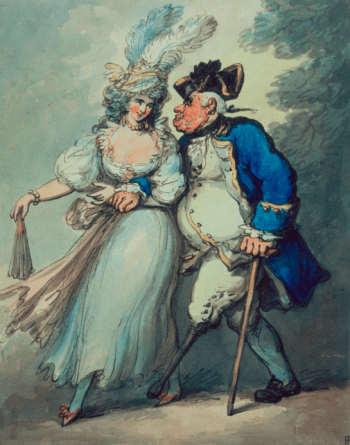
Thomas Rowlandson, A French Frigate Towing an English Man o’ War into Port, no date, pen and watercolor (The Huntington Library, Art Collections, and Botanical Gardens; Gilbert Davis Collection)
As one of Britain’s premier draftsmen, Thomas Rowlandson (1756–1827) lent his vast talent to the comic depiction of a wide range of topics, from politics to pornography. His satirical views of Georgian society are among his strongest work, and The Huntington’s collection focuses primarily on this aspect of his oeuvre. Rowlandson’s observations of the follies of the world around him provide us with a view of late 18th- and early 19th-century England that goes beyond what we see in aristocratic portraits or in the prose of Jane Austen, which portray a world of grand ladies and gentlemen and genteel manners.
This display of 11 rarely-exhibited watercolors from the collection focuses on Rowlandson’s depiction of women. His subjects are primarily those who were most visible within the public sphere—street vendors, servants, actresses, and prostitutes as they plied their various trades—with an occasional glance at the foibles of the upper class. Eschewing complex political or philosophical messages, Rowlandson’s images, though humorous, provide a fascinating glimpse into the reality of women’s lives at this time.
Exhibition | Shoes: Pleasure and Pain

Pale-blue shoes, silk satin with silver lace and braid, diamond and sapphire buckles, England, 1750s (London: V&A: T.70+A—1947; M.48+A—1962). Photographed on the mantelpiece in The Norfolk House Music Room, the British Galleries at the V&A.
◊ ◊ ◊ ◊ ◊
Press release from the V&A:
Shoes: Pleasure and Pain
Victoria & Albert Museum, London, 13 June 2015 — 31 January 2016
The Bowes Museum, Barnard Castle, County Durham, 11 June — 9 October 2016
Peabody Essex Museum, Salem, Massachusetts, 9 November 2016 — 12 March 2017
Savannah College of Art and Design, Savannah, Georgia, March — June 2017
Curated by Helen Persson
The transformative power of extreme footwear will be explored in the V&A’s summer 2015 fashion exhibition, Shoes: Pleasure and Pain. More than 200 pairs of historic and contemporary shoes from around the world will be on display, many for the first time. The exhibition will explore the agonizing aspect of wearing shoes as well as the euphoria and obsession they can inspire.
The V&A’s shoe collection is unrivalled, spanning the globe and over 2000 years. For Shoes: Pleasure and Pain, curator Helen Persson has delved into this, other international collections and the wardrobes of private individuals to select an exceptional range of shoes from a sandal decorated in pure gold leaf originating from ancient Egypt to futuristic looking shoes created using 3D printing.
 Shoes worn by or associated with high profile figures including Marilyn Monroe, Queen Victoria, Sarah Jessica Parker, and the Hon Daphne Guinness will be shown as well as famous shoes, such as the ballet slippers designed for Moira Shearer in the 1948 film The Red Shoes. Footwear for men and women by 70 named designers including Manolo Blahnik, Christian Louboutin, Jimmy Choo, and Prada will be on display. Historic lotus shoes made for bound feet and 16th-century chopines, silk mules with vertiginous platforms designed to lift skirts above the muddy streets, will also feature.
Exhibition curator, Helen Persson, said: “Shoes are one of the most telling aspects of dress. Beautiful, sculptural objects, they are also powerful indicators of gender, status, identity, taste and even sexual preference. Our choice in shoes can help project an image of who we want to be.”
The exhibition will be shown over two floors. The luxurious, boudoir design of the ground floor gallery will examine three themes: transformation, status, and seduction.
‘Transformation’ will present shoes that are the things of myth and legend, opening with different cultural interpretations of the Cinderella story from across the globe. It will explore the concept of shoes being empowering as passed down through folklore, illustrated by the Seven League Boots from the ‘Hop o’ My Thumb’ tale, and how this feeds into contemporary marketing for such things as football boots and the concept of modern-day, fairy-tale shoemakers, whose designs will magically transform the life of the wearer.
‘Status’ will reveal how impractical shoes have been worn to represent privileged and leisurely lifestyles—their design, shape and material can often make them unsuitable for walking—and how shoes also dictate the way in which the wearer moves, how they are seen and even heard. Shoes on display will include Indian men’s shoes with extremely long toes, noisy slap-sole shoes worn in Europe during the 17th century and the now infamous Vivienne Westwood blue platforms worn by Naomi Campbell in 1993. ‘Status’ will also demonstrate how historically shoe fashions originated from the European royal courts, while today the focus has shifted to famous shoe designers. Desirable shoes such as the ‘Pompadour’, worn by trend-setting women in the 18th-century French court will sit together with designs by the some of the most well-known names in fashion today, including Alexander McQueen and Sophia Webster.
Within ‘Seduction’, the shoes represent an expression of sexual empowerment or a passive source of pleasure. Like feet, shoes can be objects of fetishism. High Japanese geta, extreme heels, and tight-laced leather boots will be on display as well as examples of erotic styles channeled by mainstream fashion in recent years.
In contrast, the laboratory style setting of the first floor gallery is dedicated to dissecting the processes involved in designing and creating footwear, laying out the story from concept to final shoe. This will be enhanced by films and animations that peel back the layers of a shoe and reveal how they are made. The displays will show how makers combine traditional craftsmanship with technological innovation and how they unite function with art.
Designer sketches, materials, embellishments and shoe lasts, such as the lasts created by H. & M. Rayne for Princess Diana, will be on show, alongside ‘pullovers’ from Roger Vivier for Christian Dior. The section will highlight the makers’ ingenuity in creating innovative styles and dealing with the structural challenges of creating ever higher heels and more dramatic shapes and will feature filmed interviews with five designers and makers.
The exhibition will go on to examine shifts in consumption and production—with examples from an 18th-century ‘cheap shoe warehouse’, one-off handmade men’s brogues and trainers made in China. It will also look at the future of shoe design, with experiments of material and shapes, moulding and plastics. On display will be footwear that pushes the boundaries of possibility, including the form-pressed ‘Nova’ shoes designed by Zaha Hadid with an unsupported 16cm heel and Andreia Chaves’ ‘Invisible Naked’ shoes that fuse a study of optical illusion with 3D printing and high quality leather making techniques. The last section of the exhibition will look at shoes as commodities and collectibles. Six different people’s collections will be presented from trainers to luxury footwear.
Sponsored by Clarks, supported by Agent Provocateur, with additional thanks to the Worshipful Company of Cordwainers
Note (added 14 June 2016) — Venues updated to reflect the latest schedule.
◊ ◊ ◊ ◊ ◊
A preview of the accompanying publication is available via Issuu:
Helen Perrson, ed., Shoes: Pleasure and Pain (London: V&A Publishing, 2015), 176 pages ISBN: 978-1851778324, £25 / $40.
 Beautiful, sculptural objects, shoes are powerful indicators of gender, status, identity, taste, and even sexual preference. Our choice in shoes can be aspirational, even fantastical—and projects an image not just of who we are, but who we want to be. Feet are made for walking, but shoes may not be. Featuring extensive new photography, this is a beautiful and authoritative guide to the history and culture of footwear. Iconic creations by celebrated designers sit alongside masterpieces by unknown craftsmen in this book.
Embracing both men’s and women’s footwear, from the Chinese lotus shoe to laser-printed contemporary shoes-as-sculpture, Shoes: Pleasure and Pain engages with the cultural significance of shoes—the source of their allure, how they are made, and the people who buy and wear them. Contributors from a wide range of disciplines consider subjects as diverse as ballet slippers and fetishism, shoes and ceramics, traditional shoemaking, and the obsessive shoe collector. The book also includes a comprehensive discussion of the history of shoe design, and case studies including Marie-Antoinette’s shoe collection and the footwear of the Maharajas.
Helen Persson is curator of Chinese textiles and dress in the V&A’s Asian Department.
◊ ◊ ◊ ◊ ◊
C O N T E N T S
Helen Persson, Introduction
Part 1: The Lure of Shoes
Hilary Davidson, Shoes and Magical Objects
Elizabeth Semmelhack, The Allure of Height
Rowan Bain, Status and Power in the Hamam
Divia Patel, Bling: Footwear of the Maharajas
Cassie Davies-Strodder, Shoes and Sex
Valerie Steele, Ballet Shoes and Fetishism
Rowan Bain, The Shoe and the Body
Part 2: Art and Innovation
Naomi Braithwaite, Shoe Design: Creativity and Process
Helen Persson, The Beauty of Shoemaking
Jana Scholze, Extreme Future
Sonia Solicari, The Shoemaker and the Ceramicist
Joanne Hackett, Plastic Galore
Christopher Breward, Men in Heels
Part 3: Shoe Obsession
Cally Blackman, The Rise of the Celebrity Shoe Designer
Giorgio Riello, Production for Consumption
Kirstin Kennedy, Cracowes and Duckbills
Helen Persson, Lotus Shoes for the Masses
Kimberly Chrisman-Campbell, Marie Antoinette’s Love of Shoes
Karin M. Ekström, The Show Cabinet: Collectors Case Study
Notes
Bibliography
Parts of a Shoe
Glossary
Index
Acknowledgements
Picture Credits
Master Drawings New York, 2015

Aert Schouman (Dordrecht 1710–1792 The Hague), A Cockerel Crowing, pencil, pen and ink and watercolour and gum arabic, heightened with white, signed ‘A. Schouman. ad.f’ in pen and brown ink, 171 x 191 mm, Provenance: Lord Fairhaven. Offered by Crispian Riley-Smith Fine Arts Ltd. and on view during Master Drawings New York 2015 at Shepherd / W & K Galleries.
◊ ◊ ◊ ◊ ◊
Press release (26 November 2014) as edited to highlight the eighteenth-century offerings:
Master Drawings New York, 2015
New York, 24–31 January 2015
The 2015 edition of Master Drawings in New York promises to be the best ever. More than thirty of the world’s leading dealers are coming to New York City to offer for sale master art works in pencil, pen and ink, chalk and charcoal, as well as oil on paper sketches and watercolours, created by iconic artists working in the 16th to 21st centuries. Each exhibition is hosted by an expert specialist and many works on offer are newly discovered or have not been seen on the market in decades, if at all.
In addition, Margot Gordon and Crispian Riley-Smith, co-founders of Master Drawings in New York, are delighted to announce that John Marciari, the new head of the Department of Drawings and Prints at the Morgan Library & Museum in New York, will provide the introduction for the 2015 brochure.
Highlights at the 2015 edition include ….
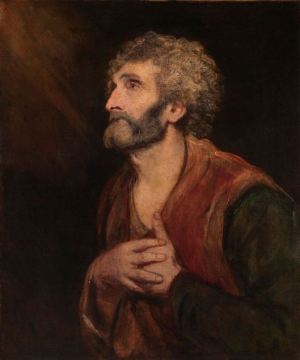
Joshua Reynolds, Dionysius Aeropagites. oil on canvas, 30 x 25 inches, ca. 1772
• A major rediscovered masterpiece by Sir Joshua Reynolds, listed as missing since 1905, and a star attraction at the exhibition of London gallery LOWELL LIBSON LTD. “Dionysius Aeropagites has only been known from an 18th-century engraving,” according to Libson. It depicts Reynolds’s favorite model, a street mender from York, George White. The painting perfectly communicates Reynolds’s ambitions as a history painter shortly after the founding of the Royal Academy.” Painted in emulation of an Italian old master, the powerful head was published shortly after its completion and given the title identifying the sitter as a follower of St. Paul. Libson is also featuring works by William Blake, John Singleton Copley, Thomas Jones, Samuel Palmer, Simeon Solomon and a fascinating group of British portrait drawings of the 1830s and 1840s depicting Queen Victoria, Talleyrand, Chopin and Paganini—plus Sir Thomas Lawrence’s portrait of the Duke of Wellington’s nieces and J.M.W. Turner’s Alpine tour watercolor, The Val d’Aosta.
• A small group of noteworthy David Cox watercolours MARTYN GREGORY is bringing to New York includes a very large one that is completely fresh to the market. Gregory says it is interesting as it is made on several sheets of the ‘Scotch’ paper Cox used later in his career, which he had carefully pieced together to make a much larger sheet. It is a fascinating watercolour which shows Cox working on grand scale, mastering one of his favourite subjects: Betwys-y-Coed in North Wales. Gregory is also showing 18th- and 19th-century British watercolours including Richard Parkes Bonington’s The Ruins of Chateau d’Harcourt near Lillebonne, a pencil and watercolour dating to 1821-22 when Bonington made his first tour of Normandy; a 1793 watercolour by British artist William Alexander showing Chinese Barges of the first British embassy preparing to pass under a bridge, led in 1792-4 by Lord Macartney; and a highly detailed wash drawing, John Hood’s The East Indiaman Essex in Three Positions.
• London specialist STEPHEN ONGPIN FINE ART always manages to acquire new-to-the-market works by the most iconic names in fine art including Edgar Degas, Thomas Gainsborough, Adolph Gottlieb, Paul Klee, Henri Matisse, Edvard Munch, Paul Signac, Alfred Sisley, Wayne Thiebaud, and Odilon Redon. This year’s exhibition won’t disappoint as Ongpin is showing Gainsborough’s Travellers Passing Through A Village, Klee’s Night impression of a Southern Town, Degas’s A Seated Young Woman Plaiting her Hair, Matisse’s Standing Female Nude, Munch’s Rocks on the Edge of a Sea, Paul Signac’s Still Life with a Bowl of Fruit, Wayne Thiebaud’s Ice Cream Cone, and Redon’s A Face in the Window.
• New exhibitor PRPH RARE BOOKS is offering an album of 70 uncensored 16th-century drawings after Michelangelo’s Last Judgment in the Sistine Chapel. The original figures depict genitalia and other ‘lewd’ elements which were later censored and painted over at the Church’s direction. These were generally unknown until the restoration of the work in 1980–84. They are bound in 18th-century calf and were in the collection of Count Leopold Cicognara (1767–1834), the leading Italian art historian of his time. PRPH is also showing a highly important complete set of 50 engraved fortune telling cards (Northern Italy 1465) by the Master of the ‘Mantegna’ Tarocchi—E-series, rebound in 18th-century cartonnato.
• London dealer GUY PEPPIATT brings over wonderful British works including artworks by one of the most important British topographical artists of the late 18th century, Edward Dayes, whose Carlsbrooke Castle Isle of Wight, dating to 1788, is featured at MDNY. Also featured is a William Callow R.W.S. watercolour A Spring Day at Florence from San Miniato, dating to 1882, and Thomas Rowlandson’s pen, ink and watercolour,The Mid-day Rest.
• PIA GALLO is offering a Salvator Rosa (1615–1673) Study for the Figure of Scylla in pen ink and wash that is a study for the painting Glaucus and Scylla at the Brussels Musee des Beaux Arts. The drawing was once owned by Queen Christina of Sweden. Also showing splendid, hand-painted, fan-shaped gouaches with views of the Gulf of Naples that were meant to be folding fans. Fans and hand screens—predominantly as a fashion accessory—became popular in Europe from the seventeenth century onwards. These two individual fans are made from natural vellum, hand-painted by an anonymous artist. The fans here are not folded nor are they mounted and date from probably around 1800. They show Romantic views of the most frequently visited sights in the Bay of Naples by travelers on the Grand Tour. Villa di Pompejo (Villa of Diomedes). Gouache on natural vellum. Veduta del Sepolcro della Sacerdotessa Mammia a Pompejano.
• CRISPIAN RILEY-SMITH of London has titled his exhibition, Flights of Fancy: Birds and Animals by Aert Schouman and his Contemporaries in 18th-century Holland. On view are six Aert Schouman watercolours, including five from the collection of the late Lord Fairhaven, and four watercolours by Abraham Meertens—plus master drawings by Bandini, Benso Hackert, Zuccarelli and Van Goyen.
• MARGOT GORDON FINE ARTS is staging a show titled Five Centuries of Faces and Figures.
• MIA WEINER is showing a selection of important works such as Gaetano Gandolfi’s Studies of Two Angels, preparatory for the flanking angels in the 1780 altarpiece Immaculate Conception in S.M. Lambarun Coeli, Bologna. She also offers a charming red chalk drawing by a student of the Carracci closest in technique to Annibale, drawing a fellow student or perhaps himself as he works from model sheets of facial features made by Agostino. Plus Filippo Lauri’s Allegorical Figures Frolicking in the Flowers in gouache, Jan Van Kessel’s watercolour of Butterfly, Moth, Rose and Spring of Gooseberries, Salvator Rosa’s Study of a River God for The Dream of Aeneas, a study for the same figure in a painting at the Metropolitan Museum. A number of 19th-century landscape oil sketches and watercolours by Northern European and Italian artists such as Carl Friedrich Heinrich Werner’s A Beautiful Water Carrier, which Weiner says is a stunning example of the artist’s work, and Daniel Israel’s large scale Portrait of a Bearded Man, as strong as any German sheet of the period.
• MIREILLE MOSLER is showing artworks spanning five centuries including works by Zacharias Blijhooft, Pieter Holsteyn II, Francois Bonvin, John Constable, Jules Bastien-Lepage, Willem van den Berg, Leo Gestel, Jan Sluyters, Jan Toorop and Jacobus van Looy. The earliest 17th-century drawings exhibited are a group of 15 small animals and insects that once belonged to a larger album in the possession of the Earl of Arundel (1585–1648) known as ‘The Collector Earl’. John Constable’s 1810 ‘En plein air’ East Bergholt depicts the surroundings where he grew up. A Francois Bonvin Study for Le Couvreur tombe dating to 1877 is a recently rediscovered study of a now lost important Salon painting of the same year.
Founded in 2006 as a way to draw upon and buttress the presence of collectors and museum officials during the important January art-buying events, including the Old Master auctions and The Winter Antiques Show, Master Drawings in New York has become an important part of the winter art scene in its own right, attracting the most influential dealers not only in New York but in England, France, Italy, Germany, and Spain who each stage a themed exhibition in more than two dozen Upper East Side galleries between East 63rd and 93rd Streets. Master Drawings in New York has received critical acclaim for orchestrating a showcase for fine art works that cut across the full range of styles, centuries, mediums and genres, and for providing greater accessibility to fine art at price points that range from several thousand dollars to several million.
◊ ◊ ◊ ◊ ◊
Note (added 4 February 2015) — A press release recapping the 2015 event is available here»
Exhibition | Liverpool’s Most Radical Son: Edward Rushton
◊ ◊ ◊ ◊ ◊
The Museum of Liverpool, the International Slavery Museum, and the Victoria Gallery and Museum celebrate the activism and legacy of Edward Rushton (1756–1814) with a trio of exhibitions:
Unsung – Liverpool’s Most Radical Son: Edward Rushton
The Museum of Liverpool, 7 November 2014 — 10 May 2015
International Slavery Museum, Liverpool, 7 November 2014 — 10 May 2015
Victoria Gallery and Museum, University of Liverpool, 7 November 2014 — 10 May 2015
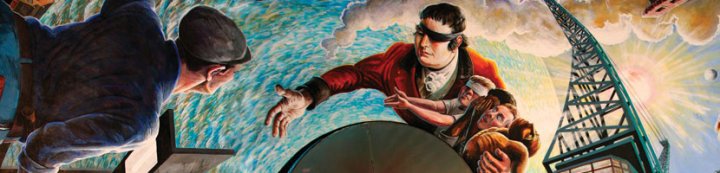
What made a Liverpool bookseller, and former seaman, publican, and newspaper editor who was blind, take on George Washington, the President of the United States of America, over his personal and public failure to liberate enslaved Africans?

Moses Haughton (1773–1849), Portrait of Edward Rushton (Liverpool: Royal School for the Blind)
Edward Rushton’s knowledge of slavery was first hand—as a West Indies sea boy from the age of ten he had experience of both the slave trade and plantation slavery. In Caribbean waters his life was saved by an African sailor, Quamina, whom he had befriended, and who lost his own life in consequence. Two years later, at eighteen, Rushton was the only crewmember who tended the enslaved Africans infected with the epidemic eye disease, trachoma. Rushton caught the infection and became blind.
Surviving a period of poverty, he opened a bookshop on Paradise Street, which became a hub for Liverpool’s ‘Friends of Freedom’. Rushton was then able to establish the Liverpool School for the Indigent Blind—still in existence today—second only in the world to the Paris school.
Edward Rushton used his pen to support the revolutionary struggles in America, France, Haiti, Ireland, and Poland and was a friend to all who were oppressed whether by human exploitation or human frailty. At the heart was his plea to respect human rights. He saw the press gang as a “a National Stain” and slavery as the “ the Foulest Stain.” Rushton’s poetry broke the mould and gave a voice to the powerless and dispossessed across the world. His work reached a wide audience—it was published on both sides of the Atlantic in newspapers, collected volumes, in broadsides and put to music.
◊ ◊ ◊ ◊ ◊
Supported by the Heritage Lottery Fund and led by DaDaFest as part of DaDaFest International 2014, Unsung began last year in Liverpool as a city-wide project celebrating the social activism and legacy of Edward Rushton on the bicentenary of his death. Kathleen Hawkins wrote about the project for the BBC back in November.
Exhibition | Fashioning the Body: An Intimate History of the Silhouette
Press release for the upcoming exhibition at the BGC:
Fashioning the Body: An Intimate History of the Silhouette
Musée des Arts Décoratifs, Paris, 5 July — 24 November 2013
Bard Graduate Center, New York, 3 April — 26 July 2015
Curated by Denis Bruna
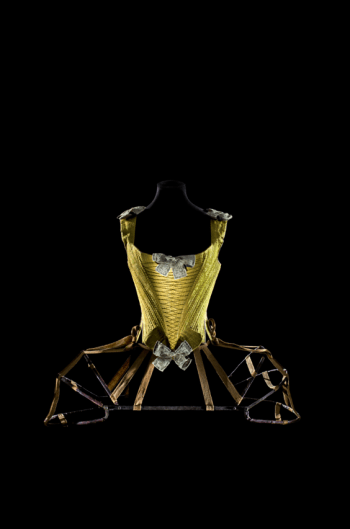
Whalebone corset. France, ca. 1740–60. Silk satin damask, braided silk, linen bows covered in silk and decorated with metallic thread, whalebone, linen lining. Les Arts Décoratifs, PR 995.16.1. Articulated pannier. France, ca. 1770. Iron covered with leather, fabric tape. Les Arts Décoratifs, depot du musée national du Moyen Âge-Thermes et hotel de Cluny 2005, Cluny 7875. Photographer: Patricia Canino.
Having garnered high acclaim at the Musée des Arts décoratifs in Paris in 2013, the exhibition Fashioning the Body: An Intimate History of the Silhouette will be on display at the Bard Graduate Center from April 3 through July 26, 2015. The exhibition will present the many devices and materials that women and men have used to shape their silhouettes from the seventeenth century to today, including panniers, corsets, crinolines, bustles, stomach belts, girdles, and push-up brassieres. The exhibition will also look at how lacing, hinges, straps, springs, and stretch fabrics have been used to alter natural body forms.
Curated by Denis Bruna, curator of pre-19th-century fashion and textile collections at the Musée des Arts décoratifs and professor at the École du Louvre, the exhibition will explore the history of what has long been ‘behind the scenes’ in clothing and fashion—far beyond the corset, the best-known device for shaping the figure. This show, which draws heavily on the Paris museum’s unrivaled costume collection, is the first of its kind, and the Bard Graduate Center will be its only venue in North America.
Although a broad array of silhouette-shaping garments has evolved over the course of fashion history, and techniques have been refined, the purpose of such garments has remained consistent: to flatten the stomach, compress the waist to the point of hollowing it out, support the bust, lift the breasts (and sometimes flatten them), and add curves to the hips. In short, comfort was superseded by appearance until about 1900, when couturiers such as Paul Poiret launched, however fleetingly, a vogue for ‘natural’ lines.
The tricks for fashioning women’s bodies have always confounded belief, from the earliest boned bodices through today’s push-ups. Spread across three floors of the Bard Graduate Center Gallery’s townhouse, Fashioning the Body opens with the seventeenth-century silhouette, exemplified by a rare women’s Spanish doublet, which was internally reinforced to be more rigid. Structured with armatures and other mechanisms, the garments of the eighteenth century enforced the erect posture prized first by the aristocracy and later by an influential bourgeoisie in order to convey a sense of superiority through the display of an idealized physical form. The epitome of the transformed female silhouette is the late eighteenth-century formal or court dress, examples of which will be on display alongside the undergarments that molded their distinctive silhouettes. In men’s fashion, the exhibition explores how padded jackets provoked arched torsos; how calf enhancers, stomach belts, and codpieces were worn; and how variations on these enhancements continued into the nineteenth century and beyond. The exhibition will also include garments for children, who wore corsets beginning in the seventeenth century.
Fashioning the Body continues into the nineteenth century, in which the corset held tyrannical sway, embodying the voguish insistence on a ‘wasp waist’, accentuated by the excessive ballooning of crinoline. After 1870 this kind of boned hoopskirt disappeared and was replaced by the bustle—also known as the faux-cul (fake buttocks), ‘shrimp tail’, or strapontin (jump seat)—which gave women an odd and sinuous profile reminiscent of a goose. Undergarments were never as abundant or as concealed as they were in the nineteenth century. The exhibition will continue with the brassiere and girdle, including examples used by men, and eventually the bust-enhancing and push-up bras of today. These devices were designed to create a plunging look for even the slimmest figures, reflecting the dictates of the canons of beauty at a time when bodies are modeled more by diets, body building, and surgery than by clothing.
In addition to complete outfits shaped by these hidden structural contraptions, the exhibition will also feature moving mannequins wearing mechanized reconstructions of panniers, crinolines, and bustles in order to show how the undergarments worked. The exhibition space will also include an area where visitors can try on specially made replicas of corsets, eighteenth-century panniers, and crinolines in order to understand the workings of these structures, which have played such an important role in the history of fashion.
Denis Bruna has a doctorate in history from the University of Paris I Panthéon-Sorbonne. He joined Les Arts Décoratifs in 2011 as curator of textile and fashion collections before the nineteenth century. He is also a professor and director of research in the history of fashion, costume, and textiles at the École du Louvre. His research focuses on the history and iconography of the costume, dress, and customs of the body. He has published several books and was the curator of the 2012 exhibition Fashioning Fashion: Two Centuries of European Fashion 1700–1915.
The Bard Graduate Center is a graduate research institute in New York City. The Center’s Gallery exhibitions and publications, MA and PhD programs, and research initiatives explore new ways of thinking about decorative arts, design history, and material culture. Founded in 1993, the BGC is an academic unit of Bard College. Fashioning the Body is the third in a series of collaborations between the Musée des Arts décoratifs and the Bard Graduate Center, which included Chinese Cloisonné (2011) and Discovering the Secrets of Soft-Paste Porcelain at the Saint-Cloud Manufactory, ca. 1690–1766 (1999).
The Musée des Arts décoratifs, housed in the Louvre building, is a unique, private institution composed of a specialized library, teaching facilities, and an ensemble of prestigious museums, including the Musée Nissim de Camondo and the Musée des Arts décoratifs. The Musée des Arts décoratifs fulfills a unique role in the French cultural landscape. Its six thousand objects on view in 10,000 square meters of exhibition space highlight the skills of craftsmen through the centuries, the evolution of styles, technological innovation, and the creativity of artists in enriching our day-to-day environ- ment. It is the only museum able to pay tribute to all the great names that have forged the history of French taste, from Boulle, Sèvres, Aubusson, Christofle, Lalique, and Guimard to Mallet Stevens, Le Corbusier, Perriand, and Starck. The museum’s chronological itinerary guides visitors through all the major styles and movements, from Gothic to Louis XVI, Art Nouveau, Art Deco, and modern design. Les Arts Décoratifs also boasts exceptional fashion and textile collections, among the finest in the world, and a vast collection of advertising posters, films, and objects. The wealth of these collections enables Les Arts Décoratifs to run a program of ten to fifteen thematic and monographic exhibitions covering every historic and contemporary aspect of the decorative arts.
◊ ◊ ◊ ◊ ◊
The Bard Graduate Center, in collaboration with Yale University Press, will publish an English-language version of the book that accompanied the exhibition in Paris, which is now out of print:
Denis Bruna, ed., with photographs by Patricia Canino, Fashioning the Body: An Intimate History of the Silhouette (New Haven: Yale University Press, 2015), 272 pages, ISBN: 978-0300204278, $50.
 This unique survey offers fascinating insights into the convoluted transformations employed by both men and women to accommodate the fickle dictates of fashion. With high design, wit, and style, Fashioning the Body tracks the evolution of these sartorial devices—from panniers, crinolines, and push-up bras to chains, zippers, and clasps—concealed beneath outer layers in order to project idealized figures. Women’s corsets constricted waists; exaggerated buttocks and hips counterbalanced jutting bust lines; and chic, aerodynamic silhouettes compressed breasts and flattened bellies. Yet masculine fashion has been no stranger to these tortuous practices. Men flaunted their virility by artificially broadening their shoulders, applying padding to their chests, and slipping codpieces over their groins. With more than 200 beautiful illustrations—including reproductions of superb historic advertisements—Denis Bruna reveals the industry and art of these contrivances meant to entice and beguile as well as assert status and power. Contemporary haute-couture designers Thierry Mugler, Jean Paul Gaultier, Rei Kawakubo for Comme des Garçons, Christian Lacroix, and Vivienne Westwood are featured in this indiscreet tour of intimate fashion history.
Exhibition | Fantastical Worlds: Adam Friedrich von Löwenfinck
From the Staatliche Kunstsammlungen Dresden:
Fantastical Worlds: Painting on Meissen Porcelain
and German Faience by Adam Friedrich von Löwenfinck (1714–1754)
Zwinger, Dresden, 1 October 2014 — 22 February 2015

Adam Friedrich von Löwenfinck, Meissen, 1734
To mark the 300th anniversary of the birth of Adam Friedrich von Löwenfinck, the Porzellansammlung of the Staatliche Kunstsammlungen Dresden presents a comprehensive exhibition of this artist’s oeuvre, bringing together around 100 selected porcelain and faience exhibits from the Dresden Porzellansammlung, private collections and renowned museums, including the Metropolitan Museum of Art, New York, the Rijksmuseum, Amsterdam, the Reiss-Engelhorn Museum, Mannheim, and the Museum für Kunst und Gewerbe, Hamburg.
Adam Friedrich von Löwenfinck (1714–1754) was one of the most important ceramic painters of the eighteenth century. He began his career at the Meissen Porcelain Manufactory in 1728, but by 1736 had fled to escape restrictions on his artistic development and difficult working conditions in the painters’ workshops. His life then took an adventurous path to a succession of faience manufactories, starting with Bayreuth and moving on by way of Fulda to Strasbourg-Haguenau. Due to his exceptional artistic abilities, but also to his guile and lack of scruples, Löwenfinck eventually rose from lowly journeyman painter to manufactory director.
Inspired by the painted decoration on Chinese and Japanese porcelain in the collection of August the Strong, he created a fantastic world inhabited by vibrantly colourful, fabulous creatures. He later took these exotic motifs, as well as his knowledge of both East Asian and European flower painting, with him as he travelled, transferring them from one workplace to the next. As Löwenfinck did not sign his works, for a long time it was impossible to attribute them with any certainty: as a result, his oeuvre long remained completely unrecognised, even among specialists.
The life and works of this exceptional artist were the focus of several years of research conducted by the Porzellansammlung of the Staatliche Kunstsammlungen Dresden. The results of this project are now presented in a comprehensive anniversary exhibition. Systematic evaluation of archive sources, including manufactory reports and case files, shed light on previously little known aspects of social conditions in the porcelain and faience manufactories of the time, and enabled a fundamental and thorough reassessment of his work.
◊ ◊ ◊ ◊ ◊
◊ ◊ ◊ ◊ ◊
From Arnoldsche Art Publishers:
Ulrich Pietsch, Phantastische Welten: Malerei auf Meissener Porzellan und deutschen Fayencen von Adam Friedrich von Löwenfinck, 1714–1754 (Stuttgart: Arnoldsche Art Publishers, 2014), 384 pages, ISBN: 978-3897904200, 78€.
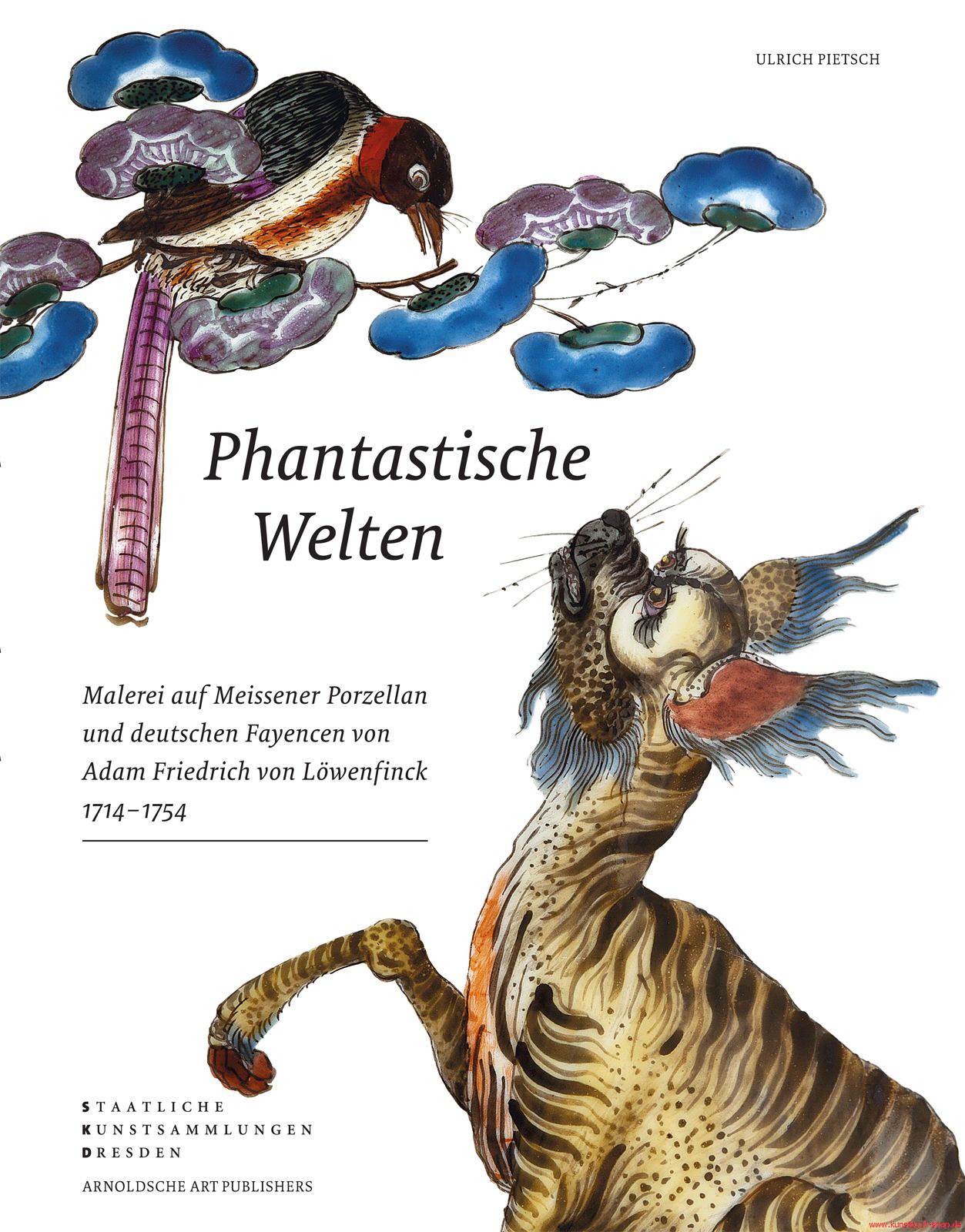 Adam Friedrich von Löwenfinck (1714–1754) war einer der bedeutendsten Keramikmaler des 18. Jahrhunderts. Er begann seine Karriere 1728 in der Porzellan-Manufaktur Meissen, die er wenige Jahre später wieder verließ, um der Einschränkung seiner künstlerischen Entfaltung und den schwierigen Arbeitsbedingungen in den Malerstuben zu entfliehen. Sein abenteuerlicher Lebensweg führte ihn in verschiedene Fayence-Manufakturen, darunter Bayreuth, Ansbach, Fulda, Höchst und Straßburg-Haguenau. Aufgrund seiner außergewöhnlichen künstlerischen Fähigkeiten, aber auch durch Geschick und Skrupellosigkeit stieg Löwenfinck schließlich vom einfachen Malergesellen in die Position eines Manufakturdirektors auf. Löwenfinck ist bekannt für seine fantastische Welt bunt schillernder und märchenhafter Fabeltiere. Er beeinflusste und prägte nachhaltig die Keramikmalerei seiner Zeit und wirkte stilprägend auf viele andere Manufakturen des 18. Jahrhunderts in Europa. Aufgrund fehlender Künstlersignaturen ist sein Werk umstritten und wurde bislang kontrovers diskutiert.
Die vorliegende Publikation ist das Ergebnis eines mehrjährigen Forschungsprojektes der Porzellansammlung Dresden, mit der nun erstmals eine grundlegende Untersuchung der Biografie und des OEuvres Adam Friedrich von Löwenfincks vorgelegt wird.
Exhibition | Jean-Etienne Liotard
On this summer at the Scottish National Gallery (more information to come in the spring). . .
Jean-Etienne Liotard
Scottish National Gallery, Edinburgh, 4 July — 13 September 2015
Royal Academy, London, 24 October 2015 — 31 January 2016
Curated by MaryAnne Stevens, William Hauptman, and Christopher Baker

Jean Étienne Liotard, Laura Tarsi, ‘A Grecian Lady’, watercolour and bodycolour on ivory, ca 1745–49 (Cambridge: Fitzwilliam Museum)
A stunning exhibition celebrating one of the greatest artists of the eighteenth century. The work of Jean- Étienne Liotard (1702–89) has been rarely exhibited, and this is the first time it will be comprehensively celebrated in Britain.
Liotard enjoyed a long career, and his finest portraits display an astonishing hyper-realism achieved through a combination of incredible, intense observation and remarkable technical skills. He excelled at the delicate art of pastel, but also drew, painted in oil, created enamels, and was a refined miniaturist and printmaker. His activity was prodigious: Liotard wrote a treatise on painting, was a collector, a dealer, a traveller and an artistic innovator. In the age of Mozart and Casanova, he was a key international figure whose achievement deserves to be better known. Highlights of this important show include famous portraits, startling self-portraits, and brilliant experiments with genre and still-life subjects from the end of his career.
◊ ◊ ◊ ◊ ◊
Update (added 5 July 2015) — From the press release:
The National Galleries of Scotland is delighted to announce a major exhibition in the summer of 2015 celebrating one of the greatest yet little- known artists of the eighteenth century. The work of Jean-Étienne Liotard (1702–1789) has rarely been exhibited and this is the first time it will be comprehensively celebrated in Britain. Liotard enjoyed a long career and his finest portraits display an astonishing hyper-realism achieved through a combination of incredible, intense observation and remarkable technical skills.
Liotard was one of the most sophisticated artists of eighteenth-century Europe; a brilliant, witty portraitist, he excelled at the delicate art of pastel, but also drew, painted in oil, created enamels and was a refined miniaturist and printmaker. According to his contemporary Horace Walpole “Truth prevailed in all his works.” In some respects he also displayed striking modernity as a highly accomplished self-publicist, formulating a powerful ‘eastern’ image of himself following his period in Constantinople, by wearing exotic clothes and growing a long beard, which became as much a focus of curiosity as his portraits. His activity was prodigious: Liotard wrote a treatise on painting, was a collector, a dealer, a traveller and an artistic innovator. In the age of Mozart and Casanova, he was a key international figure, whose achievement deserves to be better known.
Born in Geneva, he travelled extensively, working in Amsterdam, The Hague, Venice, Rome and Naples. He spent four years in Constantinople depicting foreign residents in the city and developed a fascination with near- eastern fashions and customs. His career also took him to the courts of Vienna, Paris and London, where he portrayed the families of Empress Maria Theresa, King Louis XV and Augusta, Princess of Wales, creating images of great candour and charm.
Christopher Baker, Director of the Scottish National Portrait Gallery, and one of the exhibition’s curators commented: “This exhibition will be a revelation to many visitors who are unfamiliar with Liotard’s dazzling achievement. He was undoubtedly one of the most remarkable and idiosyncratic artists of the eighteenth century, and his work and career are fascinating, as they touch on themes such a travel, orientalism, court art, fashion and technical experimentation.”
Liotard depicted a number of important British patrons, in addition to members of the Royal family, such as the actor David Garrick, and some of his key works remain in U.K. public and private collections. Highlights of the exhibition will also include a selection of his startling self-portraits and brilliant experiments with genre and still life subjects that date from late in his career.
◊ ◊ ◊ ◊ ◊
Christopher Baker, Duncan Bull, Marc Fehlmann, William Hauptman, Neil Jeffares, Aileen Ribeiro, MaryAnne Stevens, Jean-Etienne Liotard (London: Royal Academy Publications, 2015), 224 pages, ISBN: 978-1907533990, £35.
 Renowned during the eighteenth century for his exquisite portraits and works in pastel, not to mention his outlandish Orientalist outfits, Jean-Etienne Liotard (1702–1789) painted some of the most significant rulers and aristocrats in Europe, including the entire British Royal Family. A peripatetic artist who worked in the Near East as well as in major European capitals, Liotard was born in Geneva and studied in Paris, before travelling to Italy and then on to Constantinople, in the company of Lord Duncannon. While there he painted the local residents as well as the British community, and adopted the eccentric style of dress that, when he later visited London, saw him become known as ‘The Turk’. This volume, accompanying the first exhibition of his works to be shown in the United Kingdom, illuminates the career of this unique artist, showcasing a variety of his extraordinary works, including portraits, drawings
and enamels.
Christopher Baker is Director of the Scottish National Portrait Gallery.
Duncan Bull is Curator of Foreign Paintings at Rijksmuseum, Amsterdam.
Marc Fehlmann is Associate Professor of Archaeology and Art History at Eastern Mediterranean University, Northern Cyprus.
William Hauptman is an independent scholar.
Neil Jeffares is an art historian with a particular interest in eighteenth-century pastels.
Aileen Ribeiro is Emeritus Professor at the Courtauld Institute of Art.
Mary-Anne Stevens, an independent curator, worked as Director of Academic Affairs at the Royal Academy for 29 years.
◊ ◊ ◊ ◊ ◊
Note (added 17 January 2016) — Neil Jeffares has compiled an extensive errata for the catalogue, available at his website.










 Enfilade
leave a comment