Installation | A Voyage to South America

Unidentified artist, active in Cuzco, Peru, Our Lady of the Rosary of Chiquinquirá with Female Donor, late 17th/early 18th century (Carl and Marilynn Thoma Collection)
◊ ◊ ◊ ◊ ◊
From the AIC:
A Voyage to South America: Andean Art in the Spanish Empire
Art Institute of Chicago, 11 November 2014 — 21 February 2016
While the Art Institute has a long tradition of collecting and displaying works from the pre-Hispanic cultures of South America, this long-term installation offers the museum’s first presentation of work from the viceregal period. Fourteen paintings and related works on paper—including pieces from the collection of Chicagoans Marilynn and Carl Thoma never before displayed in a museum, as well as important loans from the Newberry Library and Denver Art Museum—introduce visitors to explorers, artists, and patrons who lived in the Spanish-governed Andes during the 17th, 18th, and 19th centuries.
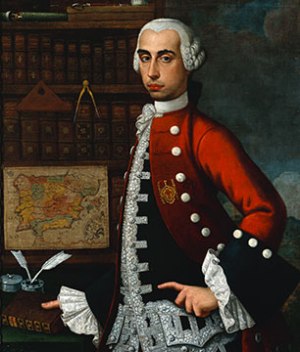
Unidentified artist, active in Spain, Portrait of Antonio de Ulloa y de la Torre-Guiral, 1768–70
(Carl and Marilynn Thoma Collection)
The metaphorical guide of this journey is Antonio de Ulloa (1716–95), a Spanish naval officer and cartographer who traveled to South America with a French scientific mission in the 1730s and 1740s. His portrait introduces the group of works assembled—paintings of identified sitters, signal works by important South American artists, and devotional paintings that include historical figures. Each work has its own direct link to individual biography and lived experience in the New World, offering a more personal look at the themes of exploration and discovery and bringing to life the culture and artistic production in South America as European conventions combined with indigenous traditions.
The installation is accompanied by a bilingual brochure as well as bilingual treatment of all object labels, wall texts, and audio guide stops. Select works have also been added to the museum’s ‘Closer’ app, featuring slide shows, videos, archival materials, and more for further insight into this unique period of cultural convergence.
At noon on 17 February 2015, Victoria Sancho Lobis, associate curator in the Department of Prints and Drawings, will discuss the exhibition.
◊ ◊ ◊ ◊ ◊
Chicago’s Newberry Library will host a symposium on Latin America in the Early Colonial Period on Saturday, 11 April 2015, exploring related material in the sixteenth and seventeenth centuries.
Exhibition | The Critique of Reason: Romantic Art, 1760–1860

George Stubbs, A Lion Attacking a Horse, 96 x 131 inches (243.8 x 332.7 cm), 1762 (New Haven: Yale Center for British Art, Paul Mellon Collection B1977.14.71)
◊ ◊ ◊ ◊ ◊
From the YCBA:
The Critique of Reason: Romantic Art, 1760–1860
Yale University Art Gallery, New Haven, 6 March — 26 July 2015
Curated by Cassandra Albinson, Nina Amstutz, Elisabeth (Lisa) Hodermarsky, Paola D’Agostino, and Izabel Gass
The first major collaborative exhibition between the Yale University Art Gallery and the Yale Center for British Art, The Critique of Reason offers an unprecedented opportunity to bring together treasures of the Romantic art movement from the collections of both museums. The exhibition comprises more than three hundred paintings, sculptures, medals, watercolors, drawings, prints, and photographs by such iconic artists as William Blake, Théodore Géricault, Francisco de Goya, and J. M. W. Turner. This broad range of objects challenges the traditional notion of the Romantic artist as a brooding genius given to introversion and fantasy. Instead, the exhibition’s eight thematic sections juxtapose arresting works of art that reveal the Romantics as attentive explorers of their natural and cultural worlds as well as deeply invested in exploring the mysterious, the cataclysmic, and the spiritual. The richness and range of Yale’s Romantic holdings will be on display, presented afresh for a new generation of museumgoers.
The Critique of Reason: Romantic Art, 1760–1860 has been co-organized by the Yale Center for British Art and the Yale University Art Gallery. The curators are, at the Center, A. Cassandra Albinson, Curator of Paintings and Sculpture, and Nina Amstutz, Postdoctoral Research Associate, and, at the Gallery, Elisabeth (Lisa) Hodermarsky, Sutphin Family Senior Associate Curator of Prints and Drawings, and Paola D’Agostino, Nina and Lee Griggs Assistant Curator of European Art; and Izabel Gass, Graduate Research Assistant, is at the Center and Gallery. The exhibition has been made possible by the Art Gallery Exhibition and Publication Fund and the Robert Lehman, B.A. 1913, Endowment Fund, as well as by funds from the Yale Center for British Art Program Endowment.
◊ ◊ ◊ ◊ ◊
Note (added 30 March 2015) — In connection with the exhibition, Yale is hosting a two-day symposium, The Romantic Eye, 1760–1860 and Beyond, 17–18 April 2015. More information is available here»
Exhibition | China: Through the Looking Glass
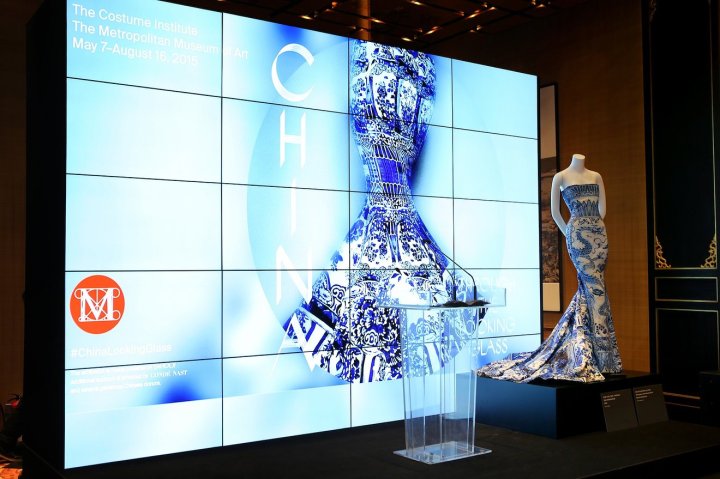
Evening dress by Roberto Cavalli, 2005
Photo: The Metropolitan Museum of Art
◊ ◊ ◊ ◊ ◊
Press release (23 December 2014) from The Met:
China: Through the Looking Glass
The Metropolitan Museum of Art, New York City, 7 May — 16 August 2015
Curated by Andrew Bolton with Harold Koda, Maxwell Hearn, Denise Patry Leidy, and Zhixin Jason Sun
The Costume Institute’s spring 2015 exhibition, China: Through the Looking Glass, will be on view at The Metropolitan Museum of Art from May 7 through August 16, 2015 (preceded on May 4 by The Costume Institute Benefit). Presented in the Museum’s Chinese Galleries and Anna Wintour Costume Center, the exhibition will explore how China has fueled the fashionable imagination for centuries, resulting in highly creative distortions of cultural realities and mythologies. In this collaboration between The Costume Institute and the Department of Asian Art, high fashion will be juxtaposed with Chinese costumes, paintings, porcelains, and other art, as well as films, to reveal enchanting reflections of Chinese imagery.
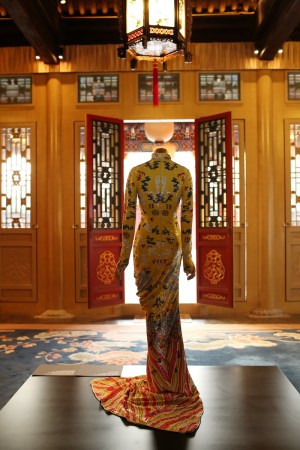
Yves Saint Laurent by Tom Ford, 2004
Photo: Courtesy of The Metropolitan Museum of A
“I am excited about this partnership between these two forward-thinking departments which will undoubtedly reveal provocative new insights into the West’s fascination with China,” said Thomas P. Campbell, Director and CEO of the Met. “The artistic direction of acclaimed filmmaker Wong Kar Wai will take visitors on a cinematic journey through our galleries, where high fashion will be shown alongside masterworks of Chinese art.”
In celebration of the exhibition opening, the Museum’s Costume Institute Benefit will take place on Monday, May 4, 2015. Silas Chou will serve as Honorary Chair. The evening’s co-chairs will be Jennifer Lawrence, Gong Li, Marissa Mayer, Wendi Murdoch, and Anna Wintour. This event is The Costume Institute’s main source of annual funding for exhibitions, publications, acquisitions, and capital improvements.
“From the earliest period of European contact with China in the 16th century, the West has been enchanted with enigmatic objects and imagery from the East, providing inspiration for fashion designers from Paul Poiret to Yves Saint Laurent, whose fashions are infused at every turn with romance, nostalgia, and make-believe,” said Andrew Bolton, Curator in The Costume Institute. “Through the looking glass of fashion, designers conjoin disparate stylistic references into a fantastic pastiche of Chinese aesthetic and cultural traditions.”
Exhibition Overview

Chanel by Karl Lagerfeld, 1984
Photo: The Metropolitan Museum of Art
This is The Costume Institute’s first collaboration with another curatorial department since AngloMania: Tradition and Transgression in British Fashion in 2006, a partnership with the Department of European Sculpture and Decorative Arts. China: Through the Looking Glass will feature more than 130 examples of haute couture and avant-garde ready-to-wear alongside masterpieces of Chinese art. Filmic representations of China will be incorporated to reveal how our visions of China are shaped by narratives that draw upon popular culture, and to recognize the importance of cinema as a medium through which we understand Chinese history.
The Anna Wintour Costume Center’s Lizzie and Jonathan Tisch Gallery will present a series of ‘mirrored reflections’ through time and space, focusing on Imperial China; the Republic of China, especially Shanghai in the 1920s, 1930s and 1940s; and the People’s Republic of China. These reflections, as well as others in the exhibition, will be illustrated with scenes from films by such groundbreaking Chinese directors as Zhang Yimou, Chen Kaige, Ang Lee, and Wong Kar Wai. Distinct vignettes will be devoted to ‘women of style’, including Oei Huilan (the former Madame Wellington Koo), Soong May-Ling (Madame Chiang Kai-shek), and Empress Dowager Cixi.
Directly above the Anna Wintour Costume Center, the Chinese Galleries on the second floor will showcase fashion from the 1700s to the present, juxtaposed with decorative arts from Imperial China, including jade, lacquer, cloisonné, and blue-and-white porcelain, mostly drawn from the Met’s collection. The Astor Court will feature a thematic vignette dedicated to Chinese opera, focusing on the celebrated performer Mei Lanfang, who inspired John Galliano’s spring 2003 Christian Dior Haute Couture Collection, ensembles from which will be showcased alongside Mr. Mei’s original opera costumes.
Designers in the exhibition will include Giorgio Armani, Vitaldi Babani, Cristobal Balenciaga, Sarah Burton for Alexander McQueen, Callot Soeurs, Roberto Cavalli, Coco Chanel, Christian Dior, Domenico Dolce and Stefano Gabbana, Peter Dundas for Emilio Pucci, Tom Ford for Yves Saint Laurent, John Galliano for Christian Dior, Jean Paul Gaultier, Valentino Garavani, Nicolas Ghesquière for Balenciaga, Maria Grazia Chiuri and Pierpaolo Picciolo for Valentino, Craig Green, Madame Grès, Ground-Zero, Guo Pei, Adrian Hailwood, Marc Jacobs for Louis Vuitton, Charles James, Charles Jourdan, Mary Katrantzou, Karl Lagerfeld for Chanel, Jeanne Lanvin, Ralph Lauren, Judith Leiber, Ma Ke, Mainbocher, Martin Margiela, Alexander McQueen, Alexander McQueen for Givenchy, Missoni, Edward Molyneux, Kate and Laura Mulleavy, Dries van Noten, Jean Patou, Paul Poiret, Oscar de la Renta for Balmain, Ralph Rucci, Yves Saint Laurent, Paul Smith, Anna Sui, Vivienne Tam, Isabel Toledo, Giambattista Valli, Vivienne Westwood, Jason Wu, Laurence Xu, and others.
The exhibition, a collaboration between The Costume Institute and the Department of Asian Art, coincides with the Museum’s year-long centennial celebration of the Asian Art Department, which was created as a separate curatorial department in 1915. China: Through the Looking Glass is organized by Andrew Bolton, Curator, with the support of Harold Koda, Curator in Charge, both of The Costume Institute. Additional support is provided by Maxwell Hearn, Douglas Dillon Chairman; Denise Patry Leidy, Curator; and Zhixin Jason Sun, Curator, all of the Department of Asian Art.
Internationally renowned filmmaker Wong Kar Wai will be the exhibition’s artistic director working with his longtime collaborator William Chang, who will supervise styling. Nathan Crowley will serve as production designer for the exhibition-he has worked on three previous Costume Institute exhibitions including Superheroes: Fashion and Fantasy (2008), American Woman: Fashioning a National Identity (2010), and Schiaparelli and Prada: Impossible Conversations (2012). The design for the 2015 Costume Institute Gala Benefit will be created by Wong Kar Wai and William Chang with 59 Productions, and Raul Avila, who has produced the Benefit décor since 2007.
“William Chang and I are pleased to be working in collaboration with The Costume Institute and the Asian Art Department of The Metropolitan Museum of Art on this exciting cross-cultural show,” said Wong. “Historically, there have been many cases of being ‘lost in translation’–with good and revealing results. As Chinese filmmakers we hope to create a show that is an Empire of Signs–filled with meaning for both East and West to discover and decipher.”
The exhibition is made possible by Yahoo. Additional support is provided by Condé Nast and several generous Chinese donors.
◊ ◊ ◊ ◊ ◊
The accompanying publication will be distributed by Yale UP:
Andrew Bolton, with Adam Geczy, Maxwell K. Hearn, Homay King, Harold Koda, Mei Mei Rado, Wong Kar Wai, and John Galliano, with photography by Platon, China: Through the Looking Glass (New York: The Metropolitan Museum of Art, 2015), 256 pages, ISBN: 978-0300211122, $45.
For centuries, China’s export arts—jade, silks, porcelains, and, more recently, cinema—have fueled Western fantasies of an exotic East and served as enduring sources of inspiration for fashion. This stunning publication explores the influence of Chinese aesthetics on designers, including Giorgio Armani, Christian Dior, Jean Paul Gaultier, Karl Lagerfeld, Ralph Lauren, Alexander McQueen, and Yves Saint Laurent. Drawing upon Chinese decorative arts, cinema, and costume—notably imperial court robes, the close-fitting cheongsam, and the unisex Mao suit—their designs are fantastical pastiches of anachronistic motifs. As in the game of “telephone,” the process of cultural translation transforms the source material into ingeniously original fashions that are products solely of the designers’ imaginations.
In a similar way, contemporary Chinese film directors render fanciful, highly stylized evocations of various epochs in China’s history—demonstrating that China’s imagery is equally seductive to artists in the East and further inspiring today’s designers. Juxtaposing modern fashions and film stills with their forebears in fine and decorative arts and historical dress, this book reveals the rich and ongoing creative dialogue between East and West, past and present.
Andrew Bolton is curator in the Costume Institute, The Metropolitan Museum of Art.
Exhibition | Goya: The Portraits
Looking ahead to the fall at The National Gallery in London:
Goya: The Portraits
The National Gallery, London, 7 October 2015 — 10 January 2016
Curated by Xavier Bray

Francisco de Goya, Self Portrait in His Studio, 1793–95 (Madrid: Museo de la Real Academia de Bellas Artes de San Fernando)
Francisco de Goya (1746–1828) is one of Spain’s most celebrated artists. He was considered a supremely gifted portrait painter and an excellent social commentator who took the genre of portraiture to new heights through his ability to reveal the psychology of his sitter. This landmark exhibition—the first ever focusing solely on his portraits—will re-appraise Goya’s genius as a portraitist and provide a penetrating insight into both public and private aspects of his life. It will explore Goya’s ambitions and development as a painter, and his innovative and unconventional approach to portraiture which often broke traditional boundaries.
The exhibition will trace Goya’s career from his early beginnings at the court of Charles III in Madrid to his appointment as First Court Painter to Charles IV, through the difficult period under Joseph Bonaparte and then Ferdinand VII, which nevertheless saw some of his finest work, and then his final years in France. By bringing together more than 50 of his most outstanding portraits from around the world, including drawings and miniatures, and organising them in a chronological and thematic sequence, the show will enable viewers to engage for the first time with the full range of Goya’s technical, stylistic and psychological development as a portraitist.
◊ ◊ ◊ ◊ ◊
Note (added 4 August 2015) — The full press release is available here.
The catalogue is distributed by Yale UP:
Xavier Bray, with Manuela Mena Marqués and Thomas Gayford, Goya: The Portraits (London: The National Gallery, 2015), 272 pages, ISBN: 978-1857095739, $60.
 Francisco de Goya y Lucientes (1746–1828) was one of the greatest portraitists of his time. The first large-scale book devoted to the topic, this handsome volume features portraits that shed light on Goya and his subjects, as well as on the politically turbulent and culturally dynamic era in which they lived. Whether portraying royalty, philosophers, military men, or friends, these works are memorable both for the insight they provide into the relationship between artist and sitter, and for their penetrating psychological depth.
Xavier Bray traces Goya’s career from his beginnings at the Madrid court of Charles III to his final years in Bordeaux, played out against the backdrop of war with France and the social, political, and cultural shift of the Enlightenment. More than 60 remarkable portraits, including drawings and miniatures, reveal the full range of Goya’s technical and stylistic achievements, while also depicting sitters with a previously unparalleled humanity. His break with traditional, late-18th-century conventions allowed him to achieve a new modernity in portraiture that paved the way for artists such as Matisse and Picasso.
Xavier Bray is chief curator at Dulwich Picture Gallery. Manuela Mena Marqués is chief curator of 18th-century paintings at the Museo del Prado, Madrid. Thomas Gayford is a former research assistant at Dulwich Picture Gallery.
Exhibition | Hungarian Treasure: Silver from the Salgo Collection
Press release (24 November 2014) from The Met:
Hungarian Treasure: Silver from the Nicolas M. Salgo Collection
The Metropolitan Museum of Art, New York, 6 April — 4 October 2015
Curated by by Wolfram Koeppe
 Nicolas M. Salgo (1915–2005), a Hungarian native and former United States ambassador to Budapest, was fascinated by the art of the goldsmith in Hungarian culture and formed his own “treasury” by collecting pieces that are individual and unique. Hungarian Treasure: Silver from the Nicolas M. Salgo Collection will celebrate the gift to The Metropolitan Museum of Art of the major part of the silver collection assembled by this focused collector over three decades.
This large collection of silver—about 120 pieces, most dating from the 15th to the late 18th century—comprises a variety of types with especially refined appearance and high levels of craftsmanship, representing Hungarian silver at its best. The earliest works in the Salgo collection are medieval: seven objects, including two rare chalices with mastered filigree enameling. The intriguing shapes, inventive decoration, and historical importance of the objects, products of once-prosperous local aristocratic dynasties, make this ensemble exceptional. As a result of this generous gift, the Metropolitan Museum is now the only museum outside Hungary to possess such an array of sumptuous goldsmiths’ work from the region.
The rich natural resources and a flourishing mining system in what it is today Hungary and Romania (including the major parts of Transylvania and the so-called Siebenbürgen area) attracted artisans from all over Europe who created decorative objects with what was to become a characteristic opulence. Because the Balkans and the neighboring dominions were a major battlefield between the West and the Ottomans for centuries, few of these objects have survived. Those that have endured—many of which are included in this exhibition—offer a fascinating look into the techniques and abilities of this distinct interpretation of Renaissance and Baroque ornamentation.
The abundant deposits of silver ore in the region sparked the development of an active goldsmith community, the forerunners of which were mainly masters of German origin who were working under the strong influence of the German-speaking cultural area. Many of these craftsmen and workers emigrated from Saxony, which at that time was one of Europe’s main mining centers. In addition to German styles, the shape and ornamentation of the objects typically show an Ottoman influence, since this region was regularly occupied by the Ottoman Empire. The ornate embellishment on many of the pieces is derived from contemporary prints, textiles (such as lace), and other luxury goods that were sought-after all over Europe.
Comparative material culled from other areas of the Metropolitan Museum’s collection—including the Arms and Armor Department, the Costume Institute, and the Robert Lehman Collection— will also be on view in the exhibition to illustrate the multi-regional, wide-ranging influence on Hungarian silver during this period.
Hungarian Treasure: Silver from the Nicolas M. Salgo Collection is organized by Wolfram Koeppe, the Marina Kellen French Curator in the Metropolitan Museum’s Department of European Sculpture and Decorative Arts. The exhibition will be accompanied by an extensive web feature on the Museum’s website, including a scholarly essay on the subject of Hungarian goldsmiths’ work, a history of the collection and its collector, and catalogue entries. This online feature is made possible by the Salgo Trust for Education, New York.
Exhibition | A Passion for Jade: Heber Bishop and His Collection
Press release (22 November 2014) from The Met:
A Passion for Jade: Heber Bishop and His Collection
The Metropolitan Museum of Art, New York, 14 March 2015 — 8 May 2016
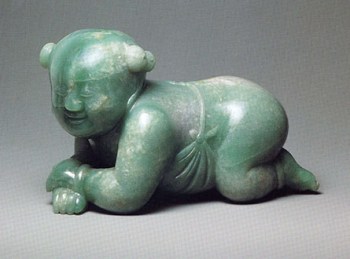 An installation of some 100 precious carvings in Chinese and Mogul jade and other hardstones, collected by Heber R. Bishop, will go on view at The Metropolitan Museum of Art beginning March 14. Featuring various types of objects—from containers for everyday use and pendants to ornaments intended for an emperor’s desk—A Passion for Jade: Heber Bishop and His Collection will illustrate the wide range of the lapidary’s repertoire.
An industrialist and entrepreneur, Mr. Bishop was an active patron of the arts and a Trustee of the Metropolitan Museum during its formative years. In the late 19th century, he assembled a collection of more than a thousand pieces of jade and other hardstones from China and elsewhere, and in 1902, he bequeathed the collection to the Museum.
Dating from Han dynasty (221–207 B.C.) to the 20th century, the objects on view in the installation will be selected entirely from the Museum’s collection. They will include outstanding Qing-dynasty (1644–1911) examples that are representative of the sophisticated art of Chinese lapidaries, as well as highly accomplished works by Mogul Indian jade carvers that provided an exotic inspiration to their Chinese counterparts. Also on display will be a set of Chinese lapidary tools and illustrations of jade workshops in China.
Exhibition | Wellington: Triumphs, Politics and Passions
Press release (29 October 2014) from the NPG:
Wellington: Triumphs, Politics and Passions
National Portrait Gallery, London, 12 March — 7 June 2015
Curated by Paul Cox with Lucy Peltz

Sir Thomas Lawrence, Portrait of Arthur Wellesley, 1st Duke of Wellington, 1815–16. (London: Wellington Collection, Apsley House, English Heritage).
The first gallery exhibition devoted to the Duke of Wellington will open at the National Portrait Gallery, to mark the 200th anniversary year of the Battle of Waterloo in 2015. Wellington: Triumphs, Politics and Passions will explore not only the political and military career of the victor of this great battle—but also his personal life through portraits of his family and friends.
Highlights include Goya’s portrait of Wellington started in 1812 after his entry into Madrid and later modified twice to recognise further battle honours and awards; and from Wellington’s London home, Apsley House, Thomas Lawrence’s famous 1815 portrait painted in the same year as the Battle of Waterloo. This iconic military image of Wellington was used as the basis of the design of the British five pound note from 1971 to 1991.
Drawn from museums and private collections including that of the present Duke of Wellington, the exhibition of 59 portraits and other art works has the support of the Marquess of Douro, and includes rarely-seen loans from the family including a portrait by John Hoppner of the Duke as a youthful soldier and a daguerreotype portrait by Antoine Claudet, in the new medium of photography, taken on Wellington’s 75th birthday in 1844. The family has also loaned Thomas Lawrence’s beautiful drawing of Wellington’s wife, Kitty (née Pakenham).
The real experience of soldiers fighting in Wellington’s armies will be explored through eyewitness accounts, including prints based on sketches by serving soldiers and the illustrated diary of a young officer, Edmund Wheatley written, in a lively style, with the intention of it being read by his sweetheart.

Francisco de Goya, Portrait of Arthur Wellesley, 1st Duke of Wellington, 1812–14 (London: The National Gallery).
Wellington: Triumphs, Politics and Passions considers the attempts of the art world to celebrate the Duke of Wellington’s military successes. Commemorative objects on display will range from royal commissions by Europe’s foremost artists and manufacturers to more modest souvenirs aimed at the domestic market. Wellington’s eventful and often difficult political career will be illustrated by examples of the many satirical prints published in the 1820s and 1830s and the exhibition will also examine the reappraisal of Wellington’s life that took place at his death and on the occasion of his lavish state funeral.
The Duke of Wellington’s long life (1769–1852) spanned the eighteenth and nineteenth centuries. Most famous for his victory over Napoleon at the battle of Waterloo, he later entered politics, serving twice as Prime Minister. Wellington: Triumphs, Politics and Passions will explore the role of visual culture in creating the hero, the legacy of heroism and the role of the portrait in Wellington’s own public and personal self-representation.
Curated by Paul Cox, Associate Curator, National Portrait Gallery, with close support from Dr Lucy Peltz, Curator of Eighteenth-Century Portraits, National Portrait Gallery, this biographical exhibition will use portraits and objects to explore Wellington’s military career and his sometimes controversial political and personal life.
Paul Cox, Associate Curator, National Portrait Gallery, London, says: “The Duke of Wellington’s victory over Napoleon at Waterloo is well known. This exhibition provides the opportunity to examine less familiar aspects of his life, including the long political career during which he saw through important forward-looking legislation, but suffered a dramatic loss of popularity. I hope that visitors to the exhibition will gain a fuller picture of Wellington as a man, rather than simply as a hero.”
The exhibition is part of the Battle of Waterloo 200th Anniversary Commemorations, the national partnership of commemorative events.
◊ ◊ ◊ ◊ ◊
Paul Cox, with a foreword by William Hague, Wellington: Triumphs, Politics and Passions (London: National Portrait Gallery, 2015), 128 pages, ISBN: 978-1855144996, £15.
This new book about the 1st Duke of Wellington provides a novel take on the traditional biography in that it explores the life of this complex man through portraits of Wellington himself, his friends, family and associates, as well as his political and military allies and opponents. There are examples of painted portraits by Goya and Thomas Lawrence, several caricatures that illustrate Wellingtons political career, and a watercolour by George Chinnery that shows the future duke as a young Major-General at the Chepauk Palace, Madras being received by Azim al-Daula, Nawab of the Carnatic, in February 1805. Also reproduced is a rare photograph, a Daguerreotype, made by Antoine Claudet on the occasion of Wellingtons seventy-fifth birthday in 1844, and sections of a sixty-six-foot roll from the Collection of the National Portrait Gallery depicting his entire funeral procession. Paul Cox explores Wellingtons military career and the battle of Waterloo, which remain central to his story, but also examines his personal relationships, his legacy and his enduring place in the popular imagination. Finally, a narrative chronology presents a useful overview of Wellingtons life and times.
Exhibition | Waterloo at Windsor: 1815–2015
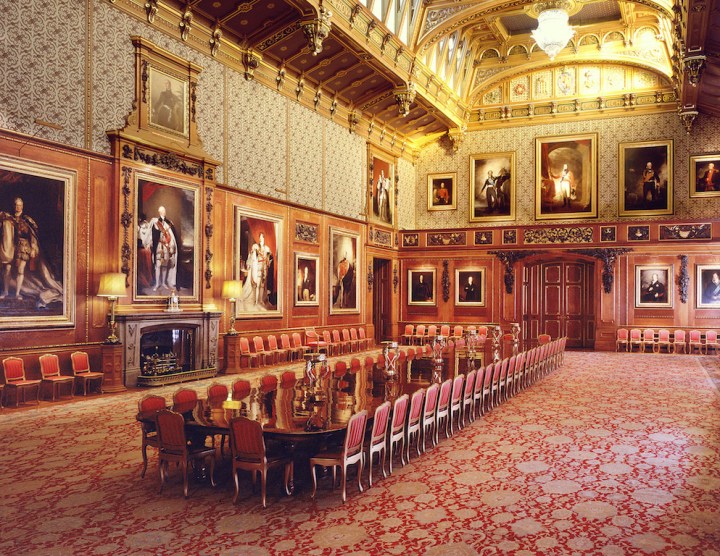
The Waterloo Chamber, Windsor Castle, Photo by Mark Fiennes for the Royal Collection Trust
© Her Majesty Queen Elizabeth II, 2014
◊ ◊ ◊ ◊ ◊
Press release (4 November 2014) from the Royal Collection:
Waterloo at Windsor: 1815–2015
Windsor Castle, 31 January 2015 — January 2016
In 2015 a special themed visit at Windsor Castle—incorporating an exhibition, a trail, and a new multimedia tour through the State Apartments—will mark the bicentenary of the Battle of Waterloo and the peace that followed nearly 25 years of war between France, under the Emperor Napoleon Bonaparte, and the allied forces including those of Great Britain, Austria, Prussia, and Russia.
Throughout the State Apartments visitors will discover unique artefacts associated with Waterloo, including items that belonged to the defeated Emperor, trophies from the battlefield, and documents from the Royal Archives. The centrepiece of the visit is the magnificent Waterloo Chamber, commissioned by George, Prince Regent (the future George IV) as a lasting monument to the battle at the heart of Windsor Castle. Throughout 2015, the route will be extended allowing visitors to walk into and around the room, rather than viewing the room from either end.
For nearly a quarter of a century Napoleon fought his way across Europe. In 1814 he was finally defeated and imprisoned, but in February of the following year he escaped exile from the Italian island of Elba. In the 100 days that followed, Napoleon overthrew the newly-restored French king and gathered his troops, before facing the leader of the allied army, the Duke of Wellington, 13 kilometres south of Brussels at Waterloo.
The Waterloo Chamber

Sir Thomas Lawrence, Arthur Wellesley, 1st Duke of Wellington, 1814–15, Royal Collection Trust © Her Majesty Queen Elizabeth II 2014
This vast room, measuring nearly 30 by 14.5 metres, was created for the sole purpose of displaying portraits of the statesmen, politicians, diplomats, and military leaders who were responsible for the overthrow of Napoleon. Despite never seeing active service, the Prince Regent regarded himself as a key player in the victory. In celebration of Napoleon’s abdication in April 1814, he invited several of the allied leaders and commanders to London and commissioned Britain’s pre-eminent portraitist, Sir Thomas Lawrence, to paint those attending. After Napoleon’s final defeat at Waterloo, Lawrence travelled to the Congress of Peace at Aix-la-Chapelle, then to Vienna and finally to Rome to complete the series.
The Waterloo Chamber remained unfinished at George IV’s death and was completed by his successor, William IV, who wanted the room to be more a commemoration of the battle than a celebration of the diplomacy that saw peace brought to Europe. A further nine portraits were added to the Waterloo Chamber’s ‘hall of fame’ by William IV and in Queen Victoria’s reign, bringing the total to 38.
Lawrence’s portrait of the Duke of Wellington dominates the room. The national hero stands beneath a triumphal arch, holding aloft the Sword of State, symbolising the sovereign’s royal authority. Beside him on a ledge rests a baton and letter signed George P.R., signifying his promotion to Field Marshal and the gratitude of the Crown. Wellington is flanked by portraits of Count Platov, commander of the Cossack cavalry, and Field Marshal Blücher, the head of the Prussian forces—the 72-year-old was nicknamed ‘Marshal Forwards’ because of his eagerness in battle. Lawrence’s portrait of Pope Pius VII, who was instrumental in the peace negotiations, is considered to be among the artist’s finest works. Imprisoned by Napoleon for many years, the Pope became a figurehead for the political and cultural regeneration of Europe after his release in 1814.
The Exhibition
Bringing together material from the Royal Collection and Royal Archives, the exhibition covers the days preceding the battle to the aftermath of conflict. Prints and drawings record the military action, devastated buildings and burial of casualties, as well as the celebration of victory. Public curiosity about Napoleon was fed by popular prints, such as those produced by the caricaturist Thomas Rowlandson.
Highlights of the Trail

Sevres porcelain factory, 1806–12, Hard-paste porcelain, gilt bronze mounts, internal wooden frame structure. Tables des Grands Capitaines, gifted to George, Prince Regent by the restored French king, Louis XVIII, courtesy Royal Collection Trust © Her Majesty Queen Elizabeth II 2014
George IV and his successors were avid collectors of works of art and souvenirs relating to the defeated Emperor. Napoleon’s cloak, taken from his fleeing carriage in the aftermath of the battle and later presented to George IV by Field Marshal Blücher, will be on display in the Castle’s Grand Vestibule. Made of red felt and lined with yellow silk brocade, it is appliquéd with Napoleon’s Imperial Eagle in silver thread. The cloak will be shown with other items removed from the Emperor’s baggage train, including Napoleon’s silver-gilt porringer—a small bowl used for food.
The Table des Grands Capitaines (Table of the Great Commanders, 1806–12), which will be on display in the King’s Drawing Room, was commissioned by Napoleon to immortalise his reign. Among the finest works ever produced by the Sèvres factory, it is decorated with the profile of Alexander the Great, the supreme military leader of antiquity, and other great commanders and philosophers. The table never left the factory and, after Napoleon’s final defeat, was presented to George IV by the restored French king, Louis XVIII, in gratitude for the allied victory. It was
one of George IV’s most prized possessions and
appears in his State portrait and in the painting by
Lawrence in the Waterloo Chamber.
Exhibition | Canaletto’s Architecture: Celebrating Georgian Britain

Canaletto (Giovanni Antonio Canal), London: The Thames from Somerset House Terrace towards the City
(Royal Collection Trust/© Her Majesty Queen Elizabeth II 2014)
◊ ◊ ◊ ◊ ◊
Press release (November 2014) from Abbot Hall (with a more complete posting available here) . . .
Canaletto’s Architecture: Celebrating Georgian Britain
Abbot Hall Art Gallery, Kendal, Cumbria, 22 October 2015 — 14 February 2016
Abbot Hall was built in the Palladian style just three years after Canaletto left England for the last time. In 1746, by then in his late 40s, he first arrived for a prolonged stay in London. He was to remain for most of the following 10 years.
Already a well established artist, his work had proved very popular with aristocratic Englishmen doing their Grand Tour of Europe. In the 1720s, having started his career as a theatrical scene painter, Canaletto started painting his distinctive views of Venice, frequently featuring the many major churches designed for it by Palladio. One of his clients was Joseph Smith, an English merchant banker who lived in Venice for 70 years, for 16 of which he was the British consul there. Smith bought many Canaletto works for himself, and also helped arrange commissions from wealthy English collectors—by the late 1720s his works were already in the collections of Goodwood, Chatsworth, Woburn and of the Prime Minister, Sir Robert Walpole. Smith himself owned by far the largest collection of works, including 52 oil paintings and over 140 drawings, which he eventually sold to George III in 1762 for £10,000—half the sum the latter paid the previous year for Buckingham Palace.

Canaletto (Giovanni Antonio Canal), Portrait of Canaletto with St Paul’s in the Background at Anglesey Abbey, Cambridgeshire (National Trust Images/Hamilton Kerr Inst/Chris Titmus)
Canaletto came to London as an indirect result of the War of the Austrian Succession, which started in 1741. This had made continental travelling difficult for his wealthy English patrons, severely reducing his income. He therefore decided to move himself to London, setting up his studio near Golden Square. He arrived a month after Culloden, the last pitched battle fought on British soil, and at the beginning of a period of unprecedented domestic peace and prosperity, which saw London turning into the world’s richest and largest city.
Although the bulk of the works with English subjects were of London scenes, with the Thames a frequent presence, he was also a regular visitor to the countryside, often at the invitation of his rich patrons, and painted several views of Warwick Castle, as well as of Alnwick, Badminton, Eton and Walton.
The rapid change of London’s architecture during his time here is also documented. In The Old Horse Guards from St James’ Park of 1749, he caught the Horse Guards Parade ground, complete with parading soldiers, as well as men peeing against the wall of Downing Street, and dozens of people promenading, showing the artist’s interest in depicting scenes of daily life. Within a couple of years, from almost exactly the same spot, he was back painting the new Horse Guards parade, the one that is still there today—it can be dated very precisely to 1752–53, as the clock tower still has scaffolding on it, while the south wing had yet to be constructed.
Canaletto is often accused of depicting London whilst using bright Venetian lighting. However, in both his pictures of the Horse Guards, the light is soft and diffused. In A View of Walton Bridge the sky is even more typically ‘English’—and un-Venetian—with the sun competing with storm clouds brewing overhead. The picture also includes a portrait of Thomas Hollis, who commissioned 5 works from Canaletto, as well as a rare self-portrait of the artist, shown painting the scene. The bridge was regarded at the time as an advanced feat of engineering. The contrasting stately bulk of Westminster Bridge and the views from it was evidently something that fascinated Canaletto, who clearly would have agreed with Wordsworth’s later opinion that “earth hath not anything to show more fair.” The bridge was under construction during his time here, and he painted and sketched it repeatedly. In one of the pictures from the Royal Collection, he frames a view of the Thames, St Paul’s and the City as if he had drawn the scene from under one of the new arches of the bridge, while others show it still under construction.
It is easy to forget that Canaletto continued to paint Venetian scenes throughout his time in London. Worked up from his sketches, or done from memory, these provided him with a significant proportion of his income whilst in London, as his more conservative patrons demanded work that they were familiar with, rather than venturing into the new views that the artist was confronting. For example, his Bucintoro at the Molo on Ascension Day, showing the state barge after the annual ‘marriage’ of Venice with the sea—which, when it sold for $20,000,000 in 2005, was briefly his most expensive painting sold at auction—was painted in London in 1754.
Ruskin had a particular down on Canaletto. It is, however, unclear quite how familiar the ascerbic critic was with genuine works by the Venetian. As a hugely popular artist, his work was widely forged and copied both during his lifetime and afterwards. It is possible that Ruskin was sometimes writing about Canaletto pupils and assistants, when he thought he was writing about Canaletto himself. In “Notes on the Louvre”, writing about a picture of the Salute and the entrance to the Grand Canal, he said that it is “cold and utterly lifeless—truth is made contemptible” and that “boats and water he could not paint at all.” The picture has since been re-attributed to Canaletto’s pupil Michele Marieschi. Similarly the “bad landscape” he saw in Turin is almost certainly a work by Bernardo Bellotto, Canaletto’s nephew. Writing about Canaletto’s “vacancy and falsehood” in Modern Painters, he refers to a painting in the Palazzo Manfrin—Augustus Hare, who visited it at about the same time, noted that the palazzo “has a picture gallery which is open daily, but contains nothing worth seeing, all the good pictures having been sold.” It is unclear which work Ruskin was referring to when he said that Canaletto’s depiction of architecture was “less to be trusted in its renderings of details than the rudest and most ignorant painter of the 13th century.” Certainly that is not the view of most modern critics of most properly authenticated works by Canaletto, but Ruskin was never one to allow the facts to affect his pet prejudices.
Exhibition | Eighteenth-Century Fans from the Lázaro Collection
◊ ◊ ◊ ◊ ◊
Thanks to Pierre-Henri Biger for noting this exhibition now on view at the Fundación Lázaro Galdiano:
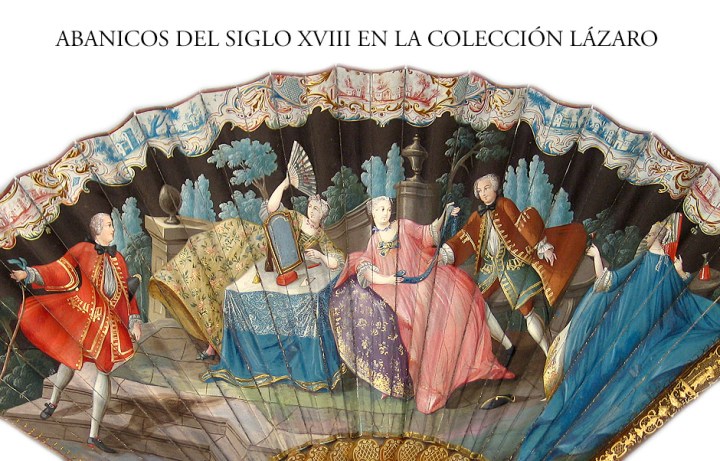
Abanicos del Siglo XVIII en la Colección Lázaro
Museo Lázaro Galdiano, Madrid, 10 October 2014 — 26 January 2015
Curated by Carmen Espinosa
La exposición Abanicos del siglo XVIII en la Colección Lázaro, comisariada por Carmen Espinosa, conservadora jefe del Museo Lázaro Galdiano, se compone de una cuidada selección de 24 piezas correspondientes a la edad de oro del abanico, elemento fundamental del adorno personal femenino, signo de distinción y de lujo. La gran variedad de abanicos que atesoró José Lázaro es muestra de su incansable búsqueda como coleccionista, de meses e incluso años, para encontrar piezas con las que obsequiar a su esposa, Paula Florido, desde que la conoció en 1901.
Los ejemplares expuestos en Abanicos del siglo XVIII en la Colección Lázaro constituyen un excelente repertorio que permite al visitante apreciar la evolución de este complemento femenino. Se muestran obras tempranas, del primer tercio del siglo XVIII, donde las referencias al barroco clasicista son evidentes; piezas en las que vemos cómo se va fraguando el gusto rococó que dio lugar al abanico galante, fiel reflejo de la vida refinada y placentera de los nobles y burgueses europeos del segundo tercio de la centuria; y otras de estructura sencilla, pero de calidad, que nos adentran en el estilo neoclásico y la moda Imperio.
Las pinturas de los países están realizadas sobre papel o vitela -piel de vaca o ternera, adobada y pulida-, materiales que permiten el plegado, y están inspiradas en asuntos mitológicos, históricos, galantes y pastorales. Los poemas homéricos de la Iliada y la Odisea, unidos a la Eneida de Virgilio y Las Metamorfosis de Ovidio, fueron una fuente inagotable para los pintores de abanicos junto a las gestas de Alejandro Magno cuya figura encarnó los ideales de valor, poder y nobleza. La pintura de los abanicos de estilo Luis XV, identificados con el rococó, refleja la creciente hegemonía de la mujer en la vida social, protagonista indiscutible reflejada en la diosa Venus, personificación del amor, la belleza y la fertilidad; en Juno, diosa del matrimonio y protectora de la mujer; o en Onfalia que hizo que Hércules olvidará su valentía abandonándose a los placeres del amor. De la historia religiosa, habitual en abanicos del primer tercio del siglo, se escogieron relatos del Antiguo Testamento, aquellos donde la mujer desempeñó un papel fundamental como Sansón y Dalila, Salomé, Betsabé o la reina de Saba. A partir de 1750, a la literatura se unen, como fuente de inspiración para los pintores, el teatro, la ópera y el ballet.
Las pinturas de Antoine Coypel, Charles Le Brun y sobre todo las de Jean Antoine Watteau y François Boucher, creadores de la fiesta galante y de la pintura pastoral, son otro gran referente para la decoración de los abanicos dieciochescos. Esta riqueza iconográfica se muestra en los abanicos de la Colección Lázaro y queda patente en esta exposición.
Variedad y calidad están presentes en los abanicos de esta muestra, citemos como ejemplo uno francés con la representación de la Alegoría de las Artes o el italiano con una escena de toilette, que figuran entre las más ostentosas de la colección. También podemos deleitarnos con los elegantes varillajes realizados en marfil o carey con trabajo de piqué -técnica italiana adoptada en Francia e Inglaterra que consiste en la incrustación de pequeños fragmentos de oro y plata-, tallados y calados en forma de rejilla o puntos -grillé / pointillé-, a los que se añaden pequeñas láminas de madreperla, plata dorada o corlada, nácar y, en ocasiones, piedras preciosas en el adorno de las palas y en el clavillo -pasador que sujeta las varillas, las fuentes y palas, del abanico-.
La colección de abanicos, compuesta por noventa piezas, es un caso especial entre todas las que conforman la Colección Lázaro. Sus obras, nos explica Carmen Espinosa, son algo más que objetos de colección, fueron testigos mudos de una relación personal, la de los coleccionistas José Lázaro y Paula Florido: desde que se conocieron, en 1901, y hasta la muerte de Paula en 1932, Lázaro regaló a su esposa abanicos en dos fechas muy señaladas: el 15 de enero, día de su cumpleaños, y el 29 de junio, en que celebraba su onomástica. Estos abanicos responden al gusto de Lázaro que se esforzó por encontrar las piezas con las que agasajar a su esposa aunque, evidentemente, existió cierta complicidad pues conocía su preferencia por la época de Luis XV y Luis XVI. Los abanicos del XVIII estaban considerados, a comienzos del siglo XX y aún hoy, como verdaderas joyas, muy buscadas y de gran valor.
◊ ◊ ◊ ◊ ◊
From La Tienda de Los Museos Online:
Este catálogo recoge la colección completa de abanicos (casi un centenar) en la que están incluidas las 24 piezas de la exposición.
Arte, Lujo y Sociabilidad: La Colección de Abanicos de Paula Florido (Año Edición, 2009), 134 pages, ISBN: 978-8496411906, 12€.
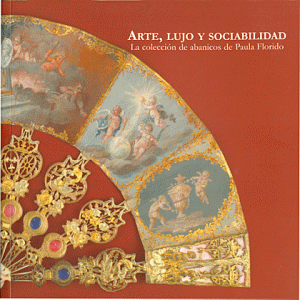 Se trata de una muestra de abanicos de elite, con materiales en su mayoría nobles de textiles, metales, brillantes, países y varillaje bien hecho y torneado, en madera de peral o de carey, con ejemplares muy selectos que abarcan los siglos XVIII y XIX.
Entre los abanicos expuestos también se encontraban cocardas (tipo paipai redondeado y recogido) o pericones, de mayor tamaño, así como abanicos de baraja. En su mayoría abanicos franceses, italianos e ingleses, con escenas bíblicas, mitológicas, heroicas, galantes, de la Comedia del arte y muy pocos con motivos políticos como el del matrimonio de doña Isabel II. En el abanico elegante se buscaban brillos y destellos de luz para impactar en sociedad.
Un bello cuadro de Luis Paret y Alcazar La Tienda (1772), perteneciente al mismo museo, ilustra sobre el modo en que un caballero y una dama adquieren ejemplares de abanico o miniaturas en aquel colmado ilustrado.
Se añaden algunos grabados de Goya que también dan cuenta del uso del abanico en Los Caprichos, objeto de indumentaria de lujo en principio, que paulatinamente se fue popularizando. El abanico era una pieza utilizada por el hombre o la mujer indistintamente, aunque era la mujer la que ofrecía con él todo un código de señales de sociabilidad.










 Enfilade
leave a comment