Exhibition | The Jason Tapestries
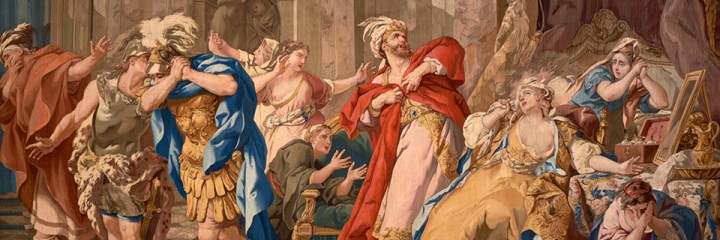
Creusa Consumed by the Poisoned Robe [detail], French, 1789. After a cartoon by Jean François de Troy, woven by Royal Gobelins Manufacture, signed “Audran 1789.” Wool, silk, and linen (Wadsworth Atheneum Museum).
◊ ◊ ◊ ◊ ◊
Press release (25 November 2014) from the Wadsworth:
The Jason Tapestries
Wadsworth Atheneum Museum of Art, Hartford, Connecticut 28 November 2014 — April 2015
The Wadsworth Atheneum Museum of Art will display rarely-exhibited tapestries from the eighteenth century in its soaring Morgan Great Hall during the final phase of the museum’s five-year, $33 million renovation. The large, intricate tapestries—which depict the saga of Greek hero Jason—will be on view through April 2015, at which point the Great Hall will be transformed in preparation for the September 19, 2015 grand reopening of the Morgan Memorial Building. The Jason Tapestries are enormous in size—ranging in height up to 14 feet, and in width up to 24 feet—presenting a challenge for curators in exhibiting them on a regular basis.
“The sheer magnitude of these stunning woven treasures, when paired with their fragility, prevents the museum from showing them as frequently as we would wish,” said Susan L. Talbott, Director and C.E.O. “The changing of the guard in our magnificent Morgan Great Hall presented us an ideal window in which to share these masterpieces with our visitors, and it is our hope that everyone will take advantage of this marvelous opportunity.”
The Jason Tapestries series was donated to the Wadsworth Atheneum in 1946. It consists of four tapestries from an original set of seven, which narrates the saga of Jason, well known to French contemporaries through the book Metamorphosis by Ovid. The tapestries depict Jason’s voyage with the Argonauts, the capture of the Golden Fleece (a symbol of kingship), and their subsequent return to Greece. Jason appears as a tragic hero—youthful, brave and clever—whose entanglement with the sorceress Medea will assure him the Fleece, but will also lead to the annihilation of his family.
From the fourteenth to the eighteenth centuries—the great period of tapestry weaving— popes, kings, and aristocrats alike competed for these luxurious pieces. Much more labor intensive and expensive to produce than paintings and sculpture, tapestries served as portable sources of wealth, and were given as precious diplomatic gifts. Manufactories used the finest materials, such as silk threads that were often combined with silver and gold. The mythological (or historical and biblical) narratives depicted were often used to glorify heroic acts of the past and present.
The story of Jason was one of the most popular tales to illustrate in tapestries of the late eighteenth century, the time of the Ancien Régime in France. In 1743, King Louis XV commissioned a seven-part Jason and Medea series for the Throne Room at Versailles, arguably the most prestigious room in France. Jean François de Troy (1679–1752) provided sketches that were later translated into life-size preparatory drawings and subsequently woven into tapestries at the Gobelins workshop. Other versions of this series were given as precious gifts by the French crown, and today belong to the Hermitage in St. Petersburg, the Royal Collections in Sweden, the Palazzo Reale in Milan and Windsor Castle in England, among others.
About Morgan Great Hall
Hartford native J. Pierpont Morgan, one of America’s richest men and greatest art collectors during the Gilded Age, donated the land and money to build the Beaux-arts Morgan Memorial. He also had a special interest in tapestries, and when the Great Hall opened in 1915, he loaned ten of them to adorn its walls. The space soon became known as ‘Tapestry Hall’. Morgan and his contemporaries saw themselves as the offspring of the old European aristocracy, who hung tapestries in the Great Halls of their country houses to demonstrate their power and influence, as well as to keep out the cold. The Wadsworth Atheneum will celebrate the centennial of the Morgan Memorial and its Great Hall in 2015; following the exhibition of The Jason Tapestries, Morgan Great Hall will be installed with masterworks from the museum’s permanent collection of European art, to open September 19, 2015, as part of the unveiling of the restored building.
Exhibition | Tiepolo: I Colori del Disegno

Giandominico Tiepolo, The Three Angels Appearing to Abraham
(Venice: Accademia)
◊ ◊ ◊ ◊ ◊
Now on at the Capitoline Museum (with caveats concerning an English translation in this particular case) . . .
Tiepolo: The Colours of Drawings / I Colori del Disegno
The Capitoline Museum, Rome, 3 October 2014 — 18 January 2015
Curated by Giorgio Marini with Massimo Favilla and Ruggero Rugolo
For the first time in Rome, the work of one of the greatest painters and printmakers of the eighteenth-century Venice, Giambattista Tiepolo. In the history of European figurative art, the impressive quantity and variety of designs produced by Tiepolo stands out as a great monument of eighteenth-century graphic representation.
 The history of European figurative culture is remarkably marked by a huge amount and variety of drawings of the Tiepolos, which stand out as a magnificent monument of Eighteenth-century graphics. Indeed, drawing is the basic element of Giambattista Tiepolo’s genial art and is where he was the most prolific. Similarly, drawing characterized the exceptional and unique production of his family-owned original atelier, where he guided the graphical activity of his sons, Giandomenico and Lorenzo, in the last example of a very old Venitian tradition. Such an inexhaustible narrative vein, mainly intended as an independent exercise, is made of an extensive variety of registers that the artist used to adjust to the different functionalities of his production. Thus, the various typologies, techniques and themes give rise to a ‘colour of drawing’. This occasion is dedicated to this peculiar perspective on the many-sided world of Tiepolo and finds its reason in the lucky chance of gathering a selection of works coming from Italian collections, unfamiliar to the great public, with sheets that have been hardly ever exhibited before.
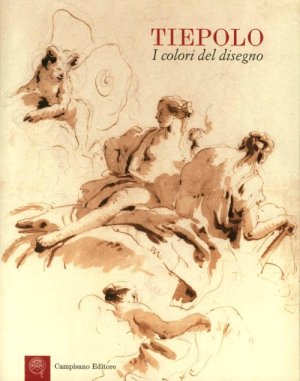 The four sections of the exhibition feature drawings and a selection of etchings according to prominent thematic clusters, but still arranged according to the range of their techniques: from the project to the early sketches, from ‘memories’ to ‘amusements’ and to the replicas of Giandomenico and Lorenzo, as an emulation of their father’s works. A measured selection of paintings is also exhibited in order to introduce and somehow represent the painting outcomes of every graphical typology. Some are well known, others have re-emerged or have been recognized only by the most recent research activities—even in the preparation of this exhibition—but they all contribute to grasp the dynamics of Tiepolo’s language, whose exceptional imaginative fertility does not exclude a constant innovation in the iteration of models.
The catalogue is available from ArtBooks.com:
Giorgio Marini et al., Tiepolo: I Colori del Disegno
(Rome: Campisano Editore, 2014), 192 pages, ISBN:
978-8898229338, $78.
Exhibition | Country House, City House
In a posting on the preservation strategy for Menokin a few days ago, I failed to note the related exhibition now on view in DC. Thanks to Pierre-Henri Biger for pointing it out! –CH
From the website Menokin: Rubble with a Cause:
Country House, City House
The Octagon House, Washington, D.C., 6 November 2014 — April 2015
 Menokin and The Octagon House are linked across the centuries through historic events, a family, and a love of architecture. Step inside their history and be immersed in the revolutionary plans for their future in the Country House, City House exhibition. The AIA Foundation (which operates The Octagon House) and The Menokin Foundation share a common mission: to encourage and educate the public and the architecture profession about the preservation of great design of the past, and the creation of great design for the future. That mission is made tangible through this
collaborative exhibition. It is comprised of three parts:
Menokin: Re-imagining A Ruin
A visual overview of the history, rehabilitation and future of Menokin.
Through Their Eyes: A Photographic Journey
Take an artistic journey through the camera lenses of two photographers—Frances Benjamin Johnston and Hullihen Williams Moore. This collection spans over eight decades of Menokin’s history, as well as the changes in technique and the advancements in photo-technology from 1930 to 2014.
Menokin Revealed
This exhibition is a curated collection of the imaginations and visions of the students of architect, Jorge Silvetti, from his 2013 studio course at the Harvard Graduate School of Design.
Additional information is available here»
Exhibition | Painting Paradise: The Art of the Garden
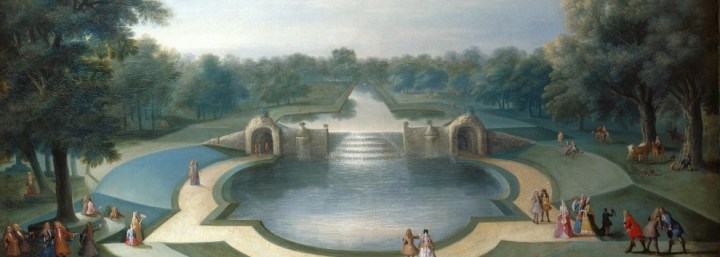
Studio of Marco Ricci, A View of the Cascade, Bushy Park Water Gardens (detail),
ca. 1715 (Royal Collection Trust)
◊ ◊ ◊ ◊ ◊
Press release (9 October 2014) from the Royal Collection Trust:
Painting Paradise: The Art of the Garden
The Queen’s Gallery, Buckingham Palace, 20 March — 11 October 2015
The Queen’s Gallery, Palace of Holyroodhouse, Edinburgh, 5 August 2016 — 26 February 2017
Curated by Vanessa Remington
Whether a sacred sanctuary, a place for scientific study, a haven for the solitary thinker or a space for pure enjoyment and delight, gardens are where mankind and nature meet. A new exhibition at The Queen’s Gallery, Buckingham Palace will explore the many ways in which the garden has been celebrated in art through over 150 paintings, drawings, books, manuscripts and decorative arts from the Royal Collection, including some of the earliest and rarest surviving records of gardens and plants. From spectacular paintings of epic royal landscapes to jewel-like manuscripts and delicate botanical studies, Painting Paradise: The Art of the Garden reveals the changing character of the garden and its enduring appeal for artists from the 16th to the early 20th century, including Leonardo da Vinci, Rembrandt van Rijn and Carl Fabergé.
The idea of an earthly paradise—an enclosed space with orchards, flowing water, shade and shelter—can be traced back to Persia in the 6th century BC. The painted miniature Seven Couples in a Garden, c.1510, from the earliest illustrated Islamic manuscript in the Royal Collection, shows a beautiful Persian garden with an octagonal pool, plane and cypress trees, and elaborately tiled pavilions laid with floral carpets.
Before the 15th century, most European images of gardens appeared in illuminated religious manuscripts. The Book of Genesis, with its references to the Tree of Life, Tree of Knowledge and Four Rivers, provided a framework for artists to create images of Eden, as in Hartmann Schedel’s woodcut of 1493. In Adam and Eve in the Garden of Eden, 1615, Jan Brueghel the Elder relegates the main protagonists and the Tree of Knowledge to the middle distance in an abundant woodland landscape rich in flora and fauna. As court painter to the Habsburg Archdukes Albert and Isabella, Breughel was able to study botanical specimens in the palace garden in Brussels.
Until the 16th century, gardens in paintings and manuscripts remained largely those of the imagination. Henry VIII’s Great Garden at Whitehall Palace, seen in the background of the painting The Family of Henry VIII, c.1545, is the first real garden recorded in British art. By the Renaissance, gardens had become status symbols to be employed in royal propaganda. The wealth of a garden’s owner could be demonstrated through elaborate horticultural features such as obelisks, pergolas, knot designs and topiary. Although in the painting Pleasure Garden with a Maze by Lodewijk Toeput (Pozzoserrato), c.1579–84, the water labyrinth is the artist’s invention, it is inspired by contemporary descriptions of 16th-century Italian formal gardens.
By the 17th century, aristocratic gardens were created on a previously unimaginable scale. The intense rivalry between the French and English kings, Louis XIV and William III, produced two of the largest and most elaborate royal gardens ever made. The exhibition includes a panoramic view by Jean-Baptiste Martin of the French king’s gardens at Versailles, c.1700, and A View of Hampton Court, by Leonard Knyff, c.1702–14, the greatest surviving Baroque painting of an English garden.
With their amphitheatres, cascades and fountains, statuary, exotic birds and aviaries, Baroque gardens offered much to engage artists. The only surviving pair of sundials by the great 17th-century horologist, Thomas Tompion, are shown in the exhibition. The fashion for parterres (ornamental flower gardens) is reflected in An Exact Prospect of Hampton Court, an etching by Sutton Nicholls, c.1700, while A View of Bushy Park Water Gardens by the studio of Marco Ricci, c.1715, shows a large cascade, a rare feature in an English landscape.
By the 18th century, gardens took on a more natural, informal style, inspired in part by the poet John Milton’s romantic description of a wild and untamed Eden in Paradise Lost, 1667. An oil painting of Kew by the Swiss artist Johan Jacob Schalch, 1759, is from a series of views of the gardens designed for Frederick, Prince of Wales by William Kent and William Chambers. The distant pagoda is the only obvious sign of human intervention among the gently sloping hills, grazing sheep and lake.
In the 19th century the garden became a symbol of wholesome and virtuous family life, and a necessary ingredient of ordered domestic harmony. In a portrait of Queen Victoria and Prince Albert by Edwin Landseer, commissioned only two months after their marriage in 1840, the royal couple are set against a view of the East Terrace garden at Windsor Castle. William Leighton Leitch’s 1855 watercolour of the Swiss Cottage, created by Prince Albert for his children in the garden of Osborne House, reflects the informal and private existence enjoyed by the family on the Isle of Wight.
The 16th and early 17th centuries saw the birth of botanical illustration, florilegia (flower books) and still-life painting. Leonardo da Vinci was the first artist to produce true botanical studies, and the exhibition includes a number of exquisite examples by the artist. The only surviving painted flower book from 17th-century England is by the English gardener and botanical artist Alexander Marshal. Produced over a period of 30 years, it includes rare specimens, such as Auriculas (Primula x pubescens), grown only in the finest gardens of the time.
Flower designs on porcelain, silver, furniture and textiles, such as the vine-covered tapestry of a pergola by Jacob Wauters, c.1650, brought the garden inside the home. In the 19th century, the ‘language of flowers’ was translated into precious luxury items, such as the brooch presented by Prince Albert to Queen Victoria in celebration of their betrothal in 1839. In the form of orange blossom, symbolising chastity, it was the first of a suite of flower jewellery given to the Queen over several years. The skill of replicating the charm and beauty of flowers in three-dimensional objects reached new heights in the workshops of Carl Fabergé, the great Russian jeweller and goldsmith. Fabergé’s Bleeding Heart, c.1900, carved in nephrite, rhodonite and quartzite, has its flowers suspended from gold stems, so that they can move gently, as if blown by the wind.
◊ ◊ ◊ ◊ ◊
Published by the Royal Collection and distributed by The University of Chicago Press:
Vanessa Remington, Painting Paradise: The Art of the Garden (London: The Royal Collection Trust, 2015), 312 pages, ISBN: 9781909741089, $75.
 The garden is of perennial interest to artists. Yet, as cultural attitudes toward the garden and how we enjoy it have changed, so too have the ways in which it has been represented in art. From a space for solitary communion with nature to the backdrop for a budding romance, and from a place for scientific study to the source of the foods we eat, Painting Paradise looks at why the garden has remained such a seductive artistic subject.
For centuries, gardens have prompted reflection on the relationship between nature and man. They have also been considered representations of the divine, as in Flemish master Jan Brueghel’s famous Adam and Eve in the Garden of Paradise. Their ability to carry messages about their creator’s status will be clear to all who have had the pleasure of walking the grounds of meticulously manicured palaces or stately homes, but they are also evocative of prevailing cultural values and a desire to better understand, classify, and collect elements of the natural world. By the sixteenth century, artists were also attempting to bring the garden indoors as a source of design elements in the decorative arts, from seventeenth-century Flemish Pergola tapestries to handcrafted flowers from the Russian House of Fabergé.
Tracing these and other themes that attracted the attention of artists from the fifteenth to the early twentieth century, Painting Paradise explores how these ideas came to be expressed in ways characteristic to a particular place and time, including works in both the Eastern and Western traditions. The curator of an accompanying exhibition opening at Buckingham Palace, Vanessa Remington has weeded through the Royal Collection to cultivate a selection of paintings, drawings, manuscripts, tapestries, and jewelry of exceptional value and extraordinary beauty. With more than three hundred color illustrations—including many treasures that have been previously unpublished—the book will be of great interest to artists, art and design historians, and all who find inspiration in the beauty of the garden.
Vanessa Remington is Senior Curator of Paintings, Royal Collection Trust, and the author of several books highlighting its collection, including Victorian Miniatures in the Collection of Her Majesty The Queen.
Exhibition | Bon Boullogne
Press release for the exhibition:
Bon Boullogne (1649–1717): A Master of the Grand Siècle / Un chef d’école au Grand Siècle
Musée Magnin, Dijon, 5 December 2014 — 5 March 2015
Curated by Rémi Cariel and François Marandet
 This retrospective aims to rediscover the work of Bon Boullogne who, alongside Charles de La Fosse, Jean Jouvenet, Antoine Coypel and Louis de Boullogne, was one of the five most celebrated history painters at the end of the reign of Louis XIV. No paintings by Bon Boullogne was displayed during the exhibitions Les Peintres du Roi-Soleil (1968), Les Amours des Dieux (1990) and La Peinture française au Grand Siècle (1994). The art of Jouvenet, La Fosse and Coypel are known through many works; the Department of Prints and Drawing at the Musée du Louvre devoted an exhibition to the drawings of Louis de Boullogne in 2010. As for his brother, Bon, he has never been the subject of an in-depth investigation, undoubtedly because of the difficulty in bringing together his work. In fact, in 1745 Dézallier d’Argenville noted the multi-faceted character of Bon Boullogne’s creations. While it is true that his work tends to elude classification methods, he nevertheless adopted a relatively constant manner: after the 1690s a genuinely formal repertoire began to emerge. This has led to roughly thirty of his works being identified in French museums and private collections.
Bon Boullogne’s works are varied, in terms of both genre and technique. Sometimes he imitated the Bolognese School; sometimes he created pastiches of the lesser masters from the Dutch Golden Age. This unusual aspect will appear in the exhibition, as well as the considerable role that Boullogne played in teaching the next generation of painters. Not only did he shape the majority of French painters working at the turn of the century in his studio, but by increasing the numbers of mythological subjects populated with nudes, Boullogne established the artistic taste that would dominate the first half of the 18th century. This exhibition will enhance our perception of history of art, in whose name a break is said to have taken place from the time of the French Regency period. As the paintings of Bon Boullogne show, this transformation was already under way in the 1690s.
Organised by the Réunion des Musées Nationaux—Grand Palais and the Musée Magnin
Curators
Rémi Cariel, chief curator, director of the Musée Magnin; François Marandet, art historian, Bon Boullogne expert
Exhibition | Prints after Veronese
From the Remondini Museum in Bassano:
Veronese Inciso: Stampe da Veronese dal XVI al XIX Secolo
Museo della Stampa Remondini, Bassano del Grappa, 14 September 2014 — 19 January 2015
Curated by Giuliana Ericani
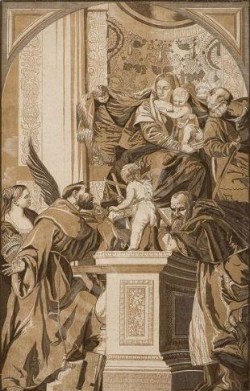 Si inserisce nell’itinerario Scopri il Veneto di Paolo Veronese con altre 5 mostre e 32 siti intitolati al grande artista del Cinquecento Veneto la mostra che i Musei civici di Bassano del Grappa dedicheranno a settembre alla fortuna di Veronese nella stampa “di traduzione.” Sarà così segnalata con larga evidenza l’enorme fama dell’artista e le capacità tecniche degli incisori di rendere con i tratti segnati sulla lastra la felicità e l’esuberanza del colore del Caliari.
La scelta di 58 fogli consente di riconoscere quasi tutti i capolavori del grande artista, alcuni irrimediabilmente perduti, opere riprodotte tra acqueforti e xilografie, tra la fine del Cinquecento fino a tutto il Settecento, a partire dalle acqueforti contemporanee di Agostino Carracci. Un paio di secoli più tardi, in pieno Neoclassicismo, la produzione più corrente dei Remondini non esita a tradurre nei segni fortemente inchiostrati la magniloquenza del disegno più che la felicità del colore, documentando per il mercato un artista la cui fama, complici il barocco e Tiepolo, non aveva mai visto flessioni.
Nella seconda metà del Settecento Giuseppe Remondini raccoglie una consistente collezione di incisioni a paragone, modello e supporto tecnico della produzione calcografica e tipografica della più grande stamperia dell’epoca, prima in Europa—è l’Encyclopédie a ricordarlo—per numero di addetti e quantità della produzione. Tale fondo, donato nel 1847 alla città dall’ultimo erede, Giambattista, è il nucleo fondante per il più recente tra gli antichi musei bassanesi—premio ICOM 2010—prezioso giacimento di questa e delle altre mostre che il Museo della stampa Remondini va via via proponendo dal 2007.
Posto d’onore in mostra per i legni xilografici incisi, con tecnica da lui inventata, dall’inglese John Baptist Jackson, tutti ceduti a Giuseppe Remondini, che saranno esposti assieme ad una selezione dei fogli da lui eseguiti sulle opere di Veronese. Una chicca che, in mezzo a stampe multiple, da sola vale il viaggio a Bassano, per gli addetti ai lavori e per chi vuole capire come le immagini si propaghino grazie alla forza espressiva delle immagini stesse.
Giuliana Ericani, ed., Veronese Inciso: Stampe da Veronese dal XVI al XIX Secolo (Naples: Arti Grafiche Zaccaria, 2014), 90 pages, ISBN: 978-8885821446, €10.
Writing for The Burlington 156 (December 2014), Xavier Salomon judges the catalogue “an essential contribution to the subject and complements Paolo Ticozzi’s catalogue of 1977” (p. 843).
Exhibitions Mark the 250th Birthday of the Hermitage

The river-god Ilissos. Marble statue from the West pediment of the Parthenon, Athens, Greece, 438–32 BCE (British Museum 1816,0610.99). Photo by Marie-Lan Nguyen, 2007, Wikimedia Commons.
◊ ◊ ◊ ◊ ◊
Founded by Catherine the Great in 1764, the Hermitage Museum celebrates its 250th anniversary this year (though it opened to the public only in 1852). In connection with events marking the occasion, The British Museum has loaned the marble Ilissos from the Parthenon—the first time a portion of the Elgin Collection has ever been loaned. The work will will be on display from 6 December until 18 January. The press release stresses the Enlightenment origins of both museums:
The British Museum opened its doors in 1759, just five years before the Hermitage. Sisters, almost twins, they are the first great museums of the European Enlightenment. But they were never just about Europe. The Trustees of the British Museum were set up by Parliament to hold their collection to benefit not only the citizens of Great Britain, but ‘all studious and curious persons’ everywhere. The Museum today is the most generous lender in the world, sending great Assyrian objects to China, Egyptian objects to India and Iranian objects to the United States—making a reality of the Enlightenment ideal that the greatest things in the world should be seen and studied, shared and enjoyed by as many people in as many countries as possible. . .
Noted (added 6 December 2014) — The AFP (Agence France-Presse) reports on Greek dissatisfaction with the loan, quoting a statement from Prime Minister Antonis Samaras: “The British Museum’s decision constitutes an affront to the Greek people.” The full article is available art Art Daily.

St Andrew Service, Germany, Meissen Manufactory, porcelain with overglaze painting, gilding, 1744–45 (The Hermitage State Museum)
◊ ◊ ◊ ◊ ◊
Also on view is this exhibition:
Gifts from East and West to the Imperial Court over 300 Years
State Hermitage Museum, St Petersburg, 3 December 2014 — 8 March 2015
The gifts from Eastern and Western countries presented at the exhibition in the General Staff Building reflect the history of Russia’s relations with the West and the East from 18th century till the fall of the Russian Empire.
The tradition of giving the diplomatic gifts had existed for centuries. They commemorated military victories, conclusions of peace, events important for the court and official visits. Presented to the Imperial court precious metal works, porcelain, arms, coins, tapestries, books, exotic objects, works of fine art are records of the history of Russia.
Exhibition | Remembering Radcliffe
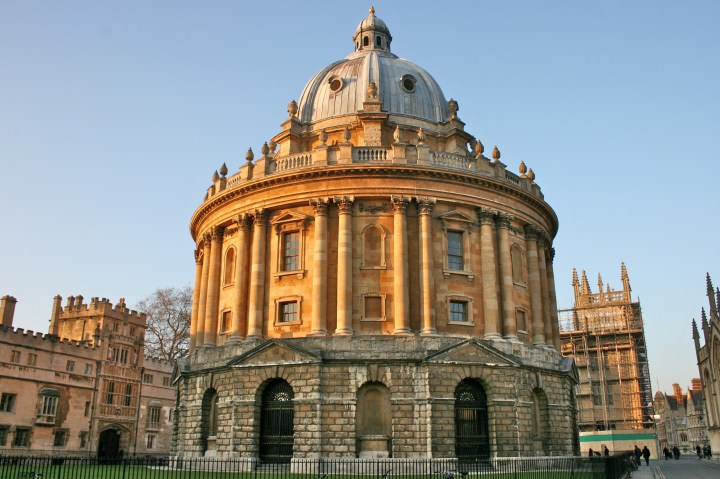
James Gibbs, Radcliffe Camera, Oxford, 1735–49
(Photo: Mike Peel, December 2007, Wikimedia Commons)
◊ ◊ ◊ ◊ ◊
From the Bodleian:
Remembering Radcliffe: 300 Years of Science and Philanthropy
Bodleian Library, Oxford, 28 November 2014 — 20 March 2015
Curated by Stephen Hebron
A new exhibition at the Bodleian Libraries explores the life and legacy of John Radcliffe, the doctor and philanthropist who gave Oxford some of its most iconic buildings. Remembering Radcliffe: 300 Years of Science and Philanthropy opens on 28 November and marks the 300th anniversary of the physician’s death.
 John Radcliffe (bap. 1650–1714) was the most successful doctor of his day and was sought after as a physician to the royal family. On his death he left the bulk of his fortune to charitable causes. With beautiful engravings, watercolours, and architectural drawings, the Bodleian’s free exhibition tells the story of the Oxford landmarks funded by Radcliffe’s legacy: the Radcliffe Camera (the first circular library in Britain), the Radcliffe Observatory, and the Radcliffe Infirmary (the precursor of the modern John Radcliffe Hospital). The exhibition also looks at Radcliffe’s ongoing legacy in the work of The Radcliffe Trust.
“This is a wonderful opportunity for people to learn more about this remarkable physician and philanthropist,” said Richard Ovenden, Bodley’s Librarian. “John Radcliffe’s legacy lives on today—not only in Oxford’s stunning buildings but through his legacy’s investment in scientific research and its support for UK heritage and crafts, and classical music performance and composition through The Radcliffe Trust.”
Exhibition Highlights
• Architectural designs by Nicholas Hawksmoor and James Gibbs for Dr Radcliffe’s Library, which later became the Radcliffe Camera, part of the Bodleian Library
• A 3D scale model of the Radcliffe Camera from 1735
• Rare and first edition books from the first collection of books housed in the Radcliffe Camera
• Early photographs and maps of Oxford including the buildings that bear Radcliffe’s name
• Watercolours, sketches, and engravings of the Radcliffe Camera, Radcliffe Observatory, and Radcliffe Infirmary
• Medical instruments, prescriptions, and records from Radcliffe’s medical career
• Letters, diary entries, and other materials related to Radcliffe’s life and death
• Silverware, stone carvings, and basket weavings produced by contemporary artists supported by The Radcliffe Trust
“The exhibition explains how an 18th-century doctor became one of Oxford’s greatest benefactors,” said curator Stephen Hebron. “Visitors can discover the story behind one of Oxford’s most famous buildings, the Radcliffe Camera, including its origins, its design, how it was built, and its role as a university library.”
On his death in 1714 Radcliffe left the bulk of this fortune to the University of Oxford, including £40,000 for the construction of the Radcliffe Camera, funds for an extension to University College and provision for two travelling fellowships in medicine. He stipulated that the residue of his estate be used for charitable purposes, forming the basis of The Radcliffe Trust. The Trust continues to this day and supports classical music performance and training as well as the UK’s heritage and crafts sector. To celebrate their tercentenary, The Radcliffe Trust has generously supported the Bodleian Libraries’ Remembering Radcliffe exhibition.
“If the amazing Dr Radcliffe had done no more than create the Radcliffe Camera as a monument to his memory this would have been an extraordinary achievement,” said Felix Warnock, Chairman of The Radcliffe Trust. “As it is, his endowment of The Radcliffe Trust was if anything even more visionary: the Trust, one of the very first grant-making charities, now stands on the threshold of a remarkable fourth century of philanthropic giving. We welcome you to the exhibition and accompanying events and hope you leave enriched and inspired by this truly original and remarkable benefactor.”
◊ ◊ ◊ ◊ ◊
Distributed by The University of Chicago Press:
Stephen Hebron, Dr Radcliffe’s Library: The Story of the Radcliffe Camera in Oxford (Oxford: Bodleian Library, 2015), 104 pages, ISBN: 978-1851244294, $25.
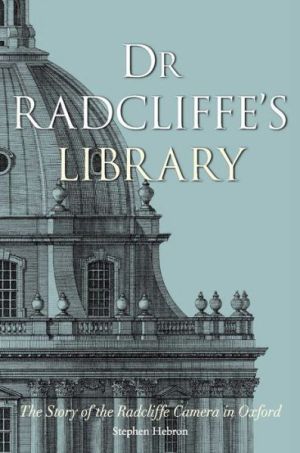 The Radcliffe Camera is one of the most celebrated buildings in Britain. Named for the physician John Radcliffe—who directed a large part of his fortune to its realization at the heart of the University of Oxford in the early eighteenth century—the circular library is instantly recognizable, its great dome rising amidst the Gothic spires of the university. Drawing on maps, plans, photographs, and drawings, Dr Radcliffe’s Library tells the fascinating story of the building’s creation over more than thirty years. Early designs for the Radcliffe Camera were drawn by the brilliant architect Nicholas Hawksmoor, who conceived the shape so recognizable today: a great rotunda topped by the University of Oxford’s only dome. From there, it would take decades to acquire and clear the site between the University Church of St Mary’s and the Bodleian. After Hawksmoor’s death, the project was taken on by the Scottish architect James Gibbs who refined the design and supervised the library’s construction. Published to accompany an exhibition opening in November at the Bodleian Library, Dr Radcliffe’s Library tells the fascinating story of the making of this architectural masterpiece.
Stephen Hebron is a curator working in the Department of Special Collections at the Bodleian Libraries. He is the author, most recently, of Marks of Genius: Masterpieces from the Collections of the Bodleian Libraries.
Cooper Hewitt to Reopen on December 12th

With the newly renovated Cooper Hewitt opening December 12th, you’ll have to visit the museum’s website to make sense of it all, everything from a specially commissioned typeface (Cooper Hewitt, which you can download for free here) to an interactive pen. I’ve noted one exhibition below, but presumably there are lots of eighteenth-century attractions. –CH
From Cooper Hewitt:
 Caroline Baumann, director of Cooper Hewitt, Smithsonian Design Museum (formerly Cooper-Hewitt, National Design Museum), has announced plans for the opening of the renovated and restored Carnegie Mansion and the 10 exhibitions that will inaugurate the revamped and expanded gallery spaces. The nation’s only museum devoted exclusively to historic and contemporary design, Cooper Hewitt will open its doors to the public on Friday, December 12. The museum will boast 60 percent more gallery space to present its important collection and temporary exhibitions and will offer an entirely new and invigorated visitor experience, with interactive, immersive creative technologies.
Cooper Hewitt’s renovation provides the opportunity to redefine today’s museum experience and inspire each visitor to play designer before, during and after their visit. Visitors will explore the museum’s collections and exhibitions using groundbreaking technologies that inspire learning and experimentation. This new participatory experience is specifically designed to engage all audiences—students, teachers, families, young children, designers and the general public.
All visitors will be given a newly developed interactive Pen to collect and create. They will be able to digitally collect design objects on view, as well as additional objects from the ultra-high-definition interactive tables. Visitors will become designers in their own right by creating their own designs with the Pen. Symbolizing and embodying human creativity, the Pen is a key part of every visitor’s experience. With it, they will be able to record their visit, which can be viewed and shared online and supplemented during future visits. . .
The largest initiative in Cooper Hewitt’s history, the renovation and expansion of the entire campus on New York’s Museum Mile—the Carnegie Mansion, Arthur Ross Terrace and Garden and the museum’s two townhouses on East 90th Street—have been achieved through a successful $91 million capital and endowment campaign.
“With four floors of exhibition galleries that can now stay open 12 months of the year, free garden access, extended garden and café hours, an inviting new street entrance and the digitization of our collections, Cooper Hewitt will reach a broader audience and be more accessible than ever before,” said Baumann. “We have created a 21st-century museum that will bring our collections to life and make design even more relevant and exciting to today’s audiences, while continuing to respect the history of this museum and the integrity of the much-treasured Carnegie Mansion.”
In addition to Cooper Hewitt’s physical transformation, the museum now has a new name, graphic identity, website and custom typeface. Formally the “Cooper-Hewitt, National Design Museum,” the museum has been renamed “Cooper Hewitt, Smithsonian Design Museum,” emphasizing the museum’s heritage. The museum has taken on a bold new graphic identity designed by Pentagram and the typeface “Cooper Hewitt” designed by Chester Jenkins of Village [available for free download here; see Michael Silverberg’s discussion here] . . . .
◊ ◊ ◊ ◊ ◊
About The Models & Prototypes Gallery:

Staircase model, France, late 18th century; Joined, bent and carved pear, wrought brass wire; 75 x 67.3 x 67 cm (NY: Cooper Hewitt, Smithsonian Design Museum; photo by James Hart)
This new second-floor gallery will be home to rotating installations showcasing the important role of design models and prototypes. For the opening installation, the gallery will present the exceptional 18th- and 19th-century models of staircases and some significant architectural models donated to Cooper Hewitt by Eugene V. and Clare E. Thaw (16 models altogether with four accompanying drawings).
The models represent a range of design styles and techniques, but most of the staircase models were designed in the compagnonnage tradition. Compagnonnage, meaning ‘group of companions’, is a type of design practice that combined formal study with practical training from masters. Apprentices honed their skills in a workshop during the day, taking courses in the art of geometrical drawing and design in the evening, living together in a boarding house. First, concepts were taught, then the handiwork, both of which became increasingly sophisticated. Each successful member made a ‘tour de France’, working and studying under masters in major cities. At each stage of the learning process (acceptance, reception, mastership), apprentices created models, leading them to become masters of their craft and design. Most of the staircase models produced in this tradition were made by masters of woodworking—joiners, cabinetmakers, and/or carpenters.
Exhibition | Marks of Genius: Drawings from the MIA
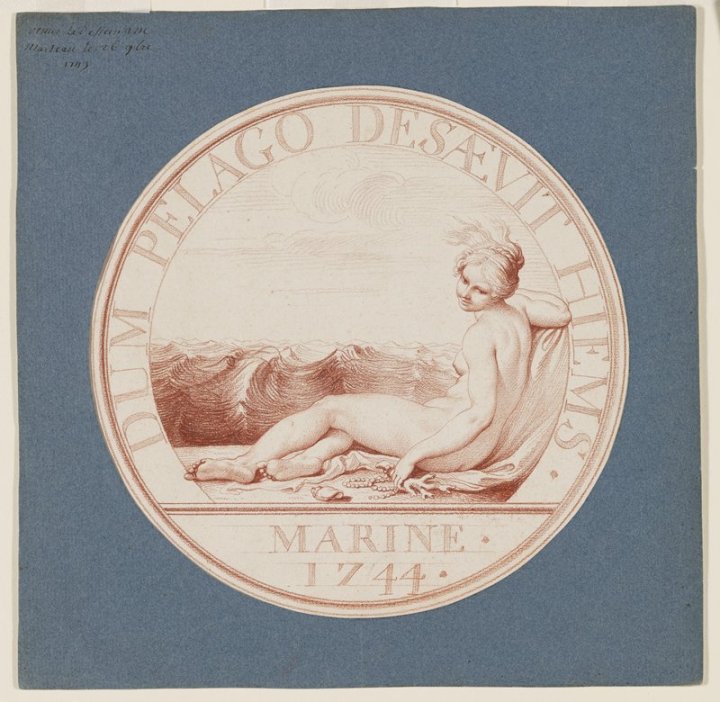
Edme Bouchardon, Design for a Token: Marine, 1744,
ca. 1743, red chalk (Minneapolis Institute of Arts)
◊ ◊ ◊ ◊ ◊
Press release (7 May 2014) from the MIA:
Marks of Genius: 100 Extraordinary Drawings from the Minneapolis Institute of Arts
Minneapolis Institute of Arts, 13 July — 21 September 2014
Grand Rapids Art Museum, 26 October 2014 — 18 January 2015
North Carolina Museum of Art, Raleigh, TBA
Joslyn Art Museum, Omaha, Nebraska, TBA
Curated by Rachel McGarry
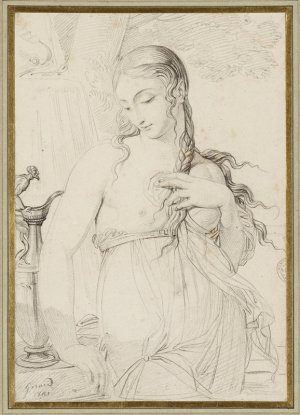
Louis Lafitte, Young Woman in Classical Dress, Study for the Month of Thermidor, ca. 1804–05, black chalk, partially incised (Minneapolis Institute of Arts).
This summer, the Minneapolis Institute of Arts (MIA) showcases an exemplary selection of its rarely seen, superb drawings collection in Marks of Genius: 100 Extraordinary Drawings from the Minneapolis institute of Arts. This special exhibition marks the first time this selection of drawings, which spans over 500 years, will be seen together by the public. Featured artist include celebrated masters such as Ludovico Carracci, Guercino, Thomas Gainsborough, Eugène Delacroix, Edgar Degas, Gustav Klimt, Egon Schiele, René Magritte, and Georgia O’Keeffe. Marks of Genius opens at the MIA and will then travel to the Grand Rapids Art Museum in Michigan, the North Carolina Museum of Art, Raleigh, and the Joslyn Art Museum in Omaha, Nebraska. A fully illustrated catalogue.
“Due to their sensitivity to light, drawings are exhibited for only short periods of time and are otherwise kept in dark storage,” says exhibition curator Rachel McGarry. While works from the museum’s large paper collection—over 40,000 prints and drawings—can be seen by appointment in the Herschel V. Jones Print Study, Marks of Genius is a rare opportunity for the public to see the cream of this collection.

Nicolas-Bernard Lépicié, Standing Male Nude, 1760s–80s, red chalk (Minneapolis Institute of Arts)
Marks of Genius is exhibited at an apropos time. The MIA’s ‘treasury’ of drawings, which includes over 2,600 works, has increased by 20 percent since 2009. Several of these recent additions will be on view for the first time in this show. The exhibition brings to life the immediacy of drawings and explores its multiple roles as a means of study, observation, problem solving, a record of the artist’s imagination, and a medium for creating finished works of art.
The thematic display highlights these different aspects of drawing:
• Spark of Creation features ‘first draft’ sketches and inventions. This portion of the exhibition, showcasing the immediacy of the artistic process, features works such as Giuseppe Bazzani’s Pan and Syrinx, c. 1760, and George Romney’s Study for ‘The Lapland Witch,’ completed c. 1775–77.
• From Life is a section which features various observational studies drawn from nature throughout history. Notable works include Käthe Kollwitz’s c. 1903 Two Studies of a Woman’s Head and Pierre-Joseph Redouté’s Amaryllis lutea. c. 1800-06.
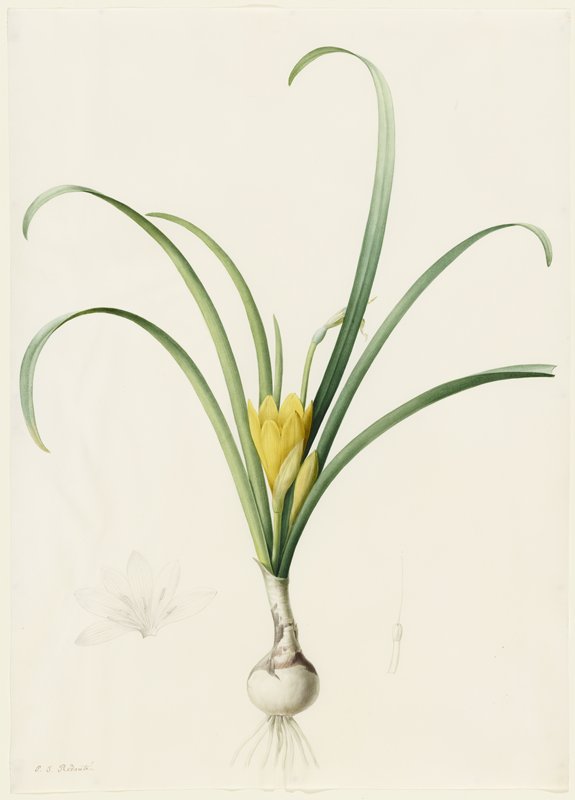
Pierre-Joseph Redouté, Amaryllis lutea, ca. 1800–06, watercolor and graphite on vellum (Minneapolis Institute of Arts)
• Portrait Drawings presents works such as Lovis Corinth’s Self-Portrait completed in 1908 and Egon Schiele’s Standing Girl, c. 1910.
• Figural Abstraction a section which documents artists’ studies of human forms and expression. Works featured in this section include Guercino’s Hercules, (1641–42) and Ernst Kircher’s Seated Woman in the Studio, completed in 1909.
• Storytelling presents drawings with a narrative theme, such as Arthur Rackham’s Little Red Riding Hood, 1909, and Ludovico Carracci’s Judith Beheading Holoferenes, c. 1581–85.
• Other themes include Sense of Place with Emil Nolde’s Heavy Seas at Sunset, c. 1930–35, and Appropriation with Roy Lichtenstein’s 1962 Bratatat!
◊ ◊ ◊ ◊ ◊
From the MIA@Artbook:
Rachel McGarry and Thomas Rassieur, Master Drawings from the Minneapolis Institute of Arts (Minneapolis: Minneapolis Institute of Arts, 2014), 300 pages, ISBN: 978-0989371841, $60.
 This lavishly illustrated book presents one hundred significant drawings from the 15th to the 21st century, including new discoveries and works by both celebrated masters and others who deserve to be better known. Among the artists represented are Annibale and Ludovico Carracci, Guido Reni, Giovanni Domenico Tiepolo, Antoine Watteau, Jean-Honoré Fragonard, Pierre-Paul Prud hon, Thomas Gainsborough, George Romney, Edgar Degas, Henri Matisse, Lovis Corinth, Ernst Ludwig Kirchner, Käthe Kollwitz, Otto Mueller, Emil Nolde, Egon Schiele, Edward Hopper, John Marin, Grant Wood, Roy Lichtenstein, Jasper Johns, Andy Warhol, and Edward Ruscha.
Catalogue entries for each drawing include complete documentation, provenance, and bibliography. The text provides important new scholarship and attributions; examines a variety of themes, such as connoisseurship, patronage, materials and techniques, watermarks, and collectors’ stamps; and discusses how a work fits into the artist’s oeuvre or represents larger developments in artistic movements or trends in artistic production










 Enfilade
leave a comment