Exhibition | Rubens and His Legacy

François Boucher, Pan and Syrinx, 1759
(London: National Gallery)
◊ ◊ ◊ ◊ ◊
Press packet from BOZAR:
Sensation and Sensuality: Rubens and His Legacy
BOZAR (Centre for Fine Arts), Brussels, 25 September 2014 — 4 January 2015
Royal Academy of Arts, London, 24 January — 10 April 2015
Peter Paul Rubens was one of the most innovative painters in the history of art. His impact on subsequent generations has been immense. For the first time, the Royal Museum of Fine Arts Antwerp (KMSKA), the Royal Academy of Arts in London, and BOZAR in Brussels have joined forces to look at Rubens as a role model. The exhibition Sensation and Sensuality: Rubens and his Legacy brings together some 160 works, including some iconic paintings by Rubens himself and, more particularly, works by his artistic heirs.
It is a paradox that Peter Paul Rubens (1577–1640) is both inimitable and has served, for four centuries now, as the great model for painters such as Rembrandt, Murillo, Watteau, Fragonard, Gainsborough, Reynolds, Delacroix, Cézanne, Renoir, Kokoschka, and many others, often far beyond the frontiers of Europe. Even in the work of Picasso, we encounter his visual language. The international exhibition Sensation and Sensuality: Rubens and His Legacy looks at this phenomenon and brings works by these celebrated artists to the world-renowned Flemish master’s homeland.
Sensational and Sensual

Thomas Gainsborough, after Rubens, The Descent from the Cross, 1766–69 (Sudbury: Gainsborough’s House)
Many Rubens works are sensational: loud, forceful, and sometimes violent, created in the service of Catholic propaganda and of absolutist rulers. With his almost cinematographic depiction of aggression, fighting, and barbaric scenes, Rubens could be called the Quentin Tarantino of his time. But he is also a sensual painter in his informal family portraits, landscapes and pastoral scenes, peasant dances and gardens of love, in which he was a precursor of Rococo, Romanticism, and Impressionism. Rubens was so many-sided that he appealed to artists of every nationality. Their interest was often selective. Spaniards preferred his religious works. The English were inspired by his portraits and landscapes. French painters were attracted, above all, by the eroticism and poetry in his work. German and Austrian artists admired his vitality and vigour. A great many talented artists were captivated by his use of composition, colour, and technique and developed flourishing careers by following his example. After meeting Rubens, Velázquez began to paint in a different way;
following his counsel, he used a lighter undercoat.
160 Works of Art, 6 Themes
The Sensation and Sensuality exhibition presents more than 160 works of art and takes the visitor through six fascinating themes that explore different aspects of life and of the painter’s art: violence, power, lust, compassion, elegance, and poetry. Each of these chapters demonstrates the links between masterpieces by Rubens and the work of artists who came after him. The Tiger Hunt from the Musée des Beaux-Arts in Rennes hangs alongside the Delacroix Lion Hunt from Stockholm and the voluptuous Pan and Syrinx from the Gemäldegalerie in Kassel alongside Boucher’s work of the same name from the National Gallery in London; the portrait of Marchese Maria Grimaldi and Her Dwarf from Kingston Lacy is juxtaposed with A Genoese Noblewoman and Her Son from Washington, by Rubens’s famous pupil van Dyck; and Manet’s Rubens pastiche Fishing from the Metropolitan Museum in New York can be seen alongside The Bacchanalia on Andros by Rubens, from the Nationalmuseum in Stockholm.
The 20 paintings, 6 oil sketches, 8 drawings, and 10 prints by Rubens himself are presented in a dialogue with works by his artistic heirs, including Böcklin, Carpeaux, Constable, Corinth, Coypel, Daumier, Delacroix, Fragonard, Gainsborough, Géricault, Jordaens, Klimt, Kokoschka, Le Brun, Makart, Murillo, Picasso, Rembrandt, Renoir, Reynolds, Sandrart, Turner, Watteau, and others.
Prestigious Loans
Exceptionally, one of the jewels of the Prado collection in Madrid, Rubens’s Garden of Love, will travel to Brussels, where it will be brought together with preparatory sketches from the Amsterdam Museum and two drawings that Rubens made of his painting for a superb print (Metropolitan Museum, New York). Bringing these pieces together allows us to see how this famous composition took shape, from idea to reproduction. As well as those already mentioned, major foreign lending institutions contributing include Tate Britain (London), the Neue Pinakothek (Munich), the Nasjonalgalleriet (Oslo), Her Majesty Queen Elizabeth II, and a number of private collections.
International Cooperation
Sensation and Sensuality is an exhibition organised by the Royal Museum of Fine Arts Antwerp (KMSKA), the Royal Academy of Arts, London, and BOZAR (Centre for Fine Arts), Brussels. After the show at the Centre for Fine Arts Brussels the exhibition will travel to the Royal Academy of Arts in London (24.01 – 10.04.2015)
Multidisciplinary Programme
This autumn, BOZAR pays homage to Rubens and shows how the Antwerp master has also inspired artists in other artistic disciplines.
BOZAR MUSIC is presenting a concert series, The Musicall Humors of Rubens, with music of the painter’s time; the highlight will be the concert on 6 December 2014, The Ear of Rubens, performed by the Huelgas Ensemble. Besides, BOZAR MUSIC and Ricercar (Outhere) present a CD with examples of the major musical genres that Rubens would have heard during his travels in Europe.
BOZAR LITERATURE has invited six writers—David Bosch, Annemarie Estor, Lydia Flem, Peter Holvoet-Hanssen, Pjeroo Roobjee, and Jean-Philippe Toussaint—to draw inspiration from a work by Rubens: you can read the results in the visitor’s guide or listen to them on a videoguide.
BOZAR CINEMA, moreover, is screening the art film that Henri Storck made about Rubens in 1948. There will also be two multimedia installations on show during the BOZAR NIGHT and the BEAF: Ingrid Van Wantoch Rekowski will present her video installation Rubens-Metamorfoses during the BOZAR NIGHT (10 November 2014); during the BEAF (25–27 September 2014), the video artist Quayola will show his installation Strata #4, a—literally—penetrating look at the great altarpieces of Rubens and van Dyck via high-resolution images.
◊ ◊ ◊ ◊ ◊
From
Tim Barringer, Arturo Galansino, Gerlinde Gruber, and Nico van Hout, David Howarth, and Alexis Merle du Bourg, Rubens and His Legacy (London: Royal Academy Publications, 2014), 352 pages, ISBN: 978-1907533778, $75.
 Peter Paul Rubens (1577–1640) is undoubtedly the most influential of all Flemish painters. Himself indebted to Titian, Rubens became a role model to Van Dyck, Rembrandt, and Velázquez, and influenced artists well beyond his time, including figures such as Cézanne, Picasso, Bacon, and Freud. This sumptuous new volume explores Rubens’s legacy thematically, through a series of sections devoted to violence, power, lust, compassion, elegance, and poetry. Each section will link artists across the centuries in their references to Rubens, from Van Dyck and Watteau to Manet, Daumier, Renoir, and Van Gogh, as well as Gainsborough, Constable, and Turner.
Tim Barringer is Paul Mellon Professor of the History of Art at Yale University. Arturo Galansino is curator at the Royal Academy of Arts, London. Gerlinde Gruber is curator for Flemish Baroque paintings at the Kunsthistorisches Museum in Vienna. Nico van Hout is a member of the collections research team at the Royal Museum of Fine Arts Antwerp. David Howarth is professor of history of art at the University of Edinburgh. Alexis Merle du Bourg is an art historian and a Rubens specialist.
Exhibition | The Diligent Needle
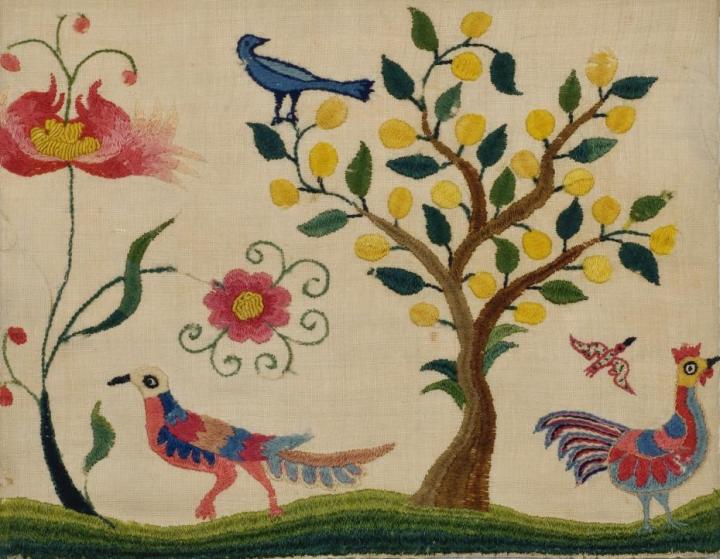
Needlework picture, 1750–1800
(Winterthur: Gift of Henry Francis du Pont 1961.1697)
◊ ◊ ◊ ◊ ◊
Now on view at Winterthur:
The Diligent Needle: Instrument of Profit, Pleasure, and Ornament
Winterthur, Wilmington, Delaware, 23 August 2014 — 5 July 2015
For centuries, instruction in needlework was an important part of women’s education. Both plain sewing and fancy embroidery are skills that take considerable time and effort to acquire, and as a result, many women took great pride in their work. Women might use their skill to earn a living through teaching or sewing, to create objects of beauty for themselves and for others, or to embellish clothing and household furnishings. This exhibition showcases the evolution of needlework and the prominent role it played in women’s lives during the 17th through 19th centuries. It opens with the diligence and skill required to learn and excel at needlework and delves into the various applications of the skill with sections on diligence, profit, pleasure, and ornament, featuring stunning visual examples:
Diligence
Samplers diligently worked on in day and boarding schools are the best documented examples of a girl’s education, but needlework skills were also learned at home, where women of all ages too part in the needlework activities of the household.
Profit
Women could use their skill with a needle to generate extra income or support themselves and their families. Some women, known as mantua makers, milliners or tailoresses, created fine dresses and other clothing, others taught embroidery or offered their skill in decorating clothing and furnishings, while others used the skill for plain sewing, mending and hemming.
Pleasure
Not everyone loved embroidery, but those who did would continue to develop their skill and artistry throughout their life.
Ornament
Those skillful with a needle often used their talent to embellish their own clothing, accessories, and textile furnishings.
Exhibition | Out of the Ordinary: Living with Chinese Export Porcelain
From Jorge Welsh:
Out of the Ordinary: Living with Chinese Export Porcelain
Jorge Welsh, London, 1–8 November 2014
Jorge Welsh, Lisbon, 14 November — 6 December 2014
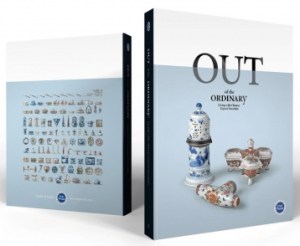 The exhibition Out of the Ordinary: Living with Chinese Export Porcelain will take place at the newly refurbished London gallery from the 1st of November, coinciding with the late night opening of Asian Art in London. The exhibition then travels to our Lisbon gallery, where it will be on view from the 14th of November until the 6th of December.
The exhibition and catalogue will focus on the most unusual forms of Chinese export porcelain produced in the late 17th and 18th centuries. Truly out of the ordinary, most of these items were copied from Western prototypes made in metal, wood, ceramics or glass. Jorge Welsh will present more than 100 objects including egg cups, strainers, cutlery handles, pudding moulds, custard pots, ladles, funnels, bulb pots, snuff boxes, cane handles, barber’s bowls and chamber pots, amongst others. Commissioned according to the latest fashions, they provide an insight into the scope of the European orders and the sophistication of contemporary consumer society in Europe at this time.
Out of the Ordinary: Living with Chinese Export Porcelain (London: Jorge Welsh Books, 2014), 344 pages, ISBN 978-0957354715, £100.
Exhibition | In Plain Sight: Discovering the Furniture of Nathaniel Gould
Press release (15 September 2014) from PEM:
In Plain Sight: Discovering the Furniture of Nathaniel Gould
Peabody Essex Museum, Salem, MA, 15 November 2014 — 29 March 2015
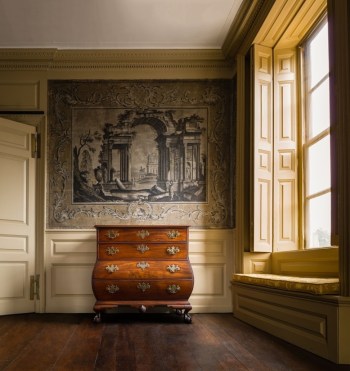
Chest of Drawers, 1758–66, attributed to Nathaniel Gould. Marblehead Historical Society and Museum. Photographed in the Jeremiah Lee Mansion (ca. 1766–68), 170 Washington Street, Marblehead. © 2014 Peabody Essex Museum. Photo by Dennis Helmar Photography.
At the dawn of the American Revolution in a city bustling with trade, politics and commerce, a craftsman of unusual ability was working tirelessly to create fine furniture for his wealthy patrons. Nathaniel Gould (1734–1781) established one of the region’s most sought-after workshops, producing thousands of technically sophisticated and aesthetically refined works for clients at home and for export. With an astute business sense, Gould thrived in one of the most tumultuous political and economic eras in American history. Despite all of this, until recently, Gould’s life and legacy was largely unknown. Masterworks sat in anonymity in the halls of major museum collections, unsigned by their maker and identified only vaguely by their geographic origin. In 2006, everything changed.
In the vaults of the Massachusetts Historical Society, among the records of Gould’s estate lawyer, researchers discovered documents that cast fresh light on—and forever enhance our understanding of—American furniture history. Three of Gould’s bound ledgers kept between 1758 and 1783 document in detail the production of almost 3,000 pieces of furniture in his Salem workshop. Painstaking analysis has revealed the identity, preferences, and transactions of more than 500 of Gould’s patrons as well as the names of his journeymen and probable apprentices. This veritable data dump of information has led museums, antique collectors, and the general public to examine their collections with fresh eyes and piqued interest. Works whose significance was obfuscated by the passage of time and lack of provenance are now being reconsidered and reappraised.
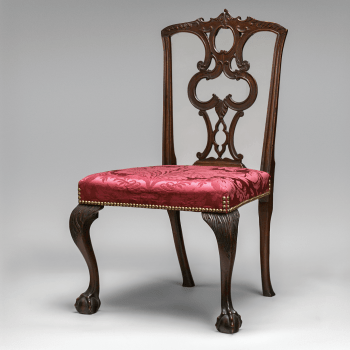
Attributed to the shop of Nathaniel Gould, Side Chair, 1770. Mahogany, maple, birch, and pine, 39 x 21 x 21 inches (NY: The Metropolitan Museum of Art: Gift of Mrs. Paul Moore, 39.88.2)
In Plain Sight: Discovering the Furniture of Nathaniel Gould—on view at PEM from November 15, 2014, through March 1, 2015—is the first exhibition to definitively unpack this discovery and describe the signature characteristics of Gould’s work. In Plain Sight also invites exploration into the life, times and social mores of early America through the lens of one of the country’s earliest and most successful woodworkers. Stately desks, bombé chests, and scalloped-top tea tables made of the finest imported mahogany are presented alongside paintings, archival materials, decorative arts, and an interactive workbench and desk provide insight into the makers and consumers of 18th-century American design and culture. The exhibition is accompanied by an exquisite publication of photographs and detailed essays from PEM curators and principal researchers Kemble Widmer, Joyce King, and Betsy Widmer.
“Possessing extraordinary woodworking skills and a refined sense of design, Gould created works that rank among the finest produced in 18th-century New England,” says Dean Lahikainen, PEM’s Carolyn and Peter Lynch Curator of American Decorative Art. “This jewel-like exhibition celebrates the best of Gould’s furniture in a format that invites contextual exploration and rewards close looking.”
Gould’s work is distinguished by its careful attention to graining, distinctive carved ball-and-claw feet, extended knee returns, and superbly carved pinwheels and scallop seashells. Clients could choose from a range of design forms, including desks and chests of drawers, tables, chairs, beds, and miscellaneous pieces, such as cradles, coffins, and fire screens. Gould built his career on his ability to translate London’s latest designs—sometimes gleaned from British pattern books, including Thomas Chippendale’s The Gentleman and Cabinet-Makers Director—into a more conservative style that pleased the tastes of the region’s wealthy elite.
The Gould ledgers reveal a high percentage of domestic furniture produced to fill wedding orders, mostly from members of the merchant class. Within a highly competitive social environment, newlywed couples aspired (as they do today) to own status symbols that communicated the family’s wealth and social position.
At the time, Salem was the hub of coastal trade and, as the ever-wise businessman, Gould saw opportunity. His ledgers reveal 616 pieces of furniture that were sold in the Caribbean and of this inventory, 62 percent were desks, half of which were made of cedar—an aromatic wood prized for its ability to deter insects in the semitropical regions. Gould’s participation in the export business also allowed him to become Salem’s principal importer of cedar and mahogany logs and allowed him to reserve the best pieces for his own magnificent workshop.
◊ ◊ ◊ ◊ ◊
From Giles:
Kemble Widmer and Joyce King with essays by Dean Lahikainen, Glenn Adamson, Daniel Finamore, and Elisabeth Garrett Widmer, In Plain Sight: Discovering the Furniture of Nathaniel Gould (London: Giles, 2014), 284 pages, ISBN: 978-1907804335, £45 / $70.
 In Plain Sight: Discovering the Furniture of Nathaniel Gould is the stunning result of happy accident and indefatigable, dedicated research. In the field of early American furniture made in Massachusetts, Nathaniel Gould has loomed as something of a mystery—believed to have been prolific, handsomely skilled, and exceptionally enterprising, yet considered elusive because of a scarcity of known works, lack of documentation, and difficulties of attribution. Accident—the unexpected discovery of Gould’s day books and account book in the collection of the Massachusetts Historical Society—and analysis—painstaking and inductive—have produced an invaluable, multifaceted case study.
This book establishes Gould unquestionably as Salem’s leading cabinetmaker before and during the period of the American Revolution. He made substantial and often expensive furniture, including case pieces of bombé form embellished with carving. The number of works that can be attributed to Gould remains small, but the foundation for increasingly assured connoisseurship lies within these pages and Gould’s archival records. The scale of his workshop, his impressively large, diverse clientele, and his successes in Salem’s furniture export trade attest to his achievements as an entrepreneur.
This book illuminates not only a particular individual, but the Salem/Boston/New England spheres in which Gould operated during a tumultuous time in American history. The scrupulously recorded notations in his ledgers are precious clues to emerging concepts of style and taste, cultural mores, business practices, socio-economic circumstances, and familial histories with local, regional, and national relevance. In Plain Sight presents a choice array of forms confidently assigned to Gould’s shop and makes accessible the ledgers themselves, meticulously analyzed and interpreted to facilitate present and ongoing scholarship regarding Nathaniel Gould, Salem, early New England furniture, and colonial America.
Kemble Widmer has applied his training and career as an industrial engineer to his examination of early furniture in Boston and Essex County, Massachusetts. Over twenty-five years, by rigorously documenting and comparing like forms, he has determined places of origin and even individual craftsmen. His research on Nathaniel Gould has disclosed an unparalleled amount of information about cabinetmaking, customers, and colonial life. Joyce King, an eleventh generation inhabitant of Salem, Massachusetts, is an expert in genealogical research. She has collaborated closely with her co-author on numerous issues of provenance that have enabled attributions of furniture to Nathaniel Gould. Glenn Adamson, formerly Head of Research, Victoria and Albert Museum, London, is The Nanette L. Laitman Director of the Museum of Arts and Design, New York. He is the founding co-editor of The Journal of Modern Craft and the author of Inventing Modern Craft. Daniel Finamore is The Russell W. Knight Curator of Maritime Art and History at the Peabody Essex Museum, Salem, Massachusetts. Dean Lahikainen is The Carolyn and Peter Lynch Curator of American Decorative Art at the Peabody Essex Museum, Salem, Massachusetts. His publications include Samuel McIntire: Carving an American Style and In the American Spirit: Folk Art from the Collections of the Peabody Essex Museum. Elisabeth Garrett Widmer, formerly director of Sotheby’s American Arts course and a Senior Vice President at Christie’s, New York, and director of Classes in Connoisseurship, is an authority on American eighteenth- and nineteenth-century decorative arts and social history. Her publications include At Home: The American Family, 1750–1870.
Exhibition | Tables from the Great Gallery of The Wallace Collection
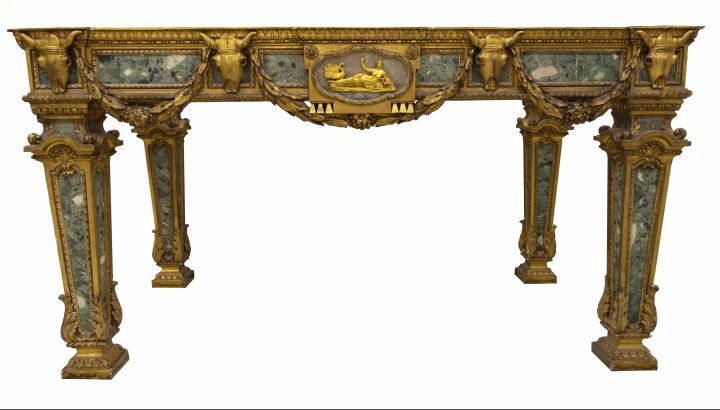
Pier table, Italy, ca. 1770 (London: The Wallace Collection)
A high resolution image is available here»
◊ ◊ ◊ ◊ ◊
Now on at The Wallace:
Collaboration, Conservation and Research: Furniture from the Great Gallery
The Wallace Collection, London, 19 September 2014 — 27 September 2015
Two pairs of monumental tables have been on display in the Great Gallery for more than a century. The recent Great Gallery refurbishment project provided the perfect opportunity for all four tables to undergo full cleaning and conservation treatment. To address the treatment needs of the tables, the Wallace Collection teamed up with Buckingham New University, City and Guilds of London Art School and West Dean College and several students undertook the work as an integral part of their degree course. Now, some two years later, the tables have returned from treatment and look stunning in their former locations, much as they would have looked in Sir Richard Wallace’s day.
During the course of their treatment conservators and curators were able to analyse the tables forensically, discovering, for example, that the two in the centre of the gallery (F510-511) are not in fact a pair, instead one is a later copy of the other. To learn more about our new findings, as well as the techniques which the students used in their conservation work on these and the pair of pier tables (F514-515), come and visit the display from 19 September in the Conservation Gallery at the Wallace Collection.
T A L K S
All talks start at 1pm in the Conservation Gallery.
Monday, 22 September: John Slight, a former student from Bucks New University, will discuss the treatment of a grand nineteenth-century Italian table.
Monday, 20 October: Hans Thompson, a former student from City and Guilds of London Art School, will discuss the treatment of the Italian eighteenth-century Pier table.
Thursday, 20 November: Kate Aughey, a former student from West Dean College, will discuss the treatment of the Italian eighteenth-century Pier table.
Monday, 8 December: Dr. Marina Sokhan, Head of Conservation at City and Guilds of London Art School, will discuss the treatment of the Italian eighteenth-century Pier table as well as the conservation course at City and Guilds of London Art School.
Exhibition | Birth of Design, Furniture Masterpieces, 1650–1789
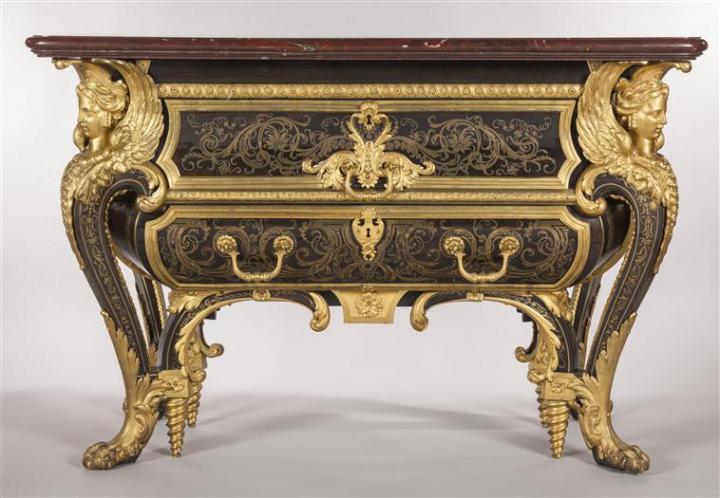
André-Charles Boulle, Louis XIV’s commode; made of resinous wood, ebony veneer, tortoiseshell and bronze inlay, gilt bronze, griotte marble; Paris, 1708, H. 88 x 131 x 65 cm (Versailles, National Museum of the Palaces of Versailles and Trianon; Inv. VMB 14279.1)
◊ ◊ ◊ ◊ ◊
From the Château de Versailles:
Eighteenth Century, Birth of Design, Furniture Masterpieces, 1650–1789
18e, aux sources du design, chefs-d’œuvre du mobilier 1650 à 1790
Château de Versailles, 28 October 2014 — 22 February 2015
From 28 October 2014 to 22 February 2015, the Palace of Versailles is hosting the exhibition 18th Century, Birth of Design, Furniture Masterpieces from 1650 to 1790 in the Africa and Crimea Rooms. The exhibition offers a glimpse of the ingenuity of a bygone era viewed from a present-day perspective and showcases the innovative and avant-garde nature of the shapes, techniques, decorations, and materials used in 18th-century furniture. The exhibition includes around 100 major works from collections at the Palace of Versailles, the Louvre Museum, the Musée des Arts Décoratifs, the Palace of Fontainbleau, and the Getty Museum, alongside works from private collections which will be on show to the public for the first time. Cabinets, desks, writing tables, commodes, and console tables, but also sofas, armchairs, folding chairs, and seating chairs will testify to the revolution that the 18th century brought about in the history of furniture, a reflection of the evolving tastes of a society enamoured by modernity and wanting to live in comfort and luxury.
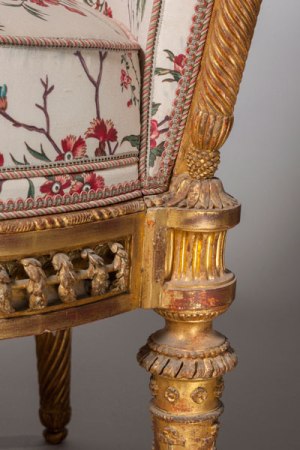
Jacques Gondoin and François II Foliot, Chair from the Pavillon du Rocher at the Petit Trianon; carved, gilded beech; 1781, 89 x 56 x 56 cm (Versailles, National Museum of the Palaces of Versailles and Trianon, Inv. V 5358)
Concept of Design
In 1712, Shaftesbury introduced the term and concept of design to art theory. It contains the dual meaning of ‘plan’ and ‘intention’ and unifies the processes of conceiving and shaping a work. For the first time, furniture was planned with forethought, created with specific intention and shaped for both functionality and comfort. 18th-century furniture was produced according to design sources, both in its overall conception and its quest for harmony between form and function.
The Transformation of Furniture
The quest for the ideal shape and form hit its peak in the 18th century, when the shape of furniture began to change. Inventiveness and creativity abounded and new outlines began to take shape, from console tables to commodes to secretary and armoire desks. Rigid outlines began to soften, then morphed into rounded curves, subsequently giving way to curved legs—sometimes four, six or even eight of them. Furniture became multi-purpose and featured mechanisms that allowed it to transform into something else.
Boldness of Materials and Colours
The same quest characterised the use of materials: furniture was covered with exotic woods, lacquers, varnishes, tortoiseshell, mother-of-pearl, bronze, brass, lead, porcelain, straw, steel and stone marquetry. Cloth, bulrush and copper began to be used in chairs. Long before the garish colours afforded by plastic in the 20th and 21st centuries, the 18th century saw the birth of furniture in red, daffodil yellow, turquoise blue, apple green, partially gilded or silvered, etc. At the same time, other colour palettes were limited to the black and gold of lacquer and bronze, and patterns were reduced to natural ones made out of quality materials such as mahogany.
◊ ◊ ◊ ◊ ◊
The catalogue is available in both French and English:
18th Century, Birth of Design, Furniture Masterpieces, 1650–1790 (Dijon: Éditions Faton, 2014), 280 pages, ISBN 978-2878441949 (English) / 978-2878441901 (French), 42€.
 The sole purpose of this book, published to tie in with the magnificent exhibition at the Palace of Versailles, is to lay bare the incredible inventiveness of the century of Enlightenment, a century in which, for the first time, furniture became an art. Architects, artists and dealers as well as ordinary craftsmen set about organising furniture and elaborating it as never before.
The eighteenth century was to turn three everyday acts—sitting, sitting at table, storing things—into an art. Furniture changed its skin and shape. For the first time, it explored new materials, sought out new forms. It broke free of architecture, but went on playing with some of its styles. It became movable and occasional, and the notion of comfort came into being. Furniture found its identity in everyday actions to which it was closely linked. The connection between the individual and furniture became obvious. From its disposition to its ingenuity, and through the matchless quality of its incomparable workmanship, furniture in the eighteenth century came to be an integral part of daily life and fashion, quick to respond to changing moods and styles. Having thus secured both a new status and recognition, it became for ever a distinct element in the intellectual process of creation.
Daniel Alcoufe, conservateur général honoraire
Gérard Mabille, conservateur général honoraire
Yves Carlier, conservateur en chef au Musée national des châteaux de Versailles et de Trianon
Patrik Hourcade, photographe et designer
Patrick Lemasson, conservateur en chef au Musée du Petit Palais
Exhibition | Caspar Wolf and the Aesthetic Conquest of Nature

Caspar Wolf, Panorama of the Grindelwald Valley with the Wetterhorn, Mettenberg, and Eiger, ca. 1774 (Aarau: Aargauer Kunsthaus, photo by Jörg Müller)
◊ ◊ ◊ ◊ ◊
From the Kunstumuseum Basel:
Caspar Wolf and the Aesthetic Conquest of Nature
Kunstmuseum Basel, 19 October 2014 — 1 February 2015
Curated by Bodo Brinkmann and Katharina Georgi
The Alps as magnificent spectacle of nature—a surprisingly recent opinion. It was only during the course of the 18th century that people began regarding jagged mountain ranges as ‘sublime’ and aesthetically pleasing. The Swiss landscape painter Caspar Wolf (1735–1783) was one of the first to conquer this largely undeveloped Alpine landscape on his extensive treks and made it available as subject matter for artistic treatment. In his galvanizing compositions, massive boulders, thundering mountain torrents, and bizarre glacier formations impede the viewer’s path. The human being, standing in awe, is reduced to a tiny figure before expansive panoramas. Wolf stands well apart from the idyllic Baroque landscapes with his radical formations and as one of the most significant precursors to European romanticism. But the same time, his work breathed the spirit of enlightenment. The exhibition includes 126 works by Caspar Wolf and his contemporaries as well as a selection of recent photographs taken at these respective locations in the Alps. In conjunction with this exhibition, the Kupferstichkabinett at the Kunstmuseum Basel will present highlights from its wealth of drawings and prints by Caspar Wolf.
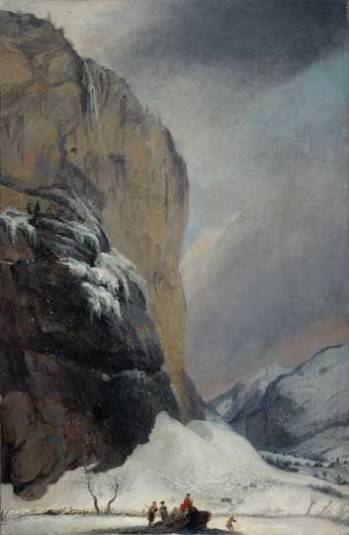
Caspar Wolf, The Staubbachfall in Winter, ca. 1775
(Bern: Kunstmuseum)
A fluke of history can be credited for Caspar Wolf ascent from impoverished childhood in Muri as carpenter’s son and moderately successful painter to artist of standing in European art history: the most important pioneer of Alpine painting and one of the most significant precursors to European Romanticism.
The fluke in question is Caspar Wolf’s encounter with the influential Bernese publisher Abraham Wagner (1734–1782). Wagner, one year his senior, had an ambitious project: to issue an encyclopedic publication of the Swiss Alpine landscape complete with illustrations of the highest artistic standard; and more to the point, these illustrations would be worked immediately from nature. The landscape that Wagner had in mind as motif was the rarely travelled and difficult to reach high Alpine region. The idea was to offer viewers a new conception of the Alpine landscape in images of previously unparalleled precision and magnificence. To author the written sections of this publication, Wagner engaged the Bernese priest and eminent natural philosopher Jacob Samuel Wyttenbach. Wolf was to accompany the two men on their extensive treks through the Alpine mountains. His task was to document and depict in paintings these unique encounters with nature.
What resulted was a comprehensive picture cycle of the Swiss Alps. Working in his studio from the nature studies completed on location, Wolf created some 200 paintings of imposing quality that bring together spontaneous observations and highly artistic formulations. Wolf invents astute painterly formulations to depict mountain ranges and glaciers, waterfalls and caves, bridges and raging torrents, lakes and high plateaus, sometimes rendering these in expansive panorama views, sometimes in close, claustrophobic compositions. His paintings include many prominent natural monuments, some no longer existent due to the environmental destruction of recent centuries: hence, the famous ‘séracs’ (pinnacles of glacier ice) of the Lower Grindelwald Glacier, evident in two exceptionally powerful paintings by Wolf, have long since melted, for instance.
Wolf’s paintings can neither be grouped with the vedute, a type painting popular at the time, nor can they be described as explicitly documentary images. Instead, they speak to a more fundamental subject matter: they consider the relationship between the mountain as rational concept and the mountain as sensual perception.
But what was the origin for the remarkable aesthetic assurance with which the artist entered the virginal territory of Alpine painting? Wolf’s intense engagement with French painting while in Paris in 1770/71 proved to be of central importance. This is vividly demonstrated in the exhibition with works by François Boucher, Claude-Joseph Vernet, Philippe-Jacques de Loutherbourg the Younger, and Hubert Robert. Surprisingly, Wolf profits greatly from his engagement with contemporary marine paintings and their depictions of dramatic storms at sea and shipwrecks.
The exhibition includes 126 works by Caspar Wolf and his contemporaries as well as a selection of recent photographs taken at these respective locations in the Alps. In conjunction with this exhibition, the Kupferstichkabinett at the Kunstmuseum Basel will present highlights from its wealth of drawings and prints by Caspar Wolf.
◊ ◊ ◊ ◊ ◊
The catalogue is available in German and English:
Caspar Wolf und die ästhetische Eroberung der Natur (Ostfildern: Hatje Cantz Verlag, 2014), 224 pages, ISBN: 978-3775738323 (German) / ISBN: 978-3775738330 (English), €58.
 The notion of the Alps as a magnificent natural spectacle is surprisingly recent. It was not until the eighteenth century that its craggy mountain ridges began to be seen as ‘sublime’ and beautiful. The Swiss landscape painter Caspar Wolf (1735–1783) was one of the first to discover the then largely unexplored world of the Alps as a subject of art through his extended forays into the mountains. Trained in southern Germany and Paris, Wolf was commissioned to produce a comprehensive series on the Swiss Alps, which he completed between 1773 and 1779. Working in his studio, the artist created some 180 imposing paintings from nature studies done outdoors. The publication demonstrates how he conveyed what he had seen according to his aesthetic criteria. In his dramatic compositions, paths are blocked by immense boulders, roaring streams of water, and glaciers, or the
view opens up to reveal giant panoramas, which are
observed by tiny, awestruck human figures.
Exhibition | Detroit before the Automobile
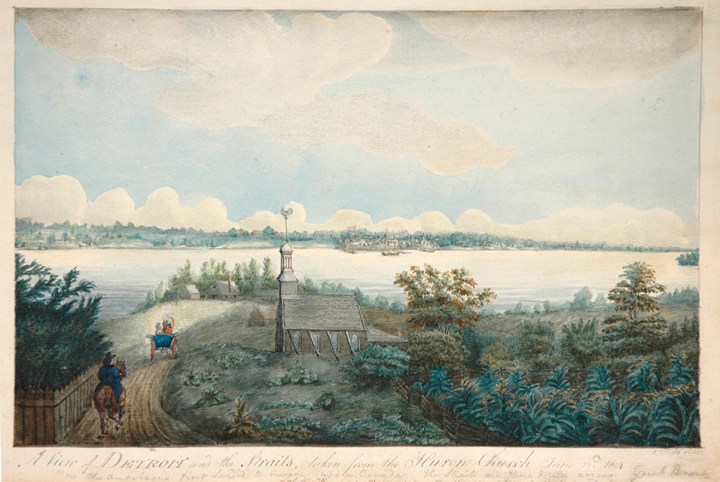
Edward Walsh, View of Detroit and the Straits,
Taken from the Huron Church, 1804
(University of Michigan: William L. Clements Library)
◊ ◊ ◊ ◊ ◊
Now on view at the University of Michigan, as noted at Art Daily:
Detroit before the Automobile: The William L. Clements Library Collection
University of Michigan Museum of Art, Ann Arbor, 18 October 2014 — 18 January 2015
In spite of the economic reverses of the last few decades, Detroit is still perceived by most Americans as the cradle of the automotive industry and the testing ground for twentieth-century innovations in manufacturing that changed the world. ‘Motown’, however, was already two centuries old by the time the Model T rolled off the first assembly line. Detroit before the Automobile examines the first 200 years of the city’s history using rare books, manuscripts, maps, and graphics from the extensive collection of the University of Michigan’s William L. Clements Library.
Detroit was founded by the French in 1701 as a trading center and agricultural settlement. In 1760 it passed to the British and became an important post for them during the American Revolution. It was ceded to the United States by the peace treaty of 1783, although the United States did not actually take control of the city until 1796. In 1805, Detroit became the capital of the Michigan Territory, but it was destroyed by fire the same year. Rebuilt to a radical new design, the town and fort were taken by the British at the outset of the War of 1812 and then recovered by the United States in 1813. In 1817 it saw the birth of the University of Michigan. During the nineteenth century, Detroit matured and grew in importance as a shipping center with a developing industrial base of shipbuilding, rail-car construction, stove manufacturing, and similar industries that ensured the city would have the infrastructure and transportation network needed to greet the infant auto industry at the dawn of the twentieth century.
The Clements Library has a rich variety of primary sources documenting the history of Detroit before 1900, from maps outlining the distinctive ‘ribbon farm’ land pattern of the French, to plans of the town, and prints charting the city’s increasing size and the height of its buildings. Together this array of primary documents brings to life the early history of one the oldest cities in the Midwest.
The exhibition is part of the U-M Collections Collaborations series, co-organized by and presented at UMMA and designed to showcase the renowned and diverse collections at the University of Michigan. The U-M Collections Collaborations series is generously supported by the Andrew W. Mellon Foundation.
Richard Wilson Online Catalogue Now Available
 The Richard Wilson Online catalogue raisonné has been compiled by Dr Paul Spencer-Longhurst (Senior Research Fellow) with the collaboration of Professor David Solkin (Curator of the exhibition, Richard Wilson: The Landscape of Reaction, 1982–83) and Kate Lowry (formerly Chief Conservator at the National Museum Wales, Cardiff), with the assistance of Maisoon Rehani (Project Coordinator) and Peter Thomas (Technical Project Consultant).
Richard Wilson Online is the outcome of intensive ongoing research undertaken since 2009 to re-establish Richard Wilson’s (1713/14–1782) status and redefine his output in celebration of the tercentenary of his birth. The website is launched as a work-in-progress designed to provide an up-to-date and freely accessible record of Wilson’s autograph paintings and works on paper. It complements and extends the public interest in and academic focus on his achievements stimulated by the exhibition, Richard Wilson and the Transformation of European Landscape Painting, on show at the Yale Center for British Art, New Haven, USA, and Amgueddfa Cymru – National Museum Wales, Cardiff in 2014.
Accessing Richard Wilson Online
Exhibition | Anne Seymour Damer: Sculpture and Society
Now on view at Strawberry Hill:
Anne Seymour Damer: Sculpture and Society
Strawberry Hill, Twickenham (London), 11 August — 9 November 2014

Anne Seymour Damer, Shock Dog, 1780
Anne Damer was the daughter of Horace Walpole’s favourite cousin, Henry Seymour Conway. Born into a life of luxury in 1748, Anne was subjected to an arranged marriage in 1767 to John Damer, a man she neither knew or liked. Her husband’s bankruptcy and subsequent suicide led her to turn to a different life as a sculpture. In marble, terracotta or bronze, Anne Damer modelled friends, family and their animals, and also political heroes, including Admiral Nelson. Anne Damer’s art provides a wealth of insight into nineteenth–century British sculpture, including the negative reactions towards the work of a woman. Living through the turbulent times, Anne Damer mixed sculpture with acting, writing and travel. Many of her friends included leading members of the political, arts and theatre world and with Georgiana, Duchess of Devonshire she became known as one of the fashionable set of ladies of London.
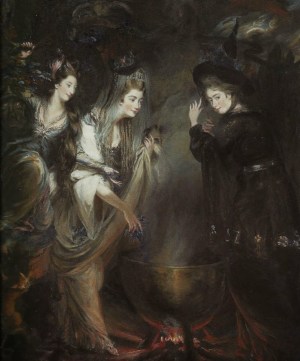
Daniel Gardner, The Three Witches from Macbeth (Elizabeth Lamb, Viscountess Melbourne; Georgiana, Duchess of Devonshire; Anne Seymour Damer), 1775 (London, National Portrait Gallery).
Horace Walpole played a significant role in Anne Damer’s life as he was her godfather and encouraged her interest in sculpture. Indeed, she developed a triangular friendship with her godfather and his protégée, Mary Berry. Horace’s affection for Anne Damer was shown in the bequest of his house to her, enabling her to live and work at Strawberry Hill until 1811. Her studio was part of Walpole’s printing house, part of which still survives today.
For the first time, Anne Damer’s life and work will be formally shown to the general public at Strawberry Hill. The exhibition, which is supported by The Henry Moore Foundation and Rainer Zietz, will showcase some of her sculptures, many from private collections and her anatomy drawing book, personal objects and a rare set of her prompt copies of plays performed at Richmond House and Strawberry Hill. The painting of The Three Witches from Macbeth (Elizabeth Lamb, Viscountess Melbourne, Georgiana, Duchess of Devonshire, Anne Seymour Damer) by Daniel Gardner will also be displayed courtesy of the National Portrait Gallery, London.
Michael Snodin, Chairman of the Trustees of Strawberry Hill Trust said, “Anne Seymour Damer: Sculpture and Society is one of a series of exhibitions on subjects related to Horace Walpole and Strawberry Hill. Anne Damer was a leading light for women of her generation and with the current interest in Georgian England, her life and work will interest many visitors to Strawberry Hill.”










 Enfilade
leave a comment