Exhibition | The Spanish Gesture: Drawings from Murillo to Goya

Francisco de Goya y Lucientes, Two Groups of Picadors Overrun Consecutively by a Single Bull, 1814–16. Red chalk and red-ink wash on laid paper
(Hamburger Kunsthalle, Kupferstichkabinett 38541; photo by Christoph Irrgang)
◊ ◊ ◊ ◊ ◊
From the Meadows Museum:
The Spanish Gesture: Drawings from Murillo to Goya in the Hamburger Kunsthalle
Dibujos españoles en la Hamburger Kunsthalle: Cano, Murillo y Goya
Meadows Museum, Dallas, 25 May — 31 August 2014
Museo Nacional del Prado, Madrid, 30 October 2014 — 8 February 2015
Curated by Jens Hoffmann-Samland
The Kupferstichkabinett (collection of prints and drawings) at the Kunsthalle of Hamburg holds, alongside Florence, Paris and London, one of the most significant collections of Spanish drawings to be found outside of Spain. This is perhaps surprising at first, given that the Hanseatic city of Hamburg has historically not been a stronghold of Catholicism. Indeed, the reason for this lies in a single, rather chance purchase by the first director of the Kunsthalle, Alfred Lichtwark (1852–1914); the motivation for this acquisition was as spontaneous as it was personal.

Francisco de Goya y Lucientes, Prince Balthasar Carlos as Hunter (after Velázquez), 1778–79. Red crayon over preliminary drawing in pencil. (Hamburger Kunsthalle, Kupferstichkabinett 38540; photo by Christoph Irrgang)
In 1891, the London art and antiques dealer Bernard Quaritch (1819–1899) offered for sale a mixed lot of Spanish and Italian drawings to the Berlin Museum. There, however, the budget had already been depleted by the purchase of a different collection. Lichtwark viewed the drawings in Berlin and, since they “pleased him greatly,” he immediately and successfully went about securing the necessary £180, thus acquiring them for Hamburg.
A few years later, however, the quality of the extraordinary collection, which today comprises over 200 drawings, had already faded from memory. When August L. Mayer (1885–1944) inquired as to whether there were any Spanish drawings in the Hamburg collection that he could include in his planned publication of 150 drawings by Spanish masters to be published by The Hispanic Society of America in 1915, he was told that “it contains almost nothing of significance.” As a result, the drawings went unheeded for a considerable length of time. There followed—at intervals of about thirty-five to forty years—a small in-house exhibition in 1931, a slightly larger exhibition in 1966 with additional items from the Museo Nacional del Prado and the Biblioteca Nacional in Madrid, and another smaller presentation in 2005 comprising forty-five works of art. To be certain, some important and, by now, famous works from the Hamburg collection have often traveled to different venues. The Spanish Gesture: Drawings from Murillo to Goya in the Kunsthalle, Hamburg is the first exhibition to present this exquisite collection on a larger scale, 123 years after it was first bought by the Kunsthalle of Hamburg.
A great part of the core of today’s Hamburg collection was assembled by Bartolomé Esteban Murillo (1617-1682) and was produced in and around the Academia de Murillo he established in Seville in 1660 with Francisco Herrera the Younger (1622-1685), Juan de Valdés Leal (1622–1690), Cornelis Schut (1629–1685) and others. Highlights from this period include Murillo’s Assumption of the Virgin (c. 1665); a pen-and-ink drawing, Nobleman in a Landscape (c. 1660), attributed to Herrera the Younger; Head of St. John the Baptist (1654–55) by Valdés Leal; and Alonso Cano’s (1601–1667) Sketch for the Altar of St. Catherine. The Hamburg Kupferstichkabinett holds the largest group of half-length holy figures, understood to represent the twelve apostles, by Francisco Herrera the Elder (c. 1590–1656), created around 1640–50, and this exhibition will display all twelve works together for the first time.
Representing the later end of the collection is a number of drawings by Francisco Goya (1746–1828). Together with his Tauromaquia prints and drawings from Goya’s “Album B,” the collection holds the majority of Goya’s drawings after Diego Velázquez (1599–1660) that he subsequently used (or intended to use) for his etchings. Among these are the two Greek literary figures Aesop and Moenippus. The collection also comprises full-length portraits of members of the royal family, dwarves and court jesters, Los Borrachos, Las Meninas, and one of Velázquez’s most important early works that leads us back to Seville, the Waterseller of Seville.
As part of the continued collaboration between the Meadows Museum and the Museo Nacional del Prado, the exhibition has been researched by Dr. Jens Hoffmann-Samland, an independent art historian. Approximately eighty drawings from the Kunsthalle of Hamburg will be on view in Dallas, and will be published in the accompanying catalogue, which is being collaboratively published by the Meadows Museum, the Museo Nacional del Prado, the Kunsthalle of Hamburg, and the Centro de Estudios Europa Hispánica (CEEH). The exhibition will travel to Madrid for display at the Museo Nacional del Prado October 2014–February 2015.
This exhibition has been organized by the Meadows Museum, SMU; the Museo Nacional del Prado; the Hamburger Kunsthalle; Centro de Estudios Europa Hispánica; Center for Spain in America; and is funded by a generous gift from The Meadows Foundation. Promotional support provided by The Dallas Morning News.
◊ ◊ ◊ ◊ ◊
◊ ◊ ◊ ◊ ◊
From the Centro de Estudios Europa Hispánica:
Jens Hoffmann-Samland, et al, The Spanish Gesture: Drawings from Murillo to Goya in the Hamburger Kunsthalle (Dallas: Meadows Museum, 2014), 294 pages, ISBN: 978-0692207864.
 Este catálogo publica por primera vez toda la colección de dibujos españoles de la Hamburger Kunsthalle. Algunas de sus obras eran ya conocidas por su singular importancia, habiéndose expuesto en varias ocasiones; faltaba un estudio completo del conjunto, su historia y los problemas atributivos que suscita. El fondo de este museo alemán contiene obras de los más destacados maestros españoles de los siglos XVI al XVIII, desde Juan de Juanes hasta Francisco de Goya pasando por los máximos representantes del Siglo de Oro, entre ellos Carducho, Francisco de Herrera el Viejo, Alonso Cano, Antonio del Castillo o Murillo.
La versión inglesa del libro acompaña la exposición de una selección de piezas en el Meadows Museum de Dallas (mayo–agosto 2014); la versión española corresponde a la segunda sede de esta muestra en el Museo Nacional del Prado (septiembre 2014–enero 2015).
Su autor principal, Jens Hoffmann-Samland, es historiador del arte independiente especializado en el arte español del Siglo de Oro.
Salacious Gossip Tours of Hampton Court Palace
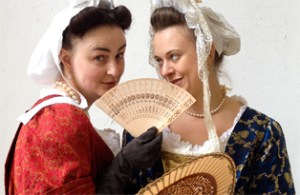 As the summer of the Georgians winds down, I thought I would mention this bit of programming. In connection with The Glorious Georges exhibition, Hampton Court Palace is featuring ‘Salacious Gossip Tours’ to highlight the “racy stories” they “dare not tell during the day!”
Historic Royal Palaces has done these in the past for The Wild, the Beautiful and the Damned exhibition (2012), and I would speculate—though it is only speculation—that the racy bits are comparable to what many of us present in class to keep students’ attention. I mention it here, in part, because as I was thinking about what readers might want from a newsletter like this one several years ago, someone perceptively replied ‘gossip!’. Ever since then, I’ve been trying (unsuccessfully) to pull that off. As with other things, suggestions are most welcome. As for the tours, participants must be at least 18 years old, tickets are £25, and the tours begins at 7:15. My hunch is that it probably adds up to a fine way to avoid the crowds, and walking out of Hampton Court Palace at 9:00 or so isn’t a bad evening. A champagne reception at the beginning couldn’t hurt either. –CH
Exhibition | Mind’s Eye: Masterworks on Paper from David to Cézanne
From the DMA’s exhibition press release (26 June 2014). . .
Mind’s Eye: Masterworks on Paper from David to Cézanne
Dallas Museum of Art, 29 June — 26 October 2014
Curated by Olivier Meslay and William Jordan
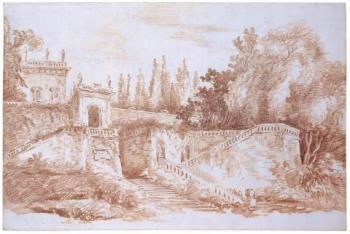
Hubert Robert, View of the Gardens at the Villa Mattei, 14 x 21 inches (34.93 x 52.39 cm), red chalk on paper, 1761 (Dallas Museum of Art, fractional gift of Charlene and Tom Marsh, 2006.17). The drawing sold in Paris at Christies (Lot 512, Sale 5075) in December 2003 for €17,625.
From quick sketches to watercolors and finished masterpieces, works by artists such as Eugène Delacroix, Jacques-Louis David, Edgar Degas, Edouard Manet, Paul Cézanne, Vincent van Gogh, Egon Schiele, Piet Mondrian and Pablo Picasso are brought together in Mind’s Eye: Masterworks on Paper from David to Cézanne. Organized by the Dallas Museum of Art, the exhibition features more than 120 works on paper—many of which have never been exhibited publicly—by 70 artists. Drawn in part from the DMA’s collection, but with significant loans from private collections in North Texas, Mind’s Eye, offers insights into the working methods of these artists, providing an intimate view of their approach to art making while also presenting the drawings and watercolors as finished works of art in their own right.
“One of the goals of the Dallas Museum of Art is to encourage collecting within the community. There is no better example of how to do this than to highlight the Museum’s graphic holdings together with those that have been assembled in private homes throughout our area,” said Maxwell L. Anderson, The Eugene McDermott Director of the DMA. “Mind’s Eye: Masterworks on Paper from David to Cézanne presents a rich and fascinating array of works in various media by artists from the Austro-Hungarian, Belgian, British, Dutch, French, German, Spanish and Swiss schools, spanning nearly 150 years—from the French Revolution to the dawn of modernism.”
The collecting and appreciation of drawings were for centuries activities associated with the privileged, the educated, or artists themselves, and the skills derived from these actions ultimately formed the basis of modern art history. Through museums, a wider audience has come to enjoy and value these most intimate of artists’ expressions. Collecting in this area has gone on throughout the DMA’s 111-year history, yet Mind’s Eye is the first exhibition to consider what has been achieved, while also serving as a tribute to the generations of collectors who have brought these drawings to Texas.
The works on view in Mind’s Eye focus on European art from the French Revolution in the late 18th century to the birth of modernism in the early 20th century. The Museum’s European works on paper collection, which has a strong holding of French art from the 19th and early 20th centuries, with an emphasis on impressionist and post-impressionist works, is complemented by loans from private collections that broaden the scope of the exhibition. Because of the different kinds of works on view, the varied roles that drawing plays for artists—as a learning exercise, as a form of note taking, as a tool for planning and development of larger works, and as an end in itself—are showcased, and the artistic process of the various artists revealed.
“Mind’s Eye is about the pleasures of collecting, but it is also about the rich history and diversity found in drawings created by artists throughout art history,” said Olivier Meslay, Associate Director of Curatorial Affairs and The Barbara Thomas Lemmon Curator of European Art. “The exhibition highlights many recognizable names along with lesser-known artists, examining overlooked works and reexamining those produced by famous artists to reveal the full effect of their contributions from a fresh, modern perspective.” Meslay is co-curator of the exhibition with Dr. William B. Jordan, formerly Director of the Meadows Museum and Deputy Director of the Kimbell Art Museum. Both are lifelong students of drawings. “This works on paper exhibition brings to light a part of the collection that is not often highlighted, despite its quality,” added Jordan.
In the exhibition, visitors will be able to learn about the care and conservation of works on paper, and how to properly frame a drawing through a video demonstration, as well as view a display of various materials represented in the works on view with examples of the different kinds of lines produced by these tools. The educational displays were created by DMA Chief Conservator Mark Leonard. In the late summer, visitors will be able to explore the exhibition with a smartphone tour featuring commentary by the exhibition co-curators, Olivier Meslay and William B. Jordan. DMA Friends will be able to earn the Mind’s Eye Special Exhibition Badge while the show is on view. For more information on the DMA Friends program, visit DMA.org/friends.
The exhibition is accompanied by a 240-page full-color publication, edited by Olivier Meslay and William B. Jordan, with contributions by Esther Bell, Richard R. Brettell, Alessandra Comini, Dakin Hart, William B. Jordan, Felix Krämer, Laurence Lhinares, Heather MacDonald, Olivier Meslay, Jed Morse, Steven Nash, Sylvie Patry, Louis-Antoine Prat, Richard Rand, George T. M. Shackelford, Richard Shiff, Kevin W. Tucker and Charles Wylie. The catalogue is distributed by Yale University Press.
◊ ◊ ◊ ◊ ◊
Distributed by Yale UP:
Olivier Meslay and William B. Jordan, eds., Mind’s Eye: Masterworks on Paper from David to Cézanne (Dallas: Dallas Museum of Art, 2014), 240 pages, ISBN: 978-0300207217, $60.
 An overview of European art from the French Revolution to the First World War, Mind’s Eye encompasses 116 works on paper in various media by seventy artists. These works range from quick sketches and working drawings to cartoons for large murals and highly finished masterpieces. Among the featured artists are such recognizable names as Pierre Bonnard, Paul Cézanne, Jacques-Louis David, Edgar Degas, Eugène Delacroix, Théodore Géricault, Fernand Léger, Pablo Picasso, Pierre-Auguste Renoir, and Georges Seurat. Also included are never-before-published works by accomplished yet lesser-known artists, such as Albert Anker, Henri Gaudier-Brzeska, Adolf Hirémy-Hirschl, Fernand Khnopff, František Kupka, and Simeon Solomon. Noted international specialists in the field address the working methods of these artists and the aesthetic beauty of their drawings and watercolors, and offer focused studies on artists, regions, schools, and themes. By simultaneously drawing attention to overlooked works and reexamining those produced by famous artists, this catalogue examines the overall effect of their cumulative contributions from a fresh, modern perspective.
Olivier Meslay is associate director of curatorial affairs at the Dallas Museum of Art, and William B. Jordan is an art historian and a trustee at the Dallas Museum of Art.
Display | An Impossible Bouquet
Press release for the display at Dulwich:
An Impossible Bouquet: Four Masterpieces by Jan van Huysum
Dulwich Picture Gallery, London, 1 July — 28 September 2014
Curated by Henrietta Ward

Jan van Huysum, Vase with Flowers, ca. 1715 (Dulwich Picture Gallery)
A special collection of works by the 18th-century Dutch artist Jan van Huysum will be on display at Dulwich Picture Gallery from 1 July until 28 September 2014. An Impossible Bouquet, Four Masterpieces by Jan van Huysum will bring together beautiful works from private collections alongside Dulwich’s own painting that together showcase the artist’s ingenuity and astonishing ability to paint flowers, fruit and insects with minute attention to detail.
Included within the display are two paintings that have remained together since they left Van Huysum’s studio around 1732: Flowers in a Vase with Crown Imperial and Fruit and Flowers in front of a Garden Vase. Their complementary compositions suggest he conceived them as pendants (painted as a pair)—a rarity amongst his oeuvre of 241 paintings. His impressive arrangements could depict over 35 different types of flowers, which, before modern cultivation techniques, would never have been seen together at the same time of year. To overcome this Van Huysum worked from sketches and painted some of his arrangements over two years, explaining why he signed his paintings with two dates.
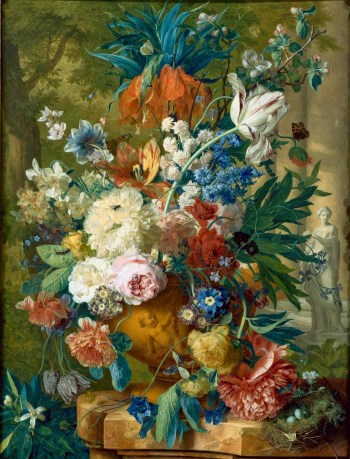
Jan van Huysum, Flowers in a Vase with Crown Imperial and Apple Blossom at the Top and a Statue of Flora, 1731–32 (Private Collection)
Van Huysum is widely regarded as the greatest still-life painter of his time. His ambitious compositions demonstrate his ability to combine a huge variety of species into beautiful, coherent still lifes that made him popular with collectors both during and beyond his lifetime. The paintings included within this display were once owned by prominent 18th-century collectors, including the Gallery’s founders, Sir Francis Bourgeois and Noël Desenfans, as well as the Swiss painter and dealer Jean-Étienne Liotard.
An Impossible Bouquet, Four Masterpieces by Jan van Huysum has been curated by Dulwich’s Curatorial Fellow Henrietta Ward. The Gallery’s forthcoming Dutch and Flemish schools catalogue, to be published by 2016, will feature Vase with Flowers along with detailed entries for masterpieces by Rembrandt, Rubens, Van Dyck, and Teniers. The catalogue is part of the Gallery’s strategy for the Curatorial Centre of Excellence, a major long-term commitment towards scholarship, learning and training of future curators.
About the Artist
Jan van Huysum (1682–1749) was based in Amsterdam, where he painted flower and fruit still lifes, as well as landscapes. He was taught by his artist-father Justus and worked in his studio until around 1701 when he decided to set up as an independent painter. His depictions of luxuriant flowers in classical vases were soon admired by collectors, particularly the way flowers, fruit and insects were rendered with astonishing accuracy and detail. He achieved this precision with fine brushes—some might have only had a single hair—which were ideal for depicting the vein structure of a leaf, the delicate hairs on a raspberry or the translucency of a water droplet. His skills earned him great acclaim and in 1750 the Dutch writer Jan van Gool (1685–1763) wrote Van Huysum’s first biography which reaffirmed the painter’s unwavering popularity amongst the wealthiest European collectors of the day; his floral paintings could be found in the aristocratic estates of the Duke of Orleans in France, Sir Robert Walpole in England, Prince William of Hesse-Kassel and the King of Poland.
Around 1720, Van Huysum turned from painting on a dark to a light background, believing the flowers and fruit wouldbe seen to better effect. He then placed his vases in architectural gardens which hinted at a grand, classical landscape beyond. The splendour of his new approach substantially increased the demand for his work, so much so that they sold for unprecedented prices, a luxury he experienced during his lifetime. Fully aware of the value of his unique skills, Van Huysum disliked anyone entering his studio, and supposedly taught only one student, for fear they might learn the secrets of his meticulous—and highly lucrative—painting techniques.
Dulwich Picture Gallery
Dulwich Picture Gallery is England’s first purpose-built public art gallery, founded in 1811 and designed by Regency architect Sir John Soane. It houses one of the finest collections of Old Masters in the country, especially rich in French, Italian and Spanish Baroque paintings and in British portraits from the Tudor period to the 19th century. The Gallery’s permanent collection is complemented by its diverse and critically acclaimed year round temporary exhibitions.
Exhibition | Australian Encounters: Charting a Continent
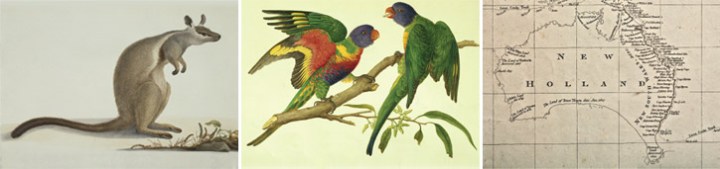
Rock Wallaby © Natural History Museum, London; Rainbow Lorrikeets © Natural History Museum; London, and Cook’s Map of Australia 1773
◊ ◊ ◊ ◊ ◊
From the museum:
Australian Encounters: Charting a Continent
Captain Cook Memorial Museum, Whitby, North Yorkshire, 1 March — 3 November 2014
Cook and his successors completed the chart of the continent’s coastline and marvelled at the strange new creatures they saw—’unlike anything encountered before!’ He and his crew navigated in unknown treacherous waters, where the ship was holed on a coral reef, and then had to be beached and repaired. The voyage, however, led to the choice of Botany Bay as the site of a new colony, starting a trail of immense change throughout Australasia. This year marks the bicentenary of the publication of the entire coastline, completed by Matthew Flinders in 1814.
The Captain Cook Memorial Museum is housed in an historic building on the harbourside: John Walker’s House. In 1746 James Cook, then a youth aged seventeen, came here to be apprenticed to Captain John Walker. A beautiful 17th-century house, this is the sole remaining building which can with certainty be connected to Cook.
Exhibition | Democratic Designs: American Folk Paintings
From the Chrysler Museum:
Democratic Designs: American Folk Paintings from the Chrysler Museum
Willoughby-Baylor House, Norfolk, Virginia, 16 August 2014 — 5 April 2015
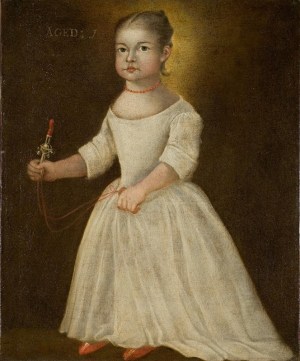
Attributed to Joseph Badger, Portrait of a Child, oil on canvas, ca. 1750 (Chrysler Museum of Art)
The Federal-era Willoughby-Baylor House provides a perfect historical setting for an exhibition of highlights from the Chrysler Museum’s deep early American collections.
Democratic Designs explores the work of artists with considerable ambition and talent, but limited access to professional training. The exhibition includes works by Ammi Phillips, Edward Hicks, Erastus Salisbury Field, and their contemporaries. The exhibition triumphantly displays individual creativity and native genius. Many pieces in this show are gifts from the pioneering collectors Bernice Chrysler Garbisch, sister of Walter P. Chrysler, Jr., and her husband Col. Edgar William Garbisch.
Exhibition | Caroline Watson and Female Printmaking
Opening next month at The Fitzwilliam:
Caroline Watson and Female Printmaking in Late Georgian England
The Fitzwilliam Museum, Cambridge, 23 September 2014 — 4 January 2015
Curated by David Alexander
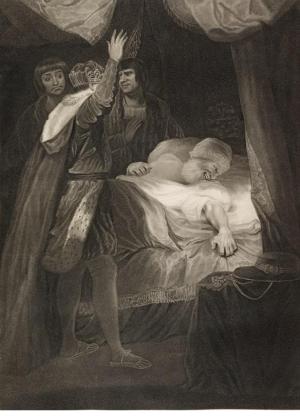
Caroline Watson, The Death of Cardinal Beaufort, stipple and etching after Sir Joshua Reynolds, 1792.
Caroline Watson (1760/61–1814) can be seen as the first British woman professional engraver. Many women in Britain had made prints before her day, but she was the first to make an extended career as an independent engraver. Nearly all those who had earlier made prints were either amateurs, making prints for amusement, or members of printmakers’ families, playing their part in family enterprises. The interest of her career is increased because she was working at a time when women were becoming more important as print buyers; some of her output reflected this change and the accompanying popularity of prints catering to feminine taste. She received support from other women, including recognition from Queen Charlotte, who appointed her ‘Engraver to the Queen’ in 1785, after she had been working for only five years. Later she was encouraged by the wealthy Bute family, particularly by the 4th Earl’s second wife, whose guest she was on several occasions at Luton Park, where Lord Bute, had one of the finest picture collections in England.
At the same time as finding support from other women Caroline Watson was encouraged by several influential men who saw advantage in using her skills; at the start of her career there were the painters Robert Edge Pine, Sir Joshua Reynolds and Ozias Humphry, as well as the printseller John Boydell, all of whom must have known her father; at the end of her career there was William Hayley, a poet and man of letters who befriended many artists. He both admired her as an ailing woman working on her own, and saw her as a reliable and talented collaborator. Having previously employed William Blake to engrave book illustrations he instead employed Caroline Watson on his Life of Romney, 1809. She did not owe her success to patronage, but to her great skill and dedication as an engraver; however the accidents of patronage were an important element in any artist’s career, especially for a woman who was of a retiring nature and not particularly robust in health.
The 200th anniversary of Watson’s death and the fact that the Fitzwilliam and the Folger Library own a number of unpublished letters by her to Hayley, which throw much light on her situation and way of life, provide a suitable opportunity not just to look at her career but to examine printmaking by women in the Britain of her time.
◊ ◊ ◊ ◊ ◊
Caroline Watson and Female Printmaking in Late Georgian England
The Fitzwilliam Museum, Cambridge, 24 September 2014
David Alexander, Honorary Keeper of British Prints and curator of the exhibition, will give a lunchtime talk at 1:15 on Wednesday, 24 September in the Seminar Room. Free admission is by token, 1 per person, available at the Courtyard Entrance desk from 12.45 on the day of the talk.
◊ ◊ ◊ ◊ ◊
Note (added 28 September 2014) — The catalogue is available from the Fitzwilliam:
David Alexander, Caroline Watson and Female Printmaking in Late Georgian England (Cambridge: Fitzwilliam Museum, 2014), 126 pages, ISBN 978-0957443464, £15.
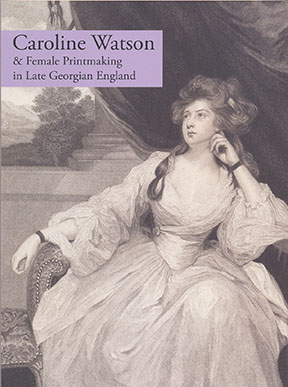 Caroline Watson, who died in 1814, can be seen as the first professional woman engraver, in the sense that she worked independently rather than as a member of a family of engravers. Over a career of thirty years she engraved more than a hundred very delicate prints in the stipple, or dotted manner, which was particularly suited for reproducing miniature portraits. The catalogue, which contains a chronological list of her prints, puts her in the context of the female printmaking of her time, and shows how exceptional was her achievement in working in a male dominated profession. The catalogue carries a transcription of sixteen letters written to her last major employer, William Hayley, which throw much light on the working methods of engravers in general.
Exhibition | Silent Partners: Artist and Mannequin
Press release (4 August) from The Fitzwilliam:
Silent Partners: Artist and Mannequin from Function to Fetish
The Fitzwilliam Museum, Cambridge, 14 October 2014 — 25 January 2015
Musée Bourdelle, Paris, 31 March — 12 July 2015
Curated by Jane Munro
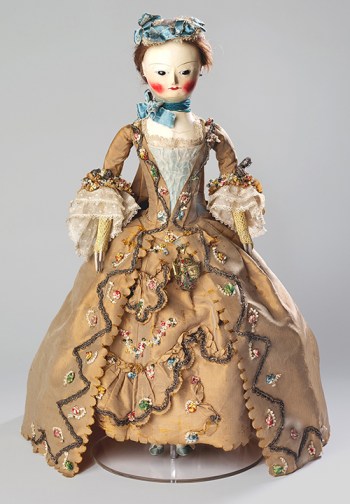
Fashion doll with costume and accessories, 1755–60; wood, gesso, paint, glass, human hair, knitted cotton, satin, silk, gilt braid, wire, silk gauze, linen, cotton, and silk satin, 60 x 42 x 43 cm (London: V&A Museum)
Every picture tells a story … but it does not always give away its secrets. For much of its existence, the artist’s mannequin, or lay figure, was one of art’s best-kept.
Now, for the first time, Silent Partners will unveil the mannequin’s secret life to show how, from being an inconspicuous studio tool, a piece of equipment as necessary as easel, pigments and brushes, the lay figure became the fetishised subject of the artist’s painting, and eventually, in the twentieth century, a work of art in its own right.
A common figure in the studios of painters and sculptors from the Renaissance onwards, this ‘artful implement’ was used to study perspective, arrange compositions, ‘rehearse’ the fall of light and shade and, especially, to paint drapery and clothing. But, while even the very greatest artists condoned its use, the mannequin best served its purpose by remaining ‘silent’: too present or visible in the finished picture, the mannequin could make figures appear stiff and unnatural, and so betray the tricks of the artist’s trade.
The nineteenth century was a turning point. Mannequin-making became a profession in its own right and Paris, especially, became a leading centre of production. Competition was fierce to create and perfect the ‘naturalistic’ mannequin, one that was life-size with an articulated skeleton that could move in realistic ways and an exterior finish that was painted and padded to look—sometimes eerily—human.
And as the mannequins became an increasingly sophisticated human replica, so they emerged from the anonymity of the studio to take their place, centre stage, on the canvas. At first the mannequin featured humorously, in witty visual games of ‘hide and seek’ and double entendre. However, throughout the course of the nineteenth century, painters such as Degas began to represent it in more troubling ways, playing on the unnerving psychological presence of a figure that was realistic, yet unreal, lifelike, yet lifeless. Others—photographers especially—explored in more voyeuristic terms how the relationship between male painter and female mannequin played out behind closed doors, revealing the studio as a place of potent erotic encounter.

Paul Huot, Female Mannequin, ca. 1816; wood, metal, horsehair, wax, silk, cotton and painted papier-mâché head, 163 x 65 cm, (Museumslandschaft Hessen Kassel, Sammlung Angewandte Kunst)
By the end of the century, innovations in the manufacture of mannequins shifted to the shop window dummy, the lay figure’s closest kin. Again, Paris led the way, and the fashion mannequin was transformed by firms such as Pierre Imans and Siégel from a schematic approximation of the human form into an uncannily realistic surrogate that inspired both consumerist longing and sexual fantasy.
This distinctively modern mannequin—one that reflected the life and elegance of its era—set a new challenge for twentieth-century painters and photographers. Featureless and expressionless, they haunted the paintings of the Italian metaphysical painters Giorgio de Chirico and Carlo Carrà, while the Surrealists celebrated the ‘modern’ mannequin as a manifestation of the ‘marvellous’, an object that could reveal the artist’s—and our—secret unconscious desires.
One of the most wide-ranging and ambitious shows ever hosted at the Fitzwilliam, the exhibition will feature over 180 paintings, drawings, books and photographs as well as fashion dolls, trade catalogues, a series of extraordinary patent documents and videos that will surprise and at times disturb. There will be paintings and drawings by Fra Bartolommeo, Cézanne, Poussin, Gainsborough, Millais, Ford Madox Brown, Courbet, Wilhelm Trübner, Kokoschka and Degas as well as photographs by and of Surrealist artists such as Bellmer, Raoul Ubac, Dalì and Man Ray; two works by Jake and Dinos Chapman will form a twenty-first-century coda. But among the most striking and fascinating exhibits will be the mannequins themselves: from beautifully carved sixteenth-century figures to haunting wooden effigies once belonging to Sickert (and maybe Hogarth) and painted dolls of full human height, top-of-the range models that were highly sought after by artists throughout Europe.
◊ ◊ ◊ ◊ ◊
From Yale UP:
Jane Munro, Silent Partners: Artist and Mannequin from Function to Fetish (New Haven: Yale University Press, 2014), 280 pages, ISBN: 978-0300208221, $65.
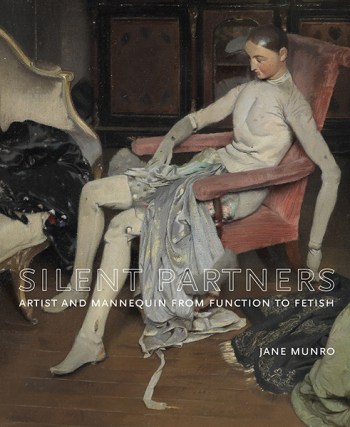 The articulated human figure made of wax or wood has been a common tool in artistic practice since the 16th century. Its mobile limbs enable the artist to study anatomical proportion, fix a pose at will, and perfect the depiction of drapery and clothing. Over the course of the 19th century, the mannequin gradually emerged from the studio to become the artist’s subject, at first humorously, then in more complicated ways, playing on the unnerving psychological presence of a figure that was realistic, yet unreal—lifelike, yet lifeless.
Silent Partners locates the artist’s mannequin within the context of an expanding universe of effigies, avatars, dolls, and shop window dummies. Generously illustrated, this book features works by such artists as Poussin, Gainsborough, Degas, Courbet, Cézanne, Kokoschka, Dalí, Man Ray, and others; the astute, perceptive text examines their range of responses to the uncanny and highly suggestive potential of the mannequin.
Jane Munro is a curator in the Department of Paintings, Drawings and Prints at the Fitzwilliam Museum and director of studies in history of art at Christ’s College at the University of Cambridge.
Hand Fans, Goose Necks, and Archery Contests
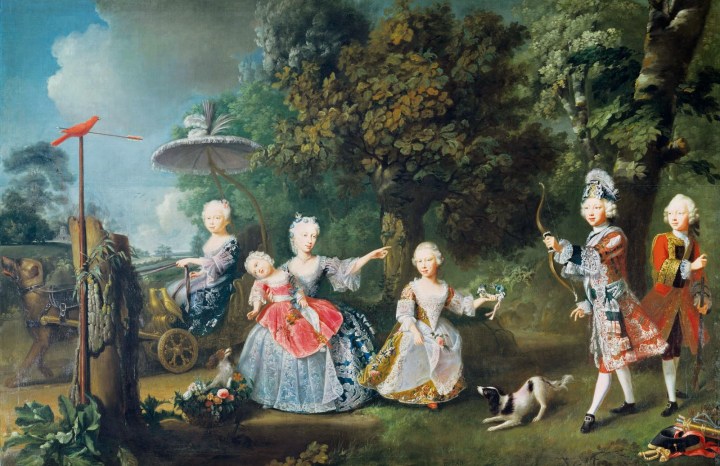
Barthélemy du Pan, The Children of Frederick, Prince of Wales, 1746
Royal Collection Trust/© Her Majesty Queen Elizabeth II 2014
◊ ◊ ◊ ◊ ◊
Pierre-Henri Biger’s website dedicated to the history of fans, Place de l’Eventail, recently published a notice related to seventeenth- and eighteenth-century target contests, commonly held in mid-August, involving a live goose (or more precisely, the goose’s neck, cou de l’oie).1 Biger quotes from Paul Sébillot’s Le Folklore de France (Paris, 1906), to make sense of a mis au rectangle (pictured at the website):
In Grez-Doiceau, in the Walloon Brabant, the second day of the fair, a live goose was hanging from a rope which brought together the upper ends of two long poles stuck in the ground. A man perched on a trestle remembered all the calamities which had hit the town during the past year, and accused the goose to be the cause. . .2
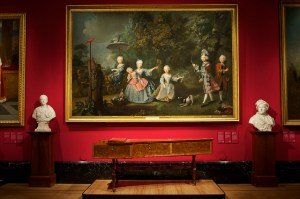
Installation view of The First Georgians, The Queen’s Gallery, Buckingham Palace, 2014.
With The First Georgians exhibition (on view at The Queen’s Gallery in London until October 12) still fresh in my memory, it’s hard to not to think of Barthélemy du Pan’s 1746 large-scale portrait of The Children of Frederick, Prince of Wales (Royal Collection), which depicts the future George III as having just struck a wooden popinjay.3 The prince wears the tartan of the Royal Company of Archers—which, as a British regimental uniform, was exempt from the 1745 ban on Scottish national dress. Bearing in mind Desmond Shawe-Taylor’s suggestion that we understand the picture as “an early example of the process by which Scottish identity became something manly and romantic, rather than threatening and rebellious,” I wonder if rustic traditions of shooting a living bird as part of a celebration with ‘atonement/scapegoat’ undertones might add another layer of relevant associations.4 I’m not sure how far I would push the point: the two contests weren’t the same thing (particularly from an animal rights perspective), and with folk festivals, it’s difficult to pin down specifics (times, places, meanings, &c.). Still, Biger’s piece, at the very least, suggests a larger context for archery contests and their pictorial representation in the eighteenth century and might encourage us to look to fans for useful points of comparison.
–Craig Ashley Hanson
1. Pierre-Henri Biger’s piece is available in both English and French. On the topic generally, see Biger’s recent article, “Introduction à l’éventail européen aux XVIIe et XVIIIe siècles,” Seventeenth-Century French Studies 36 (July 2014): 84–92. The issue, edited by Katherine Ibbett, is dedicated to the topic of fans. The table of contents is available as a PDF file here.
2. Paul Sébillot, Le Folklore de France (Paris, 1906), volume 3, pp. 247–48.
3. The Royal Collection’s online entry for Barthélemy du Pan’s The Children of Frederick, Prince of Wales is available here.
4. Desmond Shawe-Taylor makes the point in the entry for the painting from the exhibition catalogue, which he also edited, The First Georgians: Art & Monarchy, 1714–60 (London: Royal Collection Trust, 2014), p. 366.
Exhibition | Picturing Mary: Woman, Mother, Idea
From the NMWA:
Picturing Mary: Woman, Mother, Idea
National Museum of Women in the Arts, Washington, D.C., 5 December 2014 — 12 April 2015
Curated by Timothy Verdon
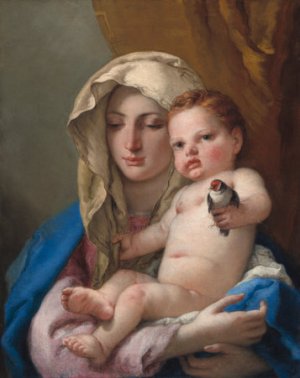
Giovanni Battista Tiepolo, Madonna of the Goldfinch, ca. 1767–70 (National Gallery of Art, Washington, D.C., Samuel H. Kress Collection #1943.4.40)
Appearing throughout the entire world, her image is immediately recognizable. In the history of Western art, she was one of the most popular subjects for centuries. Picturing Mary: Woman, Mother, Idea is a landmark exhibition at the National Museum of Women in the Arts (NMWA), bringing together masterworks from major museums, churches and private collections in Europe and the United States. Iconic and devotional, but also laden with social and political meaning, the image of the Virgin Mary has influenced Western sensibility since the sixth century.
Picturing Mary examines how the image of Mary was portrayed by well-known Renaissance and Baroque artists, including Botticelli, Dürer, Michelangelo, Pontormo, Gentileschi and Sirani. More than 60 paintings, sculptures and textiles are on loan from the Vatican Museums, Musée du Louvre, Galleria degli Uffizi, Palazzo Pitti and other public and private collections—many exhibited for the first time in the United States.
“Among the most important subjects in Western art for more than a millennium was a young woman: Mary, the mother of Jesus. Her name was given to cathedrals, her face imagined by painters and her feelings explored by poets,” said exhibition curator and Marian scholar Monsignor Timothy Verdon, director, Museo dell’Opera del Duomo, Florence, Italy. “This exhibition will explore the concept of womanhood as represented by the Virgin Mary, and the power her image has exerted through time, serving both sacred and social functions during the Renaissance and Baroque periods.”
Picturing Mary is the newest project in an ongoing program of major historical loan exhibitions organized by NMWA, including An Imperial Collection: Women Artists from the State Hermitage Museum (2003) and Royalists to Romantics: Women Artists from the Louvre, Versailles, and other French National Collections (2012). In addition to illustrating the work of women artists, NMWA also presents exhibitions and programs about feminine identity and women’s broader contributions to culture. Picturing Mary extends, in particular, the humanist focus of Divine and Human: Women in Ancient Mexico and Peru, a large-scale exhibition organized by NMWA in 2006.
The full press release (16 July 2014) is available as a PDF file here»
◊ ◊ ◊ ◊ ◊
From ACC Distrbution:
Timothy Verdon, Melissa R. Katz, Amy Remensnyder, Miri Rubin, Kathryn Wat, Picturing Mary Woman, Mother, Idea (New York: Scala Arts Publishers, 2014), 160 pages, ISBN: 978-1857598957, $45 / £30.
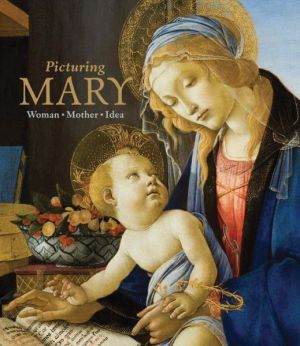 Iconic and devotional, but also fraught with social and political significance, the image of the Virgin Mary has shaped Western art since the sixth century. Depictions of the Virgin Mary in art through the ages are examined from a unique combination of Christian, Jewish, Muslim and contemporary art-historical perspectives. The thought-provoking texts examine Mary’s image as an enthroned queen, a tender young mother and a pious woman, demonstrating how her personification of womanhood has resonated throughout history to the present day.
Timothy Verdon is director of Museo dell Opera di Santa Maria del Fiore. Melissa R. Katz is Luther Gregg Sullivan Fellow in Art History, Wesleyan University. Amy Remensnyder is associate professor, Department of History at Brown University. Miri Rubin is Professor of Medieval and Early Modern History, Queen Mary University of London. Kathryn Wat is Chief Curator,
National Museum of Women in the Arts.










 Enfilade
leave a comment