Exhibition | Wedding Dresses, 1775–2014
Press release for the upcoming exhibition at the V&A (also see the exhibition blog). . .
Wedding Dresses, 1775–2014
Victoria & Albert Museum, London, 3 May 2014 — 15 March 2015
Curated by Edwina Ehrman
◊ ◊ ◊ ◊ ◊
The V&A’s spring 2014 exhibition will trace the development of the fashionable white wedding dress and its interpretation by leading couturiers and designers, offering a panorama of fashion over the last two centuries. Wedding Dresses 1775–2014 will feature over 80 of the most romantic, glamorous and extravagant wedding outfits from the V&A’s collection. It will include important new acquisitions as well as loans such as the embroidered silk coat design by Anna Valentine and worn by The Duchess of Cornwall for the blessing after her marriage to HRH The Prince of Wales (2005), the purple Vivienne Westwood dress chosen by Dita Von Teese (2005), and the Dior outfits worn by Gwen Stefani and Gavin Rossdale on their wedding day (2002).
Displayed chronologically over two floors, the exhibition will focus on bridal wear. Most of the outfits were worn in Britain, by brides of many faiths. Alongside the dresses will be accessories including jewellery, shoes, garters, veils, wreaths, hats and corsetry as well as fashion sketches and personal photographs. Garments worn by bridegrooms and attendants will also be on display. The exhibition will investigate the histories of the garments, revealing fascinating and personal details about the lives of the wearers, giving an intimate insight into their occupations, circumstances and fashion choices.

Silk brocade gown, hat, and shoes, 1780. Olive Matthews Collection, Chertsey Museum. Photo by John Chase.
The opening section of the exhibition will feature some of the earliest examples of wedding fashion including a silk satin court dress (1775) and a ‘polonaise’ style brocade gown with straw bergère hat (1780) lent by the Chertsey Museum. The preference for white in the 19th century will be demonstrated by a white muslin wedding dress decorated with flowers, leaves and berries (1807) recently acquired by the V&A, and a wedding outfit embellished with pearl beads design by Charles Frederick Worth (1880). As the 19th century drew to a close historical costume influenced fashion. A fine example will be a copy of a Paris model designed by Paquin Lalanne et Cie made by Stern Brothers of New York (1890) for an American bride.
Designs from the 1920s and 1930s will illustrate the glamour of bridal wear which was now influenced by evening fashions, dresses were slim-hipped and made from richly beaded textured fabrics and slinky bias-cut satin. During the Second World War when clothing restrictions were introduced, brides needed to make imaginative and practical fashion choices. They used non-rationed fabrics such as upholstery materials, net curtaining and parachute silk, or married in a smart day dress or service uniform. On display will be a buttercup patterned dress made in light-weight upholstery fabric by London dressmaker Ella Dolling (1941).
Wedding Dresses 1775–2014 will also explore the growth of the wedding industry and the effect of increasing media focus on wedding fashions. Improvements in photography in the early 20th century encouraged photojournalism and society weddings were reported in detail in the national press and gossip columns. Two of the most spectacular wedding dresses on show will be the Norman Hartnell dress made for Margaret Whigham (later Duchess of Argyll) for her marriage to Charles Sweeny (1933), and the Charles James ivory silk satin dress worn by Barbara ‘Baba’ Beaton for her marriage to Alec Hambro (1934). These dramatic dresses will be seen alongside archive film and news clippings of the occasions as examples of society ‘celebrity’ weddings.
The mezzanine level will feature wedding garments from 1960 to 2014, taking the exhibition right up to date with Spring/Summer 2014 designs by Jenny Packham and Temperley Bridal. Emphasising the glamour and spectacle of weddings today, key designers will include Vivienne Westwood, John Galliano, Christian Lacroix, Lanvin, Vera Wang, Jasper Conran, Bruce Oldfield, Osman, Hardy Amies, Bellville Sassoon, Mr.Fish, John Bates and Jean Muir, with millinery by Philip Treacy and Stephen Jones. This section will explore the changing social and cultural attitudes to the wedding ceremony and marriage in the late 20th century and will feature examples of innovative and unconventional wedding outfits including dresses designed by Gareth Pugh and Pam Hogg for the weddings of Katie Shillingford (2011) and Mary Charteris (2012).
A version of the exhibition previously toured to Bendigo Art Gallery, Victoria, Australia (2011), Museum of New Zealand Te Papa Tongarewa (2011–12), National Museum of Singapore (2012), and Western Australian Museum, Perth, Australia (2012–13).
◊ ◊ ◊ ◊ ◊
From the V&A:
Edwina Ehrman, The Wedding Dress: 300 Years of Bridal Fashions, 2nd edition (London: V&A Publishing, 2014), 208 pages, ISBN 978-1851778133, £30 / $50.
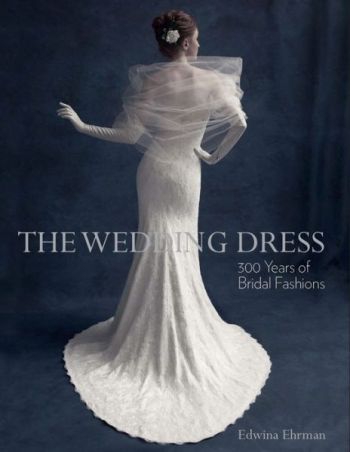 This sumptuous book draws on wedding garments in the V&A’s collection, photographs, letters, memoirs, newspaper accounts and genealogical research to explore the history of the wedding dress and the traditions that have developed around it since 1700. It focuses on the white wedding dress, which became fashionable in the early nineteenth century and is now chosen by women across the world. The book considers the way couturiers and designers have challenged and refreshed the traditional white dress and the influence of the wedding industry, whose antecedents lie in the commercialization of the wedding in Victorian Britain. The Wedding Dress is not only about costume, but also about the cultivation of the image of the bride. This book is a glorious tribute to an exquisite, stylish, glamorous gown, the romance of its evolution and the splendour of its design.
Edwina Ehrman is a curator of Textiles and Fashion at the V&A and of the exhibition The Wedding Dress: 300 Years of Bridal Fashions. She is co-author of The London Look: Fashion from Street to Catwalk and a contributor
to The Englishness of English Dress.
Exhibition | The Coast and the Sea
Press release (4 October 2013) from D. Giles:
Linda S. Ferber, The Coast and the Sea: Marine and Maritime Art in America (London: D. Giles Limited, 2013), 104 pages, ISBN 978-1907804311, $30 / £20.
The Society of the Four Arts, Palm Beach, Florida, 25 January — 9 March 2014
The Baker Museum of Art, Naples, Florida, 19 April — 6 July 2014
Portland Museum of Art, Portland, Maine, January — May 2015
The Mattatuck Museum, Waterbury, Connecticut, 6 June — 13 September 2015
The New York State Museum, Albany, New York, 24 October 2015 — 22 February 2016

A Southeast Prospect of the City of New York, ca. 1756–61. Oil on canvas. 38 x 72 1/2 in. (96.5 x 184.2 cm). Collection of the New-York Historical Society.
◊ ◊ ◊ ◊ ◊
The Coast and the Sea: Marine and Maritime Art in America will be published by D Giles Limited, in association with the New-York Historical Society, in December 2013. It is an appealing and colourful volume which presents over 50 of the best marine paintings and artifacts from the New-York Historical Society’s impressive maritime art collection.
 The works range in date from 1750 to 1940, and are by eminent marine artists like Thomas Birch, John Frederick Kensett, and Charlton T. Chapman. Highlights include large format canvasses of famous sea battles, ships at work, portraits of heroic sea captains, dashing naval officers like James Gordon Bennett Jr. and pioneering merchants, such as the aptly named Preserved Fish of New York, prominent in shipping in the early 19th century. There are also maritime themed objects such as an engraved whale’s tooth from the late 19th century, and a silver presentation urn commemorating acts of bravery from the War of 1812. An essay by curator Linda S. Ferber places the works within their wider historical and cultural narrative.
The works are then arranged thematically rather than by artist or period; there is for example a chapter on the Anglo-Dutch tradition in American marine art: the War of 1812 with its great sea battles and heroes and romantic and idealized visions of the sea. A section on the merchant marine and maritime trade features paintings of major trading posts in and around the Pearl River Delta, including Hong Kong; some of these paintings were by a group of Chinese artists working in the European style specifically for the export market. There are views of the Hudson River and the great Port of New York, as well as Gilded Age nostalgia for the great age of sail, with its clipper ships and majestic wind-jammers.
Linda S. Ferber is Senior Art Historian, the New-York Historical Society.
◊ ◊ ◊ ◊ ◊
Note (added 1 August 2014) — The original version of this posting included only the first two exhibition venues.
Exhibition | From Watteau to Fragonard: Les Fêtes Galantes
The exhibition opens today at the Jacquemart-André. In addition to the remarkably comprehensive 30-page press kit, the exhibition website, available in both French and English, is outstanding. -CH
From Watteau to Fragonard: Les Fêtes Galantes
Musée Jacquemart-André, Paris, 14 March — 21 July 2014
Curated by Christoph Vogtherr and Mary Tavener Holmes

Antoine Watteau, An Embarrassing Proposal, oil on canvas, ca. 1715–20
(Saint-Petersburg, Hermitage Museum)
◊ ◊ ◊ ◊ ◊
The Musée Jacquemart-André is delighted to be holding the exhibition From Watteau to Fragonard, les fêtes galantes. There will be approximately sixty works on display, mostly paintings lent for the occasion by major collections, predominantly public, from countries including France, Germany, the UK and the USA.
The poetical term fête galante refers to a new genre of paintings and drawings that blossomed in the early 18th century during the Regency period (1715–1723) and whose central figure was Jean-Antoine Watteau (1684–1721). Inspired by images of bucolic merrymaking in the Flemish tradition, Watteau and his followers created a new form, with a certain timelessness, characterised by greater subtlety and nuance. These depict amorous scenes in settings garlanded with luxuriant vegetation, real or imaginary: idealised dancers, women and shepherds are shown engaged in frivolous pursuits or exchanging confidences. The poetical and fantastical atmospheres that are a mark of his work are accompanied by a quest for elegance and sophistication characteristic of the Rococo movement, which flourished during the Age of Enlightenment, evidenced in his flair for curved lines and light colours.

Jean-Honoré Fragonard, A Game of Hot Cockles, oil on canvas, ca. 1775–80 (Washington, D.C., National Gallery of Art)
The exhibition offers a chance to rediscover the pioneering nature of Watteau’s output. These are works of great creativity, depictions of life outdoors in some of his finest paintings and most accomplished drawings. Nicolas Lancret (1690–1743) and Jean-Baptiste Pater (1695–1725) were greatly influenced by the master, their works revisiting and refining the codes of the fêtes galantes. Their imaginary scenes are anchored in reality, featuring locations, works of art and multiple details that would have been easily recognisable to their contemporaries.
The flexibility of the fête galante theme proved to be an invitation to experimentation and innovation, and the genre was to inspire several generations of artists, occupying a central place in French art throughout the 18th century. Works by other highly creative painters, such as François Boucher (1703–1770) and Jean-Honoré Fragonard (1732–1806), illustrate their very personal visions of the joys of the fête galante as first imagined by Watteau.
The Musée Jacquemart-André, with its marvellous collection of 18th-century French paintings, is the perfect setting for an exhibition looking at fêtes galantes. We are particularly pleased that several of the finest drawings from the period, from the collection created by Nélie Jacquemart and Édouard André, will also be on display as part of the exhibition.
The Curators
 Currently director of London’s Wallace Collection, Christoph Vogtherr is a specialist in 18th-century French painting. He is the author of an authoritative work on the subject, the catalogue raisonné of paintings by Jean-Antoine Watteau, Jean-Baptiste Pater, and Nicolas Lancret in Berlin and Potsdam, published in 2010. During 2011, he curated two successful exhibitions of works by Watteau at the Wallace Collection.
Mary Tavener Holmes holds a doctorate from the Institute of Fine Arts at New York University. A specialist in 18th-century French paintings and drawings, she has over thirty years’ experience as a curator, author and professor of European art. She has produced numerous publications, including A Magic Mirror: The Portrait in France, 1700–1900 (1986) and Nicolas Lancret: Dance before a Fountain (2006).
◊ ◊ ◊ ◊ ◊
The catalogue is available from Artbooks.com:
Christoph Vogtherr and Mary Tavener Holmes, De Watteau à Fragonard. Les Fêtes Galantes (Antwerp: Mercator, 2014), 224 pages, ISBN: 978-9462300453, €39.
Exhibition | Hatch, Match, and Dispatch, Part II
My nomination for notable exhibition title of the year comes from the current show at the Fan Museum in Greenwich (complete with the use of the older spelling of that third term and the irresistible ‘part II’). -CH
Hatch, Match & Despatch, Part II
The Fan Museum, Greenwich, 11 January — 1 June 2014
 An intriguing display of fans which commemorate births, marriages and deaths…
Covering a period of over 300 years (beginning in the mid seventeenth century), the exhibition reveals how fans recorded not only joyous occasions of national significance such as royal births and weddings but those of a darker, melancholic nature, too. From lavishly crafted examples given as part of a bride’s wedding trousseau to modest commemorative confections produced in quantity and designed to appeal to all pockets, these fans reveal an often subtle undercurrent of dynastic and political intrigue.
Hatch, Match & Despatch celebrates the theatricality of love, life and death—the foundations upon which all human experience is built.
Pictured on the French fan on the right-hand side of the poster is The Marriage of the Dauphin, ca. 1770.
Exhibition | The Exotic at Home: China in Portuguese Ceramics
From Lisbon’s National Azulejo Museum:
The Exotic is Never at Home? China in Portuguese Faience and Azulejo, 17th–18th Centuries
O Exótico nunca está em casa? A China na faiança e no azulejo portugueses (séculos XVII–XVIII)
Museu Nacional do Azulejo, Lisbon, 17 December 2013 — 29 June 2014
Curated by Alexandra Curvelo
◊ ◊ ◊ ◊ ◊
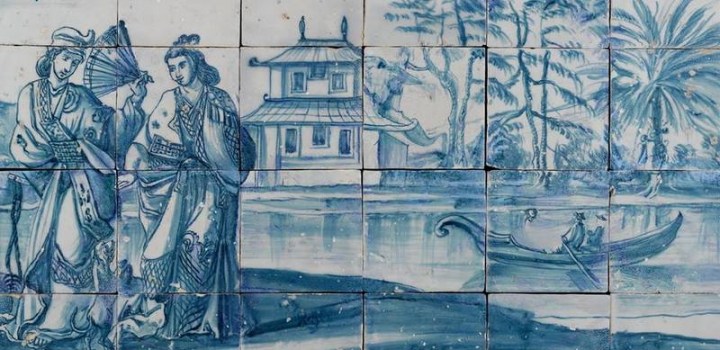
Since 1513, the Portuguese established a direct and regular contact between China and Europe. Taking on the role of suppliers and commercial brokers, Lusitanian adventurers and merchants progressively penetrated that immense kingdom, which was, perchance, the most exotic of the horizons dreamed and created in Europe since the Middle Ages. Exotic is a term of Latin origin, delivered from ancient Greek, meaning ‘outside’, an essential condition to arise one’s condition to marvel as it only exists after it is discovered. To this purpose the exotic object must always be transferred to a new context, in which it is reinterpreted, assuming another importance and meaning. But is the exotic always away from home, or are there moments in which it is ‘at the door’, if not even ‘in house’? These are the questions this exhibition aims to answer, by presenting the influence of China in Portuguese faience and azulejo in the 17th and 18th centuries.
◊ ◊ ◊ ◊ ◊
Dana Thomas writes about Lisbon in the March 2014 issue of Architectural Digest. . .
Be sure to pay a visit to the Museu Nacional do Azulejo (National Tile Museum), set in the opulent Madre de Deus Convent. Artist Joana Vasconcelos, who represented Portugal at last year’s Venice Biennale, calls it “one of Lisbon’s best-kept secrets.” The gem of the museum’s collection is a 75-foot-long mural from 1738 that’s made up of 1,300 tiles illustrating Lisbon before the earthquake of 1755, a cataclysm that destroyed much of the city and killed as many as 60,000 residents. Another impressive display of azulejos can be found at the São Vicente de Fora Monastery, which is decorated with tile panels depicting French poet Jean de La Fontaine’s fables. The hilltop monastery, in the historic residential neighborhood of Alfama, offers some of the finest views of the city. . .
The full article is available here»
Exhibition | By George! Handel’s Music for Royal Occasions
Press release for The Foundling exhibition:
By George! Handel’s Music for Royal Occasions
The Foundling Museum, London, 7 February — 18 May 2014

Robert Sayer, A Perspective view of the building for the fireworks in the Green Park taken from the reservoir, ca. 1749 (London: The Foundling Museum, Gerald Coke Handel Collection)
◊ ◊ ◊ ◊ ◊
No composer has been more closely associated with the British monarchy than German-born George Frideric Handel (1685–1759). His anthem Zadok the Priest has been performed at every coronation since that of King George II on 11 October 1727, while his Water Music was performed in 2012 on the River Thames for the Diamond Jubilee of Queen Elizabeth II.
In the 300th anniversary year of the coronation of George I, the first Hanoverian king, this fascinating new exhibition explores Handel and his music for royal occasions, drawing on the Gerald Coke Handel Collection at the Foundling Museum and significant loans from major institutions including the British Library, Lambeth Palace, and the National Portrait Gallery.
Handel enjoyed the patronage of three British monarchs during his lifetime: Queen Anne, George I, and George II. Employed by George I in Hanover, Handel had the advantage of knowing the new king before he ascended the British throne in 1714. Although he was not appointed Master of the King’s Musick, Handel was favoured by George I and his family, while the appointed Master was left to compose music for smaller, less significant occasions. Handel tutored the royal princesses and composed music for almost all important royal events. He went on to compose the coronation anthems for George II, as well as the Music for the Royal Fireworks and the famous Water Music.

Philip Mercier, The Music Party (Frederick Lewis, Prince of Wales, and his sisters: Anne, Princess Royal and Princess of Orange; Princess Caroline Elizabeth; and Princess Amelia Sophia Eleanora), 1733 (London: The National Portrait Gallery)
Exhibits include paintings of the royal family and the 1727 Order of Service for the Coronation of George II, annotated by the Archbishop of Canterbury. Musical instruments of the period will be displayed alongside autograph manuscripts including Zadok the Priest, the Ode for the Birthday of Queen Anne, and Lessons for Princess Louisa, which Handel composed to teach the royal princesses to play the harpsichord. Rarely-seen documents from the archives of Westminster Abbey give an insight into the organisation of major royal events.
The Librarian of the Gerald Coke Handel Collection, Katharine Hogg, said: “Handel combined his musical genius with an ability to place himself at the heart of the British establishment, while retaining his independence as an entrepreneur and philanthropist. His identity as part of the British musical tradition and his legacy of quintessentially British music reflects his ability to adapt his musical skills to meet the expectations of his patrons and audiences.”
Handel was a governor of the Foundling Hospital. He donated the organ to its Chapel, composed an anthem for the Hospital, and conducted annual fundraising concerts of Messiah. Today’s charity concerts and fundraising auctions can trace their roots back to the Foundling Hospital and the remarkable creative philanthropy of Handel.
The Foundling Museum’s Director, Caro Howell said: “By exploring Handel’s royal relationships here, in the context of a home for the most vulnerable children, we’re revealing two sides of a remarkable artist. The musician who personally tutored the royal princesses also oversaw the music at the Foundling Hospital’s chapel where illegitimate and abandoned children were christened. The composer who directed the music at lavish and unique royal events, including the Royal Fireworks, exploited the same appetite for scale by conducting fundraising concerts at the Hospital.”
By George! is accompanied by a series of public events, including a concert by the Academy of Ancient Music [on Tuesday, March 18], performances of Handel’s music for nursery children, and eighteenth-century dancing and costume workshops. By George! opens a year of celebration at the Foundling Museum.
The Foundling Museum celebrates its 10th anniversary in June 2014. This milestone year coincides with three significant anniversaries in the story we tell: the 275th anniversary of the establishment of the Foundling Hospital, the UK’s first children’s charity; the 250th anniversary of the death of William Hogarth, whose donation of paintings to the Hospital created England’s first public art gallery; and the 300th anniversary of the coronation of George I, the first Hanoverian king. We will be marking this year of celebration and commemoration with a series of major exhibitions, events and the re-opening our Introductory Gallery after a major refurbishment.
Additional images are available as a PDF file here»
Exhibition | Ruin Lust
For anyone with Richard Wilson on the mind, he turns up in Tate Britain’s ruin exhibition, too.
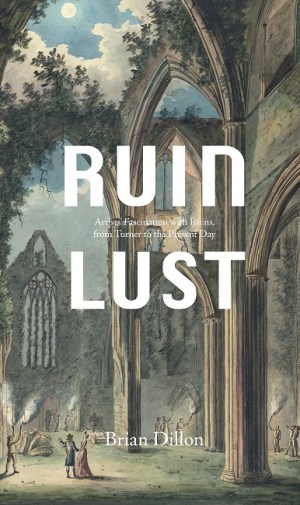
Ruin Lust
Tate Britain, London, 4 March — 18 May 2014
Curated by Brian Dillon, Emma Chambers, and Amy Concannon
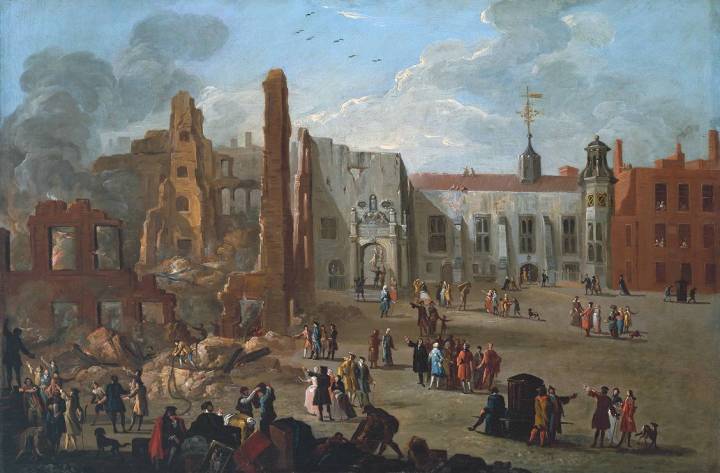
Richard Wilson, The Inner Temple after the Fire of 4 January 1737, oil on canvas, 1737 (Tate Britain). The picture records the devastation caused by a fire that destroyed Crown-Office Row in the Inner Temple. The group in the centre includes Frederick, Prince of Wales (in blue, wearing the Garter star), who had sent fifty soldiers to help the firemen and later came to inspect the scene himself. More information is available here»
◊ ◊ ◊ ◊ ◊
Ruin Lust, an exhibition at Tate Britain from 4 March 2014, offers a guide to the mournful, thrilling, comic and perverse uses of ruins in art from the eighteenth century to the present day. The exhibition is the widest-ranging on the subject to date and includes over 100 works by artists such as J.M.W. Turner, John Constable, John Martin, Eduardo Paolozzi, Rachel Whiteread, and Tacita Dean.
The exhibition begins in the midst of the craze for ruins that overtook artists, writers and architects in the eighteenth century. J.M.W. Turner and John Constable were among those who toured Britain in search of ruins and picturesque landscapes, producing works such as Turner’s Tintern Abbey: The Crossing and Chancel, Looking towards the East Window 1794 and Constable’s Sketch for ‘Hadleigh Castle’ c.1828–29.
 This ruinous heritage has been revisited—and sometimes mocked—by later artists such as Keith Arnatt, who photographed the juxtaposition of historic and modern elements at picturesque sites for his deadpan series A.O.N.B. (Areas of Outstanding Natural Beauty) 1982–84 and John Latham whose sculpture Five Sisters Bing 1976, which was part of a project to turn post-industrial shale heaps in Scotland into monuments. Classical ruins have a continued presence in the work of Eduardo Paolozzi, Ian Hamilton Finlay, and John Stezaker. In works such as Keith Coventry’s Heygate Estate 1995 and Rachel Whiteread’s Demolished—B: Clapton Park Estate 1996, which shows the demolition of Hackney tower blocks, we see Modernist architectural dreams destroyed.
The exhibition explores ruination through both the slow picturesque decay and abrupt apocalypse. John Martin’s The Destruction of Pompeii and Herculaneum 1822 recreates historical disaster while Gustave Doré’s engraving The New Zealander 1872 shows a ruined London. The cracked dome of St Paul’s Cathedral in the distance was a scene partly realised during the Blitz.
Ruin Lust will include work provoked by the wars of the twentieth century, including Graham Sutherland’s Devastation series 1940–41, which depicts the aftermath of the Blitz and Jane and Louise Wilson’s 2006 photographs of the Nazis’ defensive Atlantic Wall. Paul Nash’s photographs of surreal fragments in the 1930s and 40s, or Jon Savage’s images of a desolate London in the late 1970s show how artists also view ruins as zones of pure potential, where the world must be rebuilt or reimagined.
The exhibition will include rooms devoted to Tacita Dean and Gerard Byrne. Dean’s nostalgic film installation Kodak 2006 explores the ruin of the image, as the technology of 16 mm film becomes obsolescent. In 1984 and Beyond 2005–07, Byrne reimagines a future that might have been. The installation presents a re-enactment of a discussion, published in Playboy in 1963, in which science fiction writers—including Isaac Asimov, Ray Bradbury, and Arthur C. Clarke—speculate about what the world might be like in 1984.
This transhistorical exhibition is curated by writer and critic Brian Dillon; Emma Chambers, Curator of Modern British Art; and Amy Concannon, Assistant Curator of British Art, 1790–1850. It will be accompanied by a book and a programme of talks and events in the gallery.
◊ ◊ ◊ ◊ ◊
From Tate Britain’s bookshop:
Brian Dillon, Ruin Lust: Artists’ Fascination with Ruins from Turner to the Present Day (London: Tate Publishing, 2014), 64 pages, ISBN: 978-1849763011, £10 / $22.
Why are we fascinated by ruins? They recall the glory of dead civilisations and the certain end of our own. They stand as monuments to historic disasters, but also provoke dreams about futures born from destruction and decay. Ruins are bleak but alluring reminders of our vulnerable place in time and space. For centuries, ruins have attracted artists: among them J.M.W. Turner, Gustave Doré, Paul Nash, Graham Sutherland, Patrick Caulf eld, Tacita Dean, and Jane and Louise Wilson. Ruin Lust explores the history of this obsession, from the art of the picturesque in the eighteenth century, through the wreckage of two world wars, to contemporary artists complex attitudes to the ruins of the recent past.
Brian Dillon is a novelist, critic, and curator who has explored many ancient and modern ruins and written widely on the history of ruination in art and culture. His books include: Objects in this Mirror: Essays; Sanctuary; In the Dark Room; and Ruins, an anthology of artists and critics reflections on ruination. He is UK editor of Cabinet magazine and reader in critical writing at the Royal College of Art.
Exhibition and Lectures | Diverse Maniere: Piranesi, Fantasy and Excess
From the Soane Museum:
Diverse Maniere: Piranesi, Fantasy and Excess
Sir John Soane’s Museum, London, 7 March — 31 May 2014
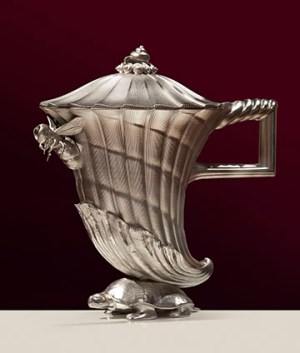
Coffee pot from Piranesi’s Diverse maniere d’adornare i cammini… (1769), cast in silver from digitally modeled elements © Factum Arte.
Sir John Soane’s Museum has one of the richest holdings of graphic work by Piranesi and this exhibition continues the exploration of Soane’s interest in Piranesi. Diverse Maniere will focus upon Piranesi’s engagement with the decorative arts. The displays will consist of meticulous three dimensional reproductions of the objects, such as coffee pots, chairs, chimneypieces and antique candelabra, tripods and altars imagined by Piranesi in such publication as Diverse Maniere or Vasi, Candelabri, Cippi etc…, but never actually realised physically. Now using the latest scanning and 3-dimensional printing technologies Factum Arte has realised Piranesi’s vision as a designer. Bronze Tripods, porphyry altars and marble candelabra will embellish the rooms of No 13 Lincoln’s Inn Fields, whilst in the Soane Gallery a display of Piranesi’s related etchings and explication of Factum Arte’s work will accompany the show. Surely, Sir John Soane, with his love of new technologies, his collections of plaster ‘reproductions’ after the antique, and his fascination with Piranesi’s boundless imagination would find this a particularly appropriate exhibition.
As part of our programme of events, three panel discussions, involving architects, designers, artists and academics, will look at how different disciplines approach these issues and what they might tell us about architectural and design practice in the past and how it has evolved today. All talks will begin at 6pm and take place at the Royal College of Surgeons, WC2A 3PE. Early bird ticket offer: purchase tickets for all three talks for £40. Individual lecture tickets, £15. Click here to find out more or to purchase tickets.
Visualising Design Ideas, 10 March 2014
Speakers: Michele de Lucchi, Ross Lovegrove and Adam Lowe
Using Objects as Evidence of Themselves, 18 March 2014
Speakers: Jerry Brotton, Lisa Jardine and Grayson Perry
Casts, Copies & the Dissemination of Design Ideas, 19 May 2014
Speakers: Adriano Aymonino and Sam Jacob
Display | Art, Revolution and War: France, 1789–1914
From The Fitzwilliam:
Art, Revolution and War: France, 1789–1914
The Fitzwilliam Museum, Cambridge, 4 March — 28 September 2014
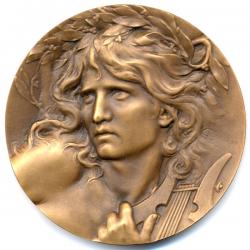 Medals, coins, and banknotes illustrate key moments in the political and artistic history of France. This display focuses on the 1789 revolution, Napoleon, the 1848 revolution, and the artistic triumphs of Art Nouveau. One of the most famous examples of the Art Nouveau style in French medals is Orphée by Marie-Alexandre Lucien Coudray (pictured right). This was exhibited to great acclaim at the 1900 Universal Exhibition in Paris, with thousands of copies sold to art lovers.
Display | From Root to Tip: Botanical Art in Britain
From The Fitzwilliam:
From Root to Tip: Botanical Art in Britain
The Fitzwilliam Museum, Cambridge, 28 January — 11 May 2014
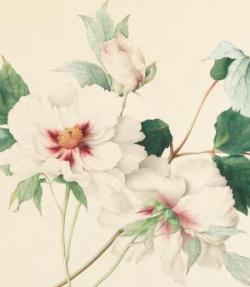 This exhibition brings together a selection of watercolours from the Fitzwilliam’s outstanding collection of botanical art. It draws on over 300 years of work by both professional and amateur artists, tracing a history of flower drawing in Britain. Works on show date from the seventeenth century to present day. See finely executed watercolours by many well-known and influential artists, including Georg Dionusius Ehret, who settled in Britain in 1736, and William Henry Hunt. These are displayed alongside recently acquired pieces by contemporary artists such as Margaret Stones and Rebecca John. The exhibition shows how artists have depicted plants and flowers in glorious detail as both botanical specimens and as part of decorative arrangements.










 Enfilade
leave a comment