Catalogue | Art and Music in Venice
This catalogue accompanies the exhibition Venice: The Golden Age of Art and Music, which opened last weekend at the Portland Museum of Art. From Yale UP:
Hilliard T. Goldfarb, ed., Art and Music in Venice: From the Renaissance to Baroque (New Haven: Yale University Press, 2013), 240 pages, ISBN: 978-0300197921, $65.
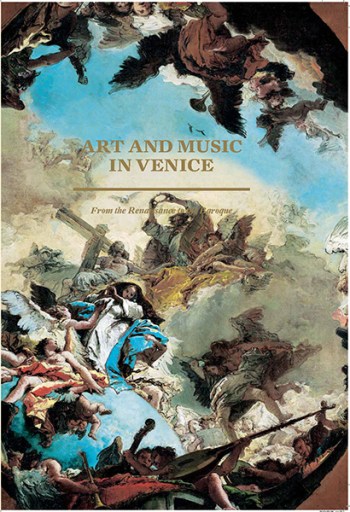 Artistic and musical creativity thrived in the Venetian Republic between the early 16th century and the close of the 18th century. The city-state was known for its superb operas and splendid balls, and the acoustics of the architecture led to complex polyphony in musical composition. Accordingly, notable composers, including Antonio Vivaldi and Adrian Willaert, developed styles that were distinct from those of other Italian cultures. The Venetian music scene, in turn, influenced visual artists, inspiring paintings by artists such as Jacopo Bassano, Canaletto, Francesco Guardi, Pietro Longhi, Bernardo Strozzi, Giambattista and Domenico Tiepolo, Tintoretto, and Titian. Together, art and music served larger aims, whether social, ceremonial, or even political. Lavishly illustrated, Art and Music in Venice brings Venice’s golden age to life through stunning images of paintings, drawings, prints, manuscripts, textbooks, illuminated choir books, musical scores and instruments, and period costumes. New scholarship into these objects by a team of distinguished experts gives a fresh perspective on the cultural life and creative output of the era.
Hilliard T. Goldfarb is associate chief curator and curator of Old Masters at the Montreal Museum of Fine Arts.
Exhibition | The Material World of the Early South
From the press release (10 February 2014). . .
A Rich and Varied Culture: The Material World of the Early South
DeWitt Wallace Decorative Arts Museum, Colonial Williamsburg, opens 14 February 2014
Curated by Ronald Hurst and Margaret Beck Pritchard

Powder Horn, attributed to Jonathan Sarrazin, Charleston, South Carolina, cow horn, 1762–64 (Winston-Salem, NC: The Museum of Early Southern Decorative Arts)
◊ ◊ ◊ ◊ ◊
A groundbreaking exhibition examining the material culture of the early South from the 17th century through 1840—the first of its kind to include a wide variety of media—will open at the DeWitt Wallace Decorative Arts Museum, one of the Art Museums of Colonial Williamsburg, on February 14. A Rich and Varied Culture: The Material World of the Early South will feature a dozen categories of media and represent three geographic regions of the South.
Some 350 objects will be drawn from the Colonial Williamsburg collections, those of 10 other institutions and 14 private collections. Many of the items in the exhibition will be on public view for the first time in a museum setting. Like the culture they represent, the objects are diverse, chronologically telling the story of the region’s population as it expanded westward and southward toward the frontier.
“The early American South has long been depicted as a society that produced almost none of the objects used by its substantial populace,” said Ronald L. Hurst, Colonial Williamsburg vice president for collections, conservation, and museums and its Carlisle H. Humelsine Chief Curator. “However, the opposite is true. Southern artists and artisans generated a vast body of material in virtually every medium. The abundance and diverse cultural resonance of these goods will be powerfully conveyed by the objects assembled for this exhibition.”
Featured in A Rich and Varied Culture will be furniture, paintings, prints, metals (silver and pewter), ceramics, mechanical arts and arms, architectural elements, archaeological objects, rare books, maps, costumes and accessories and musical instruments. These objects are each receiving detailed, exhaustive research that sometimes challenges previous research. In one example, a remarkable painting of Frances Parke Custis, on loan from Washington and Lee University, has recently been identified as the work of the Broadnax Limner, a little-known artist who worked in Virginia during the 1720s. Similarly, an elaborately decorated 1770s ‘dresser’ or hutch was long thought to be a Pennsylvania product, but has proven instead to be the work of a Quaker cabinetmaker working in Alamance County, N.C.
While the majority of the objects and paintings in the exhibition come from the various collections of the Colonial Williamsburg Foundation, several sister institutions are also lending to this important undertaking in an example of unprecedented partnership. Chief among them is The Museum of Early Southern Decorative Arts (MESDA) at Old Salem Museums and Gardens in Winston-Salem, N.C., with which the Art Museums recently announced a five-year partnership. It is the largest lender with 39 objects. Other lenders include Drayton Hall, a Historic Site of the National Trust for Historic Preservation in Charleston, S.C..; The Charleston Museum; Washington and Lee University in Lexington; The Winterthur Museum, Garden, and Library in Winterthur, Del.; Historic Charleston Foundation; Tennessee State Museum; the University of Tennessee’s Department of Anthropology and McClung Museum of Natural History and Culture; Marble Springs State Historic Site in Knoxville, Tenn.; and The President’s House Collection at The College of Williams & Mary in Williamsburg. Fourteen private collectors are also generously lending to the exhibition. (more…)
Valentine’s Day at the Museum of London
As reported by Nick Clark for The Independent (30 January 2014). . .
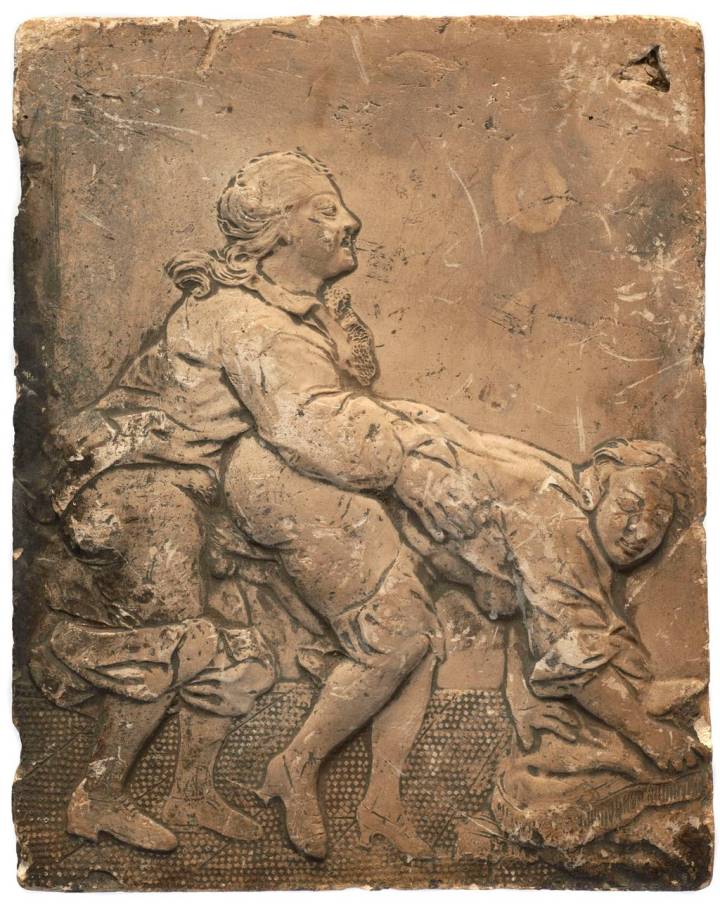
Detail of one of eight eighteenth-century plaster tiles discovered in 1962. Click on the image for the full view of another tile (with usual warnings about sexually explicit images).
For one night only. . . amorous visitors to the Museum of London will have the chance to see the steamy side of the 18th century. A series of erotic tiles, detailing various sexual positions and even spanking, will go on display for the first time at a late-night Valentine’s Day event at the site in the heart of the City. The eight tiles were discovered in 1962 after a fire in an upper room of one of London’s most memorable old pubs and remain shrouded in mystery.
Jackie Keily, curator at the museum, said: “We can’t normally display them because they are so graphic. It is a fascinating glimpse into the sexual history of London; so few of these artefacts survive.”
They will be part of an evening event called Late London: City of Seduction which is open to over 18-year-olds only. The tiles were discovered in 1962 following a fire at Ye Old Cheshire Cheese pub on Fleet Street and were handed to the museum shortly after.
The full article, with additional photos, is available here»
Details of Late London: City of Seduction are available here»
Exhibition | Capturing the Castle: Watercolours of Windsor
From the exhibition press release (18 December 2013). . .
Capturing the Castle: Watercolours of Windsor by Paul and Thomas Sandby
The Drawings Gallery, Windsor Castle, 7 February — 5 May 2014
Curated by Rosie Razzall

Paul Sandby, The Lower Ward Seen from the Base of the Round Tower,
ca. 1760 (The Royal Collection)
◊ ◊ ◊ ◊ ◊
Twenty views of Windsor Castle by the great 18th-century watercolourists Paul and Thomas Sandby go on display at the Castle from 7 February. Created from the 1760s to the 1790s, they provide a fascinating insight into life at Windsor during the reign of George III (1760–1820), who used the Castle as an occasional country retreat for his growing family. The drawings will be displayed alongside a number of early guidebooks, showing what visitors to Windsor would have experienced some 250 years ago. 21st-century visitors can use a free app to explore the 18th-century views and compare them with the appearance of the Castle today.
 ‘The father of English watercolour’, Paul Sandby (1730–1809) and his older brother Thomas (1721–98) were among the founding members of the Royal Academy under the patronage of George III in 1768. They sometimes worked together, with Paul Sandby adding figures to his older brother’s landscapes.
Thomas Sandby was Draughtsman to William Augustus, Duke of Cumberland, and came to Windsor in 1746 following the Duke’s appointment as Ranger of Windsor Great Park. After Paul’s arrival in Windsor a few years later, the brothers set about producing views of the Castle from numerous angles and viewpoints, creating an unrivalled visual record of the building and surrounding area.
During this period the Castle became a popular tourist destination—the Precincts were open to the public, and access to the State Apartments was granted upon application to the Housekeeper. The Sandby watercolours show the informality of daily life around the Castle in the mid-18th century. They record soldiers chatting idly with the townsfolk, street traders hawking their wares, and elegantly dressed visitors strolling on the North Terrace, from where they could admire the views across the Thames Valley. The watercolours also document the appearance of the Castle before the major remodelling of the building by George III’s son, George IV, in the 1820s. In Paul Sandby’s View of the Quadrangle, from around 1765, the Round Tower appears significantly lower than it is today. Sixty-five years later it was heightened by some nine metres (30ft), and given Gothic-style battlements and a flag turret, creating Windsor’s now world-famous skyline.
◊ ◊ ◊ ◊ ◊
The Royal Collection Acquires Rare Portrait of Paul Sandby

Paul Sandby, The Quadrangle Looking West, ca. 1765
(The Royal Collection)
◊ ◊ ◊ ◊ ◊
Press release (4 February 2014) . . .
He is known for his beautiful views of Windsor, providing a fascinating insight into life at the Castle during the reign of George III (1760–1820). Now, 250 years later, a portrait miniature of Paul Sandby (1731–1809), ‘the father of English watercolour’, will go on display in a new exhibition at Windsor Castle and return the artist to the royal residence where he made his name. One of only a few known images of the artist, the miniature has been acquired by The Royal Collection Trust for the Royal Collection, which holds one of the world’s largest groups of work by Paul Sandby and his older brother Thomas. The miniature will be shown alongside some of Paul Sandby’s most famous views. The exhibition, Capturing the Castle: Watercolours of Windsor by Paul and Thomas Sandby, includes 20 works produced from the 1760s to the 1790s by the two brothers. They reveal the informality of daily life at Windsor during the reign of George III, who used the Castle as an occasional country retreat for his growing family.
 Despite his successful career as one of the founding members of the Royal Academy, Paul Sandby was rarely painted himself. A half-length portrait, the miniature shows Sandby at the age of 56 against a landscape with Windsor Castle in the background. He wears a blue coat, white waistcoat and cravat, and holds a porte-crayon, used for drawing with pieces of chalk, and an open sketchbook. The miniature was painted in 1787 by the Jersey-born artist Philip Jean (1705–1802), who also produced portraits of the British royal family, including George III and his consort Queen Charlotte.
Born in Nottingham, Paul Sandby arrived at Windsor in the early 1750s, following Thomas’s employment as Draughtsman to William Augustus, Duke of Cumberland (uncle to George III), who had been appointed the Ranger of Windsor Great Park in 1746. The brothers set about producing views of the Castle from numerous angles and viewpoints, creating an unrivalled visual record of the building and surrounding area.
The watercolours record soldiers chatting with the townsfolk, street traders hawking their wares, and elegantly dressed visitors strolling along the North Terrace and admiring the views across the Thames Valley. One particularly noticeable difference between the 18th-century Castle and that today is documented in the Sandbys’ watercolours: in The Quadrangle, Windsor Castle, looking west, c.1765, the iconic Round Tower appears significantly lower. It was heightened by some nine metres (30ft) 65 years later, as part of the George IV’s remodelling of the Castle. Gothic-style battlements and a flag turret were added, creating Windsor Castle’s now world-famous skyline. (more…)
Exhibition | Samuel Hieronymus Grimm, 1733–1794
From Bern’s Kunstmuseum:
Samuel Hieronymus Grimm, 1733–1794: A Very English Swiss
Kunstmuseum, Bern, 17 January — 21 March 2014
Curated by William Hauptman with Therese Bhattacharya-Stettler
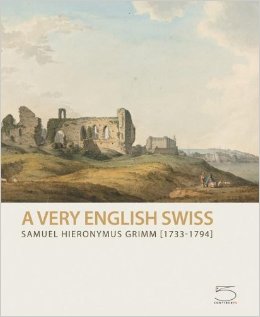 Samuel Hieronymus Grimm (1733–1794) is being presented in a comprehensive exhibition for the very first time. He pursued a career as topographer, illustrator, caricaturist and painter of watercolors, acquiring quite a reputation especially in England.
Grimm was born in Burgdorf and was initially devoted to poetry. Around 1760 he became interested in painting and took lessons with Johann Ludwig Aberli (1723–1786). In 1765 he went to Paris to continue his art studies with Jean-Georges Wille (1715–1808). There Grimm focused on landscape painting, going on long hikes with his art teacher in the countryside. In 1768 he moved to London, where he stayed for the rest of his life, working as both an illustrator and a caricaturist. With biting humor Grimm portrayed British society, fashion and politics. Around 1773, he was commissioned by Sir Richard Kaye to paint to watercolors. Kaye was to become one of his most devoted patrons, giving Grimm carte blanche to capture everything he found ‘unusual’. 2600 watercolors and drawings illustrating everyday subjects in Britain, the country’s architecture and the mores of its people were the outcome of Kaye’s patronage, producing a veritable illustrated encyclopedia of Georgian England during the 18th century. Grimm had numerous additional well-known personages as his patrons whom he accompanied on trips in England and Wales.
Grimm’s great popularity is due to the exactness of his representations; he was renowned for his speed with the pen, his moderate prices, and the perfection of his technique in sketching and painting outdoors. Specialists on British art see in Grimm one of the most talented topographers of his generation, his watercolors leave nothing to be desired and are equal to those of the best British masters of the time.
The exhibition combines examples from every genre Grimm worked in and will be accompanied by a richly illustrated catalogue in German and English. Prof. William Hauptman, Lausanne, is curator of the show, a great specialist for the period. Already in 1996 he was in charge of organizing the large John Webber exhibition at the Kunstmuseum Bern. Dr. Therese Bhattacharya-Stettler is co-curator.
William Hauptman, Samuel Hieronymus Grimm, 1733–1794: A Very English Swiss (Milan: 5 Continents Editions, 2014), 224 pages, ISBN: 978-8874396627, €35 / $45.
Exhibitions | Frozen Thames: Frost Fair, 1684 and 1814
Press release (29 January 2014) from the Museum of London:
Frozen Thames: Frost Fair 1814 and Frozen Thames: Frost Fair 1684 open at the Museum of London Docklands and Museum of London respectively, from Wednesday 29 January to Sunday 30 March 2014. The mini-exhibitions feature objects, paintings, keepsakes, engravings and etchings from the collection.
Why did the Thames freeze?
The Thames could freeze over not necessarily because it was colder these years, but because the river was much more sluggish and slow flowing than today. There was no embankment and the arches of the former London Bridge was much wider and protected by floating pontoons in front of them which impeded the current. Evidence for this is that after 1831 the old London Bridge—resting on its twenty solid piers—was demolished, and replaced with a new bridge with just five arches. No further Frost Fairs have been recorded since. Narrower and with fewer obstacles, the Thames now flows too fast to freeze, and the Thames Frost Fair is a spectacle we will probably never see again.
◊ ◊ ◊ ◊ ◊
Frozen Thames: Frost Fair 1814
Museum of London Docklands, 29 January — 30 March 2014

George Cruikshank and Thomas Tegg,
Gambols on the River Thames, February 1814.
◊ ◊ ◊ ◊ ◊
To the modern observer, it is a scene from London’s history that is difficult to comprehend. For just under one week, from 1 February 1814 until 5 February 1814, the River Thames, the artery of the city, froze completely solid between London Bridge and Blackfriars Bridge. Exactly 200 years ago this week, Londoners of all backgrounds took to the ice to revel in the event.
Georgina Young, Senior Curator at the Museum of London said: “The 1814 Frost Fair brightened the depths of London’s coldest winters. Imagine a travelling carnival and a street market rolled into one. Coffee houses, taverns and souvenir stalls formed improvised streets across the frozen Thames, with entertainments from skittles to swings ranged all around.”
The only surviving piece of gingerbread bought at the 1814 Frost Fair, is among a variety of objects, paintings, keepsakes, engravings and etchings which will go on display as part of two Frost Fair displays, running in parallel at the Museum of London Docklands near Canary Wharf and the Museum of London in the City of London.
The 1814 Fair was the last of its kind, but it was not the first. Between 1309 and 1814, the Thames froze at least 23 times and on five of these occasions, the freeze was extensive enough to support the weight of festivities, and a Frost Fair was born. The Museum of London collection evidences five Fairs in 1683–84, 1716, 1739–40, 1789 and 1814.
The display at the Museum of London Docklands includes a varied collection of original keepsakes from the 1814 Frost Fair, and important contemporary illustrations of the Fair, including two etchings by satirical artist, George Cruikshank, and a print by George Thompson.
For most people, a Frost Fair on the frozen Thames was a once in a lifetime occasion, and all kinds of mementoes were kept. These include fragments of stone chipped from Blackfriars Bridge, printed keepsakes, and a piece of gingerbread, bought at the Fair, which comes with an original handwritten note, identifying the purchaser as Thomas Moxon. The printed items were produced and sold by enterprising printers, who relocated their businesses onto the ice, turning crisis into opportunity. Indeed, when the Thames froze over, the normal workings of London froze with it—even the Thames Watermen converted their boats into temporary stages, and there are reports that an elephant was led across the Thames by Blackfriars Bridge.
◊ ◊ ◊ ◊ ◊
Frozen Thames: Frost Fair 1684
Museum of London, 29 January — 30 March 2014

Abraham Hondius, Frost Fair, 1684
(Museum of London)
◊ ◊ ◊ ◊ ◊
The star objects in the Museum of London display are two paintings by the Dutch artist, working in London, Abraham Hondius (c.1625–91) who was a notable artist in the expanding art market fostered by Charles II. The first painting depicts the frozen Thames in 1677 looking eastwards towards London Bridge (though this was not recorded as a ‘Frost Fair’), and the second, portrays the area of present day Temple on the north side of the river, in the grip of the 1684 Frost Fair.
Pat Hardy, Curator for Paintings, Prints and Drawings at the Museum of London, said: “Hondius brought with him from the Netherlands new painting and print techniques as well as an acute observation of contemporary life. The pleasures of the 1684 Fair are vividly captured.”
The paintings by Hondius appear alongside other works by unknown artists, which depict the 1684 Fair, and a later drawing of the 1716 Frost Fair, which grew even larger than its predecessor.

Frost fair on the Thames in 1715–16, woodcut. This view is taken from
near Temple Stairs, with Old London Bridge in the background.
Exhibition | Handel and Charles Clay’s Musical Clocks
From the Handel House:
Handel and Charles Clay’s Musical Clocks
Handel House Museum, London, 20 November 2013 — 23 February 2014
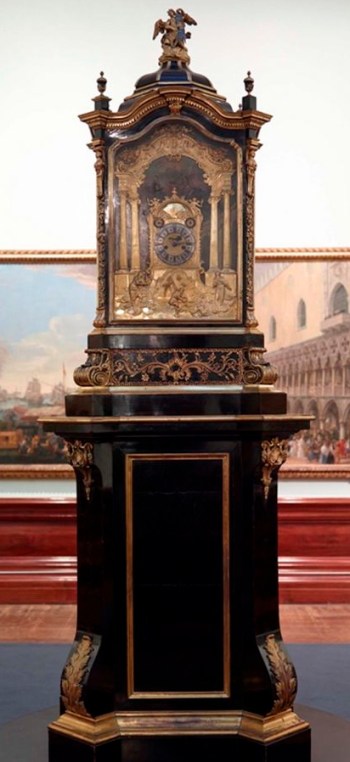 In the 1730s Handel provided music for a series of clocks created by watch and clockmaker Charles Clay. These beautiful machines, which incorporated automata, paintings, sculptures, furniture and gold and silver work by some of the finest artisans in London, also included chimes and pump organs that played extended musical excerpts from popular operas and sonatas.
This exhibition provides the opportunity to view a Clay clock from the Birmingham Museum and Art Gallery in an intimate Georgian setting which recalls the context in which such new inventions were originally viewed in the clockmaker’s own home. It will be joined by a gilt bronze relief from another Clay clock on loan from the V&A, and a manuscript of Handel’s clock tunes from the British Library. In addition, a recording of the music from a Clay clock in a private collection demonstrates the earliest ‘recordings’ of Handel’s music made during his lifetime.
For more information about the Kensington Palace clock, view a video here. For details of the Windsor clock, click here.
The exhibition is kindly supported by the A.C.H.Crisford Charitable Foundation.
◊ ◊ ◊ ◊ ◊
Additional information and images are available from the Handel House; also see a posting at the Antiquarian Horological Society’s blog The Story of Time.
Exhibition | Arlene Shechet: Meissen Recast
From the exhibition press release (20 November 2013). . .
Arlene Shechet: Meissen Recast
RISD Museum, Providence, Rhode Island, 17 January — 6 July 2014
Organized by Judith Tannenbaum

Arlene Shechet, Asian Vase, 2013.
In the first U.S. exhibition of her one-of-a-kind Meissen sculptures, Arlene Shechet presents works she produced during a recent artist residency at the world-renowned German porcelain manufacturer. Arlene Shechet: Meissen Recast is a two-part exhibition on view at the RISD Museum from January 17 to July 6, 2014. It is the utilitarian factory casts behind fine porcelain production, rather than the ornate ceramic confections, that inform Shechet’s ‘Meissen’ series. Her range of sculpture brings to the fore the seams, plate impressions, indentations, inventory numbers, and other evidence of the industrial process that an 18th-century Meissen craftsman would have sought to erase. Almost every sculpture on view in the Museum’s Upper Farago Gallery is derived from one or more of 47 historic Meissen mold patterns, reconceived in unanticipated combinations of forms and scale. Shechet’s complete reinstallation of the Museum’s historic Meissen collection of figurines and tableware in the Porcelain Gallery completes the two-part show, connecting the past and present, fine arts, and decorative arts.
“The Museum is excited to present this compelling new work by RISD alumna Arlene Shechet,” says John W. Smith, director of the RISD Museum. “Meissen Recast extends the Museum’s long and groundbreaking tradition of encouraging artists to use the collection, dating from Andy Warhol’s Raid the Icebox (1970) to Spencer Finch’s Painting Air exhibition (2012). By moving some of RISD’s Meissen figures, including the famous Monkey Band, from their normal location in the Porcelain Gallery to the contemporary Upper Farago Gallery and, conversely, inserting her own porcelain sculptures into the cases of the more traditional, wood-paneled room, she heightens our awareness and appreciation for the refined historical pieces and her own more organic, intuitive approach.” (more…)
Exhibition, Study Group, and Conference | Chinese Wallpaper
This posting depends upon the terrific communication channels maintained by an impressive network of people: Courtney Barnes of Style Court, Emile de Bruijn of Treasure Hunt for the National Trust, and the UCL-based project team for The East India Company at Home, 1757–1857. Anyone interested in participating should follow these links to contact the relevant parties. -CH
◊ ◊ ◊ ◊ ◊
From the latest East India Company at Home Newsletter (January 2014). . .
On 28 January [2014] Helen [Clifford] assisted with the Chinese Wallpaper Study Day held at the National Trust Office at Grosvenor Gardens, London. This event was organised as a means of drawing together those who are active in the Chinese Wallpaper Study Group, begun by Emile de Bruijn, to exchange information and help plan for a major international conference on the subject which we hope will be held this summer. Over 25 attendants included academics, students, curators, conservators, entrepreneurs and property managers.
◊ ◊ ◊ ◊ ◊
◊ ◊ ◊ ◊ ◊
From Woburn Abbey:
Peeling Back the Years: Chinese Wallpaper at Woburn Abbey
Woburn Abbey and Gardens, Bedfordshire, opens 11 April 2014
Curated by Her Grace, The Duchess of Bedford and Lucy Johnson

Chinese white male pheasant on a rock amongst tree peonies; detail from Chinese wallpaper hung in the 4th Duke of Bedford’s private bedchamber at Woburn Abbey, 1752 by Crompton & Spinnage
This exhibition tells the fascinating history of a decorative element with which we all live, in its most inventive and luxurious form. It begins by following one room’s story from the height of opulence in 1752 as the 4th Duke of Bedford’s private bedchamber, to its changing status as the housekeeper’s room, visitor entrance, tribute to the 4th Duke and current exhibition room.
Explore Woburn’s two distinct periods of Chinoiserie in both the house and garden. The recently discovered mid-18th-century wallpaper fragments in the family, private and State apartments were amongst the earliest Chinese wallpapers made for the European market and have not been seen since these rooms were redecorated in the late 18th and early 19th centuries. The second wave of Chinoiserie decoration in the early 19th century shows how taste and designs changed. The V&A has loaned a wallpaper photographed in Lady Ermyntrude’s sitting room in January 1884 and Endsleigh House Hotel, a wallpaper hung when Endsleigh was built as a family fishing lodge. Woburn is also collaborating with the National Trust Wallpaper Trail, and comparisons will be made with related wallpapers at Belton House, Felbrigg Hall, Ightham Moat, Penrhyn Castle, Saltram and Uppark.
A trail of artworks in the collection will show how the passion for Chinoiserie influenced the collecting taste of the Dukes of Bedford. A second trail of Chinoiserie features and Oriental plants will explain how this influence extended into the gardens, winner of the 2013 Georgian Group Architectural Award for Restoration of a Georgian Garden or Landscape.
Experience the processes which allow us to unravel a room’s history. Inventories and invoices show how these wallpapers were discovered, purchased and hung. Watch the story of the discovery, conservation and recreation of the wallpaper found in the 4th Duke’s private bedchamber unfold. See and handle materials used to make and conserve Chinese wallpapers and understand how we care for them today. Peeling Back the Years: Chinese Wallpaper at Woburn Abbey is included within the price of a standard admission ticket to Woburn Abbey and Gardens. Events for all age groups will be held throughout 2014 where visitors can meet the experts and engage in creative design.
Exhibition | The Monuments Men of the Nelson-Atkins
Press release (21 January 2014) from the Nelson-Atkins:
The Monuments Men of the Nelson-Atkins
The Nelson-Atkins Museum of Art, Kansas City, 5 February — 9 March 2014
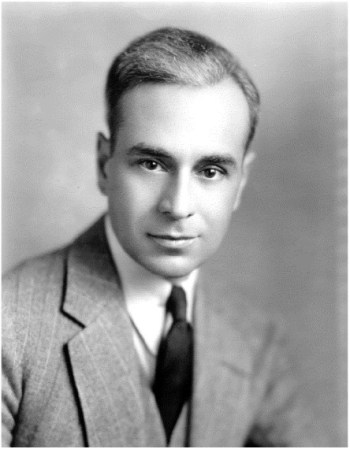
Paul Gardner (1894–1972), director of the Nelson-Atkins Museum of art from 1933 to 1953 (Nelson-Atkins Archive)
As excitement builds for the release of the Sony film The Monuments Men, The Nelson-Atkins Museum of Art applauds six real-life Monuments Men who either worked in or closely with the museum. Monuments men and women, commissioned by Franklin D. Roosevelt during World War II, were tasked with the protection, recovery, and preservation of millions of Europe’s masterpieces during the Nazi occupation.
“The men and women involved in this selfless effort to keep art objects safe during a dangerous time in history showed immense courage,” said Julián Zugazagoitia, CEO and Director of the Nelson-Atkins. “We are deeply in their debt for preserving these treasures for humanity.”
A display of archival materials will be on view in Bloch Lobby that includes postcards, manuscripts, newspaper clippings, and biographies of the Nelson-Atkins’ Monuments Men.
“My research has shown that these six men brought to their military duties the same passion for art and culture that made them so valuable to the Nelson-Atkins,” said MacKenzie Mallon, a researcher in the European Painting & Sculpture Department who has been working on this project for many months. “They took their responsibilities as protectors of these monuments very seriously.”
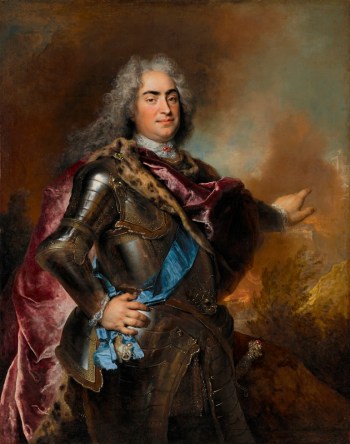
Nicolas de Largillière, Augustus the Strong, Elector of Saxony and King of Poland, ca. 1714–15. Oil on canvas, 58 x 46 inches (146 x 116 cm)
The Nelson-Atkins Museum of Art, Kansas City.
The museum employed four of the Monuments Men and maintained strong ties with two others. Paul Gardner, the first director of the Nelson-Atkins, served as Director of the Fine Arts Section of the Allied Military Government in Italy. Another former director, Laurence Sickman, was assigned to General Douglas MacArthur’s Tokyo headquarters after the Japanese surrender and served as a technical advisor on collections and monuments, making trips to China and Korea to assess the level of damage to monuments in those countries. He was awarded the Legion of Merit for his war services.
The first curator of European Art at the museum, Patrick J. Kelleher, served as the head of the Greater Hesse Division of the Monuments, Fine Arts and Archives section. Otto Wittmann, Jr., the first curator of Prints for the museum, was part of the OSS Art Looting and Investigation Unit (ALIU).
Langdon Warner served as the Asian art advisor to the Trustees of the Nelson-Atkins in 1930 and was a close colleague of Sickman. He helped found the American Defense-Harvard Group, a precursor of the Roberts Commission, Roosevelt’s task force. James A. Reeds served with the Monuments, Fine Arts and Archives section in France in 1944. He taught linguistics at University of Missouri at Kansas City and served as a docent for the Nelson-Atkins.
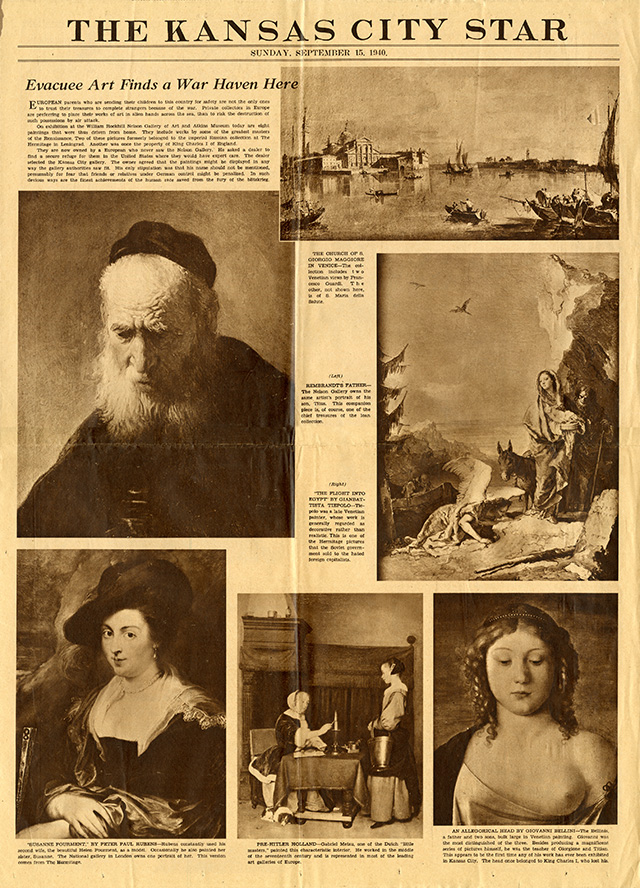
The Kansas City Star (Sunday, 15 September 1940).
One of the finest examples of 18th-century portraiture at the Nelson-Atkins, Nicolas de Largillière’s Augustus the Strong, Elector of Saxony and King of Poland, was found by the Monuments Men in a bomb-rigged salt mine in Alt Aussee, Austria and returned to Clarice de Rothschild, whose family owned the painting. It was purchased by the Nelson-Atkins in 1954 after Rothschild sold it to an art dealer in New York. During World War II, the Nelson-Atkins also served as a safe house for more than 150 paintings and tapestries from collections on the East and West coasts.
U.S. Senator Roy Blunt from Missouri recently introduced a bipartisan bill that would award Congressional Gold Medals to all 350 of the men and women referred to as Monuments Men. “The Nelson-Atkins has a rich history which is only enhanced by the individuals who have worked there,” said Senator Blunt. “These Monuments Men protected historical artifacts from destruction and saved these treasures for future generations. I am proud to introduce legislation to award the Congressional Gold Medal to the men and women who fought to preserve this priceless history.”
The Monuments Men, starring George Clooney and Matt Damon, will be released nationally on February 7. The film is based on the book The Monuments Men: Allied Heroes, Nazi Thieves and the Greatest Treasure Hunt in History by Robert M. Edsel, who continued his investigation into the soldiers who rescued cultural treasures in Saving Italy. The latter book discusses the heroism of former Nelson-Atkins director Paul Gardner. Edsel has created the Monuments Men Foundation for the Preservation of Art, which honors the legacy of the Monuments Men. For more information, visit monumentsmenfoundation.org.
◊ ◊ ◊ ◊ ◊
◊ ◊ ◊ ◊ ◊
Writing about the film for The NY Times, Tom Mashberg offers this important reminder:
Tom Mashberg, “Not All Monuments Men Were Men,” The New York Times (29 January 2014).
The art-hunting team, officially known as the Monuments, Fine Arts and Archives Section, grew to more than 300 people in the postwar years. The women never numbered more than a few dozen, but, like the men, they were dedicated scholars and at times notable heroes.
Rose Valland, whose role is depicted briefly by Cate Blanchett in the film, was a French Resistance operative who spied on the Nazis and showed herself able to shoot and drink with the boys. Edith A. Standen was a captain in the Women’s Army Corps who went on to a career at the Metropolitan Museum of Art [serving as curator of textiles from 1940 to 1970]. And Ms. Hall was a Smith College graduate who came to the task from a career focused on the study of Asian art. . . .
The full article is available here»










 Enfilade
leave a comment