Exhibition, Study Group, and Conference | Chinese Wallpaper
This posting depends upon the terrific communication channels maintained by an impressive network of people: Courtney Barnes of Style Court, Emile de Bruijn of Treasure Hunt for the National Trust, and the UCL-based project team for The East India Company at Home, 1757–1857. Anyone interested in participating should follow these links to contact the relevant parties. -CH
◊ ◊ ◊ ◊ ◊
From the latest East India Company at Home Newsletter (January 2014). . .
On 28 January [2014] Helen [Clifford] assisted with the Chinese Wallpaper Study Day held at the National Trust Office at Grosvenor Gardens, London. This event was organised as a means of drawing together those who are active in the Chinese Wallpaper Study Group, begun by Emile de Bruijn, to exchange information and help plan for a major international conference on the subject which we hope will be held this summer. Over 25 attendants included academics, students, curators, conservators, entrepreneurs and property managers.
◊ ◊ ◊ ◊ ◊
◊ ◊ ◊ ◊ ◊
From Woburn Abbey:
Peeling Back the Years: Chinese Wallpaper at Woburn Abbey
Woburn Abbey and Gardens, Bedfordshire, opens 11 April 2014
Curated by Her Grace, The Duchess of Bedford and Lucy Johnson

Chinese white male pheasant on a rock amongst tree peonies; detail from Chinese wallpaper hung in the 4th Duke of Bedford’s private bedchamber at Woburn Abbey, 1752 by Crompton & Spinnage
This exhibition tells the fascinating history of a decorative element with which we all live, in its most inventive and luxurious form. It begins by following one room’s story from the height of opulence in 1752 as the 4th Duke of Bedford’s private bedchamber, to its changing status as the housekeeper’s room, visitor entrance, tribute to the 4th Duke and current exhibition room.
Explore Woburn’s two distinct periods of Chinoiserie in both the house and garden. The recently discovered mid-18th-century wallpaper fragments in the family, private and State apartments were amongst the earliest Chinese wallpapers made for the European market and have not been seen since these rooms were redecorated in the late 18th and early 19th centuries. The second wave of Chinoiserie decoration in the early 19th century shows how taste and designs changed. The V&A has loaned a wallpaper photographed in Lady Ermyntrude’s sitting room in January 1884 and Endsleigh House Hotel, a wallpaper hung when Endsleigh was built as a family fishing lodge. Woburn is also collaborating with the National Trust Wallpaper Trail, and comparisons will be made with related wallpapers at Belton House, Felbrigg Hall, Ightham Moat, Penrhyn Castle, Saltram and Uppark.
A trail of artworks in the collection will show how the passion for Chinoiserie influenced the collecting taste of the Dukes of Bedford. A second trail of Chinoiserie features and Oriental plants will explain how this influence extended into the gardens, winner of the 2013 Georgian Group Architectural Award for Restoration of a Georgian Garden or Landscape.
Experience the processes which allow us to unravel a room’s history. Inventories and invoices show how these wallpapers were discovered, purchased and hung. Watch the story of the discovery, conservation and recreation of the wallpaper found in the 4th Duke’s private bedchamber unfold. See and handle materials used to make and conserve Chinese wallpapers and understand how we care for them today. Peeling Back the Years: Chinese Wallpaper at Woburn Abbey is included within the price of a standard admission ticket to Woburn Abbey and Gardens. Events for all age groups will be held throughout 2014 where visitors can meet the experts and engage in creative design.
Exhibition | The Monuments Men of the Nelson-Atkins
Press release (21 January 2014) from the Nelson-Atkins:
The Monuments Men of the Nelson-Atkins
The Nelson-Atkins Museum of Art, Kansas City, 5 February — 9 March 2014
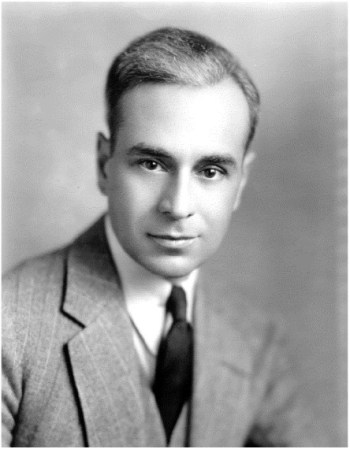
Paul Gardner (1894–1972), director of the Nelson-Atkins Museum of art from 1933 to 1953 (Nelson-Atkins Archive)
As excitement builds for the release of the Sony film The Monuments Men, The Nelson-Atkins Museum of Art applauds six real-life Monuments Men who either worked in or closely with the museum. Monuments men and women, commissioned by Franklin D. Roosevelt during World War II, were tasked with the protection, recovery, and preservation of millions of Europe’s masterpieces during the Nazi occupation.
“The men and women involved in this selfless effort to keep art objects safe during a dangerous time in history showed immense courage,” said Julián Zugazagoitia, CEO and Director of the Nelson-Atkins. “We are deeply in their debt for preserving these treasures for humanity.”
A display of archival materials will be on view in Bloch Lobby that includes postcards, manuscripts, newspaper clippings, and biographies of the Nelson-Atkins’ Monuments Men.
“My research has shown that these six men brought to their military duties the same passion for art and culture that made them so valuable to the Nelson-Atkins,” said MacKenzie Mallon, a researcher in the European Painting & Sculpture Department who has been working on this project for many months. “They took their responsibilities as protectors of these monuments very seriously.”
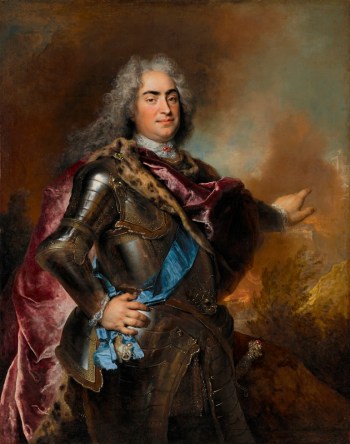
Nicolas de Largillière, Augustus the Strong, Elector of Saxony and King of Poland, ca. 1714–15. Oil on canvas, 58 x 46 inches (146 x 116 cm)
The Nelson-Atkins Museum of Art, Kansas City.
The museum employed four of the Monuments Men and maintained strong ties with two others. Paul Gardner, the first director of the Nelson-Atkins, served as Director of the Fine Arts Section of the Allied Military Government in Italy. Another former director, Laurence Sickman, was assigned to General Douglas MacArthur’s Tokyo headquarters after the Japanese surrender and served as a technical advisor on collections and monuments, making trips to China and Korea to assess the level of damage to monuments in those countries. He was awarded the Legion of Merit for his war services.
The first curator of European Art at the museum, Patrick J. Kelleher, served as the head of the Greater Hesse Division of the Monuments, Fine Arts and Archives section. Otto Wittmann, Jr., the first curator of Prints for the museum, was part of the OSS Art Looting and Investigation Unit (ALIU).
Langdon Warner served as the Asian art advisor to the Trustees of the Nelson-Atkins in 1930 and was a close colleague of Sickman. He helped found the American Defense-Harvard Group, a precursor of the Roberts Commission, Roosevelt’s task force. James A. Reeds served with the Monuments, Fine Arts and Archives section in France in 1944. He taught linguistics at University of Missouri at Kansas City and served as a docent for the Nelson-Atkins.
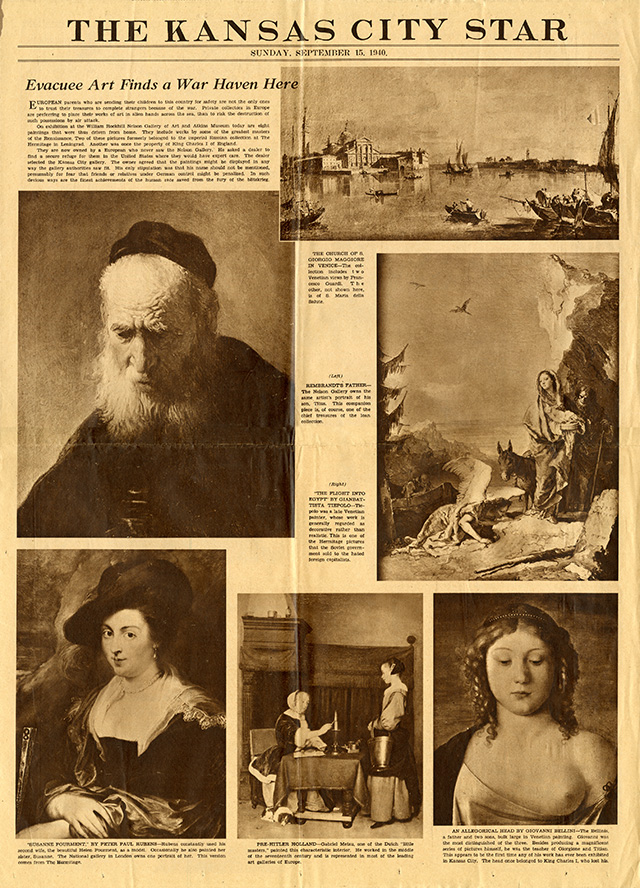
The Kansas City Star (Sunday, 15 September 1940).
One of the finest examples of 18th-century portraiture at the Nelson-Atkins, Nicolas de Largillière’s Augustus the Strong, Elector of Saxony and King of Poland, was found by the Monuments Men in a bomb-rigged salt mine in Alt Aussee, Austria and returned to Clarice de Rothschild, whose family owned the painting. It was purchased by the Nelson-Atkins in 1954 after Rothschild sold it to an art dealer in New York. During World War II, the Nelson-Atkins also served as a safe house for more than 150 paintings and tapestries from collections on the East and West coasts.
U.S. Senator Roy Blunt from Missouri recently introduced a bipartisan bill that would award Congressional Gold Medals to all 350 of the men and women referred to as Monuments Men. “The Nelson-Atkins has a rich history which is only enhanced by the individuals who have worked there,” said Senator Blunt. “These Monuments Men protected historical artifacts from destruction and saved these treasures for future generations. I am proud to introduce legislation to award the Congressional Gold Medal to the men and women who fought to preserve this priceless history.”
The Monuments Men, starring George Clooney and Matt Damon, will be released nationally on February 7. The film is based on the book The Monuments Men: Allied Heroes, Nazi Thieves and the Greatest Treasure Hunt in History by Robert M. Edsel, who continued his investigation into the soldiers who rescued cultural treasures in Saving Italy. The latter book discusses the heroism of former Nelson-Atkins director Paul Gardner. Edsel has created the Monuments Men Foundation for the Preservation of Art, which honors the legacy of the Monuments Men. For more information, visit monumentsmenfoundation.org.
◊ ◊ ◊ ◊ ◊
◊ ◊ ◊ ◊ ◊
Writing about the film for The NY Times, Tom Mashberg offers this important reminder:
Tom Mashberg, “Not All Monuments Men Were Men,” The New York Times (29 January 2014).
The art-hunting team, officially known as the Monuments, Fine Arts and Archives Section, grew to more than 300 people in the postwar years. The women never numbered more than a few dozen, but, like the men, they were dedicated scholars and at times notable heroes.
Rose Valland, whose role is depicted briefly by Cate Blanchett in the film, was a French Resistance operative who spied on the Nazis and showed herself able to shoot and drink with the boys. Edith A. Standen was a captain in the Women’s Army Corps who went on to a career at the Metropolitan Museum of Art [serving as curator of textiles from 1940 to 1970]. And Ms. Hall was a Smith College graduate who came to the task from a career focused on the study of Asian art. . . .
The full article is available here»
Exhibition | Visions and Nightmares
From the exhibition press release:
Visions and Nightmares: Four Centuries of Spanish Drawings
The Morgan Library & Museum, New York, 17 January — 11 May 2014
Curated by Edward Payne

◊ ◊ ◊ ◊ ◊
It was traditionally assumed that Spanish artists rarely drew, but recent research has demonstrated that drawing was, in fact, central to artistic practice in Spain. Visions and Nightmares: Four Centuries of Spanish Drawings explores the shifting roles and attitudes toward the art of drawing in Spain, as well as the impact of the Catholic Church and the nightmare of the Inquisition on Spanish artists and their work. It is the first exhibition of Spanish drawings ever to be held at the Morgan Library & Museum, whose holdings in this area are relatively small but strong.
On view in the Clare Eddy Thaw Gallery through May 11, the exhibition features more than twenty drawings spanning the sixteenth through the nineteenth centuries. Works by well-known artists such as José de Ribera, Bartolomé Esteban Murillo, and Francisco Goya are presented alongside sheets by equally talented but less familiar artists, including Vicente Carducho, Alonso Cano, and Eugenio Lucas. Complementing the drawings is a display of contemporary Spanish letters and volumes, notably a lavish 1780 edition of Cervantes’ Don Quixote.
“With one of the world’s most important collections of master drawings, the Morgan is committed to developing exhibitions that explore important subjects that may be less familiar or have been overlooked,” said William M. Griswold, Director. “The practice of drawing in Spain is relatively unexplored, by comparison to that in Italy or France, but the extraordinary works in this show demonstrate an artistry and themes unique to their country of origin.”
Among the drawings in the exhibition is one of many sheets preparatory for a series of fifty-six paintings that Vicente Carducho designed for the Charterhouse of El Paular. In the foreground, Father Andrés is tortured using a device called la garrucha; the background reveals his subsequent murder by a mob. Squared for transfer to the oil sketch that preceded the final painting, the drawing bears an inscription by the patron indicating that the suspended figure should be larger and more centrally placed. Carducho incorporated this correction into the finished canvas.
José de Ribera was drawn to violent subjects—notably, the flaying of St. Bartholomew and his pagan counterpart, Marsyas, a satyr who challenged Apollo to a musical contest. As punishment for losing the competition and for his sin of pride, Marsyas was tied to a tree and skinned alive. This drawing depicts the bound satyr screaming, his skin still intact. In a variation on the theme, Ribera portrays Marsyas with human (rather than goat) legs, thus connecting this mythological subject to the artist’s numerous other drawings of bound figures.
On view are three drawings by Alonso Cano, including his masterpiece on paper: a monumental design for the altarpiece of the Chapel of San Diego de Alcalá. Composed of seventeen joined sheets, the work is highly finished, indicating that it was a presentation drawing, offering the patron different options to consider. King Philip IV became patron of the chapel in 1657; his coats of arms appear at the lower left and right of the drawing.
Renowned for his paintings of religious themes, Bartolomé Esteban Murillo made this preparatory drawing for one of his many versions of the Immaculate Conception. The loose, sketchy handling of this sheet is typical of the artist’s later style. The doctrine of the Immaculate Conception—the belief that the Virgin was born free of original sin—was especially popular in seventeenth-century Spain. Here the abstract ideal is embodied by the figure of the Virgin standing on a crescent moon.
Visions and Nightmares includes four drawings by Francisco Goya. Toward the end of his life, the artist drew increasingly for his own pleasure, executing eight albums now lettered A through H and variously named. Pesadilla (Nightmare)—one of two drawings on view from the so-called Black Border Album—depicts a disheveled woman astride a flying bull, her eyes bulging as she screams in terror. Although the image of a woman and bull traditionally personified the European continent, Goya’s drawing seems to symbolize the turmoil in Spain following the Peninsular War.
Eugenio Lucas’s ominous drawing depicts Death reading from an oversized book supported by the back of a kneeling man who serves as a human lectern. Moody and macabre, this sheet recalls the threat of the Inquisition. Also on view is another sheet by Lucas, which depicts a figure shrouded in white, its arms extending toward the top of the page. The latter drawing may be seen as the pendant to Death Reading from a Human Lectern—the two works representing death and resurrection, respectively.
Visions and Nightmares also includes items from the Morgan’s collections of printed books, letters, and music manuscripts. One highlight is a deluxe edition of Don Quixote, commissioned by the Royal Spanish Academy and printed in Madrid in 1780. In addition to lavish engravings, the volume includes editorial revisions to the text, a biography of Cervantes, and the first map to chart Quixote’s itinerary. Also on view is a letter written by Goya to his lifelong friend Martín Zapater, in which he relates the exciting news that he was appointed painter to the Spanish king Charles III, the most prestigious position for an artist in Spain.

◊ ◊ ◊ ◊ ◊
P U B L I C P R O G R A M S
Visions and Nightmares: Four Centuries of Spanish Drawings
Friday, February 7, 6:30 pm
An informal tour with exhibition curator Edward Payne, Moore Curatorial Fellow, Drawings and Prints. Free with museum admission.
Blancanieves (2012, 104 minutes) Director: Pablo Berger
Friday, February 28, 7 pm
“Snow White” is retold in 1920s Seville, with imagery inspired by Francisco Goya. Spain’s Academy Awards submission for Best Foreign Film in 2013, starring Maribel Verdú and Daniel Giménez Carlos. In Spanish with English subtitles. Free with museum admission.
From Inquisition to Enlightenment: Drawing in Spain
Wednesday, March 5, 6:30 pm
Edward Payne, the Morgan’s Moore Curatorial Fellow, will lead this discussion on Spanish drawings with Jonathan Brown, the Carroll and Milton Petrie Professor of Fine Arts, Institute of Fine Arts, NYU, and scholar Lisa Banner. They will explore how new research has altered the perception of the role of drawing in Spain from the sixteenth through the nineteenth centuries, a period that witnessed the horror of the Inquisition, the rise of the Catholic Church, and the intellectual curiosity of the Enlightenment. The exhibition Visions and Nightmares will be open at 5:30 pm for program attendees. Tickets: $15; $10 for members; and free for students with valid ID; 212-685-0008 x560; themorgan.org/programs.
Exhibition | Love & Play: A Pair of Paintings by Fragonard
From the museum’s press release:
Love & Play: A Pair of Paintings by Fragonard
Toledo Museum of Art, 24 January — 4 May 2014

◊ ◊ ◊ ◊ ◊
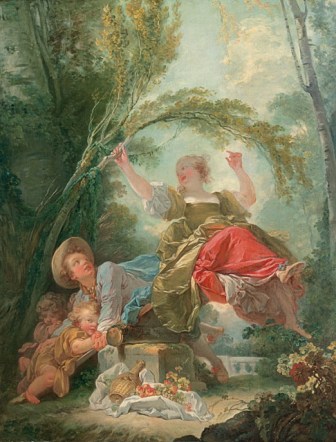
The original wardrobe malfunction might have originated more than 250 years ago, at the hands of a 20-something Frenchman named Jean-Honoré Fragonard. Fragonard was only beginning to discover his niche as a portrayer of thinly veiled eroticism when he painted an errant body part peeking out from his subject’s frilly 18th-century dress. The resulting work of art, Blind Man’s Buff, and its companion, The See-Saw, comprised a pair of paintings that must have delighted his patron with symbolic depictions of seduction.
The two works will be reunited for the first time in 25 years in a special focus exhibition at the Toledo Museum of Art titled Love and Play: A Pair of Paintings by Fragonard, on view January 24 until May 4, 2014 in Gallery 28. It’s the first in the Museum’s Encounters series, concentrated shows and installations that pair exceptional works of art in new or interesting ways.
Blind Man’s Buff, part of the Museum’s collection, and The See-Saw, on loan from the Thyssen-Bornemisza Museum, Madrid, will be displayed alongside two engraved copies of the paintings, a terracotta sculpture by Clodion and a small selection of French decorative arts of the period.
“They’re risqué, they’re provocative—and the artist intended these canvases to be seen together,” said Lawrence W. Nichols, William Hutton senior curator of European and American painting and sculpture before 1900. “So to reunite these two very important paintings by one of the most significant French artists of the 18th century is quite an exciting opportunity.”
Painted in Paris in the first years of the 1750s, they were likely commissioned by Baron Baillet de Saint-Julien and subsequently passed through the hands of private 18th-century collectors, a Parisian comte and a Rothschild. When they came onto the open market in 1954, they were finally separated. (more…)
Exhibition | A Dialogue with Nature: Romantic Landscapes
Press release from Sue Bond:
A Dialogue with Nature: Romantic Landscapes from Britain and Germany
The Courtauld Gallery, London, 30 January — 27 April 2014
The Morgan Library & Museum, New York, 30 May — 7 September 2014
Curated by Rachel Sloan

John Robert Cozens, A Ruined Fort near Salerno, ca. 1782
watercolour on paper (The Courtauld Gallery)
◊ ◊ ◊ ◊ ◊
Organised as a collaboration between The Courtauld Gallery and The Morgan Library & Museum in New York, this exhibition explores aspects of Romantic landscape drawing in Britain and Germany from its origins in the 1760s to its final flowering in the 1840s. Bringing together twenty-six major drawings, watercolours and oil sketches from both collections by artists such as J.M.W. Turner, Samuel Palmer, Caspar David Friedrich, Carl Philipp Fohr, and Karl Friedrich Lessing, it draws upon the complementary strengths of both collections: the Morgan’s exceptional group of German drawings and The Courtauld Gallery’s wide-ranging holdings of British works. A Dialogue with Nature offers the opportunity to consider points of commonality as well as divergence between two distinctive schools. Together, these drawings exemplify Friedrich’s understanding of Romantic landscape draughtsmanship as ‘a dialogue with Nature’.
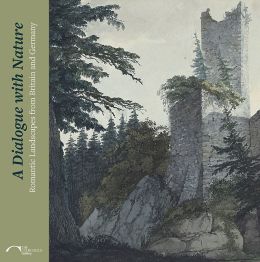 Friedrich claimed that ‘the artist should not only paint what he sees before him, but also what he sees in himself’. His words encapsulate two central elements of the Romantic conception of landscape: close observation of the natural world and the importance of the imagination. The display opens with a selection of drawings made in the late 18th century. The legacy of Claude Lorrain’s ideal vision is visible in both Jakob Philipp Hackert’s magisterial view of ruins at Tivoli, near Rome, and in Thomas Gainsborough’s more informal rendering of a rustic cottage among rolling hills, while cloud and tree studies by John Constable and Johann Georg von Dillis demonstrate the importance of drawing from life and the observation of natural phenomena. This newfound emphasis on drawing out of doors extended to amateur artists as well, exemplified by two remarkable sketchbooks by dilettante draughtsmen, the composer Felix Mendelssohn and the British naval officer Robert Streatfeild.
The important visionary strand of Romanticism is brought to the fore in a group of works centred on Friedrich’s Moonlit Landscape and The Jakobikirche as a Ruin and Samuel Palmer’s Oak Tree and Beech, Lullingstone Park. These are exemplary of their creators’ intensely spiritual vision of nature as well as their strikingly different techniques, Friedrich’s painstakingly fine detail contrasting with the dynamic freedom of Palmer’s penwork.
The final grouping shows Romantic landscapes at their most expansive and painterly, featuring Turner’s St Goarshausen and Katz Castle, one of fifty watercolours inspired by his first visit to Germany in 1817 and his highly atmospheric late rendering of a full moon over Lake Lucerne, as well as Friedrich’s subtle wash drawing of a coastal meadow on the remote Baltic island of Rügen. The exhibition closes with three small-scale drawings revealing a more introspective and intimate facet of the Romantic approach to landscape: Theodor Rehbenitz’s fantastical medievalising scene, Palmer’s meditative Haunted Stream and, lastly, Turner’s Cologne made as an illustration for The Works of Lord Byron (1833), which underscores important links between literature and the visual arts in the ongoing exchange of ideas between Britain and Germany.
A Dialogue with Nature is the first exhibition to be organised jointly by The Courtauld’s IMAF Centre for Drawings and The Morgan Library & Museum’s Drawings Institute. The accompanying publication will feature an essay by Matthew Hargraves (Yale Center for British Art and Morgan-Courtauld Fellow) and individual catalogue entries for each work by Rachel Sloan (The Courtauld Gallery).
From Athena Books/Paul Holberton:
Matthew Hargraves and Rachel Sloan, A Dialogue with Nature: Romantic Landscapes from Britain and Germany (London: Paul Holberton Publishing, 2014), 84 pages, ISBN: 978-1907372667, $25.
Book and Display | Baroque and Later Ivories in the V&A
From the V&A:
Baroque and Later Ivories in the V&A
Victoria & Albert Museum, London, 25 January — 28 September 2014
This is a display of a number of sculptures from the outstanding collection of baroque and later ivories in the V&A, including German, Austrian, Netherlandish, French, British and Hispanic works. A range of objects will be seen: portrait busts, tankards, statuettes, and devotional reliefs. Carved and turned ivories were highly treasured items throughout the seventeenth, eighteenth and nineteenth centuries. They might render dramatic mythological scenes, present exquisitely carved portrait likenesses on a small scale, or depict religious narratives. This small exhibition celebrates the recent publication of a catalogue of these ivories at the V&A.
From the V&A Shop:
Marjorie Trusted, Baroque and Later Ivories in the V&A (London: V&A Publishing, 2013), 544 pages, ISBN: 978-1851777679, £85.
 Over 500 baroque and later ivories from the V&A’s outstanding collection are illustrated and discussed in this scholarly catalogue. This publication includes every ivory sculpture made after 1550 from a collection comprising German, Austrian, Netherlandish, British, French, Italian, Scandinavian, Russian and Spanish pieces, as well as examples from the Philippines, Goa, Sri Lanka and South America. The range of objects is extensive: statuettes, reliefs, tankards, boxes, cabinets, snuff rasps and cutlery handles are all represented. These small-scale sculptures might render dramatic scenes from mythology, present exquisitely carved portrait likenesses on a small scale, or depict religious narratives. The high quality of the V&A’s holdings is readily apparent; leading ivory sculptors to be found here include Francis van Bossuit, Benjamin Cheverton, Balthasar Griessmann, Joachim Henne, Johann Christoph Ludwig Lücke, David Le Marchand, and Balthasar Permoser. In addition to detailed entries on each piece, the Introduction summarises the history and techniques of baroque and later ivory carving, while indexes of subjects and artists, in addition to a comprehensive bibliography, provide a full scholarly apparatus.
Marjorie Trusted is Senior Curator of Sculpture at the V&A. She has published and lectured widely, specializing in European art from the seventeenth century onwards, in particular British and Spanish sculpture. Her books include Spanish Sculpture (V&A 1996), British Sculpture 1470–2000 (co-author, V&A 2002), The Making of Sculpture (V&A 2007), and The Arts of Spain (V&A 2007).
Exhibition | The Image of the European City
From the Correr:
The Image of the European City from the Renaissance to the Enlightenment
Museo Correr, Venice, 8 February — 18 May 2014
Curated by Cesare De Seta
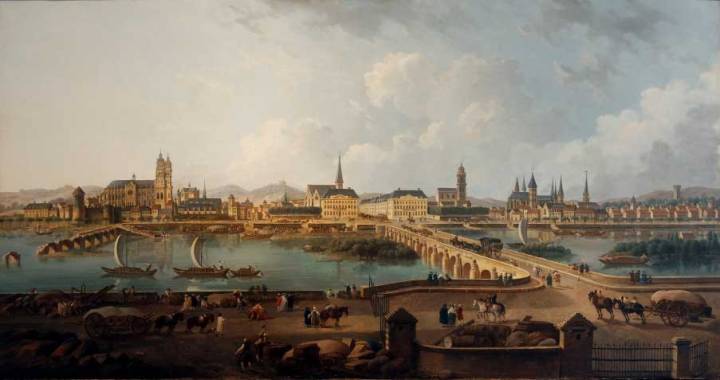
Pierre-Antoine Demachy, Panoramic View of Tours,
1787 (Musée des Beaux-Arts, Tours)
◊ ◊ ◊ ◊ ◊
The fascinating context of the European city from the Renaissance to the Enlightenment is evoked in this exhibition through an extraordinary iconographic repertory comprising over a hundred paintings, prints and drawings from prestigious public and private, Italian and foreign collections.
Ever since the Middle Ages, towns have been a favoured subject in European painting and a means for a state to promoate itself and show off its virtues. The exhibition brings together those global images of an especially high quality that for centuries were the only or most persuasive means for showing off the beauty and wealth of Europe’s leading cities. The exhibition starts with Italy, the first to introduce the imago urbis thanks to the invention of perspective in the early years of the 15th century, providing a fascinating manifesto of the ambitions of popes, princes and sovereigns. Following a chronological and geographic itinerary, the visitor can then travel virtually through cities transformed by time, which for the most part no longer exist in the same way.
For more information, see the press release, available here»
Exhibition | Georgians: 18th-Century Dress for Polite Society
From Bath’s Fashion Museum:
Georgians: 18th-Century Dress for Polite Society
Fashion Museum, Assembly Rooms, Bath, 25 January 2014 — 1 January 2015
 …it being absolutely necessary that propriety of dress should be observed at so polite an assembly as that at Bath. Captain William Wade, Master of Ceremonies, New Assembly Rooms Bath 1771.
The Fashion Museum’s special exhibition for 2014, Georgians, celebrates the museum’s situation in the Georgian Assembly Rooms in Bath. The new exhibition will present a selection of the finest fashions worn by those attending Assemblies, and other glittering occasions of 18th-century life.
An Assembly was defined at the time as “a stated and general meeting of the polite persons of both sexes for the sake of conversation, gallantry, news and play.” As Bath grew in popularity in the 18th century, there was a need for a grand Assembly Room in the fashionable upper town, and in 1771 the New Rooms, designed by John Wood the Younger and financed by public subscription, opened to the public. Today, the New Rooms are known as the Assembly Rooms and are the location of the world-famous Fashion Museum.
Georgians will include over 30 original 18th-century outfits and ensembles from the museum’s world-class collection, including gowns made of colourful and richly patterned woven silks, as well as embroidered coats and waistcoats worn by Georgian gentlemen of fashion. A highlight of the exhibition will be a trio of wide-skirted Court dresses dating from the 1750s and 1760s (held out by cane supports known as panniers, from the French word for baskets), the early years of the reign of King George III. The grand finale of Georgians will include 18th-century-inspired fashions by five top fashion designers: Anna Sui, Meadham Kirchhoff, Vivienne Westwood, Stephen Jones, and AlexanderMcQueen. All are influenced by the 18th-century aesthetic, and all (in different ways) show how the elegance and grace of Georgian dress continues to inspire fashion today.
Exhibition | Fame and Friendship
From the YCBA press release:
Fame and Friendship: Pope, Roubiliac, and
the Portrait Bust in Eighteenth-Century Britain
Yale Center for British Art, New Haven, 20 February — 19 May 2014
Waddesdon Manor, Buckinghamshire, 18 June — 26 October 2014
Curated by Malcolm Baker

Louis François Roubiliac, Portrait Bust of Alexander Pope, 1741, marble (Yale Center for British Art)
Opening in February 2014, the Yale Center for British Art, in collaboration with Waddesdon Manor, will present an exhibition on the eighteenth-century literary figure and poet Alexander Pope (1688–1744), whose sculpted portraits exemplified his fame at a time when the portrait bust was enjoying new popularity. Fame and Friendship: Pope, Roubiliac, and the Portrait Bust in Eighteenth-Century Britain will bring together paintings, sculptures, and materials that convey Pope’s celebrity status, high-lighted by a series of eight busts by Louis François Roubiliac (1702–1762), the leading sculptor of the period, to explore questions of authorship, replication, and dissemination.
Frequently used in antiquity to represent and celebrate writers, the portrait bust became the most familiar way of lauding famous writers in the eighteenth century, as the concept of authorship was being newly conceived. The signed and documented versions of Roubiliac’s busts of Pope, which span the years from 1738 to 1760, are among the most fascinating and iconic images of the poet. These early versions of Roubiliac’s bust are likely to have been made for Pope’s close friends, serving to articulate those friendships that were so important to him. Further, the comparisons of these related versions, together with copies from the period in marble, plaster, and ceramic, will provide a unique and unprecedented opportunity to understand the role of replication and repetition in eighteenth-century sculptural practice.
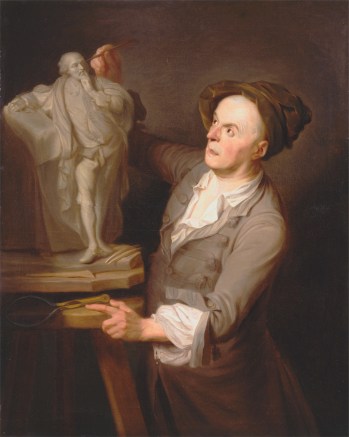
Adrien Carpentiers, Louis-Francois Roubiliac Modelling His Monument to Shakespeare, between 1760 and 1761 (Yale Center for British Art)
Complementing the sculptures of Pope will be busts of other sitters with whom Pope’s image was associated, reflecting the poet’s place in a developing literary canon, as well as a selection of painted portraits of the poet by artists such as Jonathan Richardson the Elder, Jean-Baptiste van Loo, and Sir Godfrey Kneller. Alongside these works will be a range of Pope’s printed texts. With their subtle changes in typography and their carefully planned illustrations and ornamental features, these early editions were produced under the watchful eye of Pope himself and were the outcome of the poet’s direct engagement with the materiality of the book and print.
Also presented will be lesser-known material about the Yale literary critic W. K. Wimsatt, who in the 1960s not only helped to make Yale a major center for the study of eighteenth-century literature (and Pope in particular), but spent twenty-five years researching the poet’s portraits, an achievement celebrated in this exhibition. As Wimsatt recognized, the relationship between Pope’s private persona and public fame was complex and ambiguous. Pope proved adept at managing the two while gradually establishing himself as an independent author, no longer dependent upon the support of noble patrons. Throughout his career, he astutely managed the presentation of his own image and reputation through both his published works and his portraits, especially those by Roubiliac.
Among the busts by Roubiliac will be a terracotta model (ca. 1738) from the collection of the Barber Institute of Fine Arts in Birmingham, England, and four marble pieces that he carved between 1738 and 1741. These busts have been assembled from a number of locations: the Center’s own collection; Temple Newsam House, Leeds Museums and Galleries; and the Shipley Art Gallery, Gateshead (formerly in the possession of the eighteenth-century actor David Garrick). Another, from a private collection, was made for Pope’s close friend, the brilliant young lawyer, William Murray, later first Earl of Mansfield, with whom the poet shared an enthusiasm for both the classics and the visual arts, particularly sculpture. Also on view will be an earlier marble bust of Alexander Pope made in 1730 by the Anglo-Flemish sculptor John Michael Rysbrack (1694–1770), from the collection of the National Portrait Gallery, London.
When this exhibition travels to Waddesdon Manor, the core group of busts of Pope by Roubiliac and some of the contextual material from the Yale Center for British Art will remain the same, but there will be an additional selection of painted portraits, a different range of printed texts lent by the British Library, and material that will illustrate the reception of Pope and his works in France in keeping with Waddesdon’s superb French collections.
Fame and Friendship: Pope, Roubiliac, and the Portrait Bust in Eighteenth-Century Britain is co-organized by the Center and Waddesdon Manor (The Rothschild Collection), where it will travel in June 2014. It is curated by Malcolm Baker, Distinguished Professor of the History of Art at the University of California, Riverside, and Honorary Senior Research Fellow at the Victoria and Albert Museum, London. The organizing curator at the Yale Center for British Art is Martina Droth, Associate Director of Research and Education, and Curator of Sculpture; and at Waddesdon Manor, Dr. Juliet Carey, Senior Curator of Paintings, Sculpture and Works on Paper.
P U B L I C A T I O N S & S C I E N T I F I C S T U D Y
 During the course of the exhibition, Yale University Press will be publishing The Marble Index: Roubiliac and Sculptural Portraiture in Eighteenth-Century Britain, Malcolm Baker’s study of the bust and the statue as genres [scheduled for release in August 2014]. Following the exhibition, a second book will appear as a volume in the series Studies in British Art, published by the Yale Center for British Art and the Paul Mellon Centre in collaboration with Yale University Press. The latter will include essays based on papers presented at the conferences at Yale and Waddesdon organized by the Center, the Paul Mellon Centre in London, and the Rothschild Foundation. It will also incorporate the results of a related research program of detailed digital scanning using the world-class facilities under development at the Yale Digital Collections Center at Yale’s West Campus. By analyzing the busts both visually and technically, this study aims to discover similarities and differences in surfaces, dimensions, construction, and materials, thus shedding new light on the studio practices of eighteenth-century sculptors. These findings will be the focus of a workshop to which leading figures in the field of eighteenth-century sculpture will be invited.
◊ ◊ ◊ ◊ ◊
Note (added 31 May 2014) — A more tightly focused catalogue will also be published by Paul Holberton:
Malcolm Baker, Fame and Friendship: Pope, Roubiliac and the Portrait Bust (London: Paul Holberton Publishing, 2014), 128 pages, ISBN: 978-0954731052, £15 / $25.
◊ ◊ ◊ ◊ ◊
Note (added 13 June 2014) — Waddesdon will host a study day (with a visit to Stowe) on July 10 and a conference on July 12.
Exhibition | The Artist’s View: Landscape Drawings
From the original Crocker Art Museum press release (23 April 2012) . . .
The Artist’s View: Landscape Drawings from the Crocker Art Museum
Crocker Art Museum, Sacramento, 22 September 2012 — 2 January 2013
Snite Museum of Art, Notre Dame, 12 January — 16 March 2014
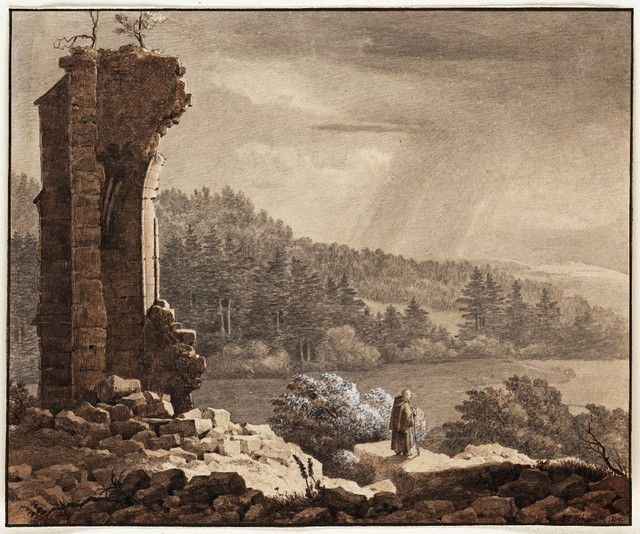
Johann Christoph Erhard, A Monk Visiting Ruins, 1814, graphite and wash on wove paper (Crocker Art Museum)
Featuring works by artists as diverse as Herman van Swanevelt and Camille Corot, this exhibition celebrates the beauty of landscape drawings from the major European schools. Spanning four centuries, The Artist’s View: Landscape Drawings from the Crocker Art Museum consists of 45 of the most important works in the collection, dating from the 16th through the 19th centuries.
This exhibition traces the historical context of landscapes from 17th-century Dutch and Flemish works, including a fine sheet by Anthonie van Waterloo and a newly-attributed Adriaen Frans Boudewijns, through 17th-century Italian and 18th-century German and French drawings. Works from 18th- and 19th-century Germany, which represent one of the heights of landscape drawing and are one of the collection’s major strengths, will also be featured.
Among the highlights of the The Artist’s View are two of the best surviving drawings by Willem van Bemmel, representing his Dutch and Italian periods. The first shows the artist himself at work recording a farmstead at the edge of a Northern forest, while the second, a view of the Colosseum, shows the transformation that Italian monuments and light worked on his style. This dialogue between Italy and the North is a major theme of the exhibition—French and German as well as Dutch and Flemish artists went to Italy to study the land, as illustrated by Hubert Robert’s Temple of Diana at Baia, near Naples, a new acquisition.
This exhibition also depicts how these artists often returned to themes explored by others. Corot’s scene of woodcutters at the edge of the forest shows the same humble labor as in Bemmel’s farmstead of three hundred years before. Such continuity among variety—of artists, their views, and the views they depicted—is part of the appeal of landscape drawing through the centuries.










 Enfilade
2 comments