Exhibition | The Age of Pleasure and Enlightenment
From the museum’s website:
The Age of Pleasure and Enlightenment
Wadsworth Atheneum Museum of Art, Hartford, Connecticut, 10 August 2013 — 27 April 2014

Pompeo Batoni, Portrait of Sir Humphry Morice, 1762 (Hartford, CT: Wadsworth Atheneum Museum of Art)
European art of the 18th century increasingly emphasized civility, elegance, comfort, and informality. During the first half of the century, the Rococo style of art and decoration, characterized by lightness, grace, playfulness, and intimacy, spread throughout Europe. Painters turned to lighthearted subjects, including inventive pastoral landscapes, scenic vistas of popular tourist sites, and genre subjects—scenes of everyday life. Mythology became a vehicle for the expression of pleasure rather than a means of revealing hidden truths. Porcelain and silver makers designed exuberant fantasies for use or as pure decoration to complement newly remodeled interiors conducive to entertainment and pleasure.
As the century progressed, artists increasingly adopted more serious subject matter, often taken from classical history, and a simpler, less decorative style. This was the Age of Enlightenment, when writers and philosophers came to believe that moral, intellectual, and social reform was possible through the acquisition of knowledge and the power of reason. The Grand Tour, a means of personal enlightenment and an essential element of an upper-class education, was symbolic of this age of reason.
The installation highlights the museum’s rich collection of 18th-century paintings and decorative arts. It is organized around four themes: Myth and Religion, Patrons and Collectors, Everyday Life, and The Natural World. These themes are common to art from different cultures and eras, and reveal connections among the many ways artists have visually expressed their cultural, spiritual, political, material, and social values.
Exhibition | Historias Naturales: A Project by Miguel Ángel Blanco
Press release from The Prado:
Historias Naturales: Un Proyecto de Miguel Ángel Blanco
Museo Nacional del Prado, Madrid, 19 November 2013 — 27 April 2014
Curated by Miguel Ángel Blanco; coordinated by Javier Portús

Miguel Ángel Blanco, A Leviathan Swallows a Goddess (Room 74)
Roman workshop, Venus with a Dolphin, MN; Dolphin skeleton, MNCN- CSIC.
Photo: Pedro Albornoz / Museo Nacional del Prado
◊ ◊ ◊ ◊ ◊
The Museo del Prado is presenting the exhibition Historias Naturales: A Project by Miguel Ángel Blanco, organised with the collaboration of the Higher Council for Scientific Research (CSIC) and the support of the Region of Madrid. 150 objects from the natural world make up the twenty-two interventions installed in the Museum’s galleries by this Madrid-born artist. Most of the objects — animals, plants and minerals — have been loaned by the Museo Nacional de Ciencias Naturales of the CSIC, displayed alongside 25 works from the Museum’s own collection. The result is a close dialogue with these 25 works of art and also with the building itself and the urban setting of the Paseo del Prado.
Through this exhibition the Prado is paying tribute to its own history and to the origins of its building, originally designed as a Natural History museum. On 19 November 1819 the Prado opened its doors to the public for the first time as the Museo Nacional de Pinturas y Esculturas (National Museum of Paintings and Sculptures). However, the Neo-classical building designed by Juan de Villanueva that now houses the Prado was originally designed as the Royal Natural History Cabinet on the orders of Charles III in 1785.

Miguel Ángel Blanco, The Anteater’s Cruel Winter (Room 90)
Antón Mengs worskshop (?), His Majesty’s Anteater, MNP; Anteater skeleton, MNCN-CSIC (Photo: Pedro Albornoz / Prado).
To celebrate the anniversary of the Museum’s first opening to the public on 19 November 1819, the Prado will be introducing visitors to a lesser known aspect of its history, namely that of its origins as a natural history museum prior to its inauguration as the Museo de Pintura y Escultura. The building that now houses the Museum was designed by the architect Juan de Villanueva in 1785 as the Natural History Cabinet on the orders of Charles III. Now, for a period of almost six months the galleries of the Permanent Collection will display objects including some of those that the monarch acquired from the collector and naturalist Pedro Franco Dávila for his new natural history museum, which was previously located in the Palacio de Goyaneche (now the headquarters of the Academia de Bellas Artes de San Fernando).
The Exhibition
Natural Histories: A Project by Miguel Ángel Blanco consists of twenty-two interventions in the Prado’s galleries, made up of 150 objects from the natural world (minerals, stuffed or preserved animals, skeletons and insects), the majority from the Museo Nacional de Ciencias Naturales, shown alongside twenty-five works from the Museum’s collection. The result is to establish a close relationship between them and also with the building itself and the surrounding urban context of the Paseo del Prado. Visitors will thus be able to see the realisation of Charles III’s desire to house a Natural History museum in the Villanueva Building. Due to the circumstances of history, the arts and sciences coexisted under the same roof on two occasions: in 1827 and during the Civil War when objects from the collections of the Real Jardín Botánico and the Museo de Ciencias were moved to the Prado for greater safety.
In order to bring about this reencounter with the Museum’s history and origins, the artist Miguel Ángel Blanco has not set out to reconstruct the Natural History Cabinet three hundred years later. Rather, as he explains, “What I have done in the Museo del Prado is to evoke that collection, the ghost of which inhabits the Villanueva Building. The twenty-two artistic interventions create a collection for the future, incorporating a creative viewpoint, interacting with the Permanent Collection and encouraging a new way of looking at the works which helps to increase the significance of the images.”
The first intervention is to be seen in the Ariadne Rotunda in the Museum, in which the preeminent work is the large-scale, recently restored sculpture of the Sleeping Ariadne (anonymous sculptor, 150–175AD). Next to it is the sculpture of Venus with a Dolphin (anonymous sculptor, 140–150AD), who now becomes the principal focus of this space. From the room’s ceiling Blanco has suspended a dolphin’s skeleton from the Museo Nacional de Ciencias Naturales, explaining that “the marble-like bones of the skeleton resemble the ivory-like marble of the sculptures.” The skeleton projects its shadow over Venus, “leaping like a Leviathan to swallow up the goddess ….”
Another of the works that sums up Blanco’s work in the Museum is his intervention based on Joachim Patinir’s celebrated painting Charon Crossing the Styx. Patinir’s work, which is among those that has most fascinated Blanco, ceases to be a painting and becomes an extension of the lake. It is transformed into pigment by the placement immediately in front of it of a giant piece of azurite (Museo Nacional de Ciencias Naturales), the source of the copper carbonate that Patinir used as a pigment in his painting, “which we can imagine as the result of the lake drying up, assisted by the similarity between the shape of its outline and that of the stone.”
Room 55B in the Prado is another space transformed into a natural history collection by Blanco through his introduction of the skeleton of a snake wound round itself, located next to Dürer’s two panels of Adam and Eve. The skeleton is one of the most beautiful objects in the Museo de Ciencias Naturales’ reptile collection. Through this juxtaposition, Dürer’s two nude studies remind us even more forcefully of the subject of human proportions, which Blanco considers “a scientific endeavour.” Here he reveals an aesthetic intent in his placement of the skeleton, while “the snake’s flexibility resulting from its numerous vertebrae echoes the sinuosity of Dürer’s figures.”
Blanco’s twenty-two installations are completed with one of his own works, Book-box no. 1072, which is part of the work for which he is best known, the Forest Library. It consists of 1131 book-boxes housing natural elements, each one forming a micro-landscape. The book-box that he has chosen for this intervention acquires meaning in front of Lucas van Valckenborch’s Landscape with an Iron Works of 1595. According to Blanco, this is one of his boxes most oriented towards landscape and can be visually related to the landscape paintings in the Room 57 of the Museum: “Among these Flemish painters I feel close to Lucas van Valckenborch, who depicted himself in some of his works with a sketchbook on his lap, reflecting the practice of observing the landscape at first hand … Of all natural environments, the forest is my place and the tree my equal.” (www.bibliotecadelbosque.net)
Miguel Ángel Blanco (born Madrid, 1958)
Miguel Ángel Blanco is among the best known of Spanish artists associated directly with nature. For some years he lived in the Sierra de Guadarrama, which has been his preferred artistic terrain and was the subject of an exhibition he held at La Casa Encendida in Madrid in 2006 entitled Visions of Guadarrama: Miguel Ángel Blanco and the pioneering artists of the Sierra. In that event his book-boxes established a dialogue with works by the leading Spanish landscape painters who visited this mountainous area in the 19th century with the aim of depicting it in their works.
Miguel Ángel Blanco has exhibited different selections from the Forest Library, his most important project, at the Biblioteca Nacional de España, the Museo Nacional de la Estampa in Mexico City, the Fundación César Manrique in Lanzarote, the Calcografía Nacional, Madrid, and the Abbey of Santo Domingo de Silos (Museo Nacional Centro de Arte Reina Sofía), among other venues. In 2008 the Ministry of Culture commissioned a project from him in memory of the dead beech tree in the garden of the Fundación Lázaro Galdiano, which presented the temporary exhibition Fallen Tree, focusing on the relationship between the tree and time.
The Catalogue
The catalogue that accompanies the exhibition includes a text by Miguel Ángel Blanco, the creator of this project, entitled “The Call of the Bird of Paradise” and another, entitled “From Wunderkammern to Enlightenment Collections,” by Javier Ignacio Sánchez Almazán, curator of the collection of invertebrates at the Museo Nacional de Ciencias Naturales. The catalogue also includes a portfolio with photographs and texts by the artist of each of the exhibition’s twenty-two interventions with technical details on all the works on display, in addition to the artist’s biography
Exhibition | Bernardo Bellotto Paints Europe
With his younger brother Pietro the focal point of an exhibition in Venice, Bernardo Belotto, the pupil and nephew of the more famous ‘Canaletto’ will be the subject of a major show in Munich next fall:
Canaletto, Bernardo Bellotto Paints Europe / Bernardo Bellotto Malt Europa
Alte Pinakothek, Munich, 17 October 2014 — 19 January 2015

Bernardo Bellotto, View of Munich from the East, 1761
© Bayerische Staatsgemäldesammlungen, Munich
◊ ◊ ◊ ◊ ◊
With around 80 loans from public and private collections in Europe and the USA, this exhibition will be the first comprehensive show of Bellotto’s work in Germany for almost 50 years and will provide a unique opportunity to accompany the Venetian vedute painter on his journey through 18th-century Europe.
Bernardo Bellotto, known as Canaletto, worked for several months in Munich in 1761 and painted a broad panorama of the city and two views of Nymphenburg Palace for Maximilian III, Elector of Bavaria. Thanks to a comprehensive restoration programme, the three large-format paintings will regain their original lustre over the next few months. These are among the artist’s major works and are also unique historical documents.
The exhibition shows Bellotto’s pictures of Munich for the first time within the context of exemplary paintings and drawings from all his creative phases. Views of royal cities, palaces and villas will form the focus of attention and bring to life the places where Bellotto worked — from Venice and Rome to Dresden, Vienna and Warsaw. In addition, groups of works, such as landscapes and the artist’s fanciful capricci that have so far been paid less attention, will also form thematic highlights in the projected exhibition.
Exhibition | Pietro Bellotti: Another Canaletto
From Ca’ Rezzonico:
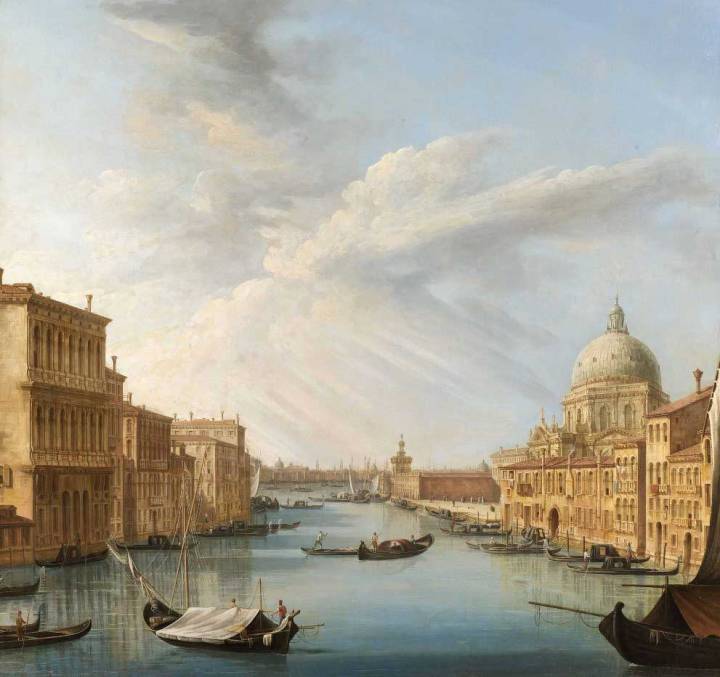
Archives of Landscape Painting | Pietro Bellotti: Another Canaletto
Ca’ Rezzonico, Museum of 18th-Century Venice, 7 December 2013 — 28 April 2014
Curated by Charles Beddington, Alberto Craievich, and Domenico Crivellari
◊ ◊ ◊ ◊ ◊
This year sees the start of a new and fascinating investigation at Ca’ Rezzonico, the symbol of 18th-century Venice, into landscape painting. This important genre developed during the 18th century in Venice, which provided an extraordinary source of inspiration for its exponents.
Among the leading figures of the genre, which is at the centre of a necessary re-evaluation, was Pietro Bellotti, Canaletto’s nephew and the younger brother of Bernardo Bellotti. Born in Venice in 1725, he developed a manner that was very different to that of the Canaletto ‘clan’ of which he was a part and despite exploiting the fame of his uncle (especially in France, where he lived for 50 years, calling himself ‘le Sieur Canalety’ or ‘Pietro Bellotti di Caneletty’). After moving to Toulouse with his family, he stayed for a brief apprenticeship in his brother’s workshop and then was active in Besançon, Nantes, Lille and Paris and, at least for a brief period, in England. Adopting an autonomous, personal style, he developed Canaletto’s inventions, producing numerous views of Europe’s most important cities, together with some architectural capriccios, some of which realised with the collaboration of other landscape painters.
The exhibition will offer a survey of the painter’s long working life, bringing together the few of his works conserved in public collections, such as at the Yale Center for British Art and the Mauritshuis in The Hague, and about 40 other pictures, including signed works in private European collections.
Exhibition | Regatta Boats
From Ca’ Rezzonico:
Imbarcazioni da Regata / Regatta Boats
Ca’ Rezzonico, Museum of 18th-Century Venice, 31 May — 10 September 2013, extended until 24 November
Curated by Alberto Craievich
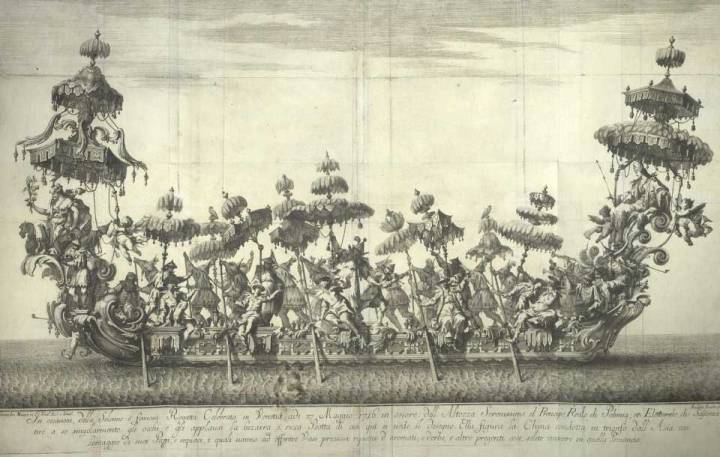
Gaspare Diziani e Andrea Zucchi,
La Cina condotta in trionfo dall’Asia
◊ ◊ ◊ ◊ ◊
Among the most spectacular ceremonies Venice used to organise in the past were the regattas arranged by the Serenissima in honour of princes and rulers visiting the city. The most important artists of the 18th century assisted in the making of the extravagant vessels bearing such exotic names as bissone, malgarote, peote: specialists in the field, like Andrea Urbani or the Mauro family, together with leading artists, including Giambattista, Tiepolo, Francesco Guardi, Giambattista Piranesi, Gaspare Diziani and Francesco Zugno.
Freed of any functional constraints, the fantasy of the artists could be unleashed in the creation of bold inventions with ornamental motifs, mythological scenes and allegorical figures. These boats were designed to last the duration of a ceremony, and are documented today only through preparatory drawings or prints conveying a sense of their extravagant decoration and exceptional design.
One of the most important collections of prints and drawings dedicated to this specifically Venetian aspect of ephemeral baroque art is conserved in the Gabinetto dei disegni e delle stampe in Museo Correr and is now displayed after a long period out of public sight, at Ca’ Rezzonico.
Exhibition | The Golden Age of the Fan
Thanks to Pierre-Henri Biger for noting this upcoming exhibition of seventy fans at the Cognacq-Jay:
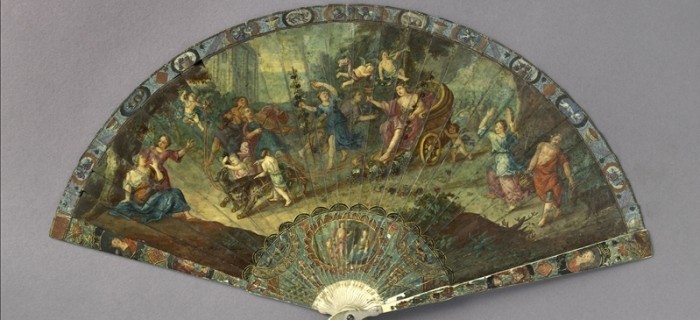
Le siècle d’or de l’éventail: Du Roi-Soleil à Marie-Antoinette
Musée Cognacq-Jay, Paris, 14 November 2013 — 2 March 2014
Curated by José de Los Llanos and Georgina Letourmy-Bordier
◊ ◊ ◊ ◊ ◊
Cette exposition rendra hommage à l’excellence du savoir-faire des éventaillistes français et montrera aussi l’extraordinaire inventivité dont témoignent ces objets fragiles et discrets que sont les éventails.
L’éventail est à la fois familier et méconnu. Accessoire de mode et objet d’art, il allie le savoir-faire d’artisans à la création artistique. Soumis à la fugacité des modes, il se renouvelle sans cesse. Importé d’Asie à la Renaissance, au milieu des cargaisons d’épices et de soies, l’éventail est adopté en France sous le règne de Louis XIV. Une corporation spécifique, celle des éventaillistes, créée en 1676, assure rapidement la domination des artisans français en Europe. Au cours du XVIIIe siècle, Paris devient ainsi la capitale de l’éventail. Le choix des décors suit alors la production des peintres à la mode et participe à la diffusion de l’art français en Europe, tout en montrant une singulière diversité. Tout peut être représenté sur un éventail : la mythologie, l’histoire antique comme l’histoire religieuse côtoient des scènes galantes. Ce sont aussi des décors empruntés à la vie quotidienne de la cour ou du peuple de Paris, ou encore des faits d’actualité, naissances et mariages royaux ou victoires militaires, célébrés par des fêtes publiques.
Avec soixante-dix oeuvres empruntées à des collections publiques et privées, en France et à l’Étranger, l’exposition du musée Cognacq-Jay, hommage à l’excellence du savoir-faire des éventaillistes français, essentiellement parisiens, montrera aussi l’extraordinaire inventivité dont témoignent ces objets fragiles et discrets.
Exhibition | Antichità, Teatro, Magnificenza: Images of Rome
Press release (14 May 2013) from the Carlos Museum (with thanks to Hélène Bremer for noting it) . . .
Antichità, Teatro, Magnificenza: Renaissance and Baroque Images of Rome
Michael C. Carlos Museum, Emory University, Atlanta, 24 August — 17 November 2013
Curated by Margaret Shufeldt and Sarah McPhee
◊ ◊ ◊ ◊ ◊
Antichità, Teatro, Magnificenza: Renaissance and Baroque Images of Rome will be on view at the Michael C. Carlos Museum of Emory University from August 24 through November 17, 2013. This spectacular temporary exhibition includes maps, views, and books on Rome from the sixteenth, seventeenth, and eighteenth centuries.
Over 130 works of art, many from the Carlos Museum’s permanent collection, representing ancient Rome will be showcased in three major sections—Antichita, Teatro, and Magnificenza. Antichita includes the Antiquae urbis imago, Pirro Ligorio’s 1561 reconstruction of the ancient city as the focal point of the antiquarian interests during the Italian Renaissance of the sixteenth century. Ligorio’s reconstruction will be surrounded by works by Hieronymous Cock, several others from the Speculum Romanae Magnificentiae, Mirror of the Magnificence of Rome, a Renaissance ‘coffee table book’ of prints of the sights of Rome produced by the French print seller and publisher Antonio Lafreri (1512–77), and images of the obelisks moved by Sixtus V—all from the Museum’s collection. This section also includes volumes from the rare book collections of the Emory Libraries such as De ludis circensibus by Onophrio Panvinio.
Antiquarians of the Renaissance were humanist scholars who sought to reconstruct, at least intellectually, Rome as it was in antiquity by studying coins, inscriptions, fragments, and the city’s ruins. The images show monuments that have been restored, healed of the ravages of time. Ligorio was one of the leading antiquarian scholars of his day. Cock on the other hand depicts the ruins just as they appeared in the sixteenth-century. The Colosseum is ravaged by time, with plants sprouting among the stones. This is the picturesque Rome that contemporary visitors to the city actually saw.

◊ ◊ ◊ ◊ ◊
The Teatro of the seventeenth century, the second section of the exhibition, is anchored by an impression of Giovanni Battista Falda’s 1676 Nuova pianta, lent by Chicago collector Vincent J. Buonanno. Also included are images from Falda’s depictions of the Giardini di Roma, as well as several books of the period. These works record the efforts of the seventeenth-century popes to refocus attention on the modern city through urban interventions known as ‘theaters’ or ‘teatri’. Piazzas were broadened and opened up to become stages where the life of the city took place and the power of the Church could be asserted. The most striking example is St. Peter’s Square. Falda’s many etchings show the theaters of the Baroque city.
The Magnificenza of the eighteenth century features Giovanni Battista Nolli’s Pianta grande and Giuseppe Vasi’s Prospetto dell’alma città di Roma. Also included are numerous views by Giovanni Battista Piranesi from the Museum’s collection and a copy of Jean Barbault’s Les plus beaux monuments de Rome ancienne among other items from Emory’s rare book collections. Also featured is a survey of Roman guidebooks through the centuries. In this section there are three different types of representations of the magnificence of the Eternal City by three different designers. Nolli’s map is an example of the rational, scientific thinking of the Enlightenment. Vasi follows in Falda’s footsteps making an encyclopedic collection of views of contemporary Rome. Piranesi takes an archaeological interest in the city and creates strikingly dramatic, imaginative views of the ancient monuments. Visitors to Rome on the Grand Tour purchased these prints as mementos of their sojourn and as evidence of their own learned interests.
Margaret Shufeldt, Carlos Museum Curator of Works on Paper, and Sarah McPhee, Emory’s Professor of Art History, are co-curators of the exhibition. Shufeldt notes, “This exhibition offers our visitors a chance to experience the Eternal City through the works of master printmakers across three centuries. One will be able to wander the city in detailed maps and marvel at imposing architecture in the diverse images of Rome.”
A Virtual Experience of Rome
In an exciting and innovative use of technology to bring the exhibition to life, the Carlos Museum is collaborating with Sarah McPhee and Jordan Williams and Erik Lewitt of plexus r + d to develop Virtual Rome. The virtual experience is grounded in the celebrated bird’s-eye view map of Giovanni Battista Falda, published in 1676, which subsumes the fine detail of over 300 etched views of the city made by the young artist. The composite image shows the urban fabric in exquisite visual detail, allowing the patient viewer to stroll the streets, count the windows in facades, and distinguish deciduous trees from evergreens.
Falda’s two-dimensional map will be transformed into a virtual, walkable Rome using the gaming platform known as NVis360. A team of educators, architects, and IT experts are documenting Falda’s Rome in maps and views, checking Falda’s data against Rome today, the surveyed map of 1748 by Giambattista Nolli, and the seventeenth-century ichnographic and surveyed maps that survive in the Roman archives. Through Virtual Rome, museum visitors will be able to journey back in time to experience the Eternal City of the seventeenth century. Virtual Rome is possible because of the generosity of Vincent J. Buonanno, who has made his extraordinary collection of Falda maps and views available in actual and digital form. McPhee notes, “The gaming platform allows us to follow the invitation of Falda’s prints to stroll the city with our eyes: to navigate lost streets and squares, take in vanished prospects, experience seventeenth-century Roman teatri in the round. This is the first time a gaming platform has been used at Emory University to recover urban history through an immersive and interactive reconstruction. We look forward to sharing the exciting results.
This exhibition has been made possible through the generous support of the Lamar Mixson Foundation, the Emory Libraries and the Manuscript and Rare Book Library (MARBL), and Mr. Vincent J. Buonanno.
Exhibition | Junípero Serra and the Legacies of the California Missions
Press release from The Huntington:
Junípero Serra and the Legacies of the California Missions
The Huntington Library, Art Collections, and Botanical Gardens, San Marino, 17 August 2013 — 6 January 2014
Curated by Catherine Gudis and Steven Hackel

◊ ◊ ◊ ◊ ◊
The life of Junípero Serra (1713–1784)—and his impact on Indian life and California culture through his founding of missions—is the subject of an unprecedented, comprehensive, international loan exhibition opening August 17, 2013, and remaining on view through January 6, 2014, exclusively at The Huntington Library, Art Collections, and Botanical Gardens. Junípero Serra and the Legacies of the California Missions coincides with the 300th anniversary of Serra’s birth and includes about 250 objects from The Huntington’s collections and those of 61 lenders in the United States, Mexico, and Spain. The exhibition examines Serra’s early life and career in Mallorca, Spain; his mission work in Mexico and California; the diversity and complexity of California Indian cultures; and the experiences of the missionaries and Indians who lived in the missions.
Junípero Serra also delves into the preservation and reconstruction of the missions as physical structures; the persistence of Indian culture from before the mission period to the present; the missions’ enduring place in California culture today; and a wide variety of perspectives—some of them irreconcilable—on Serra and the meaning of his life.
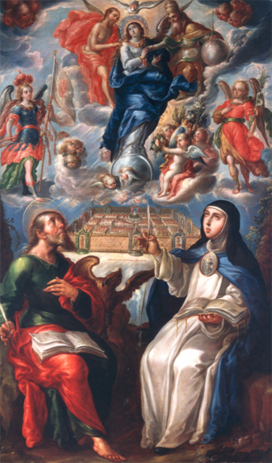
Cristóbal de Villalpando, La Mística Ciudad de Dios (The Mystical City of God), 1706. Museo regional de Gaudalupe/CONACULTA– INAH, Guadalupe, Zacatecas Nacional del Virreinato, Mexico.
“It’s a rich, complex, and multi-faceted story, and one that has not been told before in an exhibition of this magnitude,” said Steven Hackel, co-curator of the exhibition, professor of history at the University of California, Riverside, and Serra biographer (Junípero Serra: California’s Founding Father, 2013). “Serra was 55 years old and had had a very full life by the time he came to California in 1769. In this show, we are working to move beyond the standard polemic that often surrounds Serra and the missions. We present a picture that is equally rich in its portrayal of not only Serra’s life but the meaning of the missions for a range of California Indians.” The general tendency is to think that Serra’s life work began with the California missions, Hackel added, and that Indian culture disappeared with the onset of those missions. “The exhibition challenges both of these assumptions.”
Contemporary art, including a video work created expressly for the exhibition by James Luna (Luiseño), and first-person narratives by descendants of the missions “defy any presumptions that Native Americans ‘vanished’ or that they hold a monolithic view about the mission past,” said Catherine Gudis, co-curator of the exhibition and professor of California and public history at the University of California, Riverside. “Rather, the show represents a range of responses—including resistance and resilience—as the result of a period of painful disruption and devastating change.”
Among key items in the exhibition are a host of rare paintings and illustrations documenting the history of the Spanish island of Mallorca, Serra’s life, 18th-century Catholic liturgical art, and New Spain, as well as several sketches and watercolors that are among the first visual representations of California and California Indians by Europeans. “These images are not only beautiful,” says Hackel, “but they are among the most important ethnographic representations of California Indian life at the onset of the missions and of Indian life in the missions.”
Also on view are Serra’s baptismal record from Mallorca, his Bible and lecture notes from Mallorca, and the diary he composed as he traveled from Baja California to San Diego in 1769. Notable and unique items documenting Indian culture in California include a textile fragment that is thousands of years old, woven by California Indians from seaweed and fiber, as well as beads, tools, baskets, and written documents from the colonial period. “Like the Spaniards, these were people who had a significant history and culture well before the Europeans showed up, and it was a history and culture that would persevere, although not without huge changes, in and after the missions,” said Gudis.
 Junípero Serra provides a sweeping examination of where Serra came from, including the history and culture of Mallorca well before his time and during his early life; where Serra traveled, including his early adult years performing missionary work from central Mexico to Baja; and finally, his work to establish a system of missions along the California coastline from south to north.
At the same time, it provides the backdrop against which the missions emerged: early California was populated by numerous and diverse groups of Indians. Culture and customs varied from village to village; more than 100 languages were spoken; and in the parts of California colonized by Spain, the Indians numbered nearly 70,000.
Serra, under the auspices of the Catholic Church and the Spanish flag, believed his mission was to convert them to Christianity. However, his dream of encouraging Indians to relocate to the missions ultimately led many to an early grave, as diseases killed thousands of Indians who lived there.
“The mission period was a defining one in California’s history—and Serra is the most visible symbol of that period,” said Hackel. “But in taking this story all the way through—from before Indians and Europeans made contact, through the construction and collapse of the mission system, and then to the present day—it is, in fact, a story of conflicting, blending, and overlapping cultures, of imperial expansion and human drama and loss, and then, finally, of the perseverance and survival of not only European institutions in California, but the California Indians who were the focus of Serra’s missions.”
E X H I B I T I O N F L O W (more…)
Exhibition | America: Painting a Nation
The exhibition, organized by several American institutions including the Terra Foundation for American Art, debuted as Art Across America at the National Museum of Korea, in Seoul, and then traveled to Korea’s Daejeon Museum of Art. From the press materials of the Art Gallery of New South Wales:
America: Painting a Nation
Art Gallery of New South Wales, Sydney, 8 November 2013 — 9 February 2014

Portrait of a Black Sailor (Paul Cuffe?), ca. 1800 (LACMA)
This exhibition is a voyage through American history, across the American landscape and into the minds of the American people. It begins in the 18th century, among pious farmers and republican merchants. It traverses the continent, alongside Native Americans and frontiersman. It explores the great cities, and the lives of workers and bohemian artists. Answering the question, ‘What makes Americans American?’ is complex, but these paintings are a guide, revealing the self-reliance and communal beliefs, optimism and anxieties, that makes America tick.
Chris McAuliffe, Curatorial consultant
America: Painting a Nation is the most expansive survey of American painting ever presented in Australia. It is part of the Sydney International Art Series which brings the world’s outstanding exhibitions to Australia, exclusive to Sydney, and has been made possible with the support of the NSW Government through Destination NSW. Over 80 works, ranging from 1750 to 1966, cover more than 200 years of American art, history and experience. The exhibition sets a course from New England to the Western frontier, from the Grand Canyon to the burlesque theatres of New York, from the aristocratic elegance of colonial society to the gritty realism of the modern metropolis. This exhibition will reveal the breadth of American history, the hardy morality of the frontier, the intimacy of family life, the intensity of the 20th-century city, the epic scale of its landscape and the diversity of its people. The works being presented – many by American masters – are the works Americans love and works that represent the stories they have grown up with.
◊ ◊ ◊ ◊ ◊
From the Art Gallery of NSW:
Angela Miller and Chris McAuliffe, America: Painting a Nation (Sydney: Art Gallery of New South Wales, 2013), 264 pages, ISBN 978-1741741018, $45.
Spectacular landscapes, epic stories and diverse peoples feature in this expansive historical survey of American painting. The 89 artworks by some 74 artists traverse over 200 years of rich history, from the colonial era to the mid 20th century. Readers will encounter the sublime poetry and drama of the land, the ambition and optimism of the country’s pioneers, the challenges of the frontier, the intimacy of family life and the intensity of the modern city. The roots of the American character and nation will be revealed through images ranging from the Grand Canyon to the Brooklyn Bridge, from classic portraits to modern abstraction.
America: Painting a Nation includes works by artists such as Mary Cassatt, Winslow Homer, Edward Hopper, Georgia O’Keeffe, Jackson Pollock, Mark Rothko, John Singer Sargent and James McNeill Whistler from the collections of some of the finest art museums in the USA: The Terra Foundation, Chicago; the Philadelphia Museum of Art; the Museum of Fine Arts, Houston; the Los Angeles County Museum of Art; and The Virginia Museum of Fine Arts.
Essays by Angela Miller and Chris McAuliffe, combined with entries on each of the artworks and biographies on each artist, illuminate this fascinating survey of American painting from 1750 to 1967.
Exhibition | Soufflot: An Architect of the Enlightenment
From the press release:
Soufflot: Un architecte dans la lumière
Panthéon, Paris, 11 September — 24 November 2013
Curated by Alexandre Gady
 Le troisième centenaire de la naissance de Jacques-Germain Soufflot (1713–1780), que le Ministère de la Culture a inscrit parmi les célébrations nationa les 2013, est l’occasion pour le Centre des monuments nationaux (CMN) de revenir sur cet architecte majeur des Lumières, dont le chef d’œuvre, Sainte-Geneviève, devenu le Panthéon, est un des monuments emblématiques du réseau du CMN.
Alors qu’une grande campagne de restauration est en cours au Panthéon, Alexandre Gady, commissaire de l’exposition y présente Jacques-Germain Soufflot et ses ambitions créatrices en combinant rigueur scientifique et accessibilité pour un large public. Cette figure majeure de l’architecture française du XVIIIe siècle est ainsi remise en lumière, en montrant la richesse de son œuvre, qui ne se limite pas au Panthéon. L’exposition suit un double parti, chronologique mais surtout thématique, afin d’éclairer la création de l’architecte et ses enjeux intellectuels.
Près de 150 œuvres sont présentées: peintures, sculptures, dessins, gravures, livres anciens, objets d’art, maquettes, provenant de grandes institutions françaises, ainsi que de particuliers : outre le CMN lui-même, citons les musées du Louvre, du château de Versailles, le Musée Carnavalet, les Archives nationales, la Bibliothèque nationale de France, le musée Gadagne de Lyon, le musée archéologique de Rouen…
Le Panthéon est enfin lui-même mis en scène, depuis la maquette de Rondelet jusqu’à la tombe de Soufflot dans la crypte, pour parachever la visite et sa démonstration.
Additional information is available here»










 Enfilade
leave a comment