Exhibition | Strange and Wondrous: Prints of India
From the exhibition press release:
Strange and Wondrous: Prints of India From the Robert J. Del Bontà Collection
Smithsonian’s Arthur M. Sackler Gallery, Washington, D.C., 19 October 2013 — 5 January 2014
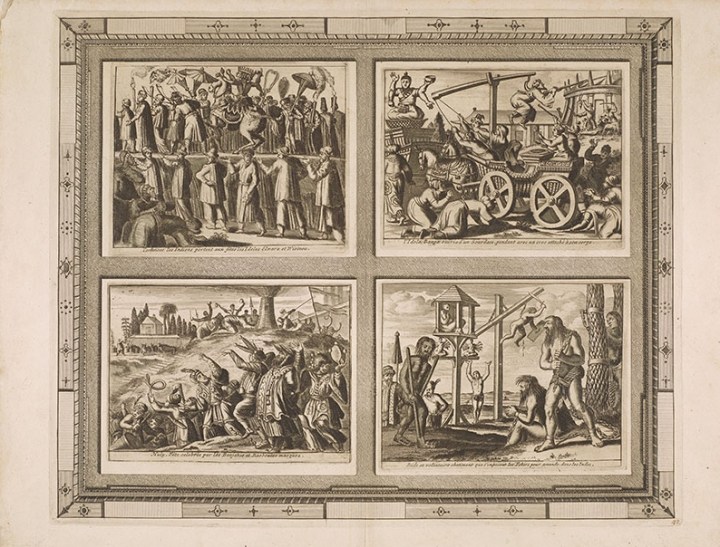
Four Scenes from India. After Jacob van Meurs (ca. 1619–before 1680). Copperplate engraving with etching on paper. From a French copy of Pieter van der Aa (1659–1733), La Galerie Agréable du Monde (The Pleasurable Gallery of the World),vol. 19: Persia, Mogol, Chine, Tartaria (Leyden: Pieter van der Aa, ca. 1725). Robert J. Del Bontà collection, E1431.
◊ ◊ ◊ ◊ ◊
Strange and Wondrous: Prints of India From the Robert J. Del Bontà Collection, on view at the Smithsonian’s Arthur M. Sackler Gallery, presents 50 printed works that trace European and American documentation of Indian ascetics, deities and religious ceremony.
As global travel boomed from the 16th to the 20th century, Europeans and Americans became increasingly fascinated with Indian culture. Merchants, missionaries and soldiers alike documented their encounters in India and foreign lands through detailed texts and illustrations. These accounts—regularly edited, amended and reprinted in publications as varied as atlases, trading cards, memoirs and magazines—became the paradigm for all that Europeans and Americans found strange, exotic, repulsive or remarkable in India.

“Hindoo devottees of the Gosannee & Jetty tribes,” James Shury, after James Forbes (1749–1819). Drawn by James Forbes, 1780, and published by White, Cochrane & Co., June 1812. Engraving with etching on paper. From an English copy of James Forbes, Oriental Memoirs, vol. 2 (London: Richard Bentley, 1834).
Created using a wide variety of techniques, such as engraving, aquatint, lithography and photogravure, these prints demonstrate how perceptions of Indian culture shifted through the centuries, from the European Enlightenment to the period of colonial expansion and into modernity.
“As a collector, Del Bontà not only pays immense attention to the subjects that captivated Europeans and Americans, but also to the multiple versions of popular prints as they travelled across countries, languages and time,” said Holly Shaffer, guest curator and Yale University doctoral candidate. “His collection allows scholars to trace how Europeans and Americans learned about India, and reminds us to always question the ‘truth-value’ of images that often have a very long train to their visual history.”
The spread of images represented in Strange and Wondrous led to broader knowledge and interest in Indian culture—but also to the creation and proliferation of negative stereotypes. Ascetics, or religious figures (often termed “yogis and “fakirs”), with their otherworldly, naked appearance and austere practices, were depicted as supernatural beings, devout penitents, militants, tricksters and beggars. Religious ceremonies, such as swinging from hooks (charak puja), were often interpreted in a Christian framework, rather than a Hindu one, leading to misconceptions of devotees as sinners and fanatics. Deities such as the Hindu god Shiva were cataloged as lovers and drug users feeding generalizations of India as a sensual, spiritual land.
American publications added another layer of satire to their interpretation of exotic cultural practices. A 1943 cover of the Saturday Evening Post illustrated by Norman Rockwell shows the beloved World War II character Willie Gillis outwitting an Indian ascetic with the children’s game “cat’s cradle,” a visual pun of the infamous “Indian rope trick.” Here an American GI has duped the once-powerful Indian yogi, and while it is perhaps a nod to American soldiers’ wily abilities during wartime, the stereotype of India remains intact.
Strange and Wondrous will be on view in conjunction with Yoga: The Art of Transformation—the world’s first exhibition on the art of yoga—also at the Sackler Gallery.
The 50 works on view in Strange and Wondrous are part of Del Bontà’s bequest of 100 printed works to the Freer and Sackler archives. The collection will be a resource for scholars and educators to evaluate and understand early European and American perspectives of Indian culture through print. Del Bontà—a polymath scholar, curator, collector and jeweler—began to collect prints related to India while completing his doctorate in South Asian art history at the University of Michigan in the 1970s. His extensive collection includes more than 2,000 loose prints and thousands more bound within books, spanning genres from Indian calendar prints, ephemera, painting and sculpture to British Raj-era publications and subjects such as ornament, flora and fauna, Indian ascetics, deities and religious ceremony.
Exhibition | Yoga: The Art of Transformation
From the exhibition press release:
Yoga: The Art of Transformation
Smithsonian’s Arthur M. Sackler Gallery, Washington, D.C., 19 October 2013 — 26 January 2014
San Francisco Asian Art Museum, 21 February — 25 May 2014
Cleveland Museum of Art, 22 June — 7 September 2014

Krishna Vishvarupa (detail), ca. 1740. India, Himachal Pradesh, Bilaspur. Collection of Catherine and Ralph Benkaim.
◊ ◊ ◊ ◊ ◊
Yoga: The Art of Transformation, the first exhibition about the visual history of yoga explores yoga’s rich diversity and historical transformations during the past 2,000 years.
On view through January 26, 2014, The Art of Transformation examines yoga’s fascinating meanings and histories through more than 130 objects from 25 museums and private collections in India, Europe and the U.S. Highlights include three monumental stone yogini goddesses from a 10th-century south Indian temple, reunited for the first time, 10 folios from the first illustrated compilation of asanas (yogic postures) making their U.S. debut, and a Thomas Edison film, Hindoo Fakir (1906), the first movie produced about India.
“This exhibition looks at yoga’s ancient roots, and how people have been trying to master body and spirit for millennia,” said Julian Raby, The Dame Jillian Sackler Director of the Arthur M. Sackler Gallery and Freer Gallery of Art. “By applying new scholarship to both rarely seen artworks and recognized masterpieces, we’re able to shed light on practices that evolved over time—from yoga’s ancient origins to its more modern emergence in India, which set the stage for today’s global phenomenon.
 A free public festival, Diwali and the Art of Yoga, Saturday, October 26, will mark both the opening of the exhibition and Diwali, the Indian festival of lights. Visitors can discover exhibition highlights through spotlight tours, play games from across Asia, attempt intricate rangoli (rice powder) drawings and make their own yoga-inspired art in hands-on workshops. Indian classical musician K. Sridhar will demonstrate the yoga of sound, and storyteller Louise Omoto Kessel will share tales of Indian deities. Free yoga classes will be offered throughout, and the day will conclude with a traditional lamp-lighting ceremony and a classical Indian music concert.
In conjunction with The Art of Transformation, the Freer and Sackler galleries will also host Yoga and Visual Culture, a free interdisciplinary symposium for scholars and yoga enthusiasts November 21–23. Seventeen scholars from a range of disciplines will present cutting-edge research on diverse aspects of yoga’s visual culture, organized around such topics as “Yoga and Place” and “Yoga and Print Culture.” A full schedule and registration is available at asia.si.edu/events/yoga-symposium/.
Yoga classes in the galleries will be offered through “Art in Context,” an interactive 90-minute workshop combining tours of the exhibition with the practice of yoga. Led by a teaching team of a museum docent and guest yoga teachers, the workshops will be held on Wednesdays and Sundays throughout the exhibition, with special sessions offered for ages 50-plus, teens and families. Advance registration is required, and visitors can find a full schedule at asia.si.edu/events/workshops.asp.
These programs are made possible in part due to the Smithsonian’s first major crowdfunding campaign, “Together We’re One.” Launched in May 2013, the campaign raised more than $174,000 over 6 weeks to support public programs, yoga classes in the galleries, and an exhibition catalogue, as well as the behind—the—scenes aspects of the exhibition. Campaign donors and exhibition ambassadors, called “Yoga Messengers,” are invited to be special guests during the October 26 “Art of Yoga” festival, and will be featured in exhibition signage.
Following its Washington, D.C., debut, The Art of Transformation will travel to the San Francisco Asian Art Museum and the Cleveland Museum of Art.
Support for the exhibition is provided by the Friends of the Freer|Sackler, Whole Foods Market, Art Mentor Foundation Lucerne, the Alec Baldwin Foundation, the Ebrahimi Family Foundation, IndiaTourism, Catherine Glynn Benkaim, media partner Yoga Journal, and “Together We’re One” donors.
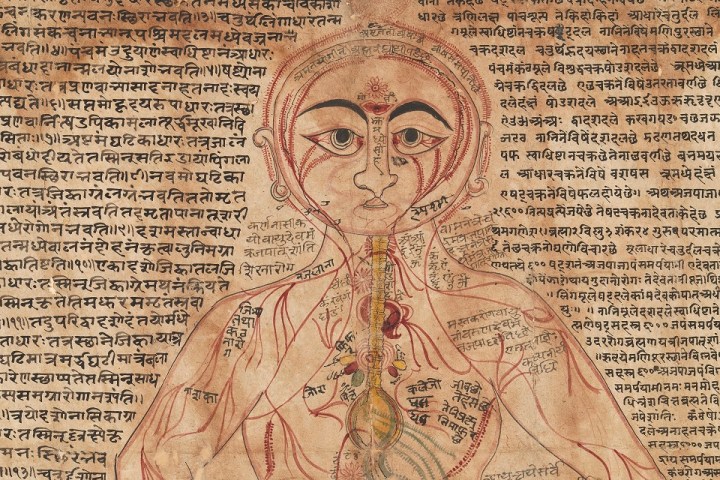
Anatomical Body, 18th century, India, Gujarat (Wellcome Library, London, Asian Collections, MS Indic Delta 74).
◊ ◊ ◊ ◊ ◊
Debra Diamond, ed., Yoga: The Art of Transformation (Washington, D.C.: Smithsonian Books, 2013), 360 pages, ISBN-13: 978-1588344595, $55.
An exploration of yoga’s meanings and transformations over time; the discipline’s goals of spiritual enlightenment, worldly power, and health and well-being; and the beauty and profundity of Indian art.
Debra Diamond is Associate curator of South and Southeast Asian art, Freer Gallery of Art and Arthur M. Sackler Gallery. Her exhibition catalogue for Garden and Cosmos (fall 2008) received two major awards for scholarship: the College Art Association’s Alfred H. Barr award and the Smithsonian Secretary’s Award for Research. She has published on yoga imagery, new methods in Indian art history, contemporary Asian art, and various aspects of the Freer|Sackler collections.
Exhibition | Bordeaux-Dublin Letters, 1757: Voice of an Irish Community
From NYU’s Center for Irish and Irish-American Studies:
The Bordeaux-Dublin Letters, 1757: The Voice of an Irish Community Abroad
The Elmer Holmes Bobst Library, New York University, 25 October 2013 — 1 April 2014
 More than two hundred and fifty years ago—in the midst of the world’s first global war—an Irish wine ship returning home from the French port of Bordeaux was captured at sea by a British warship. In January 2011, the mailbag from that ship, the Two Sisters of Dublin, was discovered by a New York University professor. These letters, most of them only recently opened for the first time, are the basis of a major exhibition in the Mamdouha S. Bobst Gallery at New York University’s Bobst Library — The Bordeaux-Dublin Letters, 1757: The Voice of an Irish Community Abroad.
Drawing on world-class collections of art and never-before-seen historical documents, the exhibition takes you back to a time when thriving communities of Irishmen played a prominent role on the European continent. The Bordeaux-Dublin Letters reconstructs the early years of the Seven Years’ War, tells the story of the fateful voyage of the Two Sisters of Dublin, and underscores the significance of the Irish presence in Europe and America. The heart of the exhibit is the extraordinary collection of letters discovered in 2011. Through them, the voice of an Irish community abroad comes alive, and we enter into a private and intimate world inhabited by ordinary men and women separated from their homeland by war.
Exhibition | Making It in America
From the exhibition press release:
Making It in America
RISD Museum, Rhode Island School of Design, Providence, 11 October 2013 — 9 February 2014
Curated by Maureen O’Brien and Elizabeth Williams; designed by Thomas Jayne
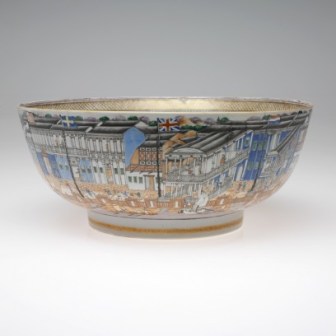

Punch Bowl, 1785–1800, Porcelain with enamel (RISD Museum). The bowl depicts warehouses along the waterfront of the city of Canton, the only port open to foreign merchants, whom the Chinese government confined to the waterfront areas. The western proprietor of each warehouse (hong) was identified by his national flag; Denmark, Spain, France, America, Sweden, England, and Holland are pictured.
◊ ◊ ◊ ◊ ◊
More than 100 outstanding works of painting, sculpture, and decorative arts from the RISD Museum’s collection illuminate connections between American ambitions and the making of art in Making It in America. The exhibition is on view through Sunday, February 9, 2014.
“American art has played a central role at the RISD Museum since its earliest days, and we celebrate this legacy with Making It in America,” says Museum director John W. Smith. “Drawn exclusively from our phenomenal permanent collection, this show is our first in-depth exploration of this subject in many years.”
Making It in America liberates artworks from the Museum’s galleries, storage vaults, and the historic period rooms of its Pendleton House wing, repositioning them within the broader context of American styles. These exceptional pieces, created between the early 1700s and early 1900s, are presented as examples of both artistic processes and aspirations. Just as individual accounts of American life revolve around searches for freedom, fulfillment, and identity, these stories are also embedded in objects that comprise the history of American art.
“The title is a double entendre that asks our viewers to think about art making and about how American art demonstrates American ideas about success,” explain exhibition co-curators Maureen O’Brien, curator of painting and sculpture, and Elizabeth Williams, curator of decorative arts and design. John Singleton Copley’s grand manner portrait of Moses Gill, for instance, illustrates the escalating wealth, social standing, and political capital of the 30-year-old merchant and future Massachusetts lieutenant governor. The land of opportunity is seen in painter Thomas Cole’s striking depictions of the American wilderness unspoiled nature ripe with promise. Closer to home, finely designed furniture with hand-carved motifs from Newport’s Townsend and Goddard workshops rivaled European examples in the 18th century, while the glorious excess of monumental silver works by Providence’s Gorham Manufacturing Company represented the city’s ambitions into the 19th and 20th centuries.
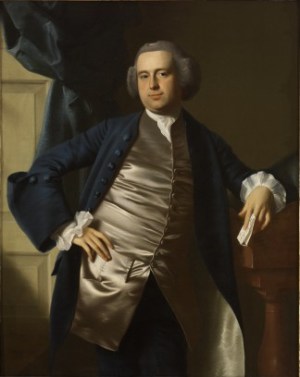
John Singleton Copley, Portrait of the Honorable Moses Gill, Esq., 1764, oil on canvas (RISD Museum)
Making It in America also touches on a theme for which the Rhode Island School of Design (RISD) is best known: the process of making art, a subtext of the show which provides a loose timeline of what happened in American art making and when. The exhibition’s intertwined threads of making art and representing achievement are woven into RISD and the RISD Museum’s own history. Inspired by the international display of art and commerce at the 1876 Centennial Exhibition, the College and Museum were established in 1877 with the mission to train American designers and publicly promote American art. The Museum’s earliest ‘contemporary’ purchase, in 1901, was Winslow Homer’s thundering seascape On a Lee Shore (1900), soon followed by the acquisition of important colonial portraits and American landscape paintings. In 1906, the RISD Museum built Pendleton House, the country’s first museum wing devoted to the display of American decorative arts, thus elevating the importance of native craftsmanship in the study of material culture.
The co-curators note that this exhibition provides exciting opportunities for visitors to explore the Museum’s rich holdings, closely examining objects that may have been behind ropes in period rooms or held in storage. Williams, who joined the RISD Museum in January and has spent much of her first year exploring the diverse decorative arts collection, looks forward to presenting 60 pieces of silver, furniture, glass, ceramics, and jewelry—more than half of which haven’t been on view in decades.
“Although many of the works in Making It in America have been on view in galleries throughout the Museum, visitors who see discrete selections rarely get a sense of the scope and quality of our collections,” says O’Brien.
Exhibition designer Thomas Jayne is a renowned decorator, decorative arts historian, and principal of Jayne Design Studio—specializing in interior decoration and product development. Jayne, who trained in the Winterthur Museum’s graduate program for American material culture, incorporates historic—and unexpected—patterns and colors to create a stunning installation that highlights the evolution of color and pattern in American design. Jayne’s previous clients include Winterthur; Edith Wharton’s country home, The Mount; the Brick House at the Shelburne Museum; and private collectors. Jayne was recently honored with the 2013 Arthur Ross Award for Interior Decoration from the Institute of Classical Architecture & Art. Drawing upon the past, he seeks details that deepen and enliven a room, exquisitely connecting history and place.
Exhibition | Naples’s Treasure: The Museum of Saint Januarius
Press release from the Museo Fondazione:
Naples’s Treasure: Masterpieces of the Museum of Saint Januarius
Il Tesoro Di Napoli: I Capolavori del Museo di San Gennaro
Museo Fondazione, Palazzo Sciarra, Rome, 30 October 2013 — 16 February 2014
Musée Maillol, Paris, 19 March — 20 July 2014
Curated by Paolo Jorio and Ciro Paolillo

Michele Dato, Necklace of Saint Januarius, gold, silver,
and precious stones, 1679, with additions made in the
eighteenth, nineteenth, and twentieth centuries.
◊ ◊ ◊ ◊ ◊
Never before have such masterpieces from the most important collection of goldsmith art in the world, together with original documents, paintings, drawings, vestments and church plate, been exhibited beyond the walls of Naples. This exhibition offers an opportunity to investigate the inestimable artistic and cultural value of the treasure of Saint Januarius from a scientific point of view.
The exhibition, curated by Paolo Jorio, Director of the Museo del Tesoro di San Gennaro, and Ciro Paolillo, a professional gemmologist and professor of history, economics and the production of jewellery in the Sapienza University of Rome, with the advice of Franco Recanatesi, will be an event of great historic and artistic importance: over seventy works belonging to one of the most important collections of goldsmith’s art will be displayed for the first time beyond the walls of the Parthenopean city, beside original documents, paintings, drawings, vestments and church plate. The exhibition will offer an opportunity to investigate the inestimable artistic and cultural worth of the treasure of Saint Januarius from a scientific point of view, in order to rediscover, pass down and re-experience Naples on a journey through time and to protect its name, history, artists and, above all, this priceless heritage that has been collected over seven centuries.
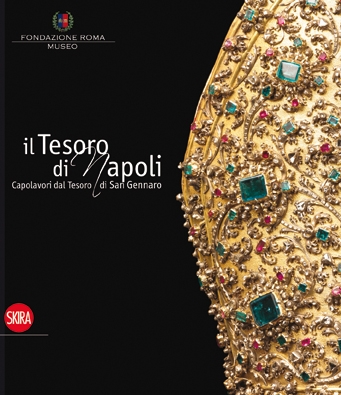 With twenty-five million devotees scattered throughout the globe, Januarius is the most famous Roman Catholic Saint in the world. Amidst devotion and prejudice, faith and disbelief, his long history is closely connected to Naples, the citizens of which – periodically threatened by natural catastrophes and historical events – even closely identify themselves with their patron saint. The exhibition to be held in Palazzo Sciarra will have both a scientific and an emotional approach, in order to explain the evolution of the cult of Saint Januarius in Naples, why the Treasure belongs to a secular institution and how Parthenopean goldsmithery was perfected over the centuries, thus creating most of the masterpieces on show.
In order to understand the impact of this event, suffice it to say that the historical value of the Treasure of Saint Januarius, formed throughout seven centuries of donations from Popes, Emperors, Kings and popular ex-votos, is higher than that of the Crown Jewels of the United Kingdom and those of the Tsar of Russia, as found during a research project conducted by a team of gemmologists led by Professor Ciro Paolillo, curator of the exhibition, the results of which were published in 2010. The team investigated several precious jewels donated to the Saint, which will be exhibited in Rome, for three years. Moreover, unlike other dynastic and ecclesiastical heritages, the Treasure has remained in tact ever since it was formed and has never endured spoliation, nor have the jewels ever been sold to fund wars. It has constantly been increased by means of acquisitions and accessions.

Matteo Treglia, Mitre in gilded silver, 3326 diamonds, 164 rubies, 198 emeralds and 2 garnets, 1714.
Professor Emmanuele F. M. Emanuele, Chair of the Fondazione Roma, says, “I believe it is essential to spread knowledge of this priceless heritage belonging to our country, the preservation and enhancement of which constitutes a strategic asset for the culture market. It is precisely due to its commitment in this field that the Fondazione Roma, by means of the activities performed by Fondazione Roma-Arte-Musei, has, in time, become a point of reference for the balance of the demand and supply of culture in the Eternal City. The exhibition devoted to Saint Januarius fully qualifies to be included in the cultural project promoted by our institution, which aims to spread all forms of art as an element of social development. The attention we pay to the relationship between culture and the community constitutes the link between the activities performed by the Foundation and those of the Museo di San Gennaro, which has led to the accomplishment of this important exhibition that will allow the public to admire, for the first time, works which, due to their preciousness and strong connotations of identity, have never been shown beyond the walls of Naples.”
 Paolo Jorio says that, “Each work of art belonging to the Treasure of Saint Januarius expresses its intrinsic artistic wealth, fruit of the unequaled craftsmanship of sculptors, silversmiths, chasers, welders and ‘put togetherers’ (as the assemblers were called in those days) who were capable of creating masterpieces of rare beauty using their technical know-how and creativity, and also tells the extraordinary story of a people and its ancient civilization. An account that places the Neapolitan people and European monarchs on the same level, since they all paid homage to Saint Januarius in a secular way and donated priceless masterpieces to the city of Naples.”
The exhibition will revolve around the two most extraordinary masterpieces of the Treasure: the Necklace of Saint Januarius, in gold, silver and precious stones created by Michele Dato in 1679, and the Mitre, in gilded silver, 3326 diamonds, 164 rubies, 198 emeralds and 2 garnets, created by Matteo Treglia in 1714, the
Tricentennial of which is celebrated this year.
The Necklace of Saint Januarius is one of the most precious jewels in the world and its history inextricably interweaves with the trail of constant devotion the city and monarchs have paid to this saint over the centuries. In 1679, the Members of the Deputation decided to use several jewels (crosses studded with sapphires and emeralds hanging from thirteen large solid gold links) in order to create a magnificent ornament for the bust, appointing Michele Dato, with the aid of other craftsmen, to enable the execution of such an exacting piece of work in only five months. The necklace is now comprised of other jewels of illustrious provenance created by various craftsmen at different times: a cross donated by Charles de Bourbon in 1734, a cross offered by Maria Amalia of Saxony, a three piece clasp with diamonds and emeralds, a cross with diamonds and sapphires dated 1775 bestowed by Maria Carolina of Austria, a crescent shaped broach dated 1799 donated by the Duchess of Casacalenga, a cross and a broach with diamonds and chrysolite offered by Victor Emmanuel II of Italy and other artefacts. Interestingly, Queen Marie Josè, consort of Umberto II of Italy, was attending a private visit to the Chapel of San Gennaro in 1933 and having nothing to donate, she removed the ring she was wearing and offered it to the saint. This regal gift is now to be found on the necklace.
When landing in Naples, even Napoleon, who plundered everywhere, not only refrained from stealing but, for once in his life, actually donated. In fact, when entering Naples in 1806 Joseph Bonaparte donated, as advised by his brother, a cross of diamonds and emeralds of rare beauty which the Deputation then included amongst the jewels bestowed by sovereigns that compose the priceless Necklace of Saint Januarius. Napoleon’s brother-in-law, Joachim Murat, who married beautiful Caroline Bonaparte, also paid heed to the advice of the French Emperor and donated a monstrance in gold and silver with precious stones in 1808. Both masterpieces will be exhibited in Rome. The arrival of the French in Naples is witnessed in only one known artwork: a painting by the French artist, Hoffman, depicted in 1800 and retrieved in Paris by the Deputation, in which the high altar in the Dome may be distinguished. The armed and threatening French troops, commanded by Championnet and Macdonald, stand on the altar ‘demanding’ Saint Januarius to perform the miracle of the liquefaction of his blood in front of the people. This painting will also be exhibited in Rome, as likewise the canvas of Saint Januarius depicted in 1707 by Solimena, the most famous authentic chromatic masterpiece in the world since, as from that year, all the holy pictures of the patron saint of Naples have been inspired by this painting.
The Mitre, the Tricentennial of which is celebrated this year, was commissioned by the Deputation in order to be placed on the bust during the festive procession held in April 1713. It was created in the Antico Borgo Orefici, established by the Anjou monarchs, which was an authentic mine of talents including the author, the maestro goldsmith, Matteo Treglia. The Mitre has an enormous material and symbolic value. The Mitre is adorned with 3964 precious stones including diamonds, rubies and emeralds, according to the traditional construction of ecclesiastical items in relation to the symbolic meaning of the gems: emeralds represented the union between the sanctity of the Saint and the emblem of eternity and power; rubies the blood of martyrs and diamonds an irreprehensible faith. The gemstones also reveal another fascinating affair. Several gems have been found to come from the ancient quarries in Latin America. Ciro Paolillo affirms that “thanks to Treglia’s devotion, today we are looking at one of the world’s most beautiful collections of emeralds belonging to the ancient people of South America; consequently, these gems are valuable both for their preciousness and history.” (more…)
Exhibition | Rome in Your Pocket: Sketchbooks and Artistic Learning
From the Prado:
Rome in Your Pocket: Sketchbooks and Artistic Learning in the Eighteenth Century
Roma en el bolsillo: Cuadernos de dibujo y aprendizaje artístico en el siglo XVIII
Museo Nacional del Prado, Madrid, 15 October 2013 — 19 January 2014

José del Castillo, Allegory of the Arts, Italian sketchbook I, p. 3, 1762
(Madrid, Museo Nacional del Prado)
Curated by José Manuel Matilla, Head of the Department of Prints and Drawings at the Museo del Prado, Studying Rome focuses on a group of artists’ sketchbooks that the Museum has acquired over the past few decades, produced by a series of Spanish artists including Goya and José del Castillo during their formative years in Rome in the last quarter of the 18th century. These sketchbooks allow for a study of the type of training experienced by young Spanish artists in Italy as they used them to set down their artistic interests. On occasions they also include later works directly inspired by the motifs that they studied.
The exhibition includes 6 of the small sketchbooks that accompanied these artists in Rome and 23 more from various Spanish and international institutions, in addition to 22 independent drawings that offer a complete overview of the artistic practice that was common to European culture at this period. As such, this material provides a source of first-hand information for understanding the artistic and personal context of the period.
The exhibition also provides a unique opportunity for seeing the complete contents of the sketchbooks belonging to the Prado through electronic screens sponsored by Samsung, which visitors can consult in the exhibition space.
Exhibition | High Spirits: The Comic Art of Thomas Rowlandson
Press release from The Royal Collection:
High Spirits: The Comic Art of Thomas Rowlandson
The Queen’s Gallery, Palace of Holyroodhouse, Edinburgh, 22 November 2013 — 2 March 2014
The Holburne Museum, Bath, 27 September 2014 — 8 February 2015
The Queen’s Gallery, Buckingham Palace, London, 13 November 2015 — 14 February 2016
![High Spirits lead crop 810584-lpr[1]_0](https://enfilade18thc.com/wp-content/uploads/2013/07/high-spirits-lead-crop-810584-lpr1_0.jpg?w=720&h=257)
◊ ◊ ◊ ◊ ◊
The absurdities of fashion, the perils of love, political machinations and royal intrigue were the daily subject-matter of Thomas Rowlandson (1757–1827), one of the wittiest and most popular caricaturists of Georgian Britain. Blunt, sometimes bawdy and often irreverent, his work offers a new perspective on an era best known through the novels of Jane Austen. Along with his contemporaries, James Gillray, James Sayers and the Cruikshank family, Rowlandson shaped the visual comedy of the period, and his colourful prints and drawings are as amusing today as when they were first produced some 200 years ago.
Rowlandson made his name poking fun at politicians, foreign enemies and even members of the royal family. Despite this, it was the young George, Prince of Wales (1762–1830), later George IV, who began the collection of around 1,000 caricature prints by Rowlandson in the Royal Collection today. Around 100 works by Rowlandson will go on display in High Spirits: The Comic Art of Thomas Rowlandson at The Queen’s Gallery, Palace of Holyroodhouse in November. The exhibition will explore Rowlandson’s life and art, and the perhaps surprising popularity of his work with George IV, and with Queen Victoria and Prince Albert.
Thomas Rowlandson studied at the Royal Academy Schools, sponsored by a wealthy aunt. A keen draughtsman, he developed a talent for portraiture and an ability to capture likeness in a couple of strokes of the pen. This skill was combined with a lively sense of humour and an eye for the absurd, and he soon found work designing and making comical prints for London publishers. In a life that would itself make an appropriate subject for satire, Rowlandson gambled and drank away his inheritance, staving off poverty through hard work and an enviable talent.
Satirical printmaking was a venerable tradition in Georgian Britain, where freedom of the press had long been exploited by artists. Satirical prints were collected by the fashionable elite and pasted into albums, on to walls and decorative screens, and laughed over at dinner parties and in coffee houses. George IV shared the taste for collecting prints, even though the royal family often found themselves the subject of the joke, and in extreme cases the butt of attacks on their lifestyle and affairs. Conversely, while George IV was collecting caricatures, he was also attempting to suppress and censor prints that showed him in a bad light, caught in a never-ending game of cat-and-mouse with inventive and mischievous printmakers.
Few of the leading political personalities of the day escaped Rowlandson’s scrutiny. The artist turned his pen on Napoleon, the licentious politician Charles James Fox and the ambitious William Pitt the Younger. In The Two Kings of Terror, Napoleon and Death sit face to face on the battlefield after Napoleon’s defeat at Leipzig in 1813. London high society too was the focus of many of Rowlandson’s caricatures. The glamorous and scandalous Georgiana, Duchess of Devonshire, who it was claimed had traded kisses for votes in the cut-throat Westminster election of 1784, is shown kissing a butcher in The Devonshire, or Most Approved Method of Securing Votes.
Other highlights of the exhibition include Dr Convex and Lady Concave, which pokes fun at two very different characters; Money Lenders, thought to be the earliest satire on the Prince of Wales’s increasingly large debts; and Sketches at – an Oratorio!, showing Rowlandson’s talent for capturing human faces and expressions. In A York Address to the Whale. Caught lately off Gravesend, the Duke of York thanks a 23 metre-long whale for distracting attention from accusations that his mistress was paid by army officers for securing their promotions from the Duke, as well as her threats to publish their love letters.
Rowlandson produced a number of highly finished watercolours, and two of his largest and most important works in this medium will be on display. The exhibition also includes a number of the artist’s landscapes, which, although never intended as satire, are infused with the humour that permeates all of Rowlandson’s work.
◊ ◊ ◊ ◊ ◊
Kate Heard, High Spirits: The Comic Art of Thomas Rowlandson (London: Royal Collection, 2013), 272 pages, ISBN: 978-1905686766, £16.
 Portly squires and young dandies. Jane Austenesque heroines and their gruesome chaperones. Dashing young officers and corrupt politicians. The keenly observant satires by English caricaturist Thomas Rowlandson (1757–1827) make clear his sharp eye for current affairs as well as his appreciation of the humour in everyday life.
High Spirits brings together nearly one hundred comic works by Rowlandson, with subjects spanning the entire range of English society. Full-colour illustrations are accompanied by new archival research on both the works and their royal collectors, from George IV to Queen Victoria and Prince Albert.
Kate Heard is Curator of Prints and Drawings, Royal Collection Trust. She is the co-author of The Northern Renaissance: Dürer to Holbein (2011) and is Deputy Editor of the Journal of the History of Collections.
Exhibition | Renaissance and Baroque Bronzes from the Hill Collection
From The Frick:
Renaissance and Baroque Bronzes from the Hill Collection
The Frick Collection, New York, 28 January — 15 June 2014
Curated by Denise Allen
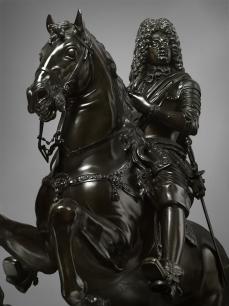
Giuseppe Piamontini, Prince Ferdinando di Cosimo III on Horseback, ca. 1695, bronze, 25 inches (62.5 cm), The Collection of Mr. and Mrs. J. Tomilson Hill
The Frick Collection will be the only venue for the first public exhibition of this private collection devoted to the bronze figurative statuette. The nearly forty sculptures included in the show are of exceptional quality and span the fifteenth through the eighteenth century, exemplifying the genre from its beginnings in Renaissance Italy to its dissemination across the artistic centers of Europe.
The Hill Collection is distinguished by rare, autograph masterpieces by Italian sculptors such as Andrea Riccio, Giambologna, and Giuseppe Piamontini. Its holding of works by the Giambologna school evokes the splendor of the late Renaissance courts, while the richness of the international Baroque is represented by Alessandro Algardi’s religious sculptures and by a remarkable assemblage of seventeenth- and eighteenth-century French bronzes in the classical mode. The Hill Collection reveals the range of artistry, invention, and technical refinement characteristic of sculptures created when the tradition of the European statuette was at its height. The exhibition is accompanied by an illustrated scholarly catalogue edited by Patricia Wengraf with
contributions by Claudia Kryza-Gersch, Dimitrios Zikos, and Denise Allen,
organizing curator of the exhibition at The Frick Collection.
◊ ◊ ◊ ◊ ◊
Patricia Wengraf, ed., Renaissance and Baroque Bronzes from the Hill Collection (London: Paul Holberton Publishing, 2014), 384 pages, ISBN: 978-1907372636, $125.
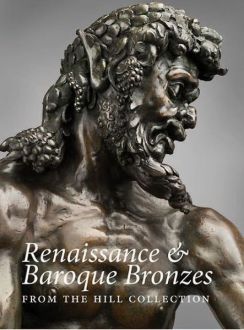 This richly illustrated and beautifully produced scholarly catalog of the superlative collection of Renaissance and Baroque bronze figurative statuettes from the Hill Collection, accompanies an exhibition of the collection at The Frick Collection, New York opening late January 2014. Spanning the 15th through the 18th century, the sculptures presented are of exceptional quality and exemplify the bronze statue or statuette from its beginnings in Renaissance Italy to its dissemination across the artistic centers of Europe.
The Hill Collection is distinguished by rare, autograph masterpieces by Italian sculptors such as Andrea Riccio and Giambologna, and has the most important collection of Baroque bronzes by Giuseppe Piamontini in the world. Its holding of works by the Giambologna school – the strongest found in any single collection, with the sole exception of the Museo Nazionale del Bargello, Florence – evokes the splendor of the late Renaissance courts, while the richness of the international Baroque is represented by religious sculptures by Alessandro Algardi, northern bronzes by Adriaen de Vries and Hubert Gerhard, and a remarkable assemblage of French 17th- and early 18th-century bronzes in the classical mode, by Barthelemy Prieur and from the circle of Ponce Jacquiot. The Hill Collection reveals the range of artistry, invention and technical refinement characteristic of sculptures created when the tradition of the European statuette was at its height.The catalog includes detailed biographies of each of the artists represented and is introduced with essays by the distinguished authors.
Patricia Wengraf is one of the world’s leading dealers in bronzes, sculpture and works of art, and in her particular specialty, bronzes of the 15th-18th centuries, her knowledge and connoisseurship are of world repute. Denise Allen is Curator of Renaissance Paintings and Sculpture at The Frick Collection. Claudia Kryza-Gersch is Curator of Renaissance Sculpture at the Kunsthistorisches Museum, Vienna. Dimitrios Zikos is Curator at the Museo Nazionale del Bargello in Florence. Rupert Harris is the leading conservator of metalwork and sculpture in the UK.
Exhibition | Georgians Revealed
Press release from the British Library:
Georgians Revealed: Life, Style and the Making of Modern Britain
British Library, London, 8 November 2013 — 11 March 2014
Curated by Moira Goff

A view of the first Bridge at Paddington, and the
Accommodation Barge going down the Grand Junction
Canal to Uxbridge © The British Library Board
◊ ◊ ◊ ◊ ◊
Exploring the changing lives of the middle classes, from homes and gardens to entertainment and celebrity, Georgians Revealed will explore the myriad ways in which the Georgians influenced modern Britain between 1714 and 1830 and marks 300 years since the period began. Through over 200 fascinating and rare Georgian artefacts from the Library’s rich collections and other UK cultural institutions, the exhibition will reveal the roots of today’s popular culture as we know it, from theatre-going and a fascination with fashion, to celebrity scandals and gambling.
Curated by specialists from the History and Classics team at the British Library, the exhibition will feature iconic artworks and artefacts from the Georgian period, such as Jeremy Bentham’s violin and Joseph van Aken’s ‘An English Family at Tea’, alongside never before seen rare books, magazines and everyday objects, from the first fashion magazines to exquisite illustrations and designs of British landmarks and buildings still standing today, including the Brighton Pavilion and Sir John Soane’s house in Lincoln’s Inn Fields.
Moira Goff, lead curator of the exhibition, says: “We’re excited to uncover these objects that shed light on daily life in such an exciting time for cultural development. The parallels we can draw between Georgian Britain and today are astonishing and we’re delighted to be able to share these with a wider audience.”
The exhibition will be accompanied by an eclectic range of events celebrating the legacy of the Georgian period, including talks by celebrated chef Heston Blumenthal and historian and author Lucy Inglis.
The 300th anniversary of the accession of George I will be celebrated throughout the UK during 2014 with displays at Kensington Palace, the Handel House Museum and the Foundling Museum among other cultural institutions.
◊ ◊ ◊ ◊ ◊
E V E N T S
Historic Heston Blumenthal
Friday 8 November, 18.30-20.00, £10/£8 concessions
Heston Blumenthal, whose name is synonymous with cutting-edge cuisine, nonetheless finds one of his greatest sources of inspiration from the original and creative recipes from Britain’s rich culinary past. Join Heston for an evening exploring the lasting impact made during the Georgian era on the culinary history of Britain and to discover their influence on some of his creations.
The Josephine Hart Poetry Hour: The Romantics
Tuesday 12 November, 18.30-20.00, £7.50/£5 concessions
Josephine Hart’s passion for poetry and commitment to having it read live electrified the evenings she hosted at the British Library. The events continue on an occasional basis, with no less capacity to move and inspire. Tonight’s programme will be devoted to the great Romantic poets: Keats, Byron and Shelley.
Georgian Londoners: Into the Streets
Sunday 17 November, 14.00 – 15.15, £7.50/ £5 concessions
In 2009 historian Lucy Inglis began her award-winning blog on the lesser-known aspects of London during the eighteenth century. Monarchs, politicians and aristocrats grab the historical limelight, but Lucy’s Georgian Londoners are the men and women who rode the dawn coach to work, opened shops bleary-eyed and hung-over, fell in love, had risky sex in side streets, realized the children had head lice again, paid parking fines, cashed in winning lottery tickets, fought for good causes and committed terrible crimes. In this talk based on her new book, Lucy takes a journey back to a time that through fantastic highs and desperate lows, changed expectations of what life could be.
LATE at the Library: Vice and Virtue
Friday 6 December, 19.30 – 23.00, £12.50
An evening of decadent pleasure and entertainment awaits. Celebrate the legacy of the Georgian era with guest DJ sets, live performance, circus, installations, bar and food and a late night opening of the exhibition. Join the rogues and gents, vamps and ladies for a night of splendour and spectacle.
In association with Georgian Townhouse Parties and Circus Space
Exhibition | The Enchanted World of German Romantic Prints
Though primarily a nineteenth-century show, this exhibition at the Philadelphia Museum of Art will appeal to many readers; it comes on the heels of Landscape, Heroes, and Folktales: German Romanticism at The British Museum last year. From the press release:
The Enchanted World of German Romantic Prints
Philadelphia Museum of Art, 21 September — 29 December 2013
Curated by John W. Ittmann

Carl Wilhelm Kolbe the Elder, Large Oak Tree Enclosed by a Plank Fence, ca. 1802–4, etching with masked plate tone, 13 x 17 inches, in the manner of the Dutch artist Anthonie Waterloo, 1609–1690 (Philadelphia Museum of Art)
In the late eighteenth and early nineteenth centuries, prints became widely available to growing and increasingly enthusiastic audiences throughout Europe and the United States. The Enchanted World of German Romantic Prints tells an important chapter in this story. This exhibition, comprising 125 etchings, lithographs, and woodcuts, will explore prints by artists from Germany, Austria, and Switzerland from 1770 to 1850, and how printmaking reflected the profound cultural changes that swept across the German-speaking regions of Central Europe during this period. The works in the exhibition represent the many artistic enthusiasms of the age: the Romantic fascination with wild, untamed landscapes teeming with life; the intimate pleasures of family scenes and friendship portraits; the rediscovery of ancient Nordic sagas and traditional fairy tales; and the synthesis of visual art, poetry, and music. The Museum’s encyclopedic collection of prints from this period is the finest in the country and includes rare prints unseen even in the finest European collections.
German Romantic Prints will feature major prints by important artists of the German Romantic era such Caspar David Friedrich, Carl Wilhelm Kolbe the Elder, and Philipp Otto Runge. The revival of interest in regional folk culture and fairy tales provided a rich source of material for artists of the time, including Ludwig Emil Grimm, the younger brother of the famous Brothers Grimm, Jacob and Wilhelm. His print The Boy Turned into a Fawn, Comforted by His Sister and Watched over by an Angel (1819) was used as the frontispiece of an early edition of his brothers’ famous tales. By the 1830s advances in technology allowed for the printing of large editions, and local art societies began to issue annual prints for members. Two large and elaborate etchings by Eugen Napoleon Neureuther illustrate the tales of Sleeping Beauty (1836) and Cinderella (1847) and attest to the continuing popularity of these stories throughout the era.
Caspar David Friedrich, one of the most important German artists of his generation, made only a handful of prints in his career. German Romantic Prints will include his rare woodcut, Woman Seated under a Spider’s Web (1803–4), a quintessential image of the Romantic era: a young woman seated between a pair of barren trees in dense undergrowth, seemingly lost in melancholy meditation on the brevity of life.
In the early 1800s, German artists and art lovers flocked to Dresden to admire Raphael’s Sistine Madonna, a painting represented in this exhibition by an engraving that was once as widely admired as the painting itself. The Sistine Madonna provided the inspiration for Runge’s visionary masterpiece, The Times of Day (Morning, Day, Evening, Night) (1805). This ambitious allegorical series depicting the cycle of life was originally conceived of as a set of mural-sized painted panels, but was realized only in the form of four large etchings, a rare first edition of which will be displayed. These large prints are bordered by delicate ornamental arabesques composed of intricate plant forms, music-playing infants, and cherubs.
An overview of a vital chapter in the history of European printmaking, German Romantic Prints illuminates one of the richest yet least known areas of the Museum’s collection. A selection of prints presented in display cases will permit enjoyment of the more finely detailed prints up close.










 Enfilade
leave a comment