Exhibition | Benjamin West: General Wolfe and the Art of Empire
From UMMA:
Benjamin West: General Wolfe and the Art of Empire
University of Michigan Museum of Art, Ann Arbor, 22 September 2012 — 13 January 2013
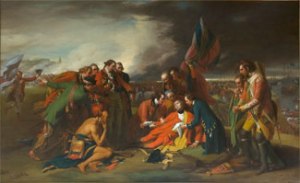
Benjamin West, The Death of General Wolfe, 1776 (William L. Clements Library, University of Michigan)
How is it that an American painter came to define the British Empire? Benjamin West’s iconic painting The Death of General Wolfe (1776) depicts the death of James Wolfe, the British commander at the 1759 Battle of Quebec, one of Great Britain’s most famous military victories, during what in this country is known as the French and Indian War. In conflating a momentous contemporary event with the genre of large-scale history painting, West flouted the conventions of academic painting and the work became one of the most celebrated paintings in Britain. The artist went on to produce six versions of the painting, one of which belongs to the William L. Clements Library at the University of Michigan. Through approximately 40 works, from Michigan, Canadian, and British collections, this ambitious and thematically focused exhibition will include the Clements canvas as well as other depictions of James Wolfe and his death on the battlefield. A fully illustrated catalogue published by the Museum as part of its UMMA Books series accompanies the exhibition.
Exhibition | Discovering Eighteenth-Century British America
From UMMA:
Discovering Eighteenth-Century British America: The William L. Clements Library Collection
University of Michigan Museum of Art, Ann Arbor, 22 September 2012 — 13 January 2013
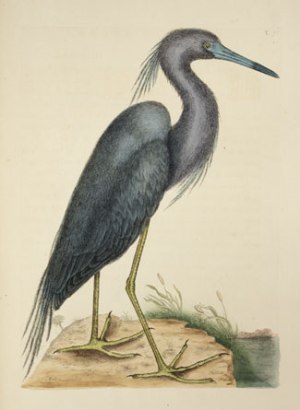
Mark Catesby, The Natural History of Carolina, Florida, and the Bahama Islands, 1731-43, hand-colored engravings (William L. Clements Library, 16791)
This significant exhibition provides glimpses of British America in the 1700s and is designed to complement the Museum’s concurrent exhibition Benjamin West: General Wolfe and the Art of Empire, which features the Clements collection’s major painting The Death of General Wolfe. William L. Clements assembled an outstanding array of primary sources on North America dating between 1492 and 1800, with a heavy emphasis on early European exploration and discovery and the eighteenth-century wars for control of the continent. The exhibition features a mix of rare items from Mr. Clements’s original donation and pieces the Library has acquired since 1923 to complement and enhance its strength in eighteenth-century American history.
This exhibition is part of the UM Collections Collaborations series, co-organized by and presented at UMMA and designed to showcase the renowned and diverse collections at the University of Michigan. The UM Collections Collaborations series is generously supported by the Andrew W. Mellon Foundation.
Display | The Geometry of War: Fortification Plans
From the University of Michigan:
The Geometry of War: Fortification Plans from Eighteenth-Century America
William L. Clements Library, University of Michigan, 15 October 2012 — 15 February 2013
 The eighteenth century was a time of intensive military activity in Europe and in the Americas. Much of this centered on fortified towns or positions. The period from the 1680s to the French Revolution has been called the “classic century of military engineering,” a time when earlier forms of artillery fortifications were perfected and frequently tested in battle.
Designing, constructing, and recording fortifications was the job of the military engineer. He followed well-tested principles of design, based on geometry, to construct fortified places. These were recorded in detailed plans, many of surprising beauty and complexity. The Clements Library is rich in examples, manuscript and printed, and offers a sample illustrating the science of fortification in eighteenth-century America.
Exhibition | Guglielmo Du Tillot and the Enlightenment
From the University of Parma:
Guglielmo Du Tillot Regista delle Arti nell’Età dei Lumi
Palazzo Bossi Bocchiarma, Parma, 28 October 2012 — 27 January 2013
Curated by Gianfranco Fiaccadori, Alessandro Malinverni, and Carlo Mambriani
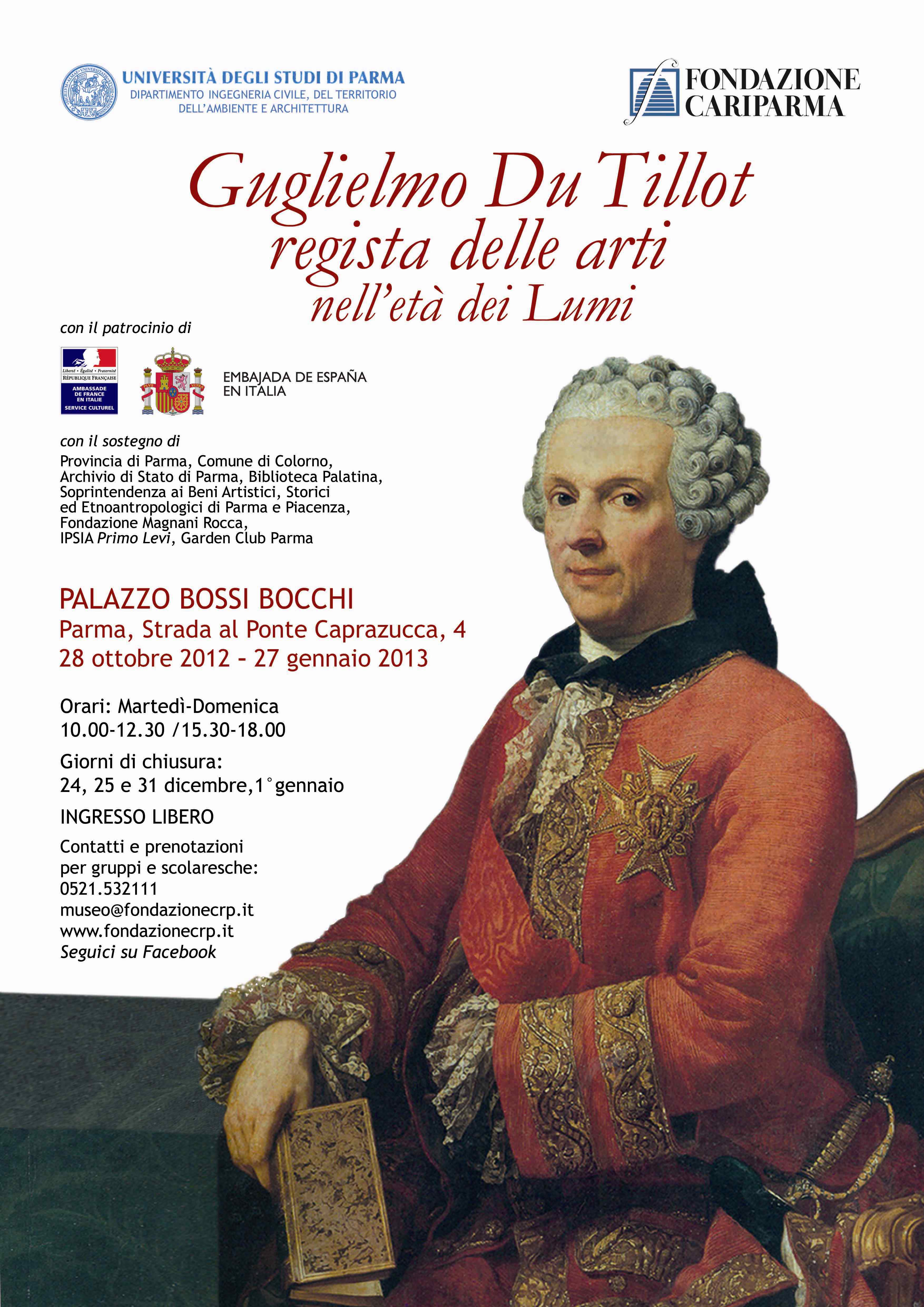 La mostra Guglielmo Du Tillot, regista delle arti nell’età dei Lumi si terrà a Palazzo Bossi Bocchi dal 28 ottobre 2012 al 27 gennaio 2013 (inaugurazione sabato 27 ottobre ore 18,00). L’esposizione, che si fregia del patrocinio delle ambasciate di Francia e di Spagna in Italia, è stata realizzata in collaborazione con Biblioteca Palatina di Parma, Soprintendenza per i Beni Storici Artistici ed Etnoantropologici di Parma e Piacenza, Archivio di Stato di Parma e IPSIA “Primo Levi” di Parma; l’obiettivo è di raccontare a un vasto pubblico l’impatto culturale e artistico della figura di Du Tillot, Intendente della Real Casa inizialmente e Primo ministro in seguito. Attraverso un ricco panorama di opere, talvolta inedite, di pittura, scultura, architettura, incisione, numismatica e arti decorative, nonché di preziosi volumi conservati nei fondi antichi della Biblioteca Palatina e della Biblioteca di Busseto, verrà illustrata la riforma artistica e culturale che permise al piccolo stato borbonico di emergere in Italia e in Europa come non era accaduto nemmeno sotto la dinastia farnesiana, facendo di Parma l’«Atene d’Italia».
Il percorso della mostra – ideata e curata da Gianfranco Fiaccadori e Alessandro Malinverni (Università di Milano) e Carlo Mambriani (Università di Parma) – si articola in due sezioni: la prima, preceduta da un inquadramento biografico del protagonista, è incentrata sulla trasformazione di Parma in «Atene d’Italia»: il ruolo del ministro, di Annetta Malaspina e della loro cerchia; le nozze dei principi come eventi di propaganda artistica e dinastica; l’istituzione dell’Accademia e l’appoggio fornito ai suoi artisti; il rinnovo delle residenze, delle manifatture e del tessuto urbano. La seconda sezione è dedicata alla committenza privata di Du Tillot a Parma e a Parigi, durante il breve esilio: l’allestimento delle sue residenze, gli acquisti di libri e di opere d’arte, gli artisti prediletti.
Tra i numerosi artisti presenti in mostra, oltre all’architetto Ennemond Alexandre Petitot, fedele collaboratore del ministro, e ai vincitori dei concorsi accademici degli anni Sessanta, si segnalano i protagonisti della ritrattistica settecentesca parmense, come Giuseppe Baldrighi e Pietro Melchiorre Ferrari, ed europea, del rango di Jean-Marc Nattier, Anton Raphael Mengs, Laurent Pecheux e Louis-Michel Van Loo.
Exhibition | Bronze at The Royal Academy
Reviewed for Enfilade by Craig Ashley Hanson
Bronze
Royal Academy of Arts, London, 15 September — 9 December 2012
Curated by David Ekserdjian and Cecilia Treves
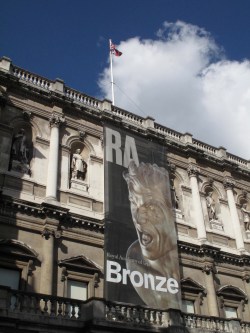 Critics have been raving about Bronze since it opened last month at the Royal Academy of Arts in London. Notwithstanding the exhibition’s sweeping coverage–in terms of geography and history–I didn’t initially include it here at Enfilade as I had trouble finding eighteenth-century points of relevance. Indeed, out of dozens of objects shown across ten rooms, only a handful of works were produced during the period. And yet, now that I’ve seen the exhibition, I’m convinced dix-huitièmistes should pay attention.
Organized by theme rather than time and place, the range of works is staggering. If, in keeping with traditional historiographical models, the show begins with an achingly beautiful example from ancient Greece–a recently recovered Dancing Satyr–it quickly brings an international array of work into open and productive dialogue. On display are works from Ghana and Nigeria, Eturia and Rome, China and Japan, Northern Europe and the United States. Categories one might expect to see are well represented: ritual dining vessels from Shang dynasty tombs, classicizing work from Renaissance Florence, Buddhist work from India (including an extraordinary sixth-century Buddha Shakyamuni from Bihar). Rodin’s Age of Bronze is, of course, included. But there are surprises, too: ancient court objects from Israel (a crown, scepter, and vulture standard), sixteenth-century French spurs, a basketball by Jeff Koons. Works by Giambologna appear next to an oversized spider by Louise Bourgeois (climbing the wall, no less).

François Girardon, Laocoön and His Sons, ca. 1690 Houghton Hall, Norfolk/Photo © Royal Academy of Arts, London, Roy Fox (click for more info)
While it all could have gone horribly wrong, the experience of viewing the exhibition appears to be, for most viewers, one of coherence rather than confusion, coherence derived from the thoughtful attention to the possibilities of bronze as a material. The medium is the subject in an entirely convincing, indeed revelatory manner. The varieties of objects, selected from a global vision of art history, work thanks to careful attention to exploration of seven thematic categories: figures, animals, groups, objects, reliefs, gods, and heads. Scale and texture, color and composition, the tensile strength and resulting artistic flexibility of bronze all become matters of first, rather than passing, interest.
And for the eighteenth-century? The final room of heads includes original choices: Massimiliano Soldani-Benzi’s Damned Soul of 1705 after Bernini and Anne Damer’s Mary Berry from 1793, while François Girardon’s Laocoön from Houghton Hall, ca. 1690, exerts a commanding presence in the gallery dedicated to groups. Particularly compelling for me, in that same room, is the sensitive installation of Francesco Bertos’s 1730s allegorical group of Sculpture, Arithmetic, and Architecture from the Prado. Placed alongside Giambologna’s 1576 Nessus and Deianira (a centaur abduction scene) and Alessandro Algardi’s 1647 St. Michael Overcoming the Devil, Bertos’s work appears as an entirely legible development from Renaissance humanism, to forceful Baroque religious expression, to refined Enlightened optimism. Adrian de Vries’s Hercules, Nessus and Deianira of 1622 dominates the center of the gallery, making the relationships–the similarities and differences within this 150-year period–all the more striking.
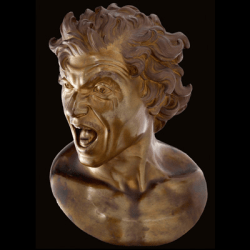
Massimiliano Soldani-Benzi, after Bernini, Damned Soul (‘Anima Dannata’), 1705-07. Bronze with golden-red lacquer patina, 39.5 cm. Liechtenstein Museum, Vienna. Photo © Liechtenstein. The Princely Collections, Vaduz-Vienna
And so historical arguments do exist within the exhibition, even if there’s no obvious central argument based on tracking change over time (it is I think one reason material from all over the world can be placed side by side so effectively). One may wish there were more eighteenth-century offerings–I’ll leave those criticisms to the sound judgment of my colleagues. But, for me, it is an exhibition that likely would make a lot more sense to eighteenth-century connoisseurs than the much more tightly focused, monographic approaches dominating exhibitions in the present age. No only is it a show I think many eighteenth-century viewers would understand (with admittedly a bit of instruction), it’s a show I think they would like.
Alongside it, the catalogue offers innovative models for thinking about different ways exhibitions generally might succeed. The book pairs beautifully with the catalogue for the 2009 exhibition Cast in Bronze: French Sculpture from Renaissance to Revolution, available–for anyone regretting that there aren’t more eighteenth-century works on
display–in the Royal Academy gift shop on the way out.
◊ ◊ ◊ ◊ ◊
Catalogue: Bronze (London: Royal Academy Publications, 2012), 248 pages, ISBN: 9781907533280, $65.
 Bronze, long celebrated for its durability and the wide range of effects that it offers, has been prized as an artistic material in many parts of the world throughout the ages. Magnificent bronze sculptures from the ancient times have emerged unscathed after millennia on the sea bed. It is a material that has been used on all scales, from the minute to the monumental. This sumptuous catalogue examines bronze’s earliest beginnings in North Africa, the Middle East and China as it transcended tools and weaponry to become a medium of fine art. Expert authors chart the virtuousity of artists in ancient Greece and Rome; developments in Asia and Africa; bronze’s great flowering in the European Renaissance and its use in the modern era by artists such as Rodin, Picasso, Brancusi and Bourgeois.
A unique testament to the works of art that one medium has inspired, Bronze contains lavish colour plates of over 150 masterworks arranged chronologically to take the reader on a voyage through time, tracing the work of sculptors, casters and chasers through the centuries.
Exhibition | American Furniture from the Kaufman Collection
Guest curator Wendy Cooper of Winterthur Museum is scheduled to speak at the National Gallery on October 28, at 2pm. The talk is entitled, “Triumphs in Craftsmanship: Masterpieces of American Furniture from the Kaufman Collection, 1700–1830.”
◊ ◊ ◊ ◊ ◊
Press release from the National Gallery in Washington, D.C.:
Masterpieces of American Furniture from the Kaufman Collection, 1700–1830
The National Gallery of Art, Washington, D.C., opening 7 October 2012
Curated by Wendy Cooper
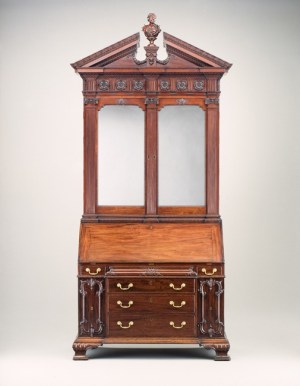
Philadelphia, Desk and Bookcase, 1755-65,
mahogany, glass, brass; 290 x 137 x 68 cm (114 x 54 x 27 in). Washington, D.C.: National Gallery of Art
The National Gallery of Art presents Masterpieces of American Furniture from the Kaufman Collection, 1700–1830. When this installation opens on October 7, 2012, on the Ground Floor of the West Building, it will be a landmark moment for the nation’s capital, which until this time has had no major presentation of early American furniture and related decorative arts on permanent public view. The installation follows the promised gift in October 2010 of one of the largest and most refined collections of early American furniture in private hands, acquired with great connoisseurship over five decades by George M. (1932–2001) and Linda H. Kaufman (b. 1938).
The Kaufman Collection comprises more than 200 works of art, including American furniture, major Dutch paintings, American paintings, and works on paper, among them some 40 floral watercolors by Pierre-Joseph Redouté (1759–1840). Many of these objects were featured in 1986–1987 when the Gallery first exhibited American Furniture from the Kaufman Collection. The upcoming installation will highlight more than 100 of the finest examples of early American furniture and decorative arts, shown with a selection of American, European, and Chinese porcelains and a number of choice Redouté watercolors—all from the Kaufman Collection. Paintings by American artists from the Gallery’s collection will also be integrated into the presentation.
“The Gallery is extremely grateful to George and Linda Kaufman, who chose to give their collection to the nation so that the public can view the finest works of some of America’s greatest artisans here in the nation’s capital,” said Earl A. Powell, director, National Gallery of Art. “This unparalleled gift dramatically amplifies the great American achievements in painting and sculpture long represented at the Gallery, while also transforming our collection of decorative arts by augmenting its fine holdings of European decorative arts with equally important American examples.” (more…)
Exhibition | Dark Romanticism: From Goya to Max Ernst
Press release from the Städel Museum:
Schwarze Romantik: Von Goya bis Max Ernst
The Städel Museum, Frankfurt am Main, 26 September 2012 — 20 January 2013
Musée d’Orsay, Paris, 4 March — 9 June 2013
Curated by Felix Krämer
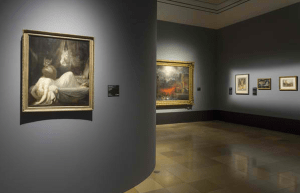 The Städel Museum’s major special exhibition Dark Romanticism: From Goya to Max Ernst is the first German exhibition to focus on the dark aspect of Romanticism and its legacy, mainly evident in Symbolism and Surrealism. Comprising over 200 paintings, sculptures, graphic works, photographs and films, it presents the fascination that many artists felt for the gloomy, the secretive and the evil. Using outstanding works in the museum’s collection on the subject by Francisco de Goya, Eugène Delacroix, Franz von Stuck or Max Ernst as a starting point, the exhibition is also presenting important loans from internationally renowned collections, such as the Musée d’Orsay, the Musée du Louvre, both in Paris, the Museo del Prado in Madrid and the Art Institute of Chicago. The works on display by Goya, Johann Heinrich Fuseli and William Blake, Théodore Géricault and Delacroix, as well as Caspar David Friedrich, convey a Romantic spirit which by the end of the 18th century had taken hold all over Europe. In the 20th century artists such as Salvador Dalí, René Magritte or Paul Klee and Max Ernst continued to think in this vein. The art works speak of loneliness and melancholy, passion and death, of the fascination with horror and the irrationality of dreams. After Frankfurt the exhibition, conceived by the Städel Museum, will travel to the Musée d’Orsay in Paris.
The exhibition’s take on the subject is geographically and chronologically comprehensive, thereby shedding light on the links between different centres of Romanticism, and thus retracing complex iconographic developments of the time. It is conceived to stimulate interest in the sombre aspects of Romanticism and to expand understanding of this movement. Many of the artistic developments and positions presented here emerge from a shattered trust in enlightened and progressive thought, which took hold soon after the French Revolution – initially celebrated as the dawn of a new age – at the end of the 18th century. Bloodstained terror and war brought suffering and eventually caused the social order in large parts of Europe to break down. The disillusionment was as great as the original enthusiasm when the dark aspects of the Enlightenment were revealed in all their harshness. Young literary figures and artists turned to the reverse side of Reason. The horrific, the miraculous and the grotesque challenged the supremacy of the beautiful and the immaculate. The appeal of legends and fairy tales and the fascination with the Middle Ages competed with the ideal of Antiquity. The local countryside became increasingly attractive and was a favoured subject for artists. The bright light of day encountered the fog and mysterious darkness of the night.
The exhibition is divided into seven chapters. It begins with a group of outstanding works by Johann Heinrich Fuseli. The artist had initially studied to be an evangelical preacher in Switzerland. With his painting The Nightmare (Frankfurt Goethe-Museum) he created an icon of dark Romanticism. This work opens the presentation, which extends over two levels of the temporary exhibition space. Fuseli’s contemporaries were deeply disturbed by the presence of the incubus (daemon) and the lecherous horse – elements of popular superstition – enriching a scene set in the present. In addition, the erotic-compulsive and daemonic content, as well as the depressed atmosphere, catered to the needs of the voyeur. The other six works by Fuseli – loans from the Kunsthaus Zürich, the Royal Academy London and the Staatsgalerie Stuttgart – represent the characteristics of his art: the competition between good and evil, suffering and lust, light and darkness. Fuseli’s innovative pictorial language influenced a number of artists – among them William Blake, whose famous watercolour The Great Red Dragon from the Brooklyn Museum will be on view in Europe for the first time in ten years.
The second room of the exhibition is dedicated to the Spanish artist Francisco de Goya. The Städel will display six of his works – including masterpieces such as The Witches’ Flight from the Prado in Madrid and the representations of cannibals from Besançon. A large group of works on paper from the Städel’s own collection will be shown, too. The Spaniard blurs the distinction between the real and the imaginary. Perpetrator and victim repeatedly exchange roles. Good and evil, sense and nonsense – much remains enigmatic. Goya’s cryptic pictorial worlds influenced numerous artists in France and Belgium, including Delacroix, Géricault, Victor Hugo and Antoine Wiertz, whose works will be presented in the following room. Atmosphere and passion were more important to these artists than anatomical accuracy. . .
The full press release is available here»
◊ ◊ ◊ ◊ ◊
Available from the publisher:
Catalogue: Felix Krämer, ed., Dark Romanticism: From Goya to Max Ernst (Ostfildern: Hatje-Cantz-Verlag, 2012), 305 pages, ISBN 9783775733731 (German edition ISBN: 9783775733724), $70 / 35€.
 The exhibition, which presents the Romantic as a mindset that prevailed throughout Europe and remained influential beyond the 19th century, is accompanied by a substantial catalogue with contributions by Roland Borgards, Ingo Borges, Claudia Dillmann, Dorothee Gerkens, Johannes Grave, Mareike Hennig, Hubertus Kohle, Felix Krämer, Franziska Lentzsch, Manuela B. Mena Marqués and Nerina Santorius. As is true for any designation of an epoch, Romanticism too is nothing more than an auxiliary construction, defined less by the exterior characteristics of an artwork than by the inner sentiment of the artist. The term ‘dark Romanticism’ cannot be traced to its origins, but – as is also valid for Romanticism per se – comes from literary studies. The German term is closely linked to the professor of English Studies Mario Praz and his publication La carne, la morte e il diavolo nella letteratura romantica of 1930, which was published in German in 1963 as Liebe, Tod und Teufel:
Die schwarze Romantik (literally: Love, Death and Devil: Dark
Romanticism).
Exhibition | Napoléon and the Art of Propaganda
From the UIMA:
Napoléon and the Art of Propaganda: Art from the Collection of Pierre-Jean Chalençon
University of Iowa Museum of Art, Iowa City, 13 September 2012 — 29 January 2013
Curated by Heidi Kraus and Sean O’Harrow, with Dorothy Johnson
The masses… must be guided without their knowing it.
— Napoléon I to Joseph Fouché, his minister of police
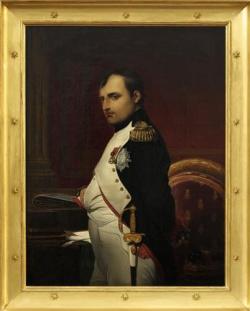
Hippolyte (Paul) Delaroche, Portrait of Emperor Napoleon the First in his Office,
(Collection of Pierre-Jean Chalençon)
From approximately 1800-1815, Napoléon Bonaparte used official propaganda to control artistic autonomy and manipulate public perceptions of his regime both in France and throughout Europe. As a result, government-sponsored art created during the Consulate and Empire is frequently dismissed by art historians as lacking in experimentation, complexity, and beauty. In this extraordinary traveling exhibition, Napoléon and the Art of Propaganda, the aesthetic value and social history of so-called ‘propagandistic art’ created during the First Empire is critically re-examined through the use of visual display, close analysis, and scholarly research. Despite strict censorship laws and a dictatorial arts administration, this exhibition demonstrates that many artists working in the service of Napoléon were deeply inspired by and passionately engaged with their prescribed ‘official’ subjects. Less of a literal presentation, this aesthetic cornucopia shows off the stunning visual aspects of this luxurious Age of Empire.
Napoléon and the Art of Propaganda is a visual chronology of more than 120 drawings, prints, paintings, works of sculpture, manuscripts, medals, and objets d’art from the remarkable private Parisian collection of Pierre-Jean Chalençon. This exhibition considers the full range of official art created under Napoléon I and emphasizes the aesthetic qualities of the period. Some of the most important artists, architects, and sculptors are included, such as Jacques-Louis David, Andrea Appiani, Anne-Louis Girodet, François Gérard, Charles Percier, and Pierre-François-Léonard Fontaine. The selected works display the visual power of the Napoléonic propaganda ‘machine’ and its scope of influence both politically and artistically; illustrate how Napoléon, his ministers, and artists fabricated and produced an imperial iconography; and provide the viewer with an understanding through the use of images of the legend or myth of Napoléon that persisted after his death in exile.
◊ ◊ ◊ ◊ ◊
An exciting array of city-wide programs has been planned to complement the exhibition: lectures (by Bernard Chevallier, Christopher Johns, and Susan Taylor Leduc), concerts, films (Sokurov’s Hubert Robert: A Fortunate Life and Patrice Jean’s Napoléon, David Le sacre de I’image), and readings. The full schedule is available here»
Exhibition | Pride and Prejudice: Female Artists in France and Sweden
Press release from Sweden’s Nationalmuseum in Stockholm:
Pride and Prejudice: Female Artists in France and Sweden 1750–1860
Nationalmuseum, Stockholm, 27 September 2012 — 20 January 2013

Constance Marie Charpentier, Melancholy, 1810
(Amiens: Musée de Picardie)
◊ ◊ ◊ ◊ ◊
Pride and Prejudice – Female Artists in France and Sweden 1750–1860 explores conditions for female artists in France and Sweden during a period of revolutionary social change. The exhibition presents works by some of the French and Swedish women who managed to establish themselves as artists and create a name for themselves at this time. Works by amateurs are also on display, since women of higher standing were expected to master skills such as drawing and embroidery.
The exhibition includes six works by Marie Suzanne Giroust. She was married to artist Alexander Roslin and is The Lady with the Veil in his well-known painting of that name. During her lifetime, she was also a recognised figure, but she later came to be omitted from art history, a fate that she shares with many other female artists. Today only 19 of her works can be identified with any certainty. Giroust was one of the few women to be inducted into France’s Royal Academy of Painting and Sculpture in the late 18th century. Its members had the exclusive opportunity to showcase works at the Salon in Paris, the most important exhibition in France at the time. Within the Royal Academy, there was staunch opposition to female artists. In the mid-18th century, a ceiling was introduced that permitted no more than four members of this gender at any one time.

Adélaïde Labille-Guiard, Portrait of a Woman, 1787 (Musée des beaux-arts de Quimper)
During this period, family ties or social relations to male artists were crucial in determining women’s opportunities for training and inclusion in the art establishment. Giroust was accepted into the Royal Academy for her high artistic quality, but her husband’s prominence was no doubt also a significant factor. The same was true for other female members: Anne Vallayer-Coster, Elisabeth Louise Vigée-Lebrun and Adélaïde Labille-Guiard were all under Royal patronage and Marie Thérèse Reboul was married to the director of the French Academy in Rome. In Sweden too, female artists were unable to access the training offered by the Royal Swedish Academy of Fine Arts. Ulrica Fredrica Pasch became the first female member of the Royal Academy in 1773. She was apprenticed to her father, portraitist Lorens Pasch the Elder, and her brother Lorens Pasch the Younger was a professor and director of the Royal Academy. Once again, family ties and relations to established artists were a precondition for admission.
After the French Revolution, the Salon was opened up to all artists. Art was broadened out, enabling women to exhibit on the same terms as men. At the same time, the revolution caused the well-heeled customers to disappear, which affected incomes and the chances of finding good patrons. Women were also still excluded from all public art-related education. Their only chance was to enrol at private art schools such as the studios of Jacques-Louis David and Jean-Baptiste Regnauld. Some of the most eminent female artists had their own students, but these were all women. Soon these exclusively female studios in Paris also began to attract Swedish students.
During the first half of the 19th century, more and more women were able to step out of the shadows and see their career follow an increasingly professional course. In certain areas, such as French miniature painting, women led the field. Portraits were a path to both fame and fortune and, coupled with genre painting, came to form an important area for women artists. Leading figures during the first half of the 17th century include Cécile Hortense Haudebourt-Lescot and Marguerite Gérard in France, and Maria Röhl, Sophie Adlersparre and Amalia Lindegren in Sweden. Women gained the formal right to become fully-fledged students at the Royal Swedish Academy of Fine Arts in 1864, which is why the exhibition has taken this particular decade as its cut-off point.
Pride and Prejudice is a joint venture with Washington’s National Museum of Women in the Arts, where several of the French works have featured in the exhibition Royalists to Romantics. In Stockholm, they will be complemented with key loans from France plus works from Nationalmuseum and other collections. For many of the works, this will be their first appearance before a Swedish audience. The exhibition comprises around 250 objects, from works in oils and pastels to drawings, miniatures and embroidered artworks. The artists on show include Marie Suzanne Giroust, Anne Vallayer-Coster, Elisabeth Louise Vigée-Lebrun, Adélaïde Labille-Guiard, Marie Thérèse Reboul, Cécile Hortense Haudebourt-Lescot, Marguerite Gérard, Ulrica Fredrica Pasch, Maria Röhl, Sophie Adlersparre and Amalia Lindegren.
The exhibition is accompanied by a fully illustrated catalogue containing articles written by various Swedish and international specialists. Magnus Olausson, Eva-Lena Bengtsson, Barbro Werkmäster, Eva-Lena Bergström, Eva-Lena Karlsson and Solfrid Söderlind are among the Swedish authors.
◊ ◊ ◊ ◊ ◊
Theme Day
Sunday, 14 October, 1–3 pm
(Program will be announced later in September)
Lecture
Thursday, 17 January, 6 pm
Royalists and Revolutionaries: Women Artists and the French Revolution, lecture by Laura Auricchio, Associate Professor of Art History, Parsons The New School for Design. In English.
Exhibition | The Last Days of Pompeii
While the exhibition showcases the nineteenth-century response to the eruption, there are still plenty of eighteenth-century offerings. The exhibition checklist is available here (as a PDF file). The following comes from the description of the accompanying publication.
◊ ◊ ◊ ◊ ◊
The Last Days of Pompeii: Decadence, Apocalypse, Resurrection
Getty Villa, Los Angeles, 12 September 2012 — 7 January 2013
Cleveland Museum of Art, 24 February — 19 May 2013
Musée national des beaux-arts du Québec, 13 June — 8 November 2013
 Destroyed yet paradoxically preserved by the eruption of Mount Vesuvius in A.D. 79, Pompeii and other nearby sites are usually considered places where we can most directly experience the daily lives of ancient Romans. Rather than present these sites as windows to the past, however, the authors of The Last Days of Pompeii: Decadence, Apocalypse, Resurrection explore Pompeii as a modern obsession, in which the Vesuvian sites function as mirrors of the present. Through cultural appropriation and projection, outstanding visual and literary artists of the last three centuries have made the ancient catastrophe their own, expressing contemporary concerns in diverse media—from paintings, prints, and sculpture, to theatrical performances, photography, and film. This lavishly illustrated volume—featuring the works of artists such as Piranesi, Fragonard, Kaufmann, Ingres, Chassériau, and Alma-Tadema, as well as Duchamp, Dalí, Rothko, Rauschenberg, and Warhol—surveys the legacy of Pompeii in the modern imagination under the three overarching rubrics of decadence, apocalypse, and resurrection.
Decadence investigates the perception of Pompeii as a site of impending and well-deserved doom due to the excesses of the ancient Romans, such as paganism, licentiousness, greed, gluttony, and violence. The catastrophic demise of the Vesuvian sites has become inexorably linked with the understanding of antiquity, turning Pompeii into a fundamental allegory for Apocalypse, to which all subsequent disasters (natural or man-made) are related, from the San Francisco earthquake of 1906 to Hiroshima, Nagasaki, 9/11, and Hurricane Katrina. Resurrection examines how Pompeii and the Vesuvian cities have been reincarnated in modern guise through both scientific archaeology and fantasy, as each successive cultural reality superimposed its values and ideas on the distant past.
Victoria C. Gardner Coates, Kenneth Lapatin, and Jon L. Seydl, The Last Days of Pompeii: Decadence, Apocalypse, Resurrection (Los Angeles: J. Paul Getty Museum, 2012), 256 pages, ISBN: 9781606061152, $40.










 Enfilade
leave a comment