Exhibition | Messerschmidt and Modernity
Press release (16 April 2012) from The Getty:
◊ ◊ ◊ ◊ ◊
Messerschmidt and Modernity
The J. Paul Getty Museum, Getty Center, Los Angeles, 24 July — 14 October 2012

The Getty Celebrates the Modern and Contemporary Legacy of Franz Xaver Messerschmidt’s Distinctive Character Heads
◊ ◊ ◊ ◊ ◊

Ken Gonzales-Day, Untitled (Franz Xaver Messerschmidt, The Vexed Man, The J. Paul Getty Museum, Los Angeles, CA), 2008. Light jet print. Courtesy of Ken Gonzales-Day and Fred Torres Collaborations, N.Y.C. © Ken Gonzales-Day
The intriguing series of heads that are collectively known as Character Heads, created by the German Baroque artist Franz Xaver Messerschmidt (1736–1783) during the last 13 years of his life, have become increasingly popular with the general public through a series of recent exhibitions and books devoted to these expressive works. Furthermore, the sculptures, depicting various states of emotion and expression, have also captured the imaginations of generations of artists—especially during the 20th and 21st centuries.
Messerschmidt and Modernity, on view at the J. Paul Getty Museum from July 24 through October 14, 2012, is the first exhibition to explore the contemporary legacy of these surprisingly modern-looking sculptures, which were carved in alabaster, or cast in a lead or tin alloy. Along with Messerschmidt’s works, the exhibition will feature a selection of modern and contemporary works of art that testify to the lasting impact of these astonishing heads. Eight Character Heads will be exhibited—among them the Getty’s own Vexed Man— along with a newly discovered reduced variation of a now-lost Character Head known as A Cheeky Nitpicky Mocker, which has never before been exhibited publicly. Contemporary artists featured in the exhibition include Tony Bevan, Tony Cragg, Ken Gonzales-Day, Bruce Nauman, Pierre Picot, Arnulf Rainer, Cindy Sherman, and Emily Young.
“Messerschmidt’s Character Heads have appealed to audiences since they were first produced. They were especially popular in turn-of-the-century Vienna and subsequently inspired modern artists of the 20th century,” explains Antonia Boström, senior curator of sculpture and decorative arts at the J. Paul Getty Museum. “Now, this unparalleled series of sculptures is enjoying a renewed popularity—not only fascinating to museum audiences and scholars, but compelling for contemporary artists.”
The exhibition demonstrates how Messerschmidt’s heads are linked to the 18th and 19th centuries’ fascination with expression and the “passions,” as well as with the pseudosciences of physiognomy and pathognomy. It also traces how this series has influenced the work of artists in fin-de-siècle Vienna and contemporary artists in Austria, Great Britain, and the United States.
Messerschmidt
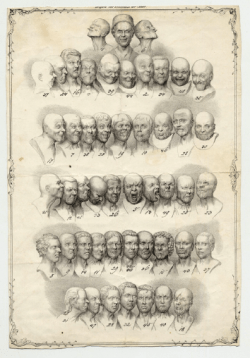
Matthias Rudolph Toma, Messerschmidt’s ‘Character Heads’, 1839. Lithograph. Courtesy of the Museum of Fine Arts, Budapest.
The German-born Messerschmidt led a successful career in Vienna in the mid-18th century, receiving many important commissions from the Habsburg empress Maria Theresa and her consort, Francis Stephen of Lorraine. Messerschmidt’s circumstances changed dramatically around 1770 when he began to show signs of mental instability, leading to the loss of prestigious commissions and conflicts with colleagues and friends. He eventually left Vienna and, in 1777, he settled in Pressburg (now Bratislava), and remained there until his death in 1783, focusing obsessively on the production of the heads as well as more conventional portraits. Messerschmidt called the dozens of heads he created between 1770 and 1783 Kopfstücke (head pieces) and intended them to represent the full range of human expressions, which he believed there are sixty-four. In 1793, ten years after his death, the heads were exhibited at the Citizen’s Hospital in Vienna, when, despite their misrepresentation, they also received the often incongruous titles by which they are still referred to today. They were only referred to as “Character Heads” after Messerschmidt’s death.
Just Rescued from Drowning belongs to a group of alabaster Character Heads probably depicting the same man, but differentiated by the arrangement of the hair. The title suggests that he has just been submerged in water, and his lank hair (or a wig) hangs down over his forehead, but the hairstyle may actually reflect those featured on Gothic sculptures of southern Germany, which would have been familiar to Messerschmidt from his youth.
Another head on view, The Ill-Humored Man, belongs to a group of middle-aged bald men within the series of Character Heads. The man’s tightly squeezed eyes and the flat strip covering his mouth contribute to a strong sense of alienation and interiority and we sense his extreme discomfort. The object covering the mouth may relate to the magnets that the German physician Franz Anton Mesmer (1734–1815) applied to patients during his therapeutic sessions. They formed part of his “animal magnetism” theory that a universal magnetic fluid coursing through the human body could be manipulated by magnets for curative purposes. Mesmer and Messerschmidt were known to be friends and these experimental procedures were of great interest to the artist.
The French artist Joseph Ducreux (1735–1802) was a contemporary of Messerschmidt, and as a painter at the court in Vienna he was probably familiar with his sculpture. Like Messerschmidt, Ducreux was interested in the pseudoscience of physiognomy, and his Self-Portrait, Yawning (by 1783, Getty Museum’s permanent collection) is an example of his experiments with the expressive possibilities of portraiture.
Some forty-nine of the sixty-nine heads Messerschmidt created are accounted for today. A lithograph on view in the exhibition has been a key element in reconstructing the series of Messerschmidt’s heads. Created by Matthias Rudolph Toma after a drawing by Josef Hasslwander, this print (from Budapest) depicts forty-nine of the heads and was made four years after the heads were publicly exhibited in 1835 by their then-owner, Josef Jüttner.
The psychological theme of Messerschmidt’s sculptures and their uncompromising aesthetic colored their public reception in Vienna. After his death and throughout the early 19th century the Character Heads were viewed as oddities and exhibited in Vienna for popular entertainment. Over time, this perception changed and by the end of the 19th century the heads were seen as useful examples of expression and emotion for art students to copy, and for students of anatomy and psychology to study. Some of the heads found their way into art-school storerooms in Vienna, while others were collected both by preeminent medical professionals and by art collectors. By the turn of the century the Character Heads found favor with Vienna’s Jewish cultural elite, which supported avantgarde art movements such as the Viennese Secession and the Wiener Werkstätte, and also had links to Sigmund Freud. Their interests in unconventional contemporary art and the science of psychiatry combined to create a new culture of support for Messerschmidt’s heads in Vienna.
Modernity and Beyond
The works created since 1900 on view in the exhibition represent a wide range of responses to the Character Heads. Modern and contemporary artists have been drawn to Messerschmidt’s heads for their perceived departure from the confines of academic convention. But it is also the combination of a reductive style, refined modeling and carving,
and exaggerated expression that make these sculptures resonate with modern audiences. By the early 20th century, Messerschmidt’s heads were well known in Vienna, and prized by collectors and artists as distinctive and affecting works of art. Anton Josef Trčka’s renowned 1914 portrait photograph of Egon Schiele (1890–1918) reflects the visual and psychological impact of Messerschmidt’s grimacing heads. The camera focuses closely on the artist’s head and hands; his anxious expression and interlocked fingers hint at his angst-ridden mood.
Contemporary artists such as Arnulf Rainer (b. 1929) and Tony Bevan (b. 1951) directly quote Messerschmidt’s sculptures, while others, including Bruce Nauman (b. 1941) and Cindy Sherman (b. 1954), incorporate their body, human expression, and self-portraiture into their work in a way that prompts comparison with Messerschmidt. The sculptures of Tony Cragg (b. 1949) and Emily Young (b. 1951) are more indirectly related, though the sculptors’ grounding in a figurative tradition and their exploration of the material’s expressive potential can be paralleled in Messerschmidt’s works. The juxtaposition of works from different time periods in this section of the exhibition illustrates the psychological power that Messerschmidt’s Character Heads continue to have for the contemporary viewer.
Expression Lab
The final gallery of the exhibition is designed to encourage visitors to consider and respond to Messerschmidt’s sculptures and the contemporary works focused on expression. The gallery is installed with mirrors, art reproductions, and an interactive “photo booth” for those who wish to actively explore and record their own facial expressions. For example, Rainer practiced “pulling faces” in the mirror, performing and documenting a series of contorted expressions as a means of investigating his own image. Using mirrors, visitors will be able to try these exercises themselves. In the photo booth, participants will be invited to replicate the intense facial expression of the Vexed Man or other character heads, or to invent an expression of their own choosing. Visitors may then share their photo on video screens in the gallery. A related video will be shown and reference books will be on hand for those who wish to learn more about Messerschmidt and expression, and about the other artists represented in the exhibition.
An audio tour, narrated by Boström and guest contributor Professor Eric Kandel, a Nobel-prize winning neuroscientist and author of The Age of Insight: The Quest to Understand the Unconscious in Art, Mind, and Brain, from Vienna 1900 to the Present, will accompany the exhibition. Messerschmidt and Modernity will also be accompanied by a richly illustrated book of the same name, written by Antonia Boström and published by Getty Publications.
◊ ◊ ◊ ◊ ◊
From the Getty Store:
Antonia Boström, Messerschmidt and Modernity (Los Angeles: Getty Publications, 2012), 80 pages, ISBN: 9780892369744, $20.
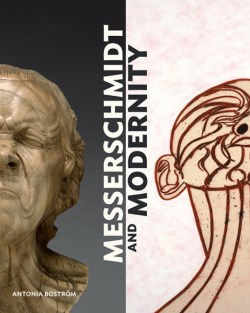 An astonishing group of sixty-nine “Character Heads” by German sculptor Franz Xaver Messerschmidt (1736–1783) has fascinated viewers, artists, and collectors for more than two centuries. The heads, carved in alabaster or cast in lead or tin alloy, were conceived outside the norm of conventional portrait sculpture and explore the furthest limits of human expression. Since their first exposure to the public in 1793, artists, including Egon Schiele (1890–1918), Francis Bacon (1909–1992), Arnulf Rainer (born 1929), and, more recently, Tony Cragg (born 1949) and Tony Bevan (born 1951), have responded to their over- whelming visual power.
Lavishly illustrated, Messerschmidt and Modernity presents remarkable works created by and inspired by Messerschmidt, an artist both of and ahead of his time. The Character Heads situate the artist’s work squarely within the eighteenth-century European Enlightenment, with its focus on expression and emotion. Yet their uncompromising style stands in sharp contrast to the florid Baroque style of Messerschmidt’s earlier sculptures for the court of Empress Maria Theresa of Austria. With their strict frontality and narrow silhouettes, the Character Heads appear to contemporary eyes as having been conceived in a “modern” aesthetic. Their position at the apparent limits of rational art have made them compelling to successive generations of artists working in a variety of media. An exhibition of the same name will be on view at the Getty Center from July 24 through October 14, 2012.
Antonia Boström is senior curator of sculpture and decorative arts at the J. Paul Getty Museum and the editor of The Fran and Ray Stark Collection of 20th-Century Sculpture in the J. Paul Getty Museum (Getty, 2008).
Exhibition | Canaletto and Guardi
From the Musée Jacquemart-André:
Canaletto – Guardi: The Two Masters of Venice
Musée Jacquemart-André, Paris, 14 September 2012 — 14 January 2013
Curated by Bożena Anna Kowalczyk

Canaletto, San Geremia and the Entrance to Cannaregio, ca. 1726-27
London, The Royal Collection, © HM Queen Elizabeth II 2012
◊ ◊ ◊ ◊ ◊
In the 18th century, Venice and its timeless charm became the subject of choice for painters known as the Vedutisti. Their views of Venice quickly spread across Europe, making the Veduta the most collected and one of the most loved genres among the public to this day. Thanks to some generous loans, the Jacquemart-André Museum is now devoting an exhibition to the Veduta for the first time in France, a genre of painting epitomised by Canaletto and Guardi. It is a very under-represented artistic genre in French public and private collections, which makes this exhibition at the Jacquemart-André Museum, Canaletto – Guardi: The Two Masters of Venice, a must-see event, from 14 September 2012 to 14 January 2013. Curated by Bożena Anna Kowalczyk, the focus is on spreading an artistic movement born at the dawn of the 18th century, which was mainly collected by wealthy Italian, British and German collectors.
The exhibition gives pride of place to Canaletto, the cornerstone of the genre, showcasing more than twenty-five of the master’s essential works from the most prestigious museums and collections, while identifying the artist’s place at the heart of the great Veduta artistic movement. His works resonate with those of Gaspar van Wittel, Luca Carlevarijs, Michele Marieschi, Bernardo Bellotto and Francesco Guardi, who was the last master to succeed in immortalising the charm and elegance of the Venetian 18th century. That is why the Jacquemart-André Museum will display about twenty of his works. The exhibition also lays the stress on capricci: striking scenes of an imaginary Venice, painted by Canaletto, Guardi and Bellotto. Some of these canvases have never been displayed in a temporary exhibition before.
Caneletto
The undisputed master of the Veduta, Giovanni Antonio Canal, known as Canaletto (Venice 1697-1768) made his mark on his century by immortalising the various faces of the Venice of his time in his canvases, including streets and piazzas, canals and views over the lagoon, daily life and festival days. Canaletto was a theatre painter in his youth, and succeeded in bringing together an expert sense of composition, a perfectly mastered technique of perspective, and attractive lighting effects.
Guardi
The exhibition takes place on the three-hundredth birthday of Francesco Guardi (1712-1793), and unites more than twenty of his works, rarely exhibited in France. It highlights his links with his older master Canaletto, both considered the most accomplished Vedutisti. For the first time, the Canaletto drawings that the young Guardi admired in Venice are now displayed opposite the Guardi canvases that they inspired. Their works exude a different awareness of perspective and atmospheric effects. While Canaletto’s approach is more rational, Guardi’s paintings also highlight his imagination and awareness, as well as the unique character that he carefully crafted for each scene. Guardi’s works are typified by warm colours and vibrant light, exalting the beauty of Serenissima and unveiling the charm of a fragile and declining Venice.
The Vedutisti
Whether they preceded or followed Canaletto, each of the great Vedutisti displayed at the exhibition brings an individual richness in vision and technique. Gaspar van Wittel (1652/3 – 1736) set the trend for views of Venice by carefully depicting spectacular settings on each canvas, where the buildings contrast with the transparency, movement and reflections of the water. In his wake, Luca Carlevarijs (1663-1730) portrayed a festive Venice, to the rhythm of foreign ambassadors’ grandiose welcomes as they arrived at the Doge’s Palace. Michele Marieschi (1710-1743), from almost the same generation as Canaletto, was his skilled rival. His preference for unexpected viewing angles sets him apart. Following Canaletto’s considerable success, his nephew, Bernardo Bellotto (1722-1780), trained at the master’s school, casting Venetian landscapes in a colder and silvery light, and often utilising innovative compositions. Belletto led to the spread of the Venitian veduta in Europe and became a major protagonist of this genre during the second half of the 18th century.
The Capricci
Although the Vedutisti sought to depict 18th-century Venice in every detail, it is little-known that they also devoted a considerable portion of their works to inventing an imaginary, fantasy Venice, through the capriccio genre. Concern with reality is abandoned in favour of dreaming up reimagined, rustic or unsettling scenes. These spectacular views, created by Canaletto, Guardi or Bellotto, will be examined in detail in the exhibition.
Exceptional Loans
In order to reunite more than fifty key works, more than twenty of which have never been displayed outside their museums of origin, the Jacquemart-André Museum has received support from the largest European and American museums, who helped to make the exhibition a reality through their exceptional loans. These include the London National Gallery, the British Royal Collection, the Thyssen-Bornemisza Museum in Madrid, the Louvre Museum in Paris, the New York Frick Collection, the Parma National Gallery, the Budapest Museum of Fine Arts, and more.
The Royal Collection
The British Crown possesses the largest collection of Canaletto paintings and drawings. Almost all of them were commissioned to Canaletto by Joseph Smith, the British consul at Venice from 1744, who then sold his collection to George III, King of England. Dr. Bozena Anna Kowalczyk, general curator of the exhibition at the Jacquemart-André Museum, studied this prestigious Canaletto collection in great detail and was granted a loan of eight of Canaletto’s exceptional works, which will be displayed for the first time in Paris. Some of these have never been shown in public outside Windsor Castle or the Queen’s Gallery in Buckingham Palace.
Exhibition Curators
Dr. Bożena Anna Kowalczyk is a renowned authority in paintings of views, and she has been at the centre of studies conducted over the last few years. She decided to focus on Canaletto and Bellotto at the University Ca’ Foscari of Venice, while writing her doctoral thesis on “Il Bellotto italiano” (1993-1996). Her work has fundamentally altered critical analysis of the two artists’ works, and she was the source of many discoveries regarding Canaletto’s works, making her an acclaimed specialist among researchers of the period. She knows also very well Michele Marieschi’s and Francesco Guardi’s work and is the main Bernardo Bellotto specialist (1722-1780), whose general catalogue she is preparing.
Exhibitions previously curated or co-curated by Dr. Bożena Anna Kowalczyk:
– Bernardo Bellotto 1722-1780, Venice, Museo Correr, 2001
– Canaletto prima maniera, Venice, Fondazione Giorgio Cini, 2001
– Canaletto: il trionfo della veduta, Rome, Palazzo Giustiniani, 2005
– Canaletto e Bellotto: l’arte della veduta, Turin, Palazzo Bricherasio, 2008
Associate curator of the exhibition: Mr. Nicolas Sainte Fare Garnot, Jacquemart-André Museum curator
◊ ◊ ◊ ◊ ◊
Note (added 29 August 2012) — See Robert O’Byrne’s piece (24 August 2012) on the exhibition for Apollo Magazine.
Exhibition | Jean-Jacques Rousseau et les Arts
Thanks to Pierre-Henri Biger for noting this exhibition now on at the Panthéon:
Jean-Jacques Rousseau et les Arts
Panthéon, Paris, 29 June — 30 September 2012
 À l’occasion du tricentenaire de la naissance de Jean-Jacques Rousseau (1712-1778), plus de 150 oeuvres et objets consacrés au philosophe et à son image sont réunis au Panthéon, monument où il repose parmi les Grands Hommes. À découvrir une exposition en deux parties, présentant Rousseau et son oeuvre, (l’Antique, le livre, la musique, la nature) et Rousseau et son image (portraits, allégories, monuments, panthéonisation), et concluant avec une évocation du couple Rousseau-Voltaire.
Cette manifestation bénéficie de prêts prestigieux consentis par la Bibliothèque nationale de France, la Bibliothèque publique universitaire de Neuchâtel, la British Library de Londres, les musées du Louvre et Carnavalet, de nombreuses autres institutions publiques en France et à l’étranger et de collections privées.
Commissaire : Guilhem Scherf, conservateur en chef au département des Sculptures du Musée du Louvre
Scénographe : Jérôme Habersetzer
Exhibition | Catherine the Great: An Enlightened Empress
Following a £46 million redevelopment, completed last summer, the National Museum of Scotland presents over 600 objects from the Court of Catherine the Great.
◊ ◊ ◊ ◊ ◊
From the museum:
Catherine the Great: An Enlightened Empress
National Museum of Scotland, Edinburgh, 13 July — 21 October 2012

Vigilius Eriksen, Portrait of Catherine II on Her Horse Brilliant, after 1762
Learn the story of the woman behind the legends and discover the greatest collection of treasures from Russia ever seen in the UK
Sharp, funny, generous, iron-willed and passionate, Catherine the Great was one of Russia’s most successful rulers and one of the greatest art collectors of all time. Presented in partnership with the State Hermitage Museum in St Petersburg, this unique exhibition is showing only in Edinburgh. Explore Catherine’s reign through her collections, which vividly reflect her own interests and provide a fascinating glimpse of the wealth and magnificence of the Imperial Russian court. Learn of a woman who won wars and built palaces, wrote plays and books, built a rollercoaster for her own entertainment and who put Russia firmly on the cultural map of Europe.
The exhibition features more than 600 priceless works collected by the Empress. See spectacular paintings, outstanding costumes and uniforms, dazzling cameos, snuffboxes and jewellery, hunting weapons and exquisite works of art seldom seen outside Russia.
◊ ◊ ◊ ◊ ◊
Writing for the The Sunday Times Magazine (1 July 2012), pp. 52-56, Amy Turner reports that the exhibition will place “special emphasis on the Russian-Scottish connection.” Along with many of the empress’s Scottish soldiers and sailor officers, there was the architect, Charles Cameron, and other Scottish characters including art dealers and physicians. As for the equestrian portrait by Eriksen, Turner writes,
The painting was recently discovered in the bowels of the Hermitage, wrapped and filthy, where it was hurriedly stashed for safekeeping at the outbreak of the Russian Revolution in 1917. It has been specially cleaned and restored in preparation for its trip to Scotland. Several copies of the painting exist around the world (one was on display at the Royal Academy’s Citizens and Kings exhibition in London in 2007), but this is the only version attributed solely to Eriksen (55).
◊ ◊ ◊ ◊ ◊
Note (added 12 July 2012) — The catalogue, edited by Godfrey Evans, is available through ACC Distribution.
Exhibition | Renaissance to Goya: Prints and Drawings in Spain
From The British Museum:
Renaissance to Goya: Prints and Drawings Made in Spain
The British Museum, London, 20 September 2012 — 5 January 2013
The Art Gallery of New South Wales, Sydney, 31 August — 24 November 2013
New Mexico Museum of Art, Santa Fe, 14 December — 9 March 2014
Curated by Mark McDonald
Spanish prints and drawings is a subject that is little known outside Spain. It is generally assumed these were marginal arts practiced only by a few well-known artists, including José de Ribera, Bartolomé Murillo and Francisco de Goya. The aim of this project is to explore the largely unchartered territory of the origins, form and function of prints and drawings in Spain. It will present for the first time a coherent study, largely based on the collections of the British Museum, that looks at their history from around 1400 through to and including Goya (died 1828). It will also present new research on the subject of the graphic arts in Spain. The material will be published in a monograph to accompany an exhibition at the British Museum in late 2012.
It is the first time prints and drawings made in Spain have been studied together. A critical aspect of the project will be to consider the presence of foreign artists working in Spain and how they contributed to the artistic landscape. Particular attention will be given to the different types of prints and drawings and their many functions to convey the role they played in artistic practice and visual culture in Spain (architectural prints and drawings, reproductive prints, landscape, religious subjects, prints made for commemorative purposes, fans, playing cards and more).
◊ ◊ ◊ ◊ ◊
Due out in October from Ashgate:
Catalogue: Mark McDonald, Renaissance to Goya: Prints and Drawings Made in Spain (Aldershot: Lund Humphries, 2012), 320 pages, ISBN: 9781848221185.
 The rich tradition of printmaking and drawing in Spain has rarely been examined, in part because of the misapprehension that Spanish artists did not draw and few turned their hand to printmaking. This spectacular study of prints and drawings will for the first time examine the history of graphic practice in Spain, providing an overview of more than 400 years of artistic production.
The story begins in the late 15th century with convergence of foreign artists in Spain who introduced new techniques and ideas. The most significant changes were brought about through the building of Philip II’s monastery of the Escorial near Madrid. Large numbers of foreign artists arrived to decorate the monastery. They included the Italians Pellegrino Tibaldi and Federico Zuccaro and the Flemish printmaker Pedro Perret, whose engravings of the Escorial are among the most remarkable architectural prints of the period. At the Escorial the international influences formed the basis of artistic practice and contributed to the distinctive appearance of art produced in Spain.
The ‘Golden Age’ — a dramatic flourishing of artistic and literary endeavour in Spain during the 17th century — is celebrated through discussion of key works by the most important visual artists of the period: Alonso Berruguete; the Carducho brothers; Murillo; Ribera; Zurbarán and the extraordinary drawings of Velázquez, about which very little is known. Each region of Spain is explored separately as independent centres of artistic activity during this time with prints and drawings examined together to demonstrate how their production was closely linked.
The book concludes with the Enlightenment and the 18th century, with a study of remarkable prints and drawings by Francisco de Goya. Goya’s important Spanish contemporaries are examined alongside the works of foreign artists who continued to come to Spain, such as the Tiepolo family who worked in Madrid.
Contents
Introduction
1. Prints and Drawings in Spain: Attitudes and Evidence
2. Drawings and Prints before 1500 and Early Collecting in Spain
3. Importing Graphic Practices: Castile 1550–1600
4. Madrid as Artistic Capital 1600–1700
5. Andalusia 1500–1700
6. Valencia 1500–1700 and Ribera in Naples
7. The Eighteenth-Century Reinvention of the Graphic Arts
8. Francisco de Goya
Appendix by Clara de la Peña McTigue, Spanish Paper and Papermaking
Bibliography
Mark McDonald is curator of Old Master prints and Spanish drawings at the British Museum. He has published widely on the subject of Old Master prints from the 15th to the 18th centuries, with special interest in the Renaissance period. He is the author of The Print Collection of Ferdinand Columbus (1488–1539): A Renaissance Collector in Seville (winner of the Mitchell Prize 2005).
◊ ◊ ◊ ◊ ◊
Note (added 1 September 2013) — The original posting did not include the Sydney venue; more information is available here»
Note (added 21 December 2013) — Earlier versions did not include Santa Fe venue; more information is available here».
Display | The King’s Artists: George III’s Academy
Now on view at the Royal Academy, as noted at British Art Research:
The King’s Artists: George III’s Academy
The Royal Academy of Arts, London, 25 May — 21 October 2012

Joshua Reynolds, Portrait of King George III, 1779. Oil on canvas, 2774 x 1855 mm. Photo: John Hammond. © Royal Academy of Arts, London
Part of a series of displays to celebrate The Queen’s Diamond Jubilee, The King’s Artists explores the influence that George III had on the early shaping and history of the Royal Academy of Arts and how his support contributed to its success.
Dominating the exhibition are the imposing portraits of George III and Queen Charlotte, painted by Sir Joshua Reynolds to hang in the Academy’s council chamber. These served as physical reminders of the Academy’s great patrons, presiding over the institution in its resplendent, purpose-built, new apartments in Somerset House.
A newly attributed chalk study by Reynolds for his grand portrait of the monarch, on loan from a private collection, will be shown for the first time alongside the finished oil painting. Hurriedly taken in the brief sittings that the King allowed, this drawing is a poignant reminder of how George and Joshua were obliged to put aside mutual antipathy for the sake of their Academy as it was about to move to Somerset House. Sculpture, drawings, prints and archival materials exploring the Academy’s royal connections are also on view.
Display | The Atlantic World at Tate Britain
From Tate Britain:
Atlantic Britain
Tate Britain, London, 5 December 2011 – 4 November 2012
Curated by Martin Myrone

James Barry, William Pitt, Earl of Chatham, Etching, line-engraving and aquatint on paper (London: Tate Britain)
The history of British art has often been told as an ‘island story’, as if the visual arts were directly shaped by the immediate social and physical environment. The modesty and naturalism of British art has been explained with reference to a mythic ‘national character’. However, all the paintings displayed here illuminate a different history – that of the ‘Atlantic world’ which connected Africa, Europe and the Americas.
British investments and colonial settlement in North America and the West Indies expanded enormously in the eighteenth century. Military successes during the Seven Years War (1756-63) resulted in Britain becoming the dominant European force in the American colonies. Even after the declaration of political independence by the North Americans in 1776, Britain remained tied to an Atlantic economy. The circulation around the Atlantic of money, goods, ideas and people (not least in the form of enslaved Africans) underpinned economic and cultural development well into the
nineteenth century.
Britain’s imperial and economic relationships were rarely addressed directly by artists in the period. But underlying these apparently unrelated works are stories which reveal how even the most parochial-looking of British paintings may be connected to a larger history of trade, war and imperial exploitation.
An illustrated checklist of all works included in the display is available here»
Exhibition | The Horse: From Arabia to Royal Ascot
While you probably wouldn’t know it from the description provided below, the eighteenth century is a major theme for this exhibition on horses at The British Museum — with a good showing of Stubbs, including Letitia, Lady Lade from the Royal Collection, but other treats, too. I found it immensely instructive, one of the most interestingly layered exhibitions I recall seeing in a long time. There’s something for everyone — antiquity and the role of the horses in early civilizations and empires of Mesopotamia and Egypt, extraordinary Persian and Mughal miniatures, textiles, equestrian rock art (photographed in stunning detail), paintings, books, portraiture, agrarian history, and sport. The challenge, however, is not simply putting together a varied exhibition but imparting coherence, and given just how much is covered in this relatively modest sized show, it succeeds brilliantly, appropriately acknowledging both the Diamond Jubilee and the Olympics without being obsequious to either one. It also offers, I think, an example of how projected photographs and video can be used effectively in an exhibition without taking over or supplanting the objects on display. For better or worse, I’m guessing we’ll see lots more moving images in the exhibitions of the future. Integrating that technology thoughtfully into the larger intellectual program of a show is a tall order. The Horse: From Arabia to Royal Ascot offers a start and plenty else besides.
-Craig Hanson
◊ ◊ ◊ ◊ ◊
From The British Museum:
The Horse: From Arabia to Royal Ascot
The British Museum, London, 24 May — 30 September 2012
Curated by John Curtis and Nigel Tallis
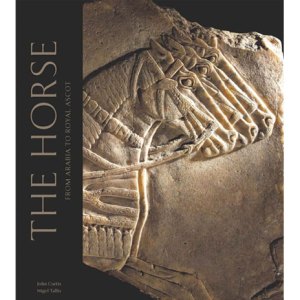 The history of the horse is the history of civilisation itself. The horse has had a revolutionary impact on ancient civilisations and this major exhibition explores the influence of horses in Middle Eastern history, from their domestication around 3,500 BC to the present day. Britain’s long equestrian tradition is examined from the introduction of the Arabian breed in the 18th century to present day sporting events such as Royal Ascot and the Olympic Games.
Important loans from the British Library, the Fitzwilliam Museum and the Royal Armouries, as well as rare material from Saudi Arabia, will be seen alongside objects from the British Museum’s exceptional collection, including famous pieces such as the Standard of Ur and Achaemenid Persian reliefs. Supported by the Board of Trustees of the Saudi Equestrian Fund, the Layan Cultural Foundation and Juddmonte Farms. In association with the Saudi Commission for Tourism & Antiquities. (more…)
Reviewed | Wax Exhibition in Venice
Notice of this exhibition appeared here at Enfilade back in March, but it’s nice to include a portion of Allison Goudie’s review from The British Society for Eighteenth-Century Studies. It also serves as a reminder of the rich offerings at the BSECS site. Links to other relevant reviews are included toward the bottom of this posting.
◊ ◊ ◊ ◊ ◊
From BSECS:
Avere una Bella Cera: Le Figure in Cera a Venezia e in Italia, Exhibition at the Fortuny Museum, Venice (10 March – 25 June 2012)
Reviewed by Allison Goudie, University of Oxford; posted 16 May 2012
. . .The current exhibition was conceived by its curator, Andrea Daninos, as a tribute to Schlosser’s pioneering efforts. Daninos recently published an Italian translation of Schlosser’s History (Officina Libraria, 2011), accompanied by an augmented catalogue of works, complementing the 2008 English translation that was incorporated into the outstanding Getty Research Institute publication ‘Ephemeral Bodies: Wax Sculpture and the Human Figure‘. Certainly, as such publications demonstrate, recent scholarly interest in the medium of wax has already very quickly made up for lost time and made significant inroads towards writing the medium back into the history of art. The Italian title of the exhibition translates in English as ‘in the pink’ – an apposite assessment of the current scholarly enthusiasm for the medium.
All the while however, what has been lacking, rather conspicuously – and of particular urgency given the investment in the materiality of wax by contemporary scholarship – is a cohesive exhibition in which the physical objects of this hitherto lost chapter in the history of portraiture may be viewed quite literally in the flesh. The exhibition at Palazzo Fortuny does exactly this. While its scope may be limited to the Italian context, its treatment of it is comprehensive, surveying almost all the life-size wax portraits extant today in Italian collections, public and private, and broaching private and commemorative, religious and quasi-scientific applications of wax portraiture. A notable absence in this survey of Italian wax portraiture would be the work of Medardo Rosso, however Schlosser, too, chose not to extend his exploration of the topic into the modern age. It was the eighteenth century that witnessed an expansion of wax portraiture on a scale incomparable in other periods, and the majority of portraits on display are eighteenth-century works. . .
The full review is available here»
◊ ◊ ◊ ◊ ◊
Additional reviews available at the BSECS site
Nicholas Hawksmoor: Architect of the Imagination
Location: Royal Academy of Arts, London
Event Date: June 2012
Reviewed By: David Frazer Lewis, University of Oxford
An homage to Hawksmoor to mark the 350th anniversary of his birth.
Location: Institut National d’Histoire de l’Art (INHA), Galerie Colbert, Paris
Event Date: June 2012
Reviewed By: Valérie Kobi, University of Neuchâtel
This perfectly formed exhibition captures the essence of how knowledge was visualised in the age of the encyclopaedia.
Johan Zoffany RA: Society Observed
Location: Royal Academy of Arts, London
Event Date: June 2012
Reviewed By: Allison Goudie, New College, Oxford
An impressive exhibition of the RA’s very own master of the conversation piece, Johan Zoffany.
Turner Inspired: in the Light of Claude
Location: National Gallery, London
Event Date: June 2012
Reviewed By: Clare Pettitt, King’s College, London
The new National Gallery show emphasises links between Turner and Claude, to the detriment of both.
Taking Time: Paintings by Chardin
Location: Waddeston Manor, Aylesbury
Event Date: May 2012
Reviewed By: Hannah Williams, University of Oxford
An enlightening exhibition of the four versions of Chardin’s Boy Building a House of Cards.
Location: Museo di Roma
Event Date: May 2012
Reviewed By: Hannah Malone
A subtle exhibition showing Rome and its many faces, as city and myth.
Location: The Foundling Museum, London
Event Date: May 2012
Reviewed By: Olive Baldwin and Thelma Wilson
Explore the world of Vauxhall Gardens at the Foundling Museum.
Exhibition | Drawings of Natoire and the Roots of Artistic Creation
Thanks to Hélène Bremer for noting this exhibition at the Musée des Beaux-Arts in Nîmes. It brings together more than 90 drawings from private and public collections, including loans from the Louvre and the Atger Museum (an English description is available here).
◊ ◊ ◊ ◊ ◊
Charles-Joseph Natoire (1700-77): Le dessin à l’origine de la création artistique
Musée des Beaux-Arts de Nîmes, 8 June — 16 September 2012
 A l’occasion de la parution de la monographie de Natoire aux éditions Arthena, rédigée par Susanna Caviglia-Brunel, le Musée des Beaux-Arts propose une exposition sur Charles-Joseph Natoire dessinateur (Nîmes, 1700 – Castel Gandolfo, 1777). Après les célébrations du bicentenaire de la mort de Natoire en 1977 et le tricentenaire de sa naissance en 2000, le Musée des Beaux-Arts rend hommage, par l’exposition inédite de sa production graphique, à cet artiste d’origine nîmoise, considéré comme l’un des grands représentants de la peinture française du XVIIIe siècle.
Né à Nîmes en 1700, Charles-Joseph Natoire illustre sans doute le mieux, avec François Boucher, un certain esprit de la peinture française sous le règne de Louis XV. Peintre subtil, dessinateur inspiré et virtuose, sa réputation s’établit rapidement après son entrée à l’Académie Royale de peinture et de sculpture en 1734 et les nombreuses commandes royales qu’il exécute avec brio (Fontainebleau, Versailles…). A partir de 1756, Natoire réduit sa production peinte au profit du dessin.
Au cœur des peintures de grands formats dont font partie les quatre cartons de tapisseries du Cycle de l’Histoire de Marc-Antoine que conserve le musée (L’entrée de Marc-Antoine à Ephèse, L’Arrivée de Cléopâtre à Tarse et Le Repas de Cléopâtre et Marc-Antoine, La Paix de Tarente), près de 90 dessins sortent exceptionnellement des réserves de collections privées et publiques (dont le musée du Louvre et le Musée Atger de Montpellier) pour le plus grand plaisir du public. Les sanguines, pierres noires et lavis permettent d’aborder les différentes fonctions du dessin dans les étapes de la création chez Charles-Joseph Natoire. Copie d’après l’Antique, étude des grands maitres, dessin sur le motif, moyen d’exercice, étude préparatoire de l’œuvre d’art ou œuvre d’art… le dessin chez Natoire révèle un charme des contours, une harmonieuse association des matériaux, le goût de l’élégance, la recherche de la beauté.
Exposition organisée avec la participation du musée du Louvre et l’aide de la DRac Languedoc-Roussillon et de l’AAMAC.
◊ ◊ ◊ ◊ ◊
From Dossier de l’Art:
Dossier de l’Art: Natoire. N° 196 (May 2012), 9€.
 C’est l’un des plus illustres enfants de Nîmes que célèbre aujourd’hui le musée des Beaux-Arts en consacrant une exposition à l’abondante production graphique de Charles-Joseph Natoire. Près de quatre-vingt-dix feuilles sorties exceptionnellement des réserves de collections privées et publiques offrent un large panorama de l’usage qu’il fit du dessin tout au long de sa carrière, des bancs de l’Académie de peinture et de sculpture de Paris à la direction de l’Académie de France à Rome. Sanguines, pierres noires, lavis, études rehaussées à la craie ou à l’aquarelle illustrent les différentes étapes du processus de création, de la copie de motifs d’après les maîtres au premier tracé, de l’étude de variantes à l’esquisse minutieuse et jusqu’au dessin comme œuvre autonome.
Articles
Entretien avec Pierre Rosenberg, de l’Académie française
Le dessin à l’origine de la création
Arrêt sur une oeuvre : la copie de motif
Arrêt sur une oeuvre : la première pensée
Arrêt sur une oeuvre : les reprises et les variantes
Arrêt sur une oeuvre : les dessins de paysage
Les techniques graphiques au XVIIIe siècle
Le songe d’une Académie idéale
Le cas Greuze
L’invention à l’œuvre
Actualités
Le musée Atger, une collection exceptionnelle de dessins anciens
Le musée des Beaux-Arts de Nîmes
Les dessins du XVIIIe siècle du musée Fabre
Les collectionneurs de dessins au XVIIIe siècle
Les dessins de la collection Adrien au musée des Beaux-Arts de Rennes










 Enfilade
leave a comment