Exhibition | Landscape, Heroes, and Folktales: German Romanticism
My apologies, this exhibition almost slipped by me completely. Thanks, however, to a brief extension, these prints and drawings (all from the private collection of Charles Booth-Clibbor) are up for another week. -CH
Landscape, Heroes, and Folktales: German Romantic Prints and Drawings
British Museum, London, 23 September 2011 — 9 April 2012
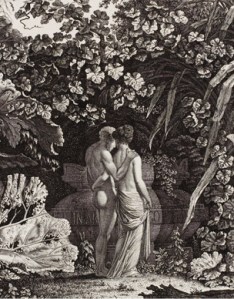
Carl Wilhelm Kolbe, "I too was in Arcadia" (detail). Etching, 1801. Private collection.
German Romanticism was a philosophical and artistic movement in the late 18th and 19th centuries which was highly influential across the whole of Europe. Key figures included composers Beethoven, Schubert and Brahms, philosophers Hegel and Schlegel, and literary giants Goethe and Schiller. Artists in 19th-century Germany were seeking a cohesive national identity that had not existed before – through works often inspired by the German landscape, mythology and Germany’s ancient past.
The prints and drawings on display capture beautiful, poetic scenes, exploring landscapes and wildlife to heroes and folktales. Romantic artists took inspiration from earlier artists, including Albrecht Dürer and Raphael. The works show high standards of draughtsmanship, depict an amazing variety of subject matter and use a range of sophisticated print techniques, including the recently invented technique of lithography. Artists featured in the exhibition include Caspar David Friedrich, Philipp Otto Runge, Wilhelm Tischbein, Carl Wilhelm Kolbe, Julius Schnorr von
Carolsfeld, Friedrich Overbeck, Peter Cornelius, Karl-Friedrich Schinkel
and Johann Christian Reinhart.
Exhibition | Workshop Drawings of Silversmith Robert-Joseph Auguste
Thanks to Hélène Bremer for noting this exhibition. The following description comes from the Nissim de Camondo (an English summary from Art Media Agency is available here). . .
Dessins d’orfèvrerie de l’atelier Robert-Joseph Auguste (1723-1805)
Musée Nissim de Camondo, Paris, 16 November 2011 — 1 April 2012
Curated by Yves Carlier

Salt cellar design, workshop of Robert-Joseph August
Inv 24 722B (Paris: Les Arts Décoratifs)
◊ ◊ ◊ ◊ ◊
Reçu maître à Paris en 1757, Robert-Joseph Auguste porte à partir de 1777 le titre d’orfèvre ordinaire du roi et devient le principal fournisseur de la Couronne jusqu’à la Révolution. Rien ne nous étant parvenu de ces fournitures, son œuvre est mieux connu par les pièces d’orfèvrerie et les services entiers qu’il réalisa pour les cours de Lisbonne, Londres, Copenhague, Saint-Pétersbourg et Stockholm.
Sélectionnés pour leur rapport avec des pièces connues de Robert-Joseph Auguste, les douze dessins présentés ont été donnés en 1925 au musée des arts décoratifs par le baron Robert de Rothschild (1880-1946) avec dix-huit autres provenant de l’atelier de l’orfèvre et faisant partie de la même vente (Paris, Hôtel Drouot, 4 avril 1925).
De techniques variées (mine de plomb, plume, sanguine, lavis), ces œuvres rares rendent compte des différentes manières de Robert-Joseph Auguste et de la variété de sa production pour les grands services d’orfèvrerie qui lui sont commandés par Christian VII du Danemark, Catherine II de Russie ou Georges III d’Angleterre (pot à oille, saucière, salière, couverts …).
Les quatre dessins de la vente de 1925 conservés dans une collection particulière viennent compléter de manière exceptionnelle cet ensemble. Deux d’entre eux figurant un seau à bouteille et une verrière portent notamment la signature « auguste f. » d’une écriture correspondant à celle de Robert-Joseph Auguste.
En regard de cet accrochage sont exposées les prestigieuses pièces d’orfèvrerie de Robert-Joseph Auguste livrées pour les cours de Russie et du Portugal et conservées dans les collections du musée des arts décoratifs.
Enfin, dans la salle à manger du musée Nissim de Camondo, les deux paires de compotiers du service dit de Moscou réalisées par Auguste pour l’impératrice Catherine II ont retrouvé leur place d’origine sur les dessertes. Dressée avec faste pour l’occasion, la table est ornée du pot à oille à la magnifique hure de sanglier exécuté par l’orfèvre pour un client portugais aux armoiries récemment identifiées.
◊ ◊ ◊ ◊ ◊
Additional information (in English) is available here (as a PDF).
Exhibition | Animal Beauty in Paris
From the Grand Palais:
Beauté Animale / Animal Beauty
Grand Palais, Galeries Nationales, Paris, 21 March — 16 June 2012
Curated by Emmanuelle Héran
 Ever since the Renaissance, artists and naturalists have observed animals closely and represented them as accurately as they could. Nevertheless, naturalism ends where the norm and morality begin: various ethical and aesthetic criteria were established which influenced the artists’ point of view. There is extraordinary variety in the ways the same animal is represented. They reveal our fascination and curiosity for a world whose diversity is far from fully explored.
Through a set of major works, the exhibition looks at the relationships that artists, often great painters and sculptors, have developed with animals. It shows that there is still a close link between art and science, between our desire to know about animals and our fascination for their beauty. Paintings, drawings, sculptures, photographs, famous or unfamiliar… the exhibition brings together about 130 masterpieces of Western art from the Renaissance to the present day, and takes a radical new approach by choosing works in which the animal is shown on its own and for itself, without any human presence. This marvellous menagerie, laid out in a clear design accessible to all audiences, will mingle wild and domestic beasts, the strange and the familiar.
I. Looking at Animals
Just like human beauty, animal beauty must meet specific criteria, which vary with different periods and milieus. A revolution occurred at the Renaissance: outstanding artists such as Dürer, and then the pioneers of zoology studied animals closely and described them in minute detail. This was also when the discovery of the New World revealed new animals, such as parrots and turkeys. Repertoires were soon built up. As soon as they could study animals, painters kept a record of them in their albums, which they dipped into for motifs which had already inspired other works. They also worked on anatomical studies and tried to analyse motion, such as the movements of a galloping horse. But man was not content to represent animal beauty; he modified it, transforming the animals themselves, with all the means that science put at his disposal. New breeds of cows, dogs and cats appear in works of art. And conversely, paintings show us breeds that have gone out of fashion.
II. Aesthetic and Moral Prejudices (more…)
Reviewed | ‘Revolution! The Atlantic World Reborn’
Thomas Bender, Laurent Dubois, and Richard Rabinowitz, eds. Revolution! The Atlantic World Reborn (London: D. Giles Limited in association with the New-York Historical Society, 2011), 287 pages, ISBN: 9780916141240 (softcover), $45 / ISBN: 9781904832942 (hardcover), $65.
Reviewed for Enfilade by Jason Nguyen (Harvard University)
 In the lavishly illustrated catalogue for Revolution! The Atlantic World Reborn (on view at the New-York Historical Society through April 15, 2012), editors Thomas Bender, Laurent Dubois, and Richard Rabinowitz present a collection of eleven essays on the connections between the American, French, and Haitian Revolutions. Whereas traditional narratives have tended to treat the three events separately, the fourteen contributors to Revolution focus instead on their political, economic, and social junctures. “The point here is not to abandon or dilute national history,” Thomas Bender suggests in the catalogue’s first essay, “but rather to enrich it by revealing the ways in which historical causation operates across space as well as through time” (40).
The chain of political events linking the three revolutions is offered straightaway by Bender (and subsequently evaluated by his fellow contributors). The financial and military support that France provided to the United States in their War for Independence sent the European kingdom into a crippling debt that led to the calling of the Estates General in May of 1789. This event resulted in the establishment of the National Assembly and, consequently, the onset of the French Revolution. The rhetoric of the Revolution, and in particular the Déclaration des droits de l’Homme et du Citoyen (1789), helped to ignite abolitionist discourses and revolutionary fervor in the French colony of Saint-Domingue (present-day Haiti). And the political and military successes by the Haitians in the early years of the nineteenth century resulted in the selling of Louisiana by Napoleon to the United States in 1803, thus providing the young American nation with its first taste of continental expansion.
While each essay addresses at least one component of this transcontinental circuit of events, the scope of the catalogue is hardly limited to the political sphere. Cathy Matson, for example, reveals how the revolutions in France and Haiti nearly destabilized the commercial life among Philadelphia grain merchants in the last two decades of the eighteenth century. And in one of the catalogue’s more emotional contributions, Rebecca J. Scott and Jean M. Hébrard chronicle through a chain of legal documents and personal letters the tumultuous social and family life of Rosalie, an African-born inhabitant of Saint-Domingue who found herself the victim of sexual and racial slavery three times during the course of her life.
Rosalie’s story encapsulates two themes that course through the various essays. First is the focus on the peripheral within the predominant historical narrative, or as Richard Rabinowitz terms it, “history’s silences.” This can be noted by the prominence of the Haitian Revolution in the catalogue, with seven of the eleven contributions centering squarely on the global and local dealings of the Caribbean colony between 1791 and 1804. Of the remaining four essays, two focus on the economic and social situation in America, one addresses the broader global condition linking the revolutionary conflicts in the United States, France, and Haiti, and one presents the aims and intentions of the exhibition. The curatorial decision to cast increased light on the Haitian Revolution serves two purposes. The first concerns the marked absence within the general public consciousness of the social and political insurrections that transformed the former French colony. And the second speaks to its privileged status as the culmination (and, indeed, the ultimate test) of eighteenth-century revolutionary fervor. “As the most thoroughgoing of these upheavals,” Rabinowitz writes in the catalogue’s concluding essay, “at least in its destruction of slavery, imperial dependency, and constitutionally sanctioned inequalities — the Haitian revolution could be viewed as the climax of the entire age of Atlantic revolutions” (255).
The revolutionary quest for “freedom” rarely followed a straight path, however: it is this concern that serves as the second theme of the catalogue. Robin Blackburn, for example, carefully unpacks the means by which the slave uprisings in Saint-Domingue during the early 1790s mobilized the Enlightenment trope of “utility” in order to achieve social and economic liberty. The first clause of the Déclaration des droits de l’Homme et du Citoyen, she notes, clearly stated that, “Men are born, and always continue, free and equal in respect of their rights. Civil distinctions, therefore, can be founded only on public utility” (118). The Haitian rhetoric of freedom, therefore, served an instrumental purpose in broadening the social, cultural, and political conceits that made the revolutionary ideology in France possible in the first place. Laurent Dubois and Julius S. Scott press the significance of figurative speech further, examining how the Haitian revolutionaries deployed a host of linguistic symbols, often in conflict with one another. Sometimes Royalist and sometimes Republican, their words and texts eventually turned toward the possibility of national sovereignty, a declaration ultimately claimed in 1804. Yet, as the early decades of Haiti’s independence reveal, this situation too presented profound struggles, including local forms of political tyranny and crippling trade embargoes by both Napoleon’s French Empire and Jefferson’s United States.
The attention paid to verbal and textual rhetoric, however, marks the limit of the authors’ interest in representation, as the images within the catalogue serve mostly an illustrating function. Yet, as art historical contributions by Tim Barringer, Darcy Grimaldo Grigsby, and Jennifer L. Roberts, among others, have made clear, colonial and revolutionary images are profoundly complex, embodying in their very form the geo-political and ideological rupturing that marked the events of this period. “To paint is, at the most fundamental level, to incorporate,” noted Grigbsy in her groundbreaking 2002 analysis of Anne-Louis Girodet’s Portrait of Jean-Baptiste Belley (1797), which serves as the cover image for the Revolution catalogue. “Formal description reenacts that deceptively transparent act of inclusion … constituting Belley as picturing’s object (paint) and aggrandizing him as social subject (portraiture’s sitter) were deeply bound up with one another …”[1] Dubois and Scott acknowledge (while not specificing by name) contributions by Grigsby and others in their essay, “An African Revolution in the Atlantic World.” For them, however, Girodet’s painting – on loan for the exhibition from the Musée National du Château de Versailles – serves not as a problematic in and of itself. Instead, it stands as an optimistic visual prolepsis, demarcating through imagery a future that was never to be realized fully.
Such a critique should hardly detract from the merits of the catalogue, which lucidly present for a general audience the social, political, and economic connections linking the late eighteenth-century Atlantic world. Timely and provocative, it suggests that the each historical event carries with it profound global ramifications. And by tracing these connections (through texts, objects, and images), we might begin to understand better the universal aspirations for human equality and freedom.
[1] Darcy Grimaldo Grigsby, Painting Empire in Post Revolutionary France (New Haven: Yale University Press, 2002), p. 13.
Exhibition | Treasures of Kenwood House
Press release (9 December 2011) from the MFAH:
Rembrandt, Van Dyck, Gainsborough: The Treasures of Kenwood House, London
Museum of Fine Arts, Houston, 3 June — 3 September 2012
Milwaukee Art Museum, 4 October 2012 — 6 January 2013
Seattle Art Museum, 14 February — 19 May 2013
Arkansas Arts Center, Little Rock, 6 June — 8 September 2013
Curated by Susan Jenkins

Thomas Gainsborough, "Portrait of Mary, Countess Howe," ca. 1764 (London: Kenwood House, English Heritage, Iveagh Bequest)
On June 3, 2012, the Museum of Fine Arts, Houston, will debut the exhibition Rembrandt, Van Dyck, Gainsborough: The Treasures of Kenwood House, London, whose four-venue national tour was announced today by the American Federation of Arts in New York. An exhibition of forty-eight masterpieces, this will be the first tour of this important group of works from the Iveagh Bequest and will provide a unique opportunity to see these superb paintings outside the United Kingdom. Most of these paintings have never traveled to the States before, and many of them have rarely been seen outside Kenwood.
Donated to the nation by Edward Cecil Guinness (1847–1927), 1st Earl of Iveagh and heir to the world’s most successful brewery, the Iveagh Bequest resides at Kenwood House, a neoclassical villa in London that was remodeled by Robert Adam in the eighteenth century. The collection was shaped by the tastes of the Belle Epoque—Europe’s equivalent to America’s Gilded Age—when the earl shared the cultural stage and art market with other industry titans such as the Rothschilds, J. Pierpont Morgan and Henry Clay Frick. Acquired mainly from 1887 to 1891, the earl’s purchases reveal a penchant for the portraiture, landscape and seventeenth-century Dutch and Flemish works typically found in English aristocratic collections. While the majority of the paintings in the exhibition are from the Iveagh Bequest, several are drawn from the works acquired specifically for display at Kenwood. Pauline Willis, AFA’s Director, remarked, “We are extremely proud to be able to give greater exposure to this magnificent selection of paintings while Kenwood undergoes a major refurbishment.” Simon Thurley, Chief Executive for English Heritage, commented, “The collection of works of art on display at Kenwood is one of the most important in England, and we are thrilled that works from this collection will travel across the Atlantic for the first time and find new audiences in the United States.”
The collection is particularly strong in works by such Golden Age eighteenth-century English portraitists as Sir Joshua Reynolds, Thomas Gainsborough and George Romney, whose depictions of society beauties of the Georgian era, also known as England’s “Age of Aristocracy,” held a great appeal for Lord Iveagh. Among the several fine Gainsboroughs in the exhibition is the sumptuous full-length portrait Mary, Countess Howe (c. 1764), an image of both aristocratic elegance and of a landowner among her properties. Such full-length portraits of ladies in nature were very popular during this period, owing to a great admiration for the aristocratic portraits of Van Dyck. Along with such aristocratic women, the collection’s “virtual harem” of English portraits features celebrity demimondes, among them Emma Hart—later Lady Hamilton—who served as Romney’s muse, and Kitty Fisher—one of the most celebrated courtesans in London society. (more…)
Exhibition | Egyptomania in Houston
Press release (16 February 2012) from the MFAH:
Egyptomania
Museum of Fine Arts, Houston, 18 March — 29 July 2012

Bow Porcelain Factory, English, Pair of Figures as Sphinxes, ca. 1750. Porcelain (The Museum of Fine Arts, Houston, The Rienzi Collection, gift of Mr. and Mrs. Harris Masterson, III)
An exhibition opening at the Museum of Fine Arts, Houston March 18, Egyptomania, explores the Egyptian Revivals of the 18th, 19th and early 20th centuries through some 40 objects, including photographs, Georgian garden sphinxes, 19th-century “Aegyptian” furniture and Art Deco perfume bottles with pharaoh-head stoppers. The works will be on view through July 29, 2012. “Westerners have long had an enduring romance with the idea of Egypt and its ancient people, of whom only their grand edifices really remain. We are captivated by their poignant narrative and other-worldliness,” said Christine Gervais, associate curator of decorative arts and Rienzi. “Egyptomania captures the way this fascination translates into European and American decorative arts objects,
from clocks, perfume bottles and ceramics to Tiffany glass
and Wedgwood.”
The fascination for Egypt has been repeatedly rejuvenated. Napoleon’s Egyptian Campaign (1798-1801), the opening of the Suez Canal (1869) and the 1922 discovery of King Tutankhamun’s tomb by English archaeologist Howard Carter all intoxicated the public, resulting in the reflection of Egyptian influences in Western culture, including literature, art and architecture. The exhibition focuses primarily on such trends in the decorative arts, where the influence can be seen in design motifs and symbols, as well as in actual forms. (more…)
Exhibition | Royal River: Power, Pageantry, and the Thames
As noted at British Art Research, this summer the Thames is on doubly on display at Greenwich. The museum website is worth visiting for the video promotion alone. From the National Maritime Museum:
Royal River: Power, Pageantry, and the Thames
National Maritime Museum, Greenwich, 27 April — 9 September 2012
Curated by David Starkey

◊ ◊ ◊ ◊ ◊
Magnificent gilded barges, liverymen in their finest uniforms, the splendour of lavish celebrations: the Thames is the ‘royal river’, used for centuries by British monarchs to involve the people in ceremony and festivities displaying their regal status. For hundreds of years this famous river has been host to the pageantry of coronations, processions of boats, and other events which helped tie people closer to the Crown and to London as Britain’s capital.
This spectacular exhibition, a landmark heritage event of the year, brings together nearly 400 beautiful, fascinating and often unique objects, including one of the largest-ever loans of Royal Collection objects to any museum. Created to mark Her Majesty The Queen’s Diamond Jubilee, and guest-curated by historian David Starkey, Royal River presents the historic Thames in all its glory, from British royal and City events to London’s famous watermen, and the river’s transformation after the notorious ‘Great Stink’.
◊ ◊ ◊ ◊ ◊
Image: Detail from The Thames on Lord Mayor’s Day, looking towards the City and St Paul’s Cathedral, before 1752, Canaletto, The Lobkowicz Collections, Czech Republic. Visitors to London Bridge station can now see a 30m-long version of the Canaletto painting gracing a temporary wall at the new station entrance. Find out more
New Gallery at Greenwich | Traders: The East India Company and Asia
From the National Maritime Museum:
Traders: the East India Company and Asia
National Maritime Museum, Greenwich, gallery opened in September 2011

◊ ◊ ◊ ◊ ◊
Established by a group of London merchants, the East India Company was given its first royal charter by Elizabeth I. By the time it was abolished 250 years later, Queen Victoria was on the throne. The East India Company took on pirates, princes and rival traders in its pursuit of profit – changing the world in the process. This new gallery at the National Maritime Museum explores the history and continuing relevance of Britain’s trade with Asia, looking at this compelling story through the lens of the East India Company. Traders: the East India Company and Asia examines the commodities that the company traded, the people that shaped its tumultuous career and the conflicts and rebellions that were its ultimate undoing.
The exotic spices the company imported brought exciting flavours to Britain. The calicos, muslins and silks carried on its ships shaped fashions, clothing rich and poor alike. But its greatest success was tea, which it helped transform from an expensive luxury to a national pastime. However, the British cup of tea had a darker side: opium. This illegal drug trade was interwoven with the company’s business, resulting in war with China on two separate occasions.

ISBN: 9781857596755, $60
The company can be seen as a forerunner of the modern multinational. But its power and global reach were unique. At its height, the company minted its own currency and ruled over a sixth of humanity. It had its own navy, the Bombay Marine, and had 250,000 soldiers at its command. Regarded by the British establishment as too big to fail, the Company was repeatedly bailed out and ended its days shrouded in controversy.
Traders: the East India Company and Asia showcases the museum’s world-famous collection of objects relating to Asia and the Indian Ocean, including: Japanese, Chinese and Burmese swords; beautifully crafted ship models and navigational instruments; Nelson’s Japan-pattern breakfast service; Victoria Crosses awarded during the Indian Mutiny; and journals kept by Company sailors.
The gallery also contains portraits of key figures from throughout the East India Company’s history including: Sir James Lancaster, commander of the first Company voyage; Jamsetjee Bomanjee Wadia, master shipbuilder at Bombay Dockyard; the ship-wrecked and imprisoned Robert Knox, said to be the inspiration for Defoe’s Robinson Crusoe; the appropriately named Money brothers, who made their fortunes in Asia; and Commodore Sir William James, a poor Welsh miller’s son who ran away to sea, and rose to become commodore of the Bombay Marine and Chairman of the Company.
To celebrate the opening of Traders the National Maritime Museum staged a festival of events throughout autumn and winter 2011. Traders Unpacked, sponsored by Sharwood’s, explored the complex legacy of the EIC and its contemporary significance though events including a textile-themed walking tour of London’s East End; an alternative East India Company pub quiz; an evening of Japanese psychedelia; Singaporean deep house and sea shanties; the Curry and a Pint nights, which explored the origins of the great British curry; a series of international tea parties; and a night of nautical games for grown-ups.
The gallery is accompanied by an illustrated history of the Company, which draws extensively on the collections of the Museum. Monsoon Traders: the Maritime World of the East India Company is published by Scala and written by Robert J. Blyth and John McAleer, curators of Imperial and Maritime History at the National Maritime Museum and H. V. Bowen, Professor of Modern History, Swansea University.
◊ ◊ ◊ ◊ ◊
Writing for The New York Times (4 November 2011), Roderick Conway Morris provides a review of the exhibition.
Exhibition | Goya: Lights and Shadows
From ArtDaily.com (16 March 2012):
Goya: Lights and Shadows / Luces y Sombras
The National Museum of Western Art, Tokyo, 22 October 2011 — 29 January 2012
CaixaForum Barcelona, 15 March — 24 June 2012
Curated by Manuela B. Mena and José Manuel Matilla

Francisco de Goya, The Clothed Maja, ca. 1800
(Madrid: Museo Nacional del Prado)
◊ ◊ ◊ ◊ ◊
Nearly two hundred years after his death, Francisco de Goya continues to exercise a universal attraction that very few others in the history of art have equalled. Not only is Goya enveloped in the greatness of his art and his genius, he is also shrouded in mystery and popular legend in a way that makes him doubly attractive and accessible. Now, almost thirty-five years after the last major exhibition devoted to the Spanish master in Barcelona, Goya. Lights and Shadows brings a large selection of great works the collection of El Prado National Museum, the most important in the world. The show features nearly one hundred pieces – oils, drawings, prints and letters – in a chronological journey through the main periods in the career of this Aragón-born artist. From the early years, in which Goya’s realism contrasted with the over-refined Rococo style favoured by his contemporaries, to the intimate works he produced towards the end of his life in Bordeaux, not forgetting the drama of the Peninsular War, which marked a turning-point in his artistic development. The exhibition is the fruit of a cooperation agreement signed between ”la Caixa” Foundation and the Prado National Museum 2011 under which the Catalan organisation became a Benefactor of the museum. Under the terms of the agreement, three more joint exhibitions will be organised in the coming years. Goya. Lights and Shadows is the first show planned as part of the joint exhibition programme established by ”la Caixa” Foundation and the Prado National Museum, the result of an agreement made between the two institutions in July 2011, under which ”la Caixa” becomes a Benefactor of the Spanish art gallery. . .
The full press release (which includes programming and lectures) is available here»
◊ ◊ ◊ ◊ ◊
Exhibition | Mantegna to Matisse: Master Drawings
Press release from Sue Bond:
Mantegna to Matisse: Master Drawings from The Courtauld Gallery
The Courtauld Gallery, London, 14 June — 9 September 2012
The Frick Collection, New York, 2 October 2012 — 27 January 2013
Curated by Stephanie Buck and Colin B. Bailey
 The Courtauld Gallery holds one of the most important collections of drawings in Britain. Organised in collaboration with the Frick Collection in New York, this exhibition presents a magnificent selection of some sixty of its finest works. It offers a rare opportunity to consider the art of drawing in the hands of its greatest masters, including Dürer, Leonardo da Vinci, Michelangelo, Rembrandt, Goya, Manet, Cézanne and Matisse. The Courtauld last displayed a comparable selection of its masterpieces more than twenty years ago and this exhibition will bring the collection to new audiences nationally and internationally.
The exhibition opens with a group of works dating from the 15th century, from both Northern and Southern Europe. An exquisite and extremely rare early Netherlandish drawing of a seated female saint from around 1475-85 is rooted in late medieval workshop traditions. It was also at this time that drawing assumed a new central role in nourishing individual creativity, exemplified by two rapid pen and ink sketches by Leonardo da Vinci. These remarkably free and exploratory sketches show the artist experimenting with the dynamic twisting pose of a female figure for a painting of Mary Magdalene. For Renaissance artists such as Leonardo, drawing or disegno was the fundamental basis of all the arts: the expression not just of manual dexterity but of the artist’s mind and intellect.
These ideas about the nature of drawing achieved their full expression in the flowering of draughtsmanship in the 16th century. At the heart of this section of the exhibition is Michelangelo’s magisterial The Dream. Created in 1533, this highly complex allegory was made by Michelangelo as a gift for a close friend and it was one of the earliest drawings to be produced as an independent work of art. More typically, drawings were made in preparation for other works, including paintings, sculptures and prints. Pieter Bruegel the Elder’s engaging scene of drunken peasants cavorting at a festival in the Flemish village of Hoboken was drawn in 1559 in preparation for a print. Whereas Michelangelo sought ideal divinely inspired beauty in the human figure, Bruegel here revels in the disorder of everyday life.

Charles Joseph Natoire, "Life Class at the Académie Royale," 1746, watercolour, chalk (black) on paper, 454 x 323 mm, © The Courtauld Gallery, London
Despite the important preparatory function of drawing, many of the most appealing works in the exhibition were unplanned and resulted from artists reaching for their sketchbooks to capture a scene for their own pleasure. Parmigianino’s Seated woman asleep is a wonderful example of such an informal study surviving from the early 16th century. Drawn approximately 100 years later in around 1625, Guercino’s Child seen from behind retains the remarkable freshness and immediacy of momentary observation. Guercino was a compulsive and brilliantly gifted draughtsman. Here the red chalk lends itself perfectly to the play of light on the soft flesh of the child sheltering in its mother’s lap. No less appealing in its informality is Rembrandt’s spontaneous and affectionate sketch of his wife, Saskia, sitting in bed cradling one of her children. The exhibition offers a striking contrast between this modest domestic image and Peter Paul Rubens’s contemporaneous depiction of his own wife, the beautiful young Helena Fourment. Celebrated as one of the great drawings of the 17th century, this unusually large work shows the richly dressed Helena – who was then about 17 – moving aside her veil to look directly at the viewer. Created with a dazzling combination of red, black and white chalks, this drawing was made as an independent work of art and was not intended for sale or public display. In its imposing presence, mesmerising skill and subtle characterisation, it is the equal of any painted portrait.
The central role of drawing in artistic training is underlined in a remarkable sheet by Charles Joseph Natoire from 1746. It shows the artist, seated in the left foreground, instructing students during a life class at the prestigious Académie royale in Paris. Drawing after the life model and antique sculpture was considered essential in the 18th and 19th centuries. One of the great champions of this academic tradition was Jean Auguste Dominique Ingres. The beautiful elongated forms of the reclining nude in his Study for the ‘Grand Odalisque’, 1813-14, represents the highest refinement of a precise yet expressive linear drawing style rooted in the academy. Outside the academy, drawing could offer the artist a means of liberating creativity. Goya’s Cantar y bailar (Singing and dancing), 1819-20, comes from one of the private drawing albums which the artist used to inhabit the world of his dreams and imagination.
Canaletto’s expansive and meticulously composed View from Somerset Gardens, looking towards London Bridge is one of several highlights of a section exploring the relationship between drawing and the landscape. This group stretches back as early as Fra Bartolomeo’s Sweep of a river with fishermen drawn in around 1505-09, and also includes a particularly strong selection of landscapes from the golden age of the British watercolour. The interest in landscape is nowhere more powerfully combined with the expressive possibilities of watercolour than in the work of J.M.W. Turner. His late Dawn after the Wreck of around 1841 was immortalised by the critic John Ruskin, who imagined the solitary dog shown howling on a deserted beach to be mourning its owner, lost at sea. For Ruskin, this was one of Turner’s ‘saddest and most tender works’. (more…)










 Enfilade
leave a comment