Exhibition | On the Edge of Reason, Works on Paper in Berlin
From the National Museums in Berlin:
On the Edge of Reason: Cycles of Works on Paper in the Age of the Enlightenment
Am Rande der Vernunft: Bilderzyklen der Aufklärungszeit
Kupferstichkabinett, Berlin, 16 March — 29 July 2012

Giovanni Battista Piranesi, "Carceri. The Giant Wheel" © Staatliche Museen zu Berlin, photo: Volker-H. Schneider
The exhibition whisks visitors to the murky edges of the Age of Reason. The creative and fantastical visual world of the capriccio thrived all the way through the 18th century, existing beyond the intellectual, socially critical and emancipatory endeavours of the Enlightenment. Stock themes of myth and reality, of antiquity and the modern day, of arcadias and Commedia dell´Arte, of ornament and decay all merge, piece-by-piece to form a kaleidoscope of playfully vivid imaginings. The pictures on display here depict the fancifully capricious but equally dark, irrational sides of nature, architecture and humankind.
Many form the theme of several extensive series of prints that are impressive for the breadth and variety of their vision. Scenes, as found in the Capricci and Scherzi di Fantasia series by Giovanni Battista Tiepolo and Bacchanales by Jean-Honoré Fragonard, remain enigmas even today. The strangeness of these images often leaves the viewer confused, as in the case of the sinister, brooding architectural fantasies of Giovanni Battista Piranesi’s Carceri or Goya’s Caprichos. For while several of their individual sheets reflect core Enlightenment themes, they also seem to contradict them, revealing visual and moral discrepancies, conveying a sense of entrapment and making the unreal appear real. The most famous sheet from the Caprichos, The Sleep of Reason Produces Monsters (El sueño de la razón produce monstruos) has become an emblem of this dark underbelly of the enlightened, illuminated world of reason and the Enlightenment.
The age of the Enlightenment is couched in a symbolism that revolves around the contrast between lumiéres (light) and tenèbres (shadow), between black and white – a set of oppositions that also defines the very essence of printmaking as a medium. Thanks to the technical refinement of various printmaking techniques attained to gain the upper edge over other art forms, the sheets and series of great artists from this epoch became prized collector’s items. In the artistic principle of the Caprice, not only does the artist’s imaginative spirit reveal itself, but also his virtuosity in his handling of the medium. This exhibition sees treasures from the Kupferstichkabinett’s rich holdings of works in this genre go on display together for the first time, giving visitors the chance to appreciate the outstanding aesthetic value of these works on paper. The exhibition invites the public to discover the artistic richness of a visual world that hovered on the edge of reason in an epoch that hovered on the threshold of modernity.
The exhibition is being held as part of a wider series of events called Art – King – Enlightenment, coordinated by the Prussian Cultural Heritage Foundation in honour of the 300th anniversary of the birth of Frederick the Great on 24 January 2012.
Exhibition | Taking Time: Chardin’s ‘Boy Building a House of Cards’
From Waddesdon Manor:
Taking Time: Chardin’s Boy Building a House of Cards and Other Paintings
Waddesdon Manor, Buckinghamshire, 28 March — 15 July 2012
Curated by Juliet Carey
 This exhibition brings together some of the greatest works to come out of eighteenth-century France. Prompted by Waddesdon’s recent acquisition of Boy Building a House of Cards (1735) by Jean-Siméon Chardin (1699-1779), the exhibition will unite all four of the artist’s paintings of the subject for the first time ever.
Loans from the UK, France and the USA will demonstrate how Chardin paired these works with other compositions to explore themes of childhood, adolescence and play. A group of Chardin’s images of servants – again, never seen together before – will provide a contrast with these images of children playing.
◊ ◊ ◊ ◊ ◊
From Paul Holberton Publishing:
Juliet Carey, with essays by Pauline Prévost-Marcilhacy, Pierre Rosenberg and Katie Scott, Taking Time: Chardin’s Boy Building House of Cards and Other Paintings (London: Paul Holberton, 2012), 160 pages, ISBN: 9781907372339, £30.
Recently acquired by Waddesdon Manor, Jean-Siméon Chardin’s early masterpiece Boy Building a House of Cards has a self-contained stillness that contrasts with the splendour of its new setting. Yet, it resonates with existing apspects of the collection from games and the representation of childhood to the influence of North European genre painting on French art. A child playing – with cards, bubbles, spinning-top or shuttlecock – was a favourite subject of Chardin’s. Such scenes, with their intimations of the transitory nature of human life, were derived from 16th- and 17th-century Dutch and Flemish vanitas, but display a delight in childhood for its own sake.
 Full of repetition, pendants and series, this catalogue allows the reader to scrutinize some of Chardin’s greatest works, and to follow the artist’s exploration of some of his most arresting subjects. Prints by Pierre Filloeul, Antoine Marcenay de Ghuy and others demonstrate the shifts in appearance and meaning that Chardin’s card-house compositions underwent through transposition from painting to engraving. The prints also help reconstruct some of the occasional pairings in which Chardin’s figure paintings were staged, whether on the walls of the Salon or in the cabinets of private collectors. The pendants include two of the most famous of all Chardin’s figure paintings, Lady Taking Tea and Girl with a Shuttlecock. Essays in self-containment and stillness, these works invite us to consider the nature of attention – the attention of the painter, his human subjects and ourselves.
This richly illustrated catalogue accompanies the exhibition at Waddesdon Manor, Buckinghamshire (28 March – 15 July 2012) that will unite Chardin’s four paintings of a boy with a house of cards for the first time (loans come from the Musée du Louvre, Paris; the National Gallery, London; the National Gallery of Art, Washington), allowing us to examine Chardin’s treatment of the subject in the context of his fascination with themes of play, childhood and adolescence. Pierre Rosenberg, former director of the Musée du Louvre and the pre-eminent scholar of Chardin’s work, considers the Rothchilds as collectors of Chardin; Pauline Prévost-Marcilhacy, an independent scholar and Rothschild specialist, gives an insight into Charlotte de Rothschild’s collecting; Katie Scott, lecturer at The Courtauld Institute of Art, specializing in French art and architecture of the early modern period, explores Chardin’s paintings of games; and Juliet Carey, Curator of Paintings, Drawings and Sculpture at Waddesdon Manor and curator of the exhibition, writes on repetition and meaning in Chardin’s houses of cards and their pendants.
Exhibition | Princes and Painters in Mughal Delhi

Press release from the Asia Society Museum:
Princes and Painters in Mughal Delhi, 1707–1857
Asia Society Museum, New York, 7 February — 6 May 2012
Curated by William Dalrymple and Yuthika Sharma
Princes and Painters in Mughal Delhi, 1707–1857 brings together 100 masterpieces created during an artistically rich period in India’s history. This major international loan exhibition provides a new look at an era of significant change during which the Mughal capital in Delhi shifted from being the heart of the late Mughal Empire to becoming the jewel in the crown of the British Raj. The exhibition includes jewel-like portrait paintings, striking panoramas, and exquisite decorative arts crafted for Mughal emperors and European residents alike, as well as historical photographs. The exhibition is curated by William Dalrymple and Yuthika Sharma. It is accompanied by a 264-page illustrated book with essays by William Dalrymple, Yuthika Sharma, Jean Marie Lafont, Malini Roy, Sunil Sharma, and J.P. Losty, published by Asia Society Museum in association with Yale University Press, New Haven and London.

(Yale University Press, 2012), ISBN: 9780300176667, $60
“Princes and Painters in Mughal Delhi, 1707–1857 is a reappraisal of a transitional era in India that provided unprecedented impetus for artistic innovation and experimentation,” says Melissa Chiu, Asia Society Museum Director and Vice President for Global Art Programs. “We’re pleased to be taking a new approach to this magnificent and vibrant work with notable author William Dalrymple and art historian Yuthika Sharma as curators.”
The exhibition focuses on the reigns of the last four Mughal emperors: Muhammad Shah (reigned 1719–1748), Shah Alam II (reigned 1759–1806), Akbar Shah II (reigned 1806–1837) and Bahadur Shah II Zafar (reigned 1837–1857). Having lost military, political and economic power to the newlyarrived British in Calcutta, Delhi continued to maintain its extraordinary cultural, literary, and artistic patronage networks. Artists were supported by the Mughal court in Delhi and the city’s ascendant European residents, creating an environment of extraordinary interaction and influence between them and the new world of the British East India Company.
As the British took over the reign of a dispersed empire from the Mughals in 1803, they were enamored of its courtly elegance and sought to participate in its culture as patrons and enthusiasts. Company painting, involving artistic commissions undertaken by Indian artists for officers of the British East India Company, was practiced alongside Mughal court painting, with both patrons utilizing the services of a common group of artists.
The exhibition looks at recognized works by Delhi-based court artists Nidha Mal and Chitarman, and less familiar works by artists such as Ghulam Murtaza Khan, Ghulam Ali Khan, and Mazhar Ali Khan. In addition to Mughal miniatures produced under later emperors, this exhibition highlights a selection of so-called Company School paintings produced for Delhi-based personalities such as William Fraser, James Skinner, and Thomas Metcalfe. The exhibition also chronicles the rise in genre portraiture during this era, epitomized by character studies of urban and rural residents of Delhi.
◊ ◊ ◊ ◊ ◊
From Yale UP:
William Dalrymple and Yuthika Sharma, Princes and Painters in Mughal Delhi, 1707–1857 (New Haven: Yale University Press, 2012), 224 pages, ISBN: 9780300176667, $60.
. . . Sumptuous color illustrations of such works illuminate the pages of this book, painting a vivid portrait of this important city and its art, artists, and patrons. Masterworks by major Mughal artists, such as Nidha Mal and Ghulam Ali Khan, and works by non-Mughal artists demonstrate the dynamic interplay of artistic production at this time. This largely overlooked period is explored in thought-provoking essays by a panel of distinguished scholars of Indian art, history, and literature to present an engaging look at this dynamic artistic culture in the midst of rapid change.
William Dalrymple is an award-winning writer, historian, and co-director of the Jaipur Literature Festival. Yuthika Sharma received a PhD in South Asian art and architecture from Columbia University and a doctorate in design from Harvard University.
Exhibitions | Ottomania at the Rijksmuseum
From the Rijksmuseum:
Ottomania: The Turkish World through Western Eyes
Rijksmuseum, Amsterdam, 7 March — 7 May 2012

Joseph-Marie Vien, fantasy costume from the Bacha de Caramanie, illustration 7 from "Caravane du sultan à la Mecque," 1748.
In observance of the 400-year anniversary of diplomatic relations between Turkey and the Netherlands, the Rijksmuseum presents two special exhibitions. Ottomania: The Turkish World through Western Eyes presents the Turkey of old, depicted in over 35 special prints from the Rijksmuseum collection. The presentation Ahmet Polat: Modern Turkey paints a picture of Turkey today, with 10 impressive portraits of young Dutch-born Turkish people, trying their luck in Turkey.
With Ottomania, the Rijksmuseum shows how the Turkish world of the 16th to 18th centuries was seen through Western eyes. Exotic travel stories, exquisite costume books, and prints by artists such as Albrecht Dürer, Rembrandt and Tiepolo demonstrate the fascination of artists with charming Eastern figures and oriental attire, although the powerful Ottoman Empire also instilled fear and inspired awe. In addition to well-known masterpieces, various new discoveries and acquisitions are also on display, including a unique 16th-century etching of Turkish oil wrestlers. A number of pithy cartoons also depict the often strained
relations between the Ottoman empire and the West. The presentation
consists of over 35 prints and illustrated books.
Exhibition | ‘Waxing Eloquent: Italian Portraits in Wax’
From the Fondazaione Musei Civici Venezia:
Avere una Bella Cera: Le Figure in Cera a Venezia e in Italia
Fortuny Museum, Venice, 10 March – 25 June 2012
Curated by Andrea Daninos
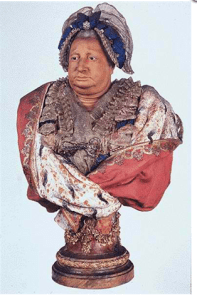
Francesco Orso, "Vittoria di Savoia Soisson," ca. 1785 (Castello di Agliè)
The exhibition aims to analyse a field that is little explored in the history of art, that of life-size wax figures; it is a fascinating subject and one that in recent years has stimulated interest from many contemporary artists, but until now no exhibition had been dedicated to this theme. The exhibition project arises from two fortunate coincidences: the existence of a series of wax portraits in the public collections and churches of Venice, and the centenary of the first study dedicated to the history of waxwork portraiture, Geschichte der Porträtbildnerei in Wachs, written by the famous Viennese art historian, Julius von Schlosser. The first Italian edition of this work has recently been published, edited by Andrea Daninos.
The exhibition will for the first time bring together the few existing examples of this genre in Italy, presenting them in an itinerary that begins with the theme of the cast and funeral mask. The first section will display a series of wax funeral masks of Venetian doges (eighteenth century), an all but unique example of the use of wax “doubles” in funeral ceremonies. The visitor will then be able to admire the only visual example to have survived of life-size votive figures, Vincenzo Panicale’s Libro dei miracoli, an early seventeenth-century manuscript documenting the votive figures in the Sanctuary of S. Maria della Quercia in Viterbo.
This is followed by the faces of saints and criminals, two recurrent subjects in the tradition of wax portraiture. The former are represented by 12 busts of Franciscan saints dating from the eighteenth century; made of wax, with glass eyes and real hair, these works constitute a complete group in this unusual religious iconography. In contrast, the visitor will also come face to face with a series of portraits of criminals made at the end of the nineteenth century by the pupil of Cesare Lombroso, Lorenzo Tenchini.
The central section of the exhibition is dedicated to the tradition of wax portraiture in Italy. It is introduced by two life-size portrait figures of eighteenth-century Venetian children. These two works, mentioned by Schlosser and Mario Praz, who compared them to the protagonists in Henry James’s Turn of the Screw, are kept in the storerooms of Palazzo Mocenigo and have not been put on public display for decades. They will certainly astonish the visitor for the quality of the execution and their disturbing realism.
The school of Bologna, the only town in Italy in which the art of life-size wax portraiture became widespread, will be represented by some of the specialists in the genre, including Anna Morandi Manzolini, Luigi Dardani and Angelo Gabriello Piò. In its last section, the exhibition will present the works of two artists who worked outside Italy, and who specialised in waxwork exhibitions. The first of these is Joseph Müller-Deym, a mysterious Austrian aristocrat who owned a famous waxworks museum in Vienna in the eighteenth century, and who will be represented here by his portrait of Maria Carolina of Austria. The other is a Piedmontese artist, Francesco Orso, who opened an analogous waxworks show in Paris during the years of the French Revolution. The present exhibition will display the works he produced for the Savoy court.
The rich and exceptional nature of the works on show is the result of the generosity of the loans from churches, scientific universities and museums, including the Museo del Dipartimento di Anatomia Umana, Farmacologia e Scienze Medico-Forensi of the Università di Parma, and the Palazzo Reale in Naples.
◊ ◊ ◊ ◊ ◊
From ACC Distribution:
Catalogue: Andrea Daninos, ed., Waxing Eloquent Italian Portraits in Wax (Officina Libraria, 2012), 160 pages, ISBN: 9788889854839, $28.
 This catalogue analyses a field of art history that only recently has been given renewed attention with the translation in French (1997), English (2008) and Italian (2011) of Julius von Schlosser’s History of Portraiture in Wax, originally published in German a century ago. The exhibit and the catalogue will present all life-size figures in wax present in Italy starting with the death masks in wax of the Venetian dogi (XVIII century), which were used as funeral effigies. The Book of Miracles, a XVII century manuscript illustrated in watercolours, documents the use of wax statues as ex-voto in churches. The heads of saints (12 Franciscan saints from the church of the Redentore in Venice) and criminals (8 manufactured in the late XIX century in Turin) will constitute another section. But the main section is dedicated to portraiture in wax and will see the presence of 7 busts and 2 full-size portraits of children, all from the XVIII and XIX century.
C O N T E N T S
Andrea Daninos, Wax Figures in Italy: A Brief History
Guido Guerzoni, Aureae Cerae: Production, Distribution and Consumption of Wax Artefacts in Modern Europe
Giovanni Ricci, Masks of Power: Funeral Effigies in Early Modern Europe
Emanuele Trevi, Written Waxes: Figures in Wax as Inspiration in Modern Literature
Catalogue Entries
Index of Names
Andrea Daninos has studied ceroplastic – the art of modelling in wax – for many years. He recently held a course on the subject at the University of Milan and he has edited and annotated the Italian translation of Julius von Schlosser’s History of Portraiture in Wax (Milan: Officina Libraria 2011), the seminal book on the argument.
Guido Guerzoni teaches Cultural Heritage and Art Markets at the Università Lugi Bocconi in Milan. His research interests are focused on the cultural and arts markets and his latest book has been translated into English in 2011 (Apollo and Vulcan: The Art Markets in Italy, 1400-1700, Michigan State University Press).
Giovanni Ricci is professor of Modern History at the University of Ferrara. He is the author of several books on urban history, the real and perceived presence of the Turks in Europe, marginal strata of society and social mobility, and funereal rites and their political use.
Emanuele Trevi is a literary critic and writer. He writes on a number of daily newspapers and has collaborated with RAI-3 Radio, one of Italy’s national radio stations. He lives in Rome.
The Burlington Magazine, February 2012
The eighteenth century in The Burlington:
The Burlington Magazine 154 (February 2012)
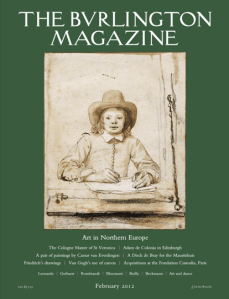 • Sophie Raux, “Carel Fabritius in Eighteenth-Century Paris,” pp. 103-06. This article establishes, among other things, that Carel Fabritius’s Mercury and Argus (c.1645–47; Los Angeles County Museum of Art) was in the collection of François Boucher, where it was seen by Fragonard.
Reviews
• Christian Tico Seifert, Review of Vadim Sadkov, The Pushkin State Museum of Fine Arts: Netherlandish, Flemish, and Dutch Drawings of the XVI-XVIII Centuries. Belgian and Dutch Drawings of the XIX-XX Centuries (Amsterdam: Foundation for Cultural Inventory, 2010), pp. 128-29.
• Xander Van Eck, Review of Lyckle de Vries, How to Create Beauty: De Lairesse on the Theory and Practice of Making Art (Leiden: Primavera Pers, 2011), pp. 129-30.
• Kate Retford, Review of the exhibition The First Actresses: Nell Gwyn to
Sarah Siddons (London: National Portrait Gallery), pp. 134-35.
• Xavier F. Salomon, Review of the exhibition Il Settecento a Verona: Tiepolo,
Cignaroli, Rotari — La Nobilità della Pittura (Verona: Palazzo della Gran
Guardia), pp. 146-48.
Exhibition | Red Chalk: Raphael to Ramsay
Press release from the National Galleries of Scotland:
Red Chalk: Raphael to Ramsay
Scottish National Gallery, Edinburgh, 2012
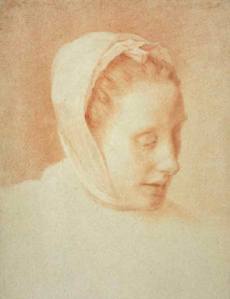
Allan Ramsay, "Head of Margaret Lindsay, The Artist’s Second Wife, Looking Down," ca. 1776 (Edinburgh: Scottish National Gallery)
This spring, a fascinating new exhibition at the Scottish National Gallery will explore the versatile and beautiful drawing medium of red chalk. Comprising some 35 works from the Gallery’s world-class collection, Red Chalk: Raphael to Ramsay will showcase a diverse range of exquisite drawings by distinguished artists, such as Peter Paul Rubens, Salvator Rosa, Jean-Antoine Watteau, Francois Boucher and David Allan. The display will feature works which, due to their delicate nature are rarely on show, as well as a number of drawings being exhibited for the first time.
Red chalk was first used for drawing on paper in late-15th century Italy. Chalk is a naturally occurring mineral, quarried directly from the earth then cut into drawing sticks which can be hand-held or chipped into a point and set into a holder. Drawing chalk can also be made, using ground up natural chalk mixed with water to form a paste then rolled into drawing sticks. This display will highlight the ways in which artists have, over the centuries, exploited the unique nature of red chalk to produce an array of dazzling and distinctive effects that cannot be achieved with any
other drawing medium.
The earliest drawing on display, and a highlight of the show, will be Raphael’s Study of a Kneeling Nude. This beautiful life-study was made in about 1518 and is a preparatory drawing for one of a series of Raphael’s painted frescos. The delicately drawn figure reveals not only the artist’s phenomenal skill as a draughtsman, but also his meticulous preparation for each composition.
Rosa’s powerful and arresting mid-17th century drawing, Head of a Bearded Man, is a fantastic example of red chalk being used to produce a highly expressive finished drawing, intended as a piece of art in its own right. A sheet of figurative studies by the influential Baroque draughtsman Pompeo Girolamo Batoni (1708–87), reveals the incredible precision and control that can be achieved with red chalk, whilst Rubens’ Four Women Harvesting from ca. 1630 demonstrates how effectively chalk can be used for rapid sketching, with the simplest and most minimal strokes.
Red chalk experienced a surge in popularity with French artists in the 18th century. Drawings in the display by Watteau and Boucher will showcase how the medium was used by artists of the Rococo period to produce highly decorative and elegant drawings. Studies by Fragonard and Hubert will also provide superb examples of red chalk being chosen as a useful medium for highly evocative depictions of the landscape.
Other highlights will include a preparatory study by Guercino for his monumental oil painting of Erminia Finding the Wounded Tancred (currently displayed in the main gallery), and the Scottish portrait painter Allan Ramsay’s iconic drawing from 1776 of his second wife, Margaret Lindsay. The show will also include works by artists David Allan, William Delacour and Archibald Skirving to illustrate how the medium was adopted in Scotland.
Whether used to draw a detailed study from nature, a summary sketch or a highly polished finished drawing, red chalk is an enduringly popular, richly expressive and unique medium for draughtsmen. Red Chalk: Raphael to Ramsay will showcase the breadth and variety of the Gallery’s drawings collection whilst providing a wonderful opportunity to see beautiful and accomplished drawings by a selection of our most admired artists.
Exhibition | Blazing with Crimson: Tartan Portraits
From the National Galleries of Scotland:
Blazing with Crimson: Tartan Portraits
Scottish National Portrait Gallery, Edinburgh, 1 December 2011 — 31 December 2013
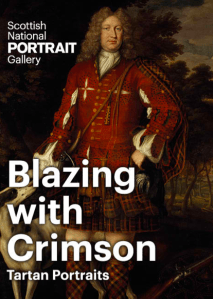 Highland dress and tartan fabric are universally recognised signs of Scotland and Scottish identity. This display explores what these distinctive garments and this highly recognisable textile meant to six different people who were painted between 1680 and 1780.
At first associated specifically with the Gaelic north and west of the nation, in particular with the flowering there of an elite warrior culture, the ‘Highland habit’ was subsequently used to convey various and sometimes conflicting messages. Highland dress was adopted by the Hanoverian army as it struggled to impose authority within Scotland, and the kilted soldier soon became a powerful symbol of the wider British Empire. In the nineteenth century British kings and queens led an obsession with Highland costume. Commerce combined with nostalgic scholarship to create a proliferation of different tartans linked to specific clans.
What most of our images have in common is a sense that the sitters, even when far from home, enjoyed the opportunities for display afforded by their dress. The artists appear to have been equally entranced by the visual appeal of bright colour and bold pattern, ample drapery and picturesque accessories.
The exhibition site includes a section on How to Wear a Great Kilt!
Exhibition: Adrian Zingg
From the Staatliche Kunstsammlungen Dresden:
Adrian Zingg: Pioneer of Romanticism / Wegbereiter der Romantik
Residenzschloss Dresden, 17 February — 6 May 2012
Kunsthaus Zürich, 25 May — 12 August 2012

Adrian Zingg, “Am Wasserfall,” 1785, Feder, aquarelliert © Kupferstich-Kabinett, Staatliche Kunstsammlungen Dresden, Fotograf: Herbert Boswank
An exhibition by the Kupferstich-Kabinett (Collection of Prints, Drawings and Photographs) of the Staatliche Kunstsammlungen Dresden in collaboration with Kunsthaus Zürich
Adrian Zingg, born in St. Gallen in 1734 and raised there, studied with Johann Ludwig Aberli in Bern and with Johann Georg Wille in Paris. In 1766, he came to Dresden. Together with his Swiss fellow, the portrait painter Anton Graff, he discovered and hiked in the Saxon and Bohemian landscape. Even today, his indexing of the site is known to have motivated the naming of the Saxon Switzerland. Zingg was running a very successful workshop in Dresden. Being a teacher for etching at the local art academy, he influenced an entire generation of landscape artists in Dresden. Furthermore, Zingg’s aftermath on the depiction of topographical landscape extended far from his death in 1816. Caspar David Friedrich was his most important heir and, at the same time, he overcame his idea of landscape depiction in the spirit of Enlightenment and Classicism.
◊ ◊ ◊ ◊ ◊
Note (added 25 May 2012): The catalogue is available at Michael Shamansky’s artbooks.com — Petra Kuhlmann-Hodick et al., Adrian Zingg: Wegbereiter der Romantik (Dresden: Sandstein, 2012), 280 pages, ISBN: 9783942422864, $72.50.
Exhibition: The Look of Love, Eye Miniatures
From the Birmingham Museum of Art:
The Look of Love: Eye Miniatures from the Skier Collection
Birmingham Museum of Art, Birmingham, Alabama, 7 February — 10 June 2012
University of Georgia, Athens, 6 October 2012 — 6 January 2013
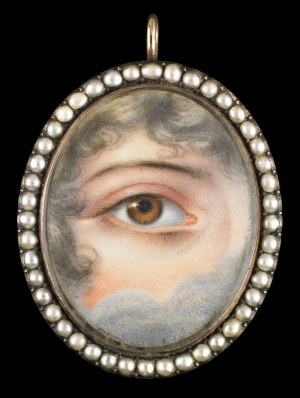 This stunning exhibition explores the little-known subject of “lover’s eyes,” hand-painted miniatures of single human eyes set in jewelry and given as tokens of affection or remembrance. In 1785, when the Prince of Wales secretly proposed to Mrs. Maria Fitzherbert with a miniature of his own eye, he inspired an aristocratic fad for exchanging eye portraits mounted in a wide variety of settings including brooches, rings, lockets, and toothpick cases. With over 100 examples, the collection of Dr. and Mrs. David A. Skier of Birmingham is the largest in the world. This exhibition offers an unprecedented look at these unusual and intriguing works of art.
Visitors can also interact with the exhibition in a new way: the Museum’s very first iPad app! The Look of Love app allows visitors to see these tiny, intricate objects at up to twenty times their actual size. They can also see images of the backs of objects or short videos of how the objects open. Twenty iPad devices are available for check-out and use in the Arrington Gallery, and
volunteers are on hand to show how the devices and the app
work.

ISBN: 9781907804014, $35
The exhibition is accompanied by a full color, hardbound catalogue of the same name, edited by Dr. Graham C. Boettcher, The William Cary Hulsey Curator of American Art, and published by D Giles Ltd., London. An essay by Elle Shushan sets the historical scene and examines the role of lover’s eyes in the broader context of Georgian and early Victorian portrait miniatures. Boettcher looks at the language and symbolism of these tokens and their jeweled settings. Additionally, novelist and biographer Jo Manning offers five fictional vignettes imagining the circumstances surrounding the creation of these extraordinary objects.
◊ ◊ ◊ ◊ ◊
N.B. — Notice of the exhibition at the Georgia Museum of Art in Athens was added on 24 October 2012










 Enfilade
leave a comment