Eighteenth-Century Accessories Exhibition in Aarhus, Denmark
As noted at Fashioning the Early Modern (thanks to Kimberly Chrisman-Campbell for pointing it out) . . .
Shoes and Accessories: Fashion and Frills in the 1700s
Den Gamle By (The Old Town), Aarhus, Denmark, 9 March — 30 December 2012
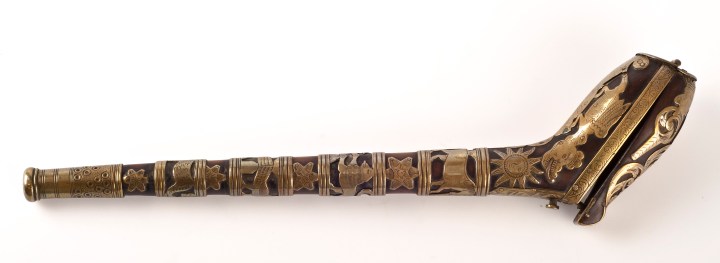
Holder for chalk pipes, eighteenth century
◊ ◊ ◊ ◊ ◊
The style specialists at Den Gamle By have gone trend-spotting, bringing you the hottest accessories and the coolest gadgets for fashionable ladies and gents to flaunt in high society. Must-haves of the 1700s include silk fans with the latest in ivory fan-sticks, practical chalk-pipe cases, English pocket watches, and silk slippers à la Madame de Pompadour, the style icon of the era. For an intimate look at eighteenth-century extravagance, complete with fashion tips from the 1700s, visit Shoes and Accessories at Den Gamle By. Be there, or be square! On show at the Mintmaster’s Mansion – a grand house from the 1700s with marble-painted Baroque Italian staircase and hand-printed Rococo wallpaper.
Farrow & Ball at the Met
I realize this exhibition — which I’ve not seen but have heard terrific things about — hardly falls in the eighteenth century — even a really long eighteenth century. But I’m completely intrigued by Farrow & Ball’s sponsorship and their use of the support in advertising. I received an email a few days ago, noting the precise paint colors with links to the company’s website (to be clear, I was already on their email list). In some ways this makes perfect sense to me, and the partnership is far less intrusive or annoying than other forms of support; personally, I’m quite glad to know the colors. And yet, the arrangement still somehow feels funny to me. Maybe this has been going on for years, and I’ve just never noticed (it would hardly be the first instance of that). -CH
◊ ◊ ◊ ◊ ◊
From Farrow & Ball:
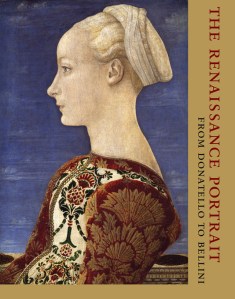 Farrow & Ball paint colours are used around the world to adorn the walls of some of the most prestigious properties and art galleries. Visit them at:
The Metropolitan Museum of Art, New York
The Renaissance Portrait from Donatello to Bellini
December 21, 2011 to March 18, 2012
The Metropolitan Museum of Art hosts an exhibition celebrating the first great age of portraiture in Europe. Farrow & Ball paint colours Black Blue, Down Pipe, Studio Green, Mouse’s Back, Light Gray and Hague Blue provide a fitting backdrop to approximately 160 works, by artists including such masters as Donatello, Filippo Lippi, Botticelli and Bellini. The works of art on display range from exquisite painting and manuscript illumination to marble sculpture and bronze medals from the 15th Century.
Exhibition: Colorful Realm in Washington
Thanks to Courtney Barnes at Style Court for noting this one. From the National Gallery of Art:
◊ ◊ ◊ ◊ ◊
Colorful Realm: Japanese Bird-and-Flower Paintings by Itō Jakuchū (1716–1800)
National Gallery of Art, Washington, D.C., 30 March — 29 April 2012
 Celebrating the centennial of Japan’s gift of cherry trees to the nation’s capital, this exhibition features one of Japan’s most renowned cultural treasures, the 30-scroll set of bird-and-flower paintings by Itō Jakuchū. Titled Colorful Realm of Living Beings (J. Dōshoku sai-e; c. 1757–1766), these extraordinary scrolls are being lent to the National Gallery of Art by the Imperial Household. Their exhibition here—for one month only—provides a unique, once-in-a-lifetime opportunity: not only is it the first time all 30 paintings will be on view in the United States, but it is also the first time any of the works will be seen here after their six-year-long restoration.
Colorful Realm stands as the most dynamic and comprehensive—yet meditative and distilled—expression of the natural world in all of Japanese art. Synthesizing numerous East Asian traditions of bird-and-flower painting, the set depicts each of its 30 subjects in wondrously meticulous detail, but in such a way as to transcend surface appearances and capture the otherwise ineffable, vital essence of the cosmos, the Buddha nature itself. To present the full significance of Colorful Realm, the exhibition and its catalogue reunite this masterpiece with Jakuchū’s triptych of the Buddha Śākyamuni from the Zen monastery Shōkokuji in Kyoto. Jakuchū had donated both works to the monastery, which displayed them in a large temple room during Buddhist rituals.
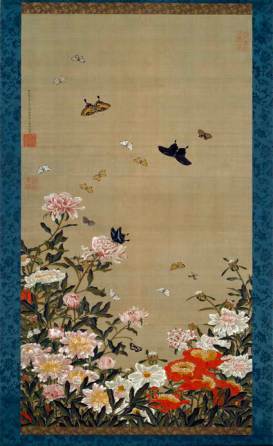 Recent conservation of Colorful Realm has generated an entirely new awareness of the material profile of the set and the technical means by which Jakuchū created each scroll. Drawing upon these findings as well as the most recent research on Jakuchū’s life and cultural environment, this exhibition offers a multifaceted understanding of the artist’s virtuosity and experimentalism as a painter—one who not only applied sophisticated chromatic effects but also masterfully rendered the richly symbolic world in which he moved.
The earliest of the 30 scrolls, Peonies and Butterflies, combines two subjects that enjoyed great popularity in East Asian pictorial traditions. On the one hand, the peony flower was likened to both feminine beauty and prosperity. It became the preferred garden flower of the imperial and aristocratic elite during China’s Tang dynasty (618–907) and at the court of Emperor Xuanzong in particular; in East Asian literary traditions Li Bai’s verse likening the beauty of Xuanzong’s favorite consort Yang Guifei (719–756) to a peony cemented the flower’s association with feminine beauty. Meanwhile, its full and gorgeous appearance lent itself to uncomplicated associations with affluence and good fortune. The butterfly also served as an auspicious symbol, though its popularity was equally attributable to its appearance in one of the most famous parables in early Chinese thought: Zhuangzi’s dream of a butterfly. According to this parable, the legendary sage Zhuangzi dreams that he is a carefree yellow butterfly. Upon awakening, however, “he didn’t know if he was Zhuangzi who had dreamt he was a butterfly, or a butterfly dreaming he was Zhuangzi.” Paintings of butterflies inevitably invoked the oneiric setting and queried selfhood of the Zhuangzi anecdote in most East Asian contexts and particularly in Jakuchū’s circle of erudite Sinophile monks, scholars, and merchants. While visually opulent, Peonies and Butterflies also suggests the uncertainty of a just-awoken dreamer who momentarily confuses reverie with reality.
Careful study of the painting’s pigmentation points to Jakuchū’s remarkable distillation and intensification of traditional East Asian coloration techniques. Different grades of opacity and transparency are achieved in the butterflies, flowers, stems, and leaves by varying the use of mineral and vegetal pigments, occasionally layering them one on top of another and adding a sublayer of color on the back of the silk. This complex stratigraphy of colors results in a convincing imbrication of the motifs in their surroundings. Indeed, when Jakuchū’s cultural and spiritual mentor Daiten (1719–1801) encountered the painting in 1760, he titled it “Beautiful Mist and Fragrant Wind” (Enka kōfū), suggesting that the real subject here was not the peonies and butterflies, but the conceptual atmosphere that enveloped them, the invisible ether within which they swayed and glided.
◊ ◊ ◊ ◊ ◊
Exhibition catalogue: Yukio Lippit, with Ota Aya, Oka Yasuhiro, and Hayakawa Yasuhiro, Colorful Realm: Japanese Bird-and-Flower Paintings by Itō Jakuchū (Chicago: University of Chicago Press, 2012), 224 pages, ISBN: 9780226484600, $50.
◊ ◊ ◊ ◊ ◊
Public Conference: The Art of Itō Jakuchū
National Gallery, East Building Concourse, Auditorium, 30 March 2012, 10:00 to 5:00
Illustrated lectures by noted scholars and conservators of Japanese art. This program is co-organized by the Center for Advanced Study in the Visual Arts, National Gallery of Art, and the Freer Gallery of Art and the Arthur M. Sackler Gallery, Smithsonian Institution. Presented in honor of the National Cherry Blossom Festival.
Exhibition: Copycat at The Clark
Press release from The Clark:
Copycat: Reproducing Works of Art
The Sterling and Francine Clark Art Institute, Williamstown, MA, 29 January — 1 April 2012
Curated by Alexis Goodin and James Pilgrim, in collaboration with Richard Rand and Jay A. Clarke

Francesco Bartolozzi, "The Libyan Sibyl," ca. 1780, etching and color etching on paper © Sterling and Francine Clark Art Institute, Williamstown, Massachusetts
The Sterling and Francine Clark Art Institute will open its latest exhibition, Copycat: Reproducing Works of Art, on January 29. Exploring the line between innovation and imitation, the exhibition features 50 prints and photographs that are both original works of art and repetitions of drawings, prints, paintings, sculptures, and architecture created by other artists. The exhibition highlights the complex process of copying by studying replications of many rarely seen works from the Clark’s permanent collection, including those by Albrecht Dürer, Paul Cézanne, Eugène Delacroix, Rembrandt van Rijn, Roger Fenton, and Édouard Manet, among others. The exhibition also marks the first public presentation of one of the Clark’s recent acquisitions, Jean Dughet’s series The Seven Sacraments. Copycat will be on view in the Clark’s Manton Research Center building through April 1, 2012.
Copycat is one of the ClarkNOW exhibitions that the Institute announced last autumn in conjunction with the launch of its campus expansion project. ClarkNOW is a series of more than 60 programs that the Clark will present in Williamstown, New York, and abroad over the next two
years as it extends the Clark’s reach and engagement during a time of
transformation on its campus. (more…)
Exhibition: Slavery at Jefferson’s Monticello
This exhibition looks intriguing for its subject alone, but even more interesting given that it’s the work (in partnership with Monticello) of a museum that doesn’t break ground until later this month. As reported by Brett Zongker of the Associated Press, the National Museum of African American History and Culture (NMAAHC) is organizing exhibits before the museum opens, in 2015, as a way to assess strategies for productively reaching large audiences with difficult subjects. -CH

◊ ◊ ◊ ◊ ◊
Slavery at Jefferson’s Monticello: Paradox of Liberty
National Museum of American History, Washington, D.C., 27 January — 14 October 2012
Atlanta History Center, 1 February — 7 July 2013
Missouri History Museum, St. Louis, 10 August 2013 — 2 March 2014
National Constitution Center, Philadelphia, 9 April 2014 — 4 January 2015
African American Museum, Dallas, 22 September — 31 December 2018 (extended to 21 January 2019)
The Smithsonian’s National Museum of African American History and Culture and Monticello will present Slavery at Jefferson’s Monticello: Paradox of Liberty, an exhibition of artifacts from the Smithsonian’s collections and from excavations at Jefferson’s Virginia plantation. Thomas Jefferson drafted the Declaration of Independence and called slavery an “abominable crime,” yet he was a lifelong slaveholder. The exhibition will provide a look at the lives of six slave families living at Monticello alongside Jefferson and his family. Personal belongings and working tools will be on display, and visitors will have a chance to learn about the families’ connections to one another, their religious faith and their efforts to pursue literacy and freedom.
◊ ◊ ◊ ◊ ◊
Note (added 23 September 2018) — The posting was updated to include the four additional venues.
Exhibition: Royalists to Romantics
The following exhibition soon opens at the National Museum of Women in the Arts (in conjunction, artist-in-residence Celia Reyer will be creating a Brunswick traveling coat inspired by 18th-century fashion). -AH
◊ ◊ ◊ ◊ ◊
Royalists to Romantics: Women Artists from the
Louvre, Versailles, and Other French National Collections
National Museum of Women in the Arts, Washington, D.C., 24 February — 29 July 2012

Rose Adélaïde Ducreux, "Portrait of the Artist," ca. 1799 (Rouen: Musée des beaux-arts)
In keeping with its mission to rediscover and celebrate women artists of the past and demonstrate their continued relevance, the National Museum of Women in Arts (NMWA) presents Royalists to Romantics: Women Artists from the Louvre, Versailles, and Other French National Collections. The exhibition features 77 paintings, prints, and sculptures dating from 1750 to 1850—many of which have never been seen outside of France. To develop the exhibition, NMWA spent months scouring the collections of dozens of French museums and libraries to cull rarely-seen works by women artists. Royalists to Romantics showcases these exceptional works and reveals how the tumultuous period that saw the flowering of the court of Louis XVI and Marie Antoinette, the terrors of the French revolution, the rise and fall of Napoleon, and the restoration of the monarchy affected the lives and careers of women artists.
Featuring 35 artists, including Marguerite Gérard, Antoine Cecile Haudebourt-Lescot, Adélaïde Labille-Guillard, Sophie Rude, Anne Vallayer-Coster, and Élisabeth Louise Vigée-Lebrun, the exhibition explores the political and social dynamics that shaped their world and influenced their work. Some of these artists flourished with support of such aristocratic patrons as Marie Antoinette, who not only appointed her favorite female artists Élisabeth Louise Vigée-LeBrun and Anne Vallayer-Coster to court, but advocated their acceptance into the Académie Royale de peinture et de sculpture. The political upheavals of the French Revolution and the following decades brought a new set of challenges for women artists. Royalists to Romantics explores the complex ways that women negotiated their cultural positions and marketed their reputations in France’s shifting social, political and artistic environment.
Royalists to Romantics: Women Artists from the Louvre, Versailles, and other French National Collections has been organized by the National Museum of Women in the Arts, Washington, D.C., with logistical support from sVo Art, Versailles.
◊ ◊ ◊ ◊ ◊
 Laura Auricchio, Melissa Hyde, and Mary D. Sheriff have contributed essays to the catalogue:
Jordana Pomeroy, ed. Royalists to Romantics: Women Artists from Versailles, the Louvre, and Other French National Collections (New York: Scala Publishers, 2012), 144 pages, ISBN: 9781857597431, $45.
This beautifully illustrated book examines eighteenth-century French theories of sexual difference and their influence on the ‘woman-artist question’; paradoxical Revolutionary attitudes toward women artists, who encountered as many new limitations as opportunities; and the complex ways that women marketed their reputations and managed their cultural positions in France’s intricate social and artistic hierarchy.
Exhibition: Shakespeare on Canvas at YCBA
From YCBA:
‘While these visions did appear’: Shakespeare on Canvas
Yale Center for British Art, New Haven, 3 January — 3 June 2012
Curated by Eleanor Hughes and Christina Smylitopoulos
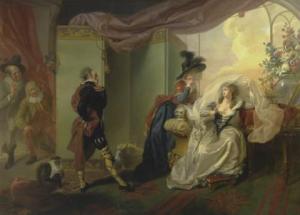
Johann Heinrich Ramberg, "Olivia, Maria, and Malvolio, from 'Twelfth Night', Act III, Scene iv," 1789, oil on canvas (Yale Center for British Art, Paul Mellon Fund)
“While these visions did appear,” a selection of Shakespearian subjects drawn from the Center’s permanent collection of paintings, forms part of Yale’s university-wide celebration of the works of William Shakespeare (1564–1616). This display focuses primarily on depictions of Shakespeare’s comedies, but also draws on comedic elements from the tragedies and histories, and encourages consideration of the multifaceted ways—verbal and visual—in which Shakespeare’s plays have inspired painters and audiences alike.
Artists and patrons in the eighteenth century responded to and encouraged the assertion of Shakespeare as Britain’s foremost national playwright. Through the remarkable efforts of David Garrick, the actor and Drury Lane theater manager, the plays flourished on the stage, while the promotion of the playwright as the “immortal bard” was seized as an opportunity to foster a British school of history painting.
Combining commerce and connoisseurship, entrepreneurial publishers like John “Alderman” Boydell and James Woodmason commissioned works such as a scene from Twelfth Night by Johann Heinrich Ramberg, and Francis Wheatley’s scene from The Two Gentlemen of Verona, respectively, creating what amounted to a new genre: the Shakespearean conversation piece. Strategies of representation included the depiction of famous actors and actresses in favored roles, such as Benjamin van der Gucht’s portrait of actor Henry Woodward in the role of Petruchio in David Garrick’s adaptation of The Taming of the Shrew, and James Northcote’s portrait of the child actor William Henry West Betty in the role of Hamlet. Other compositions, destined to be illustrations for new print editions of Shakespeare’s plays, depict characters in pivotal dramatic moments, such as Phillippe-Jacques de Loutherbourg’s portrait of Falstaff from Henry IV. (more…)
Small Exhibition: Women and Children in Prints after Chardin
From the Fitzwilliam:
Work, Rest and Play: Women and Children in Prints after Chardin
Fitzwilliam Museum, Cambridge, 6 September 2011 — 4 March 2012
 In 1733 the Parisian artist Jean-Siméon Chardin, who had made his name as a painter of ‘animals, cookware and various vegetables’, began to paint domestic interiors containing women, children and servants. The paintings were an immediate hit, and engravings reproducing certain works soon became available for purchase. This exhibition investigates the appeal of Chardin’s familial imagery for the 18th-century public, and takes a close look at the skill of the printmakers who interpreted his canvases into graphic art.
Charrington Print Room (16)
Exhibition: Piranesi at the Hermitage
From the Hermitage:
Ruins, Palaces and Prisons: Piranesi and Italian Eighteenth-Century Architectural Fantasies
State Hermitage Museum, St Petersburg, 7 December 2011 — 25 March 2012
Curated by A.V. Ippolitov, M.F. Korshunova, and V.M. Uspenskiy
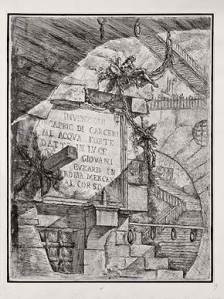
Piranesi, Title page of the 'Carceri' series, 1749-1750
On December 7th, 2011, Saint Catherine’s day, the State Hermitage Museum welcomed an exhibition entitled Ruins, Palaces and Prisons: Giovanni Battista Piranesi and Italian Eighteenth-Century Architectural Fantasies, dedicated to the early period of Piranesi’s work. This exhibit is being held as part of the Year of Italy in Russia and Year of Russia in Italy 2011 program, which continues tradition of partnership and cooperation between the two countries in the fields of art and culture.
This exhibition, presenting about 100 drawings and prints from the collection of the Hermitage, is divided into two parts: the first is dedicated to Piranesi and will present the series entitled Prima Parte (“Prima Parte “), Grotteschi (“Grotesques”) and Carceri (“Dungeons”) in their rare original condition, which have never been published in Russia before. All of them are from the 1750 album Opere Varie, which was acquired by the Empress Catherine the Great in 1768 as part of the collection of Count Bruhl and became the basis of the graphic arts collection of the Hermitage. The Carceri is presented in two conditions; the early one, from the Bruhl
collection, and a later one which was extensively revised. This is the first
time this sort of juxtaposition has been presented in Russia.

Piranesi, "Drawbridge," A page from the 'Carceri' series, 1749-1750
The second part consist of drawings by Italian artists of the 18th century who worked as scene decorators, designers and architects and created the unique genre of imaginative Veduta, which is important for understanding the style of the settecento, as the 18th century is called in Italian, a unique and complex phenomenon. Imaginative Veduta is represented by the work of the Galli Bibiena family, G. Valeriani, Pietro Gonzaga, G. Barbari, G. Mannocchi, many of which are being published for the first time. The phenomenon of Piranesi’ early fantasies is put in the context of a unique genre, and is examined at this exhibit as original sources, as is the influence of the Piranesi phenomenon on the later development of imaginative Veduta.
Giovanni Battista Piranesi (1720-1778) has an enduring place in the history or art as an artist who defined European art in the mid 18th- early 19th century. Piranesi is acknowledged as a reformer of public taste and one of the progenitors of neoclassicism, which might be called the Avant Garde of the 18th century, and as such his name is associated with this movement. However, while the series of etching entitled Carceri (dungeons), a procession of frightening, inexplicable and obscure images was not well known in the artist’s life, was many decades ahead of its time. Carceri become of the works of art most beloved by modernism. This series, which was not particularly popular during Piranesi’s life, a rediscovery of Romanticism attracted writers, architects, directors then and continues to do so now not only with its unusual subject matter, but also with its unusual spatial construction, which reminds one not of real architecture, but of the unreal space of a dream or hallucination. (more…)
Exhibition: Herculaneum at the Hermitage
From the Hermitage:
Herculaneum Antiquities
State Hermitage Museum, St. Petersburg, 16 December 2011 — 12 February 2012
Curated by Stefano de Caro, Anna Trofimova, and Elena Borisovna Ananich

"Architectural Landscape," fresco from the Augusteum in Herculaneum, 65-79 (National Archaeological Museum of Naples)
On 17 December 2011, as part of the Year of Italy in Russia and Year of Russia in Italy, an exhibit entitled Herculaneum Antiquities opened in the State Hermitage Museum in the General Staff Building; it was jointly organized by the State Hermitage Museum, the Ministry for the Preservation of the Cultural Heritage of Naples and Pompeii with the support of the Italian embassy in Moscow, and Consulate General in St. Petersburg. This is the first exhibit to give the Russian public a chance to view these world-famous works of classical sculpture, discovered at the ancient city of Herculaneum, which like Pompeii and Stabia, perished during the eruption of Vesuvius in 79 AD, and was also well preserved.
All of these artifacts, which once decorated the so-called Basilica or Augusteum (a building for ceremonies of the Imperial cult), are now held in the National Archaeological Museum of Naples. At this exhibit, they have been brought together in one place, as a united whole, with additional cartographic materials, reconstructions, data from archaeological and historical research, which make it possible to get a sense of how Augusteum might have looked two thousand years ago and in what sequence and part of the building the exhibit items were placed. (more…)










 Enfilade
leave a comment