Exhibition: Eighteenth-Century Verona — Tiepolo, Cignaroli, Rotari
The following comes from the Comune di Verona website. There’s also a fine site dedicated to the exhibition.
Il Settecento a Verona: Tiepolo, Cignaroli, Rotari
Palazzo della Gran Guardia, Verona, 26 November 2011 — 9 April 2012
Curated by Fabrizio Magani, Paola Marini, and Andrea Tomezzoli
 La mostra è incentrata sulle peculiarità che la cultura e la tradizione pittorica assunsero nel Settecento a Verona, città che riuscì a mantenere sempre autonomia e originalità rispetto alle correnti dominanti nella vicina Venezia.
Sono esposti 150 capolavori tra dipinti, disegni, stampe e documenti, provenienti da importanti musei stranieri come l’Ermitage di Pietroburgo, il Prado di Madrid, il Victoria and Albert di Londra, la Gemäldegalerie di Dresda, il Kunsthistorisches di Vienna, lo Szépmuvészeti di Budapest, oltre che dai principali musei italiani.
Ampio spazio sarà dedicato a due importanti artisti veronesi: Pietro Antonio Rotari, definito il “pittore della corte russa” per aver lavorato a lungo a servizio degli zar e dell’imperatrice Elisabetta, e Giambettino Cignaroli, fondatore dell’Accademia di Pittura che porta il suo nome. I due furono emblemi di un classicismo di grande innovazione e modernità che, grazie al patrocinio di un altro grande veronese, Scipione Maffei, ha dominato la pittura dell’intero secolo.
Le sezioni della mostra daranno conto anche della ricchezza e della varietà dei risultati conseguiti a Verona nell’età dei Lumi, nonché della rete di committenti prestigiosi – anche internazionali (del calibro di Stanislao Augusto Poniatowsky di Polonia, dei principi di Sassonia, di Clemente Augusto di Baviera o Carlo Firmian, plenipotenziario di Maria Teresa) – che richiesero opere veronesi.
 Nell’esposizione avrà un posto speciale la sezione dedicata ai vedutisti come Bernardo Bellotto, così come il nucleo di opere realizzate per la città scaligera da Giambattista e Giandomenico Tiepolo. Con modalità assolutamente innovative, grazie all’ausilio delle nuove tecnologie, il pubblico avrà il privilegio esclusivo di scoprire il lavoro di recupero che ha portato alla restituzione virtuale del soffitto dipinto da Giambattista Tiepolo per Palazzo Canossa a Verona, andato in parte distrutto al termine della seconda guerra mondiale.
La mostra sarà integrata da itinerari che guideranno il visitatore alla scoperta, da un lato, di opere d’arte sacra conservate nelle chiese di Verona, dall’altro, di straordinari interventi pittorici realizzati per palazzi e ville signorili della città e della provincia che sveleranno il secolo d’oro della decorazione delle ville venete.
◊ ◊ ◊ ◊ ◊
Three of the five lectures associated with the exhibition took place in October and November. Two more take place in January and February. Click on the image to the right for more information.
31 January 2012, 5:30
Giuseppe Pavanello (Fondazione Giorgio Cini), Il “Monumento funerario di Maria Cristina d’Asburgo-Lorena” di Antonio Canova: dal patetismo alla compassione
28 February 2012, 5:30
Catherine Whistler (Ashmolean Museum), Fantasia e realtà: Giambattista Tiepolo a Würzburg, Verona e Madrid
Exhibition: Microscopes from the Golub Collection
Eighteenth-century news from an airport press release? A first for everything. This exhibition of sixty microscopes looks like a fine way to pass an hour or two during a layover. From the San Francisco Airport:
A World Examined: Microscopes from the Age of Enlightenment to the Twentieth Century
SFO Museum, San Francisco International Airport, 24 December 2011 — 24 June 2012
Curated by Steven Ruzin

George Adams, detail of New Universal Microscope, ca. 1746
(The Golub Collection, University of California, Berkeley)
◊ ◊ ◊ ◊ ◊
The microscope is a relatively young invention. Although magnifiers and “burning glasses” are referenced in ancient Chinese texts and in the first-century CE writings of Roman philosophers, the use of an optical instrument for observing microscopic specimens dates only to the sixteenth century when European scientists first used lenses to magnify objects. Englishman Robert Hooke, one of the most important scientists of his age, modified the compound microscope in the mid-seventeenth century and documented his observations in vivid descriptions and extraordinary copper-plate illustrations of dozens of minuscule phenomena—animal, vegetable, mineral, even man-made objects such as the point of a needle or a razor’s edge. His work stands as a remarkable testament to the keen and curious minds operating at the dawn of the Age of Enlightenment.
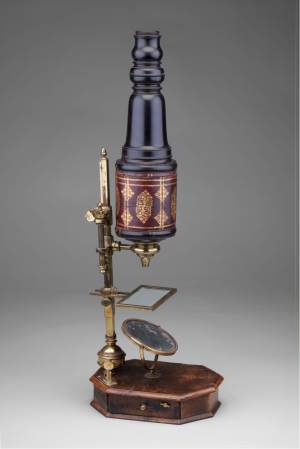
John Marshall, Great Double Microscope, London, 1710. Wood, brass, cardboard, leather, and gilt (The Golub Collection, University of California, Berkeley)
From mid-seventeenth-century simple microscopes to the modern compound optical devices by German makers during the late nineteenth and early twentieth centuries, these are the instruments that revealed the long-held secrets of the natural world—the existence of microorganisms, the structure of biological cells, and the composition and operation of a variety of previously unseen life forms. Nearly 350 years after Robert Hooke introduced a “newly visible world,” we continue to rely on the microscope in our eternal quest to better understand the world we inhabit and the challenges posed by that which remains invisible to the unaided eye.
A World Examined: Microscopes from the Age of Enlightenment to the Twentieth Century is located pre-security in the International Terminal Main Hall Departures Lobby, San Francisco International Airport. The exhibition is on view, free of charge, to all Airport visitors from December 24, 2011 to June 24, 2012.
This exhibition was guest curated by Steven Ruzin, Ph.D., Director of the CNR Biological Imaging Facility and Curator of The Golub Collection at the University of California, Berkeley. A selection of images are available here»
◊ ◊ ◊ ◊ ◊
SFO Museum was established by the Airport Commission in 1980 for the purposes of humanizing the Airport environment, providing visibility for the unique cultural life of San Francisco, and providing educational services for the traveling public. The Museum has been accredited by the American Association of Museums since 1999, and has the distinction of being the only accredited museum in an airport. Today, SFO Museum features approximately twenty galleries throughout the Airport terminals displaying a rotating schedule of art, history, science, and cultural exhibitions, as well as the San Francisco Airport Commission Aviation Library and Louis A. Turpen Aviation Museum, a permanent collection dedicated to the history of commercial aviation.
◊ ◊ ◊ ◊ ◊
More information on the exhibition, including a history of the formation of the collection and photographs of the installation at SFO Museum, are available via The Golub Collection website.
Exhibition: Chess Sets from the Past
Thanks to all of you who have helped make 2011 such a good year for Enfilade. I’m taking a few days off, but postings will resume soon. Happy holidays, and I hope the next few days bring plenty of tasty food, some extra sleep, time with friends and family, and maybe even some games around a table. -CH
◊ ◊ ◊ ◊ ◊
From the World Chess Hall of Fame:
Chess Masterpieces: Highlights from the Dr. George and Vivian Dean Collection
World Chess Hall of Fame, St Louis, 9 September 2011 — 12 February 2012
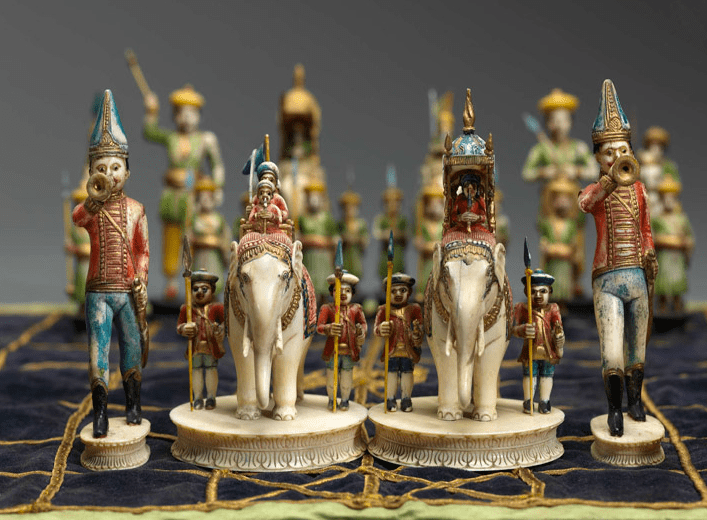
John Style Chess Set, India
Late 18th century, polychromed ivory
◊ ◊ ◊ ◊ ◊
Chess Masterpieces: Highlights from the Dr. George and Vivian Dean Collection celebrates the Deans’ 50th year of collecting together and uses outstanding selected works to trace the development of the game of chess and the design of fine chess sets from the tenth to the early twentieth century. Sets come from Austria, Cambodia, China, England, France, Germany, India, Italy, Japan, Kashmir, Morocco, Persia, Russia, Syria, and Turkey. Among the works on display are ones owned or commissioned by Catherine the Great, Napoleon, Czar Nicolas II, and the British royal family.
Chess has been called ‘The Royal Game’ not only because it originated in such royal courts but also because, across all eras and cultures, chess sets have been created from gold, silver, ivory, gemstones, crystal, and other opulent materials by the world’s finest craftsmen. The world-renowned Fabergé, Meissen, and Wedgewood workshops and many others were eager to join ranks with generations of elite anonymous craftsmen who worked for their ruler, church, or wealthy civil patrons to craft chess sets recognized as consummate works of art.
Just as the world’s finest craftsmen devised ever-more ingenious chess set designs, chess players plotted and planned ever-more innovative and elegant styles of play. Hence, each chess set in this exhibition is shown in a famous middle game or problem position from approximately the same timeframe and locale as the set. This enables one to view the pieces as they were intended to be viewed – in play, with the visual beauties of the designs complimented by the strategic brilliancies of the games. Hopefully, looking at pieces in the middle of a period game will bring one a step closer to the original experience of both the chess set and chess play of the time. These games were researched by curator Larry List with the help of chess scholar Myron Samsin of the Ken Whyld Association and noted chess teacher and author, Fred Wilson.
◊ ◊ ◊ ◊ ◊
Information on the John style set pictured above, from the exhibition checklist:
The theme of this style set is the opposition of native Indian troops to the John Company soldiers (often British mercenaries). These soldiers enforced the English control of Indian provinces and guarded the lucrative trade of the British East India Company. Such highly detailed decorative sets were made for display, not play. They were bought from skilled carvers in Berhampur by the British soldiers and traders as mementoes of their time in India serving the Crown. This prime example of the figurative polychromed designs uses the earliest Indian chess color scheme— red vs. green, with red-suited Brits facing off with green-clothed Indians.
Reviewed: ‘Thomas Lawrence: Regency Power and Brilliance’
Recently added to caa.reviews:
Cassandra Albinson, Peter Funnell, and Lucy Peltz, eds., Thomas Lawrence: Regency Power and Brilliance, exhibition catalogue (New Haven and London: Yale Center for British Art, National Portrait Gallery, London, and Yale University Press, 2011), 280 pages, ISBN: 9780300167184, $70.
Reviewed by Bruce Redford; posted 17 November 2011.
‘How various he is!’ Thomas Gainsborough’s tribute to Joshua Reynolds applies equally well to their successor in grand-manner portraiture. It is one of the signal achievements of ‘Thomas Lawrence: Regency Power and Brilliance’ that it removes any lingering traces of the negative stereotype: Lawrence the slick, formulaic sycophant who prostituted his gifts in the service of a decadent Regency elite. In its place this wide-ranging exhibition and thoughtful catalogue substitute a dynamic, probing, and inventive explorer of human psychology—one who is keenly attentive to the interplay of surface and depth, social mask and private self. Even Lawrence’s most public statements create a form of co-extensive space: not by breaking the picture plane, as in Caravaggio for instance, but by drawing the viewer into an
electric zone of intimacy. . . .
The full review is available here» (CAA membership required)
Happy Hanukkah
From The Jewish Museum:
The Jewish Museum, New York, 2 December 2011 — 29 January 2012
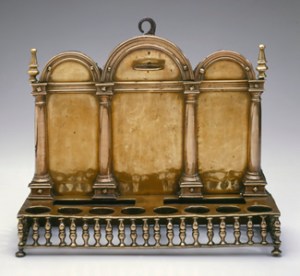
Hanukkah Lamp, Italy, 18th century (?), copper alloy, wood, and iron (New York: The Jewish Museum)
For this exhibition, the museum invited renowned artist and illustrator Maurice Sendak to choose a group of Hanukkah lamps from the collection. Sendak’s work is characterized by a push and pull between beauty and sorrow, light and darkness. His art is triggered by memories and is also their repository. The world he creates is both dangerous and healing, as he tries to deal with the trauma of the Holocaust, in which many members of his family perished.
When going through the museum’s collection, the sheer number and variety of lamps struck a nerve, underscoring Sendak’s deep, lifelong sense of loss at the destruction of the prewar world of his Eastern European Jewish parents. Having movingly evoked that world in his drawings for Zlateh the Goat and Other Stories (1966) and In Grandpa’s House (1985), he surprised himself by mostly avoiding its rich visual language when choosing lamps for this presentation. “I stayed away from everything elaborate. I kept looking for very plain, square ones, very severe looking,” he explained. “Their very simplicity reminded me of the Holocaust. And I thought it was inappropriate for me to be thinking of elaboration.”
The lamps Sendak finds most compelling and poignant are those that “go right to the heart,” whose “beauty is contained.” Yet his sense of humor is never far from the surface: as he made his choices he often free-associated, whimsically recalling old movies and Catskills family vacations. Above all, he is guided by his sensibility as an artist and author. He is drawn to simplicity of line, to a design “subservient to the basic idea of the piece,” and responds to the depth of emotion that emanates from a work itself or from the stories behind it. Concerned lest the past be forgotten, he hopes that young visitors to this exhibition will keep alive the memory of a vanished world.
Susan L. Braunstein and Claudia J. Nahson
Exhibition: Making the News in Eighteenth-Century France
From Carleton University:
Making the News in 18th-Century France
Carleton University Art Gallery, Ottawa, 13 February – 15 April 2012
Curated by Stéphane Roy
In 18th-century France, the dramatic rise in the production and rapid dissemination of prints played a key role in the creation of modern political culture. Prints helped people grasp the nature of newsworthy events both near and far, covering a wide range of historical moments, from the taking of Québec City in 1759 or the storming of the Bastille in 1789, to seemingly anecdotal acts of virtue performed by members of the monarchy or everyday individuals. Despite (or because) of the variable time lag involved in their making, printed images shaped public opinion as much – if not more – than the printed word, giving visual and tangible meaning to abstract yet politically-charged ideas and concepts such as “tyranny” or “patriotism.” Making the News presents approximately 40 prints made in France from 1770 to 1820, looking at their representation of actual events and the ways in which they fashioned how the French perceived their own place in History. Woven into a narrative linking history and art history, literature and journalism, politics and image-making, these objects will shed new light on art and ideas in the era of the Enlightenment and the French Revolution. Bound to the possibilities of centuries-old printmaking techniques, the 18th-century public’s relation to visual information echoes, in many ways, our own experience in the digital age, concerned with access to and transformation of content. Making the News ultimately prompts us to examine our current practice of looking, understanding and consuming the news.
Exhibition: French Drawings in Grenoble

Jean-François-Pierre Peyron, “Curius Denatus refusant les présents
des ambassadeurs Samnites,” XVIIIe siècle, Musée de Grenoble
◊ ◊ ◊ ◊ ◊
Currently on display at the Musée de Grenoble, as noted by Hélène Bremer . . .
L’idée et la ligne – Dessins français
Musée de Grenoble, 5 November 2011 — 12 February 2012
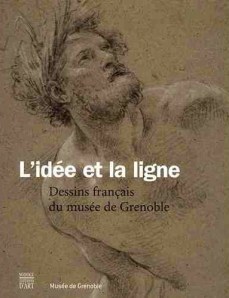 Après la présentation de ses plus belles feuilles italiennes, le musée de Grenoble met en valeur son extraordinaire fonds de dessins français. De la Renaissance à la fin du XVIIIe siècle, les plus grands artistes répondent présents. Nicolo dell’Abate, appelé pour travailler à Fontainebleau, offre une introduction magistrale à un parcours graphique qui puise ses sources en Italie. Laurent de la Hyre, Simon Vouet, Philippe de Champaigne, Patel, Charles Mellin, Charles Alphonse Dufresnoy ou François Perrier illustrent brillament les tendances d’une école française qui s’affirme et prend peu à peu son indépendance face à l’Italie. Le Brun, Noël Coypel, Jean-Baptiste de Champaigne, Louis de Boulogne et Charles de la Fosse poursuivent les avancées sous Louis XIV. La partie la plus riche et paradoxalement la moins connue de cette collection concerne le XVIIIe siècle : Boucher, Pierre ou Huber Robert viennent marquer le triomphe de la couleur et de la nature. Feuillet après feuillet, un pan entier de l’histoire de l’art française se dessine
sous nos yeux.
◊ ◊ ◊ ◊ ◊
Catalogue: Guillaume Kazerouni, Barbara Brejon de Lavergnée, Jérôme Delaplanche and Pierre Rosenberg, L’idée et la ligne: Dessins français du musée de Grenoble, XVIe-XVIIIe siècle (Paris: Somogy éditions d’art, 2011), 240 pages, ISBN: 9782757204818, €35.
Exhibition: Boxes and Objets de Vertu
From the Cognacq-Jay, as noted by Hélène Bremer . . .
Boîtes en or et objets de vertu
Cognacq-Jay Museum, Paris, 21 December 2011 — 6 May 2012
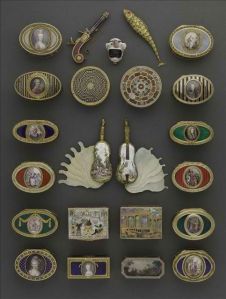 A l’occasion de la parution du Catalogue raisonné des Boîtes en or et objet de vertu, le musée Cognacq-Jay expose cet hiver sa riche collection de boîtes, tabatières, étuis, boîtes à rouge, à mouches, nécessaires de toilette, à écrire… Avec 240 objets, celle-ci est l’une des plus importantes des musées français.
Chefs-d’œuvre de l’orfèvrerie, en or, enrichis de pierres dures ou précieuses, d’émail, de porcelaine, d’ivoire ou de nacre. . . étaient dès le XVIIIe siècle l’objet d’orgueil et de convoitise Leur forme était parfois étrange, prenant l’apparence d’un dromadaire, d’un tatou, d’une jambe, d’une tête, d’un violoncelle. . . Leur usage, participant aux rituels de la vie quotidienne, témoigne des pratiques de la sociabilité au Siècle des Lumières : le tabac, les modes cosmétiques, le jeu. . .
L’exposition mettra exceptionnellement en lumière cette collection, au moyen d’une scénographie originale et surprenante, et en réunissant autour de ces
objets des dessins, des gravures pour mieux comprendre leurs secrets de
fabrication et leur usage.
◊ ◊ ◊ ◊ ◊
Catalogue: Objets de Vertus, Boites, Tabatieres, Etuis et Necessaires Collections D’Orfevrerie (Paris: Paris Musées, 2011), ISBN: 9782759601813, €44.
Exhibition: Winter Tales, from Bruegel to Beuys
From the Kunsthistorisches Museum:
Winter Tales: Depictions of Winter in European Art from Bruegel to Beuys
Kunsthistorisches Museum, Vienna, 18 October 2011 — 8 January 2012
Kunsthaus Zurich, 10 February — 29 April 2012
Curated by Ronald de Leeuw

Joshua Reynolds,"Lady Caroline Scott as Winter," 1776. Collection of the Duke of Buccleuch and Queensberry, Bowhill, Selkirk, Scotland (Photo: Wikimedia Commons)
The creation myths of most great civilizations agree that winter came into the world to punish man, or as a plague. Boreas, the Greek god of the cold north wind, personified winter. In northern mythology three years of frost herald the end of the world.
Large-scale depictions of how Napoleon’s Grande Armée was defeated by the Russian winter are a modern equivalent of these ancient scenarios of the end of the world. The contrary vision comprises serenity and joyous cheer: we gaze at views of a snow-covered countryside with skaters enjoying themselves on frozen ponds and rivers in the distance. The late 18th century sees a revival of long-unfashionable winter landscapes: at first romanticized, they evolve to reflect the palette of winter.
Impressionism, Dutch art and a wealth of landscapes – these were the ingredients of earlier winter exhibitions. The Kunsthistorisches Museum and the Kunsthaus Zurich have expanded this successful trio. Broadening the selection to include many different genres and schools, the two museums present a comprehensive survey comprising over 180 works by west-European artists. Four galleries and nine small rooms of the KHM’s
Picture Gallery form the show’s spectacular setting. The works on show
date from 1450 to the present. In addition to the subjects mentioned
above there are Dutch allegories of the months, depictions of winter
festivities and folk customs, and still lifes; even portraits join in and
present changing winter fashions.
 The paintings are arranged more or less in chronological order; the show’s guest curator, Ronald de Leeuw, was able to augment the selection by including large-scale tapestries and an imperial sleigh as well as cups and goblets, fragile porcelain figures and vessels cut from semi-precious stones. Three years in the making, the exhibition brings together important loans from Amsterdam, Munich, London, Cambridge, Paris, Strasbourg, Rotterdam, Dresden, Zurich, Philadelphia, Darmstadt, Edinburgh, Cologne, The Hague, New York, Gent, Weimar and Boston, to name but a few. However, the unique focal point of any winter exhibition is in the Picture Gallery of the Kunsthistorisches Museum: Pieter Bruegel the elder’s painting “Hunters in the Snow”, perhaps the most famous depiction of winter in European art. The large panel cannot be loaned and will only be on show in Vienna.
In addition to works by Pieter Bruegel the exhibition includes paintings by Jacob van Ruisdael, Hendrick Avercamp, Jan van Goyen, Aert van der Neer, Peter Paul Rubens, Jan Steen, Jacob Jordaens, William Turner, Francisco de Goya, Caspar David Friedrich, Gustave Courbet, Jean-François Millet, Claude Monet, Alfred Sisley, Camille Pissarro, Vincent van Gogh, Giovanni Segantini, Edvard Munch, Joseph Beuys and Anselm Kiefer.
For more information, see the exhibition press release»
◊ ◊ ◊ ◊ ◊
Catalogue: Sabine Haag, Ronald de Lleuw, and Christoph Becker, Wintermärchen: Der Winter in der Kunst von Bruegel bis Beuys (Cologne: DuMont, 2011), 432 pages, ISBN: 9783832193935, €39 / $77.50 [available from artbooks.com]
Exhibition: Duncan Phyfe, Master Cabinetmaker in New York
From The Met:
Duncan Phyfe: Master Cabinetmaker in New York
The Metropolitan Museum of Art, New York, 20 December 2011 — 6 May 2012
Museum of Fine Arts, Houston, 20 June — 11 September 2012
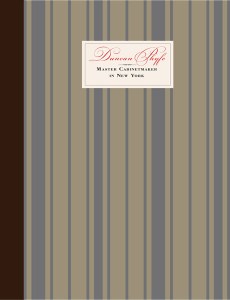 In the early 1800s, furniture from the workshop of New York City cabinetmaker Duncan Phyfe (1770–1854) was in such demand that he was referred to as the “United States Rage.” This exhibition—the first retrospective on Phyfe in ninety years—will serve to re-introduce this artistic and influential master cabinetmaker to a contemporary audience.
The full chronological sweep of Phyfe’s distinguished career will be featured, including examples of his best-known furniture based on the English Regency designs of Thomas Sheraton, work from the middle and later stages of his career when he adopted the richer “archaeological” antique style of the 1820s, and a highly refined, plain Grecian style based on French Restauration prototypes. The exhibition brings together nearly one hundred works from private and public collections throughout the United States. Highlights of the exhibition include some never-before-seen documented
masterpieces and furniture descended directly in the Phyfe family, as well as
the cabinetmaker’s own tool chest.
Organized chronologically, the exhibition will present the cabinetmaker’s life and work through drawings, documents, personal possession, and furniture. Portraits of his clients and contemporary depictions of New York City street scenes and domestic interiors will provide a glimpse into Phyfe’s milieu.
Read more»
◊ ◊ ◊ ◊ ◊
Catalogue: Peter Kenny, Frances Bretter, Michael Brown, and Matthew Thurlow, Duncan Phyfe: Master Cabinetmaker in New York (New York: Metropolitan Museum of Art, 2011), 352 pages, ISBN: 9780300155112, $65.










 Enfilade
leave a comment