Exhibition: The English Prize, The Capture of the Westmorland
From the YCBA:
The English Prize: The Capture of the Westmorland, an Episode of the Grand Tour
The Ashmolean Museum, Oxford, 17 May — 27 August 2012
The Yale Center for British Art, New Haven, 20 September 2012 — 6 January 2013
Curated by Scott Wilcox, Elisabeth Fairman, and María Dolores Sánchez-Jáuregui Alpañés
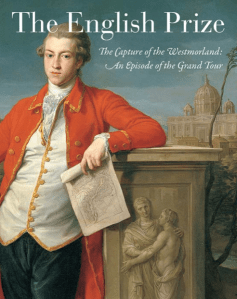 This exhibition tells the extraordinary story of the capture of the Westmorland, a British merchant ship laden with works of art acquired by young British travelers on the Grand Tour in Italy, and the subsequent disposition of its contents. Shortly after sailing from Livorno, Italy, in 1778, the ship was captured by the French navy, which was well aware of its exceptional contents. The Westmorland was escorted to Málaga, in southern Spain, where its contents were inventoried and acquired by agents who in turn sold most of the works of art on board to King Carlos III of Spain. Much of the material was subsequently presented by the king to the Real Academia de Bellas Artes de San Fernando in Madrid. The original inventories, which survive in the Academia’s archives, are remarkably thorough, enabling the identification of many of the items on board the ship when it was captured. Much of the material remains in the Real Academia, but significant works were passed on to the Spanish Royal Collection and are now in the Museo Nacional del Prado or in royal residences in Spain. Because most of these works can be associated with the tourists who were sending them back to Britain, the contents of the Westmorland forms the most complete “cross section” of the Grand Tour discovered to date. The exhibition comes out of a major research project initiated in the late 1990s, led by Professor José María Luzón Nogué, that investigates the story of the Westmorland and its contents. In recent years, with the support of the Paul Mellon Centre for Studies in British Art in London, remarkable progress has been made in identifying and cataloguing these extraordinarily diverse treasures, and this research forms the basis of the exhibition.
◊ ◊ ◊ ◊ ◊
Catalogue: María Dolores Sánchez-Jáuregui Alpañés and Scott Wilcox, eds., The English Prize: The Capture of the Westmorland, an Episode of the Grand Tour (New Haven: Yale University Press, 2012), 400 pages, ISBN: 9780300176056, $75.
◊ ◊ ◊ ◊ ◊
Charlotte Higgins writes about the exhibition for The Guardian (20 November 2011).
Exhibition: French Genre Painting, 1770-1820
From the museum’s website, as noted by Hélène Bremer . . .
Petits théâtres de l’intime: La peinture de genre française
Musée des Augustins, Toulouse, 22 October 2011 — 22 January 2012
 The history of French genre painting from 1770 to 1820: a window into changing tastes,fashions and the curiosity of society
Through this exhibition, the Musée des Augustins offers a panorama of the various movements in French genre painting from the end of the 18th century to the beginning of the 19th century. By presenting these scenes of day-to-day life, the exhibition gives the viewer a fresh vision of a set of painters. Some works by the most famous artists such as Fragonard, Marguerite Gérard, Greuze, Boilly or Drolling will be presented to the public for the first time, but there will also be many works by artists whose names have been forgotten or lost.
Through sixty scenes, this exhibition echoes moments in French society between the end of the Ancien Régime and the Restoration: private moments, family time, artistic and society events.These works, which have been kept both in French public collections and in private collections, illustrate changes in tastes and fashion and the influence of foreign schools on the French painting of this very troubled period.
A brochure for the exhibition (in French) is available here»
Exhibition: French Drawings from the Mariette Collection
From the Louvre, as noted by Hélène Bremer:
French Drawings from the Mariette Collection
Musée du Louvre, Paris, 10 November 2011 — 6 February 2012
Curated by Pierre Rosenberg, Laure Barthélemy-Labeeuw, and Bénédicte Gady

Jean-Baptiste Oudry, Egret (Paris: Louvre)
Pierre Jean Mariette (1694–1774) brought together one of the most fascinating collections in the whole of the eighteenth century, with drawings taking pride of place (around ten thousand sheets). Masterpieces by great artists stood alongside pieces of bravura by minor masters, in line with the encyclopedic commitment of this “genius jack-of-all-trades.” A collection of this caliber seemed destined to join those of king and nation. This was the wish of both Mariette and the administration—but, as sometimes happens, the heirs decided otherwise. The auctioning-off lasted for no less than two and a half months, during which time nearly one thousand drawings were nonetheless purchased for the king’s cabinet.
Pierre Rosenberg, of the French Academy, President emeritus of the Musée du Louvre, assisted by Laure Barthélemy-Labeeuw, rose to the dizzying challenge of reconstructing this legendary collection by scouring public and private collections the world over to track down drawings that had once belonged to Mariette. On the occasion of the publication of two initial volumes listing nearly four thousand French drawings, the Musée du Louvre is presenting the survey’s methodological basis and its main findings. On display are around one hundred works, some famous and some recently identified, which went from the collector’s to the museum’s portfolios.
◊ ◊ ◊ ◊ ◊
From Artbooks.com:
Pierre Rosenberg and Laure Barthélemy-Labeeuw, Les Dessins de la Collection de Pierre-Jean Mariette, volumes 1-2 (Milan: Electa, 2011), 704 pages, ISBN: 9788837064273, €600 / $900.
After the reproduction of the complete auction catalogue illustrated by Saint-Aubin and kept in Boston, a necessary tool through which to track down many of the items, the entire drawing collection which belonged to Pierre-Jean Mariette (1694-1774) is now being reproposed. Without any doubt, to use the words of Frederik Johannes “Frits” Lugt, the 20th-century collector, Mariette was the greatest, if not the ‘prince’ in the field of drawing collections. He began his collection during brief sojourns in Italy and, from 1750 onwards, devoted himself exclusively to this pursuit. During his lifetime he put together almost 9,000 items, carefully cataloguing them according to school and type. When he died, they were scattered as a result of 42 auctions (between November 1775 and January 1776).
The incredible task of putting the collection back together was made possible because of the trade-mark (a capital M) which Mariette stamped on every drawing he owned and by the unusual mounting of each drawing on a blue background (‘Mariette blue’) which brought out the best qualities of the drawings. The whole collection will be published in six volumes: the first two are devoted to the French School, three to the Italian school and one to the Dutch, Flemish and German schools. A monumental work of inestimable historical and artistic value. This ambitious publishing project reconstructed the world’s largest-ever collection of drawings. The first volumes focus on the French school: thousands of drawings that were scattered worldwide can now finally be seen at a single glance.
Additional information (in Italian) comes from the Italian bookseller, LibroCo.Italia»
Humphrey Wine provides a review in the April 2012 issue of Apollo Magazine (note added April 2012).
Exhibition: Contested Visions in the Spanish Colonial World
From LACMA:
Contested Visions in the Spanish Colonial World
Los Angeles County Museum of Art, 6 November 2011 — 29 January 2012
Museo Nacional de Historia, Mexico City, 6 July — 7 October 2012

"The Apparition of San Miguel del Milagro to Diego Lázaro," first half of the 18th century (Museo Universitario Casa de los Muñecos, Benemérita Universidad Autónoma de Puebla, Mexico)
Contested Visions in the Spanish Colonial World examines the significance of indigenous peoples within the artistic landscape of colonial Latin America. The exhibition offers a comparative view of the two principal viceroyalties of Spanish America—Mexico and Peru—from the fifteenth to the nineteenth centuries. Under colonial rule, Amerindians were not a passive or homogenous group but instead commissioned art for their communities and promoted specific images of themselves as a polity. By taking into consideration the pre-Columbian (Inca and Aztec) origins of these two vast geopolitical regions and their continuities and ruptures over time, Contested Visions offers an arresting perspective on how art and power intersected in the Spanish colonial world. The exhibition is divided into themes:
Contested Visions
Tenochtitlan and Cuzco Pre-Columbian Antecedents
Ancient Styles in the New Era
Conquest and New World Orders
The Devotional Landscape and the Indian as Good Christian
Indian Festivals and Sacred Rituals
Memory, Genealogy, and Land
A checklist of the exhibition is available here»
◊ ◊ ◊ ◊ ◊
Exhibition catalogue: Ilona Katzew, ed., Contested Visions in the Spanish Colonial World (New Haven: Yale University Press, 2011), 320 pages, ISBN: 9780300176643, $70.
 Contested Visions offers a comparative view of the two principal viceroyalties of Spanish America: Mexico and Peru. Spanning developments from the 15th to the 19th century, this ambitious book looks at the many ways and contexts in which indigenous peoples were represented in art of the early modern period—by colonial artists, European artists, and themselves. More than two hundred works of art, including paintings, sculptures, illustrated books, maps, codices, manuscripts, and other materials such as textiles, keros, and feather works, are reproduced in full-color illustrations, demonstrating the rich variety of these artistic approaches.
A collection of essays by an international team of distinguished scholars in the field uncovers the different meanings and purposes behind these depictions of native populations of the Americas. These experts explore
the role of the visual arts in negotiating a sense of place in late pre-Columbian and colonial Latin America. They address a range of important topics, such as the construct of the Indian as a good Christian; how Amerindians drew on their pre-Columbian past to stake out a place within the Spanish body politic; their participation in festive rites; and their role as artists. Lavishly illustrated, this ambitious book provides a compelling and original framework by which to understand the intersection of vision and power in the Spanish colonial world.
Ilona Katzew is curator and co-department head of Latin American art at the Los Angeles County Museum of Art.
◊ ◊ ◊ ◊ ◊
Symposium: Contested Visions in the Spanish Colonial World
Los Angeles County Museum of Art, 2-4 December 2011
LACMA and UCLA are co-sponsoring a major international three-day symposium in conjunction with the special exhibition Contested Visions in the Spanish Colonial World, which brings together thirty of the most distinguished scholars in the field from Mexico, South America, Europe, and the United States.
Free, no reservations | Printable Schedule | View Abstracts
Exhibition: Collective Creativity in 18th-Century Japanese Painting
From The Princeton University Art Museum:
Multiple Hands: Collective Creativity in Eighteenth-Century Japanese Painting
Princeton University Art Museum, 8 October 2011 — 22 January 2012
Curated by Xiaojin Wu
The study of individual artists has dominated modern art history, to the neglect of the collective creativity that contributed to countless important works of art. In Japan, as in many other cultures, collective creativity played—and still plays—a significant role in art-making. The exhibition Multiple Hands: Collective Creativity in Eighteenth-Century Japanese Painting, through a selection of paintings from the Princeton University Art Museum, the Metropolitan Museum of Art, the Philadelphia Museum of Art, and a private collection, provides a thoughtful consideration of the collective art-making process by focusing on two kinds of collective painting practices—workshop and collaborative— in eighteenth-century Japan.

Kano Tsunenobu, "Four Accomplishments," ca. 1700. Hanging silk scroll, 224.8 x 190.5 cm.
Interrelated but not identical, both practices involved multiple artists in the production of single works. In a workshop system, the head of the studio designed the composition of a painting, often a large-format work, and his assistants executed the details and applied colors. Only the master’s name was signed, however, making the presence of multiple hands in the paintings’ creation sometimes difficult to discern. Representative of the Kano school workshop—a prodigious hereditary apprentice system organized by generations of the Kano family from the sixteenth to the nineteenth century—is a pair
of large hanging scrolls, Four Accomplishments.

Kano Tsunenobu, "Four Accomplishments," ca. 1700. Hanging silk scroll, 224.8 x 190.5 cm.
Signed by the head of the workshop, Kano Tsunenobu (1636–1713), the two paintings exhibit the brushwork styles of more than one artist, particularly evident in the background. This signals the involvement of multiple workshop members in producing Four Accomplishments. Another important feature of the Kano workshop operation is the use of style manuals: workshop assistants had limited access to original paintings, so copies made by the head of the workshop served as style manuals that the assistants studied and relied on in collectively producing one work. Consequently, certain
motifs in a similar style are used repeatedly in different works, as
demonstrated by a painting of a long-tailed bird by Kano Tsunenobu
and a similar passage in his Four Accomplishments. (more…)
Exhibition: Daniel Sarrabat
From the Centre des monuments nationaux website:
Daniel Sarrabat (1666-1743) l’éclat retrouvé
Monastère royal de Brou, Bourg-en-Bresse (near Lyon), 15 October 2011 — 29 January 2012
Curated by François Marandet
 Cette exposition révèle l’art d’un des plus grands peintre d’histoire à Lyon et dans sa région, pendant la première moitié du XVIIIe siècle : Daniel Sarrabat (1666-1743). Alors que le style rocaille triomphe en France, il poursuit l’idéal artistique de Nicolas Poussin, et montre combien la peinture d’histoire s’est maintenue à Lyon et dans sa région depuis la disparition de Jacques Stella (1596-1657) et Thomas Blanchet (1614-1689).
Cette toute première rétrospective rassemble près de 50 œuvres de l’artiste, dont 36 tableaux. Sont présentées des réalisations inédites aux cotés d’œuvres de collections privées, notamment le décor mythique de l’Hôtel de Sénozan, à Lyon, complété par un groupe de tableaux provenant du patrimoine religieux de la région, avec le cycle illustrant l’histoire de Marie-Madeleine de l’église de Thoissey. Le parcours de l’exposition restitue les étapes successives de la carrière de Daniel Sarrabat : l’époque de son apprentissage à Paris, le séjour à
Rome (1685-1694), son implantation à Lyon en 1695, jusqu’à sa consécration
(1716-1732).
Additional information is available from the exhibition brochure (PDF).
◊ ◊ ◊ ◊ ◊
Catalogue: François Marandet, Daniel Sarrabat, 1666-1748 (Saint-Étienne: I.A.C. Éditions d’Art, 2011), 128 pages, ISBN: 9782916373478, $42.50. [Available from Artbooks.com]
Exhibition: Mexican Miracle Paintings at the Wellcome
From the Wellcome Collection:
Infinitas Gracias: Mexican Miracle Paintings
Wellcome Collection, London, 6 October 2011 — 26 February 2012
Mexican votives are small paintings, usually executed on tin roof tiles or small plaques, depicting the moment of personal humility when an individual asks a saint for help and is delivered from disaster and sometimes death. Infinitas Gracias will feature over 100 votive paintings drawn from five collections held by museums in and around Mexico City and two sanctuaries located in mining communities in the Bajío region to the north: the city of Guanajuato and the distant mountain town of Real de Catorce. Together with images, news reports, photographs, devotional artefacts, film and interviews, the exhibition will illustrate the depth of the votive tradition in Mexico.
Usually commissioned from local artists by the petitioner, votive paintings tell immediate and intensely personal stories, from domestic dramas to revolutionary violence, through which a markedly human history of communities and their culture can be read. The votives displayed in Infinitas Gracias date from the 18th century to the present day. Over this period, thousands of small paintings came to line the walls of Mexican churches as gestures of thanksgiving, replacing powerful doctrine-driven images of the saints with personal and direct pleas for help. The votives are intimate records of the tumultuous dramas of everyday life – lightning strikes, gunfights, motor accidents, ill-health and false imprisonment – in which saintly intervention was believed to have led to survival and reprieve.
Infinitas Gracias will explore the reaction of individuals at the moment of crisis in which their strength of faith comes into play. The profound influence of these vernacular paintings, and the artists and individuals who painted them, can be seen in the work of such figures as Diego Rivera and Frida Kahlo, who were avid collectors. The contemporary legacy of the votive ritual will be present in the exhibition through a wall covered with modern-day offerings from one church in Guanajuato: a paper shower of letters, certificates, photographs, clothing and flowers, through which the tradition of votive offering continues today. The sanctuaries at Guanajuato and Real de Catorce remain centres of annual pilgrimage, attracting thousands of people to thank and celebrate their chosen saints.
Exhibition: Masterworks from the Speed Art Museum in Tulsa
Press release from the Philbrook:
Magnificent Vision: Two Centuries of European Masterworks from the Speed Art Museum
Philbrook Museum of Art, Tulsa, 9 October 2011 — 8 January 2012
Flint Institute of Arts, Flint, Michigan, 5 May — 19 August 2012

Adélaïde Labille-Guiard, “Portrait of Madame Adélaïde,” ca. 1787, oil on canvas (Louisville: Speed Art Museum)
After two exhibitions focusing primarily on work from 20th-century America, Tulsa’s Philbrook Museum of Art is preparing for a dramatic shift in both time and setting. For the Museum’s final and biggest show of the year, the Museum is taking a look back at Europe in the 17th and 18th centuries. Magnificent Vision: Two Centuries of European Masterworks from the Speed Art Museum features more than 70 major works by the likes of Rembrandt, Rubens, Tiepolo, and Gainsborough.
The works in the exhibition are entirely drawn from the permanent collection of the Speed Art Museum in Louisville, KY, one of this country’s premier regional art museums. Forming the backdrop to this exhibition, which is organized thematically, is a two-hundred-year period in which European art underwent a dramatic and radical transformation. During the 1600s, particularly in the Netherlands, a newly affluent populace with a desire to improve their standing in society helped to generate a tremendous demand for artwork, and the market for paintings boomed. In the 1700s, as the artistic profession became institutionalized, the mood shifted and the abundance and variety of the earlier period was replaced. As significant taste-making institutions like the Academie des Beaux-Arts in Paris gained new power, demand for paintings remained high but became more focused.
“It is a group of paintings that not only dovetails beautifully with Philbrook’s own collection, but it also elegantly reflects one of the most extraordinary and inspiring periods in European art; it was truly a Golden Age,” says Dr. Tanya Paul, Philbrook’s Ruth G. Hardman Curator of European Art.
Exhibition: Satire and Religion
From The Walpole Library:
Sacred Satire: Lampooning Religious Belief in Eighteenth-Century Britain
The Lewis Walpole Library, Farmington, Connecticut, 22 September 2011 — 2 March 2012
Curated by Misty Anderson and Cynthia Roman
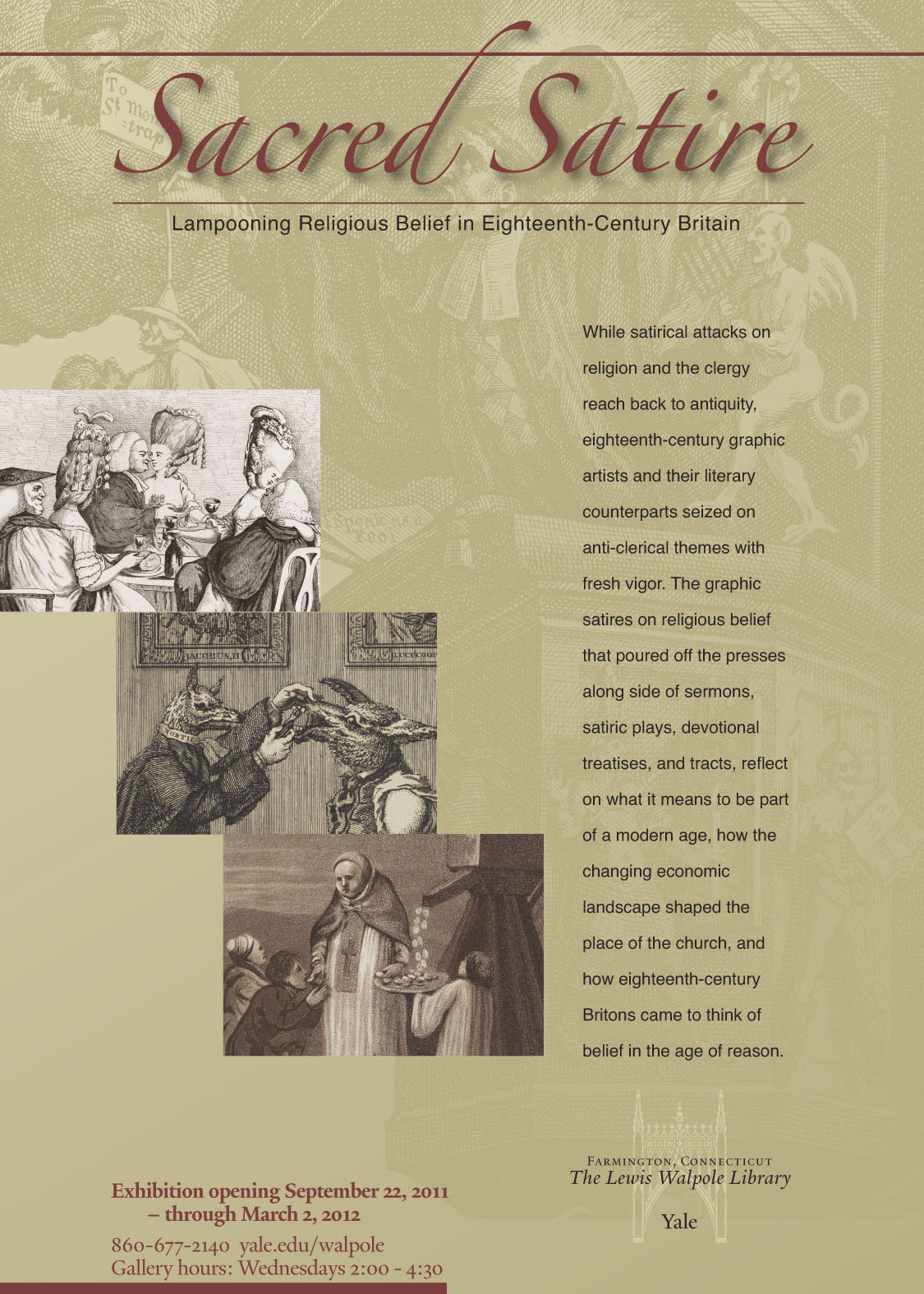 Religious beliefs and practices provided ample subject matter for the irreverent printmakers producing graphic satire in eighteenth-century Britain. While clerical satire is an ancient mode, eighteenth-century British artists seized on it with fresh vigor. Satirists appropriated centuries-old themes like corruption, hypocrisy, and greed, but updated them with contemporary concerns about the role of religion in the age of enlightenments. The visual rhetoric of these prints illustrates some of the ways in which eighteenth-century Britons were renegotiating their relationship to religious practice and belief.
The prints in this exhibition reflect a tension between a vision of religion as part of traditional life and the emergence of modern Christianity as a collection of new movements, practices, and ideas about belief. The eighteenth-century images on display preserve for us a moment in an ongoing conversation about the relationship of religion, representation, and modernity.
Stormy Skies, Calm Waters: Vernet’s Lansdowne Landscapes
Press release (18 October 2011) from the Dallas Museum of Art (as noted at ArtDaily):
Vernet Pendants from Lansdowne House Reunited in Dallas
Dallas Museum of Art, 18 October — 11 December 2011

Claude-Joseph Vernet, "A Mountain Landscape with an Approaching Storm," 1775 (Dallas Museum of Art)
Two landscape paintings by eighteenth-century French master Claude-Joseph Vernet have been reunited for the first time in more than 200 years at the Dallas Museum of Art. Commissioned in 1774 at the height of Vernet’s career by famous English collector Lord Lansdowne, the two large-scale paintings depict the complementary scenes of unruly rustic landscape and tranquil seaport. The duo, A Mountain Landscape with an Approaching Storm and A Grand View of the Sea Shore, hung together in the collector’s home, Lansdowne House, Berkeley Square, London, until his death, when the paintings were sold to separate private collections in 1806.

Claude-Joseph Vernet, "A Grand View of the Sea Shore Enriched with Buildings Shipping and Figures" 1775
On view through December 11, 2011, the Dallas presentation is the first opportunity, since the Museum acquired A Mountain Landscape several decades ago, to bring the two paintings together to be viewed as Vernet originally intended. The exhibition will be accompanied by a new monograph published by the Dallas Museum of Art examining Vernet’s landscape practice.
The Dallas Museum of Art is presenting the paintings in its second-floor European art galleries, where they can be viewed in dialogue with other eighteenth-century masterworks. The landscapes, which are unusually large for the genre, measuring five by eight feet each, reflect both the collector’s neoclassical taste as well as Vernet’s powerful use of light and atmosphere. A Grand View of the Sea Shore depicts elegant buildings set against a tranquil sea at sunset, while A Mountain Landscape portrays an ominous rocky terrain with villagers scrambling to weather an impending storm.
ISBN: 9780936227009, $20
The presentation of the Vernet paintings is made possible by the generous loan of A Grand View of the Sea Shore by collector David H. Koch. The landscape paintings will remain on view at the Dallas Museum of Art through December 11, 2011.
“The temporary reunion of the pair not only presents a singular opportunity for our audiences to experience anew a beloved painting in our collection, but allows for a new scholarly consideration of Vernet’s oeuvre,” said Olivier Meslay, Interim Director of the DMA and its Senior Curator of European and American Art and The Barbara Thomas Lemmon Curator of European Art. “Vernet’s precision in and exploitation of pairings has been highly influential to European art, and we are delighted to be able to display these
magnificent works together.”
“The Museum has sought to reunite these two landscape works since the realization, in January 2011, that A Grand View of the Sea Shore was not lost as presumed, and after such a lengthy separation the reunion is extraordinarily vivid, both historically and visually,” said Dr. Heather MacDonald, The Lillian and James H. Clark Associate Curator of European Art at the DMA. “In bringing the pair back together, we are finally able to fully experience the contrasting natural effects and the complex dialogue of aesthetics and ideas created by the two scenes. Their full meaning is finally revealed.”
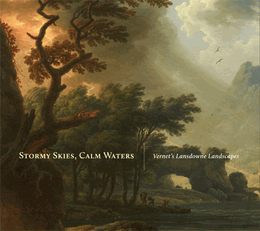
A monograph, the first English book-length publication on Vernet’s work in thirty years, will be published in conjunction with the reunification of the pair at the DMA. The fifty-page illustrated catalogue, Stormy Skies, Calm Waters: Vernet’s Lansdowne Landscapes, with an introduction by Olivier Meslay and scholarly essay by Heather MacDonald, provides a reappraisal of the Lansdowne commission and examines the meaning of the pairing and the role of pendant canvases within Vernet’s practice as a whole.
◊ ◊ ◊ ◊ ◊
Heather MacDonald, Stormy Skies, Calm Waters: Vernet’s Lansdowne Landscapes (Dallas: Dallas Museum of Art, 2011), 48 pages, ISBN: 9780936227009, $20.










 Enfilade
leave a comment