Exhibition: ‘The Art of Courtly Lucknow’
I’m afraid this exhibition slipped past me when it was at LACMA. It opens today, however, at the Musée Guimet in Paris. Thanks to Hélène Bremer for pointing it out. The following description comes from the LACMA press release:
India’s Fabled City: The Art of Courtly Lucknow / Une cour royale en Inde: Lucknow
The Los Angeles County Museum of Art, 12 December 2010 — 27 February 2011
Musée National des Arts asiatiques-Guimet, Paris, 6 April — 11 July 2011
Curated by Stephen Markel and Tushara Bindu Gude
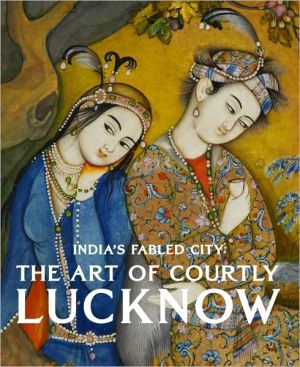
Exhibition catalogue, 272 pages, ISBN: 9783791350752
The Los Angeles County Museum of Art presents India’s Fabled City: The Art of Courtly Lucknow—the first major international exhibition devoted to the cosmopolitan culture of the northern Indian court of Lucknow, and the refined artistic production of the city’s multiethnic residents and artists. On view from December 12, 2010 through February 27, 2011, the exhibition will include almost 200 artworks: European oil paintings, watercolors, and prints; Indian opaque watercolor paintings generally made for albums, vintage photography, textiles, and garments, and a range of decorative art objects including metalwork, glassware, weaponry, and jewelry. Organized by Stephen Markel, LACMA curator of South & Southeast Asian art and department head, and Tushara Bindu Gude, associate curator, The Art of Courtly Lucknow will not only present the unique artistic traditions of Lucknow, but will also provide a framework for understanding the history of this extraordinary region and the nature of India’s colonial history and memory. . . .

After Johann Zoffany, "Colonel Polier Watching a Nautch," gouache on paper, ca. 1786-88 (Zurich: Museum Rietberg)
Lucknow was the capital of Awadh (a province in the Mughal Empire located in the present-day Indian state of Uttar Pradesh), and has become identified with the broader region and culture. From the mid-eighteenth century until the establishment of formal British rule in India in 1858, Lucknow overshadowed Delhi—the capital of the Mughal dynasty—to become the cultural center of northern India. Indian artists, poets, and courtiers flocked to Awadh seeking security and patronage, as Delhi suffered an extended period of unrest beginning in 1739. European artists, travelers and political agents were also soon lured to the region, seduced by tales of the wealth, opulence, and the generosity of Lucknow’s rulers (nawabs) and by the beauty of the city itself. The dynamic interaction between Indians and Europeans, the interplay
between their respective tastes and traditions, and the hybrid
lives led by many of Lucknow’s residents are explored in the
exhibition and accompanying publication. (more…)
‘Street Cries’ at the Museum of London
From the Museum of London:
Street Cries
Museum of London, 25 March — 31 July 2011
Curated by Francis Marshall
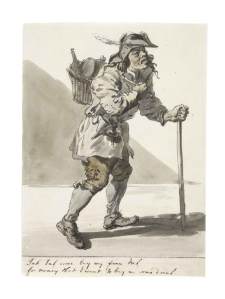
Paul Sandby, "Ink Seller," watercolour, ca. 1759 © Museum of London
Street Cries uses the Museum of London’s extensive art collection to consider how the urban poor were depicted from the 17th to the 19th century. Some of the earliest visual records of the urban poor were prints showing street traders. These first appeared in 15th-century Europe and continued to be made well into the 19th century. The market for this type of imagery was a flourishing one, particularly in London.
Many of these images presented an idealised vision of the poor. However, some artists, attempted greater realism. In 1760, for instance, Paul Sandby sought to redress the sanitizing tendency with his etchings Twelve London Cries Drawn from the Life. However, he anticipated a much larger set running to around forty images. He made watercolour drawings for these, of which the museum has an important group, but they were never published, probably because Sandby’s work was too realistic. Sixty years later, the French artist Théodore Géricault produced a print series depicting London’s poor. These powerful prints where a commercial flop largely because the imagery was too hard hitting to appeal to collectors at
the time.
Images of street vendors, and the urban poor generally, pose interesting questions about how society was organised, the motives of those making, selling and buying the prints, and the status and identity of the people depicted. Amongst other things, they can be seen as precursors of Mayhew’s efforts to produce a taxonomy of the London poor. The exhibition explores these issues as well as showcasing some of the Museum’s most important 18th- and 19th-century prints and drawings. Amongst the artists included are Paul Sandby, Gustave Doré, Théodore Géricault, and Thomas Rowlandson.
April 27, 3:00 — Curator Francis Marshall speaks on the exhibition at the Museum of London.
◊ ◊ ◊ ◊ ◊
Writing for The Independent (21 March 2011), Matilda Battersby reviews the show:
Put them all together and they resemble the cast of Oliver Twist: street urchins, prostitutes, beggars and street vendors all carefully drawn, painted or printed in the 17th and 18th centuries. They are some of the earliest depiction of London’s poor and are due to go on show at the Museum of London this week.
It is an interesting body of work for two reasons. Firstly, it encapsulates the diverse roles, functions and perceptions of Britain’s ‘underclass’ during those two centuries as well as giving insight into what was eaten, sold and readily available. Secondly, it shows an increased, although for the most part snobbish, awareness of what was then the ‘undeserving poor’ and an anthropological, if not exactly philanthropic, interest in them. . . .
The full review — plus a video with Francis Marshall discussing three images from the exhibition — is available here»
Stockholm Show Surveys Sexuality
Press release from the museum:
Lust & Last / Lust & Vice
Nationalmuseum, Stockholm, 24 March — 14 August 2011

Louis Lagrenée, "Amor and Psyche," (Stockholm: Nationalmuseum)
On 24 March 2011, Nationalmuseum opens the doors to Lust & Vice, a major exhibition filling three rooms and five display cases. Over 200 works from the 16th century to the present day, mostly little-known treasures from the museum’s own collection, will illustrate how views of sexuality, virtue and morality have changed over the centuries. The exhibition includes works coloured by the religious teachings of the 16th and 17th century, which held that sexual relationships could only take place inside marriage. However, there was a big difference between the behaviour the church prescribed for ordinary people and the liberties taken by the elite. The exhibition continues by examining the upper-class view of marriage in the 18th century: a social institution that left the parties to seek true passion elsewhere. In other words, an
attitude diametrically opposed to that of the church. The 18th
century was a time of double standards: one for the masses
and another for the enlightened elite.

Adolf Ulrik Wertmüller, "Danaë and the Shower of Gold,"(Stockholm: Nationalmuseum)
From the 19th century onward, the city becomes a central theme. Large-scale urbanization frequently led to anonymous sexual encounters and prostitution. Secret images for private consumption coexisting with moralistic public art were another by-product of urbanization. The exhibition presents examples of how virtue and sin have been depicted in art through the ages. One of the display cases examines how girls were brought up to lead a virtuous life in order to be good marriage material. Exhibits include a real chastity belt on loan from Nordiska museet. One wall in the first room displays paintings of women’s bottoms – an erotic reference that was long considered sinful because sex, besides taking place inside marriage, required eye contact in order to be morally acceptable. Artists managed to paint erotic motifs by portraying
myths or biblical scenes, often with moralistic undertones
alluding to the consequences of a sinful lifestyle. (more…)
Drawings in Portland, Maine
Press release from the museum:
European Drawings at the Portland Museum of Art
Portland Museum of Art, Portland, Maine, 26 March — 22 May 2011

Thomas Rowlandson, "Norfolk Broads," watercolor, graphite, and ink, ca. 1795 (Portland Museum of Art)
In the spring, the Portland Museum of Art will feature an exhibition devoted to European drawings comprised of 30 works from the Museum’s permanent collection and on loan from private collectors. European Drawings at the Portland Museum of Art, on view March 26 through May 22, 2011, will highlight masterworks by the finest draughtsmen of the 18th, 19th, and 20th centuries. This will be a unique opportunity to see works of art that are rarely exhibited because of the fragile nature of paper. The exhibition is part of Where to Draw the Line: The Maine Drawing Project, a statewide collaboration of 20 arts organizations that will present exhibitions dedicated to the medium of drawing throughout 2011. (more…)
Review: Amanda Lahikainen on Thomas Rowlandson
The Rowlandson exhibition opens next week at The Frances Lehman Loeb Art Center at Vassar College (8 April — 11 June 2011). And so in a timely manner, Amanda Lahikainen here inaugurates a new feature of Enfilade, original reviews. They won’t become a major feature of the site anytime soon, but there are a few more on the way.
Patricia Phagan, Vic Gatrell, and Amelia Rauser, Thomas Rowlandson: Pleasures and Pursuits in Georgian England (London: D. Giles Limited, 2011), 184 pages, ISBN: 9781904832782.
Reviewed for Enfilade by Amanda Lahikainen
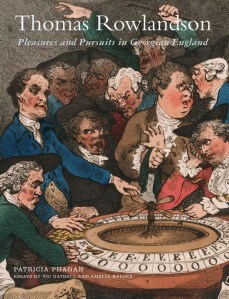 The lens of social life and social mixing frames the exhibition and accompanying catalogue, Thomas Rowlandson: Pleasure and the Pursuits in Georgian England. It’s a concept that Rowlandson himself might have chosen for such an exhibition of his own work. The show and catalogue stress the importance of broad historical contextualization, with an emphasis on pleasure and socialization in England during Rowlandson’s life (1757-1857). Edited by the exhibition’s curator, Patricia Phagan, the catalogue divides Rowlandson’s prints into six categories, each with an introductory essay, including images of street life and scenes from the theater. The color photographs are generously sized, and the entries aid readers both in deciphering the social and political references within the satires and in contextualizing the prints within the market for satire more generally. Entry #9, for instance, includes a caricature by the cotemporary satirist James Gillray for comparison, and entry #27 allows us to compare Rowlandson’s print The Brilliants to its likely predecessor, A Midnight Modern Conversation by William Hogarth. Readers find detailed information about Rowlandson’s life and the placement of his work within Britain’s hierarchy of genres. Also included is discussion of his pornographic subject matter and boisterous tavern scenes so important for an artist who relished whimsical and grotesque vignettes from common life. Fortunately, the catalog offers multiple points of engagement between “high art” and “low art,” thereby problematizing facile distinctions that have long plagued scholarly assessments of Rowlandson.
Especially valuable for British art studies are the two essays by Vic Gatrell, a historian, and Amelia Rauser, an art historian. Both scholars have recently published important books on graphic satire, in 2006 and 2008 respectively, and they usefully approach Rowlandson’s art from different perspectives. Gatrell lays bare the complex network of print makers and artists that defined Rowlandson’s world and visualizes this history using a detailed topographical map of Covent Garden and the Strand, an area of London which he describes as the “emotional heartland and a chief source” of Rowlandson’s comic vision. Toward the end of the essay, he tackles the critical reception of Rowlandson; this section is well worth reading even as an abstract meditation on the values that often guide our judgments of prints, including anxieties about reproduction and the pitfalls of strict subject categories.
Rauser’s essay asks us to look closely at Rowlandson’s prints and acknowledge that his work often simultaneously captivates and repulses. She gives a compelling answer to the question of what makes Rowlandson’s satire distinctive. Starting from the observation that Rowlandson’s art is amoral, she identifies his “commitment to embodiedness” and bemused “ironic detachment” as exceptional strengths. Her point is a good one: Rowlandson deflates his subjects by relentlessly reminding his viewers that they inhabit a body bound by the laws of nature and desire. Whether or not we follow Rauser in thinking of Rowlandson’s unrelenting interest in the human body as a product of Romanticism or Gatrell in thinking of Rowlandson’s humorous and grotesque bodies as responses to the growing wealth of the middle-class print buyers, we can agree that Rowlandson handles the human form to great effect. It is perhaps because of his disregard for didactic messages that he so successfully demonstrates the absurdity of social norms, especially deflating the rich and powerful along the way.
Amanda Lahikainen, a Ph.D. candidate at Brown University, is finishing her dissertation on the representation of abstract ideas in British graphic satire during the French Revolution. She has an article forthcoming in Print Quarterly and is currently working towards writing a book on the embodiment of debt in satire over the course of the eighteenth and nineteenth centuries.
In Munich: Conserving Boulle Furniture, Exhibition and Symposium
From the museum’s website:
Prunkmöbel am Münchner Hof: Barocker Dekor unter der Lupe
Bayerisches Nationalmuseum Munich, 8 April — 31 July 2011
Symposium — Baroque Furniture in the Boulle Technique: Conservation, Science and History
Bayerisches Nationalmuseum Munich, 5-7 May 2011
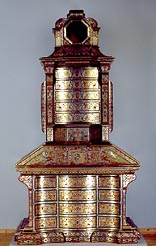 In spring 2011 the Bayerisches Nationalmuseum will have completed an interdisciplinary research project dedicated to the conservation /restoration of four writing cabinets decorated with fine marquetry in the Boulle technique. These cabinets were made by Johann Puchwiser (1680-1744), ebenist to the Munich court. The project has been supported by the Getty Foundation, the Ernst von Siemens Kunststiftung und the Eleonora-Schamberger-Stiftung and joined by an international group of furniture experts, scientists and conservators/restorers.
To showcase this project, we are planning the exhibition Prunkmöbel am Münchner Hof: Barocker Dekor unter der Lupe from 8th April to 31st July 2011. The show will present magnificent furniture in the Boulle technique and focuses especially on the conservation of the Puchwiser cabinets, stylistic developments, manufacturing
techniques, and Boulle marquetry in general.
 The announced symposium on the conservation project Baroque Furniture in Boulle Technique: Conservation, Science, and History is addressed to art historians, conservators/restorers and scientists. Internationally recognized experts will present their results in conservation/ restoration and scientific analysis of objects in Boulle technique. Lectures and guided tours will be held in English. Post-prints will be published shortly after the conference and can be ordered in advance. Conference fee including coffee break and lunch: 120€ / Reduced fee for students: 60€. Deadline for registration: 15th April 2011.
On Thursday 5th May we will meet for an evening dinner in the restaurant of the Bayerisches Nationalmuseum. If you would like to join, please add 40€ to the conference fee. For registration and information, please contact:
restaurierung.sekretariat@bnm.mwn.de
A preliminary program is available here»
Rijksmuseum Acquisition: Glass Engraved with Plantation Scene
Press release from the Rijksmuseum:
Rijksmuseum Acquires Surinamese Occasional Glass
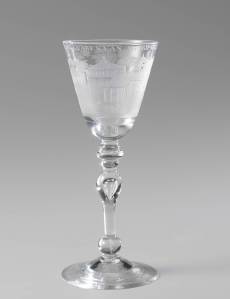 The Rijksmuseum has acquired an extremely rare 18th-century glass engraved with a scene depicting the Surinamese sugar plantation Siparipabo and the text ‘t welvaren van Siparipabo’ [‘The Prosperity of Siparipabo’]. The magnificent, detailed engravings are partly polished. Once the Rijksmuseum’s main building reopens, the glass will be given a prominent place among the 18th-century works of art, telling the story of Surinam’s plantation economy. Plantation owners in Surinam and Europe used glasses such as these to toast the prosperity of their possessions; in this case, the prosperity of the Siparipabo sugar plantation in Surinam. The plantation is first mentioned on a map dated 1686, on which it is depicted adjacent to the River Commewijne. The glass was probably ordered at the beginning of the 18th century by the owner of the plantation, Catharina Marcus, widow of Willem Pedij d’Oude. The engraver based his depiction on engravings from the book Beschryvinge van de volks-plantinge Zuriname (‘Description of the Surinam People’s Plantation’) by J. D. Herlein, which was published in 1718. One scene depicts a female slave resting under a tree and a male slave with a shovel and a sheaf of sugar cane. The other scene shows the plantation owner’s house, the sugar mill and the slave huts. The engraver has expertly depicted the original print in glass, allowing for the tapered shape of the goblet. He added vitality to the engraving by polishing certain parts. The detail of the little huts in the background, for example, is not as precise as the detail of the sugar mill in the foreground.
From the moment when the Netherlands exchanged Surinam as a colony for New Amsterdam (now New York) in 1667, the Dutch took African men and women there to work as slaves on the plantations (approximately 100,000 in the 17th century and approx. 400,000 in the 18th century). By 1775, there were around 600 plantations in Surinam, most of which were for sugar. There were still around 35,000 slaves in the colony when the Netherlands abolished slavery in 1863.
Eveline Sint Nicolaas, Curator in the Rijksmuseum’s History Department, explains: ‘When I first saw the glass I knew immediately that it was very special. There are only a few glasses that refer to Surinamese plantations and the combination with the prominently featured slaves near the sugar mill makes this a very special acquisition. The text and the scenes depicted also set one thinking. Why does it say ‘prosperous’ (‘welvaren’)? Hopefully it will soon have the same effect on the museum’s visitors. Apart from this item, there are very few objects in the collection that depict slavery in the former colonies, which is why the glass will have an important place among the 18th- century objects in the new Rijksmuseum’.
Exhibition: Empress Elizabeth Petrovna in Moscow
From the museum’s website (with some editing for clarity) . . .
Elizabeth Petrovna and Moscow
The State Tretyakov Gallery, Moscow, 10 December 2010 — 27 March 2011

А. Belskiy, "Allegory, Astronomy," oil on canvas, 1756
This exhibition in honour of the 300th anniversary of the birth in Moscow of empress Elizabeth Petrovna (1709–1762) finishes the trilogy devoted to mutual relations of the Russian emperors of the eighteenth century and the ancient capital. The intermuseum project will unite exhibits from funds of the largest treasuries of Moscow and Moscow suburbs. All stages of the biography and a side of the person of the empress are shined: childhood and youthful years, coronation celebrations of 1742, “a small court yard,”court hunting, the visiting of orthodox monasteries in vicinities of the first capital city (Moscow), home life and activity in the culture sphere, connected with foundation University in Moscow and Academy of Arts in Petersburg and the creation of the first Russian theatre. Paintings, jewelry, sculpture, drawings, and architectural sketches and models will present a life of the empress against a wide background of life in the middle of eighteenth-century Moscow.
Exhibition: Chardin in Madrid
The Chardin exhibition formerly on view in Ferrara recently opened at the Prado:
Chardin: The Painter of Silence
Ferrara, Palazzo dei Diamanti, Ferrara, 17 October 2010 — 30 January 2011
Museo Nacional del Prado, Madrid, 1 March — 29 May 2011
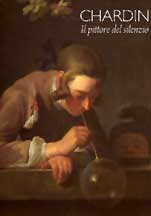 The Museo del Prado presents the exhibition Chardin, a comprehensive survey of the work of Jean Siméon Chardin (1699-1779). Chardin is one of the leading names in 18th-century French painting but has never been the subject of an exhibition in Spain, which only houses three of his paintings, all in the Museo Thyssen. After being shown at the Palazzo dei Diamante in Ferrara, the exhibition is presented in Madrid thanks to the sponsorship of Fundación AXA. It comprises 57 paintings by this great master of the still life and of genre painting, including some works not shown in the version of the exhibition seen in Italy.
Additional information is available here»
Exhibition: Pastel Portraits at the Met
Press release from the Met:
Pastel Portraits: Images of 18th-Century Europe
Metropolitan Museum of Art, New York, 17 May — 14 August 2011
Curated by Katharine Baetjer and Marjorie Shelley
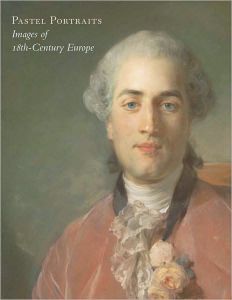 In the 18th century, pastel portraiture was so popular in Europe that by 1750 almost 2,500 artists and amateurs were working in pastel in Paris alone. Across Europe works were commissioned by royalty and courtiers, as well as the wealthy middle classes. Although pastel is a drawing material, 18th-century portraits are often highly finished, relatively large, brightly colored, elaborately framed, and hung in the same fashion as oil paintings. The powdery pastel crayons and slightly roughened paper are particularly suited to capturing the evanescent effects of expression that characterize the most life-like portraits. Pastel Portraits: Images of 18th-Century Europe will feature 40 pastel portraits from the collections of the Metropolitan Museum and other museums, and from private collections in New York, Princeton, and New Haven. At the core of the exhibition will be a group of French works, and the English, German, Italian, and Swiss schools will also represented.
Pastels are susceptible to fading if overexposed to light, and they are vulnerable to damage from excessive vibration, which can loosen the powder. As a practical consequence, they can only be shown three months of the year, rarely travel, and are not often exhibited in museums. Pastel Portraits will give visitors the rare opportunity to view these exquisite works in a museum exhibition, which will include generous loans from the Princeton University Art Museum, Yale Center for British Art, New Haven, Pierpont Morgan Library, New-York Historical Society, and Frick Collection, as well as several private collections.
Pastel Portraits will feature a number of fine works by Maurice Quentin de La Tour and Jean Baptiste Perronneau, two of the best known and outstanding artists who were working with this medium in mid-18th–century Paris. Highlights of the exhibition will include La Tour’s Jacques Dumont le Romain (1701-1781) Playing the Guitar; Perronneau’s Olivier Journu; Adélaïde Labille-Guiard’s portrait of the sister of Louis XVI, Madame Elisabeth de France (1764-1794), recently acquired by the Metropolitan Museum; Jean Étienne Liotard’s Young Woman in Turkish Costume with a Tambourine; John Russell’s John Collins of Devizes; and the beautiful Young Woman with Pearl Earrings by Venetian artist Rosalba Carriera, who became a favorite of Grand Tourists visiting Italy. The popularity and appeal of pastel in the 18th century reached as far as Boston, where John Singleton Copley, who was self-taught and had never seen an important European work in the medium, created exceptional portraits. Two of Copley’s portraits, also recently acquired by the Metropolitan Museum, will be on view in the exhibition.
Katharine Baetjer and Marjorie Shelley, Pastel Portraits: Images of 18th-Century Europe, exhibition catalogue (New Haven: Yale University Press, 2011), 9780300169812, 56 pages, $14.95.










 Enfilade
leave a comment