Exhibition: Gardens in Perpetual Bloom
From the Ringling Museum:
Gardens in Perpetual Bloom: Botanical Illustration in Europe and America from 1600-1850
Nagoya/Boston Museum of Fine Arts, Nagoya, Japan, 12 December 2009 — 4 April 2010
John and Marble Ringling Museum of Art, Sarasota, 29 January — 24 April 2011
Museum of Fine Arts, Boston, 1 May 2011 — 1 May 2012
 Until the mid-nineteenth century, gardening was not the popular pastime of the average person that it is today. It was the occupation of the professional employed by royalty and the wealthy, the horticulturist who bred and cultivated new plants, and the botanist whose concern was the scientific classification of plant life. In this exhibition it will be possible to trace the transition of the study and appreciation of flowers and their cultivation from the world of monks and princes to the everyday gardener.
The earliest books depicting flowers were herbals, first illuminated manuscripts, then printed with woodcuts, dedicated to the medicinal, therapeutic properties of plants. In the early seventeenth-century, illustrated books were published to describe the contents of the gardens of the well-to-do. When Carl Linnaeus, the Swedish botanist, published his Systema naturae in 1735, which classified and gave order to our knowledge of the plant kingdom, the botanical book often took on a new purpose. Botanists endeavored to accurately illustrate all the varieties according to the new sexual system, whereby plants were organized and given nomenclature according to their numbers of stamens and pistils.
Explorers to the Americas, Asia, and Africa observed the native vegetation and brought back cuttings, seedlings, and bulbs to be cultivated, named, described and elaborately illustrated. The nursery business thrived. By the nineteenth century, as a result of this efflorescence of botanical publication, horticulture and gardening became a readily accessible hobby for the amateur. Artists and decorators were provided with immense new visual resources. Apart from their botanical interest, flower prints possess great variety and a visual appeal that can be bold and vibrant or delicate and refined. These plates almost always reveal the artist’s eye and hand in the rhythmic and graceful placement of the flower and its parts elegantly spread gracefully across the page. One of the earliest examples represented in this exhibition is the strikingly dramatic and monumental Large Sunflower, taken from Basil Besler’s Hortus Eystettensis…a florilegium (book describing a garden or flower collection), first published in 1613, which illustrated plants and flowers in the garden of the Bishop of Eichstätt in Bavaria. Besler, an apothecary and gardener for the Bishop, drew the flowers over many years and employed engravers to follow his designs and other artists to color them by hand.
Comprised of more than 100 flower prints, Gardens in Perpetual Bloom features the products of a fruitful collaboration of botanists, horticulturists, painters, and printmakers from the 17th to 19th centuries. Requiring technical virtuosity and complex techniques to achieve an amazing range of line and tone, these colorful works reveal the detail, structure, texture, tone, and lifelike appearance of a magnificent iris, an exotic lily, or a single elegant rose executed with an originality of design and composition.
Exhibition Catalogue: Nancy Keeler, Gardens in Perpetual Bloom: Botanical Illustration in Europe and America 1600-1850 (Boston: MFA, 2010), 136 pages, ISBN: 9780878467495, $24.95.
Exhibition: Four Hundred Years of French Drawings
Press release from The Frick in Pittsburgh:
Storied Past: Four Centuries of French Drawings from the Blanton Museum of Art
The Frick Art & Historical Center, Pittsburgh, 5 February — 17 April 2011
Blanton Museum of Art, The University of Texas, Austin, 18 September — 31 December 2011
Iris and B. Gerald Cantor Center for Visual Arts, Stanford University, 28 May — 24 August 2014
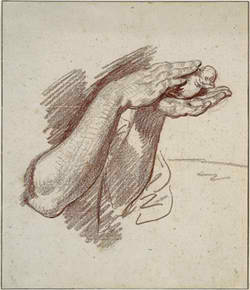
Jean-Baptiste Greuze, "The Arms of a Girl Holding a Bird," red chalk on cream paper, ca. 1765 (Austin: Blanton Museum of Art, The University of Texas)
Composed of 56 drawings made between 1500 and 1900, this exhibition chronicles the full range of artistic uses of the medium, from quick sketches to finished compositional studies, to drawing as an end in itself. The Blanton Museum at the University of Texas at Austin has organized the exhibition from their permanent collection, which was supplemented a bit more than a decade ago by a large gift of drawings. The French drawings from this gift had not received systematic academic study, nor had most of them been published. Especially rich in 17th- and 18th-century drawings, the exhibition illustrates the rise to dominance of the Académie royale de peinture et de sculpture as one of the most dominant cultural and political institutions in Europe. The exhibition includes works by François Boucher (1703–1770), Jean-Baptiste Greuze (1725–1805), and Nicolas Lancret (1690–1743), among others, with the nineteenth century represented by choice sheets from François-Marius Granet (1777–1849), Théodore Rousseau (1812–1867), Jean Forain (1852–1931), Théophile-Alexandre Steinlen (1859–1923), and others who reflect shifts in the approach to drawing
in the modern era.

Exhibition catalogue, ISBN: 9781555953560, $65
At the Frick, the exhibition will find a perfect counterpart in the museum’s permanent collection, which visitors will enter as they exit the traveling drawings show. Paintings by Jean-Marc Nattier (1685–1766), Lancret (1690–1743), Jean-Baptiste Pater (1695–1736), Boucher, Hubert Robert (1733–1808), and Nicolas-Bernard Lepicié (1735–1784), will be displayed with examples of decorative arts from the period, which will provide for a richer understanding of the 18th century in particular. . . .
The exhibition begins in a period of transition from the mannerism of the late Renaissance to the Baroque period. Two sheets showing designs for a powder flask made by an artist associated with the School of Fontainebleau show the sophisticated sense of decoration that prevailed among artists working around the court of Francis I. Two drawings attributed to seminal printmaker Jacques Callot (1592–1635) and his circle date to the period he spent in Florence, and show his interest in melding his observations of life around him into his expressive and inventive finished compositions. The fluid chalk Study of a Man with a Turban, c. 1617, attributed to Callot, is characteristic of his elegant figures and displays a masterful ability at controlling light and shade and swiftly capturing the spirit of a figure, as well as its contours. (more…)
Exhibition: Bronze Sculpture in Minneapolis
Notwithstanding the show’s title, there are significant eighteenth-century works included (the ‘long Baroque’). Press release from the MIA:
Beauty and Power: Renaissance and Baroque Bronzes from the Peter Marino Collection
The Wallace Collection, London, 29 April — 25 July 2010
The Huntington Library, San Marino, CA, 9 October 2010 — 24 January 2011
Minneapolis Institute of Arts, 6 February — 15 May 2011
Curated by Jeremy Warren
 An important international exhibition, Beauty and Power: Renaissance and Baroque Bronzes from the Peter Marino Collection opens at the Minneapolis Institute of Arts (MIA) February 6 and runs through May 15. Additionally, the MIA is presenting Lost Wax, Found Sculpture, an exhibition that explains the technique of making bronze sculpture according to the historically popular technique of lost-wax casting.
Beauty and Power is selected from Marino’s unparalleled private collection of 16th- to 18th-century Italian and French bronzes, and contains many pieces never publicly displayed before the show debuted in early 2010 at the Wallace Collection in London. It comes to the MIA from its only other U.S. venue, the Huntington Library, Art Collections and Botanical Gardens in San Marino, California.
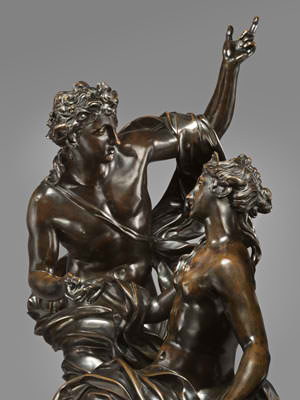
Corneille van Clève (1646-1732), "Bacchus and Ariadne," bronze, ca. 1703-04
“The MIA is fortunate to be able to show more about thirty bronzes statuettes from Mr. Marino’s exemplary collection that spans the golden age of the art form,” said Eike Schmidt, the James Ford Bell curator of Decorative Art and Sculpture at the MIA. “For three-and-a-half months we are the beneficiaries of his two-decade quest to assemble one of the strongest compilations of Renaissance and Baroque small bronzes in the nation.”
Beauty and Power coincides with and complements three other important MIA exhibitions from the same time period: Titian and the Golden Age of Venetian Paintings: Masterpieces from the National Galleries of Scotland, Venice on Paper, and The Mourners: Tomb Sculptures form the Court of Burgundy. . . .
Bronze statuettes became a serious art form in Renaissance Italy when interest in ancient Rome and Roman bronze-casting was revived, often using themes inspired by Greek and Roman mythology. Bronze has always been valued for its surface and molten qualities, which create complex and satisfying sculptural forms full of sensuality and emotion. Created on a scale that made them easy to collect and display, these bronzes were in demand, and sculptors across Europe created them to showcase their abilities. Included in the show are such works as the powerfully violent Samson and the Philistine (c. 1550–60), attributed to Baccio Bandinelli; the atypical depiction of an at-peace Diana (c. 1720–40) by Antonio Montauti; and Corneille van Cleve’s masterpiece Bacchus and Ariadne (c. 1703–4), showing the romantic encounter between the abandoned goddess and her rescuer. It also includes Florentine sculptor Giovanni Battista Foggini’s heroic David and Goliath (c. 1722), Ferdinando Tacca’s touching Hercules and Iole (c. 1640–50), and Robert Le Lorrain’s symbolically portrayed Andromeda (c. 1695–1700). (more…)
Exhibition: The Farnese Palace
Crucial for Roman culture in the sixteenth and seventeenth centuries, the Farnese Palace and its collections were also important for eighteenth-century artists and connoisseurs. Upon the death of Antonio Farnese in 1731, the family line came to an end, and the building passed to the Bourbons (hence the subsequent relocation of the collection to Naples). The current exhibition provides an extraordinary opportunity to view the building’s interior and some of the most important objects from the Farnese collection in their early modern setting. From www.france.fr . . .
The Farnese Palace: From the Renaissance to the French Embassy
Farnese Palace, Rome, 17 December 2010 — 27 April 2011

Giuseppe Vasi,"Palazzo Farnese," mid-eighteenth century
For this exhibition, the Farnese collection (the “Museum Farnesianum”) will return to its original premises. For the first time in centuries, the historic rooms of the emperors and philosophers will be recreated and the famous Dacian Prisoners will resume their place beside the door of the Grand Salon. The return of these exceptional works to “their” palace was made possible by the generous loan from the National Archaeological Museum in Naples. The Palace courtyard will be home to the monumental statue of Apollo Citharoedus made of porphyry and marble, known as Roma triumphans at the time, and will be filled virtually with the imposing silhouettes of the Farnese Hercules and the Latin Hercules, but also the Farnese Bull. Among the most important pieces of furniture are the Farnese cabinet from Ecouen Museum, a precious item of furniture from the Renaissance made by Flaminio Boulanger to contain the collection of coins, intaglios and meats of the Farneses. Tapestries from Quirinal, on loan from the President of the Republic of Italy and Chambord Castle, will be returned to the salons of the “noble floor,” as will Renaissance ceramics.
The collection of preparatory drawings by Annibale Carracci, coming from the Louvre Museum in particular, and the frescoes of the Fava Palace in Bologna will illustrate the creation of the famous Carracci Gallery. The opulent collection of paintings will return to the Northeast Gallery. The Portrait of Pope Paul III by Titian, Christ and the Canaanite Woman painted by Annibale Carracci for the private chapel of Cardinal Odoardo Farnese, works by Sebastiano del Piombo, the Carracci and Greco will all testify to the quality of the spectacular Farnese collection. Most of the aforementioned paintings come from the Capodimonte National Museum in Naples along with the galleries in Parma and Bologna.
This exceptional exhibition is a unique occasion for the public to rediscover the splendours of the Pomp of the Farneses. It will enable them to relive the intertwined histories of the popes, cardinals, kings, ambassadors and artists who, for five centuries, lived and came together at the Farnese Palace, helping to make it an exceptional place.
Exhibition: ‘Caring for William Hunter’s Prints’
From the Hunterian:
Past, Present and Future: Caring for William Hunter’s Prints
Hunterian Art Gallery, Glasgow, 2 October 2010 — 21 June 2011

"Portraits de Nanteuil" volumes 1 & 2
This new display highlights a current Hunterian project on the Hunter volumes of prints. They consist largely of portraits of past celebrities and prints of paintings and drawings by Old Masters, including Leonardo da Vinci, Raphael and Rembrandt. An award from Museums Galleries Scotland has enabled conservation of some of the volumes, the cataloguing and digitizing of all and a research program carried out in collaboration with the University’s History of Art department.
Joanne Orr, CEO of Museums Galleries Scotland, said: “Museums Galleries Scotland investment to Scotland’s Recognised Collections of National Significance aims to enhance the overall visitor experience. Providing new opportunities to explore and enjoy Scotland’s top collections is a key focus and this exhibition is a excellent example of how this is happening. What goes on behind the scenes is as important as what visitors see ‘on stage’ when they arrive – this is a rare chance to get up close and personal to the fascinating work of curators.”
This work has provided valuable new information on Hunter’s motivations for collecting such volumes and on his close relationships with leading contemporary artists.
Exhibition: Canaletto in Washington
Venice: Canaletto and His Rivals
National Gallery, London, 13 October 2010 — 16 January 2011
National Gallery, Washington D.C., 20 February — 30 May 2011

Canaletto, "The Square of Saint Mark's, Venice," 1742/1744 (DC: National Gallery, Gift of Mrs. Barbara Hutton 1945.15.3)
As the Canaletto exhibition opens in Washington, it will be introduced with a lecture by Charles Beddington (guest curator) and David Alan Brown (curator of Italian and Spanish paintings, National Gallery of Art). The show runs through the end of May.
Additional information is available here»
Exhibition: ‘Georgian Faces’ of Dorset Couny
Press release from the Dorset County Museum:
Georgian Faces: Portrait of a County
Dorset County Museum, Dorchester, 15 January — 30 April 2011
Curated by Gwen Yarker

William Hogarth, "Portrait of Thomas Coombes, a Dorset Boatman Aged 108," 1742
Georgian Faces: Portrait of a County includes over sixty, mostly previously unseen, portraits of the people who shaped Dorset during the eighteenth century. The catalyst for the exhibition was provided by the Museum’s recent acquisition of George Romney’s Portrait of the Reverend Thomas Rackett as a Young Boy, a purchase made possible by the generosity of the Art Fund, HLF South West and local support. For the past year, curator Gwen Yarker (formerly of the National Maritime Museum) has been selecting portraits for the exhibition from all over Dorset and further afield. Some paintings are on loan from national institutions, but the majority have come from private collections. The exhibition shows portraits by many of the important portrait artists of the eighteenth century, including Sir Joshua Reynolds, George Romney, Thomas Gainsborough and Allan Ramsay. The exhibition also throws a spotlight on Thomas Beach, who was born at Milton Abbas, Dorset, trained with Reynolds and worked as a portrait painter in London, Bath and the West Country. The exhibition will provide the first opportunity for William Hogarth’s Portrait of Thomas Coombes, a Dorset Boatman Aged 108 to be exhibited for over 100 years. Hogarth’s father-in-law, the famous decorative painter Sir James Thornhill, was a native of the county who retired to Dorset in the 1720s.
George III visited Weymouth for his health following his first attack of porphyria. From 1789 to 1805 he regularly stayed in the town essentially requiring the court to relocate to the Dorset coast every year. From the 1790s the threat of invasion meant a local volunteer force was created. Portraits of several of its officers painted by Dorset-born Thomas Beach, feature in the exhibition. Georgian Faces also includes a series of cut-out silhouettes produced by George III’s daughter, Princess Elizabeth, during her friendship with local diarist and botanist Mary Frampton.
Portraits of Poole’s merchant princes reveal the riches gained from cod fishing and fur trading with Newfoundland. A highlight is Thomas Frye’s unpublished Portrait of Sir Peter Thompson, now in Poole Museum. The portrait of this rich merchant came to light when Gwen Yarker was cataloguing in Dorset for the Public Catalogue Foundation.
The exhibition shows that Dorset was not an isolated rural county, but that many of its residents, especially the Reverend Thomas Rackett and his circle, brought the latest thinking, ideas and intellectual developments in London to rural centres such as Blandford. They in turn returned to the capital with their local discourses in natural philosophy, antiquarianism and archaeology.
Exhibition: French Drawings at The Morgan in the Fall
From The Morgan:
David, Delacroix, and Revolutionary France: Drawings from the Louvre
The Morgan Library and Museum, New York, 23 September — 31 December 2011
Curated by Louis-Antoine Prat
This exhibition features the first-ever U.S. showing of some of finest French drawings from the Louvre, covering a period between 1789 and 1848 when France experienced a tremendous political, social, and cultural upheaval. Some 75 drawings by such artists as Jacques-Louis David, J. A. D. Ingres, Eugène Delacroix, J. B. C. Corot, Théodore Gericault, Pierre Paul Prud’hon, and their contemporaries, will be presented. The exhibition will be organized chronologically, with large groups of works by David, Ingres, and Delacroix, serving as major focal points.
◊ ◊ ◊ ◊ ◊
“In the Drawing Room,” a profile by Martin Bailey of curator and collector Louis-Antoine Prat appeared in the September issue of The Art Newspaper (published online on 20 September). Prat is also curating the upcoming Watteau exhibition at the Royal Academy of Arts.
Exhibition: Tools and Locks in Berlin
From the Staatliche Museen zu Berlin website:
Fine Craftsmen’s Tools and Locks from Three Centuries
Kunstgewerbemuseum (Museum of Decorative Arts), Köpenick Palace, Berlin, 8 January — 15 May 2011
The Museum of Decorative Arts has in its collection numerous magnificent handcrafted works, the products of all manner of trades and crafts, ranging from the middle ages to the present day. However, the tools once used by craftsmen are also often themselves very sophisticated in design. The spectrum of objects on display here ranges from decorated tools once in everyday use up to splendid tools that were hardly ever used, including mere copies of devices, as seen in the symbol of a particular guild or in model tools.
This small exhibition in the museum’s foyer presents a selection of these kinds of ‘fine’ tools, dating from the 16th to the 18th century, found in the museum’s storerooms. Due to the disappearance of many traditional crafts and techniques, often little is known today of their insignia and original functions. This is the case, for instance, in the tap and dies used to cut wooden screws, the cooper’s bung borer, or the quill cutter. The original function of other implements, however, are obvious to us through their form, such as measuring tape, a cobbler’s foot measure or scissor-shaped snuffers; while folding yardsticks, planes and thimbles are still in use today and virtually unchanged in design. Locks and keys are also objects that very often bear such intricate designs that they are raised from being merely functional objects and become valid symbols of the aesthetic sentiment of the age in which they were created.
Exhibition: The Tragic Muse in Chicago
From the Smart:
The Tragic Muse: Art and Emotion, 1700-1900
Smart Museum of Art, University of Chicago, 10 February — 5 June 2011
Curated by Anne Leonard

Noël Hallé, detail of "Joseph Accused by Potiphar’s Wife," c. 1740–44 (Chicago: Smart Museum of Art)
Art is often appreciated for its ability to delight our eyes and refresh our minds. But it can also serve as a powerful vehicle for exploring darker emotions, such as fear, sadness, and grief. And while these themes have a history dating back to the ancients, the ways in which they have been represented in art has changed dramatically over time.
This exhibition examines two centuries of works intertwined with emotion—from the sacrifice of classical heroines to the grief of ordinary people, from martyred saints to actors in tragic roles—and explores how art’s cathartic power grows or fades for new generations of viewers. With over forty paintings, sculptures, and prints, The Tragic Muse combines works from the Smart’s collection—both long-held treasures and new acquisitions—with important loans from the Art Institute of Chicago, Milwaukee Art Museum, National Gallery of Art, and Tate. Together with an accompanying catalogue, the exhibition draws on the scholarship of University of Chicago faculty to offer fresh insight into the visual representation of tragedy and art’s power to express and elicit intense emotions.
This exhibition is one in a series of projects at the Smart Museum of Art supported by an endowment from the Andrew W. Mellon Foundation that fosters interdisciplinary use of the Museum’s collections by University of Chicago faculty and students in both courses and special exhibitions. The Tragic Muse exhibition catalogue has received additional grant support from the Samuel H. Kress Foundation.
◊ ◊ ◊ ◊ ◊
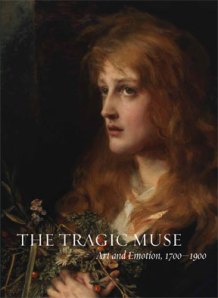 Anne Leonard with contributions by Joyce Suechen Cheng, Glenn W. Most, Erin Nerstad, Sarah Nooter, and Thomas Pavel, The Tragic Muse: Art and Emotion, 1700-1900, exhibition catalogue (Chicago: Smart Museum of Art, 2011), 128 pages, ISBN: 9780935573497, $30.
Published to coincide with the Smart Museum of Art’s exhibition The Tragic Muse, the publication draws on the work of several distinguished scholars to examine the richly varied representation of tragedy in the European artistic tradition over the course of two centuries. This catalogue is generously illustrated with full-color reproductions of all the works contained in the exhibition, and the fascinating contributions offer new insights into the approaches taken by the visual arts, as well as literature and drama, in expressing and eliciting strong emotions.










 Enfilade
leave a comment