Exhibition of Boxes at The Met
Press release from The Met:
Thinking Outside the Box: European Cabinets, Caskets, and Cases from the Permanent Collection
The Metropolitan Museum of Art, New York, 7 December 2010 — 21 August 2011
Organized by Daniëlle O. Kisluk-Grosheide

James Cox, Nécessaire, ca. 1770–72. Case: moss agate, mounted in gold and set with diamonds, rubies, and emeralds; silver; Dial: white enamel, with frame pavé-set with paste jewels (NY: Metropolitan Museum of Art) Gift of Mrs. Florence Schlubach, 1957 (57.128a–o).
Thinking Outside the Box: European Cabinets, Caskets, and Cases from the Permanent Collection (1500–1900) will feature 100 works selected from the Metropolitan Museum of Art’s Department of European Sculpture and Decorative Arts. The objects featured in this installation will range from strongboxes to travel cases and from containers for tea or tobacco to storage boxes for toiletries or silverware. These lidded pieces, some of which have not been on display for many years, are made in a large variety of shapes and sizes, and of many different materials, and were created by mostly unknown artists, craftsmen, and amateurs. Viewed together, these works reflect changes in social customs as well as the evolution of styles over four centuries. Many are precious works of art that were collected in their own right.
The objects in Thinking Outside the Box will be displayed according to the materials they are made of or embellished with, including tortoiseshell, carved or veneered wood, porcelain, hard stones and natural substances, embroidery, various metals, leather, enamel, pastiglia, and straw. Craftsmen ranging from silversmiths to furniture makers and from metalworkers to enamellers created the boxes, which are utilitarian in nature and were used either for the shipping of goods or the safekeeping of specific objects or ingredients. Boxes were also exchanged as presents—valuable snuffboxes mounted with diamonds and other precious stones often served as diplomatic gifts, and Italian white lead pastiglia caskets, scented with musk and civet, and thought to have aphrodisiacal qualities, were deemed suitable as bridal presents.
Although it is not always possible to determine what each object was originally meant to contain—such as the 16th–century Italian cases made of boiled, embossed, and tooled leather (cuir bouilli)—it has become clear that many of the elaborately wrought boxes played a role in the dressing rituals of the past. The desire to keep various beautifying implements together goes back to ancient Egypt and led to the creation of special chests. Since the 16th century, the daily grooming ritual known as the toilette (from the toile or cloth spread on the table during the various dressing activities) was taken very seriously and formed, in fact, a kind of semi-public ceremony. The importance of this custom was expressed in the creation of costly toilette services comprising numerous matching pieces, including a variety of boxes and caskets. Exquisite examples of necessaries, small travel cases containing objects deemed necessary for toilette, writing, or needlework or a combination of these three, will be on view. A particularly splendid example—the 18th–century English nécessaire by James Cox, made of moss agate mounted in gold and set with diamonds, rubies, and emeralds—not only includes dressing implements, but also a clock and automaton, and was probably intended for export to India.
These personal objects are fascinating not only for their shape and decoration but for the treasures and possible secrets they may contain.
◊ ◊ ◊ ◊ ◊
Sunday at the Met Lecture Series—Thinking Outside the Box
The Metropolitan Museum of Art, New York, 27 February 2011
Boxes, caskets, cabinets, and chests played an important role in everyday life in Europe and were frequently much more than simple receptacles. This program, presented in conjunction with the installation Thinking Outside the Box: European Cabinets, Caskets, and Cases from the Permanent Collection (1500–1900), explores how the objects’ form and decoration reflected changes in different social customs and manners as well as the latest stylistic developments in Europe. It concludes with music performed on cabinet organs, hidden keyboards, and not-so-ancient voice boxes. Free with Museum admission, in the Grace Rainey Rogers Auditorium.
- 2:oo Danielle O. Kisluk-Grosheide (curator, Department of European Sculpture and Decorative Arts, MMA), Thinking Outside the Box: Placing European Cabinets, Caskets, and Cases in Context
- 2:45 Charles Truman (art historian and independent scholar, London), The Eighteenth-Century Gold Box: The Ultimate Fashion Accessory and a Microcosm of All the Arts
- 3:30 ARTEK, Gwendolyn Toth (director and keyboards), Jukeboxes of Old: Music from Past Centuries
Exhibition: Porcelain from Augustus the Strong’s Japanese Palace
From the Philadelphia Museum of Art:
A Royal Passion: Meissen and Asian Porcelain from Augustus the Strong’s Japanese Palace
Philadelphia Museum of Art, 18 December 2010 — 3 April 2011
Curated by Donna Corbin
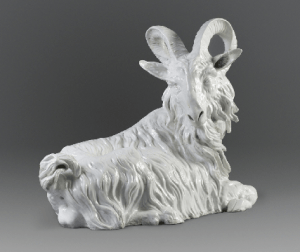
"Figure of a Goat," ca. 1733, original modeled by Johann Joachim Kändler, hard-paste porcelain, 21 3/4 x 28 x 13 3/4 inches (Philadelphia Museum of Art)
In 1717, Augustus II, Elector of Saxony and King of Poland, known as “Augustus the Strong,” acquired a small palace on the right bank of the Elbe River in Dresden. He later enlarged the building and created what was essentially a “porcelain palace.” What became known as the Japanese Palace housed Augustus’s extensive collection of Asian ceramics—which numbered some 20,000 pieces—along with the products of the porcelain factory founded by his official decree in Meissen, near Dresden, in 1710. Within a decade, and after much experimentation, the Meissen factory became the first commercially viable European factory to produce a type of high-fired porcelain that closely resembled much-coveted Chinese and Japanese wares. In the scheme for the interior of the palace, the rooms on the second floor were reserved for the Meissen porcelain. The most spectacular display was a large gallery exhibiting a menagerie of life-size and near-life-size birds and animals made in porcelain. Orders and delivery began in 1730 for the projected 292 figures depicting thirty-two different birds and 296 figures representing thirty-seven other animals of domestic, exotic, and fantastic origin. Creation of the figures continued until 1736, some three years after Augustus’s death. While never completed, the project remains one of the outstanding artistic achievements of the eighteenth century. A Royal Passion, which celebrates the 300th anniversary of the founding of the Meissen factory, features nineteen pieces of porcelain from the Japanese Palace collection and highlights a pair of goats from the Museum’s permanent collection that was originally intended for Augustus’s porcelain menagerie.
Goya’s ‘Los Caprichos’ at The Taft in Cincinnati
From The Taft’s website:
Francisco Goya: Los Caprichos
The Taft Museum of Art, Cincinnati, 4 December 2010 — 30 January 2011

Francisco José de Goya, "And So Was His Grandfather." ("Caprichos, no. 39: Asta su abuelo."), 1796–1797, aquatint, 1799.
For those who feel a secret empathy with Scrooge and the Grinch, the Taft offers an antidote to Yuletide’s good cheer this winter. The full set of Francisco Goya’s 80 haunting images from Los Caprichos (“The Whims” or “The Fantasies,” published in 1799) confront human hypocrisy, pretense, fear, and irrationality, picturing them in every conceivable form. Goya’s singularly original visions of monsters, specters, corpses, and other bitter or callous beings enact challenges to authority of all kinds, including that of the church and state. Los Caprichos are likely the great Spanish artist’s most influential works and continue to inspire artists to this day. As both prints and images, they are decades ahead of their time. In them, Goya pioneered astonishingly innovative etching techniques, visual forms, and artistic themes, anticipating the later movements known as Realism, Post-Impressionism, Symbolism, and Surrealism. The etchings on view are from an early first edition, one of four sets acquired directly from Goya, and belong now to an American private collector. The exhibition is organized by Landau Traveling Exhibitions. Goya (1746–1826) is one of the world’s greatest artists, as famous for portraits that seemingly penetrate his sitters’ souls as he is for portrayals of the brutality of
the Napoleonic Wars in Spain (1808–14). The Taft Museum of Art owns an
important oil portrait by Goya, Queen Maria Luisa of Spain, of about 1800.
◊ ◊ ◊ ◊ ◊

Edited by Janis Tomlinson (New Haven: Yale University Press, 2002), ISBN: 9780300094930, $75
Janis Tomlinson, “The Changing Face of Women in Goya’s Art”
The Taft Museum of Art, Cincinnati, 27 January 2011
Throughout his career, the Spanish artist Francisco Goya (1746-1828) explored the wide-ranging roles of women in Spanish society–from good mothers to prostitutes, seductive sirens to victims of war. Dr. Janis Tomlinson will explore the changing face of women in Goya’s paintings and prints, with special emphasis on their portrayal in the etchings of Los Caprichos. Tomlinson is director of University Museums at the University of Delaware and has written and spoken extensively on Goya.
Reviewed: ‘The Intimate Portrait’
Recently added to caa.reviews:
Stephen Lloyd and Kim Sloan, The Intimate Portrait: Drawings, Miniatures, and Pastels from Ramsay to Lawrence, exhibition catalogue (Edinburgh and London: National Galleries of Scotland and British Museum, 2009). 272 pages, ISBN: 9781844543984, £25.
Reviewed by Robin Nicholson, Virginia Museum of Fine Arts; posted 1 December 2010.
The 2008 exhibition that this catalogue accompanied was instigated by the British Museum’s acquisition of an important drawing by Sir Thomas Lawrence, “Mary Hamilton” (1789). Cover-girl of the catalogue and an astonishing tour-de-force by the gifted nineteen-year-old artist, this work reminded authors Stephen Lloyd and Kim Sloan of just how ubiquitous miniatures and portrait drawings were in the eighteenth and nineteenth centuries—particularly at the Royal Academy—and how central they were to the contemporary debates on the purpose and significance of portraiture. As Lloyd (of the Scottish National Portrait Gallery) and Sloan (of the British Museum) admit, this publication only begins to address some of the pressing issues of the genre. Their goal is “to open up the discourse . . . looking at them as physical objects as well as symbolic ones, asking how and why they were made, commissioned, whether for pleasure or as gifts, where they were kept or hung or worn—displayed, encased or bejeweled” (9). Although it can be deemed only a partial success, the catalogue is nonetheless a beautiful, erudite, and informative publication. . . .
For the full review, click here» (CAA membership required)
Exhibition: Furniture of John Shearer
From the DAR Museum:
‘A True North Britain’: The Furniture of John Shearer, 1790-1820
Daughters of the American Revolution Museum, Washington, D.C., 8 October 2010 — 26 February 2011
Curated by Elizabeth Davison
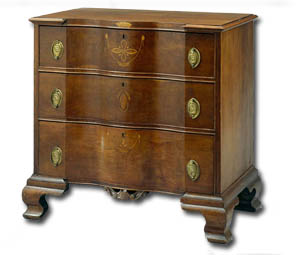 The exquisitely detailed furniture of craftsman John Shearer is showcased in the DAR Museum exhibition ‘A True North Britain’: The Furniture of John Shearer, 1790-1820, which runs from October 8, 2010, through February 26, 2011. Noted not only for its form but also for the politically charged symbols inlaid in many pieces, the furniture helps to explore early America’s cultural ties to Great Britain during the most contentious period in the two nations’ shared history.
John Shearer worked in northern Virginia and western Maryland in the late 18th and early 19th centuries. He left behind no paper trail, choosing instead to inscribe his biography and his politics directly on his furniture. While other early craftsmen were inlaying
their work with eagles to symbolize a new American government,
Shearer glorified Great Britain and its Royal Navy.
Shearer was from Edinburgh, Scotland. Like many from this region, he identified with the Kingdom of Great Britain, formed by the 1707 Treaty of Union which unified Scotland and England. Shearer touts his loyalty by signing two desks on view in this exhibition with the slogan, “A True North Britain.” On another desk, he cheers Napoleon’s downfall and Britain’s victory in the Peninsular War by depicting a crowned lion rampant (rearing on hind legs, paws raised) from the Scottish and English royal coats of arms along with the inscription “Victory Be Thine.”
Shearer documented the Royal Navy’s exploits almost like a political cartoonist. Although fine furniture was an unusual medium for these messages, 52 of his pieces survive, showing that his pro-British sentiments did not deter demand for the simple but unconventionally embellished furniture. As America formed a national identity, its cultural and political diversity included many who retained a strong sense of loyalty to Great Britain.
 Not all Shearer’s messages were meant to be seen, however. Shearer, following the age-old tradition of artist retaliating against problematic patron, hid a note inside one desk accusing his customer, a slave holder and trader, of being “the Greatest Scoundrel in Loudoun County.” This unique piece is among 20 on display in “A True North Britain.” Independent scholar Elizabeth Davison is the guest curator for this exhibition. Her book, a catalog raisonne of Shearer’s work, will be published this winter. Her expertise informs this exhibition, exploring the work of one eccentric artist to show how a diversity of cultures and loyalty was built into the foundations of our country.
◊ ◊ ◊ ◊ ◊
Elizabeth Davison, The Furniture of John Shearer, 1790-1820: A True North Britain in the Southern Backcountry (Altamira Press, 2011), 256 pages, ISBN: 978-0759119543, $90.
Exhibition: Secret Life of Drawings at The Getty
Of the thirty drawings included in the exhibition, six come from the eighteenth century. The show also addresses eighteenth-century restoration techniques. Press release from The Getty:
The Secret Life of Drawings
The Getty Center, Los Angeles, 23 November 2010 — 13 February 2011
Curated by Stephanie Schrader with Nancy Yocco
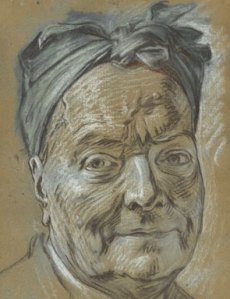
Maurice-Quentin de La Tour, "Portrait of Louis de Silvestre," black and white chalk, blue and rose pastel on faded blue paper, ca. 1753 (Los Angeles: The J. Paul Getty Museum)
Works on paper are inherently more fragile—in terms of sensitivity to light and handling—than mediums such as canvas, panel, bronze, or clay, and often show the passage of time more acutely than their counterparts. Frequent handling by artists in their workshops and later by collectors, combined with poor storage and display conditions, often leads to distracting damage. As a result of their fragility, drawings in the Getty Museum’s collection spend much of their life inside solander boxes in climate-controlled storage areas, where they’re protected from light, mold, insects, and other threats to their preservation; and, the fascinating “secrets”—of how they were made and displayed, damages they sustained, and treatments they were given—often go untold.
The Secret Life of Drawings brings together 30 drawings from the Getty’s stellar collection to explore the role played by paper conservators in reducing the effects of handling and the passage of time with treatments such as filling losses, reducing stains and mold, repairing tears, and treating white highlights that have turned black. The exhibition also reveals the secrets conservators discover, such as unknown drawings
hidden beneath mounts or watermarks that help authenticate the date of
the paper. (more…)
Portrait Exhibition at The Clark
From The Clark:
Eye to Eye: European Portraits, 1450-1850
The Sterling and Francine Clark Art Institute, Williamstown, MA, 16 January — 27 March 2011
For centuries, portraiture has captured the imagination of artists and viewers, not to say the sitters themselves. What makes a successful portrait? An accurate likeness, an indication of the sitter’s character or social status, or simply a fabulously made work of art?
Eye to Eye explores these questions through the presentation of an extraordinary collection of master portraits, dating from the late fifteenth century to the early nineteenth century, and featuring little-known paintings by Memling, Cranach, Parmigianino, Ribera, Rubens, Van Dyck, Greuze, and David, among others. This exhibition will be shown exclusively at the Clark.
Fall of 2011: Stubbs at The Neue Pinakothek
From the museum’s website:
George Stubbs
Neue Pinakothek, Munich, 15 October 2011 — 15 January 2012
The English animal painter George Stubbs (1724-1806) is the most prominent representative of so-called ‘sporting art’ that reached its peak in the 18th century as a result of the growing enthusiasm for horse breeding, racing and hunting, as an occupation for the prosperous upper classes. His work largely comprises portraits of thoroughbreds and their jockeys, of dogs and hunting scenes. With his subtly balanced and sometimes bold compositions Stubbs developed a classical style using subjects derived entirely from contemporary life.
In the Anglo-Saxon world, George Stubbs has long been regarded as one of the greatest artists of his time and, alongside William Hogarth and Thomas Gainsborough, as the most important artist of the 18th century. The Neue Pinakothek, which has a first-rate collection of English painting from the 18th and 19th centuries and boasts the only painting by George Stubbs in Germany, is staging the first exhibition on this artist to be held on the Continent. A selection of thirty paintings, mostly from collections in England, will be complemented by drawings and prints that underline the artist’s far-reaching influence in the field of animal painting in France and Germany.
Small Exhibition at the V&A: Huguenot Silver
From the V&A:
Sacred Silver for London’s Huguenot Communities
Victoria & Albert Museum, London, 3 November 2010 — 2 October 2011
This display of sacred silver from Huguenot churches dating from 1717 to 1898 includes a Communion flagon presented for use in the French Hospital chapel, Victoria Park, Hackney in 1867. Made by Barnards, its sale is recorded in their London business archive recently saved for the V&A. The silver is lent by the French Hospital, Rochester, Kent which provides sheltered housing for elderly people of Huguenot descent.
French Drawings from the National Gallery of Scotland
Press release from The Wallace:
Poussin to Seurat: French Drawings from the National Gallery of Scotland
The Wallace Collection, London, 23 September 2010 — 3 January 2011
The National Gallery of Scotland, Edinburgh, 5 February — 1 May 2011

Catalogue by Michael Clarke, 144 pages, ISBN: 9781906270315, $25
This exhibition is the latest in an ongoing series mounted by the Wallace Collection which features selections from celebrated collections of French drawings. The holdings of French paintings in the National Gallery of Scotland are world famous and include magnificent examples by Claude, Poussin, Watteau, Greuze and many of the Impressionists and Post-Impressionists. Not so well-known, however, is the Gallery’s complementary collection of French drawings. This has been deliberately strengthened over the past thirty years to build on the existing core of fine drawings, many of which came to the Gallery, via the Royal Scottish Academy, from the collection of the Edinburgh bookseller and antiquarian David Laing (1793-1878). Of the more familiar names who have recently entered the collection mention can be made of Poussin, Boucher, Ingres, Corot, Pissarro and Seurat. These acquisitions have been complemented by excellent sheets by lesser-known masters such as Jeaurat, Lancrenon, Hesse and Dulac – thereby ensuring a mix of the familiar and less familiar.
In subject-matter, the exhibition ranges from the courtly art of Fontainebleau in the sixteenth century to the more down-to-earth imagery of the Realists and Impressionists in the nineteenth century. There are preparatory drawings for tapestries and for ambitious Salon pictures, as well as figure studies made in the studio or landscape sketches inspired by study in the open air. Two artist-writers also feature in the selection – Eugène Fromentin, whose most celebrated text is probably Les maîtres d’autrefois, and the novelist George Sand, whose extraordinary invented landscape watercolours anticipate the work of Surrealists such as Max Ernst in the twentieth century.
The selection made for this exhibition, which will also be shown in Edinburgh, has deliberately been chosen so as to relate to the holdings of the Wallace Collection. Accordingly there are drawings by Claude, Watteau, Scheffer, Decamps and Delaroche – masters who are particularly associated with the collecting of Lord Hertford and Sir Richard Wallace. The most celebrated linkage, however, occurs with the inclusion of Poussin’s exceptional preparatory drawing for one of the greatest paintings in the Wallace Collection, the Dance to the Music of Time, the title of which was taken by Anthony Powell for his celebrated series of novels.
◊ ◊ ◊ ◊ ◊
Writing in The Financial Times (24 September 2010), Emma Crichton-Miller explores the growth of the collection in an interview with Michael Clarke, the director of the National Gallery of Scotland. The article is available here»










 Enfilade
leave a comment