Small Exhibition at the V&A: Huguenot Silver
From the V&A:
Sacred Silver for London’s Huguenot Communities
Victoria & Albert Museum, London, 3 November 2010 — 2 October 2011
This display of sacred silver from Huguenot churches dating from 1717 to 1898 includes a Communion flagon presented for use in the French Hospital chapel, Victoria Park, Hackney in 1867. Made by Barnards, its sale is recorded in their London business archive recently saved for the V&A. The silver is lent by the French Hospital, Rochester, Kent which provides sheltered housing for elderly people of Huguenot descent.
French Drawings from the National Gallery of Scotland
Press release from The Wallace:
Poussin to Seurat: French Drawings from the National Gallery of Scotland
The Wallace Collection, London, 23 September 2010 — 3 January 2011
The National Gallery of Scotland, Edinburgh, 5 February — 1 May 2011

Catalogue by Michael Clarke, 144 pages, ISBN: 9781906270315, $25
This exhibition is the latest in an ongoing series mounted by the Wallace Collection which features selections from celebrated collections of French drawings. The holdings of French paintings in the National Gallery of Scotland are world famous and include magnificent examples by Claude, Poussin, Watteau, Greuze and many of the Impressionists and Post-Impressionists. Not so well-known, however, is the Gallery’s complementary collection of French drawings. This has been deliberately strengthened over the past thirty years to build on the existing core of fine drawings, many of which came to the Gallery, via the Royal Scottish Academy, from the collection of the Edinburgh bookseller and antiquarian David Laing (1793-1878). Of the more familiar names who have recently entered the collection mention can be made of Poussin, Boucher, Ingres, Corot, Pissarro and Seurat. These acquisitions have been complemented by excellent sheets by lesser-known masters such as Jeaurat, Lancrenon, Hesse and Dulac – thereby ensuring a mix of the familiar and less familiar.
In subject-matter, the exhibition ranges from the courtly art of Fontainebleau in the sixteenth century to the more down-to-earth imagery of the Realists and Impressionists in the nineteenth century. There are preparatory drawings for tapestries and for ambitious Salon pictures, as well as figure studies made in the studio or landscape sketches inspired by study in the open air. Two artist-writers also feature in the selection – Eugène Fromentin, whose most celebrated text is probably Les maîtres d’autrefois, and the novelist George Sand, whose extraordinary invented landscape watercolours anticipate the work of Surrealists such as Max Ernst in the twentieth century.
The selection made for this exhibition, which will also be shown in Edinburgh, has deliberately been chosen so as to relate to the holdings of the Wallace Collection. Accordingly there are drawings by Claude, Watteau, Scheffer, Decamps and Delaroche – masters who are particularly associated with the collecting of Lord Hertford and Sir Richard Wallace. The most celebrated linkage, however, occurs with the inclusion of Poussin’s exceptional preparatory drawing for one of the greatest paintings in the Wallace Collection, the Dance to the Music of Time, the title of which was taken by Anthony Powell for his celebrated series of novels.
◊ ◊ ◊ ◊ ◊
Writing in The Financial Times (24 September 2010), Emma Crichton-Miller explores the growth of the collection in an interview with Michael Clarke, the director of the National Gallery of Scotland. The article is available here»
Exhibition to Recreate a Day in the Life of a Parisian Townhouse
Press release from the Getty:

Paris: Life & Luxury
J. Paul Getty Museum, Los Angeles, 26 April — 7 August 2011
Museum of Fine Arts, Houston, 18 September — 10 December 2011
Curated by Charissa Bremer-David with Peter Björn Kerber
The nation of France, and its capital city of Paris in particular, held a special status in European culture during the 18th century. The upper echelons of societies throughout Europe were predominantly Francophiles—imitating French fashions of dress and furniture in their daily lives. On view in the Exhibitions Pavilion at the J. Paul Getty Museum at the Getty Center, April 26 through August 7, 2011, Paris: Life & Luxury re-imagines, through art and material culture, the complex and nuanced lifestyle of elite 18th-century Parisians who made their city the fashionable and cultural epicenter of Europe.

ISBN: 978-1606060520, $45
Inspired by the Getty Museum’s extensive French decorative arts collection and the correspondingly strong holdings of French illustrated books in the Getty Research Institute, Paris: Life & Luxury will provide a rich cultural and historical experience that closely mirrors daily life in 18th-century France. Bringing together approximately 160 objects, roughly half of which will be on loan from twenty-six museums and private collections around the world, the exhibition will include a wide range of paintings, sculpture, applied arts, drawings, metalwork, furniture, architectural fittings, lighting and hearth fixtures, scientific and musical instruments, clocks and watches, textiles and dress, books, and maps.
David Bomford, acting director of the J. Paul Getty Museum said, “Paris: Life & Luxury will transport visitors back to Paris in the mid-1700s. More than celebrating the period or perpetuating the mythology of its charm and gallantry, this exhibition re-imagines the varied and complex range of values and practices of the city’s elite within a rich material context.”
Charissa Bremer-David, curator of sculpture and decorative arts at the J. Paul Getty Museum and the exhibition’s co-curator added, “The exhibition will be a rich and deep sensory experience, engaging the viewer’s initial attention with the compelling visual appeal of superlative and virtuoso works of art. From this breadth and diversity, visitors will learn generally about the contributions of the French, and in particular the Parisian, to the visual and performing arts, language, literature, history, science, and even culinary arts during this time period—in short, about their major contribution to the humanities at large.”
Following a structure based on the traditional visual allegories of the Four Times of Day, the objects in the exhibition are grouped according to their associations with common activities as pursued in the chronology of a single day, from morning to night. As such, objects of diverse mediums are juxtaposed, as they would have been within an 18th-century Parisian domestic setting, regardless of modern museological or academic categories. Through constellations of art and related artifacts, the exhibition follows the conventional activities in the cycle of a Parisian day, such as dressing, writing, collecting, eating, and evening entertainment—allowing visitors to envision the activities and accessories of quotidian life, in order to find resonances with their own daily lives. (more…)
Exhibition: Preaching in the Seventeenth and Eighteenth Centuries
A center of Jansenism in the seventeenth century, the schools at Port-Royal des Champs were closed in 1660. The nuns of the convent were turned out in 1709, and most of the buildings were then razed. Today the museum hosts various concerts and exhibitions. From the museum’s website:
Representer la Prédication aux XVIIe et XVIIIe Siècles
Musée National de Port-Royal des Champs, 15 September — 13 December 2010

Jean-Bernard Restout (1732–97), "John the Baptist Preaching in the Desert," Musée du Louvre © RMN / Thierry Le Mage
Figure issue du Moyen-âge, le prédicateur est celui qui est chargé de diffuser la parole de Dieu pour le compte de l’Église. A partir du XVIe siècle, l’élan missionnaire mêle intimement instruction des fidèles, conversion des Protestants et évangélisation des terres nouvellement découvertes. Les ordres les plus actifs de la Réforme catholique, comme les Jésuites (fondés en 1540 par Ignace de Loyola), les Oratoriens (fondés en 1611 par Pierre de Bérulle) ou les Lazaristes (fondés en 1625 par Vincent de Paul), participent aux missions lointaines comme intérieures. L’importance de la prédication dans l’Église occidentale à l’époque des réformes marque l’art religieux de l’Europe aux XVIIe et XVIIIe siècles.
Les missionnaires prennent les fondateurs de leur Ordre comme modèles, et l’iconographie les montrent devant la foule des fidèles, aux portes d’une église comme pour la Prédication de François de Sales d’Eustache Le Sueur, ou plus généralement dans un paysage, comme pour la Prédication de Vincent de Paul d’Aureliano Milani. (more…)
Exibition: Courtly Ephemera in Paris
From the INHA website:
Chroniques de l’éphémère: Le livre de fête dans la collection Jacques Doucet
Institut national d’histoire de l’art, Paris, 15 September — 15 December 2010

Charles Nicolas Cochin, "The Funeral of Catherine Opalińska in Notre Dame de Paris," 1747
Dès la Renaissance, fêtes et cérémonies de cour ont donné lieu à la production de livres et d’estampes : décrire l’événement, le commémorer, exalter la majesté du prince, telles sont les fonctions de ces publications, des plus modestes aux plus luxueuses. L’illustration des grandes fêtes des cours européennes, par le livre, le texte et l’image, la diffusion de formes artistiques codifiées, expriment à l’époque moderne un jeu subtil entre l’art et le pouvoir.
À travers cette exposition, la Bibliothèque de l’INHA, riche de plus d’un millier de livres de fête, issus des collections exceptionnelles constituées par Jacques Doucet, propose un parcours illustrant la mise en livre de fêtes organisées à Paris et à Versailles aux XVIIe et XVIIIe siècles. Divers événements donnant lieu à la fête – des naissances princières aux pompes funèbres – sont évoqués, ainsi que les mises en scène qui peuvent y être associées : feux d’artifices, carrousels, ballets (tel que Le Ballet des singes et des autruches), représentations théâtrales…
Courts programmes, livrets explicatifs, brochures, placards, pamphlets, ou luxueux ouvrages commémoratifs, les livres de fête se présentent sous diverses formes, aux fonctions et publics différents. Les plus somptueux d’entre eux, objets d’art prestigieux, sont destinés à diffuser largement l’image de la grandeur monarchique auprès du public français, mais aussi des cours étrangères. Souvent illustrés par les dessinateurs de la Chambre et du Cabinet du Roi, comme le Carrousel des galans Maures de Jean Berain (1685), ces livres mettent particulièrement en valeur le rôle des institutions monarchiques, comme l’administration des Menus Plaisirs, dans la production et la diffusion du livre, élément parmi d’autres de la propagande et du mécénat royal.
Enfin, les traités de fête établissent des règles, mais aussi un répertoire européen de fêtes, dans lequel puisent artistes et érudits pour offrir au spectateur, courtisan, ambassadeur ou simple badaud, des spectacles grandioses, portraits de la puissance du souverain auxquels ils sont dédiés.
Exhibition: Rowlandson on Pleasures and Pursuits
From The Block Museum:
Thomas Rowlandson: Pleasures and Pursuits in Georgian England
The Mary and Leigh Block Museum of Art, Northwestern University, Evanston, IL, 14 January — 13 March 2011
The Frances Lehman Loeb Art Center, Vassar College, Poughkeepsie, NY, 8 April — 11 June 2011
Curated by Patricia Phagan
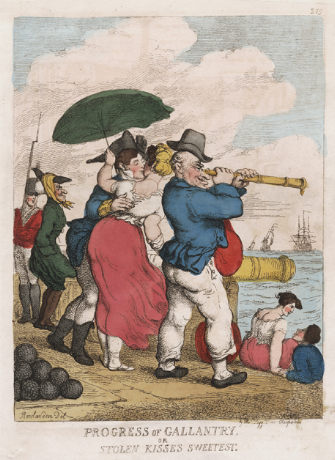
Thomas Rowlandson, “Progress of Gallantry, or Stolen Kisses Sweetest,” 1814, etching with stipple, in black ink with watercolor on cream wove paper (Yale University: Lewis Walpole Library)
Artist Thomas Rowlandson (1757–1827) depicted high society and politics, encounters on the street, camaraderie in clubs and taverns, outdoor entertainments, musings about art, drama, and dance, and romantic and sexual tangles. In other words, the social life of Georgian England. One of the most popular caricaturists of his time, Rowlandson’s work was noted for lighthearted, deft humor and the unmatched flowing line of his drawing.
Organized by the Frances Lehman Loeb Art Center at Vassar College, Thomas Rowlandson: Pleasures and Pursuits in Georgian England presents more than 70 of the artist’s prints, drawings, watercolors, and illustrated books. The exhibition is curated by Patricia Phagan, the Philip and Lynn Straus Curator of Prints and Drawings at the Frances Lehman Loeb Art Center. The first major exhibition of Rowlandson’s work in the United States in 20 years, it will be accompanied by a full-color 184-page catalogue.
◊ ◊ ◊ ◊ ◊
Description of the catalogue, from the publisher’s website:
Patricia Phagan, Vic Gatrell, and Amelia Rauser, Thomas Rowlandson: Pleasures and Pursuits in Georgian England (London: D. Giles Limited, 2011), 184 pages, ISBN: 9781904832782.
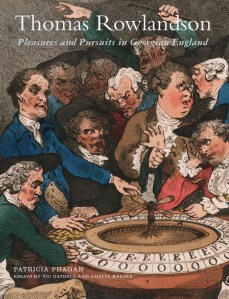 Thomas Rowlandson: Pleasures and Pursuits in Georgian England is a completely new illustrated volume which presents 72 watercolours, drawings, prints, and illustrated books to reassess the legacy of this renowned 18th-century satirist. Published in February 2011 by D. Giles Limited in association with the Frances Lehman Loeb Art Center, it accompanies the first major exhibition of Rowlandson’s work in North America for 20 years, and reflects the growing emphasis on the social and political context of the satirical art of the 18th- and early 19th-centuries. In so doing, it rescues Rowlandson from what co-author Vic Gatrell calls “the immense condescension of posterity.” This catalogue explores Rowlandson’s unique perspective on Georgian social life, and the crossing of class boundaries.
With heavy-handed humour and a low subject matter, the work of Thomas Rowlandson (1757–1827) provides an invaluable insight into the workings and mentality of late Georgian society. He was quite simply a product of his times, who relished recording the street life of London and whose drawings and etchings reveal an attraction to repulsive visions of wickedness and hardship, whilst maintaining a high degree of humanity. (more…)
Exhibition: Samplers at Boston’s MFA
From the MFA website:
Embroideries of Colonial Boston: Samplers
Museum of Fine Arts, Boston, 20 November 2010 — 13 March 2011
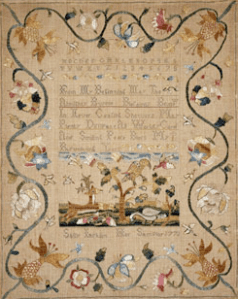 The embroideries of colonial Boston girls and women have long been treasured family possessions and are now much sought after by collectors. The charm and craftsmanship of the Adam and Eve samplers, pastoral pictures with leaping stags and galloping hunters, as well as crewelwork bed hangings and delicately embroidered baby caps bring to mind a warm domesticity; however, as a group they also reveal much about the lives of Boston women and their role within colonial society.
The first of three exhibitions in the Edward and Nancy Roberts Family Gallery in the new wing for Art of the Americas, “Embroideries of Colonial Boston: Samplers” demonstrates the role these schoolgirl exercises played in educating Boston’s genteel young women. The use of samplers was common in Europe, and when the first colonists to New England arrived they brought their samplers with them to help educate their children.
The exhibition will feature a pair of 17th-century samplers brought to Boston as well as two 17th-century American examples clearly illustrating the connection between Great Britain and the colonies. During the 18th century, samplers evolved from their original format as collections of embroidery stitches and designs into more pictorial works that could be proudly hung in the family home. Distinctive sampler styles developed throughout Boston that can be associated with specific neighborhoods. The exhibition will feature many of these styles, including Boston’s most famous samplers—those including the depiction of Adam and Eve at the bottom that were woven by girls from the North End of the city.
Exhibition: Drawings at the Art Institute
The current exhibition of drawings at the Art Institute includes works by Charles de la Fosse, Charles-Antoine Coypel, Panini, Canaletto, Tiepolo, Guardi, Gaetano Gandolfi, Fragonard, Jean-Baptiste Isabey, David, and Ingres. From the museum’s website:
Gray Collection: Seven Centuries of Art
The Art Institute of Chicago, 25 September 2010 — 2 January 2011
Curated by Suzanne Folds McCullagh
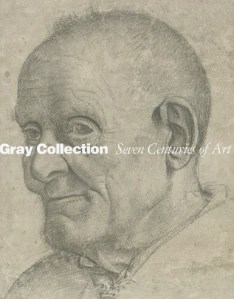 One of America’s foremost art dealers, Richard Gray, and his wife, art historian and author Mary Lackritz Gray, have gathered an unparalleled collection of paintings, drawings, and sculpture spanning the 15th century to the present. This exhibition features more than 120 of the couple’s most dynamic and important works on paper, including Renaissance- and Baroque-era treasures by Guercino, Tiepolo, and Rubens; 19th-century works by masters such as Delacroix, Degas, and Seurat; and stellar examples by acclaimed 20th-century artists Picasso, Matisse, and Miró.
Lifelong Chicagoans deeply involved in the cultural life of city, the Grays have devoted more than half a century—both privately and professionally—to pursuits associated with the visual arts. Their first work on paper was a Paul Klee lithograph received as a wedding present in 1953; ten years later, Richard founded the Richard Gray Gallery, exposing the couple to a much more encyclopedic view of art as he helped major museums and private individuals form collections of real substance and quality. At the same time, the Grays acquired works for their own collection without any specific program, discovering the various pleasures of looking at and living with drawings. This highly personal collection has been shaped by Richard’s informed eye as a dealer—his intuitive sense, willingness to take risks and respond to opportunities—and Mary’s historical and contextual approach enriched by her graduate degree in art history. As the reach of their collecting interests in more recent years extended back in time from the modern and contemporary masters they knew so well, the art of drawing has offered a quality of instantaneity, a means to maintain contact with artistic genius across the centuries. The varied, individually important works collectively combine to create a rich and resonant survey of some of the most accomplished draftsmen of the ages. (more…)
Exhibition: Science at Versailles
From the Palace of Versailles:
Sciences and Curiosities at the the Court of Versailles
Château de Versailles, 26 October 2010 — 27 February 2011
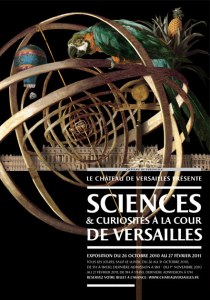 This exhibition reveals a new, unexpected face of Versailles as a place of scientific inquiry in its most various forms: the Hall of Mirrors electricity experiment, Marley Machine on the banks of the Seine, burning mirror solar power demonstration, etc. It brings together works and instruments from the old royal collections, spectacular achievements of beauty and intelligence, for the first time.
Versailles is the place where control over science was exercised. At the urging of Jean-Baptiste Colbert, Louis XIV’s “prime minister,” the royal authority became aware of the benefits of scientific research. In 1666 Colbert founded the Academy of Science, establishing a new contract between the government and scientists. Many “natural philosophers,” as they were known at the time, including some of the most famous, assiduously frequented the Court as physicians, army engineers, tutors, etc. The physicists Benjamin Franklin and Abbot Nollet compared their theories in front of the king and the encyclopaedists Diderot and D’Alembert met in the office of Dr. Quesnay, physician to Madame de Pompadour, Louis XV’s favourite. Some courtiers were real experts.
The Château de Versailles offered many research resources. Anatomists and zoologists could study the menagerie’s ostriches, pelicans, rhinoceroses and other rare animals, botanists and agronomists the plants on the grounds of the Trianon and “hippiatrists,” the forerunners to veterinarians, the horses in the Grand Stables. Educators developed new teaching methods using cutting-edge tools for the royal children and the kings’ personal practice. While Louis XIV considered himself a protector of the arts and sciences without practicing them, his successors, Louis XV and Louis XVI, became true connoisseurs. A presentation to the king or demonstration before the Court was the highest honour, equivalent to winning a Nobel Prize. Many people know about the first hot-air balloon flight, but numerous other events have fallen into oblivion, such as the burning mirror demonstration in front of Louis XIV or the electricity experiment in the Hall of Mirrors under his successor’s reign. The mosaic of places, people and events that Science and Curiosities at the Court of Versailles presents must be perceived not as a conclusion but as a stepping-stone to further research.
Engraved Portraits on Display in Moscow
From the State Historical Museum website:
Russian Portrait Engravings of the 18th Century
State Historical Museum, Moscow, 6 October — 21 November 2010
For the first time the richest and little-known Museum’s collection of engraved portraits is exhibited. Two hundred works executed by the best Russian and foreign masters permit visitors to see the whole variety of Russian portraits — equestrian, child’s, full-length, and half-length. At the exhibition there are engraved portraits of the epochs of Peter the Great, Empress Anna, Empress Elizabeth, Catherine the Great, and Paul I. Among the exhibits there are unique prints and copper plates. Engraved portrait is a bright phenomenon of Russia’s artistic culture; at the same time it is an invaluable historical source of images of famous Russians of the 18th century: imperial, statesmen, military leaders, court nobility, men of letters, and scientists.










 Enfilade
leave a comment