Eighteenth-Century Season at the Louvre: Now and Upcoming
Saison XVIIIe au Louvre
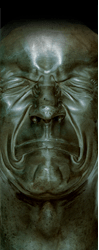
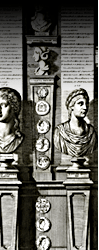 In Paris, there has recently been a grand revival of some canonical French artists and historical periods of art including exhibitions on Claude Monet at the Grand Palais and Musée Marmottan and one on France 1500, re-emphasizing European traditions for better or for worse. The Louvre has also decided to return to its own classical heritage staging a series of four small exhibitions centered around the eighteenth century:
- Musée de papier, L’Antiquité en livres, 1600-1800 (opened September 25)
- Le Louvre au temps des Lumières
- L’Antiquité rêvée
- Franz Xaver Messerschmidt
A special website for the current show on paper museums features pop-up interactive dialogue boxes with detailed information on highlighted drawings, book plates, and other materials in the exhibitions, some of which are taken from the Jacques Doucet Collections at the INHA and the Bibliothèque Nationale de France. -JF.
‘Fashioning Fashion’ Exhibition in Los Angeles
From the LACMA website:
Fashioning Fashion: European Dress in Detail, 1700-1915
Los Angeles County Museum of Art, 2 October 2010 — 6 March 2011
Curated by Sharon Takeda and Kaye Spilker

Vest, France, 1789-94, Photo © 2010 LACMA

Man’s Suit, France, ca. 1760, Photo © 2010 LACMA
Fashioning Fashion: European Dress in Detail, 1700-1915 celebrates the museum’s groundbreaking acquisition of a major collection of European men’s, women’s, and children’s garments and accessories.The exhibition tells the story of fashion’s aesthetic and technical development from the Age of Enlightenment to World War I. It examines sweeping changes in fashionable dress spanning a period of over two hundred years, and evolutions in luxurious textiles, exacting tailoring techniques, and lush trimmings.
Highlights include an eighteenth-century man’s vest intricately embroidered with powerful symbolic messages relevant to the French Revolution; an evening mantle with silk embroidery, glass beads, and ostrich feathers designed by French couturier Émile
Pingat (active 1860-96); and spectacular three-piece
suits and gowns worn at the royal courts of Europe.
◊ ◊ ◊ ◊ ◊
Fashioning Fashion: European Dress in Detail, 1700-1915, by Sharon Takeda, Kaye Spilker and Kimberly Chrisman-Campbell, preface by John Galliano (Prestel, 2010), ISBN: 978-3791350622 $55.
 Luxurious textiles, exacting tailoring, and lush trimmings abound in this glorious volume that celebrates the Fashioning Fashion: European Dress in Detail, 1700-1915 exhibition at LACMA. Fashion is in the details. Textiles, tailoring, and trimmings all work together in the creation of the finest pieces. Drawing on the Los Angeles County Museum of Art’s internationally known fashion collection, this gorgeous book tells the story–in words and beautiful pictures–of fashion’s aesthetic and technical development from the Age of Enlightenment to World War I, a period when fashionable dress underwent sweeping changes. Many remarkable examples of men’s, women’s, and children’s garments are featured here for the first time, including an extraordinarily rare 1790s man’s vest designed to promote sympathy with the French Revolution; a stunning 1845 black satin gown from the royal court of Portugal heavily embroidered with gold; and an 1891 evening mantle with silk embroidery, glass beads, and ostrich feathers designed by French couturier Aemile Pingat. An invaluable resource for anyone interested in the evolution of fashion, this generously illustrated book provides a rich visual history of the changes that occurred in fashionable dress spanning a period of more than two hundred years.
Sharon Sadako Takeda is the Senior Curator and Head, Costume and Textiles Department, Los Angeles County Museum of Art. Kaye Durland Spilker is Curator, Costume and Textiles Department, Los Angeles County Museum of Art. John Galliano, one of the most influential fashion designers of our time, is the chief designer of the haute couture house Christian Dior. Kimberly Chrisman-Campbell is a fashion-research scholar who writes and reviews books and exhibitions for Dress, Costume, and Woman’s Art Journal.
‘Eye for the Sensual’ in Los Angeles
Press release from LACMA:
Eye for the Sensual: Selections from the Resnick Collection
Los Angeles County Museum of Art, 2 October 2010 — 2 January 2011
Curated by J. Patrice Marandel and Bernard Jazzar
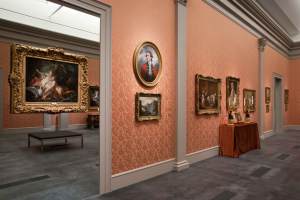
Photo © 2010 Museum Associates/LACMA
The Los Angeles County Museum of Art (LACMA) presents Eye for the Sensual: Selections from the Resnick Collection, which features more than 100 paintings, sculptures, and decorative arts from the collection of Lynda and Stewart Resnick, long-time patrons of the museum. Since the early 1980s, the Resnicks have collected in many areas ranging from European to American and modern art. This exhibition reflects their interest in European painting, sculpture, and decorative arts from the sixteenth to the early twentieth century. Eye for the Sensual is one of three inaugural exhibitions to open the new Lynda and Stewart Resnick Exhibition Pavilion, named in honor of the Resnicks’ generous donation to LACMA’s ongoing Transformation campaign. The exhibition — designed by Pier Luigi Pizzi– beautifully illuminates the Resnicks’ broad taste and great love for collecting.

Installation of "Eye for the Sensual" at LACMA, Photo © 2010 Museum Associates/LACMA
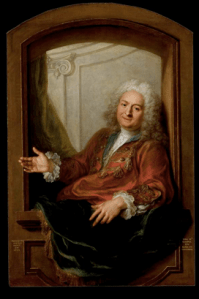
Charles-Antoine Coypel, "Portrait of Monsieur Dupillé," 1733 Photo © 2010 Museum Associates/LACMA
The Resnick collection is rich in eighteenth-century French paintings including portraits, landscapes, still lifes, and mythological scenes. François Boucher and his pupil, Jean-Honoré Fragonard, are particularly well represented with three paintings each. Two of the paintings by Boucher—both sensuous representations of Venus—were originally commissioned by the artist’s greatest patron, Madame de Pompadour, for one of her many residences. The third work, Leda and the Swan (1742), was known only through a second version at the Nationalmuseum in Stockholm before the Resnicks acquired the original. Fragonard’s paintings display the artist’s versatile talent and reveal, in turn, a world of playful eroticism, deep passion, and domestic intimacy.
The feminine aspect of the Resnick collection has often been noted: on one hand, many of the paintings’ subjects, whether allegorical or mythological, glorify the female form. On the other, numerous female artists are represented in the collection: Anne Vallayer-Coster with a still life of flowers; Elisabeth Louise Vigée Lebrun whose imposing Portrait of Marie Antoinette, Queen of France (1783), commissioned by the sitter, evokes the doomed splendor of the last days of the French monarchy; and Marguerite Gérard, who, under the guidance of her brother-in-law Fragonard, achieved fame in late eighteenth century for her portraits and genre scenes. Two of the Gérard works on view are small, intimate portraits of sitters who belonged to the artist’s enlightened circle of friends. A larger genre scene shows a female artist in her studio, a personification of Gérard’s own success and social status in the changing art world of early nineteenth-century France.
The Resnick collection also includes important Italian, Flemish, Dutch, and French paintings from the seventeenth and eighteenth centuries. Francesco Guardi’s Ridotto at Palazzo Dandolo (1750s), a recent addition to the collection, is a vivid image of gambling and masquerade in eighteenth-century Venice that evokes the risqué world of Casanova. Among the Northern paintings, the vigorous Revel of Bacchus and Silenus (c. 1615) executed by Jacob Jordaens while still in his twenties exudes verve and passion, and a rare pair of decorative tondos by the little–known Dirk van der Aa reveals an unexpected aspect of late eighteenth-century Dutch painting. Two French masterpieces frame the core group of late eighteenth-century works: Simon Vouet’s dignified representation of the goddess Diana and her companions from around 1640, and Jean Auguste Dominique Ingres’s magisterial The Virgin with the Host (1860). Both paintings, in spite of being worlds apart, lend a note of pure and austere classicism to the collection.
European sculpture has been a long-standing interest of the Resnicks. The couple has assembled a collection that spans more than 400 years and includes Italian and French marble busts, English full-length neoclassical figures, French eighteenth-century terracottas, as well as bronzes dating from the Renaissance to the twentieth century. Some of the best-known sculptors in the collection include Barthélemy Prieur, Giambologna, Claude Michel (Clodion), Jean-Antoine Houdon, and Aristide Maillol.
Eye for the Sensual also includes a selection of Art Deco furniture and decorative arts, a more recent interest of the Resnicks. The couple has favored the elegant creations of such artists as Emile-Jacques Ruhlmann and Jules Leleu, as well as numerous pieces by Italian designer Gio Ponti, whose ceramic plates and vessels include depictions of the female figure in various activities. These modern touches gracefully enhance the setting and set the stage for this engaging and evocative exhibition.
Eye for the Sensual is curated by J. Patrice Marandel, LACMA’s Robert H. Ahmanson Chief Curator of European Art, and Bernard Jazzar, Curator of the Lynda and Stewart Resnick Collection. The installation for the exhibition was designed by the world-famous Studio Pier Luigi Pizzi-Massimo Pizzi Gasparon. Recognized as one of the leading designers of opera productions in the world, Pier Luigi Pizzi’s work has graced all of the great opera stages, including those of the Teatro La Fenice, Venice, and the Teatro alla Scala, Milan. Pizzi has designed many installations, such as those for the 2009 Florence Biennale and Seicento: La Peinture italienne dans les musées de France, a major exhibition of seventeenth-century Italian paintings in French museums held at the Grand Palais in 1992. The presentation for Eye for the Sensual will be the designer’s first project in Los Angeles.
◊ ◊ ◊ ◊ ◊
Eye for the Sensual: Selections from the Resnick Collection, by Pierre Rosenberg, Scott Schaefer, and Bernard Jazzar with contributions by Antonia Boström, Anne-Lise Desmas and Anne Woollett (2010), $39.95.
 Published in conjunction with the exhibition Eye for the Sensual: Selections from the Resnick Collection at LACMA, this catalog presents a selection of eighty-three European paintings and sculptures from the renowned collection of Lynda and Stewart Resnick. Comprised of Old Master paintings and sculpture from the sixteenth century to the late nineteenth, each work is discussed in a scholarly entry. The emphasis of the collection is on French eighteenth-century paintings, including works by François Boucher, Jean-Honoré Fragonard, Nicolas Lancret, Élisabeth-Louise Vigée-Lebrun, and Marguerite Gérard. Other works by Flemish and Italian masters are also included: Jacob Jordaens, Hendrick de Clerck, Francesco Albani, and Francesco Guardi. Among the sculptures represented in the Resnick collection are Renaissance works by Giambologna and Barthélemy Prieur, eighteenth-century French figures by Jean-Antoine Houdon and Clodion and Neoclassical sculpture by John Gibson and Joseph Gott. Also included are photographs illustrating the works as they are displayed in the Resnick’s magnificent home in Beverly Hills.
Anne Poulet, Director of The Frick, Announces Retirement
Press release from The Frick Collection:
Anne Poulet to Retire in September 2011

Director Anne L. Poulet (Photo: Christine A. Butler)
Margot Bogert, Chairman of The Frick Collection, announces that Director Anne L. Poulet will retire in the fall of 2011, following a remarkable tenure. “The Board of Trustees is deeply indebted to Anne Poulet for her leadership of The Frick Collection and accepts her retirement with enormous regret. Having served the institution with great distinction, commitment, and wisdom, Anne leaves the Frick—both the museum and the library—with a brilliant and multi-faceted legacy and a glowing and solid future. Principal among the long list of achievements associated with her leadership is a strong program of critically acclaimed exhibitions and publications, which provided visitors with new perspectives on artists and media represented in the collection and, in many cases, those complementary to it. Anne made remarkable acquisitions, by both purchase and gift, while maintaining an unwavering focus on the care and interpretation of the Frick’s existing holdings. Building on the strengths of the collection, she added staffing critical to the curatorial, conservation, education, and publications functions, most notably, creating an endowed position for the Frick’s first curator of decorative arts. Anne has directed a sensitive, systematic refurbishment of the 1914 mansion’s galleries and public spaces, a progression of initiatives that has often been cited as a model for museum custodianship. In the coming year, this work continues with the enclosure of the Fifth Avenue portico to create the first new gallery space added to the building in over thirty years. Under Anne Poulet, the Frick Art Reference Library has proactively pursued digitization and collection-sharing initiatives. The library’s mission to serve scholars has been enhanced by the continued development of its holdings and by the initiation of the ground-breaking creation of the Center for the History of Collecting in America. Finally, the overall health of The Frick Collection has been fortified by Anne’s successful fundraising program, through which she has fostered many avenues for support during challenging economic times. These include the formation of the Director’s Circle and a roster of fundraising events ranked highly on philanthropic and social calendars. With our supporters’ confidence in the future of the Frick at an all-time high, we owe Anne Poulet a huge debt of gratitude, knowing that as we move forward in the next year with the search for her successor, the institution is well-poised to make this transition and continue on a smooth and uncompromisingly productive path.” (more…)
Betsy Ross Exhibition at Winterthur
From the Winterthur website:
Betsy Ross: The Life behind the Legend
Winterthur Museum, Delaware, 2 October 2010 — 2 January 2011

(Henry Holt & Co., 2010) $30, ISBN: 978-0-8050-8297-5
Both iconic and controversial, Betsy Ross is one of the best known figures of the American Revolutionary era—and also the least understood. The story of Betsy Ross and the making of the first American flag was introduced to public audiences by her grandson William Canby in 1870, at a talk before the Historical Society of Pennsylvania. The legend that grew cast Betsy as a simple seamstress honored by an unexpected chance to contribute to the independence movement. But the real Elizabeth Griscom Ross Ashburn Claypoole (1752–1836) would not have recognized the Betsy Ross of popular historical imagination.
Among the early flagmakers of the rebellion, Ross also fabricated cartridge cases for American soldiers and was among the most important professional flagmakers of the new republic. She labored for more than five decades as an upholsterer, crafting chair cases and covers and curtains and blinds as well as fabricating thousands of yards of fringe and tassels.
Co-curated by Marla Miller (University of Massachusetts) and Winterthur’s Linda Eaton and Katie Knowles, this exhibition reveals the life and work of this celebrated flagmaker and upholsterer and looks at how the legend began.
Exhibition on George Washington Now in Raleigh
Washington’s dentures coming to a city near you. . . . From the N.C. Museum of History:
Discover the Real George Washington: New Views From Mount Vernon
Heinz History Center Pittsburgh, 19 February — 1 August 2010
North Carolina Museum of History, Raleigh, 10 September 2010 — 21 January 20110
Seven additional venues listed below

Gilbert Stuart, "Portrait of George Washington," c. 1798 (Mount Vernon)
The N.C. Museum of History is hosting the traveling exhibition Discover the Real George Washington: New Views From Mount Vernon during its three-year national tour. Approximately 100 objects associated with Washington are featured in this exhibition on view through Jan. 21, 2011, in Raleigh. The N.C. Museum of History is the only venue in the Southeast on the exhibition’s tour. “Although over a million people come to walk in Washington’s footsteps at Mount Vernon each year, we know that not everyone will have a chance to visit his home,” said Jim Rees, President of Mount Vernon. “We wanted to bring the fascinating story of Washington’s life to people around the country by showing a wide variety of compelling personal belongings and some intriguing elements from our new Donald W. Reynolds Museum and Education Center.”
Discover the Real George Washington offers a new and refreshing perspective on our nation’s first president, his achievements, and his family and times. The exhibition reveals the real George Washington not only as a general and president, but as a young land surveyor, experimental farmer and savvy entrepreneur. Washington’s views on religion and slavery, and the influence of his wife, Martha, are also explored. Highlights among the objects associated with Washington include:
- the only surviving complete set of Washington’s famous dentures, made of ivory, human teeth and animal teeth
- three life-size figures of Washington based on cutting-edge forensic research, showing him at different stages of his life: as a young surveyor, as commander in chief, and as our first president
- Gilbert Stuart’s famous portrait of Washington, ca. 1798
- the family Bible from Washington’s personal library
- surveying equipment and maps used by Washington.
Mrs. Washington is represented by original jewelry, pieces of her china, silver, glassware, and reproductions of her gold wedding dress and purple satin slippers. Discover the Real George Washington is presented in 11 sections, ranging from Washington’s youth to his final days. Engaging videos and a large 3D model of Mount Vernon Estate & Gardens enhance the visitor experience, and computer touch screens encourage interactivity. The exhibition features a full-size, functional replica of Washington’s pew at Pohick Church and detailed scale models of Fort Necessity, a gristmill, and an innovative 16-sided treading barn. An extensive selection of educational programs is offered throughout the exhibition run, and children can enjoy hands-on activities in the museum lobby. A dedicated Web site (DiscoverGeorgeWashington.org) provides additional learning opportunities.
Complete List of Venues
Heinz History Center, Pittsburgh, 19 February — 1 August 2010
North Carolina Museum of History, Raleigh, 10 September 2010 — 21 January 2011
Minnesota History Center, St. Paul, 22 February — 29 May 2011
National Constitution Center, Philadelphia, 1 July — 5 September 2011
Fort Worth Museum of Science and History, 11 October 2011 — 20 January 2012
Ronald Reagan Presidential Library and Museum, Simi Valley, CA, 22 February — 18 May 2012
Gilcrease Museum Tulsa, 22 June — 23 September 2012
Western Reserve Historical Society Cleveland, 19 October 2012 — 18 January 2013
Nevada, 15 February — 15 May 2013
Flaxman at UCL
From the UCL website:
Life, Action, and Sentiment: John Flaxman on the Art of Modern Sculpture
University College London, Strang Print Room, 21 June — 17 December 2010
 This exhibition celebrates the 200th anniversary of John Flaxman’s appointment as the first Professor of Sculpture at the Royal Academy. On display are the many preparatory sketches Flaxman drew to work through his ideas on how to convey life, action and sentiment in three-dimensional form. Kept for reference at his studio, then given to UCL by his family, these informal, linear drawings are shown together for the first time. They reveal Flaxman’s almost obsessive dedication to his cause, the creation of a modern school of sculpture.
Flaxman at the Royal Academy of Arts in London
From the Royal Academy of Arts:
The Language of Line: John Flaxman’s Illustrations to the Works of Homer and Aeschylus
Royal Academy of Arts Library, London, 27 July — 29 October 2010
Curator’s Talk, Tuesday, 5 October, 3:30 in the Library Print Room

John Flaxman, "Lampetia Complaining to Apollo," 1792-93, pen and ink with pencil on paper. © Royal Academy of Arts, London; photographer J. Hammond
This year marks the 200th anniversary of John Flaxman’s appointment as the first Professor of Sculpture at the Royal Academy. Although recognised as one of the leading sculptors of his day, it was Flaxman’s talent as a draughtsman that won him international acclaim. His dynamic yet understated outline illustrations to the works of Homer, Hesiod, Aeschylus and Dante were an immediate success when published as engravings and proved highly influential for generations of artists. The display features a selection of Flaxman’s drawings for the Iliad, the Odyssey and the Tragedies of Aeschylus. The works reveal delicate modifications to the designs that offer insight into the artist’s creative process prior to the production of the engraved plates. Flaxman’s experimentations with pose and composition are resolved into an archetypal style of linear clarity in the engravings, highlighting the practice underpinning his ability to convey dramatic, emotive and even comic effect with a single line.
Canaletto Exhibition To Open Soon in London
Press release from the National Gallery in London:
Venice: Canaletto and His Rivals
National Gallery, London, 13 October 2010 — 16 January 2011
National Gallery, Washington D.C., 20 February — 30 May 2011
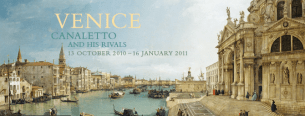 This exhibition presents the finest assembly of Venetian views, by Canaletto and all the major practitioners of the genre, to be held since the much-celebrated display in Venice in 1967. Remarkably, considering the dominant role of British patronage in this art form, Venice: Canaletto and His Rivals is also the first exhibition of its kind to be organised in the UK.
Additional information can be found here»
New Installations Open at the Getty
From the Getty:
New Galleries for Neoclassical, Romantic, and Symbolist Sculpture and Decorative Art
Getty Center, Los Angeles, opened 31 August 2010
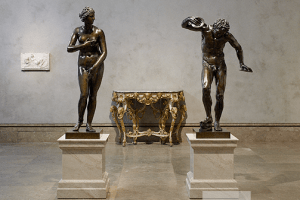 A suite of newly designed sculpture and decorative arts galleries in the West Pavilion at the Getty Center takes visitors through a survey of European sculpture, decorative arts, and paintings, 1700–1900. Recent acquisitions are prominently featured, including Pietro Cipriani’s Medici Venus and Dancing Faun and Jean-Désiré Ringel d’Illzach’s nine-foot-high Vase covered with life casts of spiders, juniper branches, and scraps of lace. Other engaging highlights include Johannes Andreas Beo’s secrétaire and a bust of French socialite Juliette Récamier by Joseph Chinard.
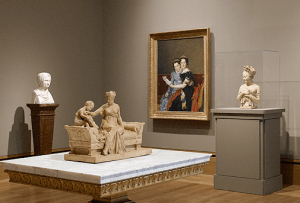 Following in the footsteps of the recently reinstalled North Pavilion galleries, the new chrono-thematic configuration juxtaposes sculptures, paintings, decorative arts, and prints from similar periods in contextualized displays. The galleries progress chronologically from around 1700 to around 1900, reflecting the development of styles associated with that span.
The Invention of a New Classical Style, 1700–1830. The excavations of ancient archaeological sites in Greece and in Italy and the wish to break with the no-longer-fashionable styles of Baroque and Rococo sculpture led in the 1700s to a fervent desire to create modern sculpture imbued with the characteristics of ancient sculpture. An ideal canon of beauty that included pure forms and silhouettes, this new classical style in Europe is defined by the predominant use of white marble and the adaptation of mythological subject matter.
 Late Neoclassicism in European Art and Design, 1780–1830. In the wake of the French Revolution in 1789, Napoleon Bonaparte’s adoption of Neoclassicism as an official imperial style, coined the Empire style, contributed to the popularity of Neoclassical ideals in France and its imitation by European rulers. The curvilinear silhouettes that had dominated the decorative arts were replaced by rectilinear lines, incorporating ancient motifs.
Romanticism to Symbolism, 1830–1900. The Romantic movement, which emphasized the irrational in man and the sublime in nature, had its roots in the literary, visual, and musical arts. Toward the end of the 19th century, a group of French and Belgian artists developed a style known as Symbolism, which reflected the spiritual and mystical philosophies of the day.











 Enfilade
leave a comment