One More Thing for the Chicago Itinerary
Sites to Behold: Travels in Eighteenth-Century Rome
Smart Museum of Art, University of Chicago, 3 November 2009 — 11 April 2010
Curated by Anne Leonard
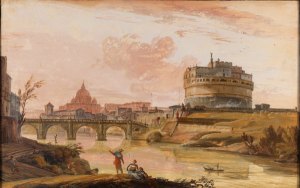
Jean-Baptiste Lallemand, "View of Rome: The Tiber River with the Castel Sant’Angelo and St. Peter’s Basilica in the Distance," n.d., Gouache on paper. Smart Museum of Art, University of Chicago, Gift of Lucia Woods Lindley, 2006.96.
Rome has long been a leading tourist destination. Many of the “must-see” sites were codified centuries ago as part of the Grand Tour, a journey undertaken by young aristocrats to complete their education and give them experience of the world. But by the late eighteenth century, the once-exclusive Grand Tour was giving way to more modern, democratic notions of travel. No longer the preserve of a privileged elite, travel to Italy and other places came within the reach of a wider public, who were eager for tangible souvenirs of what they saw and experienced. This exhibition presents etchings by Giovanni Battista Piranesi, gouache drawings by Frenchman Jean-Baptiste Lallemand, and other works depicting Rome and nearby Tivoli. These eighteenth-century artists, with their different temperaments, techniques, and styles, produced a breathtaking variety of art. A far cry from the monotony of the picture-postcard aesthetic, the works on view appealed to a wide array of tastes and allowed travelers of the period to marvel at the splendor and ruin of an ancient world long after they returned home.
◊ ◊ ◊ ◊ ◊
Right about now, those of you attending CAA in Chicago are probably beginning to cringe at just how tight your schedule already looks. But in the event you can find a few hours to get away from the conference hotel, I would whole-heartedly recommend a morning or afternoon in Hyde Park. In addition to this exhibition at the Smart Museum, the campus of the University of Chicago offers the Oriental Institute Museum, Frank Lloyd Wright’s Robie House, and the Renaissance Society (for ancient, modern, and contemporary aesthetic experiences). The Renaissance Society is currently showing the photographs of Anna Shteynshleyger. No visit is complete without a stop at the Seminary Co-Op Bookstore (one of the best academic bookstores in the world), and La petite folie makes for a lovely quiet lunch or dinner. Hyde Park is easily reached via the Metra commuter train system, available just a few blocks from the Hyatt at Millennium Station. –C.H.
Courtly Frames in Munich
From The Art Newspaper:
The Art of the Frame: Exploring the Holdings of the Alte Pinakothek
Alte Pinakothek, Munich, 28 January — 18 April 2010

Johann Christian Sperling, "Markgraf Karl Wilhelm Friedrich von Brandenburg-Ansbach as a 13-year-old Boy," 1726, frame by Cuvilliés, 1755
The Alte Pinakothek was a pioneer in exhibitions devoted to picture frames and framing when it showed Italian Frames from the 14th to the 18th Centuries in 1976. Now the museum resumes its investigations with this more closely focused exhibition that presents ‘court’ frames dating from between 1600 and 1850. In the baroque period, frames were made by cabinetmakers rather than woodcarvers or sculptors as was the case elsewhere.
The majority of frames were made of ebony or ebonised wood with wave and ripple ornaments referred to as flammleisten—flame moulding—alluding to the effect caused by the flickerings of candlelight on the broad, black surfaces. The most significant change came with the return of the Elector Maximilian II Emanuel from exile in the Netherlands and France in 1715, with his architect Joseph Effner. Vast, three-dimensional sculptural frames with a range of gold leaf were used for the display of ceremonial scenes, portraits and old masters.
Effner was succeeded as court architect by François de Cuvilliés, the central figure in Munich of the pan-German enthusiasm for the rococo, the taste for which lasted up to 1780 (shown here, Johann Christian Sperling, Markgraf Karl Wilhelm Friedrich von Brandenburg-Ansbach as a 13-year-old Boy, 1726; frame by Cuvilliés, 1755).
 In 1779 Carl Albert von Lespilliez was commissioned to frame the Electoral picture collection in the Hofgarten Galerie which he did using the up-to-date neo-classical frame, with leaf, frieze, beading and scotia. The Napoleonic wars spelled the end of the craftsman-made frame along with other luxury items, and the Industrial Revolution ushered in the period of mass-produced products. . .
For the full article click here»
◊ ◊ ◊ ◊ ◊
As noted in a press release for the exhibition, there is an accompanying catalogue, edited by the show’s curator, Helge Siefert, Rahmenkunst: Auf Spurensuche in der Alten Pinakothek (Munich: Prestel, 2010), ISBN: 9783775726061
Seven Years’ War at the Huntington
From the Huntington’s website:
A Clash of Empires: The Seven Years’ War and British America
Huntington Library (West Hall), San Marino, CA, 13 February — 28 June 2010
Some 20 years before the shot “heard ‘round the world” initiated the War of Independence, other shots, fired in what is now southwestern Pennsylvania, literally set the world on fire. On May 28, 1754, a detachment of Virginia militia commanded by a young George Washington ambushed a party of French soldiers in the territory claimed by both France and England. Less than two months later, French reinforcements surrounded the stockade hastily built by Washington’s men and forced their surrender. This skirmish triggered a chain of events that erupted in a conflict known as the French and Indian War or the Seven Years’ War and drew into its vortex all the European powers and engulfed the entire globe. A Clash of Empires examines the causes, course, and consequences of the conflict through the eyes of its many participants, publicly displaying for the first time materials from the Huntington Library’s vast collections documenting this turning point in modern history.
Built by Numbers
This exhibition was on view at Oxford’s Museum of the History of Science last summer; it opens at the YCBA in February. The following description comes from the latter’s website:
Compass & Rule: Architecture as Mathematical Practice in England, 1500-1750
Museum of the History of Science, Oxford, 16 June — 6 September 2009
Yale Center for British Art, New Haven, 18 February — 30 May 2010

Catalogue edited by Anthony Gerbino and Stephen Johnston (New Haven: Yale University Press, 2009)
The spread of Renaissance culture in England coincided with the birth of architecture as a profession. Identified as a branch of practical mathematics, architecture became the most artistic of the sciences and the most scientific of the arts. During this time, new concepts of design based on geometry changed how architects worked and what they built, as well as the intellectual status and social standing of their discipline.
Compass & Rule examines the role of mathematics in architectural design and building technology, highlighting the dramatic transformation of English architecture between the sixteenth and eighteenth centuries. The exhibition brings together some of the finest architectural and scientific material from the early modern period, including drawings of St. Paul’s Cathedral, an astrolabe commissioned for Queen Elizabeth I, and architectural drawings by King George III. Also on view will be nearly one hundred drawings, paintings, printed books and manuscripts, maps, and other unique mathematical instruments that illustrate the changing role of both the architect and the profession 1500 to 1750.
An illustrated catalogue edited by exhibition curators Anthony Gerbino, architectural historian and Senior Research Fellow of Worcester College, University of Oxford, and Stephen Johnston, Assistant Keeper at the Museum of the History of Science, University of Oxford, will accompany the exhibition.
Canaletto’s Venice
From the Ringling Museum website:
Venice in the Age of Canaletto
John and Marble Ringling Museum of Art, Sarasota, 8 October 2009 — 10 January 2010
Brooks Museum of Art, Memphis, February 14 — 9 May 2010
Curated by Stanton Thomas and Alexandra Libby

Edited by Alexandra Libby and Stanton Thomas (Prestel) ISBN: 978-3791380001, $60
Venice in the Age of Canaletto is a collaborative project between The John and Mable Ringling Museum of Art and the Memphis Brooks Museum of Art that will consider Giovanni Antonio Canal, called Canaletto in a Venetian context. In particular, it focuses upon the contrast between the artist’s paintings and the works of his contemporaries also active in the city. Canaletto’s vedute, or view paintings, were arguably the most familiar artistic products of eighteenth-century Venice; yet, for all their ability to reproduce immediately recognizable views of the city, they are curiously devoid of the exuberance, sensuality, and rich coloring of most Venetian art of the period. When Canaletto’s paintings are compared with the works of Giambattista Tiepolo, Francesco Guardi, and Sebastiano Ricci, they are revealed as beautiful but rather anomalous creations. The exhibition explores the strange tension that exists between Canaletto’s austere, seemingly realistic cityscapes and the exuberant, pastelline fantasies, religious pictures, and historical dramas of the Venetian Rococo.
Venice in the Age of Canaletto considers a span of approximately 100 years, beginning in 1697, the year of the artist’s birth, and ending in 1797, the year that Napoleon invaded the city and brought the Venetian Republic to an end. This period captures the fascinating social, religious, political, and artistic evolution that precipitated the end of the Republic. The exhibition focuses upon a time when Venice, perhaps more than any other European city, cultivated an elusive civic image of pleasure, fantasy, and escapism. (more…)
‘Masterpieces’ from Ponce, Puerto Rico in Memphis
From the Brooks Museum of Art website:
Masterpieces from Museo de Arte de Ponce
Brooks Museum of Art, Memphis, 3 October 2009 – 10 January 2010
Organized by Museo de Arte de Ponce, Puerto Rico

Joseph-Marie Vien,"Greek Lady at the Bath," 1767
Comprising 60 world-class European paintings from the 14th through 19th centuries, Masterpieces from Museo de Arte de Ponce offers a remarkable opportunity to view iconic works by major Italian, British, French, Dutch, Spanish, and German artists. The exhibition includes paintings by famed Pre-Raphaelite visionaries Edward Burne-Jones and Dante Gabriel Rossetti, as well as pictures by the renowned Baroque master Peter Paul Rubens, the darkly romantic Francisco Goya, and the great belle-époque painter, James Tissot. . . .
The works included in Masterpieces from Museo de Arte de Ponce largely reflect the vision and generosity of Luis A. Ferré (1904–2003). An industrialist, philanthropist, classically trained pianist, and former governor of Puerto Rico, Ferré founded the museum after his first trip to Europe in 1950. Working with a limited budget and relying upon the expertise of famous art historians, he sought out paintings of high quality and exceptional beauty, rather than pictures defined by the prevailing tastes and fashions of the time. For instance, instead of buying popular (and expensive) Impressionist and Modern works, Ferré collected Victorian paintings, which were considered old-fashioned at the time. As a result, the museum he founded possesses an extraordinary collection of Pre-Raphaelite canvases, works that are today unanimously hailed as artistic treasures.

Pompeo Batoni, "Antiochus and Stratonice," 1746
At the same time, Ferré astutely purchased works by major Old Masters that had been largely forgotten by the 1950s. These acquisitions enriched the Ponce collection with a wealth of monumental Baroque canvases from France, Spain, and Italy. In selecting paintings for Ponce, Ferré sought out works that would communicate a sense of wonderment to scholars, artists, and especially the public. Indeed, to him the museum he founded was more important than all his other accomplishments and philanthropic efforts.
The exhibition marks the first comprehensive presentation of the collection in the United States.
◊ ◊ ◊ ◊ ◊
Eighteenth-century paintings in the exhibition include:
- Pompeo Batoni, Antiochus and Stratonice, 1746
- Johan Georg Platzer, Continence of Scipio and Alexander the Great and Queen Thalestris of the Amazons, mid-eighteenth century
- Jean-François de Troy, Susanna the Elders, 1748 and Lot and His Daughters, 1748
- Joseph-Marie Vien, Greek Lady at the Bath, 1767 (commissioned by Étienne-François, duc de Choiseul)
- Angelica Kauffman, Judgment of Paris, 1781
- Benjamin West, Resurrection, 1782
- Goya, Portrait of Martin Zapater, 1790
Also in Virginia: Pirates . . . with a ‘Buccanneer Ball’ to Boot
Designed as a crowd-pleasing exhibition with children particularly in mind, the following show on pirates, currently in Norfolk, looks like immense fun. It certainly would have stolen my heart as a nine-year old. At a more critical level, the exhibition perhaps belongs in a discussion of how the eighteenth century is presented (and marketed) to a popular audience. But that can wait (here I’m reminded of the ability of the brilliant Medievalist Michael Camille to find pleasure even in the ersatz historical theme park ‘Medieval Times’ for an episode of This American Life). From the website of National Geographic:
Real Pirates: The Untold Story of the Whydah from Slave Ship to Pirate Ship
Nauticus, Norfolk, Virginia, 21 November 2009 — 4 April 2010

Model of the "Whydah," shown here decked out in her pirate colors after being captured by Samuel Bellamy. Matthew Prefontaine © Arts and Exhibitions International
Organized by National Geographic
The slave ship Whydah began her short life in London, England, in 1715. Less than two years later, now a pirate ship, she sank to the ocean floor off Cape Cod. Using artifacts recovered from the wreck, Real Pirates: The Untold Story of the Whydah from Slave Ship to Pirate Ship reveals the true story behind this vessel—a story more compelling than anything dreamt up by Hollywood. From the team behind Tutankhamun and the Golden Age of the Pharaohs, this new exhibition tells the story of the crew of a real pirate ship that started as a slave ship—and gives some insights into the violence and idealism of early eighteenth-century piracy.

 The exhibition features real stories of the people who populated the Atlantic world in the age of slavery and piracy: artisans and traders from West Africa, slave ship captains and their captives, Native American boat pilots, impoverished sailors from all over Europe, and pirates—including women pirates and John King, a boy no more than 11 years old, who “went on the account.” Guests see more than 200 actual Whydah artifacts recovered by underwater explorer Barry Clifford, such as treasure from more than 54 ships, gold and silver coins from all over the world, Akan gold jewelry, cannons, swords, pistols, personal belongings, leg iron moldings from shackles, the ship’s bell and its massive anchor! Kids also learn about the exciting world of nautical archaeology and the many technologies that have been developed to allow scientists and historians to unlock the clues embedded in these 300 year old “treasures.” Discover how high-powered digital x–rays of mysterious underwater concretions can reveal the artifacts hidden within.
Visitors return to a time when the cities of North America were still small towns with few interconnections. It was the Caribbean, with its enormous sugar plantations, that made up the dynamic center, drawing vast quantities of money, goods, and people from all corners of the Atlantic. Some people came by choice. But most were transported to this world against their will: men, women and children from across Africa who were kidnapped and sold to slavers; Native Americans bound into slavery from colonial North America; South American natives enslaved in Spanish mines; and indentured servants shipped from Europe.
Slave ships were perfect prizes for pirates: easy to maneuver, unusually fast, and armed to the hilt. After the Whydah‘s human cargo was unloaded in the West Indies, the ship was captured by notorious pirate Sam Bellamy and his motley crew. These pirates created an outlaw life within the brutal realities of the European and Caribbean world. Hailing from many nations, they included ordinary seamen, free black men, political dissidents, escaped slaves, indentured servants, Africans freed from slave ships taken at sea, Native Americans, and runaway plantation workers.
◊ ◊ ◊ ◊ ◊
And for those who find themselves in Norfolk on New Year’s Eve, there’s a Buccaneer Ball to ring in 2010 (pirate costumes optional, though I’m not sure why one would go in anything but fancy dress). Additional information about the show can be found at the exhibition website. Happy New Year!
A Christamas Toast: To Handel

Ed. by Donald Burrows and Rosemary Dunhill (Oxford University Press, 2002)
‘I was much pleased this year with our exhibitions, and though I fear we shall never overtake Italy, ‘tis some praise that we begin to think, that, both in painting and in music, tis worth following’.
–James Harris in Salisbury to William Hamilton in Naples, 15 September 1774 (BL Add MS 42069, folios 94-5)
I’m not sure about the specific items included in the exhibition now on display at the Handel House Museum in London, but the book detailing the Harris collection of manuscripts is certainly fascinating. In assessing the volume for the English Historical Review 118 (April 2003): 446-48, William Weber suggests that
the letters and diaries of James Harris, his family and friends, between 1732 and 1780 take us close into the life of England’s elites, from theatres and assembly rooms in Salisbury, to concerts at Almack’s or the King’s Theatre in Westminster, and to court life in Spain, Germany, and Poland as seen through a diplomat’s eyes. Browsing through the 1068 pages of carefully annotated documents instils a highly nuanced sense of how such
people lived, and what music meant to them.

Handel House Museum, 25 Brook Street (Photo: Wikimedia Commons)
◊ ◊ ◊ ◊ ◊
From the museum’s website:
Mr Handel’s Friends
Handel House Museum, London, 10 November 2009 — 28 February 2010
Curated by Donald Burrows and Rosemary Dunhill
Handel had many friends and admirers in London who collected, played and promoted his music, entertained him in their homes, and supported him in difficult times. Through the private letters and diaries of the Harris family this exhibition explores these relationships and shows the many sides of the famous composer’s character and fortunes.
◊ ◊ ◊ ◊ ◊
And if the holiday season has the Messiah running through your head, then you might enjoy Jonathan Kandell’s profile in The Smithsonian Magazine. In
the eighteenth century, the oratorio wasn’t tied to Christmas but was a feature
of the annual concerts held to benefit the Foundling Hospital (another
outstanding small museum in London). 2009 marks the 250th anniversary of
Handel’s death.
–Craig Hanson
Study in Contrasts: Mather Brown and Benjamin West in London
Yankees in King George’s Court: Mather Brown and Benjamin West
Burlington House (Library Print Room), London, 13 October — 24 December 2009

Thomas Park after Mather Brown, "Mr. Holman and Miss Brunton in the Characters of Romeo and Juliet," published in 1787, mezzotint. Photo: R.A./Prudence Cuming Associates Ltd. ©Royal Academy of Arts
This display of engravings and archive material drawn from the Academy’s collections contrasts the fortunes of two expatriate American artists working in Britain during the second half of the 18th century. Benjamin West (1738–1820) left Pennsylvania to travel, via Italy, to Britain, where he achieved great success. Following the death of Sir Joshua Reynolds in 1792, he became the second President of the Royal Academy. Boston-born Mather Brown (1761–1831) arrived in London in 1781. The ambitious young artist worked in West’s studio and studied at the RA Schools, but never gained the recognition he hoped for. A series of letters in the display tells the story of the breakdown of his relationship with the Academy of which he longed to become a member. The display is timed to coincide with the conference on Trans-Atlantic Romanticism organised by University College London in association with the Royal Academy of Arts, the Paul Mellon Centre for Studies in British Art and the Terra Foundation for American Art.
A Glimpse of Sun for the French Winter
From the website of Versailles:
Louis XIV: The Man and the King
Château de Versailles, 20 October 2009 — 7 February 2010
Curated by Nicolas Milovanovic and Alexandre Maral
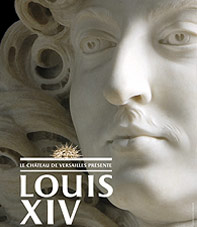 For the first time, a major exhibition is devoted to Louis XIV, the king’s personality, his personal tastes. This exhibition, Louis XIV: The Man and the King, brings together more than 300 exceptional works coming from collections all over the world and never shown together before. Paintings, sculptures, objets d’art and furniture will be exhibited. These masterpieces, some of which have never been presented in France since the days of the Ancien Régime, will enable visitors to get to know the famous monarch better in both his personal tastes and through his public image.
The King’s Public Image
The richness of the image of Louis XIV has no precedent in history: Louis XIV is the Sun King, i.e. Apollo as the sun god. Fashioned by the king himself and his counsellors, this image constantly evolved to convey emblematic figures of the royal power: the king of war leading his troops, the patron king and protector of the arts, the very Christian king and Defender of the Church, the king of glory, an image constructed for posterity. This visible glory, given mythical proportions, which was constructed during his lifetime, took shape thanks to the excellence of the artists chosen, such as Bernini, Girardon, Rigaud, Cucci, Gole, Van der Meulen and Coysevox who set out to sublimate the royal portrait, which the exhibition allows the visitors to rediscover.
The King’s Taste
He saw himself as a king who was the protector of the arts and a collector, competing with other sovereigns of Europe who were also genuine connoisseurs. Benefiting from the example of Mazarin, Louis XIV formed his taste in direct contact with artists, and through the personal relations that he established with them: Le Brun and Mignard in painting, Le Vau and Hardouin-Mansart in architecture, Le Nôtre in the art of gardens, Lully in music, and Molière in theatre. By assembling the works appreciated by the king, a genuine portrait emerges of a passionate lover of the arts and a man of good taste through the jewels, cameos, medals, miniatures and objets d’art, as well as the paintings and sculptures that he loved to surround himself within the Petit Appartement in Versailles.
Accompanying the show is a tapestry exhibition, Royal Pomp, Louis XIV’s Tapestry Collection, at the Gobelins Gallery in Paris.
◊ ◊ ◊ ◊ ◊
Reviews and notices of the exhibition can be found at Newsweek, the Telegraph, and The New York Times. The catalogue, Louis XIV, l’homme et le roi (Skira-Flammarion, 2009; ISBN: 9782081228108) is available through Michael Shamansky’s artbooks.com.










 Enfilade
leave a comment