More on the ‘Art and Theatre’ Exhibition in Toronto
Artdaily.org (11 March 2010) includes more information on the ‘Art and Theatre’ show as it will appear at the AGO, starting in June (interesting to see how it will be presented in Toronto, complete with “a life-size 18th-century set”).
De la scène au tableau / Drama and Desire: Artists and the Theatre
Musée Cantini, Marseille, 6 October 2009 — 3 January 2010
Museo di Arte Moderna e Contemporanea, Rovereto, 6 February — 23 May 2010
Art Gallery of Ontario, Toronto, 19 June — 26 September 2010
Lust. Passion. Murder. Many of the greatest artists of the 19th century shared a profound fascination with the theatre and its themes of triumph and destruction, love and despair. This summer, the Art Gallery of Ontario gives centre stage to key artworks by these artists in a major international exhibition titled Drama and Desire: Artists and the Theatre, opening June 19 and continuing through September 26.
Conceived by Guy Cogeval, president of the Musée d’Orsay in Paris, the exhibition includes over 100 paintings, drawings and theatrical maquettes, by masters such as Edgar Degas, Eugène Delacroix, Jacques-Louis David, Jean Auguste Dominique Ingres, William Blake, Aubrey Beardsley, Henri de Toulouse-Lautrec, and Édouard Vuillard. The works were selected from the collections of some of the world’s greatest museums, including the Louvre, the Metropolitan Museum of Art, the Musée d’Orsay, the British Museum, and the Victoria and Albert Museum.
The AGO has commissioned Gerard Gauci, set designer for Toronto’s Opera Atelier, to make Drama and Desire an experience like no other. Visitors will enter the exhibition by walking ‘onstage’ through a life-size 18th-century set; the works will be displayed using enhanced lighting, sound and video components as well as innovative theatrical devices; and a full-scale re-creation of an early 20th-century theatre maquette will mark the finale of the exhibition. (more…)
Theater and Painting
From the website of the Musée d’Orsay:
De la scène au tableau / From Stage to Painting
Musée Cantini, Marseille, 6 October 2009 — 3 January 2010
Museo di Arte Moderna e Contemporanea, Rovereto, 6 February — 23 May 2010
Art Gallery of Ontario, Toronto, 19 June — 26 September 2010

"De la scène au tableau" (Flammarion, 2009) ISBN: 9782081236912
David, Delacroix, Hayez, Degas, Gustave Moreau, Toulouse-Lautrec, Vuillard . . . all these painters shared a passion for the performing arts. What role did the theatre and the opera play in the artistic production of these great masters and in developing the composition of their paintings? To what extent did their art influence future developments in stage design?
Ranging from the Neoclassicism of David to the experimental work of the scenographer and stage director Adolphe Appia, this exhibition highlights the direct influence of the theatre, or the more subtle effect of theatricality, on painting. Conversely, it also demonstrates how the great movements in the history of art influenced the theatre and opened it up to the 20th century.
However, there is another story, that of the movement towards the dematerialisation of the image (a specific feature of Modernism) which is presented in Marseille through almost two hundred works from prestigious institutions and collections around the world, including a collection of drawings and paintings by Daumier, Degas, Toulouse-Lautrec and Cabanel, on special loan from the Musée d’Orsay.
◊ ◊ ◊ ◊ ◊
The description perhaps downplays the role of the eighteenth-century for the exhibition, though the following review by Didier Rykner posted at The Art Tribune suggests there may be a bit more here for dix-huitièmistes.
The goal of the exhibition organized at the Musée Cantini is to understand the relationship between theatre and painting from the second half of the 18th century to the early 20th . . . Two paintings by Louis-Jean-François Lagrenée . . . prove very early on – halfway through the 18th century – the progressive change towards Neoclassicism, particularly Horace after Slapping his Sister from the Musée des Beaux-Arts in Rouen. While David is represented by well-known canvases (his copy of Girodet’s The Oath of the Horaces, recently seen at the Louvre, and his reception piece for the Ecole des Beaux-Arts), the two works from Bordeaux by Pierre-Narcisse Guérin and the very beautiful Marcus Curtius Dentatus Refusing the Gifts from the Samnites by Pierre Peyron, held at the Musée des Beaux-Arts in Marseille, are admirable. As is often the case in this type of exhibition, the most pleasant surprises come from the lesser-known paintings, discovered a new thanks to excellent restorations.
For the full review, click here»
Sandby Conference in London
Paul Sandby and the Geographies of Eighteenth-Century Art
Paul Mellon Centre, London, 18-19 March 2010
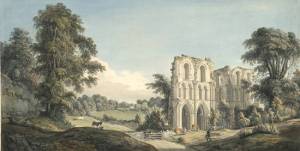
Paul Sandby, "Roche Abbey, Yorkshire," c.1770s. Watercolour over graphite, 300 x 588 mm. Royal Academy of Arts, London. Photo © Royal Academy of Arts/Slingsby
This conference, to be held at the Paul Mellon Centre for Studies in British Art, will address issues arising from the exhibition Paul Sandby: Picturing Britain (Nottingham Castle Museum and Art Gallery, 25 July-18 October 2009; National Gallery of Scotland, Edinburgh, 7 November 2009-7 February 2010; Royal Academy of Arts, London, 13 March-13 June 2010). Organised by Nottingham Castle Museum and Art Gallery, this is the first exhibition to bring together drawings, paintings and prints by this important, if neglected, artist, spanning his long career, and from all the major public collections of his works. In addressing Sandby’s vast and versatile body of work, in its figurative as well as topographical aspects, the exhibition explores how the artist portrayed the character of landscape throughout Britain, and indeed contributed to envisioning the country as a nation state from the cementing of the Act of Union with Scotland, after the failure of the 1745 Jacobite Rebellion, to the wars with revolutionary and Napoleonic France at the century’s end. Through extensive tours, initially as a military draughtsman and then as a professional artist, Sandby pioneered the artistic depiction of landscape in Scotland and Wales, and searched out new sites throughout England. His art is arguably unrivalled among that of his contemporaries in its portrayal of the appearance and meaning of a range of subjects, rural and urban, modern and historical, in a country experiencing rapid social and commercial development.
Thursday 18 March, Royal Academy of Arts
6:30 Private view of the exhibition, Paul Sandby: Picturing Britain, led by John Bonehill (Curator of Paul Sandby: Picturing Britain and Lecturer in Art History, University of Glasgow), followed by a wine reception.
Friday 19 March, The Paul Mellon Centre
9:40 Welcome by Brian Allen (Director of Studies, The Paul Mellon Centre)
9:45 Morning Session introduced and chaired by Kim Sloan (Curator, Department of Prints and Drawings, British Museum)
9:50 Keynote address by Bruce Robertson (Professor of Art History, University of California-Santa Barbara), “Paul Sandby: Father of English Watercolour?”
10:30 Timothy Wilcox (Independent Scholar), “‘Burying the Hatchet’: Paul Sandby at Luton Park”
11:40 Finola O’Kane (Lecturer in Architecture, University College Dublin), “’A Genuine Idea of the Face of the Kingdom’? Jonathan Fisher and Paul Sandby’s portrait of Ireland within the frame of Great Britain”
12:20 John Barrell (Professor of English, Centre for Eighteenth Century Studies, University of York), “A Common in Wales: Edward Pugh, the Pastoral, and Progress”
2:15 Afternoon session introduced and chaired by Shearer West (Director of Research, Arts and Humanities Research Council)
2:20 Gillian Forrester (Curator of Prints and Drawings, Yale Center for British Art), “‘No Joke Like a True Joke’? ‘Twelve London Cries done from the Life’”
3:00 Nick Grindle (Teaching Fellow, Department of Art History, University College London), “Living in London and Windsor: The Sandby Brothers’ Residences, c.1752-1809”
4:10 Carolyn Anderson (Ph.D. candidate, School of Geography, University of Edinburgh), “’The Art of Depicting with a Soldier’s Eye’: The Military Mapping of Eighteenth-Century Scotland”
4:50 Stephen Daniels (Professor of Cultural Geography, University of Nottingham), “‘Great Balls of Fire’: Representing the Remarkable Meteor of 18th August 1783”
5:30 Panel and audience discussion chaired by Sam Smiles (Emeritus Professor of Art History, University of Plymouth)
6:15 Wine reception
Enamels at the Hermitage
Enamels of the World 1700-2000 from the Khalili Collections
Hermitage, St Petersburg, 8 December 2009 – 18 April 2010

Throne table Guangzhou (Canton), 1736-1795 Gilt copper, painted enamel, 37 x 90.5 x 42 cm
Due to popular demand Enamels of the World 1700-2000 from the Khalili Collections, being exhibited at the State Hermitage Museum, St Petersburg, has been extended until 18 April. This is the inaugural presentation of a remarkable new facet of the Khalili Collections, perhaps best known for the their unparalleled Islamic and Japanese art. The exhibition features some 320 pieces selected from approximately 1,200 works in the enamel collection.
Enamelling has been an essential accomplishment of the virtuoso jeweller for more than 3,000 years, and many ancient works rank among the treasures of European and Asian art – to the extent, perhaps, that it tends to be popularly, though
misleadingly, identified with ancient and mediaeval art.

Novelty scent spray, attributed to Mouliné, Bautte & Co. or Moulinié & Bautte, Geneva, circa 1805 Gold, translucent and painted enamel, agate and seed pearls, 11 x 5.5 x 1.4 cm
Partly because of this, its history since 1700 or so has become the province of highly specialised scholars often working in ignorance of their colleagues’ work in closely related fields, which is especially paradoxical since enamellers themselves have always been highly mobile. The rapidity of travel and the ease with which motifs and techniques could be transferred, virtually from one end of the industrialised world to the other, in the 18th and 19th centuries, has given their work a truly international dimension. Many of their names are little known to the general public. Professor Nasser D Khalili’s achievement has been not just to present their work but to show them working in a global environment and, whether European or Asian, transcending the boundaries of national frontiers or individual enterprise. The historicist taste of the 19th century, imbued by the conviction that the traditions of the past dynamically influenced the arts of a nation, went hand in hand with the conviction that exotic art could be exploited to revive them. This was as true of Meiji Japan and Qing China, as of Tsarist Russia, Victorian Britain and Ottoman Turkey.

Drawn by the most humble Muhsin known as ‘The Aleppan’, Iran, ca. 1800
The exhibition includes splendid enamelling by the most prestigious European masters. The firm of Fabergé is represented by twenty-six works including a combined timepiece and photograph frame, while the work of Feodor Rückert, a workmaster who regularly supplied Fabergé, is seen in three items dating from different periods of his career including one of his great masterworks, the Ol’sen kovsh. The eminent French master Jean-Valentin Morel is also represented by three works, among them the very last that he made. The genius of René Lalique, which was so fêted at the Paris Exposition Universelle of 1900, may be appreciated both on a small scale with a corsage ornament and on a large scale with a remarkable surtout de table. At the same Exposition, the firm of Cartier also enjoyed great critical acclaim and the exhibition features fifteen works by Cartier, among them clocks, cigarette cases and vanity cases. Much of the enamelling produced in the Islamic lands is the work of anonymous craftsmen. However, the exhibition includes a rare signed example, a gold box signed by Muhsin, known as ‘the Aleppan’, an artist working at the court of Fath ‘Ali Shah.

Timepiece Laurent, Paris, 1793-1794 Painted marble and gilt-metal, copper with opaque, translucent and painted enamel with paillons, 40.8 x 26 x 16 cm
As a whole the collection magnificently displays the great variety of work produced by enamellers ranging from precious personal accessories such as jewellery to clocks, vases, and even pieces of furniture. Similarly striking is the element of fantasy employed in their creation, for example the scent spray formed as a pistol, the scent issuing from a flower that emerges from the muzzle when the trigger is pulled, or the evening bag made by Aloisia Rucellai in 1968, where the folds and ‘watering’ of moiré silk have been extravagantly replicated in engraved gold and enamel. Equally remarkable is the variety of techniques used to decorate these pieces including cloisonné, painted and plique à jour enamel. At the same time fascinating differences may be noted in the use of the same technique in different locations such as China and Japan.
The impact of patronage is well illustrated by many works in the exhibition. Specific commissions include the small almanac made for the Empress Marie-Louise, second consort of Napoleon I, to commemorate the birth of their son, the King of Rome, and the casket made for Elisabeth, Queen of Roumania, which she gave to the French painter Jean Lecomte de Nouÿ. Other works were made to order for royal and imperial households; among these are the Russian cigarette case by Hahn with a diamond-set imperial eagle and the pair of Japanese vases by Hattori Tadasaburo which incorporate the Imperial kikumon. In other instances enamelled works of art were used to commemorate an event such as the spectacular charger by Pavel Ovchinnikov that was presented by the city of Moscow to Emile Loubet, President of the French Republic, during his state visit to Russia in 1902.

Edited by Haydn Williams
Historical revivalism is a major theme covered by the Collection. The rise of nationalism during the 19th century encouraged artists to study the past in the hope of defining national identity. In northern Europe the Gothic era was thoroughly reviewed while in Russia interest focused upon the art made before Peter the Great’s policy of westernisation. Filigree enamelling, a traditional technique practised in the cities of Moscow, Velikii Ustiug and Solvychegodsk, was revived. One of the leading exponents of this was Pavel Ovchinnikov, the maker of the imposing double-handled kovsh. Widespread interest in the past also stimulated collectors to seek antiques for their collections. The scarcity of authentic examples, combined with great demand, soon led to the production of imitations that made good the shortfall. One of the most noted makers of such work was Reinhold Vasters and the exhibition includes three spectacular examples by him, among them the large covered bowl applied with jewelled gold and enamel mounts. Other masters drew on the past in a more informal and fanciful way as can be seen in the charger by Herman Ratzersdorfer or the timepiece by Vever frères which was exhibited at the Paris Exposition Universelle in 1889.
The importance of the Khalili Collection and the number of wonderful pieces made by Russian craftsmen make its unveiling in one of the world’s greatest museums, the State Hermitage Museum, entirely appropriate and in keeping with Professor Khalili’s wish to share his collections with the world and to promote greater understanding between people of different cultures.
Exhibition catalogue: Haydn Williams, ed., Enamels of the World, 1700-2000 : The Khalili Collections (London: The Khalili Family Trust, 2009), 450 pages, ISBN: 9781874780175, $75
Jean Raoux Retrospective
Jean Raoux, virtuose et sensuel (1677-1734)
Musée Fabre de Montpellier, 28 November 2009 – 11 April 2010
 Jean Raoux est avec Sébastien Bourdon, Joseph-Marie Vien, François-Xavier Fabre et Frédéric Bazille, l’un des grands artistes français originaires du Languedoc. Ce peintre, contemporain d’Antoine Watteau, participa de manière active au renouvellement de la peinture française au temps de la Régence. Virtuose, sensuel, élégant, Jean Raoux mérite que sa ville natale lui consacre une exposition d’envergure.
Cette première rétrospective réunit les plus beaux chefs-d’oeuvre de l’artiste provenant des grands musées français, mais aussi de collections allemandes, autrichiennes, italiennes, anglaises, américaines et russes. De provenance prestigieuse, rarement montrés, les tableaux de cette exposition dévoilent l’étendue de son talent de portraitiste de l’aristocratie, du monde du spectacle, de peintre de sujets historiques et religieux, mais aussi de scènes de genre à la manière hollandaise. Sa poésie exalte la beauté de la femme, qu’elle soit héroïne de la mythologie ou coquette vaquant à ses occupations quotidiennes. Cette sélection permet de mettre en lumière les multiples facettes de cet artiste célèbre en son temps et estimé de Voltaire.
Qui est Jean Raoux ?
Né à Montpellier en 1677, Raoux a continué sa formation à Paris dans le grand atelier de Bon Boullongne. De 1705 à 1714, il séjourne à Rome, Padoue et Venise où il répond à d’importantes commandes de peintures mythologique et religieuse. De retour à Paris en 1714, il entre à l’Académie et reçoit la protection du Grand Prieur de l’Ordre de Malte, le libertin Philippe de Vendôme et travaille aussi pour le régent Philippe d’Orléans. Ses portraits, ses scènes de genre très poétiques et d’une exécution virtuose témoignent de l’esprit de ce milieu qu’il fréquente, à la fois léger, féminin et parfois mélancolique.
Exhibition Catalogue: Michel Hilaire and Olivier Zeder, Jean Raoux, 1677-1734 (Paris: Somogy, 2009), ISBN: 9782757202876, $58.95 (for an English description and a link to purchase the catalogue, click here»)
Exhibition on Cook’s Voyages
James Cook and the Exploration of the Pacific / James Cook und die Entdeckung der Südsee
Art and Exhibition Hall of the Federal Republic of Germany, Bonn, 28 August 2009 — 28 February 2010
Kunsthistorisches Museum (Museum of Ethnology), Vienna, 10 May — 13 September 2010
Historisches Museum, Bern, 7 October 2010 — 13 February 2011
The British navigator and explorer James Cook (1728–1779) is famous for having led three expeditions into the vast and uncharted waters of the Pacific Ocean. He was the first to survey and map New Zealand, Australia and the South Pacific islands, completing our modern image of the world and refuting once and for all the existence of a mythical Southern Continent.
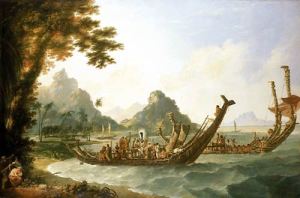
William Hodges, The War-Boats of the Island of Otaheite, Tahiti, 1777, © National Maritime Museum, Greenwich, London, Ministry of Defence Art Collection
An interdisciplinary presentation of the Age of Enlightenment
The exhibition focuses on the European perspective on the newly discovered worlds. In the spirit of the Age of Enlightenment, it seeks to bring together and crosslink for the first time research results from a wide range of disciplines, such as natural history, maritime history, art history and early ethnology. Cook’s expeditions into the South Seas brought about a fundamental change in the way Europe saw the world and ushered in the dawn of modern Europe under the auspices of the Enlightenment belief in the power of progress.
It is to Cook and the naturalists, scholars and draughtsmen who took part in his three expeditions that Europeans owe the first systematic, reliable maps and the earliest comprehensive surveys of the geological structures and the flora and fauna of the Pacific islands. Similarly, the encounters with the people ‘on the other side of the world’ were described and documented in a degree of detail never before attempted.
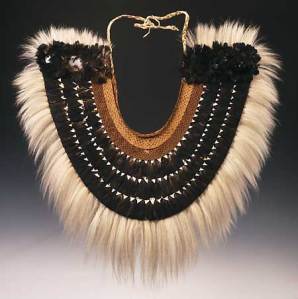
A breast ornament from the Society Islands. © The Cook/Forster Collection, University of Göttingen
Objects from all over the world recount Cook’s expeditions
A fascinating selection of some 550 objects and artefacts recount the pioneering voyages of James Cook and his international team of scientists. By the end of the 18th century the ethnographic and natural history objects collected from many different Pacific cultures during the three Cook voyages had been dispersed among collections all over Europe. The exhibition in Bonn brings them back together for the first time in over two hundred years. Another important first is the cooperation between the leading British ethnographic collections in Oxford, London and Cambridge and their counterparts on the Continent – above all the collections of Göttingen, Vienna and Bern – as well as other museums worldwide.
Many of the exquisite feather ornaments, wooden sculptures and other Oceanic artefacts are of incalculable value to art historians, since comparable objects have all but disappeared from the Pacific region. Made before the fateful encounter with the Europeans, these objects allow present-day Pacific cultures to assert or rediscover their own identity in today’s globalised world.
The ethnographic items are complemented by magnificent paintings and drawings by the artists accompanying Cook on his voyages. These works capture the unique mix of euphoria and inquisitiveness that characterised the explorers’ encounter with the exotic world of the South Seas. Ship models, original sea charts and navigation instruments bring to life James Cook’s daring voyages into the unknown. Alongside spectacular loans from the National Maritime Museum, the Natural History Museum and the British Library in London, the Art and Exhibition Hall is delighted to have secured the loan of items of Cook’s personal property from Australia. (more…)
Ship Models from the Permanent Collection of the AGO
Ship Models: Thomson Collection
Art Gallery of Ontario, Toronto

Two-decker Warship rigged with original sails Prisoner of War Model, 1794-1815 Great Britain, probably by French sailors Bone, brass, silk (9½ x 11 x 3½ ins)
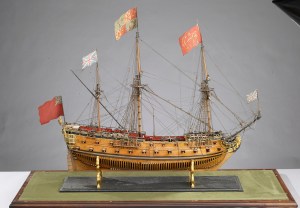
British Two-decker 50/54-Gun Warship Navy Board Model, Great Britain, c. 1703 Wood, paper, paint, gilding, glass (32½ x 40½ x 15¼ ins)
The Thomson Collection at the AGO spans some 350 years and contains examples of exquisite workmanship and some of the masterpieces of the genre.
Foremost are rare late 17th- and 18th-century British dockyard models, made to scale for the Royal Navy and wealthy individuals. There is also a large number of models made by some of the 120,000 prisoners of the Napoleonic Wars. These models, made from wood and bone, with rigging of silk and human hair, were produced by teams of skilled craftsmen and sold to local British collectors who gathered at the prison gates. The shipbuilders’ models extend from the mid 19th century to the Second World War, representing a diversity of both model style and ship type ranging from tugs, dredgers and trawlers to cargo vessels, passenger steamers, private yachts, corvettes, battleships, cruisers, torpedo boats, destroyers and two aircraft carriers.
Homecoming for Reynolds
From the City of Plymouth’s exhibition website:
Sir Joshua Reynolds: The Acquisition of Genius
Plymouth City Museum and Art Gallery, 21 November 2009 — 20 February 2010

Exhibition catalogue edited by Sam Smiles, ISBN: 9781906593407
Sir Joshua Reynolds: The Acquisition of Genius is a major art exhibition that celebrates the life and work of a man who was born in Plympton in 1723 and went on to become one of Britain’s finest and most fashionable portrait painters. This, the largest exhibition on Reynolds ever held outside London, showcases new research by the University of Plymouth as well as works of art from Plymouth City Museum and Art Gallery’s own collections, major loan items from regional, national, public and private collections and fascinating personal objects.
Learn about Reynolds’s career from his earliest commissions in and around Plymouth to his pre-eminence in the London art world of the late 18th century. Re-discover his significance to Plymouth and the South West. Find out about his
achievements as both an artist and a collector.
◊ ◊ ◊ ◊ ◊
Hugh Belsey reviews the exhibition for Apollo Magazine (February 2010). Coverage can also be found at the BBC.
Bon Mardi Gras
From the website of the Réunion des musées nationaux (RMN):
Josephine’s Wine Cellar at Malmaison during the Empire
Châteaux de Malmaison and de Bois-Préau Museum, 18 November 2009 — 8 March 2010
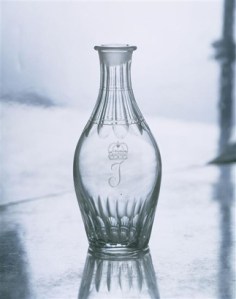
Carafe with Josephine’s monogram, First Empire (1804-1814), crystal, Musée National des Châteaux de Malmaison et Bois-Préau © Rmn / André Martin
The idea for this exhibition came from the inventory drawn up after the death of the Empress Josephine which listed the contents of the cellar at Malmaison – over thirteen thousand bottles. The list of wines served to guests in the house is striking for the number of crus mentioned and the variety of the regions they came from. The best crus from Bordeaux and Burgundy stand alongside Mediterranean wine, in the sweet, syrupy taste of the eighteenth century, the most famous names in Champagne, wines from Languedoc-Roussillon, Côtes du Rhône and the Rhineland. Rum and liqueurs from the West Indies are a reminder of the Empress’ origins.
The exhibition attempts to show the evolution of wine production and marketing during the Empire. It was boosted by progress in the glassmaking industry, which was particularly noticeable in the shape of the bottles. Iconographic documents and account books kept by Josephine’s suppliers reveal the variety and quantity of the empress’ orders.
Elegant ice buckets, glass coolers, crystal and metal punch bowls illustrate the refinement and prestige of the tableware at Malmaison and stand alongside the most brilliant pieces of glassware, some bearing the monograms the sovereigns from Josephine to Louis-Philippe. The latter demonstrate the technical progress made in French glassmaking, which facilitated the search for new forms, and bear witness to the evolution of table manners in the years after the revolution. Objects made after the Consulate and the Empire complement this rich overview and show the changes in the production of glassmaking, bottling and labelling in the first half of the nineteenth century up until the beginning of the Second Empire.
With the classification of the grands vins of Bordeaux in 1855 and developments in transportation, this was a period of deep change. A final section is dedicated to the representation of wine in the Napoleonic legend.
The exhibition brings together more than two hundred objets d’art and iconographic documents not only from the Musée de Malmaison but from the collections of the museums of the Château de Fontainebleau, the Château de Compiègne, the Château d’Eu (Musée Louis-Philippe), the Musée Carnavalet, the Musée des Arts Décoratifs, the Musée National de Céramique de Sèvres, the Archives Nationales, the Fondation Napoléon, the musée Napoléon Thurgovie, château et parc d’Arenenberg, (canton of Thurgovia, Switzerland) and the Museo Napoleonico, Rome. Other items are on loan from industrial or commercial firms such as Moët et Chandon, or from private collections. Taking an artistic and historical angle, the exhibition shows that Josephine’s cellar is a precious testimony to the gracious entertaining which long made the charm and reputation of Malmaison. (more…)
Amber Exhibition in Scotland
As noted at Artdaily.org:
Amber: Treasures from Poland
Hunterian Art Gallery, University of Glasgow, 5 February — 17 April 2010
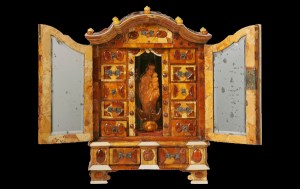
Amber cabinet of King Stanisław August Poniatowski (the last king of Poland). Made in Gdańsk after 1771. Donated by Lady Barbara Carmont of Edinburgh to the Malbork Castle Museum collections in 1979. © Malbork Castle Museum.
From the earliest times, the southern shores of the Baltic Sea have been associated with the gathering, trading and working of amber – a natural substance which has been long valued by man. Featuring some of the finest items from the Polish national collection, this new exhibition, Amber: Treasures from Poland offers a unique chance to see some fascinating and beautiful artefacts which represent both natural history and northern European craftsmanship. This is the first time that these items have been exhibited in the UK.
Most are from the famous Malbork Castle collection in Poland which has an important national collection of Baltic amber artefacts. Also included is the famous Gierłowska lizard from the Gdańsk Amber Museum, as well as a collection of insects trapped in amber and some historical amber artefacts from the Hunterian collection.
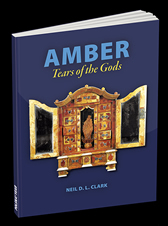 Amber is found in many varieties of colours and forms and amber from the Baltic region of Europe is one of the most abundant in the world. It is used around the world for medical or spiritual wellbeing, for adornment or decoration, and for scientific reasons.
This exhibition introduces amber from prehistory to natural history; it looks at how people related to amber from the Stone Age onwards and at the incredible techniques and skill of the amber craftsmen who created some of the finest examples of amber art ever seen.
The launch of a new book Amber: Tears of the Gods (Dunedin Academic Press) will coincide with the opening of the exhibition. It has been written by Dr Neil DL Clark, Curator of Palaeontology at the Hunterian.










leave a comment