Exhibition | Fanciful Figures

Soane office hand, RA Lecture Drawing of the Portico of Holkham Hall, Norfolk, 1806–19
(London: Sir John Soane’s Museum 17/1/20)Lisbon: Calouste Gulbenkian Museum)
◊ ◊ ◊ ◊ ◊
Now on view at Sir John Soane’s Museum:
Fanciful Figures
Sir John Soane’s Museum, London, 22 March — 9 June 2024
Fanciful Figures turns visitors’ attention to ‘staffage’, the small human and animal figures in architectural drawings, which became increasingly popular during the eighteenth century. Drawing on the drafting practices of past and present, the exhibition illustrates staffage’s ability to animate architects’ visions, both for built projects and unrealised designs.
The Georgians placed these figures—whether beautifully dressed, sociable, or industrious—into their drawings to animate, add intrigue, and enhance the aspirational appeal of their designs. They also played, and continue to play, an important role in indicating the scale and function of architectural elements and drawing attention to the special features of designs. Just as architects today use staffage to help prospective buyers imagine a life in and around new developments, these historic scenes were created to market new possibilities to audiences. They have, therefore, taken on a new significance as a means of signalling shifts in style, demographics, work, and culture. Between the city traders and happy families, street-side boxing matches and children riding in dog-carts, the figures celebrated in this exhibition help piece together a vibrant picture.
The exhibition draws largely from the Museum’s own collection, including a very early instance of staffage by figure artist Leonard Knyff from 1695. This is shown alongside works by Soane’s favourite draughtsman Joseph Gandy and a series of never-before-seen prints by Benedict Van Assen, both pioneers in this practice.
A specially commissioned film, on display in the Museum’s Foyle Space, explores the representation of figures and communities in contemporary architectural drawing, illustrating the roles that these figures play in reflecting the values, priorities, and aspirations of architects and their projects. The film discusses this subject with four prominent architectural practices: Nimtim, Muf, Office S&M, and OMMX. At the cutting edge of their field, these architects question who is represented in architectural designs and what the impact of this representation of our shared spaces has on how we live.
Exhibition | Emulating Books
Now on view at The Met:
Emulating Books: Book Objects from the Lynn and Bruce Heckman Gift
The Metropolitan Museum of Art, New York, 18 April — 16 July 2024

Box with Tulip and Hearts Motif in Book Form, 1714, carved wood (possibly European walnut), 9 × 7 × 3 cm (NY: The Metropolitan Museum of Art, gift of Lynn and Bruce Heckman, N7433.3 .B69 1714).
Creating objects in book form has been an artistic practice for a millennium. These personal, inventive objects are ubiquitous in many cultures. They have been made for various purposes by people from all walks of life and skill levels. Whether precious or plain, useful or symbolic, they all benefit from their connection to the book. For example, the book-style relic of the ship Eurydice, which sank in 1878, killing over 300 sailors, was carved from a piece of the ship, and serves as an emblem documenting the history of the event, as well as a memorial book honoring the dead.
An object made in the form of a book translates the meaning of the type of book it emulates, therefore imbuing the object with the emotional, material, or spiritual values of the original or imagined book. These objects can express feelings of love, enlightenment, humor and faith, and sometimes the mere experience of holding a book object, as with a treasured tome, can comfort its owner, as in the case of the solid wood Holy Bible which will never open, but comforts just the same. As a result of the book’s power, traditions of making specific types of book objects, such as book safes and game boards, have evolved and flourished. Examples of these traditions, made during the eighteenth to twentieth centuries can be seen in this exhibition.
The Heckman collection is a gift to the Thomas J. Watson Library from Lynn Geringer Heckman, who began collecting objects in book form with her late husband Bruce Heckman in 1989, eventually amassing over 1,000 works. The Watson gift is a select group chosen from the larger collection. The objects on display will be available for consultation in our Reading Room at the conclusion of the exhibition.
Exhibition | Black Newporters, 17th–19th Centuries

Opening this month at the Newport Historical Society:
A Name, A Voice, A Life: The Black Newporters of the 17th–19th Centuries
Newport Historical Society, 29 May — 29 November 2024
Curated by Zoe Hume
Discover the rich narratives of five individuals of African descent who resided in Newport from its inception in 1639 to the abolition of slavery in Rhode Island’s constitution in 1842. Delve into their connections, commercial endeavors, religious affiliations, and more through an immersive exhibit at the Newport Historical Society Richard I. Burnham Resource Center. The exhibition also features interpretations by three Rhode Island artists, offering visual insights into the lives and experiences of these historical figures.
Exhibition | Maria Cosway (1760–1838)
Opening this month at the Pasquale Paoli Museum in Merusaglia:
Maria Cosway (1760–1838): A strada eccezziunale di un’artista
Museu Pasquale Paoli, Merusaglia (Corsica), 18 May — 30 October 2024
Curated by Amandine Rabier
 Maria Cosway (1760–1838): A Strada eccezziunale di un’artista (L’itinéraire singulier d’une artiste), présentée au Musée Maison natale de Pasquale Paoli raconte le cheminement d’une femme brillante que tout prédestinait à une grande carrière d’artiste dans la High Society anglaise et qui, contre toute attente, trouvera sa véritable émancipation en renonçant à sa première vocation pour se consacrer à l’éducation des jeunes filles. Ami fidèle, Pasquale Paoli (1725–1807) fut présent à chaque étape de cette vie singulière. Ses lettres à l’attention de Maria Cosway, tel un fil rouge, ponctuent les différentes sections de cette exposition. Fruit de deux années de travail en collaboration avec des institutions britanniques et italiennes reconnues, l’exposition s’accompagne d’un catalogue édité en français et en anglais, richement illustré et documenté par des historiens d’art réputés, spécialistes du XVIIIe siècle, sous la direction d’Amandine Rabier, commissaire de l’exposition. Cette exposition est aussi pour le musée de Merusaglia, l’occasion de s’extraire de son enracinement local pour rayonner sur la scène internationale, conformément à son Projet Scientifique et Culturel.
Introduction
• L’apprentissage en Italie
• Maria Hadfield devient Maria Cosway
Salle 1 | Maria Cosway dans la société anglaise
• La reine de Pall Mall
• À propos des femmes artistes
• Pasquale Paoli et Maria Cosway
Salle 2 | Maria Cosway peintre
• L’influence du cercle romain
• L’amitié avec David
• Exposer à la Royal Academy
Salle 3 | Rupture
Salle 4 | Émancipation: Maria Cosway pédagogue
Amandine Rabier, ed., Maria Cosway (Ghent: Snoeck Publishers, 2024), ISBN: 978-9461619051, €30.
Exhibition | Splendour in Venice: Canaletto and Guardi

Francesco Guardi, The Feast of the Ascension in the Piazza San Marco, detail, ca. 1775, oil on canvas
(Lisbon: Calouste Gulbenkian Museum)
◊ ◊ ◊ ◊ ◊
Opening this fall at Lisbon’s Calouste Gulbenkian Museum:
Splendor in Venice: Canaletto and Guardi in 18th-Century Painting
Veneza em Festa: Canaletto e Guardi na Pintura do Século XVIII
Calouste Gulbenkian Museum, Lisbon, 24 October 2024 — 13 January 2025
Museo Thyssen-Bornemisza, Madrid, 3 February — 12 May 2025
In 2024, the Calouste Gulbenkian Museum welcomes the masters of 18th-century Venetian painting in an exhibition organised in collaboration with the Museo Thyssen-Bornemisza. After working together on a 2009 exhibition devoted to the French painter Henri Fantin-Latour, the Calouste Gulbenkian Museum and the Museo Thyssen-Bornemisza are joining forces once again to promote an encounter between the works of their respective collections, based on their characteristic affinities. This new project, which starts in Lisbon in autumn 2024 and continues in Madrid in early 2025, takes as its theme 18th-century Venetian painting, with each museum contributing works that echo and complement one another. Canaletto, Guardi, Bellotto, and Tiepolo—creators of some of the most brilliant compositions of their time—will be brought together with other artists for the exhibition. The display will focus on the feste (the celebrations held in La Serenissima), vedute (panoramic views of a specific location), and capricci (fantastical architectures dreamt up by local artists), all of which are naturally festive motifs.
◊ ◊ ◊ ◊ ◊
Note (added 16 August 2025) — The posting was updated to include the dates in Madrid. Also, note that the catalogue is distributed by ACC Art Books and Simon & Schuster.
Exhibition | Ranjit Singh: Sikh, Warrior, King
Now on view at The Wallace Collection:
Ranjit Singh: Sikh, Warrior, King
The Wallace Collection, London, 10 April — 20 October 2024
Explore the life of the great Sikh leader Ranjit Singh (1780–1839) in this major exhibition
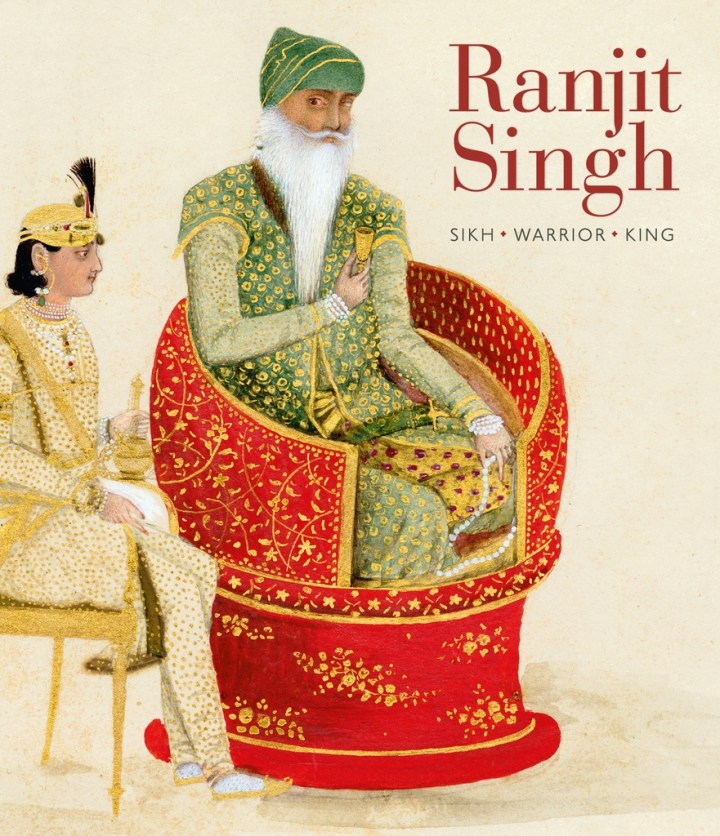 With an unwavering sense of destiny, Ranjit Singh conquered the Punjab, an area that today encompasses Pakistan, following a period of anarchy caused by decades of Afghan invasions. By the early 19th century, he emerged as the undisputed Maharaja, establishing the influential Sikh Empire. Ranjit Singh’s leadership led to a golden age marked by thriving trade, flourishing arts, and a formidable army. Discover his story through nearly 100 stunning artworks, including jewellery and weaponry from the Sikh Empire drawn from major private and public collections. The exhibition also features historic objects from his court, courtiers, and family, including items owned by the Maharaja and the most famous of his 30 wives, Maharani Jind Kaur. Ranjit Singh: Sikh, Warrior, King is a unique opportunity to see our remarkable collection of Sikh arms and armour alongside other Sikh artworks for the first time.
From Bloomsbury Press:
Davinder Toor, Ranjit Singh: Sikh, Warrior, King (London: Philip Wilson Publishers, 2024), 144 pages, ISBN: 978-1781301265, £20 / $30.
This book, published to coincide with the exhibition at the Wallace Collection, features historic artworks, jewellery, and weaponry from Ranjit Singh’s court, courtiers, and family members. Also highlighted are objects intimately connected with his son, Maharaja Duleep Singh—the deposed boy-king turned country squire who was a favourite of Queen Victoria and father of the prominent suffragette Princess Sophia Duleep Singh. Richly illustrated, this catalogue also reveals the achievements of Ranjit Singh’s European and American officials. Acknowledging Ranjit Singh’s remarkable feat of holding back the threat of a British invasion for four decades, these ‘Firangis’ would nickname their esteemed Sikh sovereign ‘The Napoleon of the East’.
Davinder Toor is a leading figure among a new generation of Sikh, Indian, and Islamic art collectors. He has acted as a consultant to major private collectors, auction houses and institutions such as the British Museum, the Victoria and Albert Museum, and the Wallace Collection. He currently lectures on the ‘Arts of the Royal Sikh Courts’ and ‘Sikh Painting and Manuscripts’ for the V&A’s prestigious Arts of Asia course. Both he and objects from the Toor Collection of Sikh Art were featured on the BBC’s Lost Treasures of the Sikh Kingdom (2014) and The Stolen Maharajah: Britain’s Indian Royal (2018) documentaries. The Toor Collection, comprising more than 1,500 works, acts as a lasting legacy to the empire of the Sikhs.
c o n t e n t s
Maps
Foreword
Preface
Prelude to Power — Davinder Toor
Masters of War — Davinder Toor
The Lahore Durbar — Davinder Toor
Firangis — William Dalrymple
Legacies — Davinder Toor
Notes
Bibliography
Image credits
Online Course | Sâqib Bâburî on Ranjit Singh
An example of the programming offered in conjunction with exhibition Ranjit Singh: Sikh, Warrior, King, now on view at The Wallace Collection:
Sâqib Bâburî | Life Stories: Ranjit Singh (1780–1839)
Online, Wednesdays 8, 15, and 22 May 2024, 18.00–20.00 BST (and recorded)
In the 18th century, the once powerful Timurid (Mughal) Empire retreated from the wealthy region of the Punjab, now divided between India and Pakistan. Unstable and continually plundered by invasions from Afghanistan, peace and prosperity was eventually restored to the region through local resistance and the enigmatic leadership of Ranjit Singh. Over three sessions, we’ll examine Ranjit Singh’s rise to power and the multifaceted reasons for the stability and duration of his almost four-decade reign—regarded as a highpoint in an otherwise violently unstable century. The course will be taught through Zoom Webinar. Each course session duration is 120 minutes, including a five-minute break and time for Q&A with the tutor. Tickets are for all dates (£60 / £57). Ticket holders will be emailed the Zoom link, Webinar ID, and Passcode 24 hours in advance of the first course session, which should be retained for accessing all three sessions of the course. The course will also be recorded. Within 48 hours of each course session, ticket holders will be emailed a link to view the recording, which will be available for two weeks only.
Sâqib Bâburî is a Content Specialist Archivist with the Qatar Foundation Partnership, based at the British Library, where he was formerly the Curator for Urdu Collections and Curator for Persian Manuscripts. His research interests include the history and art history of Persianate South Asia, palaeography and manuscript cultures, ornament and design, arms and armour, regalia, and culinary cultures. Dr Bâburî has worked among other institutions with the Royal Collection Trust, Victoria and Albert Museum, the Universities of Oxford, Cambridge, Oldenburg, Göttingen, Singapore, King’s College London, Warburg Institute, SOAS University of London, and the Austrian Academy of Sciences.
Session One | Ranjit Singh, an Origin Story
We’ll begin our course by tracing the rise of Ranjit Singh’s ancestors through the Persian account, Tazkirat al-umarāʾ (Remembrance of the Nobles) written by his contemporary Colonel James Skinner (1778–1841). We’ll also examine the significance of militant resistance to the Timurid Empire and Afghan invaders in Ranjit Singh’s journey to rule over a cosmopolitan kingdom, termed the Khalsa State, centred on Lahore.
Session Two | Between War and Peace
In our second session we’ll explore the tensions between Ranjit Singh’s private life and public duties, focusing on his early years as a free-spirited prince taking pleasure in military exercises and avoiding bookish learning. Looking at his household, consorts, and offspring, we’ll also chart the significant developments that shaped the course of his career as an administrator, patron, and military leader. We’ll look closely at architecture, paintings, manuscripts, documents, and arms and armour to understand the aesthetic and thematic range of Ranjit Singh’s patronage.
Session Three | European Encounters
In our final session we’ll consider Ranjit Singh’s role in promoting transregional and international commercial and diplomatic relations. Once holding an antagonistic attitude towards the Timurid Empire, we’ll understand his efforts to renew connections across India, as well as West and Central Asia. Finally, we’ll look at how Ranjit Singh’s later relations with Britain, Russia, and France anticipated future disputes over the Afghanistan-Punjab corridor, leading to the collapse of the Khalsa State within a few years of his demise.
Exhibition | High Strung: 500 Years of Keyboard Instruments
One of the world’s finest musical instrument collections (boasting the world’s oldest cello as well as significant archival resources) is housed on the campus of the University of South Dakota in Vermillion, in the southeast corner of the state, about 40 miles from Sioux City, Iowa. Founded in 1973 around Arne Larson’s collection of some 2500 instruments, the National Music Museum recently finished a major renovation and re-installation project. In January, Elizabeth Rembert provided a profile for NPR’s All Things Considered (2 January 2024), and later that month the museum announced the acquisition of five cellos (including 17th- and 18th-century instruments), 27 bows, archival materials, and a Hawaiian guitar previously owned by the late cellist Robert Cancelosi. In addition to the NMM’s regular exhibitions, this special exhibition is on view through the end of the year:
High Strung: Five Centuries of Stringed Keyboard Instruments
National Music Museum, Vermillion, South Dakota, March — December 2024
 For over 600 years, stringed keyboard instruments have served as repositories for human imagination, science, technology, craft, artistry, and music. They are admired for their stature—and oftentimes stunning beauty—alongside their ability to play both melody and harmony. Keyboard innovation has continuously expanded throughout the world, throughout time. The special exhibition High Strung: Five Centuries of Stringed Keyboard Instruments explores the form, function, and development of keyboard instruments from early harpsichords to the modern piano. The special exhibition brings together nearly 20 keyboard instruments from the NMM’s collections—some of which have never before been exhibited.
Exhibition | 18th-Century Masterpieces from the Uffizi
This is the fourth of ten planned exhibitions to emerge from a 2021 partnership between the Uffizi and the Bund One Art Museum (with thanks to Art History News for noting it). From coverage in Shine, an affiliate of Shanghai Daily:
18th-Century Masterpieces from the Uffizi
Bund One Art Museum, Shanghai, 11 April — 25 August 2024
 The exhibition reveals the artistic evolution brought by the political and social changes in the 18th century through the presentation of the Uffizi’s 18th-century collection of treasures, varying from grand historical themes to detailed common customs, showing a panoramic view of the splendid artistic development during that pivotal period in Western history.
Many modern and even contemporary features began to take shape at this time. It was also the Age of Enlightenment, illuminated by the light of reason, a new secular way of thinking that broke through prejudice and brought an irreversible and progressive change that encompassed culture, economy and society.
The Uffizi’s collection of 18th-century art comes mainly from the customizations and collections of the last descendants of the Medici family (rulers of the Grand Duchy of Tuscany until 1737) and of the Habsburg-Lorraine family, the successors of the Grand Duchy. The exhibition features 80 masterpieces . . .
Exhibition | Works from Notre Dame Restored
The exhibition includes 21 paintings, including some of the ‘May’ pictures commissioned for the cathedral of Notre-Dame de Paris by the goldsmiths’ guild each spring from 1630 to 1707. More information is available from Artnet.
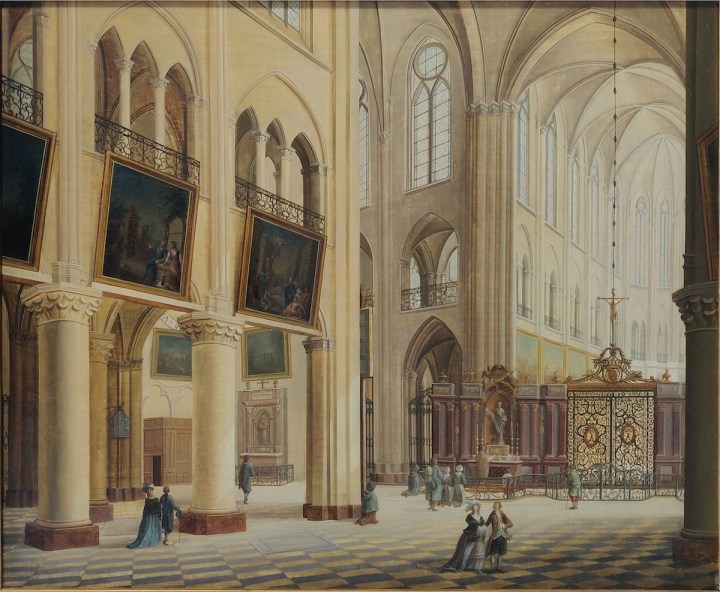
Interior of Notre-Dame at the Transept Crossing, ca. 1780, oil on canvas, 47 × 58 cm
(Société des amis de Notre-Dame de Paris)
◊ ◊ ◊ ◊ ◊
Grands décors restaurés de Notre-Dame
Galerie des Gobelins, Paris, 24 April — 21 July 2024
Curated by Caroline Piel and Emmanuel Pénicaut
À la veille de la réouverture de la cathédrale Notre-Dame de Paris, le 8 décembre prochain, le Mobilier national et la direction régionale des Affaires culturelles d’Île-de-France (ministère de la Culture) s’associent pour présenter au public les chefs-d’œuvre du décor intérieur de l’édifice, soit vingt et un tableaux de grand format, parmi lesquels treize grands « mays », restaurés dans le cadre d’un chantier mené avec l’appui du Centre de recherche et de restauration des musées de France (C2RMF).
D’autres objets remarquables complètent cet ensemble : la tenture de la vie de la Vierge tissée pour orner le chœur au XVIIe siècle, en quatorze pièces, aujourd’hui conservée à la cathédrale de Strasbourg, et l’immense tapis de Savonnerie offert à la cathédrale par le roi Charles X, dont la restauration vient de s’achever au Mobilier national.
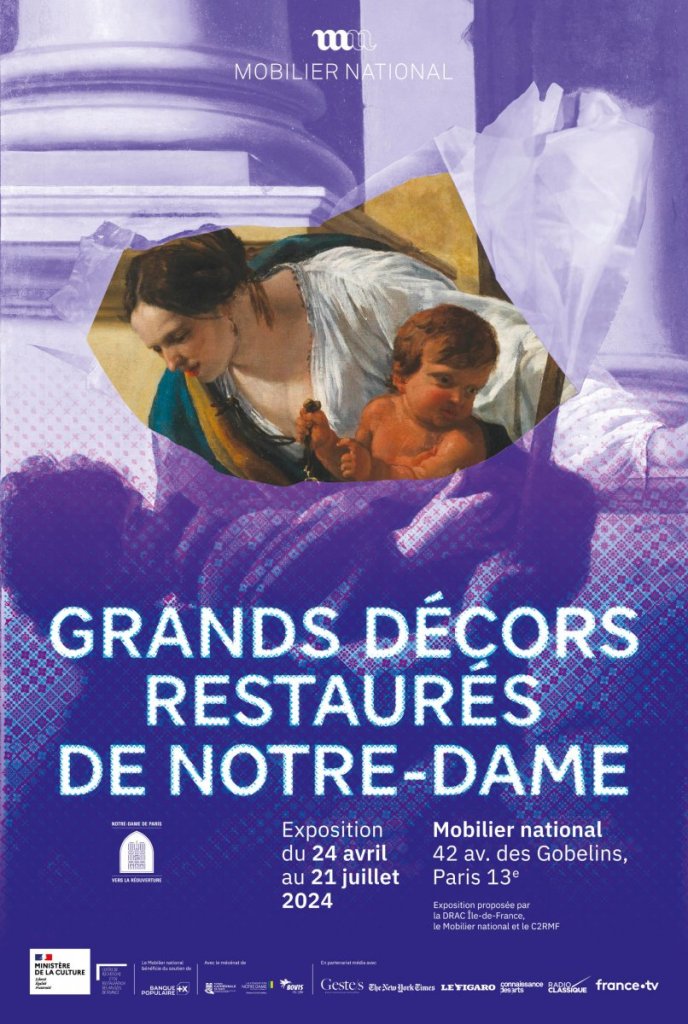 Enfin, en accord avec le diocèse de Paris, sont aussi présentées les maquettes du futur mobilier liturgique actuellement en cours de réalisation. Restauration et création se mêlent ainsi, du XVIIe au XXIe siècle, pour faire de la cathédrale non seulement un fleuron de l’art gothique mais aussi un écrin d’objets d’art et de piété de qualité exceptionnelle.
Depuis l’incendie de 2019, près de 1 000 artisans travaillent au quotidien à la restauration de la cathédrale. Parmi eux, les restaurateurs de peintures ne sont pas les moins actifs. Ce sont eux qui ont redonné vie et couleur aux grands « mays », ces chefs-d’œuvre de peinture religieuse offerts chaque année au mois de mai, entre 1630 et 1707, par la confrérie des orfèvres de la ville de Paris. Leurs auteurs sont les plus grands peintres français de l’époque : Laurent de La Hyre, Aubin Vouet, Charles Le Brun, Eustache Le Sueur…). Accrochés à l’origine côte à côte dans la nef de la cathédrale, ils formèrent une collection unique en France, dispersée à la Révolution, puis partiellement rassemblée et replacée dans l’édifice.
La restauration de ces grands mays et des autres œuvres peintes, françaises et italiennes, conservées dans l’édifice à la veille de l’incendie et restauration, a été confiée par la DRAC Île-de-France confiée à trois groupements de restaurateurs du patrimoine, avec le soutien du Centre de recherche et de restauration des musées de France. Les treize mays restaurés sont présentés dans un ordre qui évoque leur accrochage originel dans la nef de la cathédrale. Des esquisses et des dessins sont aussi présentés, accompagnés de textes, de multimédia et d’explications qui aident à comprendre la richesse propre de chaque œuvre et le savoir-faire exceptionnel des restaurateurs du patrimoine.
Commissaires
• Caroline Piel, inspectrice des patrimoines, collège Monuments historiques (h)
• Emmanuel Pénicaut, directeur des collections du Mobilier national
assistés de
• Marie-Hélène Didier, conservatrice des Monuments historiques, DRAC Île-de-France
• Oriane Lavit, conservatrice du patrimoine, Centre de recherche et de restauration des musées de France (C2RMF)
Caroline Piel and Emmanuel Pénicaut, eds., Grands décors restaurés de Notre-Dame de Paris (Milan: Silvana Editoriale, 2024), 112 pages, ISBN: 978-8836656820, €15.
Note (added 28 January 2025) — The posting was updated to include the accompanying publication.










 Enfilade
leave a comment