Byron 200 Years after His Death
George Gordon Byron (1788–1824) died 200 years ago on Friday (19 April). Writing this week for The Washington Post, Michael Dirda reviews two new books about the poet (noted below), while Benjamin Markovits, in a New York Times essay, grapples with how (and whether) people still read him. A Byron Festival is being held at Trinity College, Cambridge (yesterday and today) while the Keats-Shelley House presents the exhibition, Byron’s Italy: An Anglo-Italian Romance, along with a series of talks and other events throughout the year. Finally (for now), Liverpool UP has discounted some of its Byron books.
The Byron Festival at Trinity
Trinity College Cambridge 19–20 April 2024
 Trinity College Cambridge will host a two-day festival to coincide with the 200th anniversary of Lord Byron’s death on 19 April 1824, in Missolonghi, Greece. Byron was a student at Trinity College and is one of its most celebrated alumni. While enrolled as an undergraduate, Byron published his collection of poetry, Hours of Idleness, and began the satirical poem that would become English Bards and Scotch Reviewers, a scathing provocation of the literary establishment.
Described by the College’s Senior Tutor of the time as a “young man of tumultuous passions,” Byron became one of the most controversial, celebrated, and influential poets of his age. When Westminster Abbey declined to accept the magnificent statue of Byron, created after his death by the Danish sculptor Thorvaldsen, Trinity gave it a home in the Wren Library, where the poet still stands—an impressive presence for students, scholars, and visitors.
But what kinds of presence does Byron have now? This question is the focus of an exciting programme of talks, readings, music, and exhibited work, which will address, and mediate, the legacy and status of Byron now, within the contexts of today’s culture and scholarship. The Byron Festival Conference programme includes talks about Byron, by academics and writers including Bernard Beatty, Drummond Bone, Clare Bucknell, Will Bowers, Christine Kenyon Jones, Mathelinda Nabugodi, Seamus Perry, Diego Saglia, Dan Sperrin, Jane Stabler, Fiona Stafford, A.E. Stallings, Andrew Stauffer, Corin Throsby, Clara Tuite, Ross Wilson.
◊ ◊ ◊ ◊ ◊
Fiona Stafford, ed., Byron’s Travels: Poems, Letters, and Journals (New York: Everyman’s Library, 2024), 728 pages, ISBN: 978-1101908426, $35.
 George Gordon, Lord Byron, was one of the leading figures of British Romanticism. The Byronic hero he gave his name to—the charming, dashing, rebellious outsider—remains a powerful literary archetype. Byron was known for his unconventional character and his extravagant and flamboyant lifestyle: he had numerous scandalous love affairs, including with his half-sister Augusta Leigh. Lady Caroline Lamb, one of his lovers, famously described him as “mad, bad and dangerous to know.”
His letters and journals were originally published in two volumes; this new one-volume selection includes poems and provides a vivid overview of his dramatic life arranged to reflect his travels through Scotland, Italy, Spain, Turkey, Albania, Switzerland, and of course Greece, where he died. It contains a new introduction by scholar Fiona Stafford highlighting Byron’s enduring significance and the ways in which he was ahead of his time.
Fiona Stafford is a professor of English literature at Oxford University. The author of many books, including a biography of Jane Austen, she also wrote and presented the highly acclaimed The Meaning of Trees for BBC Radio 3’s The Essay. Her book The Long, Long Life of Trees, published in 2017, was a Sunday Times Nature Book of the Year.
◊ ◊ ◊ ◊ ◊
Andrew Stauffer, Byron: A Life in Ten Letters (Cambridge: Cambridge University Press, 2024), 300 pages, ISBN: 978-1009200165, $30.
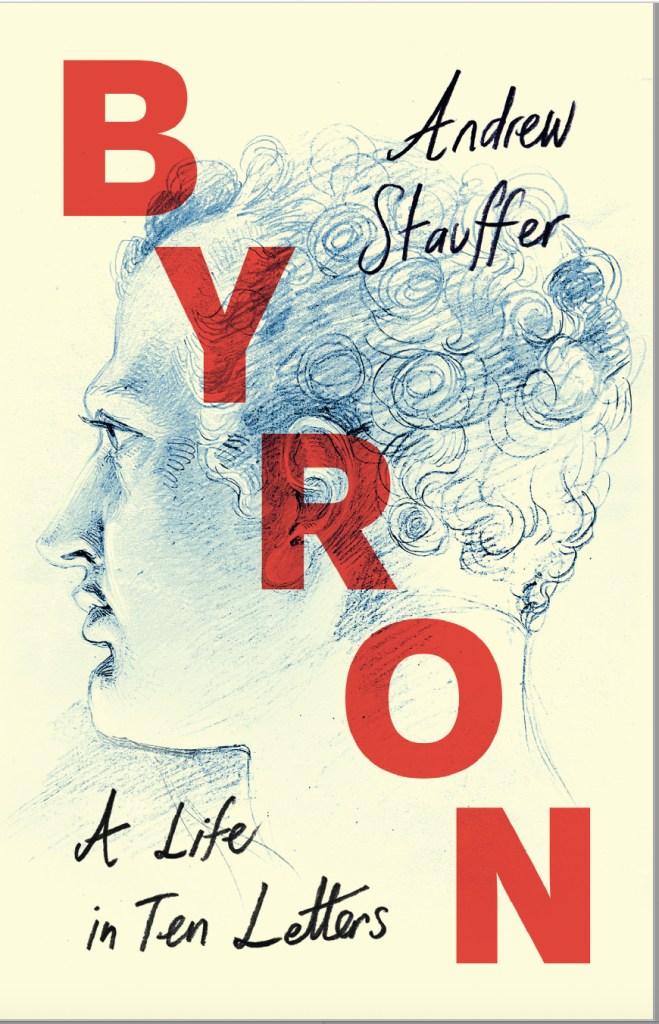
Lord Byron was the most celebrated of all the Romantic poets. Troubled, handsome, sexually fluid, disabled, and transgressive, he wrote his way to international fame—and scandal—before finding a kind of redemption in the Greek Revolution. He also left behind the vast trove of thrilling letters (to friends, relatives, lovers, and more) that form the core of this remarkable biography. Published to coincide with the 200th anniversary of Byron’s death, and adopting a fresh approach, it explores his life and work through some of his best, most resonant correspondence. Each chapter opens with Byron’s own voice—as if we have opened a letter from the poet himself—followed by a vivid account of the emotions and experiences that missive touches. This gripping life traces the meteoric trajectory of a poet whose brilliance shook the world and whose legacy continues to shape art and culture to this day.
Andrew M. Stauffer is a professor in the English Department at the University of Virginia, where he specializes in nineteenth-century literature, especially poetry.
Exhibition | The Tiepolos: Invention and Virtuosity in Venice
Now on view at the Beaux-Arts de Paris:
The Tiepolos: Invention and Virtuosity in Venice
Beaux-Arts de Paris, 22 March — 30 June 2024
Curated by Hélène Gasnault and Giulia Longo
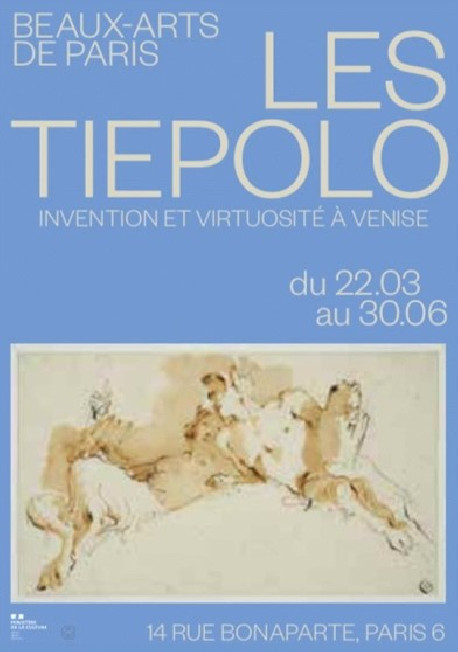 This exceptional exhibition brings together drawings and etchings by Giambattista Tiepolo and his two sons, Giandomenico and Lorenzo Tiepolo, a family of virtuoso artists in 18th-century Venice.
The Beaux-Arts de Paris owns a remarkable collection of ten works by Giambattista Tiepolo (1696–1770), making it the second-largest public collection of the artist’s drawings in France. Above all, this collection is the only one in France to include drawings not only by Giambattista, but also by his two painter sons, Giandomenico (1727–1804) and Lorenzo (1736–1776), as well as another of Tiepolo’s assistants in the 1730s, Giovanni Raggi. This collection alone provides an overview of graphic practices within the family and the studio.
The study of these sheets and prints, combined with works by other artists—sources of inspiration such as Rembrandt, masters such as Piazzetta, and contemporaries such as Canaletto, Guardi, and Novelli—highlights the great modernity of their art. This is particularly evident in their ability to produce variations on the same theme, both in traditional religious and mythological subjects and in figure studies, particularly caricatures, as well as scenes from Venetian life. The exhibition also explores the relationship between the father and his sons, and the work within a family of artists.
The exhibition opens with a series of studies of heads and faces that raise the question of training in the Tiepolo studio. It then moves on to religious paintings and large-scale secular decors produced by the Tiepolos and their contemporaries in Venice, followed by autonomous graphic works conceived outside of any painted project, as pure graphic exercises or pleasures, based on iconographic themes repeated almost obsessively, in multiple variants. It is the exceptional inventiveness of Giambattista and Giandomenico Tiepolo, one of the most fascinating facets of their artistic personalities, that these drawings and prints allow us to rediscover.
Curated by Hélène Gasnault, curator of drawings at Beaux-Arts de Paris, and Giulia Longo, curator of engravings and photos at Beaux-Arts de Paris.
Hélène Gasnault, ed., with additional texts by Catherine Loisel and Giulia Longo, Les Tiepolo: Invention et virtuosité à Venise (Paris: Beaux-Arts de Paris éditions, 2024), 112 pages, ISBN: 978-2840568780, €25.
Exhibition | Disegno Disegni
This exhibition of over 100 Italian drawings closed on Sunday, though there is a catalogue:
Disegno Disegni
Musée Jenish, Vevey, Switzerland, 8 December 2023 — 14 April 2024
Curated by Emmanuelle Neukomm et Pamella Guerdat

Pietro Palmieri, Trompe-l’oeil with eight copied engravings and study drawings stacked on top of each other, 1783, pen, black and brown inks, brown wash, and blue watercolor on paper, 45 × 60 cm (Vevey: Musée Jenish; photo by David Quattrocchi).
Avec Guerchin, Novelli, Piola, Tiepolo ou encore Zuccari, le dessin italien ancien et moderne est au coeur de l’exposition Disegno disegni.
Dans le sillage du legs de René de Cérenville en 1968, qui faisait la part belle à la création graphique de la Péninsule, les fonds italiens du Musée Jenisch Vevey n’ont cessé de s’enrichir au fil des années, constituant aujourd’hui l’un des noyaux essentiels du patrimoine veveysan. Plus de 100 feuilles issues d’une collection particulière déposée au musée depuis 2003 sont mises en lumière pour l’occasion, dans un dialogue fécond avec les propres fonds de l’institution. Les pièces ainsi réunies invitent à voyager à travers les grands centres artistiques d’Italie, de Venise à Rome, en passant par Bologne et Florence. Autant d’écoles à l’origine d’une production dessinée placée sous le signe de la diversité technique et matérielle. Sujets religieux et profanes, pages d’études et dessins autonomes célèbrent la pluralité qui caractérise le médium et ses multiples fonctions, entre la fin du XVe siècle et les premières décennies du XIXe siècle.
Une exposition sous le commissariat de Emmanuelle Neukomm et Pamella Guerdat, conservatrice et conservatrice adjointe Beaux-Arts, assistées de Leïla Thomas, collaboratrice scientifique.
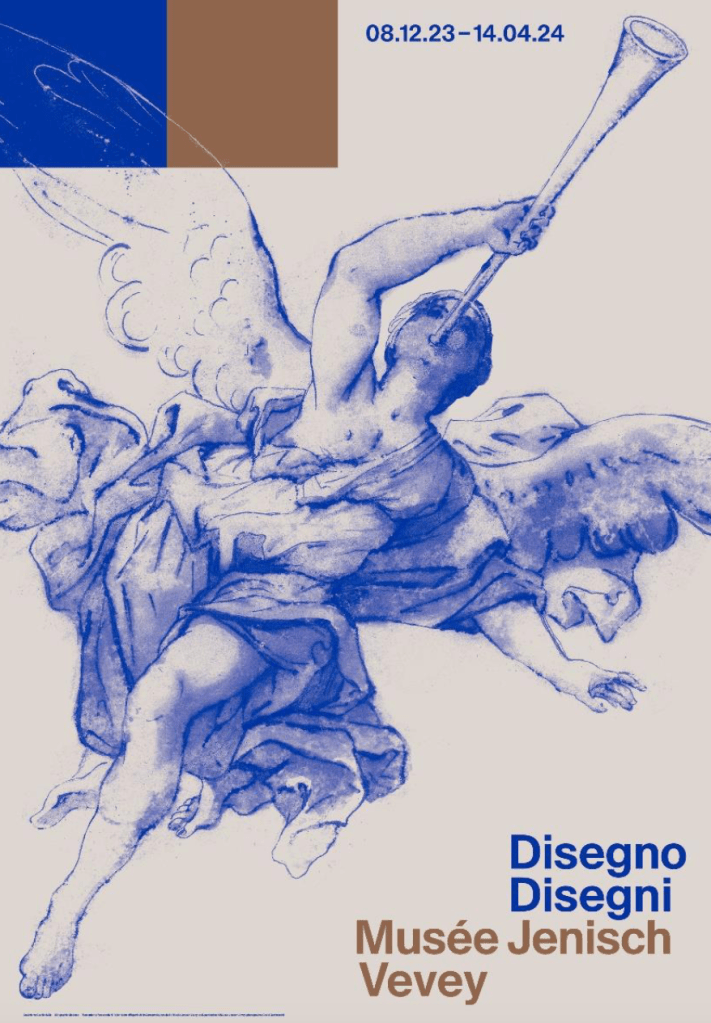
Marcantonio Franceschini, Allegory of Fame, before 1696 (Private Collection).
Pamella Guerdat et Emmanuelle Neukomm, eds., Disegno disegni: Dessins italiens de la Renaissance au XIXe siècle (Milan: Silvana Editoriale, 2024), 340 pages, ISBN: 978-8836654727, €45.
Préface — Nathalie Chaix
Le dédale des provenances — Ètienne Dumont
Connoisseurship et marché de l’art — Frédéric Elsig
Avertissement
Catalogue: Dessins italiens de la Renaissance au XIX siècle
Du dessin, la part maudite — Jérémie Koering
Index
Bibliographie sélective
Remerciements
Impressum
On Display | Quapaw Treaty of 1818
From the press release:
Nation to Nation: Treaties between the United States and American Indian Nations — Quapaw Treaty of 1818
National Museum of the American Indian, Washington, DC, April–October 2024
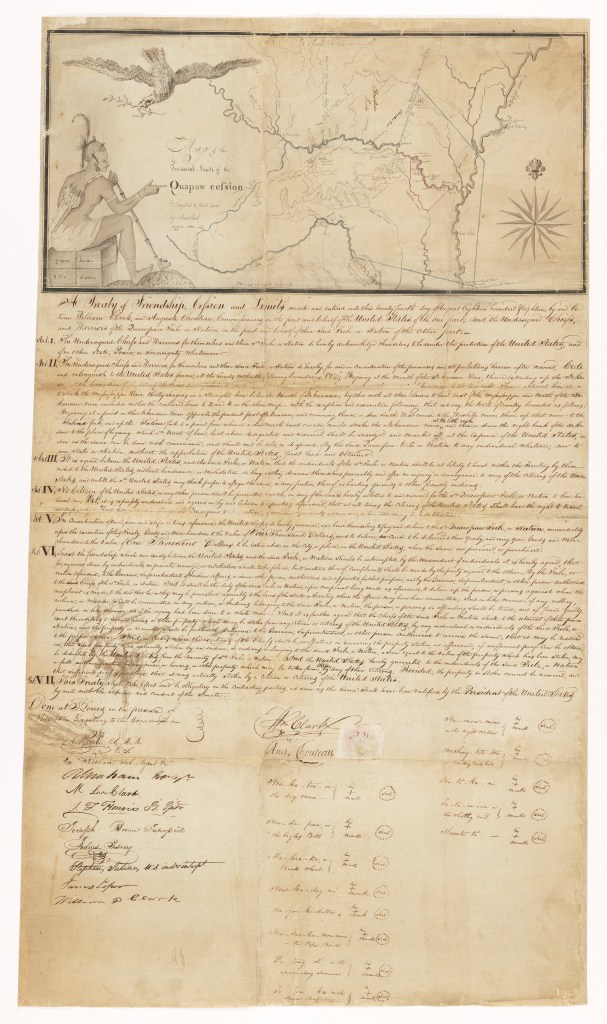
Quapaw Treaty, 24 August 1818 (Washington, DC: National Archives). Transcript originally published in Indian Affairs: Laws and Treaties, compiled and edited by Charles J. Kappler, 1904; digitized by Oklahoma State University.
The National Museum of the American Indian, in partnership with the National Archives and Records Administration, is displaying the Quapaw Treaty of 1818 as part of the exhibition Nation to Nation: Treaties between the United States and American Indian Nations (2014–28). The Quapaw Treaty will be on view until October 2024.
When the U.S. negotiated the Treaty of 1818, the Quapaw lived in four towns along the lower Arkansas River, although their hunting territories extended broadly to the west. The U.S. wished to acquire rights to these territories, which they considered excess Quapaw land, with the idea that those lands might be used for the resettlement of eastern tribes dispossessed by removal. The U.S. offered a lump-sum payment, promises of more payments annually for perpetuity, and a reservation composed of the territories occupied by the Quapaw towns. Just six years after the treaty was ratified, U.S. negotiators returned in 1824 at the behest of white settlers who desired the prime agricultural land of the lower Arkansas. The Quapaw were forced to abandon the 1818 reservation and move further west. Quapaw leader Heckaton, who felt compelled to agree to removal, said, “Since you have expressed a desire for us to remove, the tears have flowed copiously from my aged eyes.”
Displaying original treaties in Nation to Nation is made possible by the National Archives and Records Administration, an exhibition partner. Several of the treaties required extensive conservation treatment by the National Archives’ conservator prior to loan. Treaties can only be displayed for a short amount of time in order to conserve them for the future. There are a total of more than 370 ratified Indian treaties in the National Archives; more information about these treaties is available through its website.
Treaty Exhibition Schedule
September 2014–February 2015 — Treaty of Canandaigua, 1794
March–August 2015 — Muscogee Treaty, 1790
September 2015–February 2016 — Horse Creek (Fort Laramie) Treaty, 1851
March–August 2016 — Treaty with the Potawatomi, 1836
September 2016–February 2017 — Unratified California Treaty K, 1852
March–August 2017 — Medicine Creek Treaty, 1854
September 2017–January 2018 — Treaty of Fort Wayne, 1809
February–April 2018 — Navajo Treaty, 1868
May–October 2018 — Treaty with the Delawares, 1778
November 2018–March 2019 — Fort Laramie Treaty, 1868
April–September 2019 — Treaty of New Echota, 1835
October 2019–March 2020 — Treaty of Fort Stanwix, 1784
October 2020–March 2021 — Treaty of Fort Jackson, 1814
November 2021–May 2022 — Treaty of Fort Harmar with the Six Nations, 1789
May–November 2022 — Treaty with the Nez Perce, 1868
November 2022–April 2023 — Prairie du Chien Treaty, 1829
May–October 2023 — Treaty with Cheyenne and Arapaho, 1865
October 2023–April 2024 — Medicine Lodge Creek Treaty, 1867
April–October 2024 — Treaty with the Quapaw, 1818
New Installation | The Calculated Curve: 18th-C. American Furniture
Now open at The Met:
The Calculated Curve: Eighteenth-Century American Furniture
The Metropolitan Museum of Art, New York, 5 April 2024 — ongoing
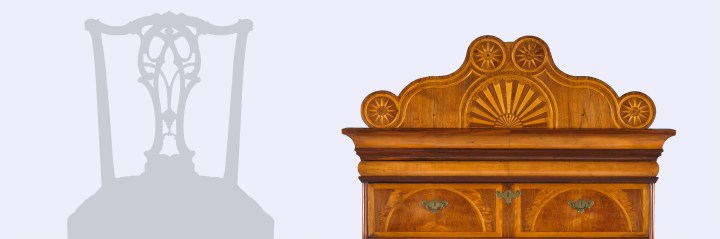 The 2024 reinstallation of the Anthony W. and Lulu C. Wang Galleries of Eighteenth-Century American Art of The Met’s American Wing elevates a pivotal moment in American furniture design between 1720 and 1770. This fresh installation encourages us to look closer at the materials and sculptural expression of this period, as well as the sensuality and ergonomics embedded in furniture design. The reinstalled galleries will feature iconic American furniture from the H. Eugene Bolles and Natalie Knowlton Blair collections, in addition to more recent gifts from premier collectors such as the Wangs as well as Erving and Joy Wolf. This striking display offers a counterpoint to the contextual installations of eighteenth-century furniture in the American Wing’s period rooms.
Major support for The Calculated Curve: Eighteenth-Century American Furniture is provided by The Edward John and Patricia Rosenwald Foundation.
Image: High chest of drawers (detail), 1730–50, American (New York: The Metropolitan Museum of Art, Bequest of Cecile L. Mayer, 1962).
Exhibition | Pocket Luxuries
Now on view at the Cognacq-Jay:
Pocket Luxuries: Small Precious Objects in the Age of Enlightenment
Luxe de poche: Petits objets précieux au siècle des Lumières
Musée Cognacq-Jay, Paris, 28 March — 29 September 2024
Curated by Sixtine de Saint Léger and Gabrielle Baraud
 L’exposition Luxe de poche au musée Cognacq-Jay présente une collection exceptionnelle de petits objets précieux et sophistiqués, en or, enrichis de pierres dures ou de pierres précieuses, couverts de nacre, de porcelaine ou d’émaux translucides, parfois ornés de miniatures. Les usages de ces objets varient, mais ils ressortent tous des us et coutumes d’un quotidien raffiné, signe de richesse, souvenir intime. Au siècle des Lumières comme aux suivants, ils suscitent un véritable engouement en France d’abord puis dans toute l’Europe. Luxe de poche a pour ambition de renouveler le regard que l’on porte sur ces objets, en adoptant une approche plurielle, qui convoque à la fois l’histoire de l’art et l’histoire de la mode, l’histoire des techniques, l’histoire culturelle et l’anthropologie en faisant résonner ces objets avec d’autres œuvres : des accessoires de mode, mais aussi les vêtements qu’ils viennent compléter, le mobilier où ils sont rangés ou présentés et enfin des tableaux, dessins et gravures où ces objets sont mis en scène. Ce dialogue permet d’envisager ces objets dans le contexte plus large du luxe et de la mode au XVIIIe et au début du XIXe siècle.
Point de départ de cette nouvelle exposition, la remarquable collection d’Ernest Cognacq est enrichie de prêts importants—d’institutions prestigieuses comme le musée du Louvre, le musée des Arts décoratifs de Paris, le Château de Versailles, le Palais Galliera, les Collections royales anglaises ou le Victoria and Albert Museum à Londres—afin d’offrir une nouvelle lecture de ces accessoires indispensables du luxe.
Commissariat scientifique
• Vincent Bastien, collaborateur scientifique au Château de Versailles
• Ariane Fennetaux, professeure des universités, Université Sorbonne Nouvelle
• Pascal Faracci, conservateur en chef du patrimoine
Sixtine de Saint-Léger, ed., Luxe de poche: Petits objets précieux au siècle des Lumières (Paris: Musée Cognacq-Jay, 2024), 96 pages, ISBN: 978-2759605798, €19. With contributions by Gabrielle Baraud, Vincent Bastien, Ariane Fennetaux, and Alice Minter.
Exhibition | Silver Treasures from Norway
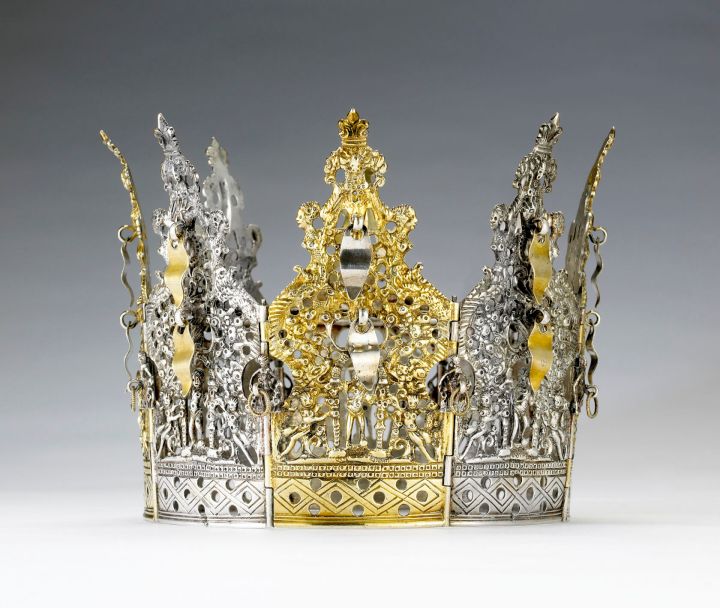
Bridal Crown, 1590–1610, silver and silver- gilt
(Christen Sveaas Collection)
◊ ◊ ◊ ◊ ◊
From the press release (8 January 2024) for the exhibition . . .
Crowning the North: Silver Treasures from Bergen, Norway
Museum of Fine Arts, Houston, 11 February — 5 May 2024
Spanning the 16th to the early 20th century, this exhibition of some 200 objects reveals the evolution of a uniquely Norwegian approach to silversmithing over centuries of global change.
For centuries, Bergen, one of the largest port cities in Scandinavia, was a thriving hub of global commerce, with a burgeoning export of fish, timber, and fur. That trade in turn spurred the development of a uniquely Norwegian approach to a timeless craft: gold and silver smithing. Crowning the North: Silver Treasures from Bergen, Norway explores the art of the Bergen silversmiths from the 16th to early 20th century and examines the evolution of the craft against the backdrop of greater political, social, and economic change in Norway and other parts of the world. Some 200 objects—from spoons, tankards, sugar bowls, and salt cellars, to elaborate ceremonial wedding crowns and fantastical vessels—are on exclusive loan to the U.S. from three public and private Norwegian collections: Kode Bergen Art Museum, the Bergen University Museum, and the private collection of Christen Sveaas.
“This presentation of objects from three prestigious Norwegian collections of art, craft, and design is an exceptional opportunity to discover Nordic history and aesthetics across centuries and across the intersecting forces of global trade, taste, and fashion,” commented Gary Tinterow, director and Margaret Alkek Williams Chair, the Museum of Fine Arts, Houston. “We are pleased to collaborate with the Kode Bergen Art Museum in bringing these remarkable objects to Houston, where they will be seen by U.S. audiences for the first time.”
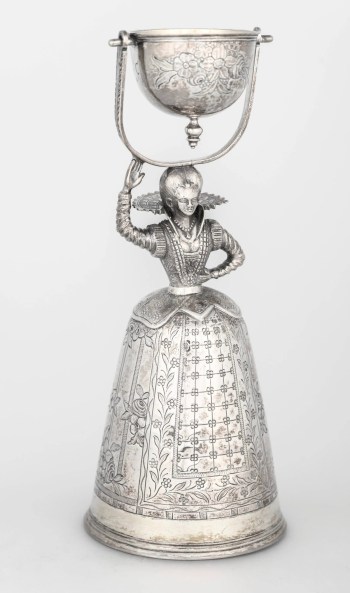
Johan Helmich Hoff, Silver Maiden Beaker, 1782, silver and silver-gilt (Kode Bergen Art Museum).
By the 16th century, Bergen had become a critically important global economic center in the trade of grain and salts for lumber and stock fish from the North. At the time ruled by Denmark, Bergen and its commerce operated under the jurisdiction of the Hanseatic League, a confederation of merchant guilds and market towns across central and northern Europe established by German traders in the 13th century. The league’s dominant global exchange network brought together two factors that fostered what would become a unique artistic heritage in Bergen: the availability of enormous quantities of silver mined from the Spanish Americas, and an influx of immigrants and their craft traditions from Germany and other European countries.
Bergen goldsmiths formed their own Goldsmith’s Guild in 1568. The goldsmith tradition that evolved in the city allowed artisans, both men and women, to craft a range of decorative and functional objects of extraordinary quality. Bergen goldsmiths’ sensibilities in the 16th century reflected the Renaissance and, later, Baroque styles of the time. Over the course of the 18th century, the influx of global commodities like tobacco and coffee from European colonies inspired goldsmiths to craft elegant objects for daily use to meet consumer demand. By the 19th century, with the excavations of three Viking ships and agitation for independence from Sweden, a growing sense of revivalism in art, literature, and popular culture inspired Norway’s goldsmiths to create fantastical objects harkening back to the Viking and medieval era. For centuries, with no banking system in place until 1816 following Norway’s union with Sweden in 1814, these silver and gold items—spoons, tankards, sugar bowls, and salt cellars, along with ceremonial objects such as brides’ wedding crowns—also functioned as a means of building personal wealth.
Crowning the North: Silver Treasures from Bergen, Norway is organized by the Museum of Fine Arts, Houston, in collaboration with the Kode Bergen Art Museum.
Kode Bergen Art Museum is one of the largest museums for art, crafts, design, and music in the Nordic region. Kode offers a unique combination of art museums and composers’ homes, showcasing contemporary art, historical collections, concerts, and parklands. The museum stewards over 50,000 objects, including paintings, works on paper, sculptures, installations, videos, musical instruments, furniture, textiles, ceramics, glass, and metal. These objects can be experienced in four different neighboring art museums in the heart of Bergen and the three beautifully located homes of the composers Ole Bull, Harald Sæverud, and Edvard Grieg.
Exhibition | Timeless Beauty: A History of Still Life
From the Staatliche Kunstsammlung Dresden:
Timeless Beauty: A History of Still Life / Zeitlose Schönheit: Eine Geschichte des Stilllebens
Gemäldegalerie Alte Meister, Zwinger, Dresden, 17 November 2023 — 1 September 2024
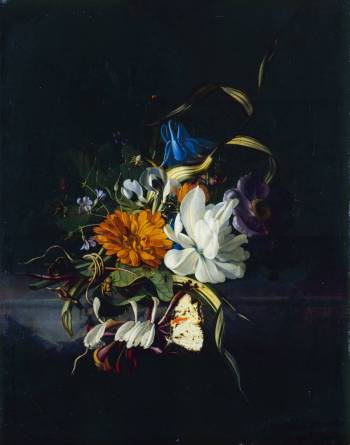
Rachel Ruysch (1664–1750), Floral Still Life, 1690, oil on canvas on oak panel, 35 × 27 cm (Dresden: Museum Gemäldegalerie Alte Meister, 3149).
In the Winckelmann Forum of the Semper Building, the Gemäldegalerie Alte Meister presents around 80 works from its own collection in the exhibition Timeless Beauty: A History of Still Life. The wide-ranging presentation—with masterpieces by painters such as Frans Snyders, Balthasar van der Ast, Jan Davidsz. de Heem, Adriaen van Utrecht, Willem Claesz. Heda, Abraham Mignon, and Rachel Ruysch—comprehensively illuminates the genre ‘still life’. Since when has it existed? What exactly constitutes a still life? What meaning, what content and what function did they have and still have today? What allegories and symbols are hidden in these motifs?
Still lifes were not only showpieces of decorative room furnishings, in which the overall effect was in the foreground. They also bear witness to natural scientific interests: the depicted object is regarded as a scientifically object and ‘document’—today as in the Age of Enlightenment. At the same time, however, still lifes are also an illusion, a game with the eye (trompe-l’œuil), in which the optical effect of the entire motif takes center stage. Through the bravura of painting, the ephemeral is immortalized. Many of the works on display, some of them recently restored, allow visitors to rediscover this fascinating genre, as only a few of the more than 100 still lifes in the Gemäldegalerie Alte Meister are on permanent display.
Konstanze Krüger, ed., Stillleben: Zeitlose Schönheit (Berlin: Hatje Cantz Verlag, 2023), 160 pages, ISBN: 978-3775751131, $50.
Konstanze Krüger, ed., Still Life: Timeless Beauty (Berlin: Hatje Cantz Verlag, 2024), 144 pages, ISBN: 978-3775751148, $40.
Exhibition | Two Masterpieces by Jan Van Huysum
From the press release for the exhibition:
Look Closely, Can You Spot the Butterfly? Two Masterpieces by Jan Van Huysum
Strawberry Hill, Twickenham, 16 May — 8 September 2024

Jan van Huysum, Flowers in a Vase with Crown Imperial and Apple Blossom at the Top and a Statue of Flora, 1731–32 (Private Collection).
Strawberry Hill House continues its acclaimed In-Focus series in 2024–25 with displays of extraordinary objects and artworks that have a connection with its original owner, Horace Walpole (1717–1797). Featuring paintings by Jan Van Huysum, a bronze bust of Caligula, and three mysterious daggers, each of the three exhibitions will tease out the fascinating facts and hidden histories connecting these artworks to this remarkable writer, connoisseur, and collector.
Evocatively demonstrating Jan Van Huysum’s (1682–1749) gift for creating sophisticated still life compositions depicting flowers and fruits, Strawberry Hill House is delighted to present the Dutch 18th-century master’s Flowers in a Vase with Crown Imperial and Apple Blossom at the top and a Statue of Flora and Fruit and Flowers in front of a Garden Vase with an Opium Poppy and a Row of Cypresses, both from 1731–32. On loan from a private collection, the paintings will be on public display for the first time in 10 years.
Art historian Andrew Graham Dixon has described the pair as “the two most brilliant and perfectly preserved paintings by the painter,” and they have remained together ever since leaving Van Huysum’s studio. It is believed that they were conceived as pendants from the outset, one showing mostly fruits, the other flowers. The pictures are in exceptional preservation and vividly showcase Van Huysum’s desired freshness of colour and transparency. They were originally owned by the painter Jeanne Etienne Liotard (1702–1789).
Van Huysum’s work was greatly appreciated during his lifetime, and for half a century afterwards his pictures sold for unprecedented sums and were only collected by the richest collectors in Europe, among which was Horace’s father, Sir Robert Walpole (1676–1745). Although Horace Walpole did not keep any Jan Van Huysums at Strawberry Hill himself—due to their rarity, expense, and difficulty in procurement—he did possess a painting by Jacob Van Huysum, Van Huysum’s brother, who resided at Sir Robert Walpole’s house in Chelsea, as well as numerous pictures by Jean Baptiste Monnoyer (1636–1699), a French-Flemish painter who relocated to Britain in the late 17th century, and works by his son Antoine Monnoyer, (1670–1747) whose compositions were similar to Van Huysum’s but less soft and finished.
Liotard was forced to sell his pair of Van Huysums, and afterwards they were bought by the Landgraf Friedrich II of Hesse-Cassel (1720–1785), only to be appropriated by Napoleon during the wars before remerging in England, in private collections. Strawberry Hill House’s In-Focus exhibition will provide visitors with an immersive experience, inviting them to delve into the intricate details and pictorial brilliance and to celebrate Walpole’s fascination with flowers and his garden at the villa, through Van Huysum’s beautiful paintings.
Rediscovered: The Lost Bronze of Roman Emperor Caligula
6 June — 8 September 2024
Is This a Dagger I See before Me? The Collector, the Actor, and the Mystery of the Ottoman Jewelled Dagger
3 October 2024 — 10 January 2025
More information on these two exhibitions is available here»
Exhibition | Glamorous Women: Gender and Fashion in Chinese Art
Now on view at The Nelson-Atkins:
Glamorous Women: Gender and Fashion in Chinese Art
The Nelson-Atkins Museum of Art, Kansas City, 18 November 2023 — 19 May 2024
Curated by Ling-en Lu
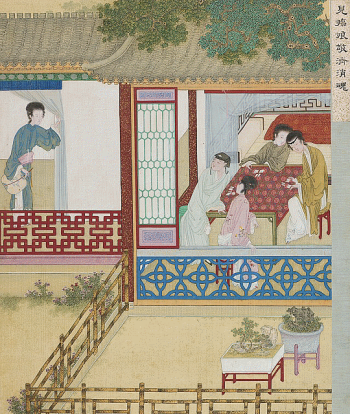
Jingju Losing His Mind upon Seeing Golden Lotus, from the album Illustrations of Scenes from ‘The Plum in the Golden Vase’, Chinese, 18th century, album leaf, ink and color on silk, 39 × 32 cm (Kansas City: The Nelson-Atkins Museum of Art, 2006.18.7).
As early as 600 BCE, Chinese women’s roles in society were primarily centered within the home. These roles were informed by Confucianism, which promoted their view of a harmonious societal order, elevating men as the household authorities and assigning women to domestic roles. As a result, women’s contributions to society were largely overlooked.
However, art depicting women and fashions created by and for women underscore their crucial impact as tastemakers in visual culture from the 1100s to 1800s. Early works like shinühua (painting of gentlewomen) portrayed women as exemplary models of beauty and femininity. Artists later revamped this tradition to illustrate women as provocative seductresses in popular Chinese stories. By the 1800s, women used fashion and accessories to transform themselves from muted muses to fashionable trendsetters in Chinese society.
By looking closely at visual clues and symbolism embedded within these works, we can learn more about women’s lives, their beauty ideals, and their overall influence on art and culture. Viewed together, we see how women impacted Chinese art and culture much more fully than what we know from written history.
Organized by The Nelson-Atkins Museum of Art. Generous support provided by the E. Rhodes and Leona B. Carpenter Foundation.










 Enfilade
leave a comment