Exhibition | William Blake’s Universe

From the press release for the exhibition:
William Blake’s Universe / William Blakes Universum
The Fitzwilliam Museum, Cambridge, 23 February — 19 May 2024
Hamburger Kunsthalle, 14 June — 8 September 2024
Curated by David Bindman and Esther Chadwick
Responding to the upheavals of revolution and war in Europe and the Americas, visionary artist, poet, and printmaker William Blake (1757–1827) produced an astonishing body of work that combined criticism of the contemporary world with his vision for universal redemption. But he wasn’t the only one. William Blake’s Universe is the first major exhibition to consider Blake’s position in a constellation of European artists and writers striving for renewed spirituality in art and life.
Organised in collaboration with the Hamburger Kunsthalle, and drawing on extensive research, this ambitious exhibition will explore the artist’s unexpected yet profound links with important European figures including pre-eminent German Romantic artists Philipp Otto Runge (1777–1820) and Caspar David Friedrich (1774–1840). It will also place Blake within his artistic network in Britain, drawing parallels with the work of his peers, mentors, and followers including Henry Fuseli (1741–1825), John Flaxman (1755–1826), and Samuel Palmer (1805–1881).

Poster with detail of William Blake after Henry Fuseli, Head of a Damned Soul, ca. 1788–90, engraving and etching on paper (University of Cambridge: The Fitzwilliam Museum).
Featuring around 180 paintings, drawings, and prints—including over 90 of those by Blake—this major exhibition marks the largest ever display of work from the Fitzwilliam’s world-class William Blake collection, with additional loans from the British Museum, Tate, Ashmolean and other institutions. Examples of the artist’s most iconic and much-loved works including Albion Rose (1794–96) and Europe: A Prophecy (1794), will be joined by rarely exhibited artworks from Blake’s oeuvre, including outstanding new acquisitions from the Sir Geoffrey Keynes bequest, displayed publicly for the first time since joining the Fitzwilliam collection. These include the trial frontispiece of Blake’s prophetic book Jerusalem (1804–1820) and his spectacular large drawing Free Version of the Laocoön (c.1825). Additional highlights include the unique first state of Joseph of Arimathea (1773), produced by Blake as an apprentice aged 16, shown alongside a reworked version of the same image, completed by Blake in his mature years.
Visitors will have a special opportunity to discover the work of Runge, one of Germany’s most important Romantic artists, who has been very rarely seen in the UK until now. Bringing together the largest number of Runge works in the UK to date, the exhibition will include the engravings from the Times of Day (1802–10) series, a defining work of German Romanticism. Representing not only the changing times of day, but the seasons, the ages of man and historical epochs, Runge obsessively returned to this important body of work, an extensive number of preparatory drawings and studies of which will be presented at the Fitzwilliam. Among the works on loan from the Hamburger Kunsthalle will be The Large Morning (1808–09), a fragmentary oil painting widely considered to be one of the most important works from Runge’s short career, cut short by his death aged 33.
Another highlight of the exhibition will be Caspar David Friedrich’s seven sepia drawings The Ages of Man (c.1826) on loan from the Hamburger Kunsthalle. Thought to be inspired by Runge’s interest in visual representations of time, the exquisitely delicate series is associated with the themes of change in nature, the cyclical representation of time, and the temporality of human life.
 William Blake’s Universe will unfold in three main sections—past, present and future—with an introductory display of artists’ portraits. ‘The Past: Antiquity and the Gothic’ will focus on the legacy of classical antiquity and Blake’s turn towards the Gothic as an alternative source of inspiration, as well as a spotlight section on Flaxman, an artistic mentor to Blake who gained great acclaim in Germany and across Europe. ‘The Present: Europe in Flames’ will concentrate on the responses of Blake and his close contemporaries in Britain to the revolutionary 1790s. The third section, ‘The Future: Spiritual Renewal’, will show how visions of redemption from a fallen world became a central concern for Blake and his contemporaries in the post-revolutionary period. Jacob Böhme’s mystical ideas about light and cosmic unity, which form a bridge between Blake and his German contemporaries, will be a central display.
William Blake’s Universe is curated by David Bindman, emeritus Durning-Lawrence professor of the History of Art at University College London, and Esther Chadwick, Lecturer in Art History at the Courtauld Institute of Art. The exhibition will be accompanied by a fully illustrated catalogue featuring new scholarship by the curators, as well as essays by leading academics Sarah Haggarty, Joseph Leo Koerner, Cecilia Muratori, William Vaughan, and James Vigus.
Curators David Bindman and Esther Chadwick said: “This is the first exhibition to show William Blake not as an isolated figure but as part of European-wide attempts to find a new spirituality in face of the revolutions and wars of his time. We are excited to be able to shed new light on Blake by placing his works in dialogue with wider trends and themes in European art of the Romantic period, including transformations of classical tradition, fascination with Christian mysticism, belief in the coming apocalypse, spiritual regeneration and national revival.”
David Bindman and Esther Chadwick, eds., William Blake’s Universe (London: Philip Wilson Publishers, 2024), 224 pages, ISBN: 978-1781301272, £35 / $45.
Exhibition | Kaendler’s Meissen Porcelain Figures
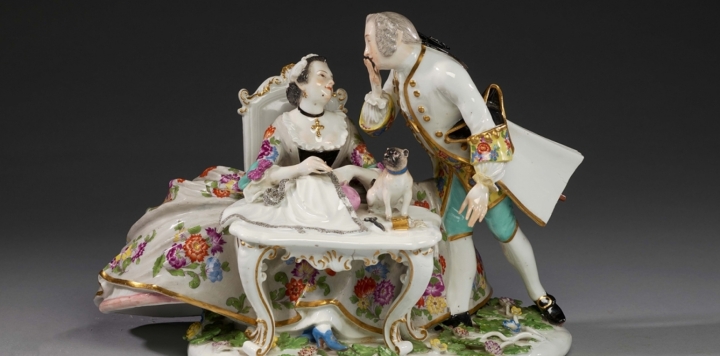
This summer at the Wawel Royal Castle:
Magnificence of Rococo: Kaendler’s Meissen Porcelain Figures
Wspaniałość rokoka: Miśnieńskie figurki porcelanowe Johanna Joachima Kaendlera
Wawel Royal Castle, National Art Collection, Kraków, 23 May — 29 September 2024
At the age of 25, Johann Joachim Kaendler (1706–1775) was appointed court sculptor by Augustus the Strong (r. 1694–1733). In the same year he joined the Meissen porcelain manufactory as a modeller, to which he remained loyal throughout his life. Kaendler’s name is closely associated with the golden age of the Meissen manufactory in the 18th century, where, he demonstrated his artistic and technical talent in creating numerous porcelain sculptures, which are still highly valued as collectors’ items today. At the same time they are still part of the manufactory’s repertoire.
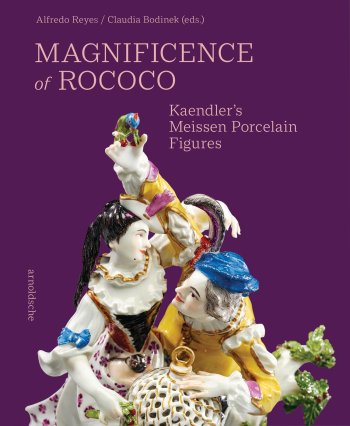 The choice of themes in Kaendler’s works reflects the courtly life of the period, which ranged from the late Baroque through the Rococo to the emerging Classicism. Until the end of the Saxon-Polish joint reign in 1763, the nobility and the court were almost the only clients of the manufactory, before the emerging middle classes finally discovered porcelain for themselves. Accordingly, Kaendler’s early works are oriented towards the preferences and fashions of the court. Hunting and theatre—especially the popular Commedia dell’arte—played a central role here, as did the Masonic Order, which was replaced by the Order of the Pug after the papal ban of 1738.
In 1736, for the first time Kaendler created one of the highly esteemed crinoline groups, which often depicted men and women in everyday court life, also in an amorous context. They were named after the ladies’ flared skirts, which were given their shape by a framework of fishbone. Alongside love adventures, the pastoral idyll, the simple life, was one of the secret longings of the nobility. This trend found its most famous manifestation in the Hameau of the French Queen Marie Antoinette (1755–1793) in Versailles. Kaendler served this fad with figures from the people, craftsmen, peasants and, last but not least, the ‘Cris de Paris’ (Cries of Paris), which embody various professions.
Increasing world trade and travel reports from distant countries stimulated people’s curiosity at that time. Exotic depictions of all kinds were in vogue. Artists and craftsmen endeavoured to satisfy the wishes of their customers with ever new subjects, which, however, were often far removed from reality—and few could verify it anyway. Kaendler devoted himself to the subject in his own way. He modelled figures in the national costumes of various peoples as well as animals that were foreign to Central Europeans at the time, such as elephants, lions and dromedaries, to name but a few. The chinoiseries had long since developed into a fashion in their own right. Kaendler did not limit himself to shaping individual figures in their characteristic costumes and physiognomy, but also created family scenes with a unique charm.
Kaendler’s surviving notes from the 1740s prove his productivity. The surviving porcelain sculptures bear witness to his creativity, his genius. Thus, within a few years, a world of his own was created in porcelain, which was enjoyed by the society of the time. Even if tastes have changed since then, Kaendler still proves to be a gifted artist when we take a closer look.
The exhibition jointly organised by the Röbbig Gallery and Wawel Royal Castle will present, for the first time in Poland, a magnificent group of figures by Johann Joachim Kaendler from European private collections. The exhibition will be an excellent pendant to the Wawel collection of Meissen porcelain, which centres around stately objects that create illustrate how the manufactory worked to elevate the prestige of the Wettin court. Wawel Hill was the seat of Polish kings from 1025, and coronations took place here, including that of Augustus II the Strony and his son Augustus III. The figurines presented by the Röbbig Gallery served the more private needs of porcelain lovers all over the world and continue to do so today. Together, the two collections will provide an opulent picture of life in the palaces and residences of the mid-eighteenth century.
Alfredo Reyes and Claudia Bodinek, eds., Magnificence of Rococo: Kaendler’s Meissen Porcelain Figures (Stuttgart: Arnoldsche, 2024), 400 pages, ISBN: 978-3897907072, $135.
Exhibition | ‘Fruit of Friendship’: Portraits by Mary Beale
From Philip Mould & Co:
‘Fruit of Friendship’: Portraits by Mary Beale
Philip Mould & Company, London, 25 April — 19 July 2024
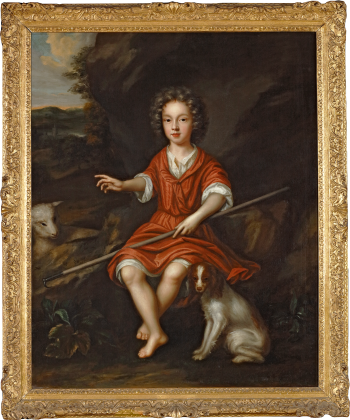
Mary Beale, Portrait of a Young Boy Seated in a Landscape, 1680s, oil on canvas, 127 × 102 cm.
Mary Beale (1633–1699) was one of Britain’s first professional woman artists. Philip Mould & Company’s forthcoming exhibition ‘Fruit of Friendship’: Portraits by Mary Beale, opening this spring, will feature twenty-five of her works from public and private collections, spanning her entire career and including self-portraits, portraits of her family and friends, and formal commissions.
The exhibition will also shed light on Beale’s studio practice and highlight its radical reversal of conventional gender roles for the period. Beale’s husband Charles dedicated himself to his wife’s career and supported her studio diligently by priming canvases, manufacturing pigments, and recording business in a series of notebooks. The exhibition will present three works not seen in public before, including an early re-discovered portrait of the artist’s husband and a portrait of Anne Sotheby, which will be displayed in the gallery for two weeks before it is exhibited in Tate Britain’s upcoming exhibition Now You See Us: Women Artists in Britain, 1520–1920.
The exhibition will be complemented by an openly available online catalogue. In anticipation of a comprehensive printed publication scheduled for summer 2024, this online resource will be an accessible guide to her works and their significance.
Ellie Smith and Lawrence Hendra, Fruit of Friendship: Portraits by Mary Beale (London: Paul Holberton Publishing, 2024), 160 pages, ISBN: 978-1913645748, £25.
◊ ◊ ◊ ◊ ◊
Note (added 4 September 2024) — The posting was updated to include the hardback catalogue.
Exhibition | Eye to Eye with Giulia Lama

From Save Venice:
Eye to Eye with Giulia Lama: A Woman Artist in 18th-Century Venice
A tu per tu con Giulia Lama: Una donna artista nel ‘700 veneziano
Pinacoteca Manfrediniana and Sacristy of the Basilica della Salute, Venice, 8 February — 8 June 2024
The special exhibition Eye to Eye with Giulia Lama: A Woman Artist in 18th-Century Venice features five canvases by Giulia Lama (1681–1747), which were recently restored thanks to Save Venice’s Women Artists of Venice (WAV) program. From 8 February until 8 June 2024, the Four Evangelists from the church of San Marziale will be on view at the Pinacoteca Manfrediniana, and the Virgin in Prayer from the church of Santa Maria Assunta on Malamocco will be installed in the nearby Sacristy of the Basilica della Salute. As these paintings are normally displayed high in their respective churches, this exhibition allows visitors the once-in-a-lifetime opportunity to view them up-close following the recent transformative conservation treatments.
The exhibition has been organized by Save Venice in collaboration with the Diocesi Patriarcato di Venezia, Pinacoteca Manfrediniana, Basilica della Salute, and UniSVe.
Exhibition | The Doering Fashion Collection

Shoes, made in England or America, ca. 1800, leather, silk, and linen
(Mary Doering Fashion Collection)
◊ ◊ ◊ ◊ ◊
From the press release for the exhibition:
Elegance, Taste, and Style: The Mary D. Doering Fashion Collection
DeWitt Wallace Decorative Arts Museum, Colonial Williamsburg, opening 22 February 2024 (with three rotations)
More than 150 objects from one of the greatest private collections of early textiles, accessories, and historic dress assembled in the United States will go on view over the next several years at the DeWitt Wallace Decorative Arts Museum, one of the Art Museums of Colonial Williamsburg. Elegance, Taste, and Style: The Mary D. Doering Fashion Collection will take visitors through 50 years of this collector’s passion and feature gowns, jackets, waistcoats, shoes, textile documents, and more dating between 1700 and 1840. Due to light sensitivity, the objects will be shown in three parts. The first installment displays approximately 40 objects and is the inaugural exhibition to be shown in the Mary Turner Gilliland and Clinton R. Gilliland Gallery, the Art Museums’ first dedicated gallery to historic costume. The dates for the second and third rotation of objects on view are still to be determined.
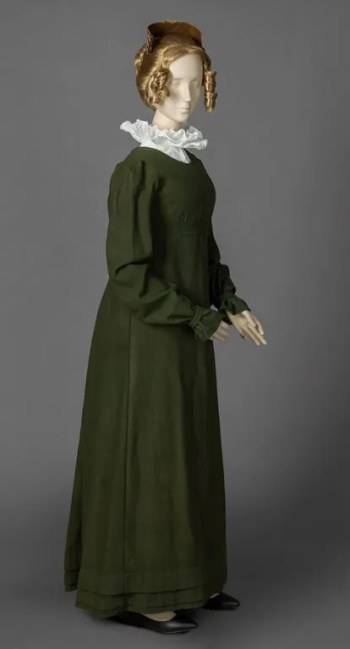
This green gown, made of wool, ca. 1815, is remarkable to have survived, because many woolen garments of the day were destroyed by moths and carpet beetles (Mary Doering Fashion Collection).
“Examples of historic dress are among the most human of artifacts from the past, providing windows into the lives and tastes of our forebearers,” said Ronald Hurst, the Foundation’s Carlisle H. Humelsine chief curator and senior vice president. “Mary Doering’s superb collection is particularly rich in such opportunities, and it is highly fitting that the Doering Collection constitutes the first exhibition in the new Gilliland Gallery for historic dress.”
When Mary D. Doering (b. 1952), a lifelong curator, educator, and researcher, was sixteen years old, she received a trunk filled with early 20th-century clothing as a bequest from her great aunt. This small gift was the impetus for what became a lifelong passion for historic dress. Throughout her career, Doering used her collection, which ultimately grew to thousands of pieces (there are approximately 800 pieces dating before 1840 alone), to educate hundreds of students and researchers about changing fashions, taste, design, and style. From the early collecting days when she went picking at local flea markets and antiques stores, to her first trip to the United Kingdom and her eventual meeting with the legendary antiques dealer Cora Ginsburg, who became Doering’s mentor, she thoughtfully and carefully selected every object in her collection. Over the nearly 50 years that she built the collection, Doering gained expertise to create a truly comprehensive assemblage ranging from underwear to the finishing accessories.
“It has been an absolute pleasure working with Mary’s collection, especially using objects so near and dear to her heart, to tell her lifelong story of collecting historic dress,” said Neal Hurst, Colonial Williamsburg’s curator of historic dress and textiles. “Every object that Mary acquired was carefully hand-selected based on her research and what she saw in other museums. Visitors to the new historic dress gallery will love seeing the range of clothing from the fine and fancy to the plain and every day.”

One highlight of the collection is a blue silk Englishman’s waistcoat, likely embroidered in the 1760s in China (Mary Doering Fashion Collection).
Among the highlights of Elegance, Taste, and Style is one of the first waistcoats Doering purchased of what was to become more than 100 examples dating between 1700 and 1840. This stunning blue silk waistcoat was probably embroidered in China in the 1760s for the Western market. Chinese embroidery is distinctive in that it uses twisted threads rather than single stranded floss. The object, the first of several Doering purchased at Christie’s in South Kensington, London, on 11 June 1974, was bought with money she saved to travel to Europe. Doering remembered the auctioneer saying, “Sold to the enthusiastic young woman on the aisle.”
Another featured object in the exhibition is an ivory, silk satin round gown in nearly perfect condition. Believed to be a wedding gown worn in the West Country of England, the style was popular in the mid-18th century; it integrates the petticoat into the structure of the skirt rather than it being a separate garment. Doering purchased this round gown along with two other gowns from Cora Ginsburg in honor of her mother who died in January 1978. Doering used the small sum of money her mother left to her to fund the gowns.
Although the Doering Collection is strong in American and English objects and focused heavily on women’s dress from the 18th and early 19th centuries, it also includes important pieces from Europe, such as the 1780s Dutch jacket that is another star piece in the exhibition. Jackets of this era, such as this one, were very low cut, even under the bust, with a large handkerchief worn over the top. Dutch women often dressed with many different prints and patterns, which varied greatly depending on the region. This example is unusual in that it uses two different block-printed cotton fabrics with black or dark blue backgrounds in the lower skirts and under the sleeves. It is important to note the careful use of textiles here with two different but very similar textiles used in obvious places; textiles were more expensive than the labor to construct the jacket, so this indicates a level of frugality.
The Doering Collection features numerous accessories, including shoes, buttons, work bags, hats, caps, and buckles. One example among the shoe collection is another highlight of Elegance, Taste, and Style. Although James B. Patterson’s identity is lost to history, he saw value in this pair of ivory, silk satin slippers with a small Italian-style heel popular in the 1780s. He affixed a paper label to the bottom that reads: “Shoes worn in 1782” along with his name. This pair shows very little wear on the soles and heels perhaps indicating that they were worn as wedding slippers.

Designed by Jean-Baptist Huet between 1800 and 1805, this piece of French-printed cotton includes amphora, Apollo’s lyre, and the mythical harpee enclosed within medallions (Mary Doering Fashion Collection).
Mary Doering also collected many textile documents to use in her class on design, manufacturing techniques, and the change in taste over time, which she taught at The Smithsonian Institution’s Master’s Program in the History of Decorative Arts in 2001. One such rare example to be seen in the exhibition is an early 19th-century cylinder print that shows the new style and taste desired across England and Europe. With the discovery of Pompeii and Herculaneum in the 1730s and Napoleon’s Egyptian Campaign at the turn of the century, ancient relics and symbols quickly became popular. Designed by Jean-Baptist Huet between 1800 and 1805, this print includes amphora, Apollo’s lyre and the mythical beast known as a Harpee, or half woman-half bird, enclosed within different medallions. The print, known as a furniture, was primarily used for bed hangings, window curtains, and slip covers. It is especially rare in that the designer, the printer, the date, and the place of production are all known.
Also included in the exhibition is a larger-than-life video panel that will be sure to delight visitors and highlight a practice we share with our 18th-century ancestors. It will show people of all races and classes, from Native Americans to soldiers, enslaved Africans to members of the top echelons of colonial society, tradesmen, and women, getting dressed.
In celebration of Elegance, Taste, and Style, a symposium on historic dress, Collections, Collectors, and Collaborations, will be held at The Colonial Williamsburg Foundation, 14–16 November 2024. The symposium will not only celebrate the opening of the Mary Turner Gilliland and Clinton R. Gilliland Gallery at the Art Museums of Colonial Williamsburg but also 90 years of historical dress and costumed interpretation at Colonial Williamsburg (since 1934), 70 years of the Margaret Hunter Shop, which was the first curated exhibition of clothing and accessories at Colonial Williamsburg (in 1954), and 40 years of mantua making in the Colonial Williamsburg’s department of historic trades (begun in 1984). Registration for the conference will launch later this spring.
Elegance, Taste, and Style: The Mary D. Doering Fashion Collection is generously funded by the Thomas L. and Nancy S. Baker Museum Exhibitions Support Fund. The exhibition’s video component, men’s accessories, and other essential aspects of the exhibition are funded by Charles and Ellan Spring.
Exhibition | Witness to Revolution: Washington’s Tent
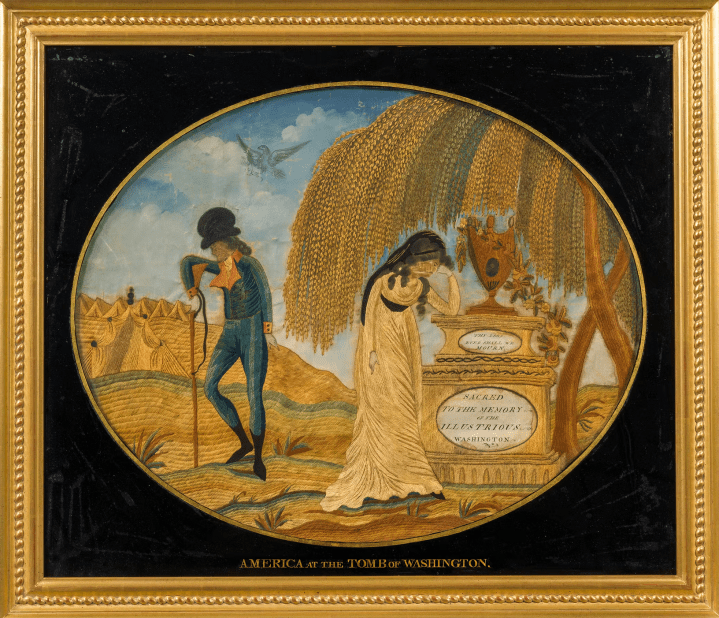
Needlework Mourning Picture, Philadelphia, ca. 1802, silk and paint on silk
(Philadelphia: Museum of the American Revolution, 2017.27.01)
◊ ◊ ◊ ◊ ◊
From the press release for the exhibition:
Witness to Revolution: The Unlikely Travels of Washington’s Tent
Museum of the American Revolution, Philadelphia, 17 February 2024 — 5 January 2025
Called “the crown jewel in the collection” by The Washington Post and the “rock-star object” by The New York Times, General George Washington’s headquarters tent from the Revolutionary War is the centerpiece of the Museum of the American Revolution, where more than a million visitors have experienced the tent’s power in an immersive theater experience. Now, in the Museum’s special exhibition, Witness to Revolution: The Unlikely Travels of Washington’s Tent, more than 100 artifacts from across the country have been brought together to explore the tent’s inspiring journey from the Revolutionary War to today.
Using objects, documents, works of art, touchscreen interactives, and audio and video elements, the exhibition brings to life the stories of individuals from all walks of life who saved Washington’s tent from being lost over the generations and who ultimately fashioned this relic into a symbol of our fragile but enduring American republic. The exhibit explores these personal stories, from well-known names like Alexander Hamilton, the Marquis de Lafayette, and Martha Washington, to lesser-known individuals like Washington’s enslaved valet William Lee, who lived alongside him in the tent, and Selina Gray, the enslaved housekeeper at Arlington House in Virginia who saved the tent during the Civil War.
“Since the Museum’s opening, visitors who have viewed our dramatic Washington’s War Tent presentation are often moved to tears and want to know more about the tent’s role as George Washington’s wartime home and about the diverse people who ensured that it survived to the present day,” said Dr. R. Scott Stephenson, Museum President and CEO. “Witness to Revolution will take visitors on a surprising journey of nearly 250 years, including stories of leadership, conflict, patriotism, and preservation. Washington’s tent helps us tell the American story.”
Visitors will follow Washington’s decision to leave the ‘tented field’ in 1783, packing up his military belongings (including the tent) and returning to private life at Mount Vernon. After General Washington’s death in 1799, the tent remained in the care of Martha Washington and her descendants. It was routinely displayed in the 1800s, most dramatically during Lafayette’s return to the United States in 1824. The exhibition explores how the tent became a ‘relic’ and a family heirloom, inherited by Martha Washington’s great-granddaughter, Mary Anna Randolph Custis, who married future Confederate General Robert E. Lee in 1831.
Witness to Revolution continues through the era of the Civil War, when the United States Army occupied the Custis-Lee home (Arlington House) and government officials confiscated the tent and placed it on display in Washington, D.C. The tent’s journey continues through Philadelphia’s Centennial International Exhibition of 1876 and a decades-long campaign by the Custis-Lee descendants to secure the return of their family heirlooms taken during the Civil War. Ultimately, a 1906 newspaper article sparked a friendship between Mary Custis Lee (1835–1918) and Episcopalian priest Rev. W. Herbert Burk (1867–1933), bringing Washington’s headquarters tent into the collection that is now on display at the Museum of the American Revolution.
The exhibition includes a recreation of the end of the headquarters tent to give visitors a sense of the tent’s size and scale. General Washington’s foldable field bedstead from the Revolutionary War, on loan from Mount Vernon, is displayed nearby. A tactile 3D-printed diorama of Washington’s sleeping and dining tents will be available for use by guests who are blind or low vision, created and donated by Clovernook Center for the Blind & Visually Impaired.
Key Artifacts on Display
Created by the Museum’s in-house curatorial team, the exhibition features works of art, rare documents, and significant historical objects from nearly 25 public and private collections across the United States, including Mount Vernon, Arlington House, Tudor Place, the Virginia Museum of History & Culture, and the Library of Congress.
• George Washington’s foldable field bedstead, which was used inside his headquarters tent during the Revolutionary War. On loan from the Mount Vernon Ladies’ Association.
• An 1872 letter written by Selina Gray to Mary Anna Randolph Custis Lee (wife of Robert E. Lee) describing the occupation of Arlington House by United States troops during the Civil War. At the time, Gray was the enslaved housekeeper at Arlington where Washington’s headquarters tent and other historical relics were stored and then confiscated by the United States Army. This manuscript is one of the few of Gray’s letters that survive. On loan from the Virginia Museum of History & Culture.
• The 1897 painting In the Presence of Washington by Howard Pyle, which depicts General Washington inside his headquarters tent during the Revolutionary War. On loan from the Biggs Museum of American Art.
• Pierre Charles L’Enfant’s panoramic watercolor of the Continental Army’s 1782 encampment at Verplanck’s Point, New York. This watercolor includes the only known eyewitness image of Washington’s headquarters tent in the field during the Revolutionary War. Collection of the Museum of the American Revolution.
• An 1844–49 daguerreotype of George Washington Parke Custis (Martha Washington’s grandson) who owned Washington’s headquarters tent during the early 1800s. On loan from the Library of Congress.
• A silver camp cup that General Washington ordered from Philadelphia silversmith Richard Humphreys in 1780 for use in his wartime headquarters and a large fragment cut from the roof of Washington’s headquarters tent. On loan from Yale University Art Gallery.
• Epaulets worn by Tench Tilghman, General Washington’s aide-de-camp, during the Revolutionary War. On loan from the Society of the Cincinnati.
• An iron hook cut from George Washington’s tent when the Marquis de Lafayette saw the tent set up at Fort McHenry in 1824 as part of his tour of the United States. The hook was cut by William B. Barney, a member of the Society of the Cincinnati of Maryland who was in the tent with Lafayette at the event. On loan from the DAR Museum.
• Fragments of the original headquarters tent and dining tent. On loan from various lenders and the Museum’s own collection.
• The original contract for purchase of the tent from 1909 and the visitor register from the Washington Memorial Chapel in Valley Forge where the tent was displayed in the early 1900s. Collection of the Museum of the American Revolution.
• A painted silk banner with a portrait of the Marquis de Lafayette at its center that was created in Philadelphia for the parade celebrating Lafayette’s return to the United States in 1824. Collection of the Museum of the American Revolution.
Exhibition | Angelica Kauffman

Angelica Kauffman, Portrait of Emma, Lady Hamilton, as Muse of Comedy, detail, 1791, oil on canvas, 127 × 102 cm
(Private collection)
◊ ◊ ◊ ◊ ◊
A version of the exhibition appeared in 2020 at Düsseldorf’s Kunstpalast and was intended to arrive much sooner at the Royal Academy but was derailed by Covid. The show opens next month (hooray!). . .
Angelica Kauffman
Royal Academy of Arts, London, 1 March — 30 June 2024
Curated by Bettina Baumgärtel and Per Rumberg, with Annette Wickham
Angelica Kauffman RA (1741–1807) was one of the most celebrated artists of the 18th century. In this major exhibition, we trace her trajectory from child prodigy to one of Europe’s most sought-after painters.
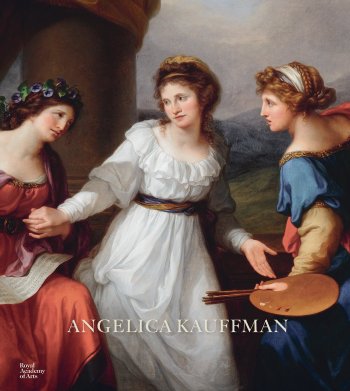 Known for her celebrity portraits and pioneering history paintings, Angelica Kauffman helped to shape the direction of European art. She painted some of the most influential figures of her day—queens, countesses, actors and socialites—and she reinvented the genre of history painting by focusing largely on female protagonists from classical history and mythology. This exhibition covers Kauffman’s life and work: her rise to fame in London, her role as a founding member of the Royal Academy, and her later career in Rome where her studio became a hub for the city’s cultural life. See paintings and preparatory drawings by Kauffman, including some of her finest self-portraits and her celebrated ceiling paintings for the Royal Academy’s first home in Somerset House, as well as history paintings of subjects including Circe and Cleopatra, and discover the remarkable life of the artist whom one of her contemporaries described as “the most cultivated woman in Europe.”
The exhibition is curated by Bettina Baumgärtel, Head of the Department of Painting at the Kunstpalast in Düsseldorf, and Per Rumberg, Curator at the Royal Academy, with Annette Wickham, Curator of Works on Paper at the Royal Academy.
Bettina Baumgärtel and Annette Wickham, Angelica Kauffman (London: Royal Academy of Arts, 2024), 144 pages, ISBN: 978-1915815033, £20 / $30.
◊ ◊ ◊ ◊ ◊
Note (added 15 February 2024) — Wendy Wassyng Roworth’s review of the 2020 exhibition catalogue appeared in The Woman’s Art Journal 42.1 (Spring/Summer 2021): 46–48.
Exhibition | Entangled Pasts, 1768–Now
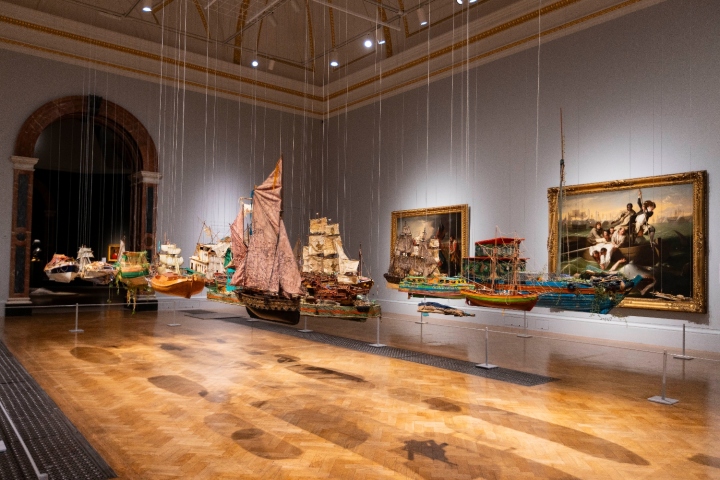
Installation view of Entangled Pasts, 1768–Now: Art, Colonialism, and Change at the Royal Academy of Arts, London, showing Hew Locke’s Armada, 2017–19 (Photo by David Parry for the Royal Academy of Arts, London).
◊ ◊ ◊ ◊ ◊
Now on view at the RA:
Entangled Pasts, 1768–Now: Art, Colonialism, and Change
Royal Academy of Arts, London, 3 February — 28 April 2024
Curated by Dorothy Price with Cora Gilroy-Ware and Esther Chadwick
J.M.W. Turner and Ellen Gallagher. Joshua Reynolds and Yinka Shonibare. John Singleton Copley and Hew Locke. Past and present collide in one powerful exhibition.
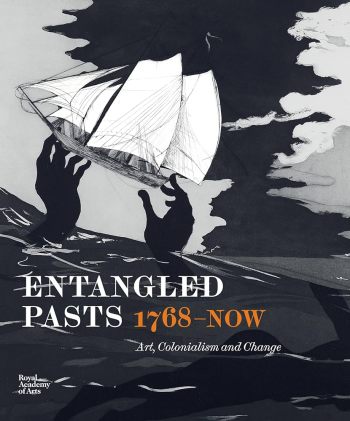 This spring, we bring together over 100 major contemporary and historical works as part of a conversation about art and its role in shaping narratives of empire, enslavement, resistance, abolition, and colonialism—and how it may help set a course for the future. Artworks by leading contemporary British artists of the African, Caribbean, and South Asian diasporas, including Sonia Boyce, Frank Bowling, and Mohini Chandra will be on display alongside works by artists from the past 250 years including Joshua Reynolds, J.M.W.Turner, and John Singleton Copley—creating connections across time which explore questions of power, representation, and history. Experience a powerful exploration of art from 1768 to now. Featuring a room of life-sized cut-out painted figures by Lubaina Himid, an immersive video installation by Isaac Julien, a giant flotilla of model boats by Hew Locke, and a major new sculpture in the Courtyard by Tavares Strachan. Plus, powerful paintings, photographs, sculptures, drawings, and prints by El Anatsui, Barbara Walker, Kerry James Marshall, Kara Walker, Shahzia Sikander, John Akomfrah, and Betye Saar. Informed by our ongoing research of the RA and its colonial past, this exhibition engages around 50 artists connected to the RA to explore themes of migration, exchange, artistic traditions, identity, and belonging.
More information is available here»
Dorothy Price, Alayo Akinkugbe, Esther Chadwick, Cora Gilroy-Ware, Sarah Lea, and Rose Thompson, Entangled Pasts, 1768–Now: Art, Colonialism, and Change (London: Royal Academy of Arts, 2024), 208 pages, 978-1912520992, £25 / $35.
Exhibition | Clockwork Treasures from China’s Forbidden City

Zimingzhong with a Crane Carrying a Pavilion, 18th century
(Beijing: The Palace Museum)
◊ ◊ ◊ ◊ ◊
From the press release (via Art Daily) for the exhibition:
Zimingzhong 凝时聚珍: Clockwork Treasures from China’s Forbidden City
Science Museum, London, 1 February — 2 June 2024
A major exhibition opened at the Science Museum on Thursday, 1 February 2024, featuring more than 20 resplendent mechanical clocks, called zimingzhong, on loan from The Palace Museum in Beijing and never before displayed together in the UK. Zimingzhong 凝时聚珍: Clockwork Treasures from China’s Forbidden City takes visitors on a journey through the 1700s, from the Chinese trading port of Guangzhou and onto the home of the emperors in the Forbidden City, the UNESCO-listed palace in the heart of Beijing. The exhibition shines a light on the emperors’ keen interest in and collection of these remarkable clockwork instruments, the origins of this unique trade, and the inner workings of the elaborate treasures that inspired British craftsmen and emperors alike. Translating to ‘bells that ring themselves’, zimingzhong were more than just clocks: they presented an enchanting combination of a flamboyant aesthetic, timekeeping, music and movement using mechanisms new to most people in 18th-century China.

Pagoda Zimingzhong, 18th century (Beijing: The Palace Museum).
On entering the exhibition, visitors encounter the ornate Pagoda Zimingzhong, a celebration of the technology and design possibilities of zimingzhong. This unique piece dating from the 1700s was made in London during the Qing Dynasty in China. The complex moving mechanism is brought to life in an accompanying video which shows the nine delicate tiers slowly rise and fall.
Next, the ‘Emperors and Zimingzhong’ section explores the vital role of zimingzhong in facilitating early cultural exchanges between East and West. Some of the first zimingzhong to enter the Forbidden City were brought by Matteo Ricci, an Italian missionary in the early 1600s. Ricci and other missionaries were seeking to ingratiate themselves in Chinese society by presenting beautiful automata to the emperor. Decades later, the Kangxi Emperor (1662–1722) was intrigued by, and went on to collect, these automata which he christened zimingzhong, displaying them as ‘foreign curiosities’. They helped demonstrate his mastery of time, the heavens, and his divine right to rule.
The ‘Trade’ section explores the clock trade route from London to the southern Chinese coast. The journey took up to a year, but once British merchants reached the coast, they could buy sought-after goods including silk, tea, and porcelain. Within this section, visitors can see a preserved porcelain tea bowl and saucer set which sank on a merchant ship in 1752 and was found centuries later at the bottom of the South China Sea.
Whilst the demand for Chinese goods was high, British merchants were keen to develop their own export trade, and British-made luxury goods like zimingzhong provided the perfect opportunity to do so. This exchange of goods led to the exchange of skills. In the ‘Mechanics’ section of the exhibition visitors can see luxurious pieces like the Zimingzhong with mechanical lotus flowers, which was constructed using Chinese and European technology. When wound, a flock of miniature birds swim on a glistening pond as potted lotus flowers open. The sumptuous decorative elements are powered by a mechanism made in China while the musical mechanism was made in Europe.
Sir Ian Blatchford, Director and Chief Executive of the Science Museum Group, said: ”The flamboyant combination of design flair and mechanical precision exemplified in these three-hundred-year-old time pieces has to be seen to be believed. We are deeply grateful to The Palace Museum in Beijing for entrusting us with these rare treasures from the Forbidden City.”
The ‘Making’ section of the exhibition explores the artistic skills and techniques needed to create zimingzhong. On display together for the first time is the Temple zimingzhong made by key British maker James Upjohn in the 1760s and his memoir which provides rich insight into the work involved in creating its ornate figurines and delicate gold filigree. Four interactive mechanisms that illustrate technologies used to operate the zimingzhong are also on display. Provided by Hong Kong Science Museum, these interactives enable visitors to discover some of the inner workings of these delicate clocks.

Zimingzhong, 18th century (Beijing: The Palace Museum).
In the ‘Design’ section, the exhibition explores how British zimingzhong, designed for the Chinese market by craftsmen who had often never travelled to Asia, reflect British perceptions of Chinese culture in the 1700s. On display is a selection of zimingzhong that embody this attempt at a visual understanding of Chinese tastes, including the Zimingzhong with Turbaned Figure. This piece mixes imagery associated with China, Japan, and India to present a generalised European view of an imagined East, reflecting the ‘chinoiserie’ style that was popular in Britain at the time. It highlights British people’s interest in China but also their lack of cultural understanding.
Although beautiful to behold, zimingzhong weren’t purely decorative. As timekeepers, they had a variety of uses, including organising the Imperial household and improving the timing of celestial events such as eclipses. The ability to predict changes in the night sky with greater accuracy helped reinforce the belief present in Chinese cosmology that the emperor represented the connection between Heaven and Earth. On display in the exhibition is a publication from 1809 written by Chaojun Xu and on loan from the Needham Research Institute, titled 自鸣钟表图说 (Illustrated Account of Zimingzhong). The document was used as a guide for converting the Roman numerals used on European clocks into the Chinese system of 12 double-hours, 时 (shi) and represents the increasing cultural exchanges between East and West.
Jane Desborough, Keeper of Science Collections at the Science Museum, said: “In this new exhibition visitors can explore how the detailed designs and mechanisms at the heart of zimingzhong represent a unique cultural exchange of ideas and skills. One of the many delicate objects that represents this exchange is the Zimingzhong with a crane carrying a pavilion. The mechanism of this intricate timepiece was made by British maker and retailer James Cox, but the delicate outer casing and beautiful decorations were almost certainly made in China. This particular zimingzhong highlights the importance of the emperors’ patronage in creating these remarkable objects.”
Part of the appeal of zimingzhong was also the sophisticated music technology they showcased; they often played a selection of popular European or Chinese songs. Skilled programmers would convert written musical scores into mechanisms. Throughout the exhibition, an accompanying soundscape of the clocks’ melodies are being played, including the “Molihua” or “Jasmine Flower,” a popular Chinese folk song, and an extract from George Frideric Handel’s 1711 opera, Rinaldo.
To explore the cultural legacy of zimingzhong, the Science Museum has collaborated with China Exchange to gather stories and memories from people of Chinese heritage living in London. These are on display throughout the exhibition and provide a range of rich, personal perspectives on the significance and meaning of zimingzhong.
Visitors can also see rare books and archival material from the Science Museum Group Collection, including Louis Le Comte’s account of his visit to China; a clock made by one of London’s leading clockmakers, George Graham; an analemmatic sundial made by the talented mathematical instrument maker, Thomas Tuttell; and a selection of hand tools from James Watts’s workshop. These objects beautifully complement the stories represented by the zimingzhong, showcasing the complexity of the instrument and clockmaking trades.
On entering the final section, visitors can explore the decline of the zimingzhong trade. In 1796, Emperor Jiaqing ascended the throne; he believed zimingzhong to be a frivolous waste of money and the trade faded. But zimingzhong continued to be used by China’s elite rulers in the Forbidden City and highlighted the growing global links being forged by trade.
Wang Xudong, Director of the Palace Museum, said: “In the 1580s, Western clocks entered China’s interior from its southern coast, and the country’s history of clock collection and manufacture began. The rich collection of timepieces in the Forbidden City serves not only as a medium of contact between China and the Western world, but also as a vehicle of cultural diversity: through a unique historical angle, it showcases over three centuries of communication, exchange and integration between China and the wider world. This is an exhibition worth looking forward to!”
Exhibition | 50 Years and Forward: British Prints and Drawings
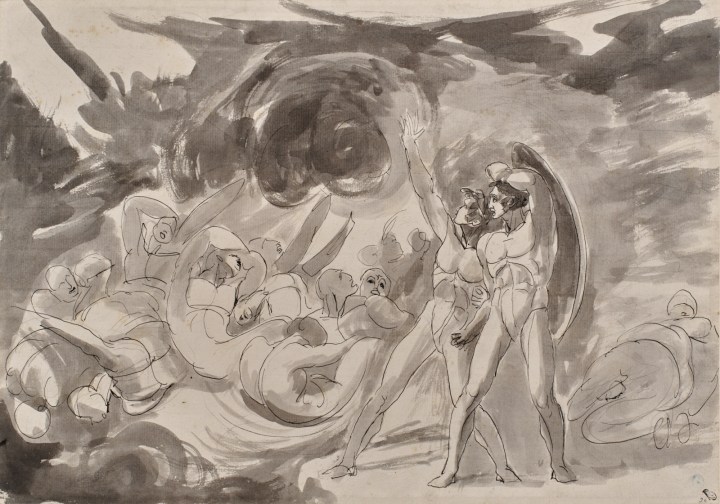
George Romney, Satan Surveying the Fallen Angels, ca. 1790, pen and black ink and brush and gray wash over graphite on laid paper, 36 × 53 cm
(Williamstown: The Clark, 2023)
◊ ◊ ◊ ◊ ◊
Now on view at The Clark:
50 Years and Forward: British Prints and Drawings Acquisitions
The Clark Art Institute, Williamstown, MA, 18 November 2023 — 11 February 2024
Curated by Anne Leonard
The emergence of British art as a significant collecting area at the Clark is a recent phenomenon. For museum founders Sterling and Francine Clark, works by artists from the British Isles did not constitute a major collecting focus. British art was largely eclipsed by the French Impressionist, American, and Old Master paintings that the Clarks so loved and that became central to the museum’s identity. A transformative gift from Sir Edwin and Lady Manton’s collection of British art, donated by the Manton Art Foundation in 2007, changed all that. British art soared dramatically in significance and visibility at the Clark, and a dedicated gallery allowed works from the Manton Collection (mostly paintings) to be on permanent display. Works on paper such as prints and drawings, however, are light-sensitive and can be on view only for short intervals, if they are to be preserved for posterity. Therefore, this exhibition is a rare opportunity to present, all at once, the broad scope of our British collection with prints and drawings of the highest quality.
50 Years and Forward: British Prints and Drawings Acquisitions offers a richly varied selection of works on paper acquired since the Manton Research Center opened in 1973. Highlights include lively figure drawings by Thomas Rowlandson; vibrant watercolor landscapes by J.M.W. Turner, Thomas Girtin, and H.W. Williams; heartfelt interpretations of nature by John Constable and Samuel Palmer; vivid portrait heads by Thomas Frye and Evelyn de Morgan; and an astonishing watercolor interior by Anna Alma-Tadema. This abundant display showcases how the Clark continues, in the wake of the Manton gift, to enrich the British works on paper collection—ensuring that it grows in strength and variety far into the future.
50 Years and Forward: British Prints and Drawings Acquisitions is organized by the Clark Art Institute and curated by Anne Leonard, Manton Curator of Prints, Drawings, and Photographs.










 Enfilade
leave a comment