Exhibition | The Fabric of Democracy

La fête de la Fédération textile, 1790
(Musee de la Toile de Jouy)
◊ ◊ ◊ ◊ ◊
Now on view at the Fashion and Textile Museum:
The Fabric of Democracy: Propaganda Textiles from the French Revolution to Brexit
Fashion and Textile Museum, London, 29 September 2023 – 3 March 2024
Curated by design historian Amber Butchart, this exhibition explores printed propaganda textiles over more than two centuries. Discover how fabric designers and manufacturers have responded to political upheaval from the French Revolution through to Brexit.
The mechanisation of textile industries from the mid-18th century led to the development of printing techniques that could create more detailed imagery on cloth, quicker than ever before. These increasingly affordable processes ‘democratised’ textile decoration, allowing governments, regimes, and corporations to harness the power of print to communicate, from wartime slogans to revolutionary ideals.
While propaganda is usually associated with public art and monumental sculpture, this exhibition explores how fabrics have been used as a political medium both in the home and on the body, through furnishing and fashion. Find out how textiles were used as a tool of the state across the political spectrum, from communism to fascism. Discover how a fraternal crisis in the monarchy played out on cloth, and how democracies promote national identity through textile design. On display will be textiles from countries including Britain, America, Italy, Germany, and Austria—ranging from French toile de Jouy to Japanese robes from the Asia-Pacific war, to Cultural Revolution-era Chinese fabrics rarely exhibited in the UK.
Amber Butchart is a curator, writer, and broadcaster who specialises in the cultural and political history of textiles and dress. She is a former Research Fellow at the University of the Arts London and is a regular public lecturer across the UK’s leading arts institutions. She researches and presents documentaries for television and radio, including the six-part series A Stitch in Time for BBC Four that fused biography, art, and the history of fashion to explore the lives of historical figures through the clothes they wore, and she is the history consultant and regular on-screen historian for BBC One’s Great British Sewing Bee. Amber is an external adviser for the National Crime Agency as a Forensic Garment Analyst, working on cases that require investigation of clothing and textiles. She has published five books on the history and culture of clothes, including The Fashion of Film, Nautical Chic, and a history of British fashion illustration for the British Library.
Exhibition | Boy’s Dress, 1760–1930
Now on view at the Fashion and Textile Museum:
Oh Boy! Boy’s Dress, 1760–1930
Fashion and Textile Museum, London, 29 September 2023 – 3 March 2024
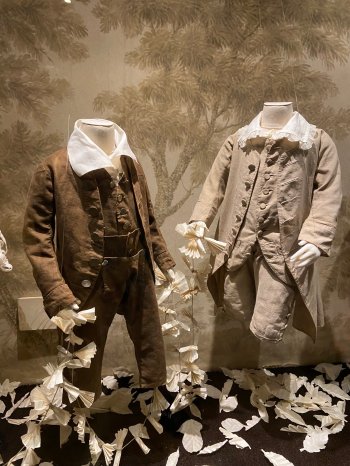 The Fashion and Textile Museum is excited to present Oh Boy!, an exploration into historical boy’s dress. Curated by leading fashion historian Amy de la Haye, alongside renowned expert collector Alasdair Peebles, the exhibition presents an unrivalled collection of an often-undervalued area of fashion history, spread over two acts.
29 September — 16 December 2023
Act One: Breeched, No More Dresses explores the ceremony of entry into the masculine world, taking place after six years of age, as boys abandoned dresses in favour of breeches. Focusing on the period from 1760 to 1810, Act One presents a dimity gown and coat, a robust three-piece fustian breeches suit, and a block-printed skeleton suit, alongside other fascinating pieces.
21 December 2023 — 3 March 2024
Act Two: Ship Shape delves into the vogue for nautical wear dating from 1860 to 1930. Starting with a miniature suit that an admiral had made for his young son and including linen and wool serge suits, loosely inspired by naval dress, accompanied by accessories. The space will be imaginatively adorned, showcasing Alasdair’s skills as a decorative period interior painter and exploring the topic of collecting as narrative.
Amy de la Haye is Professor of Dress History & Curatorship, and joint director of the Centre for Fashion Curation at London College of Fashion (LCF). Recent and current projects include Gluck: Art & Identity at Brighton Museum (2017), Ravishing: The Rose in Fashion at MFIT (2021), Wild & Cultivated: Fashioning the Rose at London’s Garden Museum (2022), Making Mischief: Folk Costume in Britain at Compton Verney (2023), and Making More Mischief… at LCF Stratford (2024). She has published extensively and writes for SHOWstudio. Formerly she served as curator of 20th-century dress at the Victoria and Albert Museum with exhibitions including the radical Streetstyle: from sidewalk to catwalk (1994).
Alasdair Peebles works as a freelance decorative painter, specialising in hand-painted wallpapers and the restoration of painted finishes in Historic houses. For the last thirty years, he has built a private collection focused exclusively on boy’s and youth’s clothes from 1750 to 1950. He is currently co-authoring a book on men’s and boys’ dress for Bloomsbury. He has lectured widely, regularly lends clothing to museums for exhibitions and works with costume designers on period film projects including Little Women and Mary Poppins.
Exhibition | Pleasing Truths: Power and Portraits in the American Home
Closing this month at the DAR Museum, with a curatorial talk scheduled for the 12th.
Pleasing Truths: Power and Portraits in the American Home
Daughters of the American Revolution Museum, Washington, DC, 17 March — 31 December 2023
Curated by William Strollo

Unidentified French artist, Portrait of Elisabeth Has Haley, ca. 1810, oil on canvas, 32 × 38 inches (Washington, DC: DAR Museum, Gift of Sarah Hawkes Thornton, 75.189.2).
In 1754, artist Lawrence Kilburn advertised that “all Gentlemen and Ladies inclined to favour him in having their pictures drawn, that he don’t doubt of pleasing them in taking a true Likeness.” Kilburn’s advertisement, loaded with meaning, is one of many examples of advertisements placed by artists in the 18th and 19th centuries to garner portrait commissions. This ad reveals a lot about his, and other artists, potential clients, and their desires for being represented on canvas. In looking closer at portraits, subjects, artists, and the context in which they were produced, a deeper understanding of society is revealed—a society that valued power, personal leisure, and prescribed gender roles. This exhibition takes a deeper dive into the context and symbolism of early portraits to better understand the transmission of ideas and their impact on people over time.
William Strollo, Pleasing Truths: Power and Portraits in the American Home (Washington, DC: Daughters of the American Revolution Museum, 2023), 135 pages, $35.
◊ ◊ ◊ ◊ ◊
As noted at Events in the Field, the calendar maintained by The Decorative Arts Trust:
Curator’s Talk: William Strollo on Pleasing Truths
Online and in-person, DAR Museum, Washington, DC, 12 December 2023, noon
The exhibition Pleasing Truths: Power and Portraits in the American Home features over 50 portraits from the DAR Museum’s collection, dating from the 17th to the 19th centuries. In this talk, William Strollo, Curator of Exhibitions, will discuss the use of portraits to convey power and prestige and to reinforce traditional gender roles in the early American home. This free event will take place in-person and will also be streamed online; pre-registration is requested.
Concord Museum Awarded Funding Prize by Decorative Arts Trust

Visitors viewing powder horns on display in the April 19, 1775 gallery at the Concord Museum, the recipient of the 2023 Decorative Arts Trust Prize for Excellence and Innovation, which includes an award of $100,000.
◊ ◊ ◊ ◊ ◊
Press release (16 November 2023) from The Decorative Arts Trust:
The Decorative Arts Trust is thrilled to announce that the 2023 Prize for Excellence and Innovation was awarded to the Concord Museum in Concord, Massachusetts, for their exhibitions and publication commemorating the 250th anniversary of the American Revolution in 2025–26.
The Concord Museum’s initiative will feature a series of three special exhibitions showcasing the stories of individuals, families, and communities during the American Revolution. Focused on the theme of “Whose Revolution,” the special exhibitions will explore themes of liberty, community, and memory, tracing the continued legacy of the Revolution today. The Museum will also create a companion digital exhibition to extend the geographical reach of the exhibitions beyond Concord and promote further education and engagement. Additionally, the Museum will release the first major publication of its American Revolution collection, from flints and powder horns carried by militia soldiers to textiles, furniture, and ceramics that were valued and preserved for their role in witnessing a revolution.
The Concord Museum began in the 1850s as the private collection of local resident Cummings Davis, who gathered and preserved the relics of his friends and neighbors as a record of local history. The collection grew throughout the 19th century and was incorporated as the Concord Antiquarian Society in 1886, moving to a new building in 1930 and later becoming known as the Concord Museum. The Museum now houses a significant collection of over 45,000 objects, with particular strengths in the decorative arts from the 18th and 19th centuries, the American Revolution, transcendentalism, and other areas relating to Concord and New England history. The Museum recently completed a major building expansion and renovation of its permanent galleries, including new spaces for collections, education, and public programs.
The Decorative Arts Trust Prize for Excellence and Innovation, founded in 2020, funds outstanding projects that advance the public’s appreciation of decorative art, fine art, architecture, or landscape. The Prize is awarded to a nonprofit organization in the United States or abroad for a scholarly endeavor, such as museum exhibitions, print and digital publications, and online databases. Past recipients include Cooper Hewitt, Smithsonian Design Museum; the Black Craftspeople Digital Archive; and Craft in America.
Exhibition | Interwoven: Women’s Lives Written in Thread

Now on view at the Concord Museum:
Interwoven: Women’s Lives Written in Thread
Concord Museum, 29 September 2023 — 25 February 2024
Our current special exhibition, Interwoven: Women’s Lives Written in Thread, highlights needlework produced by young women in New England and specifically the extraordinary collection of samplers at the Concord Museum. Featuring 30 samplers sewn in the early 1700s to mid-1800s, Interwoven explores how young women created records of their own lives and experiences, written in thread.

Detail of Sampler by Phebe Bliss, 1749 (Concord, MA: Concord Museum, gift of Mrs. Richard D. Boyer, T18).
The exhibition explores the history of needlework and embroidery, its importance as an art form, and its significance to women in the 18th and 19th centuries. Intended to showcase young women’s accomplishments, the samplers also communicate details of their lives and education, their communities, and their families. The exhibition provides a unique view into their private lives. For most of these young women, their samplers are the only objects that survive from their lives. Many of the samplers have never been displayed before.
Learn about the education of privileged young women in the early republic and understand how wealth and enslaved labor enabled them to pursue decorative arts. Explore the materials used in constructing samplers, such as linens, dyes and silk, and how and where these materials were produced. View samplers that demonstrate how women recorded family history and the loss of loved ones through needlework. Understand how they incorporated the importance of community and a strong sense of place in their samplers. The gallery includes areas for hands-on and interactive activities. Exhibition programs connect the history of samplers to contemporary work through visiting artists, demonstrations, workshops, and more.
Exhibition | Maestras
Now on view at the Thyssen:
Maestras / Women Masters
Museo Nacional Thyssen-Bornemisza, Madrid, 31 October 2023 — 4 February 2024
Curated by Rocío de la Villa
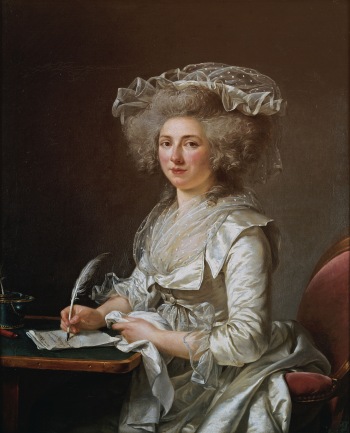
Adélaïde Labille-Guiard, Portrait of a Woman, ca. 1787, oil on canvas. 100 × 81 cm (Musée des Beaux-Arts de Quimper).
Artemisia Gentileschi, Angelica Kauffmann, Clara Peeters, Rosa Bonheur, Mary Cassatt, Berthe Morisot, María Blanchard, Natalia Goncharova, Sonia Delaunay, and Maruja Mallo were celebrated artists in their lifetimes who are now enjoying renewed recognition in response to their erasure from the art-historical account alongside others who broke moulds with creations of undoubted excellence. Featuring nearly 100 works—including paintings, sculptures, works on paper, and textiles—Maestras is curated from a feminist viewpoint by Rocío de la Villa. The exhibition presents a survey from the late 16th century to the early decades of the 20th century through eight contexts important within women’s path towards emancipation. Starting from the contemporary notion of sisterhood, it focuses on groups of female artists, patrons, and gallerists who shared values as well as favourable socio-cultural and theoretical conditions despite the patriarchal system. Employing a structure principally based on the conjunction of historical periods, artistic genres, and themes, the exhibition reveals how these artists approached important issues of their day, established their positions, and contributed new iconographies and alternative gazes.
The exhibition is divided into eight sections:
• Sisterhood I. The Causa delle Donne
• Botanists, Well-Versed in Wonders
• Enlightened Women and Academicians
• Orientalism / Genre Painting
• Workers, Carers
• New Portrayals of Motherhood
• Sisterhood II. Rapport
• Emancipated Women
Women Masters is the first major exhibition to reflect the process of feminist rethinking on which the Museo Thyssen has been engaged over the past few years. It benefits from the collaboration of the Comunidad de Madrid and sponsored by Carolina Herrera. After its presentation in Madrid, a reduced version of the exhibition can be seen at the Arp Museum Bahnhof Rolandseck in Remagen (Germany).
Rocío de la Villa, Haizea Barcenilla, Ana Martínez-Collado, and Marta Mantecón, Maestras (Madrid: Museo Nacional Thyssen-Bornemisza, 2023), 256 pages, ISBN: 978-8417173784, €38. Spanish with appendix with texts in English.
Exhibition | Berthe Morisot and the Art of the 18th Century
Now on view at the Musée Marmottan Monet:
Berthe Morisot et l’art du XVIIIe siècle: Watteau, Boucher, Fragonard, Perronneau
Dulwich Picture Gallery, London, 31 March — 10 September 2023
Musée Marmottan Monet, Paris, 18 October 2023 — 3 March 2024
Curated by Marianne Mathieu and Dominique d’Arnoult, with Claire Gooden
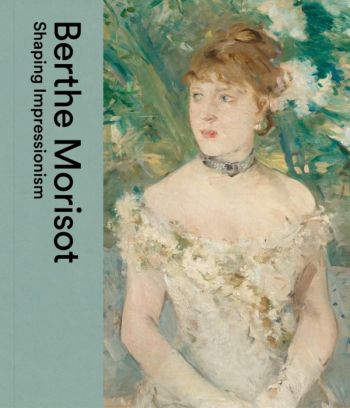 From 18 October 2023 to 3 March 2024, the Musée Marmottan Monet will present a very special exhibition, entitled Berthe Morisot and the Art of the 18th Century: Watteau, Boucher, Fragonard, Perronneau. The exhibition is curated by art historians Marianne Mathieu and Dominique d’Arnoult, with the participation of Claire Gooden, Head of Conservation at the Musée Marmottan Monet. Sixty-five art works from French and international museums, as well as private collections are brought together here for the first time to highlight the links between the work of the first female Impressionist Berthe Morisot (1841-1895) and the art of Antoine Watteau (1684–1721), François Boucher (1703–1770), Jean-Honoré Fragonard (1732–1806), and Jean-Baptiste Perronneau (1715–1783). Based on an analysis of mainly unpublished sources (letters, press clippings, and notebooks belonging to Berthe Morisot and her husband Eugène Manet and their entourage) and an in-depth genealogical study, this exhibition and the corresponding catalogue shed new light on a subject often mentioned by historians yet never having been the focus of dedicated and exhaustive research. While it has been demonstrated that Berthe Morisot is not Fragonard’s great-grand-niece and had no family ties to him, the exhibition nevertheless emphasizes the veritable foundations of their artistic affinities, retracing the chronology of their development, as well as their main characteristics.
Berthe Morisot: Shaping Impressionism (London: Dulwich Picture Gallery, 2023), 210 pages, ISBN: 978-1898519485, $40.
Exhibition | Superb Line: Prints and Drawings from Genoa, 1500–1800
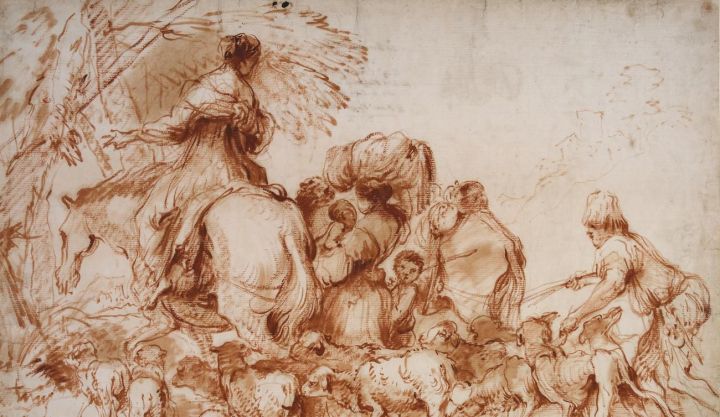
Giovanni Benedetto Castiglione, A Group of Shepherds and Their Animals, detail, ca.1650, brush and red-brown paint on paper with three crescents watermark, 43 × 57 cm (London: The British Museum, 1997,0607.10). The drawing was presented by Padre Antonio Piaggio to Sir William Hamilton and then sold at Christie’s in 1801. The subject is likely a biblical journey scene, a favorite of the artist.
◊ ◊ ◊ ◊ ◊
Now on view at The British Museum:
Superb Line: Prints and Drawings from Genoa, 1500–1800
The British Museum, London, 5 October 2023 — 1 April 2024
Showcasing prints and drawings from Genoa’s golden age, this display spotlights an artistic powerhouse that rivalled Venice, Florence, and Rome.
From the 16th to the 18th centuries, the port city of Genoa was one of Italy’s major artistic centres. Nicknamed ‘La Superba’ (‘the proud one’) by the Medieval poet Petrarch, it was among the wealthiest cities on the Italian peninsula, with strong trade links across Europe and beyond. These links and the riches they brought made Genoa a desirable destination for painters and sculptors wanting to study or find lucrative work. Superb Line opens with works by the first major arrival, Raphael’s pupil Perino del Vaga, who transformed the artistic scene when he came in 1528, introducing a new, modern manner seen in drawings like the Venus and Aeneas, which typifies his distinctive blend of graphic confidence and courtly stylishness.
Other prominent artists soon followed Perino’s lead and, over the next 150 years, the city continued to attract even bigger names like Rubens and van Dyck. This constant injection of new blood kept Genoa at the cutting edge of artistic trends, creating a nurturing environment for homegrown talents to develop in their own right. In the following centuries the city produced a steady stream of internationally renowned painters, among them Luca Cambiaso, Bernardo Strozzi, and Giovanni Benedetto Castiglione, who were especially feted for their innovative, often experimental graphic works, wowing collectors with dazzling displays of line. Featuring highlights from the British Museum’s longstanding holdings of Genoese prints and drawings, this display celebrates the virtuosity and originality of the city’s artists.
Exhibition | Untold Stories of a Monumental Pastel
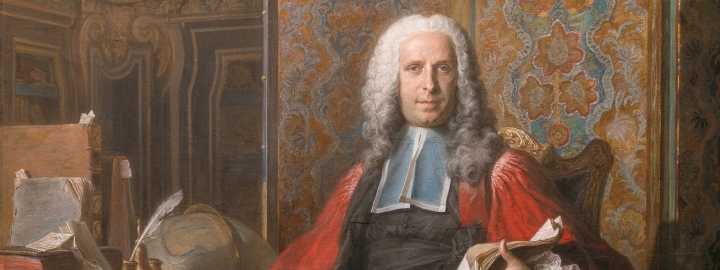
Maurice Quentin de La Tour, Portrait of Gabriel Bernard de Rieux (detail), 1739–41, pastel and opaque watercolor on blue paper, laid down on canvas, unframed: 200 × 150 cm (Los Angeles: Getty Museum, 94.PC.39).
◊ ◊ ◊ ◊ ◊
Now on view at The Getty:
Untold Stories of a Monumental Pastel
Getty Center, Los Angeles, 3 October 2023 — 20 October 2024
One of the largest pastels made in the 18th century, Maurice Quentin de La Tour’s Portrait of Gabriel Bernard de Rieux is an astonishing object. In this colossal portrait, the ambitious La Tour (1704–1788) pushed pastel to new heights, capturing his sitter’s likeness and surrounding de Rieux with the trappings of his wealth: fine furniture, an extensive library, imported porcelain, and a globe turned to display the West coast of Africa. This focused exhibition highlights both La Tour’s technical achievement and the global reality that financed and furnished de Rieux’s world.
The Met | Look Again: European Paintings 1300–1800

Details of European paintings in The Met Collection.
◊ ◊ ◊ ◊ ◊
After a five-year infrastructure project to replace the skylights, The Met’s newly installed galleries of European paintings will open to the public on Monday. For the 18th century, some significant changes have been made to the French, Italian, and British galleries, addressing issues of race, gender, class, and colonialism. A good time to revisit old friends, formulate fresh questions, and discover new favorites! –CH
From The Met:
Look Again: European Paintings 1300–1800
The Metropolitan Museum of Art, New York, opening 20 November 2023
The reopened galleries dedicated to European Paintings from 1300 to 1800 highlight fresh narratives and dialogues among more than 700 works of art from the Museum’s world-famous holdings. The newly reconfigured galleries—which include recently acquired paintings and prestigious loans, as well as select sculptures and decorative art—will showcase the interconnectedness of cultures, materials, and moments across The Met collection.
The chronologically arranged galleries will feature longstanding strengths of the collection—such as masterpieces by Jan van Eyck, Caravaggio, and Poussin; the most extensive collection of 17th-century Dutch art in the western hemisphere; and the finest holdings of El Greco and Goya outside Spain—while also giving renewed attention to women artists, exploring Europe’s complex relationships with New Spain and the Viceroyalty of Peru, and looking more deeply into histories of class, gender, race, and religion.
The reopening of the suite of 45 galleries at the top of the Great Hall staircase (galleries 600–644) follows a five-year project to replace the skylights. This monumental infrastructure project improves the quality of light and enhances the viewing experience for a new look at this renowned collection.
Major support for Look Again: European Paintings 1300–1800 is provided by Candace K. and Frederick W. Beinecke.










 Enfilade
leave a comment