Exhibition | Seeing the Light: Turner’s Discovery of Italy in 1819
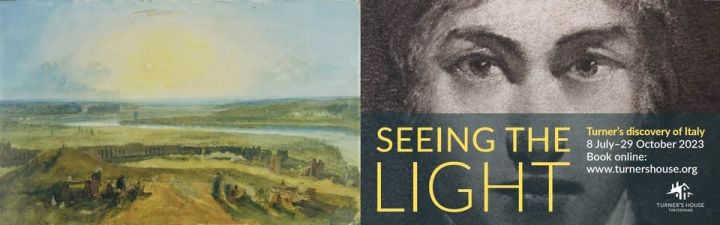
Left: J. M. W. Turner, The Roman Campagna from Monte Testaccio, Sunset, 1819, gouache, graphite, and watercolour on paper, 25 × 40 cm
(London: Tate, accepted by the nation as part of the Turner Bequest 1856, D16131).
◊ ◊ ◊ ◊ ◊
Closing this month at Turner’s House:
Seeing the Light: Turner’s Discovery of Italy in 1819
Turner’s House, Twickenham, 7 July — 29 October 2023
In the summer of 1819, the landscape artist J.M.W. Turner (1775–1851) set off on a journey to Italy that would have a profound impact on his life and work. Visitors to Turner’s House will be able to enjoy an exhibition of evocative watercolours capturing some of the painter’s first impressions of the place he was to later call the “land of all bliss,” and which provided inspiration for the rest of his career. Seeing the Light provides an exciting opportunity for the public to see some of Italy’s most well known and loved sites—Venice, Rome, Naples—through Turner’s eyes, in the unique setting of his then rural retreat in Twickenham. Visitors to this tightly-focussed exhibition will also be able to appreciate Turner’s evolving use of colour and light before and after 1819, thanks to generous loans from Tate, the Guildhall Art Gallery, and a private collection.
Exhibition | Hub of the World: Art in 18th-Century Rome

Gaspar van Wittel, known as Vanvitelli, The ‘Casino’ of Cardinal Annibale Albani on the Via Aurelia, 1719, oil on canvas, 74 × 135 cm
(Private Collection, United Kingdom)
◊ ◊ ◊ ◊ ◊
From the press release (via Art Daily) for the exhibition:
Hub of the World: Art in 18th-Century Rome
Nicholas Hall Gallery, New York, 6 October — 30 November 2023
This fall, Nicholas Hall presents Hub of the World: Art in 18th-Century Rome, organized in association with the Milanese Galleria Carlo Orsi. Presented at the Upper East Side gallery in New York, the exhibition celebrates the legacy of esteemed American scholar, connoisseur, and artist Anthony M. Clark (1923–1976), who would have turned 100 this year.

Pompeo Batoni, Saint Louis Gonzaga, ca. 1744, oil on canvas, oval, in an 18th-century frame, 81 × 67 cm (Private Collection, NY).
Considered one of the most influential and admired museum professionals of his generation, Clark made a profound impact on American collecting trends in the 1950s and 1960s through his taste for art made in 18th-century Rome, especially the paintings of the Pompeo Batoni. The exhibition brings together more than 60 works by artists who lived in or traveled to Rome in the 18th century, along with a selection of Clark’s personal notebooks and a portrait photograph on loan from the National Gallery of Art in Washington, DC.
After graduating from Harvard, Clark began his career in 1955 at the Rhode Island School of Design before going on to prominent curatorial roles at the National Gallery of Art, the Metropolitan Museum of Art, and the Minneapolis Institute of Arts, of which he later became director. He also taught art history at the Institute of Fine Arts, NYU and at Williams College, Williamstown. During his tenure at Mia and The Met, Clark made significant acquisitions for the institutions and organized world-class exhibitions as a pioneering American scholar of 18th-century Rome.
The Hub of the World brings to light the fundamental role Clark played in the revival of interest among American museums in collecting work from this period. Clark deeply believed in the importance of Roman Settecento painting, drawing, and sculpture, and this passion is brilliantly reflected in his scholarship and writings. As a curator, he consistently created a historic context for art by showing sculpture and decorative arts alongside paintings and drawings at a time when it was customary to maintain a ‘hierarchy’ of the arts by studying and displaying the mediums separately.

Domenico Corvi, The Liberation of Saint Peter, 1770, oil on canvas, 63 × 49 cm (Private Collection, Paris).
Tragically Clark succumbed to a heart attack at age 53 while jogging in his favorite city, where, at the time, he was a fellow at the American Academy in Rome. Born in Philadelphia, Clark worked closely with curators at the Philadelphia Museum of Art over the course of his career; and, in 2000, the PMA—in partnership with the Museum of Fine Arts, Houston—mounted The Splendor of 18th-Century Rome, which was dedicated to his memory.
In the words of Nicholas Hall: “Anthony Clark was a larger-than-life character who changed the way we look at Old Masters. He rescued the art of 18th-century Rome from obscurity by dint of his own personal enthusiasm and brilliant scholarship. He had enormous personal charm: the son of the owner of two works in the exhibition remembers how, as a boy, he enjoyed Clark’s visits to see his parents. Clark, an avid ornithologist, later bequeathed to him a stuffed Green Woodpecker. Our exhibition is an homage to a great scholar, a tastemaker, and a dedicated museum professional.”
Hub of the World highlights the richness of the culture of 18th-century Rome with its extraordinary mixture of patronage, from popes and cardinals, to Roman aristocrats and visiting foreigners—including the German writer and poet Johann Wolfgang von Goethe, from whom the exhibition borrows its title. Goethe deemed Rome the “hub of the world,” writing that “the entire history of the world is linked up with this city.” Hall and Orsi have gathered a diverse selection of paintings, drawings, sculpture, and decorative arts that will provide a rare opportunity to experience the cosmopolitan appeal of 18th-century Rome.

Hubert Robert, Colonnade and Gardens at the Villa Medici, 1759, oil on canvas, 75 × 64 cm (Assadour O. Tavitian Trust).
Headlining the exhibition is View of the Villa Medici by Hubert Robert (1733–1808), painted in 1759 during the artist’s transformative time in Rome and on loan from the Assadour O. Tavitian Trust. A recent discovery, the exceptional work has rarely been on view to the public—previously only exhibited in the U.S. briefly at the National Gallery of Art. Other works on view include the Hemp Harvest in Caserta, executed by Jackob Philipp Hackert for the King of Naples; a portrait of the Cardinal Carlo Rezzonico by Anton Raphael Mengs that remained in the sitter’s family until the last decade; a unique view of the Villa Albani by Vanvitelli, recorded in the inventory of Cardinal Albani; a pair of oil on coppers by Angelika Kauffmann based on James Thomson’s pastoral poetry that newly resurfaced from a private Kenyan collection; a caricature painting by Joshua Reynolds, recently discovered at the estate where it has hung for over two centuries; A Vestal by Jacques-Louis David painted in Rome; a harbor scene painted on copper by Claude Joseph Vernet; Anton von Maron’s Portrait of Two English Gentlemen before the Arch of Constantine; the Rockingham Silenus, a 1st-century sculpture reworked by the celebrated Roman sculptor Bartolomeo Cavaceppi; a set of candelabras in the form of Antonius-Osirus by Luigi Valadier; and a console table designed by Antonio Asprucci, made for the Egyptian Room of the Palazzo Borghese. The exhibition pays tribute to Clark as an expert on Pompeo Batoni, as represented by a painting of Saint Louis Gonzaga and its preparatory drawing in red chalk, among several other works. Once belonging to Clark, a painting of the artist Paolo de Matteis by Pier Leone Ghezzi will also be showcased.
In conjunction with the exhibition, Nicholas Hall and Galleria Carlo Orsi will publish a fully illustrated catalogue with original essays by Italian art experts and renowned historians Edgar Peters Bowron, Alvar Gonzáles-Palacios, Melissa Beck Lemke, and J. Patrice Marandel.

Pier Leone Ghezzi, Four Samples of Classical Polychrome Marbles, 1726, watercolor on paper; from top left clockwise: ‘Diaspro Verde Fiorito, 16 × 21 cm, ‘Bianco e negro antico’, 19 × 24 cm, ‘Broccatello’, 19 × 21 cm, ‘Alabastro Orientale’, 19 × 23 cm (Private Collection, Italy). To be published by Dr. Adriano Aymonino in his upcoming book from MIT press, Paper Marbles: Pier Leone Ghezzi’s Studio di Molte Pietre (1726).
Talk and Exhibition | The Jews, the Medici, and the Ghetto of Florence
From the Medici Archive Project (MAP):
Piergabriele Mancuso and Alice S. Legé | The Jews, the Medici, and the Ghetto of Florence: History and Challenges of an Exhibition
Online, The Medici Archive Project, 10 October 2023, 5pm (EDT)

Ketubah (Marriage Contract), 1739 (Archivio di Stato di Firenze)
The exhibition The Jews, the Medici, and the Ghetto of Florence (Gli ebrei, i Medici, e il Ghetto di Firenze)—on view from 23 October 2023 until 20 January 2024 at the Palazzo Pitti—offers a comprehensive exploration of a relatively understudied aspect of the Medici and Jewish history. Delving into the intricate evolution of the Florentine Ghetto, the exhibition traces the site’s history from its establishment under the Grand Duke Cosimo I de’ Medici in 1570 to its eventual dissolution in the 19th century. Visitors will see a rich array of artifacts, including illuminated manuscripts, paintings, archival documents, photographs, maps, and sculptures. These items provide insights into the complex relationship between the Jewish community and the Grand Duchy of Tuscany.
This talk by the exhibition’s curators will focus on the creation of the exhibition, prompting important inquiries into topics such as segregation, protective measures, urban integration, and the invaluable cultural contributions made by the Jewish populace during the Florentine Renaissance.
To watch this talk, click here on Tuesday, 10 October, at 5pm (EDT).
The Burlington Magazine, September 2023
The eighteenth century in the September issue of The Burlington:
The Burlington Magazine 165 (September 2023)

Bed, by Ince and Mayhew, 1768, mahogany and other woods, with original blue silk ‘flowered tabby’ in the ‘Large Antique Headboard’, tester and cornice, height 356 cm (Stamford: The Burghley House Collection).
a r t i c l e r e v i e w
• Lucy Wood, “The Industry and Ingenuity of William Ince and John Mayhew,” pp. 996–1001.
Fifty years ago, the question was asked what had become of the furniture made by Ince and Mayhew, one of the most successful and long-lasting firms of cabinetmakers in eighteenth-century London? A monograph by Hugh Roberts and Charles Cator, decades in the making, provides the answer in a revelatory picture of the achievements of these rivals of Thomas Chippendale.
r e v i e w s
• Christoph Martin Vogtherr, Review of the exhibition Rosalba Carriera – Perfection in Pastel (Gemäldegalerie Alte Meister, Zwinger, Dresden, 2023), pp. 1007–10.
• Christopher Baker, Review of the Redevelopment of the National Portrait Gallery, London (reopened in June 2023), pp. 1013–17.
• Raha Shahidi, Review of the exhibition catalogue L’Amour en scène! François Boucher, du théâtre à l’opéra, ed. by Hélène Jagot, Jessica Degain, and Guillaume Kzerouni (Éditions Snoeck, 2022), pp. 1029–31.
• Christopher Rowell, Review of Tessa Murdoch, ed., Great Irish Households: Inventories from the Long Eighteenth Century (John Adamson, 2022) and Conor Lucey, ed., House and Home in Georgian Ireland: Spaces and Cultures of Domestic Life (Four Courts Press, 2022), pp. 1038–40.
• Armin Kunz, Review of Mareike Hennig and Neela Struck, eds., Zeichnen im Zeitalter Goethes: Zeichnungen und Aquarelle aus dem Freien Deutschen Hochstift (Hirmer, 2022), pp. 1040–42.

Sewell Bequest, 2008,3008.1). Room 18 of the National Portrait Gallery, London, showing the newly acquired Portrait of Mai (Omai) by Joshua Reynolds (c. 1776) as the centrepiece of a group of eighteenth-century portraits (Photography by Dave Parry).
Exhibition | Fantastic Animals
Now on view at Lens:
Fantastic Animals / Animaux Fantastiques
Musée du Louvre-Lens, 27 September 2023 — 15 January 2024
Curated by Hélène Bouillon, with Jeanne-Thérèse Bontinck, Caroline Tureck, and Yaël Pignol

Johann Heinrich Füssli (Fuseli), Thor Fighting the Midgard Serpent, 1790, oil on canvas (London: Royal Academy of Arts).
Dragons, griffins, sphinxes, unicorns, phoenixes: present as early as Antiquity, fantastic animals inhabit the tiniest recesses of our contemporary world, from films and cartoons to everyday objects. By turns images of terror or admiration, expressions of our hidden unconscious and our anxieties, these often hybrid creatures contain within them a fundamental ambiguity. Who are they? Where do they come from? What do they mean?
They share with real fauna the power to fascinate people. We confer on them a closeness to nature, a wildness mingled with wisdom. Yet these are no ordinary animals. They differ in their appearance. Gigantic, excessive and deformed, their bodies adopt the characteristics of several animals, such as a horse’s body with the wings of a bird or an eagle with a lion’s head. This extraordinary physiognomy is a reflection of their supernatural powers. Fantastic animals embody the elementary forces of nature: stormy waters and choleric gusts of wind, as well as tranquil streams and the nourishing earth. They represent their immensity, their violence, their beauty, and above all their excesses. Some of them have a face and hands and legs, which link them to the world of humans while evoking distance and danger.
Featuring more than 250 works—sculptures, paintings, and objets d’art, as well as films and music—from Antiquity to the present day, the exhibition offers a journey through time and space, retracing the history of the most famous of these animals through their legends, their powers, and their habitats. It explores our passionate relationships with these creatures whose unreal presence seems more than ever necessary.
Hélène Bouillon, ed., Animaux fantastiques: Du merveilleux dans l’art (Ghent: Snoeck Publishers, 2023), 400 pages, ISBN: 978-9461617873, €39.
Exhibition | Liotard and The Lavergne Family Breakfast

The exhibition opens this fall at The National Gallery (with the press release available here) . . .
Discover Liotard and The Lavergne Family Breakfast
The National Gallery, London, 16 November 2023 — 3 March 2024
In the second of our ‘Discover’ exhibitions, which explore well-known paintings through a contemporary lens, we reunite for the first time in 250 years Swiss painter Jean-Étienne Liotard’s pastel and oil versions of The Lavergne Family Breakfast. With the pastel and oil works side by side, the exhibition presents a rare opportunity to compare the difference in technique and effect between the two.

Jean-Etienne Liotard, The Lavergne Family Breakfast, 1754, pastel on paper stuck down on canvas, 80 × 106 cm (London: National Gallery, accepted in lieu of Inheritance Tax by HM Government from the estate of George Pinto, 2019, NG6685).
Long regarded as Liotard’s masterpiece, The Lavergne Family Breakfast (executed in Lyon in 1754) is the artist’s largest and most ambitious work in pastel. Despite the medium’s notorious delicacy, Liotard skilfully reproduced complex textures: the sheen on the metal coffee pot, the shiny ceramic jug, the silky fabrics and reflections, in the black lacquer tray. Liotard was extremely versatile, producing works in pastel, oil, enamel, chalk, and even on glass. Highly unusually, he returned to The Lavergne Family Breakfast 20 years later to make an exact replica in oil.
Liotard (1702–1789) worked across the length and breadth of 18th-century Europe. Following four years in Constantinople, he grew a long beard, adopted Turkish dress, and nicknamed himself ‘the Turkish painter’. The exhibition showcases the raw materials used to make pastels as well as drawings, paintings, and miniatures that seek to bring this idiosyncratic artist to life.
Francesca Whitlum-Cooper, with contributions by Iris Moon, Discover Liotard & The Lavergne Family Breakfast (New Haven: Yale University Press, 2024), 120 pages, ISBN: 978-1857097023, $20.
Exhibition | Hokusai: Beyond the Great Wave

Katsushika Hokusai, Under the Wave off Kanagawa (The Great Wave), from Thirty-Six Views of Mt Fuji, late 1831, color woodblock print (London: The British Museum, acquired with the assistance of Art Fund and a contribution from the Brooke Sewell Bequest, 2008,3008.1).
◊ ◊ ◊ ◊ ◊
Opening in October at the Bowers Museum:
Beyond the Great Wave: Works by Hokusai from the British Museum
The British Museum, London, 25 May — 13 August 2017
Bowers Museum, Santa Ana, California, 21 October 2023 — 7 January 2024
Katsushika Hokusai (Japanese, 1760–1849) is the renowned artist behind The Great Wave, one of the most iconic prints ever made. Originally part of the series Thirty-Six Views of Mount Fuji, this seminal vision of man in nature is just one of the estimated 30,000 prints that Hokusai designed over his 70-year career. This exhibition includes a beautiful early example of The Great Wave and ventures beyond to feature a broad selection of works that Hokusai produced right up to his death at the age of 90.
 Visitors will be able to examine Hokusai’s personal beliefs through more than 100 paintings, drawings, woodblock prints, and illustrated books that speak to his early career, rise to fame, interest in the natural and supernatural worlds, personal life, and search for immortality. Distinct from the art of his Japanese contemporaries, Hokusai’s work is intensely individual, subjective, energized, and sublime; and the exhibition will provide a powerfully emotional and spiritual experience.
Hokusai never left Japan, but his work traveled around the globe to inspire many European artists and collectors such as Monet and Van Gogh. The exhibition includes biographical portraits of six individuals who helped build the Hokusai collection at the British Museum and shows how these scholars and proponents of Japanese art understood and appreciated Hokusai’s genius, skill, and invention.
The presentation of this exhibition is a collaboration between the British Museum and the Bowers Museum.
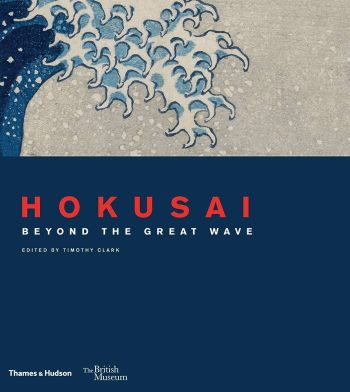
Timothy Clark, ed., Hokusai: Beyond the Great Wave (London: Thames & Hudson, 2017), 352 pages, ISBN: 978-0500094068, $65.
Exhibition | Paintings in Print: Studying Art in China
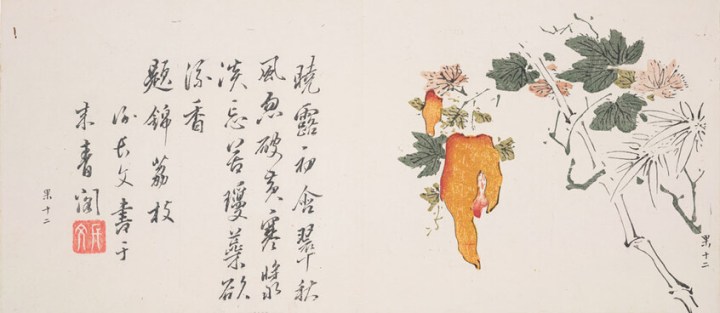
Bitter Melon in Ten Bamboo Studio Collection of Calligraphy and Painting, ca. 1633–1703, woodblock-printed book mounted as album leaves, ink and colors on paper (multi-block technique), published in Nanjing (San Marino: The Huntington Library, Art Museum, and Botanical Gardens).
◊ ◊ ◊ ◊ ◊
Opening next month at The Huntington:
Paintings in Print: Studying Art in China
The Huntington Library, Art Museum, and Botanical Gardens, San Marino, 7 October 2023 — 27 May 2024
The exhibition Paintings in Print: Studying Art in China examines the ways painting manuals published in the 17th and 18th centuries used innovative printing methods to introduce the techniques, history, and appreciation of painting to widening audiences in early modern China.
In the 16th century, Chinese publishers began creating educational art manuals filled with colorful prints of paintings and texts on the history and methods of brush arts. The manuals were unprecedented because they taught aspiring painters and collectors from the growing merchant class how to create and appreciate literati art—a combination of painting, calligraphy, and poetry long practiced by elite scholars. Drawing from The Huntington’s collection, the exhibition focuses on two books: The Mustard Seed Garden Manual of Painting and Ten Bamboo Studio Collection of Calligraphy and Painting. The books will be displayed together, in their entirety, for the first time in the United States. The texts will be presented in their original form as well as digitized to allow visitors to explore the materials more closely. They will be complemented with paintings—including recent donations from the Berman Foundation—that exemplify how artists studied manuals like these to learn the basics of their art.
Exhibition | William Blake: Visionary
Opening this fall at The Getty:
William Blake: Visionary
Getty Center, Los Angeles, 7 October 2023 — 14 January 2024
 A remarkable printmaker, painter, and poet, William Blake (1757–1827) developed a wildly unconventional world view, representing universal forces of creation and destruction—physical, psychological, historical—through his own cast of characters. By combining his poetry and images on the page through radical graphic techniques, Blake created some of the most striking and enduring imagery in British art. This major international loan exhibition explores the artist-poet’s imaginative world through his most celebrated works.
Organized by the J. Paul Getty Museum in cooperation with Tate.
Edina Adam and Julian Brooks, with an essay by Matthew Hargraves, William Blake: Visionary (Los Angeles: J. Paul Getty Museum, 2020), 168 pages, ISBN: 978-1606066423, $35.
Celebrated for his boundless imagination and unique vision, William Blake (1757–1827) created some of the most striking and distinctive imagery in art, often combining his poetry and visual images on the page through innovative graphic techniques. He has proven an enduring inspiration to artists, musicians, poets, and performers worldwide and a fascinating enigma to generations of admirers. Featuring over 130 color images, this catalogue brings together many of Blake’s most iconic works. Organized by theme, it explores Blake’s work as a professional printmaker, his roles as both painter-illustrator and poet-painter, his relationship to the medieval, Renaissance, and Baroque artists that preceded him, and his legacy in the United States. It also examines his visionary prophetic books, including all eighteen plates of America a Prophecy.
A specialist in works on paper, Edina Adam is assistant curator of drawings at the J. Paul Getty Museum. Julian Brooks is senior curator and head of the Department of Drawings at the J. Paul Getty Museum and is the author of many books, most recently The Lure of Italy: Artists’ Views (Getty Publications, 2017) and Andrea del Sarto: The Renaissance Workshop in Action (Getty Publications, 2015). Now the director of the Wadsworth Atheneum Museum of Art, Matthew Hargraves was previously chief curator of art collections and head of collection information and access at the Yale Center for British Art.
Exhibition | French Revolution Style: Furniture, Art, and Wallpaper
Now on view at the Museum of the French Revolution (near Grenoble):
French Revolution Style: Furniture, Works of Art, and Wallpapers
Style Révolution française: Mobilier, objets d’art et papiers peints
Musée de la Révolution française, Vizille, 30 June 2023 — 11 March 2024

Arabesque wallpaper, manufacture Réveillon, Paris, 1790 (Vizille, Musée de la Révolution française).
Prétendument qualifiés de style Louis XVI ou de style Directoire, les arts décoratifs de la dernière décennie du XVIIIe siècle ont été dépouillés de leur spécificité historique par rejet de la Révolution française, au profit du dernier règne de l’Ancien Régime et de la période post thermidorienne. Tout découpage de ce genre est arbitraire, mais justement pourquoi ne pas mettre en avant un « style Révolution française » qui couvrirait les années de Liberté après la prise de la Bastille (1789–1792) et les premières années de la République (1792–1799) ?
Pour la première fois, le public découvre une partie du décor de papier peint en arabesque de la manufacture Réveillon à Paris, produit en 1790 et donné par la famille Benoist en 2004. Ce papier peint est l’écrin d’un ensemble exceptionnel de sièges de Georges Jacob (1739–1814), qui excelle dans la sculpture sur bois, ainsi qu’un bureau d’Adam Weisweiller (1746–1820) déposés par le Mobilier national.










 Enfilade
leave a comment