Exhibition | Black Founders: The Forten Family of Philadelphia
Now on view at the Museum of The American Revolution:
Black Founders: The Forten Family of Philadelphia
Museum of The American Revolution, Philadelphia, 11 February — 26 November 2023
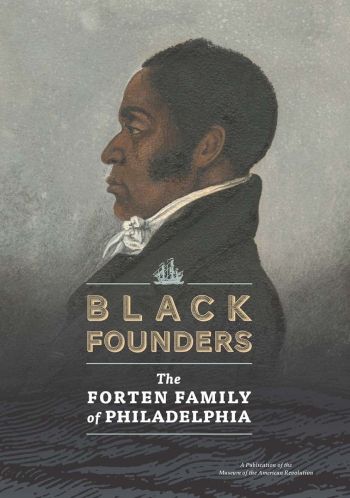 When James Forten (1766–1842) walked the streets of Philadelphia as a young man in the 1770s, he was surrounded by the sights and sounds of transformation. He heard the words of the Declaration of Independence read aloud for the first time in 1776 before setting sail to fight for independence in 1781. Born a free person of African descent, Forten built upon his coming-of-age in a revolutionary city and his wartime experience to forge himself into a changemaker in Philadelphia and the young United States, becoming a successful businessman, philanthropist, and stalwart abolitionist.
In our new special exhibition Black Founders: The Forten Family of Philadelphia, the Museum introduces visitors to Forten and his descendants as they navigated the American Revolution and cross-racial relationships in Philadelphia to become leaders in the abolition movement in the lead-up to the Civil War and the women’s suffrage movement. Using objects, documents, and immersive environments, Black Founders: The Forten Family of Philadelphia explores the Forten family’s roles in the Revolutionary War, business in Philadelphia, and abolition and voting rights from 1776 to 1876.
The exhibition features more than 100 historical artifacts, works of art, and documents from 38 different lenders, including both institutions and private collectors, as well as the Museum’s own collection. Rare historical objects on loan from descendants of the Forten family are on view for the very first time in a public exhibit.
The unique journey and exceptional story of this family of Revolutionaries explores the legacy of the American Revolution, the history of the American experiment of liberty, equality, and self-government, and the ongoing work to improve the nation’s dedication to the principle that “all men are created equal.”
Black Founders: The Forten Family of Philadelphia (Philadelphia: Museum of the American Revolution, 2023), ISBN: 978-1933153445, $38.
Exhibition | Dutch and Flemish Paintings from Woburn Abbey

Aelbert Cuyp, A Landscape near Calcar with the Artist Sketching, ca. 1652
(Woburn Abbey Collection)
◊ ◊ ◊ ◊ ◊
The collection of Netherlandish works at Woburn Abbey was assembled primarily in the eighteenth and early nineteenth centuries. From the press release for the exhibition:
Mastering the Market: Dutch and Flemish Paintings from Woburn Abbey
The Barber Institute of Fine Arts, University of Birmingham, 17 June — 24 September 2023
Curated by University of Birmingham MA students alongside experts from the Barber and Woburn Abbey
This summer, the Barber Institute of Fine Arts, University of Birmingham, presents a dazzling selection of Dutch and Flemish 17th-century masterpieces from Woburn Abbey, the ancestral home of the Dukes of Bedford. Featuring a dozen Old Master paintings, the exhibition Mastering the Market: Dutch and Flemish Paintings from Woburn Abbey is one of the largest and most significant group of such works from this important ducal collection to be exhibited in a public gallery since the 1950s.
Focused on the themes of patronage and collecting, Mastering the Market is curated by four Art History and Curating MA students from the University of Birmingham, with guidance and supervision from experts at both the Barber Institute and Woburn Abbey. Other aspects of the innovative and dynamic 17th-century Dutch art market will also be explored—from the unique character of artistic culture in the newly independent Dutch Republic, through art dealership and attribution, to the demand for and development of new genres. The burgeoning wealth and rise of the merchant classes in the Netherlands in the 17th century sparked huge demand for portrait commissions, also examined here through fresh interpretations of the works from Woburn Abbey.
Assembled principally by the 4th, 5th, and 6th Dukes of Bedford between the 1730s and 1830s, the Woburn Abbey collection of Dutch and Flemish paintings is one of the finest in private hands in the UK. Works include superb portraits and head studies by Rembrandt Van Rijn, Frans Hals, and Anthony Van Dyck, exquisite landscapes and seascapes by Aelbert Cuyp and Jan van de Cappelle, and lively subject pictures by Jan Steen and David Teniers. The exceptional opportunity to see these paintings together in a public gallery has arisen due to the extensive and ongoing refurbishment of the Abbey.
Key loans include Rembrandt’s Portrait of a Bearded Old Man, 1643, Hals’s Portrait of a Man, c. 1635–38, Van Dyck’s Portrait of a Married Couple, identified as Daniel Mytens and his Wife, c. 1632–34, Cuyp’s A Landscape near Calcar with the Artist Sketching, c. 1652, Steen’s Twelfth Night or ‘Le Roi Boit’, 1670–71, and Van de Cappelle’s A Dutch Harbour with Numerous Fishing Boats, c. 1652–54.
Complementing the Woburn masterpieces is a small selection of the outstanding Dutch and Flemish paintings in the Barber’s own permanent collection, notably Jan Steen’s The Wrath of Ahasuerus, c. 1668–70, Van Dyck’s Ecce Homo, c.1625–26, and Portrait of François Langlois, early 1630s (jointly owned with the National Gallery, London), plus Hals’s Portrait of a Man Holding a Skull, c. 1611–12.
Robert Wenley, Barber Institute Deputy Director, Research and Collections, says: “The exhibition will present the public with the rare opportunity to view these works up close in a gallery setting and facilitate an appreciation of the ways in which patronage and collecting reflected and contributed to a dynamic period of European history. Our talented young team of student curators will also explore the tastes and achievements of the successive Dukes of Bedford as collectors of Dutch and Flemish paintings in the decades following their first purchases on the art market of works from these schools in the early 18th century.”
Professor Jennifer Powell, Director of the Barber Institute, says: “We are delighted to present works from this important collection in Birmingham. The Barber is proud to support this unique opportunity for students of the University of Birmingham to co-curate an exhibition of such exceptional quality in its main gallery programme.”
Matthew Hirst, Curator of the Woburn Abbey Collection, says: “We are delighted to have the opportunity to present these masterpieces from Woburn Abbey alongside other works by the same masters from the Barber’s own choice collection. This opportunity to compare these works and consider the phenomenon of the Dutch and Flemish market is only possible due to the input of the students at this unique time whilst Woburn Abbey is closed to undergo a generational refurbishment project.”
Woburn Abbey houses an outstanding collection of works of art brought together by the family over nearly 500 years. During the closure, there is an active loans programme to share some of these treasures so they can be enjoyed in different contexts. Woburn has partnered with a number of prestigious venues since 2020, including Royal Museums Greenwich, the Holburne Museum, Worcester City Art Gallery, and Gainsborough’s House. Many of the important works of art from the collection have been exhibited in new ways due to these partnerships. Full restoration and renewal of the roof at Woburn Abbey has led to a prolonged closure period. This has enabled these partnerships to continue and expand offering more opportunities to share Woburn’s impressive art collection with a wider audience.
Exhibition | Sensing Naples
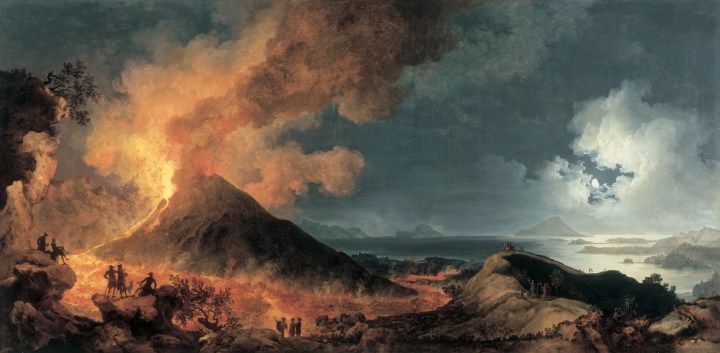
Pierre-Jacques Volaire, An Eruption of Vesuvius by Moonlight, 1774, oil on canvas, 130 × 260 cm (Compton Verney; photo by John Hammond). As noted at ArtUK, this is the largest of Volaire’s many views of the volcano.
◊ ◊ ◊ ◊ ◊
With scents in the gallery, readers may recall The Essence of a Painting: An Olfactory Exhibition on view last summer at the Prado. From Madrid to Compton Verney:
Sensing Naples
Compton Verney, Warwickshire, 1 April — 31 December 2023
Come and be transported to Naples—where the scent of orange blossom drifts on the air and the spectacle of Vesuvius smoulders in the distance. Bringing to life the smells, sounds, sights, tastes, and sensations of visiting this vibrant Italian city, Sensing Naples will see the exquisite historic works in our Naples Collection rehung and reimagined. Interactive elements and new wall texts will foreground exciting new research into objects in the collection undertaken in collaboration with the University of Oxford and the Centre for the Art and Architectural History of Port Cities, Naples.

Installation view of Sensing Naples at Compton Verney, 2023.
The display features new interactive elements, including samples of music from the period and six bespoke fragrances, which are paired with specific paintings. Developed in collaboration with a specialist fragrance house, the scents have been designed to highlight elements within the paintings and to evoke the experience of visiting the city of Naples in the period 1600–1800. Some are pleasant, others not so: they include the smells of the Bay of Naples, perfumed gloves, a fish market, tobacco smoke, a floral still life, and an eruption of Mount Vesuvius. You will also find a new, interactive play table modelled on an erupting Vesuvius, a permanent fixture in the galleries aimed at engaging our youngest visitors.
Additional works on display include examples of souvenirs made from the lava of Vesuvius and brought back to Britain in the eighteenth and nineteenth centuries, as well as two new commissions produced by artists working today.

Aaron McPeake, Commissioned work for the exhibition, three bronze bells suspended from the ceiling above a lava rock. More information is available here.
The new artworks respond to the theme of the senses and also to works in the historic collection, and have been commissioned in partnership with disability arts platform Unlimited. DYSPLA, a neuro-divergent led award-winning arts studio, have created a work that speaks to Lorenzo Vaccaro’s marble busts of The Four Continents, through four new performative digital sculptures. Accessed via a QR code, these holographic sculptures invite you to engage with your own physicality through touch. The senses of sight, hearing, and touch are further addressed in the second new artwork, which takes the form of three bronze bells suspended above a piece of Vesuvius lava rock. The bells, which can be gently rung, were created for Compton Verney by Aaron McPeake, an artist whose practice explores his own experience of sight loss later in life.
Exhibition | Giacomo Ceruti: A Compassionate Eye
From The Getty:
Giacomo Ceruti: A Compassionate Eye
Brescia Musei Foundation, 14 February — 11 June 2023
The Getty Center, Los Angeles, 18 July — 29 October 2023
 In a group of remarkably haunting paintings by the Italian 18th-century artist Giacomo Ceruti, beggars, vagrants, and impoverished workers are portrayed in mesmerizing realism, emanating a sense of dignity and emotional depth. Why were these subjects painted? Where and how were these works displayed, and for whom? At a time when severe inequalities continue to mark even the wealthiest societies, Ceruti’s work testifies to the enduring power of art to reflect our shared humanity.
Organized with Fondazione Brescia Musei.
From The Getty Shop:
Davide Gasparotto, ed., with contributions by Roberta D’Adda, Francesco Frangi, Alessandro Morandotti, and Lorenzo Coccoli, Giacomo Ceruti: A Compassionate Eye (Los Angeles: J. Paul Getty Museum, 2023), 128 pages, ISBN: 978-1606068366, $28.
The northern Italian artist Giacomo Ceruti (1698–1767) was born in Milan and active in Brescia and Bergamo. For his distinctive, large-scale paintings of low-income tradespeople and individuals experiencing homelessness, whom he portrayed with dignity and sympathy, Ceruti came to be known as Il Pitocchetto (the little beggar). Accompanying the first US exhibition to focus solely on Ceruti, this publication explores relationships between art, patronage, and economic inequality in early modern Europe, considering why these paintings were commissioned and by whom, where such works were exhibited, and what they signified to contemporary audiences. Essays and a generous plate section contextualize and closely examine Ceruti’s pictures of laborers and the unhoused, whom he presented as protagonists with distinct stories rather than as generic types. Topics include depictions of marginalized subjects in the history of early modern European art, the career of the artist and his significance in the history of European painting, and period discourses around poverty and social support. A detailed exhibition checklist, along with provenance, exhibition history, and a bibliography, provides information critical for the further understanding of Ceruti’s oeuvre.
Davide Gasparotto is senior curator of paintings and chair of curatorial affairs at the J. Paul Getty Museum.
◊ ◊ ◊ ◊ ◊
Note (added 6 August 2023) — The posting was updated to include the Brescia venue, where the exhibition was entitled Miseria & Nobiltà: Giacomo Ceruti nell’Europa del Settecento.
Exhibition | Object Lessons in American Art
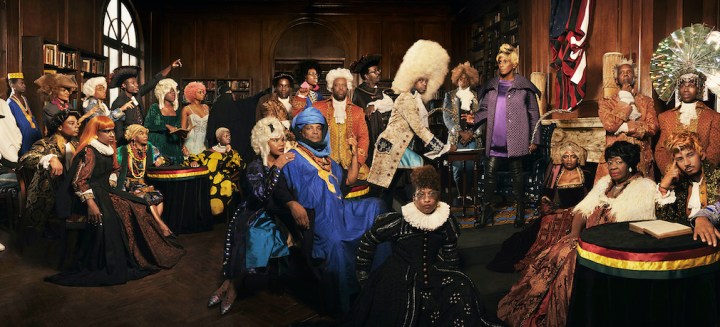
Renee Cox, The Signing, 2018, inkjet print, 122 × 213 cm
(Princeton University Art Museum)
◊ ◊ ◊ ◊ ◊
From Princeton University Art Museum:
Object Lessons in American Art: Selections from the Princeton University Art Museum
Georgia Museum of Art, University of Georgia, Athens, 4 February — 14 May 14 2023
Florence Griswold Museum, Old Lyme, Connecticut, 3 June — 10 September 2023
Speed Art Museum, Louisville, 29 September 2023 — 7 January 2024
Curated by Karl Kusserow

Henry Inman, O-Chee-Na-Shink-Ka a, 1832–33, oil on canvas, 78 × 645 cm (Promised gift from a Private Collection, member of Class of 1982).
Object Lessons in American Art features four centuries of works from the Princeton University Art Museum that collectively explore American history, culture, and society. Inspired by the concept of the object lesson—the study of a material thing to communicate a larger idea—the exhibition brings groups of objects together to ask fundamental questions about artistic significance, materials, and how meaning changes across time and contexts. With a focus on race, gender, and the environment, these pairings demonstrate the value of juxtaposing diverse objects to generate new understanding. Object Lessons presents Euro-American, Native American, and African American art from contemporary perspectives, illustrating how fresh investigations can inform and enrich its meaning, affording new insights into the American past and present. Curated by Karl Kusserow, John Wilmerding Curator of American Art.
Karl Kusserow, ed., with contributions by: Horace Ballard , Kirsten Pai Buick , Ellery Foutch , Karl Kusserow , Jeffrey Richmond-Moll, and Rebecca Zorach, Object Lessons in American Art (Princeton: Princeton University Press, 2023), 200 pages, ISBN: 978-0691978857, £35 / $40.
Object Lessons in American Art explores a diverse gathering of Euro-American, Native American, and African American art from a range of contemporary perspectives, illustrating how innovative analysis of historical art can inform, enhance, and afford new relevance to artifacts of the American past. The book is grounded in the understanding that the meanings of objects change over time, in different contexts, and as a consequence of the ways in which they are considered. Inspired by the concept of the object lesson, the study of a material thing or group of things in juxtaposition to convey embodied and underlying ideas, Object Lessons in American Art examines a broad range of art from Princeton University’s venerable collections as well as contemporary works that imaginatively appropriate and reframe their subjects and style, situating them within current social, cultural, and artistic debates on race, gender, the environment, and more.
C O N T E N T S
Foreword
Preface and Acknowledgments
• Introduction — Lenticular: Subject and Object in American Art — Karl Kusserow
• ‘Race’ as Object Lesson: Objects of Rebellion — Kirsten Pai Buick
• Looking Back and Looking Forward: A Feminist Lens on a Collection of American Art — Ellery E. Foutch
• Oblique Assemblies: Toward Queer Ecologies in American Art — Horace D. Ballard
• Intimations of Ecology: Varieties of Environmental Experience in American Art — Karl Kusserow
• Material Echoes, Traumatic Histories, and Liquid Transformations: The Romance of the Sea in American Art — Rebecca Zorach
• Learning from Object Lessons: Toward a Curatorial Pedagogy of Unfixing and Defamiliarizing the Past — Jeffrey Richmond-Moll
Contributors
Index
Photography Credits
Exhibition | Peter Brathwaite: Rediscovering Black Portraiture
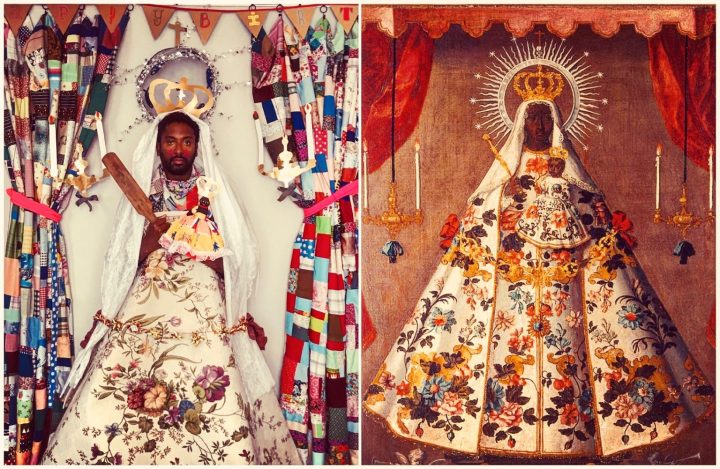
Left: Peter Brathwaite’s restaged version of The Virgin of Guadalupe. Right: Unknown painter, The Virgin of Guadalupe, oil painting, 1745 (London: Wellcome Collection), cropped from original and colour saturated.
◊ ◊ ◊ ◊ ◊
From the Bristol Museum & Art Gallery:
Peter Brathwaite: Rediscovering Black Portraiture
King’s College London, Strand Campus, October 2021 — February 2022
Bristol Museum & Art Gallery, 14 April — 3 September 2023
During the first lockdown in 2020, with all his performances cancelled, baritone, artist, broadcaster, and writer Peter Brathwaite began researching and reimagining more than 100 artworks. These artworks featured portraits of Black sitters, as part of the online #GettyMuseumChallenge to use household objects to restage famous paintings. He called the photographic series Rediscovering Black Portraiture. Alongside this project he also intensified his research into his dual heritage Barbadian roots, uncovering a wealth of detail about his enslaved and enslaver ancestors and their history, including an uprising of enslaved people in 1816 and songs of resistance they sang. Three years on, with a London exhibition behind him and a book out with Getty Publications, Peter Brathwaite brings his whole practice to the history of Georgian House Museum and the collections of Bristol Museum & Art Gallery. New interventions and sound installations reveal the Black presence hidden at the heart of our spaces and objects. The exhibition opened to coincide with the anniversary of the Barbados insurrection, 14 April 1816.
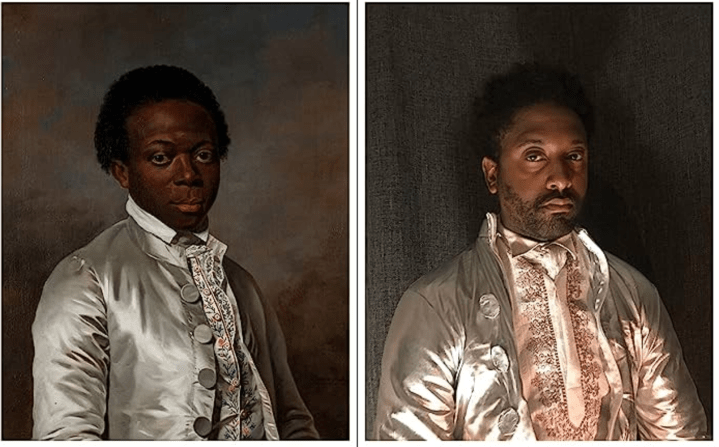
Left: Marie-Victoire Lemoine, Portrait of a Youth in Embroidered Vest, 1785, oil on canvas, 68 × 50 cm (Jacksonville, Florida: Cummer Museum of Art & Gardens). Right: Peter Brathwaite’s restaged version of a Youth in Embroidered Vest.
◊ ◊ ◊ ◊ ◊
From The Getty:
Peter Brathwaite, with contributions by Cheryl Finley, Temi Odumosu, and Mark Sealy, Rediscovering Black Portraiture (Los Angeles, Getty Publications, 2023), 168 pages, ISBN: 978-1606068168, $40.
 Join Peter Brathwaite on an extraordinary journey through representations of Black subjects in Western art, from medieval Europe through the present day. Since the beginning of the COVID-19 pandemic, Peter Brathwaite has thoughtfully researched and reimagined more than one hundred artworks featuring portraits of Black sitters—all posted to social media with the caption “Rediscovering #blackportraiture through #gettymuseumchallenge.”
Rediscovering Black Portraiture collects more than fifty of Brathwaite’s most intriguing re-creations. Introduced by the author and framed by contributions from experts in art history and visual culture, this fascinating book offers a nuanced look at the complexities and challenges of building identity within the African diaspora and how such forces have informed Black portraits over time. Artworks featured include The Adoration of the Magi by Georges Trubert, Portrait of an Unknown Man by Jan Mostaert, Rice n Peas by Sonia Boyce, Barack Obama by Kehinde Wiley, and many more. This volume also invites readers behind the scenes, offering a glimpse of the elegant artifice of Brathwaite’s props, setup, and process. An urgent and compelling exploration of embodiment, representation, and agency, Rediscovering Black Portraiture serves to remind us that Black subjects have been portrayed in art for nearly a millennium and that their stories demand to be told.
Peter Brathwaite is an acclaimed baritone who performs in operas and concerts throughout Europe. He is a presenter on BBC Radio 3 and has been shortlisted for a Royal Philharmonic Society Award. Cheryl Finley is inaugural distinguished visiting director of the Atlanta University Center Art History and Curatorial Studies Collective and the author of Committed to Memory: The Art of the Slave Ship Icon (2018). Temi Odumosu is an art historian, curator, and assistant professor at University of Washington Information School and the author of Africans in English Caricature 1769–1819: Black Jokes, White Humour (2017). Mark Sealy is director of Autograph and professor of photography, race, and human rights at University of the Arts London. His numerous publications include Different (2001), coauthored with Stuart Hall; Decolonising the Camera: Photography in Racial Time (2019); and Photography: Race, Rights, and Representation (2022).
Exhibition | Rosalba Carriera: Perfection in Pastel

Rosalba Carriera, Portrait of an Unknown Lady in a Blue Coat over a Light Dress, detail, pastel on paper, 76 × 64 cm
(Dresden: Gemäldegalerie Alte Meister)
◊ ◊ ◊ ◊ ◊
From Dresden’s Zwinger:
Rosalba Carriera – Perfection in Pastel / Perfektion in Pastell
Gemäldegalerie Alte Meister, Zwinger, Dresden, 9 June — 24 September 2023
On the occasion of the 350th anniversary of the birth of Rosalba Carriera (1673–1757), the Gemäldegalerie Alte Meister (Old Masters Picture Gallery) is dedicating a special exhibition to the most famous pastel painter. More than 100 objects will be presented, including around 70 works by the portraitist, who was one of the first female artists to enjoy success throughout Europe. With 73 pastels, Dresden possesses the world’s largest collection of the Venetian artist’s work. Under August III, more than twice as many pieces by Carriera were in the gallery’s holdings, and in 1746 a separate pastel cabinet was even set up in the Johanneum near the Frauenkirche and named after her.
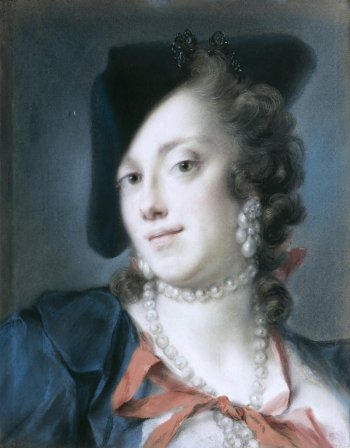
Rosalba Carriera, A Venetian from the House of Barbarigo (Caterina Sagredo Barbarigo), ca. 1735/40, pastel on paper, 42 × 33 cm (Dresden: Gemäldegalerie Alte Meister).
Pastel painting was still considered a comparatively young genre at the time. Carriera was instrumental in making this technique a valued form of painting. The many portraits of princes of the ruling dynasties of Europe show how much in demand the artist was. But she also captured the likenesses of literary figures, musicians, and dancers from her native Venice; a visit to her studio was part of the regular programme of the numerous travellers through Italy. Thus, portraits constitute the largest part of her oeuvre.
Carriera’s pastels bear witness to the beauty ideals of the Rococo period, whose cosmetics were dominated by powder: pale, even skin, powdered hair, and wigs. The powdery surfaces of pastel painting reflect this fashion and thus bring us closer to this bygone era. In cooperation with the Theatre Design/Mask Design course at the Dresden University of Fine Arts, students are illustrating the maquillage of the 18th century in a project that will thus be brought to life in the exhibition.
Carriera’s artistic beginnings lay in miniature painting, as she had little competition to fear from male painter colleagues in this field. In 1705, the San Luca Academy of Art in Rome appointed her a member. This high distinction was bestowed on only a few women, especially as academic training was still denied them for a long time. The Accademia Clementina in Bologna also accepted her as a member in 1720, and a year later the Académie Royale in Paris.
The exhibition shows over 100 objects, taking the public first to the lagoon city of Venice, with views of the Grand Canal, where Carriera had her residence. In addition to the pastel paintings, there are also typical Venetian handicraft products such as glass, lace, and fine cloth to discover.
Roland Enke and Stephan Koja, Rosalba Carriera: Perfection in Pastel (Dresden: Staatliche Kunstsammlungen Dresden, 280 pages, ISBN: 978-3954987580 (English) / ISBN 978-3954987573 (German), €44.
Installation | Nicolas Party and Rosalba Carriera
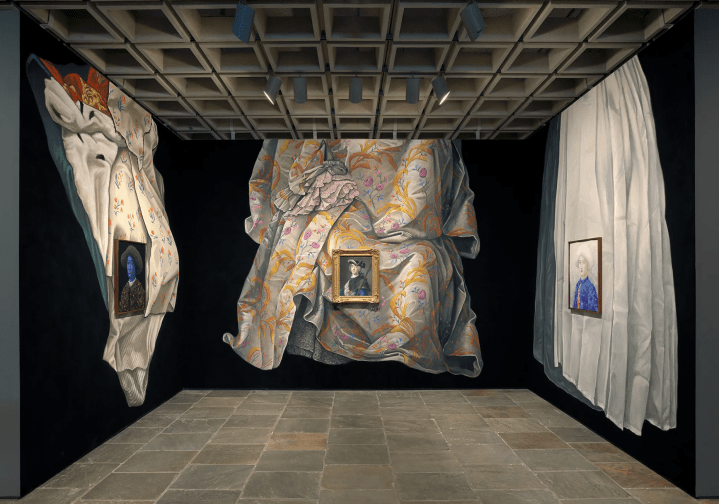
Installation View of Nicolas Party and Rosalba Carriera at Frick Madison, 2023
(Photo by Joseph Coscia Jr.)
◊ ◊ ◊ ◊ ◊
From the press release for the installation:
Nicolas Party and Rosalba Carriera
The Frick Madison, New York, 1 June 2023 — 3 March 2024
Organized by Xavier F. Salomon
The Frick Collection has unveiled a large pastel mural commissioned from the Swiss-born artist Nicolas Party at the museum’s temporary home, Frick Madison. This site-specific work was created in response to Rosalba Carriera’s Portrait of a Man in Pilgrim’s Costume—one of two eighteenth-century pastels by Rosalba bequeathed to the Frick by Alexis Gregory in 2020. The installation features Rosalba’s superb portrait at the center of a three-wall mural designed by Party, as well as two new related works specially created by Party for this presentation.
On view from 1 June 2023 through the remainder of the Frick’s residency at the Breuer building (until 3 March 2024), this installation will inspire the Frick’s summer and early fall programming as well as a new publication.
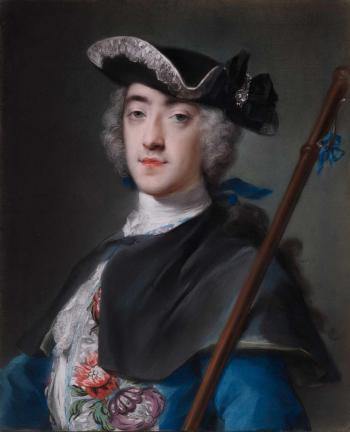
Rosalba Carriera, Portrait of a Man in Pilgrim’s Costume, ca. 1730. pastel on paper, glued to canvas, 59 × 48 cm (New York: The Frick Collection, Gift of Alexis Gregory, 2020.3.01).
The project, which also marks the 350th anniversary of Rosalba’s birth, is organized by Xavier F. Salomon, the Frick’s Deputy Director and Peter Jay Sharp Chief Curator. Salomon comments, “It has been a particular pleasure to work with Nicolas Party. I met Nicolas in April 2021 and since then have enjoyed an ongoing and enlightening conversation on pastels. Nicolas’s installation at Frick Madison is the result of our exchanges, and I am delighted with the result.”
Party adds, “When I first fell in love with pastels, some ten years ago, my research quickly led me to the queen of pastel, Rosalba. Her practice and love for the powdery sticks increased the popularity of the medium and were crucial to the development of the art form. I felt a powerful attraction to her pastels. Today, I like to think our approaches might not be all that different.”
Born in Venice, Rosalba Carriera (1673–1757) was celebrated throughout Europe during her lifetime for her portraiture. She was the preeminent portraitist in Venice in the mid-eighteenth century, at the same time the Venetian Carnival reached its zenith. During this period, foreign travelers flocked to Venice for the masked revelries that became synonymous with the city, and Rosalba’s studio was a popular stop for visiting foreigners, who often posed for her in their elegant Carnival costumes. Portrait of a Man in Pilgrim’s Costume (ca. 1730) is most likely one such work. The sitter is possibly French, British, or German, but his identity remains unknown. With his black cape, staff, and jaunty tricorn hat, he is depicted as a pilgrim.
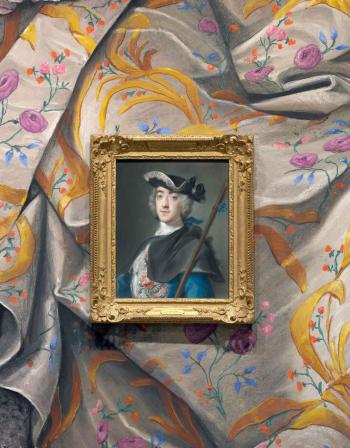
Installation View of Nicolas Party and Rosalba Carriera at Frick Madison, 2023 (Photo by Joseph Coscia Jr.)
Party’s mural includes elaborate draperies that highlight the Rosalba portrait along with two additional pastel portraits he created in response to it. These ornate draperies evoke the work of two other towering figures in European pastels—Jean-Étienne Liotard (1702–1789) and Maurice-Quentin de La Tour (1704–1788)—echoing the function of Venetian Carnival masks, designed to conceal and reveal the features of their wearers. Party’s installation engages devices of disguise and disclosure, from masks to draperies to makeup (often produced with the same chemical components used to make pastel sticks).
The large-scale murals created by Party, whose primary medium since 2013 has been pastel, are ephemeral, lasting only for the duration of a specific exhibition at a unique location. The historical nature of his practice aligns perfectly with the installation at Frick Madison, which has given the museum a unique opportunity to re-imagine its permanent collection display, presented for the first time outside the domestic setting of the Gilded Age mansion at 1 East 70th Street.
This project is part of a series of initiatives in recent years that invite contemporary responses to the Frick’s holdings. Party’s installation not only offers a fresh perspective on an important recent acquisition, but furthers Frick Madison’s prompting of visitors to question the impact of site and setting on their perception of historic objects in the collection.
Born in Lausanne in 1980, Party is a figurative painter who has achieved critical admiration for his familiar yet unsettling landscapes, portraits, and still lifes that simultaneously celebrate and challenge conventions of representational painting. His works are primarily created in soft pastel, which allows for exceptional degrees of intensity and fluidity in his depictions of objects both natural and manmade. Transforming these objects into abstracted, biomorphic shapes, Party suggests deeper connections and meanings. His unique visual language has coalesced in a universe of fantastical characters and motifs where perspective is heightened and skewed to uncanny effect.
Over the years, Party has created work in response to that of European painters including Louis-Léopold Boilly (1761–1845), Arnold Böcklin (1827–1901), and René Magritte (1898–1967). In 2019, Party organized the pastel exhibition at the FLAG Art Foundation in New York, where he created large—and ephemeral—pastel murals inspired by French eighteenth-century artists including François Boucher (1703–1770) and Jean-Honoré Fragonard (1732–1806), both of whom are represented in the Frick’s permanent collection.
Nicolas Party and Xavier Salomon, Rosalba Carriera’s Man in Pilgrim’s Costume (London: Giles, 2023), 80 pages, ISBN: 978-1913875510, £20 / $25.
Funding for the installation is generously provided by The Christian Humann Foundation and the David L. Klein, Jr. Foundation, with the support of the Swiss Arts Council Pro Helvetia.
◊ ◊ ◊ ◊ ◊
Note (added 25 August 2023) — The posting was updated with details on the publication.
Display | The Wildmans in Bedford Square and Newstead Abbey
Now on view at the Mellon Centre:
A Harpy and His Brothers: The Wildmans in Bedford Square and Newstead Abbey
Paul Mellon Centre, London, 30 May — 15 September 2023
Curated by Martin Myrone

George Romney, Portrait of Thomas Wildman MP, detail, oil on canvas, 78 × 64 cm (Private Collection).
This Drawing Room display shows some of the ways that the architectural and cultural histories of Bedford Square and Newstead Abbey have been addressed in the past and the ways in which those stories might be revised and complicated. The inclusion of the film project Blood Sugar, developed by volunteers at Newstead Abbey, offers further perspectives on these historical stories.
Bedford Square has always been esteemed as one of London’s most prestigious addresses. Built in 1775–82, it is widely considered to be the finest surviving example in London of a Georgian town square, embodying in its orderly architecture appearance the favoured self-image of the British social elite. This display explores the history and reputation of Bedford Square by focusing on two brothers who were among its first inhabitants: the successful lawyer Thomas Wildman (1740–1795) and his younger brother James Wildman (1747–1816). Together with a third brother, the merchant Henry Wildman (1746–1816), they made a fortune through their connections with the fabulously wealthy William Beckford, managing his legal affairs and his extensive plantations in the West Indies. Thomas Wildman’s wealth allowed his son, also Thomas (1787–1859), to purchase Newstead Abbey, a historic property in Nottinghamshire previously owned by the poet Lord Byron.
A digital version of the accompanying 36-page booklet is available here»
◊ ◊ ◊ ◊ ◊
More information about “Blood Sugar: The Slavery History of Newstead Abbey” can be found here, with the 5-minute 2018 film itself available on YouTube.
Exhibition | A Very Strong Likeness of Her: Portraiture and Identity
Opening this month at the Milwaukee Art Museum:
A Very Strong Likeness of Her: Portraiture and Identity in the British Colonial World
Milwaukee Art Museum, 23 June — 22 October 2023

Francis Cotes, Portrait of Miss Frances Lee, 1769, oil on canvas. 36 × 28 inches (Milwaukee Art Museum: Gift of Mr. and Mrs. William D. Vogel, M1964.5; photo by Larry Sanders).
Focusing on a singular work from the Museum’s collection, A Very Strong Likeness of Her explores the challenging and sometimes conflicting histories that an artwork can represent. On its surface, the English artist Francis Cotes’s (1726–1770) portrait of Miss Frances Lee is a charming image of a young girl and her napkin-turned-rabbit companion. The exhibition’s close study of the painting, however, reveals a complex story of identity, family dynamics, and British colonialism in Jamaica. A Very Strong Likeness of Her employs a range of materials to bring to life the underlying narratives in this deceptively simple painting.
Lecture by Mia L. Bagneris
Thursday, 27 July, 6.15pm
Learn about race and class status in colonial Jamaica through the story behind the portrait of Miss Frances Lee. Mia L. Bagneris, associate professor of art history and Africana studies and director of the Africana Studies Program at Tulane University, details this complex history.
Gallery Talk with Tanya Paul
Thursday, 10 August, noon–1pm
Tanya Paul is the Museum’s Isabel and Alfred Bader Curator of European Art.










 Enfilade
leave a comment