Exhibition | Is It Any Good?
Now on view at The Walpole Library with a talk from Dr Roman on February 4:
Is It Any Good? Prints, Drawings, and Paintings at the Lewis Walpole Library
The Lewis Walpole Library, Farmington, CT, 22 September 2023 — 28 June 2024
Curated by Cynthia Roman
 Art historians, curators, and connoisseurs often pose the question, ‘Is it any good?’ evoking a sense of quality manifest in canonical works of art. By contrast, when building a collection of 18th-century prints that would become a cornerstone for research at the Lewis Walpole Library, W.S. and Annie Burr Lewis envisioned a visual collection that is essentially archival. Prints were valued foremost as documents that would improve their library dedicated to the life and times of Horace Walpole and to 18th-century studies. The Lewises’ iconographic approach, however, does not preclude the importance of assessing what is good. Aesthetic, material, and technical attributes are integral to understanding the power of visual art and artifacts to communicate the eighteenth-century histories they document. Asking Is it any good? this exhibition presents a selection of prints, drawings, and paintings at the Lewis Walpole Library to explore the intersections of quality and documentary value.
◊ ◊ ◊ ◊ ◊
Cynthia Roman, Curating the Caricature Collection at the Lewis Walpole Library
Sunday, 4 February 2024, 2.00pm
Cynthia Roman, Curator of Prints, Drawings and Paintings at the Lewis Walpole Library will present the story of the library’s internationally recognized print collection. Often in W.S. Lewis’s own words, this talk will explore the commitment that he and Annie Burr Lewis shared to “make more use of political and personal caricatures” when building a research collection for 18th-century studies that included Annie Burr’s celebrated chronological and subject-based card catalog. Reflecting on more than twenty years of stewarding the print collection, Roman will present both the Lewises’ vision of caricature as archival documents and subsequent curatorial initiatives to acquire prints that more deliberately embrace material, technical, and aesthetic considerations; circumstances of production, marketing and circulation including prolific practices of copying; as well as the legacy of caricature today.
Cynthia E. Roman, PhD, is Curator of Prints, Drawings and Paintings at the Lewis Walpole Library, Yale University. Her research focuses on 18th-century British art, particularly prints. She has published essays on graphic satire, collecting history, and ‘amateur’ artists, and has edited and co-edited collected volumes including Horace Walpole’s Strawberry Hill Collection with Michael Snodin (2009–10), Hogarth’s Legacy (2016), Staging ‘The Mysterious Mother’ with Jill Campbell (2024), and Female Printmakers, Printsellers, and Print Publishers in the Eighteenth Century: The Imprint of Women, c. 1700–1830, with Cristina Martinez (2024).
Exhibition | Petr Brandl: The Story of a Bohemian

Installation view of the exhibition Petr Brandl: The Story of a Bohemian, Waldstein Riding School, Prague (2023).
◊ ◊ ◊ ◊ ◊
Now on view at Národní galerie Praha (as noted at Art History News) . . .
Petr Brandl: The Story of a Bohemian / Příběh bohéma
Waldstein Riding School, National Gallery Prague, 19 October 2023 — 11 February 2024
Curated by Andrea Steckerová
After over fifty years, this exhibition presents the work of the most important Baroque artist in Bohemia, Petr Brandl (1668–1735). On display are his monumental altarpieces—specially restored for the occasion—as well as his portraits and genre paintings of very interesting subject matter. Visitors will also see newly discovered works by Brandl for the very first time. The exhibition is organized around two parallel narratives: the painter’s works and his life.
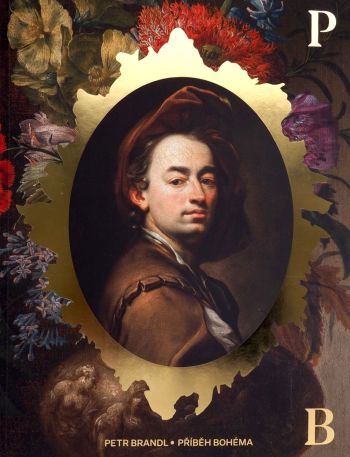 We have numerous archival documents of Brandl’s life of bohemian revolt, which is remarkable even today, offering interesting contexts for the problems of our time. Brandl was, for instance, a lifelong debtor due to his penchant for the luxury lifestyle of nobility, which he was keen to enjoy himself. It also led him to court battles with his wife Helena over alimony. In addition, Brandl was regularly in trouble with his commissioners, as he often failed to comply with the terms of his contracts. The painter’s unbound life has inspired a contemporary theatre play Three Women and a Hunter in Love, which will be staged together with the exhibition (Geisslers Hofcomoedianten).
None of this, however, changes the fact that Brandl was the highest-paid artist of his time, probably because of his very distinctive and original style of painting, in which we can trace certain parallels with Rembrandt. X-rays and macro-photographs of Brandl’s works complement the exhibition to give visitors a glimpse into the inner workings of his painting.
Andrea Steckerová, Petr Brandl: Příběh Bohéma (Prague: Národní galerie Praha, 2023), 288 pages, ISBN: 978-8070358221, 1050 Czech Koruna / $46.
Exhibition | South Asian Miniature Painting and Britain
Closing this month at The Box, with the catalogue appearing this spring from Bloomsbury:
Beyond the Page: South Asian Miniature Painting and Britain, 1600 to Now
The Box, Plymouth, 7 October 2023 — 28 January 2024
 Beyond the Page explores how the traditions of South Asian miniature painting have been reclaimed and reinvented by modern and contemporary artists, taken forward beyond the pages of illuminated manuscripts to experimental forms that include installations, sculpture, and film. The exhibition features work by artists from different generations working in dialogue with the miniature tradition, including Hamra Abbas, Zahoor ul Akhlaq, David Alesworth, Nandalal Bose, Noor Ali Chagani, Lubna Chowdhary, Adbur Rahman Chughtai, Olivia Fraser, Samuel Fyzee-Rahamin, Alexander Gorlizki, N.S. Harsha, Howard Hodgkin, Ali Kazim, Bhupen Khakhar, Matthew Krishanu, Jess MacNeil, Imran Qureshi, Nusra Latif Qureshi, Mohan Samant, Willem Schellinks, Raqib Shaw, Gulammohammed Sheikh, Nilima Sheikh, Arpita Singh, the Singh Twins, Shahzia Sikander, Abanindranath Tagore and Muhammad Zeeshan. Contemporary works are shown alongside examples of miniature painting dating as far back as the 16th century drawn from major collections including The Royal Collection, the Victoria & Albert Museum, and The British Museum, many on public display for the first time.
Anthony Spira and Fay Blanchard, eds., with essays by Emily Hannam and Hammad Nasar and catalogue entries by Emily Hannam, Cleo Roberts-Komireddi, and Elizabeth Brown, Beyond the Page: South Asian Miniature Painting and Britain, 1600 to Now (London: Philip Wilson Publishers, 2024), 224 pages, ISBN: 978-1781301258, $40.
Exhibition | Indian Skies: The Howard Hodgkin Collection

An Elephant and Keeper, India, Mughal, ca. 1650–60, opaque color and gold on paper
(New York: The Metropolitan Museum of Art, Howard Hodgkin Collection, 2022.187)
◊ ◊ ◊ ◊ ◊
Opening next month at The Met:
Indian Skies: The Howard Hodgkin Collection of Indian Court Painting
The Metropolitan Museum of Art, New York, 6 February — 9 June 2024
Over the course of sixty years, British artist Howard Hodgkin (1932–2017) formed a collection of Indian paintings and drawings that is recognized as one of the finest of its kind. A highly regarded painter and printmaker, Hodgkin collected works from the Mughal, Deccani, Rajput, and Pahari courts dating from the 16th to the 19th centuries that reflect his personal passion for Indian art. This exhibition presents over 120 of these works, many of which The Met recently acquired, alongside loans from The Howard Hodgkin Indian Collection Trust.
The works on view include stunning portraits, beautifully detailed text illustrations, studies of the natural world, and devotional subjects. The exhibition will also display a painting by Hodgkin, Small Indian Sky, which alludes to the subtle relationship between his own work, India, and his collection. This exhibition is accompanied by an issue of The Metropolitan Museum of Art Bulletin.
Exhibition | Fashioning an Empire: Textiles from Safavid Iran

Textile with Pink, Red and Blue Flowers, Iran, 1700–22, silk and metal-wrapped thread
(Doha: Museum of Islamic Art, 2014.282)
◊ ◊ ◊ ◊ ◊
From the press release (via Art Daily) for the exhibition:
Fashioning an Empire: Textiles from Safavid Iran
Smithsonian’s National Museum of Asian Art, Washington, DC, 18 December 2021 — 15 May 2022
Museum of Islamic Art, Doha, 23 October 2023 — 20 April 2024
The Museum of Islamic Art, Doha is currently showcasing Fashioning an Empire: Textiles from Safavid Iran, a captivating exhibition that highlights the critical role silk played during the Safavid period (1501–1736). The exhibition is organised into four sections: starting with the establishment of the silk monopoly and state-funded manufacturing and exploring the production and technical components of textiles; the rise of Isfahan as imperial capital; fashion and trends in Safavid society; and lastly, contemporary commissions created by local designers inspired by Safavid textiles. Fashioning an Empire was conceived by and first presented at the Smithsonian’s National Museum of Asian Art, Washington, DC (2021–22).
Silk’s complex manufacturing process and supple feel against the skin make it a valuable and highly prized luxury good. Since the 6th century, Iran has produced high quality silk, widely appreciated and traded long distances. It was, however, during the reign of Iran’s most important ruler in modern history, Shah ‘Abbas I the Great (r. 1588–1629), that silk became a state-controlled industry—it boosted the country’s economy by supplying both an eager internal demand and feeding a vigorous export market spanning from England to Thailand. Shah ‘Abbas was the fifth shah of the Safavid dynasty (1501–1722). Under the Safavids, Iran experienced a period of renewed political strength and artistic creativity, geographical borders were consolidated, and most of the population adopted Shi‘a Islam, which became the country’s official state religion. The rise of the silk economy during Shah ‘Abbas’s reign had effects beyond the markets, inspiring artistic development and fostering cultural exchange.
Born out of a collaboration with the National Museum of Asian Art in Washington, DC, the exhibition explores the development of the silk industry under Shah ‘Abbas. It presents the capital city of Isfahan as the heart of the Safavid state and showcases fashion styles during a time when Iran established itself as a major player in the global arena.
The exhibition ends with a series of contemporary works created by Qatar-based designers in collaboration with M7, Qatar’s epicentre for innovation and entrepreneurship in fashion and design. Their artworks respond to the splendid historic textiles on display and illustrate the powerful creativity that Safavid silks still inspire in today’s creative minds.
Exhibition | Within Reach of Asia
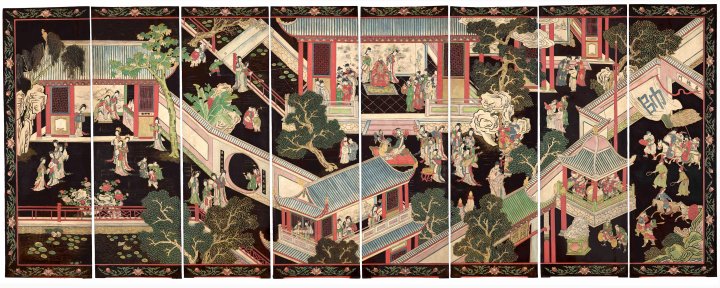
Eight-leaf screen, depicting a Palace Scene with the Arrival of a Delegation and Festivities in Honor of Tang General Guo Ziyi 郭子儀, Qing dynasty, Kangxi (1662–1722) or Qianlong (1736–1795) period, late 17th or 18th century; wood, ‘Coromandel’ lacquer, 135 × 346 cm (Dijon: Musée des beaux-arts). In the 18th century, the screen was part of the collection of Jehannin de Chamblanc (1722–1797).
◊ ◊ ◊ ◊ ◊
A review of the exhibition (in French) by Gilles Kraemer, with excellent installation photographs, is available at Le Curieux des Arts:
Within Reach of Asia: Asian Art Collectors and Dealers in France, 1750–1930
Musée des Beaux-Arts, Dijon, 20 October 2023 — 22 January 2024
Curated by Catherine Tran-Bourdonneau, Pauline d’Abrigeon, and Pauline Guyot
On 20 October 2023, the Musée des Beaux-Arts in Dijon opened its new exhibition À portée d’Asie: Collectors, Collectors and Dealers of Asian Art in France, 1750–1930, labelled of national interest by the Ministry of Culture. In partnership with the Institut National de l’Histoire de l’Art (INHA), the exhibition highlights two centuries of enthusiasm for Asian arts in France, from the royal collections of Louis XV and Marie-Antoinette, to collections gathered for commercial and scientific purposes between 1850 and 1930, along with the vogue for Japonism shared by artists, collectors, and simple amateurs of the bibelotage in the 19th century.
 Extending a research program of INHA, the exhibition brings together national collections and Far Eastern collections of regional museums, which include multiple objects brought from Asia over the ages. With more than 300 works—diverse technically (with lacquers, porcelains, ivories, bronzes, screens, prints and illustrated books, silk paintings, and theater masks), as well as historically and geographically (with objects from China, Japan, Korea, and Cambodia)—the exhibition draws on prestigious loans from important national institutions, including the Musée Guimet, the Louvre, the Palace of Versailles, the Musée des Arts Décoratifs, and the Musée du Quai Branly. Also well represented are the Asian collections of the region (those of Florine Langweil in Colmar and Strasbourg, Jules Adeline in Rouen, and Adhémard Leclère in Alençon) and especially those of Dijon’s Musée des Beaux-Arts. Moreover, through a participatory sponsorship campaign, €10,000 was raised for the museum’s restoration of a Coromandel lacquer screen from the 18th-century collection of Jehannin de Chamblanc.
Organized by the City of Dijon, in partnership with the National Institute of Art History (INHA), the exhibition is recognized as being of national interest by the Ministry of Culture, which provides exceptional financial support. The label ‘Exhibition of National Interest’ (Exposition d’intérêt national) was created by the Ministry of Culture in 1999 to support remarkable exhibitions organized by French museums in different regions. Such exhibitions highlight themes that reflect the richness and diversity of the collections of museums in France. The label rewards an innovative museum discourse, a new thematic approach, a scenography and a mediation device with the aim of reaching various audiences.
Pauline d’Abrigeon, Pauline Guyot, and Catherine Tran-Bourdonneau, eds., À portée d’Asie: Collectionneurs, collecteurs et marchands d’art asiatique en France, 1750–1930 (Paris: Lienart éditions, 2023), 320 pages, ISBN: 978-2359064049, €35.
Exhibition | Shopping in Canton

Opening this month at the Hong Kong Museum of Art:
Shopping in Canton: China Trade Art in the 18th and 19th Centuries (Phase II) / 廣州購物誌──18至19世紀外銷藝術(第二期)
Hong Kong Museum of Art, 13 January — 15 November 2024
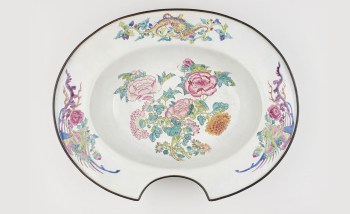
Barber’s basin with floral design in painted enamel, mid 18th century, copper, 36 × 28 × 7 cm (Hong Kong Art Museum, C1987.0010).
During the 18th and 19th centuries, Canton (Guangzhou) was the centre of foreign trade in China. There were some busy shopping streets near the Thirteen Factories district in the southwest suburbs of the Canton city along the Pearl River, with rows of stores selling various crafts and curiosities, tea leaves, local products, snacks and drinks. The target customers were mostly foreign merchants. This exhibition showcases a wide variety of China trade art collections to reconstruct scenes of the bustling shopping paradise in Canton. Visitors will immerse themselves in the interactive animations created by local animators the Tsui Brothers, as they go window-shopping down the memory lane while discovering the art and history of this thriving neighbourhood.
Exhibition | Thomas Frye: An Irish Artist in London
From Ireland’s Office of Public Works:
Neglected Genius — Thomas Frye: An Irish Artist in London
Dublin Castle, 1 December 2023 — 19 March 2024
Curated by William Laffan
The Office of Public Works is pleased to announce the opening of a major exhibition dedicated to Ireland’s most successful design-entrepreneur of the eighteenth century, Thomas Frye (1710–1762).
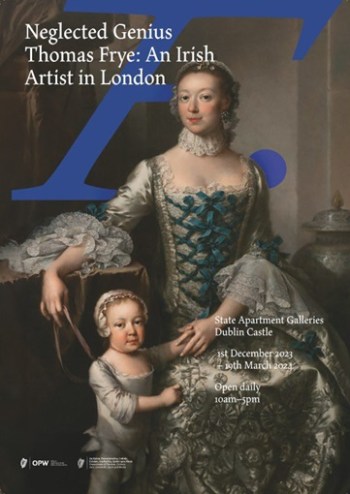 Born in 1710, most likely in Edenderry, County Offaly, Thomas Frye moved to London as a young man, where he quickly established himself as a successful portrait painter. From the mid-1740s, he ran a factory in Bow, just east of the City of London, set up to recreate Chinese porcelain, which had been admired in Europe for centuries. Under Frye’s management the Bow factory thrived, producing inexpensive ceramics both decorative and utilitarian in a variety of designs.
Frye was among the earliest European artists to collapse the distinction between ‘high’ art and factory-produced design. In an age of increasing specialisation, the manner in which he ranged freely across multiple techniques and media was unique. Although his name is scarcely known today outside specialist circles, Frye has a strong claim to the title of Ireland’s most successful printmaker, industrial artist, and design entrepreneur. At the same time, Frye’s career in London illustrates the incipient globalization of the period. Frye attempted to emulate Chinese technology with raw materials from north America.
This exhibition sets side-by-side Frye’s portraiture in oil, his enamel miniatures, his mezzotints, and the production of the Bow porcelain factory under his management. For the first time equal emphasis is afforded to each facet of this supremely gifted and highly innovative Irish artist. Included are loans from the Victoria and Albert Museum; The Foundling Museum, London; the Holburne Museum, Bath; and the National Gallery of Ireland, along with leading private collections.
William Laffan, the curator of the exhibition states: “Frye must be acknowledged as a pioneering figure in portraiture, porcelain and printmaking, and as one of the most inventive and ‘ingenious’ artists of the Georgian era.”
The Burlington Magazine, December 2023
The eighteenth century in the December issue of The Burlington, which focuses on Spain:
The Burlington Magazine 165 (December 2023)

Francisco de Goya, Self-Portrait with Dr Arrieta, 1820, oil on canvas, 115 × 77 cm (Minneapolis Institute of Art, 52.14).
a r t i c l e
• Mercedes Cerón Peña, “Goya’s Self-Portrait with Dr Arrieta,” pp. 1300–04.
In 1820 Goya painted a portrait of himself as he had appeared during his serious illness of the year before, attended by his doctor, Eugenio García Arrieta. Newly discovered biographical information about Arrieta suggests that the painting’s red and and green colour scheme may allude to the political views he shared with Goya.
r e v i e w s
• Michael Hall, Review of the new Galería de las Colecciones Reales (Royal Collections Gallery) in Madrid (opened 28 June 2023), pp. 1339–43.
• Stephen Lloyd, Review of the exhibition Return of the Gods (World Museum, Liverpool, (April 2023 — February 2024), pp. 1343–45. “Britain’s largest assemblage of Classical sculpture outside London belongs to National Museums Liverpool . . . In 1959 Liverpool City Council and its museums were gifted the entirety of the Ince Blundell collection—approximately six hundred heavily restored Roman marbles . . . collected by . . . Henry Blundell (1724–1810), a wealthy Catholic landowner, between 1776 and 1809.”
• Humphrey Wine, Review of the catalogue raisonné by Joseph Assémat-Tessandier, Louis Lagrenée, dit l’Aîné (1725–1805) (Arthena, 2022), pp. 1364–65.
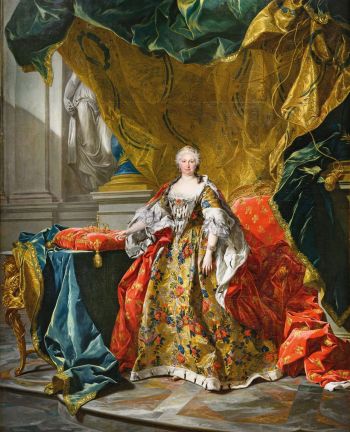
Louis-Michel van Loo, Portrait of Isabel Farnese, 1737, oil on canvas, 341 × 264 cm (Madrid: Galería de las Colecciones Reales).
• Rebeka Hodgkinson, Review of Stephanie Barczewski, How the Country House Became English (Reaktion, 2023), pp. 1370–71.
• Peter Humfrey, Review of Eveline Baseggio, Tiziana Franco, and Luca Molà, eds., La chiesa di Santa Maria dei Servi e la comunità veneziana dei Servi di Maria, secoli XIV–XIX (Viella, 2023), pp. 1374–75. “The demolition of the great fourteenth-century church of the Servi in about 1812–13 represents one of the most grievous of the many losses suffered by Venice’s artistic heritage during the Napoleonic period.”
o b i t u a r y
• Saloni Mathur, Obituary for Kavita Singh (1964–2023), pp. 1379–80.
Professor of art history and Dean of the School of Arts and Aesthetics at Jawaharlal Nehru University, Kavita Singh became internationally known for her publications on the history and politics of museums and the pre-modern art of South Asia. An authority on Indian court paintings, she was an inspiring colleague and teacher who publicly championed both her university and the study of Mughal art in the subcontinent.
Exhibition | Part of the Furniture: The Library of John Bedford
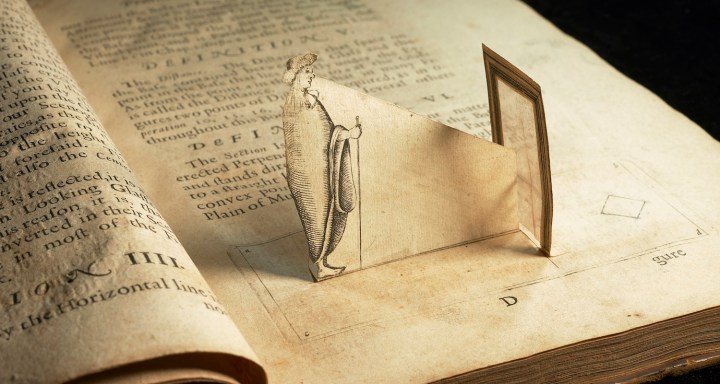
Joseph Moxon, Practical Perspective; or Perspective Made Easie (London, 1670)
(University of Leeds)
◊ ◊ ◊ ◊ ◊
Now on view at the University of Leeds, with additional information at the Antique Collecting Magazine. Also, see this posting at Antique Dealers Blog by one of the show’s curators, Mark Westgarth.
Part of the Furniture: The Library of John Bedford
Brotherton Gallery, University of Leeds, 9 January — 21 December 2024
Curated by Mark Westgarth, Rachel Eckersley, and Rhiannon Lawrence-Francis
Rare and beautiful books chart the evolution of furniture design over the centuries and the journey from drawing board, to workshop, to home
Selected from the world-leading library of antiques dealer John Bedford (1941–2019), ornate patterns by a renaissance pioneer, designs by Chippendale, Sheraton, Pugin, and Morris, elaborate trade cards, colourful catalogues, drawings, and manuals show how ideas and trends took shape, gained influence, and were eventually revived as fashions came full circle.
Upholsterer and furniture dealer Daniel Thorn might be less of a household name, but his personal sketchbook of designs for drapery, curtains, and furniture is a lively working record of the looks of the late-18th and early-19th centuries. Other highlights include the only complete coloured copy of The Ladies Amusement, an 18th-century book of decorative designs made to cut out and paste. Henry Lawford’s gloriously garish 1855 fold-out sofa catalogue sweeps away clichés of dismal Victoriana in a colour-lithographed riot of puce, lavender, and pea-green.
The exhibition also celebrates Bedford’s life, his vast knowledge, and his generous legacy to the University of Leeds, which enabled the extension and refurbishment of The Brotherton Research Centre and the establishment of The John Bedford Fellowship, in addition to the donation of his dazzling library.
Part of the Furniture: The Library of John Bedford is curated by Mark Westgarth, Associate Professor of Art History and Museum Studies and Director of the Centre for the Study of the Art & Antiques Market; Rachel Eckersley, Rare Book Specialist; and Rhiannon Lawrence-Francis, Special Collections Curator.
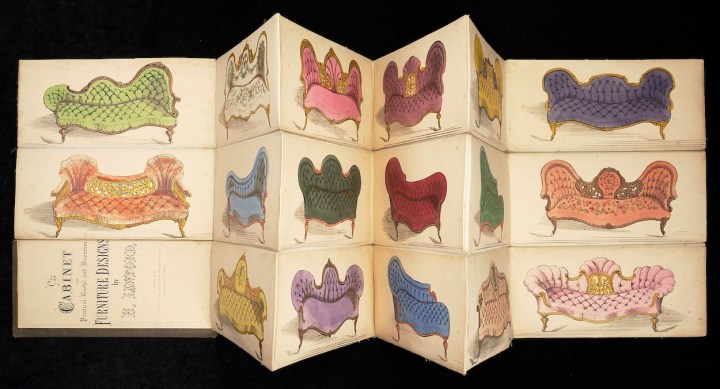
Henry Lawford, The Cabinet of Practical, Useful, and Decorative Furniture Designs (J. S. Virtue & Co., 1855)
(University of Leeds)










leave a comment