The Burlington Magazine, April 2023
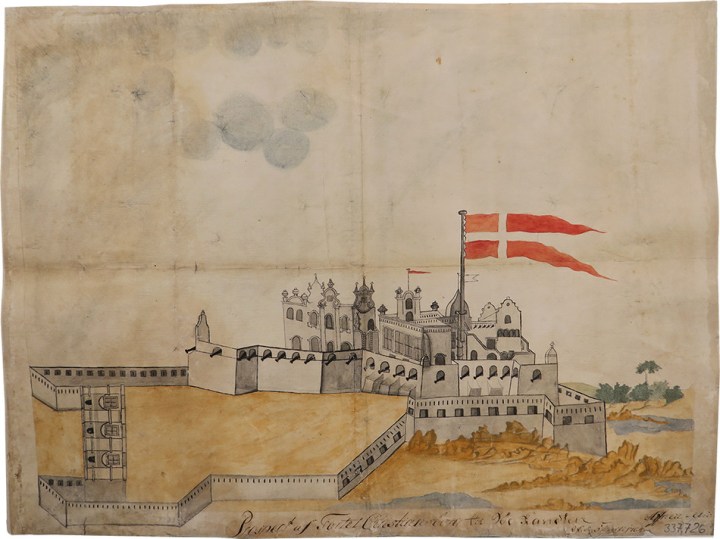
View of Fort Christiansborg [Christiansborg Castle, Osu] from the Shore, March 1764, ink and coloured wash on paper
(Danish National Archives)
◊ ◊ ◊ ◊ ◊
The eighteenth century in the April issue of The Burlington . . .
The Burlington Magazine 165 (April 2023)
A R T I C L E S
• Gauvin Alexander Bailey, “The Design of Cape Coast Castle and Dixcove Fort, Ghana,” pp. 378–93.
The first analysis of the design of two of the principal eighteenth-century British slave castles and forts of the Gold Coast reveals the Western engravings used as prototypes but also acknowledges these buildings’ engagement with African cultures and forms. Identifying the people who built them and assessing the forts’ association with the coastal African community challenges the popular misconception that they were no more than European transplants.
R E V I E W S
 • Morlin Ellis, Review of the exhibition Spain and the Hispanic World: Treasures from the Hispanic Society Museum and Library (Royal Academy of Arts, 2023), pp. 442–45.
• Simon Jervis, Review of the exhibition catalogue, Reinier Baarsen, Process: Design Drawings from the Rijksmuseum 1500–1900 (Rotterdam: 2022), pp. 456–58.
• Philip Ward-Jackson, Review of the exhibition catalogue, Yvette Deseyve, ed., Johann Gottfried Schadow: Embracing Forms (Hirmer Verlag, 2023), pp. 463–66.
• Thomas P. Campbell, Review of Helen Wyld, The Art of Tapestry (Philip Wilson Publishers, 2022), pp. 472–75.
• Charles Saumarez Smith, Review of András Szántó, Imagining the Future Museum: 21 Dialogues with Architects (Hatje Cantz, 2022), pp. 482–83.
• John Martin Robinson, Review of Dudley Dodd, Stourhead: Henry Hoare’s Paradise Revisited (Head of Zeus, 2021), pp. 484–85.
O B I T U A R I E S
• Christopher Wood, Obituary for Hans Belting (1935–2023), pp. 486–88.
Exhibition | Coins, Medals, and the Rule of Law

Der Medailleur Jacques-Antoine Dassier setzte 1753 Charles de Montesquieu ins Medaillenrund. In dessen Hauptwerk De l’Esprit des lois von 1748 entfaltete er eine Theorie der Gewaltentrennung, die erheblichen Einfluss auf die Entwicklung des modernen Verfassungsstaates hatte (Staatliche Museen zu Berlin, Münzkabinett, ex Slg. Thomas Würtenberger / Karsten Dahmen)
◊ ◊ ◊ ◊ ◊
From the Staatliche Museen zu Berlin:
Ius in nummis: Die Sammlung Thomas Würtenberger
Bode-Museum, Berlin, 26 May 2023 — 7 April 2024
Eine Sonderausstellung des Münzkabinetts der Staatlichen Museen zu Berlin
Ius in nummis: Die Sammlung Thomas Würtenberger ist in ihrer Breite einzigartig. Sie wurde über den Zeitraum eines halben Jahrhunderts zusammengetragen und umfasst mehr als 3.000 Objekte—vornehmlich Medaillen und einige Münzen—mit dem Fokus auf die neuzeitliche Rechtsgeschichte Westeuropas in zunehmend globaler Perspektive. Jedes Objekt erschließt dabei ein Stück juristischer Vergangenheit.
Iūs, iūris, n. bedeutet unter anderem Recht. Regeln und Gesetze ordnen und durchdringen seit Jahrtausenden den Alltag der Menschen. Recht und Gerechtigkeit bilden dabei dynamische Spannungsfelder. Rechtshandlungen und Rechtsauffassungen gehen von Individuen aus. Rechtsstaat und Unrechtsstaat oder Verfassungsstaat und Willkürherrschaft erinnern an die Konsequenzen gelebter Wertesysteme. Die Rechtsgeschichte erkundet mittels vielfältiger Quellen Ereignisse wie Rechtssetzungen und Rechtsakte, aber auch individuelle Rechtspersonen und Rechtskulturen.
nummus -ī, m. bezeichnet eigentlich Münzen und Geldstücke, doch hat es sich bewährt, auch ein verwandtes Medium unter diesen Begriff zu fassen: die Medaille. Für die Rechtsarchäologie bietet sie eine ergiebige Primärquelle. Von Moses bis zu den Menschenrechten eröffnet die Medaillenkunst ein weites Panorama der Inszenierung von Recht.
Die Ausstellung Ius in nummis: Ein Sammlungsüberblick in zwölf Segmenten
Das Münzkabinett hat es sich zur Aufgabe gesetzt, die Sammlung Würtenberger zu verwahren und zugänglich zu machen. Die digitale Erfassung seit 2020 ist die Voraussetzung der ersten systematischen Erschließung dieses Kulturguts. Ausstellung, Katalog und Begleitprogramm sind dicht am Puls laufender Forschungsarbeiten um diese wichtige Neuerwerbung angesiedelt. Präsentiert wird zunächst die Fragestellung der Spezialsammlung „Ius in nummis“. Weiterführend geht es aber nicht zuletzt um die Erkenntnispotenziale numismatischer Quellen für die Rechtsgeschichte.
Weitgehend geschlossen überliefert, zeigen numismatische Objekte das nahezu vollständige Bild einer erfolgreichen Kulturtechnik. Je nach Materialität und Auflage exklusiv oder für Jedermann halten sie Personen, Dinge und Ereignisse fest. Als mobile und beständige Medien können Medaillen über politische, religiöse und kulturelle Barrieren hinweg von Mensch zu Mensch gehen. Und bisweilen künden die Oberflächen dieser handlichen Denkmale von wechselvollen Objektgeschichten.
Die Ausstellung bietet innerhalb des thematisch, geografisch und diachron vielfältigen Bestandes eine erste Orientierung. Zwölf Segmente präsentieren anhand von Schwerpunkten einen Sammlungsüberblick. Von Symbolen, Individuen, Strukturen, Institutionen, bis hin zu Revolutionen und Verfassungsfragen werden dabei stets weiterhin aktuelle Themen im Medaillenrund vergleichbar.
Heutige Perspektiven auf Fragen von Recht und Gerechtigkeit
Eine eigens für Ius in nummis ins Leben gerufene Edition des Berliner Medailleurkreises flankiert die Ausstellung. Aktuelle Perspektiven auf die großen und kleinen Fragen von Recht und Gerechtigkeit kommentieren im Medaillenrund die Ausstellungsthemen. Beteiligt sind der Berliner Medailleurkreis sowie Mitglieder der Deutschen Gesellschaft für Medaillenkunst.
Zur Ausstellung wird ein Begleitband erscheinen.
Exhibition | Rear View
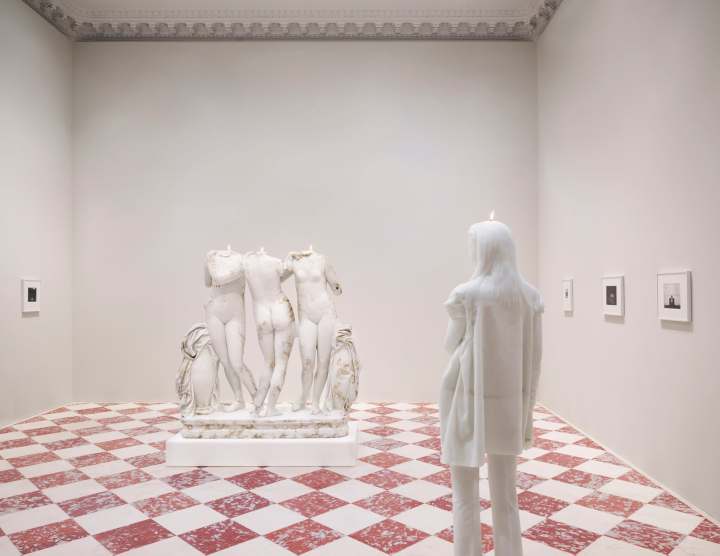
Urs Fischer, Divine Interventions, 2023, wax, based on the Metropolitan Museum of Art’s Roman sculpture The Three Graces (second century CE), with a wax portrait in the foreground of Pauline Karpidas, the contemporary art patron who once owned the ancient work. Installation view of a gallery at LGDR, 2023.
◊ ◊ ◊ ◊ ◊
It’s not an eighteenth-century show, but I’m left wishing that it were: an exploration of where classicism(s) and Romanticism meet, with Rococo impulses in-between. The emotional tenor of works varies widely; Carrie Mae Weems’s photographs strike me as especially powerful. See Jason Farago’s review for The New York Times (20 April 2023). –CH. From the press release for the exhibition:
Rear View
LGDR, New York, 18 April — 1 June 2023
Spanning two floors of LGDR’s landmark Beaux-Arts-style townhouse, Rear View presents a transhistorical selection of over sixty paintings, sculptures, works on paper, and photographs that explore representation of the human figure as seen from behind—an enduring, wide-ranging paradigm that has exerted potent influence upon modern and contemporary artists. In addition to rare twentieth-century masterworks by Félix Vallotton, Edgar Degas, René Magritte, Francis Bacon, Egon Schiele, Paul Cadmus, Aristide Maillol, and others, Rear View brings together seminal works by a diverse group of living artists spanning generations.
Long before the term Rückenfigur was popularized in the nineteenth century by Caspar David Friedrich, painters and sculptors from as far back as antiquity deployed the human figure seen from behind as a conceptual and formal device. Rear View provides a lens onto this specific genre as it pertains to artists’ desire to capture a range of human states and emotions—contemplation, longing, voyeurism, refusal, fetishism, and defiance—while drawing our attention to the act of looking itself and to the viewer’s role in constructing meaning and identity.
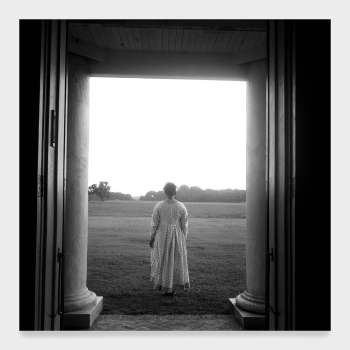
Carrie Mae Weems, Passageway II, 2003 (Jack Shainman Gallery, New York and LGDR).
Many contemporary artists have engaged the Rückenfigur trope, deliberately harnessing its critical potential. In one of the most compelling examples, Carrie Mae Weems has photographed herself in canonical landscapes and charged historical sites over many years, as a means of addressing complex issues around race, gender, and class, while also subjecting the signature paradigm of Romanticism to radical, politicized revision.
From the idealized bodies celebrated in Hellenistic sculpture to the bathers glimpsed in snapshot-like paintings and drawings by Impressionists and early modernists, images of nude bodies portrayed from behind have been integral to the unfolding story of figuration in the West. Urs Fischer directly quotes the Classical origins of this art historical paradigm in a monumental new candle sculpture made specifically for Rear View. Divine Interventions (2023) reprises one of the Metropolitan Museum of Art’s Roman marble Three Graces (second century CE), turning the trio of iconic feminine paragons, Aglaia (Beauty), Euphrosyne (Mirth), and Thalia (Abundance), into ephemeral forms cast in wax. Admiring this sculptural group—and in essence joining the Graces—is a wax effigy of Pauline Karpidas, the legendary contemporary art patron who once owned the ancient work that the Met would come to acquire.
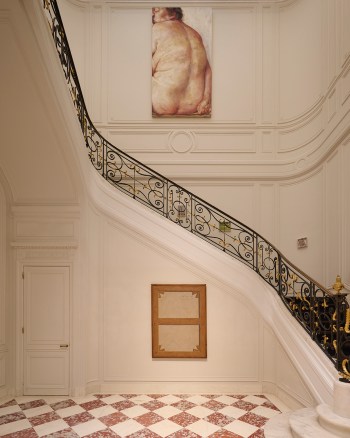
Installation view of Rear View at LGDR with work by Jenny Saville, Juncture (1994), top, and Domenico Gnoli, Back View (1968), below (Photo by Jason Schmidt).
The eroticism of ‘rear view’ images emerges not only from the frisson of nudity—the iconography of the human derrière emerges as a whole transhistorical subject onto itself—but from the narrative implication of intimacy between the depicted subject and the artist, the viewer’s fantasizing gaze and the sensuousness of the image on canvas. The trope of the mirror, the ritual of bathing, and the lounging or sleeping body are typical rear view scenarios taken up by artists across the centuries—from Edgar Degas to René Magritte, from Félix Vallotton to Barkley L. Hendricks, through to our present day. Fernando Botero’s painting The Bathroom (1989) features a woman, at once monumental and delicate, gazing at herself in the mirror, wearing only heels and a headband. The figure’s unselfconscious posture suggests she is unaware of the artist, invested only in herself.
By contrast, John Currin’s Nude in a Convex Mirror (2015) looks over her shoulder, presumably at the painter who is depicting the curves of her accentuated buttocks—but also at the viewer observing the action. The subject of Paul Cadmus’s ca. 1965 crayon drawing Standing Male Nude (NM 48) likewise peeks over his shoulder at the artist and the viewer, but with a loaded glance and flirtatious pose—one foot ever so slightly lifted to reveal its sole—that encode a sexual charge of mutual male gazes into an otherwise classical image. Jared French, who was part of the homosocial circle of artists around Cadmus, are represented in the exhibition by emblematic, dreamlike paintings populated uniquely by idealized male figures. The performative signifiers of masculinity emerge as an important subtheme of Rear View, evident in Giorgio de Chirico’s hyper-stylized Gladiatori (1928), Francis Bacon’s tormented figure in Study for Portrait of John Edwards (1986), and Andy Warhol’s abstracted depiction of a butch man’s hind quarters.

John Currin, Nude in a Convex Mirror, 2015, oil on canvas, 42 inches.
In their foreclosure of a complete picture, turned figures such as Currin’s nude also signal fetishism, another theme explored in Rear View. A number of works in the exhibition illuminate ways in which contemporary painting has absorbed the cinematic motif of the rear view, translating the camerawork of film noir and Hitchcockian thrillers like Rear Window (1954) into paint on canvas or rich black-and-white photographic images. Eric Fischl and Danielle Mckinney, for example, draw upon our collective cinematic imagination in composing their deeply narrative scenes, often populated by mysterious figures shown from the back and seemingly unaware of being observed. By contrast, but with no less enigmatic intensity, Harry Callahan’s mid-century rear-view photographs of his beloved wife, Eleanor, testify to the impact of cinematic vision when personalized to a single, deceptively simple subject.
In this context, another thematic trope of Rear View manifests in the work of Edgar Degas. Second only to his images of ballet dances, Degas’s voyeuristic bathing scenes dominate his vast oeuvre. On view in the exhibition, the artist’s delicate 1889–92 pastel Femme se peignant depicts a young nude female, seen from behind, combing her raven-colored tresses over her head. Degas’s scopophilic gaze focuses on the model’s flowing mane—a visual and psychological effect echoed by Domenico Gnoli’s sumptuous large-scale canvas Curly Red Hair (1969), which lingers over the texture of auburn curls cascading down a woman’s back. Tightly cropped to the subject at hand and denying the identifying details of the figure, this painting reveals Gnoli’s seeming uninterest in the body, except as a support for signifying ornament.

Félix Vallotton, Étude de fesses / Study of Buttocks, ca. 1884, oil on canvas, 38 × 46 cm (Private Collection).
The fragmented, fetishized human body emerged as a loaded trope in art history, according to esteemed feminist scholar Linda Nochlin in her study The Body in Pieces: The Fragment as a Metaphor of Modernity (1994). Spurred by the violence and social upheaval of the French Revolution, Nochlin notes, artists began to systematically deploy radical spatial cropping as well as isolating specific body parts, in order to explore the specific conditions of modern urban life—alienation, desire, suffering, obsession, ambiguous anonymous experiences. Nochlin’s observations find a contemporary echo in Issy Wood’s intimate canvas on view in the exhibition: Health and Hotness (2018) shows only the muscular back and bottom of a swimmer framed by her purple bathing suit. Wood’s enigmatic image is also a meditation on the impact of compressed and splitting planes and shapes—a study of the body as an abstraction.
Political refusal and personal irreverence also figure into art historical manifestations of the rear view. Six photographs from Anselm Kiefer’s polemical 1969 series Occupations (Besetzungen) take up this political mantle. In this series, the young artist photographed himself—often shown from behind, mimicking the heroic stance of Friedrich’s Rückenfigur—performing the Nazi salute in front of European monuments and natural sites. Of the series, controversial then as now, art historian Benjamin Buchloh remarked that it is “a real working through of German history. You have to inhabit it to overcome it.”
“String bottoms together in place of signatures for petition of peace.” This is how Yoko Ono described her infamous Film No. 4 (Bottoms) (1966–67)—an 80-minute montage of 365 human bottoms, featuring different genders, races, and body types. Marshaling her conceptual Fluxus rigor and sly humor into a powerful political protest against the Vietnam War, Ono’s provocative film retains its antiwar bite as well as its universalizing humanism today.
In the diptych that Francesco Clemente created for Rear View, Gold on Green, Green on Gold (2023), the artist slyly questions the front/back logic that underpins the exhibition as well as the binary thinking that governs so much of Western culture. Using gold leaf and a radically reduced palette, Clemente portrays ambiguous, gender-indeterminate figures that appear to be engaged in oral sex. The artist muses, “Maybe our mistaken ideas—based on duality, based on ‘us against them’—begin with the fact that we can only see half of what there is. We can only face one direction. We feel incomplete because we can never see completely ourselves. Painting may repair that, offering a vision of totality.”
As a pendant presentation to Rear View, Full Frontal (exhibited on the gallery’s second floor) explores the opposite art historical trope: frontal nudity. As the idiom of the title suggests, debates around moral propriety and censorship in art and popular culture often ascribe a confrontational value to front-facing nudes. While the naked body has always been present in visual culture, shifting social values have influenced representational approaches to the subject. Featured in Full Frontal are works by Miriam Cahn, Jenna Gribbon, and Barkley L. Hendricks, among others.
Exhibition | In a New Light: Paintings from the YCBA
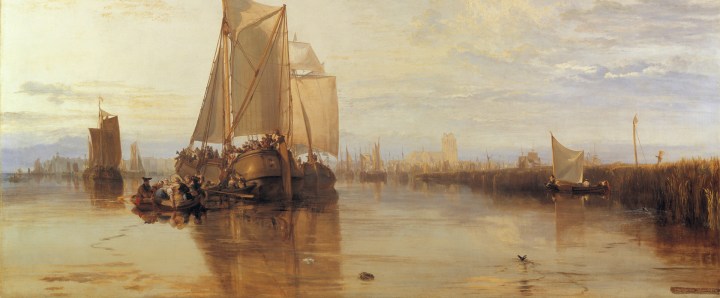
J. M. W. Turner, Dort or Dordrecht: The Dort Packet-Boat from Rotterdam Becalmed, detail, 1818, oil on canvas
(New Haven: Yale Center for British Art, Paul Mellon Collection)
◊ ◊ ◊ ◊ ◊
From the YCBA:
In a New Light: Paintings from the Yale Center for British Art
Yale University Art Gallery, New Haven, 24 March — 3 December 2023
More than fifty paintings from the Yale Center for British Art will be on view at the Yale University Art Gallery through December 3, 2023. The exhibition offers visitors the opportunity to engage with the YCBA’s collection while the museum is closed to the public for a building conservation project. The exhibition spans four centuries of British landscape and portraiture traditions, with works by Mary Beale, John Constable, Thomas Gainsborough, William Hogarth, Gwen John, Angelica Kauffman, George Stubbs, and Joseph Mallord William Turner, among others. Several of these paintings were on view at the Gallery in 2015, where they were featured in The Critique of Reason: Romantic Art, 1760–1860, the first major collaborative exhibition between the two Yale art museums.
In a New Light will occupy the special-exhibition galleries on the fourth floor of the Gallery’s Kahn building, which opened in 1953 and was the architect’s first significant commission and the first modernist structure on Yale’s campus. Directly across the street, Kahn’s final building, the YCBA, was completed after his death and opened to the public in 1977.
Exhibition | Léopold and Aurèle Robert
From the Musée d’art et d’histoire in Neuchâtel:
Léopold et Aurèle Robert. Oh saisons…
Musée des beaux-arts, La Chaux-de-Fonds / Musée d’art et d’histoire, Neuchâtel, 14 May — 12 November 2023
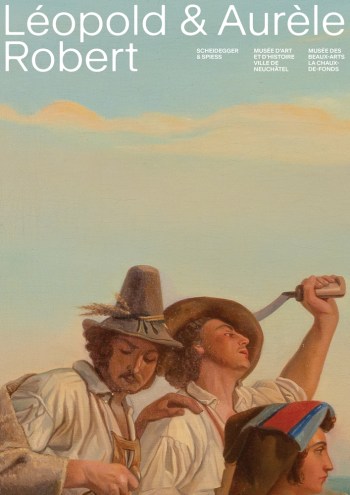 The Neuchâtel artist Léopold Robert (1794–1835), who enjoyed European acclaim during his lifetime, embodies the myth of the Romantic painter, doomed to a tragic fate and shrouded in mystery.
Educated in Paris at the École des Beaux-Arts and later in the studio of Jacques-Louis David, Robert moved to Italy in 1818. His genre paintings brought him great popular success during the first half of the 19th century but were less fulsomely received by the critics. The Musée d’art et d’histoire de Neuchâtel and the Musée des beaux-arts de La Chaux-de-Fonds have joined forces to pay tribute to the work of Léopold Robert and his brother Aurèle (1805–1871). The exhibition also re-examines Aurèle’s role, considering him not only as a ‘disseminator’ of Léopold’s oeuvre, but also as an artist in his own right. The joint exhibition focuses on Léopold Robert’s unfinished Seasons cycle and features works from both institutions as well as several prestigious loans. The exhibition in La Chaux-de-Fonds is given over to ‘Spring’, while Neuchâtel celebrates ‘Summer’ and ‘Winter’. The exhibition also explores how these masterpieces were produced and circulated, and examines their depiction of music, dance, and the beauty ideal. The exhibition is enriched by contributions from artist Gina Proenza that offer a direct, contemporary response to the historical works of Léopold and Aurèle Robert.
The catalogue (in French) is distributed by ACC Art Books:
David Lemaire and Antonia Nessi, eds., Léopold & Aurèle Robert (Scheidegger & Spiess, 2023), 240 pages, ISBN: 978-3858818874, £45.
◊ ◊ ◊ ◊ ◊
Note (added 26 October 2023) — The posting was updated to correct the dates of the exhibition (here originally given as 15 May — 15 October).
Exhibition | Finding Family
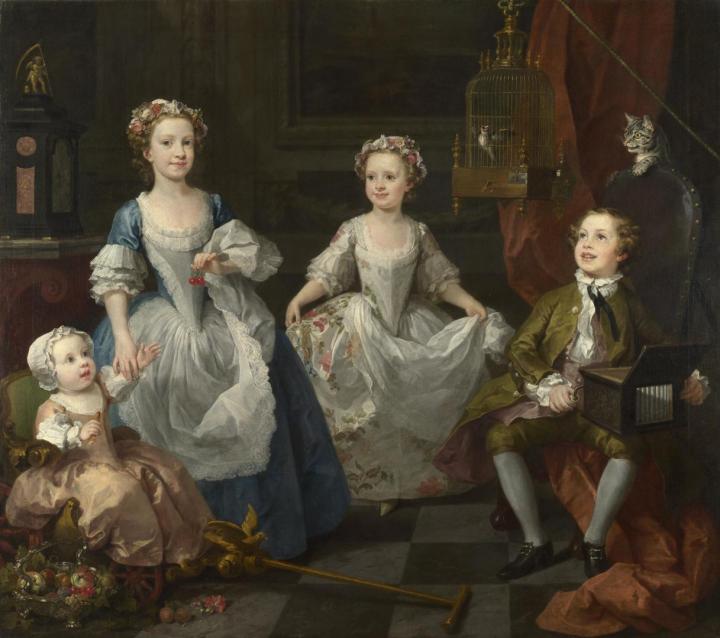
William Hogarth, The Graham Children, 1742, oil on canvas, 161 × 181 cm
(London: National Gallery)
◊ ◊ ◊ ◊ ◊
From the press release for the exhibition:
Finding Family
Foundling Museum, London, 17 March — 27 August 2023
One word, with many meanings: family lies at the heart of all our lives and is considered one of the most important units of society. The exhibition Finding Family, now on view at the Foundling Museum, explores the idea of family through art from the 17th century to the present day. Uncover and explore new perspectives on what family is and can be through this original, insightful exhibition. Involving participants of Tracing Our Tales, the Foundling Museum’s award-winning programme for young care leavers, Finding Family also includes their creative responses to works of art and the exhibition’s themes, from the context of their own lived experience, with challenging, moving, and surprising results.

Le Nain Brothers (Antoine, Louis, and Mathieu), Four Figures at a Table, ca. 1643, oil on canvas, 45 × 55 cm (London: National Gallery).
Is it Blood?
Is it Connection?
Is it Bond?
Is it Love?
Through these four themes, the exhibition presents a series of historic and contemporary works that explore blood relations, social bonds, personal connections, and love—to look at the ways in which artists have represented and responded to ideas of family, past, and present. The show encourages an exploration far beyond the idea of family in a nuclear sense, suggesting a broader, more inclusive definition that also invites us to consider where our own sense of connection and identity lie.
“Our family is always going to form in our hearts because we need role models, connection, and a sense of identity—so we learn to seek family in other places and things, like pets, fashion, friends, culture.” –Tracing Our Tales participant
“Family is very much what you make it. It doesn’t have to be those who you share the same blood with, but those who you share the same interest with.” –Tracing Our Tales participant

Thomas Gainsborough, The Painter’s Daughters Chasing a Butterfly, ca. 1756, oil on canvas, 114 × 105 cm (London: National Gallery).
In partnership with The National Gallery, the exhibition includes three large-scale masterpieces from the Gallery’s collection, by Hogarth, Gainsborough, and the Le Nain Brothers. Objects from the Foundling Museum’s collections and creative responses from the Tracing Our Tales participants invite visitors to look afresh at these well-loved paintings and to question their assumptions. Works by contemporary artists who have responded to the theme of family, as well as newly commissioned pieces, further enrich the exploration of the themes, revealing changes and continuities over time. Contemporary artists loaning work include Matthew Finn, Sunil Gupta, Chantal Joffe, Gillian Wearing, and Hetain Patel, alongside Mark Titchner, Annabel Dover, Tamsin van Essen, Harold Offeh, and Helen Barff who have created new work.
As a charitable home for children whose mothers could no longer keep or care for them, the Foundling Hospital was an alternative to family for the 25,000+ children who were admitted between 1741 and 1954. Without family, foundlings were forced to find connections elsewhere—through their foster families, peers, teachers, and places of employment. Within the context of the Museum’s historic story of care, Finding Family challenges the social construct of family and asks important questions about who and what defines who we are, how we interact with one another, and how we perceive others. The exhibition also showcases the ongoing power of art to challenge, question, and encourage us to see the world with new eyes.
“Writing poetry whilst being in the Foundling Museum is important because we get a sense of how we would feel in the foundlings’ shoes. We have a lot to relate to, especially if you’ve been in care.” –Tracing Our Tales participant
Exhibition | Seeing the Light

Joseph Wright of Derby, A Philosopher Giving That Lecture on the Orrery, in which a Lamp Is Put in Place of the Sun, ca. 1766, oil on canvas, 58 × 80 inches (Derby Museum & Art Gallery).
◊ ◊ ◊ ◊ ◊
Now on view at the Foundling Museum:
Seeing the Light
Foundling Museum, London, 7 March — 4 June 2023
We at the Foundling Museum are excited to display A Philosopher Giving That Lecture on the Orrery in Which a Lamp is Put in Place of the Sun by revered ‘painter of light’ Joseph Wright of Derby. First exhibited in London in 1766, this dramatic painting—on loan from Derby Museum & Art Gallery—offers a fascinating window to changing social attitudes and public understanding of science, education, and technology in the eighteenth century. Wright and his large network of friends and acquaintances had multiple points of connection with key people in the Foundling Hospital’s history and collections. Visit the Museum to discover the story of the Lunar Society and the threads that link a token admitting the holder to a lecture in experimental philosophy, a clock detailing the phases of the moon, and a letter written by girls apprenticed by the Hospital to Wright’s painting and the Age of Enlightenment it celebrates.
While The Orrery is on display in London, visitors can see the Foundling’s magnificent painting by William Hogarth, The March of the Guards to Finchley (1750), at Derby Museum & Art Gallery.
◊ ◊ ◊ ◊ ◊
Note (18 April 2023) — Although it it has yet to penetrate the widespread conception of Wright as a progressive revolutionary artists set, above all, on visualizing Enlightenment science, Matthew Craske’s book Joseph Wright of Derby: Painter of Darkness (Paul Mellon Centre for Studies in British Art, 2020) should be required reading for anyone trying to understand Wright as an eighteenth-century artist. –CH
Exhibition | Hogarth’s Britons
Now on view in Derby:
Hogarth’s Britons: Succession, Patriotism, and the Jacobite Rebellion
Derby Museum & Art Gallery, 10 March — 4 June 2023
Curated by Jacqueline Riding and Lucy Bamford
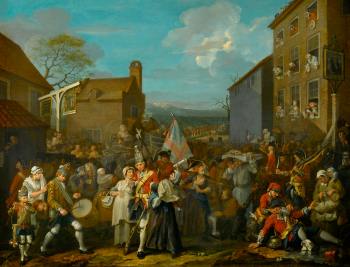
William Hogarth, The March of the Guards to Finchley, 1749–50, oil on canvas (London: The Foundling Museum).
No other artist defines our image of 18th-century Britain quite like William Hogarth. His vibrant narrative paintings, reproduced and circulated widely through print, engaged with some of the most pressing social and political issues of the times. Amongst these was Jacobitism, a campaign to restore the exiled Stuart dynasty to the throne of Great Britain. This exhibition explores Hogarth’s response to this threat, including the last and most serious of all attempts: the Jacobite Rebellion of 1745. Led by Prince Charles Edward Stuart (‘Bonnie Prince Charlie’) with support from France, the Jacobite Army would eventually reach Derby before retreating back north to Scotland and defeat at the Battle of Culloden.
Led by Derby Museums, Hogarth’s Britons has been produced in partnership with the National Gallery and the National Portrait Gallery and is the first exhibition of Hogarth’s works to be staged in Derby. It brings many pieces that have never before been seen in the city, including Hogarth’s masterpiece, The March of the Guards to Finchley (Foundling Museum, London). Others, such as the newly discovered portrait of the Prince by Allan Ramsay (National Galleries of Scotland), will be returning to Derby for the first time since the rebellion of 1745. The exhibition also brings together items from national and private collections, representing local divided loyalties and the experience of life under Jacobite-army occupation.
Hogarth’s Britons: Succession, Patriotism, and the Jacobite Rebellion is co-curated by Jacqueline Riding, acclaimed art historian and author of Jacobites (2016) and Hogarth: Life in Progress (2021); and Lucy Bamford, Senior Curator of Art at Derby Museums.
Jacqueline Riding, Hogarth’s Britons (London: Paul Holberton Publishing, 2023), 120 pages, ISBN: 978-1913645458, £18 / $25.
◊ ◊ ◊ ◊ ◊
Note (added 29 February 2024) — The original posting was updated to include information on the catalogue.
Exhibition | Hair and Body Hair
From the Musée des Arts Décoratifs:
Des cheveux et des poils / Hair and Body Hair
Musée des Arts Décoratifs, Paris, 5 April — 17 September 2023
Curated by Denis Bruna

Poster for the exhibition Des cheveux et des poils © Aurélien Farina. Jacob Ferdinand Voet, Portrait of a Man, before 1689 (Sotheby’s / Art Digital Studio); model photographer: © Virgile Biechy.
Following the success of the exhibitions La mécanique des dessous (2013), Tenue correcte exigée! (2017), and Marche et démarche (2019), the Musée des Arts Décoratifs continues its exploration of the relationship between the body and fashion with an exhibition on hair styles and body hair grooming. Des cheveux et des poils (Hair & Hairs) demonstrates how hairstyles and the grooming of human hair have contributed to the construction of appearances for centuries. Hair is an essential aspect of one’s identity and has often been used as a means of expressing our adherence to a fashion, a conviction, or a protest while invoking much deeper meanings such as femininity, virility, and negligence, to name just a few.
Through 600 works, from the 15th century to the present, the exhibition explores themes inherent in the history of hairstyles, as well as questions related to facial hair and body hair. The trades and skills of yesterday and today are highlighted with iconic figures: Léonard Autier (favorite hairdresser of Marie-Antoinette), Monsieur Antoine, the Carita sisters, Alexandre de Paris, and more recently studio hairdressers. Great names in contemporary fashion such as Alexander McQueen, Martin Margiela, and Josephus Thimister are present with their spectacular creations made from this unique material that is hair.
Fashion and Extravagance
The exhibition opens with the evolution of feminine hairstyles as a social indicator and marker of identity. In the Middle Ages, in response to the command of Saint Paul, the wearing of the veil was imposed on women until the 15th century. Gradually, women abandoned it in favor of extravagant hairstyles that were constantly renewed. In the 17th century, hairstyles such as ‘to the Hurluberlu’ (dear to Madame de Sévigné) and ‘to the Fontange’ (after the name of Louis XIV’s mistress) were emblematic of a real fashion phenomena. Around 1770, high hairstyles known as Poufs appeared, among the most extraordinary of Western hair modes. Finally, in the 19th century, women’s hairstyles—whether inspired by ancient Greece, or known as ‘the giraffe’, in curls, or ‘the Pompadour’—could be just as convoluted.
To Beard or Not to Beard
After the hairless faces of the Middle Ages, a turning point occurred around 1520 with the appearance of the beard, symbol of courage and strength. In the early 16th century, the three great Western monarchs: Francis I, Henry VIII, and Charles V were young and wore beards, which were then associated with the virile and warrior spirit. From the 1630s until the end of the 18th century, the hairless face and the wig were the hallmarks of courtiers. Facial hair did not reappear until the early 19th century with the mustache, sideburns, and beard: the period was by far the hairiest in the history of men’s fashion. A multitude of small objects used (mustache wax, brushes, curling irons, wax, etc.) attest to the enthusiasm for mustaches and beards. During the 20th century, the rhythm of bearded, mustached, and smooth faces continued, until the return of the beard among Hipsters in the late 1990s. The maintenance of hairiness among these young urbanites has given rise to the profession of barber, which had disappeared since the 1950s. Today, the thick beards tend to give way to the mustache that had deserted faces since the 1970s.
Keeping, eliminating, hiding, or displaying hair on other parts of the body is a subject also addressed in the exhibition through the representation of nude bodies in visual arts and written testimonials. Hairiness is rare, or even absent from ancient painting. The hairless body is synonymous with the antique and idealized body, while the hairy body is associated with virility or triviality. Only enthusiasts of virile sports such as boxing and rugby, as well as erotic illustrations or medical engravings, show individuals covered in hair. Around 1910–1920, when women’s bodies were exposed, advertisements in magazines touted the benefits of hair removal creams and more efficient razors to eliminate them. In 1972 actor Burt Reynolds posed naked with his hairy body on display for Cosmopolitan magazine, but fifty years later, an abundance of hair is no longer in fashion, even for men. Since 2001, athletes being photographed naked for calendars like Les dieux du stade (The Gods of the Stadium) have had rigorously controlled hairiness.
Between True and False
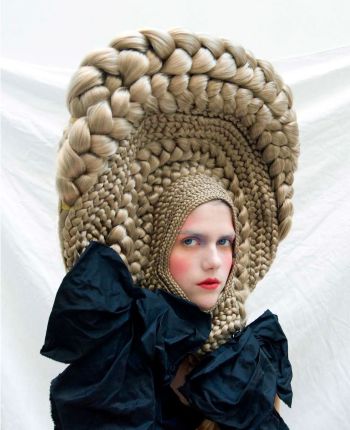
Marisol Suarez, Braided wig, © Katrin Backes.
Hair styling is an intimate act. Moreover, a well-born lady could not show herself in public with her hair down. A painting by Franz-Xaver Winterhalter, dated 1864, depicting Empress Sissi in a robe and with her hair untied, was strictly reserved for Franz Joseph’s private cabinet. Louis XIV, who became bald at a very young age, adopted the so-called ‘bright hair’ wig, which he then imposed on the court. In the 20th century, Andy Warhol had the same misfortune: the wig he wore to hide his baldness became an icon of the artist. Nowadays, hairpieces and wigs are used in high fashion, during fashion shows or, of course, to compensate for hair loss.
The natural hair colors and their symbolism are presented along with what they convey. Blonde is said to be the color of women and childhood. Red hair is attributed to sultry women, witches, and some famous stage women. As for black hair, it would betray the temperament of brown and brunettes. From the experimental colorations of the 19th century to the more certain dyes from the 1920s: artificial colors are not forgotten. The work of the hairdresser Alexis Ferrer who makes digital prints on real hair is also presented.
Trades and Skills
The exhibition reveals the different hair professions: barbers, barber-surgeons, hair stylists, wigmakers, ladies’ hairdressers, etc., through archival documents and a host of small objects: signs, tools, various products, and the astonishing perming machines and dryers of the 1920s.
In 1945, the creation of haute coiffure elevated the profession to the rank of an artistic discipline and a French savoir-faire. 20th-century hairdressing was marked by Guillaume, Antoine, Rosy and Maria Carita, and Alexandre de Paris styling princesses and celebrities. Nowadays, great hairstyling is mainly expressed during the fashion shows of prestigious fashion houses. Sam McKnight, Nicolas Jurnjack, and Charlie Le Mindu were invited to the exhibition to create extraordinary hairstyles for top models and show business personalities.
A Hairy Century
Finally, a special focus will allow us to evoke the iconic hairstyles of the 20th and 21st centuries: the 1900 chignon, the 1920s garçonne haircut, the 1930s permed and notched hair, the 1960s pixie and sauerkraut, the 1970s long hair, the 1980s voluminous hairstyles, the 1990s gradations and blond streaks, not to mention afro-textured hair.
The arrangement of hair in a particular form can reveal belonging to a group and manifest a political and cultural expression in opposition to society and the established order. More ideological than aesthetic, the Iroquois crest of the punks, the neglected hair of the grunges, or the shaved heads of the skinheads are strong moments of hair creativity.
Wearing the hair of another, known or unknown, has an eerie dimension, and this superstition seems well-entrenched. Despite these apprehensions, some creators choose to transcend this familiar material into fashion objects. This is the case of contemporary designers such as Martin Margiela, Josephus Thimister, and Jeanne Vicerial. The question of identity, treated lightly or more deeply, is often at the heart of the reasoning, whether the hair is real or fake.
Presented in the Christine & Stephen A. Schwarzman’s fashion galleries of the Musée des Arts Décoratifs, the exhibition is curated by Denis Bruna, Curator in Chief, Fashion and Textile Department, Collections before 1800. The scenography is by David Lebreton of the Designers Unit agency. The Musée des Arts Décoratifs has benefited from exceptional loans from the Château de Versailles, the Musée des Beaux-Arts d’Orléans, the Musée du Louvre and the Musée d’Orsay.
Denis Bruna, ed., Des cheveux et des poils (Paris: Les Arts Décoratifs, 2023), 288 pages, ISBN: 978-2383140139, €55. With contributions by Marie Brimicombe, Denis Bruna, Yanis Cambon, Astrid Castres, Pierre-Jean Desemerie, Ana Escobar Saavedra, Saga Esedín Rojo, Louise Guillot, Guillaume Herrou, César Imbert, Sophie Lemahieu, Maëva Le Petit, Aurore Mariage, Anne-Cécile Moheng, Sophie Motsch, Marie Olivier, Dominique Prevôt, Hélène Renaudin, Raphaël Sagodira, and Bastien Salva.
◊ ◊ ◊ ◊ ◊
Diane Pernet provides a useful summary with lots of images and an interview with Denis Bruna here»
◊ ◊ ◊ ◊ ◊
Note (added 11 August 2023) — Rosa Lyster reviewed the show for The NY Times: “Big Hair and Big Thoughts at a Paris Museum,” The New York Times (28 July 2023). An exhibition with over 600 items explores the evolution of women’s hairstyles, questions around body hair, and more. But hair is never just hair.
Exhibition | Doucet and Camondo: A Passion for the 18th Century
Now on view at the Musée Nissim de Camondo:
Doucet et Camondo: une passion pour le XVIIIe siècle
Musée Nissim de Camondo, Paris, 16 March — 3 September 2023
Curated by Juliette Trey
 Between 1906 and 1912, the celebrated couturier and great patron of the arts, Jacques Doucet (1853–1929), lived in an hôtel particulier built especially to house his collection of 18th-century art on the Rue Spontini in the 6th arrondissement of Paris. Drawings held a particularly important place in it. The exhibition Doucet et Camondo: une passion pour le XVIIIe siècle evokes the mansion through the watercolors done by the decorator Adrien Karbowsky (1855–1945) and forges the link between Doucet and Moïse de Camondo (1860–1935), who purchased some of the items in his collection from Doucet.
Les Arts Décoratifs et l’Institut national d’histoire de l’art (INHA) présentent, au musée Nissim de Camondo, une exposition consacrée à la riche collection d’œuvres d’art du XVIIIe siècle constituée par Jacques Doucet. Célèbre couturier et grand mécène, Jacques Doucet (1853–1929) est aussi l’un des plus importants collectionneurs de son temps. Une sélection de dessins, photographies et documents d’archives conservés à l’INHA retrace l’histoire de ce prestigieux patrimoine. L’exposition dévoile les décors éphémères de l’hôtel particulier situé rue Spontini dans le XVIe arrondissement que Doucet fait spécialement édifier pour accueillir cet ensemble de tableaux, dessins, sculptures, meubles et objets d’art du XVIIIe siècle. Elle met en lumière les œuvres ayant appartenu à Jacques Doucet, conservées notamment au musée Nissim de Camondo, ancien hôtel particulier de Moïse de Camondo, tissant ainsi le lien entre ces deux grands collectionneurs.
More information is available here»
Juliette Trey, Jacques Doucet et Moïse de Camondo: Une Passion pour le XVIIIe Siècle (Paris: Les Arts Décoratifs / INHA, 2023), 48 pages, €12.










 Enfilade
leave a comment