Exhibition | Portrait Miniatures from the Grantchester Collection
On view at Compton Verney:
Portrait Miniatures: Highlights from the Grantchester Collection
Compton Verney Art Gallery and Park, Warwickshire, 10 September 2022 — 31 December 2023
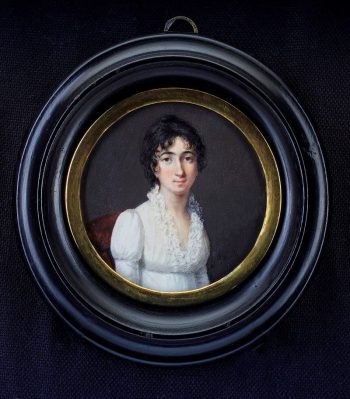
Henriette Rath, Portrait of Madame Argand, 1799, watercolour on ivory, 1799 (Compton Verney Art Gallery and Park, photograph by Jamie Woodle). Together with her sister, Jeanne-Françoise, Henriette founded the Musée Rath in Geneva, the first purpose-built art museum in Switzerland, constructed between 1824 and 1826.
We are excited to present highlights from the Grantchester Miniatures Collection in Compton Verney’s British Portraits gallery. The Grantchester Collection of portrait miniatures was gifted to Compton Verney in 2019. It is a highly personal collection developed by the late Lady Grantchester [Betty Suenson-Taylor], the sister of our founder Sir Peter Moores, who established the Compton Verney House Trust in 1993. Showcasing over 40 exquisite miniatures from the sixteenth, seventeenth, and eighteenth centuries, this will be the first time that many of these works have been shown in public. The collection includes portraits in miniature by Isaac Oliver, Richard Cosway, George Engleheart and John Smart.
A guide to the exhibition is available here»
Exhibition | History in the Making
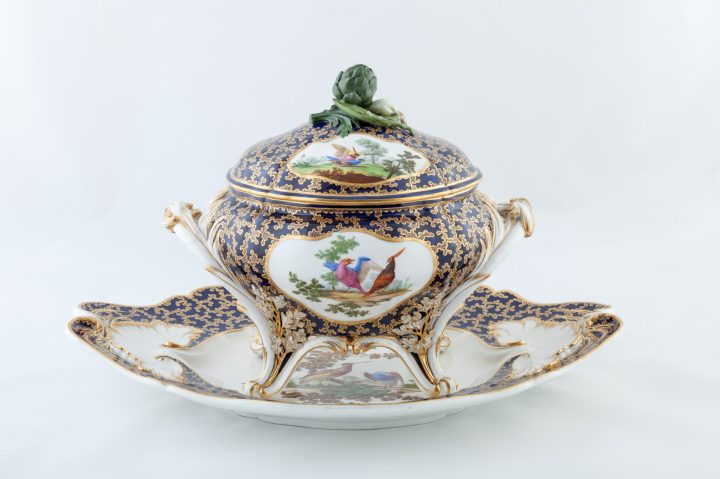
‘Bedford Gift Service’ tureen and stand, Sèvres, decoration by Jean-Pierre Ledoux, 1761–63
(Woburn Abbey Collection)
◊ ◊ ◊ ◊ ◊
From the press release (via Art Daily) for the exhibition at Compton Verney:
History in the Making: Stories of Materials and Makers, 2000BC to Now
Compton Verney Art Gallery and Park, Warwickshire, 21 October 2023 — 11 February 2024
Curated by Oli McCall and Hannah Obee
History in the Making: Stories of Materials and Makers presents the stories of the people and processes behind outstanding examples of historic and contemporary craft by bringing together a treasure-trove of objects in a unique exploration and celebration of materials and making. Installed in both suites of temporary exhibition galleries at Compton Verney, the exhibition presents historic craft masterpieces from Woburn Abbey and Compton Verney alongside contemporary creations by some of the most exciting makers working today, many of which are being loaned for the first time by the Crafts Council, the UK’s national charity for craft.
 Works on display include ancient Chinese ceramics from Compton Verney’s internationally renowned Chinese collection, 18th-century Indian bed textiles from Woburn Abbey, painted silks by award-winning artist and designer Christian Ovonlen, and glazed stoneware vessels by rising star ceramic artist Shawanda Corbett. By displaying the historic in dialogue with the new, the exhibition uncovers the skilful craft processes, technical innovations, and material properties of decorative objects across the ages, while also highlighting the environmental and ethical considerations around the use of natural materials. Each gallery focuses on a different material group—textile, organic, metal, stone, clay, and wood—providing a framework within which contemporary issues such as globalisation and colonial economies, social class and the importance of craft traditions in diverse cultures will be explored.
A highlight of History in the Making is the chance to see one of Woburn Abbey’s newly conserved Mortlake Tapestries. Dating from the 1660s, these huge wall hangings have been painstakingly conserved over a period of five years. Inspired by Raphael’s cartoon for The Miraculous Draught of Fishes (ca. 1515–16, on loan to the V&A from His Majesty The King), originally commissioned by Pope Leo X for the Sistine Chapel, the tapestry shows two boats on the waters of lake Galilee; on the left Christ is seated, with the Apostles Peter and Andrew in astonishment before him, their boat full of miraculous fish. The Mortlake manufactory was established in 1619 in the village of Mortlake, west of London. Under royal patronage, the workshop was able to rival continental centres such as Brussels and Paris for high-quality textiles. The tapestry from Woburn Abbey is being displayed in a gallery with pieces by textile artist and ceramicist Matt Smith, who has reworked vintage tapestries by unpicking and re-stitching elements—often faces—to illustrate how historical narratives are never objective accounts of truth, alluding to the marginalisation of queer people in society. His work often reshapes objects from their original uses to highlight marginalised points of view and hidden stories.
The exhibition includes examples of the Sèvres dinner service given by Louis XV of France to the Duke and Duchess of Bedford in 1763. The Sèvres ceramics have provided an intriguing opportunity for the exhibition’s co-curator Hannah Obee to delve into the iconic French manufacturer’s archives. She notes that “in the 18th century, luxury porcelain was about enhancing the prestige and wealth of nations. The individuals who made it were not part of the narrative, unlike today. However, the Sèvres archives provide a rich resource of information; so, we can now put names and sometimes faces to the objects they created. This is a unique feature of the show at Compton Verney.”
The exhibition also contains a set of bed textiles made in the 1750s in Gujarat, India. “Even now their colours are amazing and so vibrant,” observes Compton Verney senior curator Oli McCall. “The Bedford family had an agent in India who reported back to them about the people making them, who were all women. From these letters we gain valuable insights into the textile trade in the 18th century, anticipating modern globalisation.”
History in the Making also includes objects, once prized, but now seen as problematic, made from natural materials such as coral, tortoiseshell, and ivory. McCall, Obee, and their colleagues decided to include several of these pieces to reflect how makers once saw artistic and creative potential, without questioning the environmental damage that would result from the huge demand for such items. To demonstrate this, History in the Making showcases the work of contemporary makers who are sourcing sustainable materials for their work.
The display of historic silverware such as 18th-century candlesticks and tableware, acts as a reminder of the importance of human migration in the dissemination of craft expertise and techniques and the challenges faced by new arrivals. Huguenot silversmiths, for example, were members of the French Protestant faith who faced persecution in their homeland with over 50,000 Huguenots coming to Britain through the 16th to 18th-centuries. Their work and that of the people who made the Mortlake Tapestries, worked in the Sèvres factory, and produced the Indian bed textiles are just a handful of examples of how Britain connected with the wider world. The exhibition demonstrates and reminds us of this, whilst shining a spotlight on the things that people created for themselves as part of everyday life. Adi Toch’s 2020 print Precious Disposables, on loan from the Crafts Council, depicts a pair of the maker’s latex gloves covered in golden-hued brass dust. Made during the Coronavirus pandemic, the work invites us to think about how what is considered valuable shifts depending on social, political, and environmental concerns.
In the final room, pieces by some of the most exciting young makers working at the forefront of scientific and material innovation are displayed, highlighting the environmental responsibility that has become a focus of contemporary craft practices proposing more planet-friendly materials and methods. Diana Scherer uses plant roots to create ‘living fabrics’, which she fashions into wall hangings and framed works of art. Nicky James, meanwhile, makes garments in wool, but has found a way to make them more resilient by mimicking strong structures found in nature, such as the giant squid beak. Other makers are using cutting-edge innovation to work with ‘leather’ made from mushrooms, and even using silk worm cocoons to create furniture.
Geraldine Collinge, Director of Compton Verney, states: “We are delighted to be able to collaborate with Woburn Abbey and the Crafts Council on this ambitious exhibition, which will give visitors a unique opportunity to explore outstanding examples of craft by many of the leading makers past and present and reflect on the universal importance of materials and making. This exhibition reflects the bringing together of the historic and contemporary to tell stories, which is something we aim to do across our creative programme at Compton Verney. Throughout the winter and into the start of 2024 we will be providing a host of hands-on craft workshops and activities where visitors can get creative and pick up new skills.”
Colloquium | Léopold Robert and Aurèle Robert
From the conference programme:
Frères d’art: Léopold et Aurèle Robert
Neuchâtel / La Chaux-de-Fonds, 9–10 November 2023
 Dans le cadre de l’exposition Léopold et Aurèle Robert présentée conjointement au Musée des beaux-arts de La Chaux-de-Fonds et au Musée d’art et d’histoire de Neuchâtel du 14 mai au 12 novembre 2023, l’Institut d’histoire de l’art et de muséologie de l’Université de Neuchâtel souhaite encourager la réflexion et l’échange d’idées à propos de ces deux figures artistiques à l’occasion d’un colloque international. Celui-ci se tiendra en présentiel le jeudi 9 novembre 2023 au Musée d’art et d’histoire de Neuchâtel, et le vendredi 10 novembre 2023 au Musée des beaux-arts de La Chaux-de-Fonds.
j e u d i , 9 n o v e m b r e 2 0 2 3
10.00 Accueil et café
10.30 La fabrique de l’œuvre: Léopold Robert au travail
• Léopold Robert au prisme de la conservation-restauration: État des lieux, nouvelles investigations et perspectives — Léa Gentil (Musée des beaux-arts de La Chaux-de-Fonds)
• La notion d’« œuvres de jeunesse » touchant Léopold Robert: Un réexamen des premières orientations de l’artiste — Cecilia Hurley (École du Louvre / Université de Neuchâtel)
• Les Brigands de Robert, ou l’art d’accommoder les restes de l’histoire de l’art — Pascal Griener (Université de Cambridge / École du Louvre)
12.30 Pause déjeuner
14.00 La fabrique de l’œuvre: Aurèle Robert au travail
• Un sens aigu de l’observation: Corpus d’études d’après nature d’Aurèle Robert conservé au Musée des beaux-arts du Locle — Anaëlle Hirschi (Chargée de projet de recherche en collaboration avec le Musée des beaux-arts du Locle)
• Les hors-champs de l’image: L’Atelier de Léopold Robert à Rome en 1829 par Aurèle Robert — Lucie Girardin Cestone (Musée d’art et d’histoire de Neuchâtel)
15.30 Pause café
16.00 Conférence
• Quand le folklore devient désirable: La mise en scène de la vie populaire entre représentation, collection et recherche — Federica Tamarozzi (Musée d’ethnographie de Genève)
v e n d r e d i , 1 0 n o v e m b r e 2 0 2 3
10.00 Accueil et café
10.30 Les stratégies de Léopold Robert, ou comment prendre sa place sur la scène artistique
• Une histoire de regards — Walter Tschopp (Fondation Ateliers d’Artistes)
• Léopold Robert et l’apparition de la grande scène de genre italienne en France — Laurent Langer (Musée d’art de Pully)
• Petit genre et grand format: Quelle grandeur pour représenter le peuple ? — Olivier Bonfait (Université de Bourgogne Franche-Comté, LIR3S)
12.30 Pause déjeuner
14.00 Regards contemporains sur Léopold Robert
• Léopold Robert et les écrivains de son temps (suite) — Alain Corbellari (Universités de Lausanne et de Neuchâtel)
• The legacy of Léopold Robert in 19th-century cosmopolitan Rome — Giovanna Capitelli (Università degli Studi Roma Tre)
15.30 Pause café
16.00 Conférence
• Et in Italia ego: Le voyage des peintres femmes à Rome et en Italie au XIXe siècle — Martine Lacas (Auteure, chercheuse et commissaire d’exposition indépendante)
The Burlington Magazine, October 2023
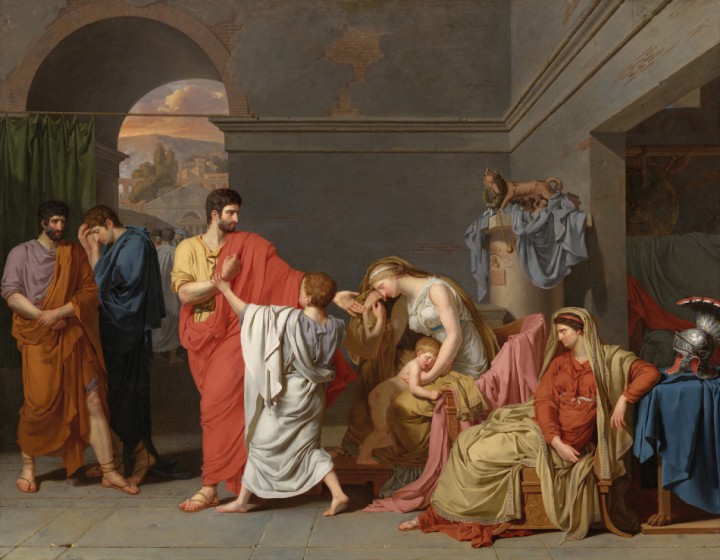
Anne-Louis Girodet de Roussy-Trioson, Coriolanus Taking Leave of His Family, 1786, oil on canvas, 114 × 146 cm
(National Gallery of Art, Washington)
◊ ◊ ◊ ◊ ◊
The eighteenth century in the October issue of The Burlington:
The Burlington Magazine 165 (October 2023)
a r t i c l e
• Aaron Wile, “Girodet’s Coriolanus Taking Leave of His Family Rediscovered,” pp. 1094–1105.
In 2019 Girodet’s lost entry for the 1786 Grand prix de peinture came to light and was acquired by the National Gallery of Art, Washington. The painting, which depicts a rarely represented incident from the story of Coriolanus—a subject that may have had contemporary political relevance—was not awarded the prize, probably because Girodet was regarded as being too close to Jacques-Louis David, a relationship to which the work may allude.
s h o r t e r n o t i c e
• Antoinette Friedenthal, “Image of a Connoisseur: An Unknown Portrait of Pierre Jean Mariette,” pp. 1106–10.
Among the unpublished miniatures in the Victoria & Albert Museum, London (V&A), is an eighteenth-century bust-length portrait of a middle-aged gentleman. A basic unillustrated inventory sheet for this work appeared in 2020 on the museum’s website. It stated that the portrait represents Pierre Jean Mariette (1694–1774) but gave no reasons for this identification and did not provide any information on the object’s provenance. It will be argued here that a combination of visual and documentary evidence confirms the identification.
r e v i e w s
 • Mark Bill, Review of the exhibition Reframing Reynolds: A Celebration (The Box, Plymouth, 2023), pp. 1124–27.
• Stephen Lloyd, Review of the refurbished Medieval, Renaissance, and Baroque galleries at the Walker Art Gallery, Liverpool, pp. 1130–33.
• Beth McKillop, Review of the exhibition China’s Hidden Century (The British Museum, London, 2023), pp. 1136–38.
• Satish Padiyar, Review of the exhibition Sade: Freedom or Evil (CCCB, Barcelona, 2023), pp. 1143–46.
• Malcolm McNeill, Review of Anne Farrer and Kevin McLoughlin, eds., Handbook of the Colour Print in China, 1600–1800 (Brill, 2022), pp. 1150–52.
• Edward Cooke, Review of Elisa Ambrosio, Francine Giese, Alina Martimyanova, and Hans Bjarne Thomsen, eds., China and the West: Reconsidering Chinese Reverse Glass Painting (De Gruyter, 2022), pp. 1152–53.
• David Ekserdjian, Review of the catalogue, Denise Allen, Linda Borsch, James David Draper, Jeffrey Fraiman, and Richard Stone, eds., Italian Renaissance and Baroque Bronzes in the Metropolitan Museum of Art (The Metropolitan Museum of Art, 2022), pp. 1156–58. The book is available as a free PDF The Met’s website.
• Rowan Watson, Review of Christopher de Hamel, The Posthumous Papers of the Manuscripts Club (Allen Lane, 2022), pp. 1160–62.
• Stefan Albl, Review of Francesco Lofano, Un pittore conteso nella Napoli del Settecento: L’epistolario e gli affari di Francesco de Mura (Istituto Italiano Studi Filosofici, 2022), pp. 1163–64.
Exhibition | Raphaël Barontini: We Could Be Heroes
From the English summary (via ArtFacts) of the exhibition opening this week at the Panthéon (Jessica Fripp’s review of Barontini’s Blue Lewoz appeared in J18 last October) . . .
Raphaël Barontini: We Could Be Heroes
Panthéon, Paris, 19 October 2023 — 11 February 2024
 In October, Raphaël Barontini will unveil a major presentation at the Panthéon in Paris, focusing on the history and the memory of anti-slavery struggle. With this monument of national memory, which honors numerous and important figures in the abolitionist movement (i.e. Condorcet, abbé Grégoire, Toussaint Louverture, Louis Delgrès, Schoelcher, Félix Éboué), Raphaël Barontini aims to shine a spotlight on heroic figures of the fight against slavery. Whether well-known or not, each played critical roles in achieving abolition.
The artist has designed a monumental, on-site installation composed of flags and banners in a guard of honor. The north and south transepts will host two panoramic textile installations, Barontini is planning a live performance during the opening: a West Indian carnival procession. The collaborative creation will involve musicians and dancers. In bringing to life the memory of these struggles, they will be interacting with the textile and graphic works installed within the artist’s creation.
Exhibition | From Pencil to Burin: Drawings for Printmaking

Left: Manuel Salvador Carmona, Drawing of François Boucher (after Alexander Roslin), detail, 1760–61, black and red chalk (Madrid: Museo Nacional del Prado D658). Right: Manuel Salvador Carmona, Print of François Boucher (after Alexander Roslin), detail, 1761, etching and engraving (Madrid: Museo Nacional del Prado G2693). The original source was Roslin’s painted portrait of Boucher, now at Versailles; Salvador Carmona was admitted to the Académie Royale de Peinture et de Sculpture as an engraver on the basis of this print; it includes the inscription, “Gravé par Manuel Salvador Carmona pour sa reception à l’Academie en 1761.”
◊ ◊ ◊ ◊ ◊
From the press release (16 October 2023) for the exhibition:
From Pencil to Burin: Drawings for Printmaking in Goya’s Day
Museo Nacional del Prado, Madrid, 17 October 2023 — 14 January 2024
Curated by José Manuel Matilla and Ana Hernández Pugh
Until 14 January in Room D of the Jerónimos Building, the Museo del Prado presents the exhibition From Pencil to Burin: Drawings for Printmaking in Goya’s Day. It comprises a selection of 80 prints and drawings revealing the important role of these designs in the creation of intaglio prints in Spain from the mid-18th to the early 19th centuries. The exhibition includes works by a number of artists, while focusing on two key figures for the development of printmaking: Manuel Salvador Carmona (1734–1820), the artist possessed of the greatest technical command of engraving in Spain, and Francisco de Goya (1746–1828), whose remarkable artistic powers and particular understanding of etching opened up new directions in artistic creation.
 Curated by José Manuel Matilla, Chief Curator of Prints and Drawings at the Prado, and Ana Hernández Pugh, author of the 2023 catalogue raisonné of Manuel Salvador Carmona’s drawings, the exhibition presents a survey of drawings made as preparatory designs for engravings, emphasizing both their functional and artistic importance. Visitors can see the techniques employed to transpose a composition to a copperplate, thus revealing how preparatory drawings played a significant role in the engraver’s understanding of the work.
The training of qualified draughtsmen and engravers in the second half of the 18th century allowed for the illustration of the texts that disseminated Enlightenment thought. While the prints of this period are well known, the preparatory drawings that acted as their starting point have been relegated to a secondary position in the history of art due to their functional nature. It was, however, the drawings that defined the compositions which were subsequently reproduced on copperplates with absolute precision and fidelity. The exhibition thus reveals a much broader artistic context, articulated around concepts that define the uses and techniques of prints to analyse different phases of the creative process. It shows the diversity of the phases and states through which an intaglio engraver had to pass in order to complete a work. Overall, the exhibition aims to reveal that it was only on the basis of a high quality drawing that a good print could be obtained.
José Manuel Matilla, Ana Hernández Pugh, Gloria Solache Vilela, and Sergio García, Del lapicero al buril: El dibujo para grabar en tiempos de Goya (Madrid: Museo Nacional del Prado, 2023), 264 pages, ISBN: 978-8484806066, €35.
The digital brochure (in English) is available here»

Installation view of the exhibition From Pencil to Burin: Drawings for Printmaking in Goya’s Day (Museo Nacional del Prado, 2023). The freestanding wall presents the first section of the show, “The Drawing and the Printmaker’s Image.”
Exhibition | Claude Gillot

Claude Gillot, Scène de la comédie italienne: Une pantomime, pen and ink with red chalk wash and graphite drawing, 16 × 22 cm
(Paris: Musée du Louvre, INV 26748)
◊ ◊ ◊ ◊ ◊
300 years after his death, Gillot (1673–1722) was the subject of a spring show at The Morgan and a related symposium; a second exhibition opens next month at the Louvre:
Claude Gillot
Musée du Louvre, Paris, 9 November 2023 – 26 February 2024
Organized by Hélène Meyer and Xavier Salmon
A draughtsman and printmaker in the last years of the Grand Siècle, Claude Gillot is known for the inventiveness and originality of his works, heralding the freedom of expression and mores of the Régence period (1715–1723). With his parodies, witchcraft scenes, farces, and fairground improvisations, he is an artist known for satire, comedy, and performing arts. His countless drawings, coveted by collectors, nevertheless attest to extensive activity in a broad range of fields: illustration, theatre and opera, costume, and interior decoration. At the core of his work, a rich corpus of drawings illustrates his penchant for the comedy of the Comédie Italienne (Italian companies performing in France), with its pantomimes, acrobatics, and cross-dressing figures. A costume and set designer for the Paris Opera starting in 1712, Gillot was also a sought-after decorator, notably collaborating with Claude Audran III on private interiors and reinventing arabesque painting in the process.
Xavier Salmon, Hélène Meyer, and Jennifer Tonkovitch, Claude Gillot (1673–1722): Comédies, Fables, et Arabesques (Paris: Lienart, with the Musée du Louvre, 2023), ISBN: 978-2359064124, €32.
Exhibition | Dutch Art in a Global Age
Now on view at the NC Museum of Art and arriving at the Kimbell in the fall of 2024:
Dutch Art in a Global Age: Masterpieces from the Museum of Fine Arts, Boston
North Carolina Museum of Art, Raleigh, 16 September 2023 — 7 January 2024
Kimbell Art Museum, Fort Worth, 10 November 2024 — 9 February 2025

Jan van Huysum, Flowers in a Terracotta Vase, 1730, oil on panel, 80 × 61 cm (Museum of Fine Arts, Boston. Promised gift of Rose-Marie and Eijk van Otterloo, in support of the Center for Netherlandish Art, L-R 13.2019).
In the seventeenth century, Dutch merchants sailed across seas and oceans, joining trade networks that stretched from Asia to the Americas and Africa. This unprecedented movement of goods, ideas, and people gave rise to what many consider the first age of globalization and sparked an artistic boom in the Netherlands.
Dutch Art in a Global Age brings together paintings by Rembrandt, Frans Hals, Gerrit Dou, Jacob van Ruisdael, Maria Schalcken, Rachel Ruysch, and other celebrated artists from the Museum of Fine Arts, Boston’s renowned collection. These are joined by prints, maps, and stunning decorative objects in silver, porcelain, glass, and more, from the seventeenth and the first half of the eighteenth centuries. Exploring how Dutch dominance in international commerce transformed life in the Netherlands and created an extraordinary cultural flourishing, the exhibition also includes new scholarship that contextualizes seventeenth-century Dutch art within the complex histories of colonial expansion, wealth disparity, and the transatlantic slave trade during this period.
Christopher D.M. Atkins, ed., Dutch Art in a Global Age (Boston: MFA Publications, 2023), 224 pages, ISBN: 978-0878468911, £54 / $60. With text by Christopher Atkins, Pepijn Brandon, Simona Di Nepi, Stephanie Dickey, Michele Frederick, Hanneke Grootenboer, Katherine Harper, Courtney Leigh Harris, Mary Hicks, Anna Knaap, Rhona MacBeth, Katrina Newbury, Christine Storti, Gerri Strickler, Claudia Swan, Jeroen van der Vliet, and Benjamin Weiss.
Online Conversation | The Van de Veldes at the Queen’s House
In connection with the exhibition at Greenwich; from The Warburg Institute:
Curatorial Conversation | The Van de Veldes at the Queen’s House, Greenwich
Online, 17 October 2023, 5.30pm
Curators Allison Goudie and Imogen Tedbury in conversation with Bill Sherman (Warburg Institute Director) and Gregory Perry (CEO, Association for Art History)
For almost 20 years in the late 17th century the Queen’s House at Greenwich was the studio address of the marine painters Willem van de Velde the Elder (1610/11–1693) and his son, Willem the Younger (1633–1707). Although the building itself bears little trace of the Van de Veldes’ presence, in the 20th century the Queen’s House once again became a home for their work, as the dedicated art gallery of the National Maritime Museum, custodian of the world’s largest collection of works by the Van de Veldes. Spanning scores of oil and pen paintings, a tapestry, and some 1,500 drawings, the collection is unique in what it can tell us about how a 17th-century artist’s studio functioned. The physical evidence provided by this collection proved invaluable for the evocation of the Van de Velde studio that forms a centrepiece of the current exhibition, The Van de Veldes: Greenwich, Art, and the Sea, marking 350 years since the Van de Veldes moved to England from the Dutch Republic. Showcasing major conservation projects on important works in the Greenwich collection that have their origin point in the Queen’s House studio, and notwithstanding a select number very generous loans, the exhibition was also a pragmatic solution to some of the challenges facing museums as they emerged from Covid, particularly how to make an event out of a permanent collection.
Online attendance is free, with advanced booking available here»
Allison Goudie is Curator of Art (pre-1800) at Royal Museums Greenwich. Before coming to Greenwich, she was Curator of Kenwood House and previously held curatorial positions at the National Gallery and the National Trust. She completed her PhD on the subject of royal portraiture during the Revolutionary and Napoleonic wars at the University of Oxford in 2014. She is the recipient of a Getty Paper Project grant to bring to life the collection of Van de Velde drawings at Greenwich and is leading on RMG’s programme in 2023 marking 350 years since the Van de Veldes arrived in England, the centrepiece of which is the exhibition in the Queen’s House co-curated with Imogen Tedbury.
Imogen Tedbury is an art historian and curator. She has held curatorial positions at Royal Holloway, University of London, the National Gallery, London, and the Queen’s House, Royal Museums Greenwich, where she was the co-curator of The Van de Veldes: Greenwich, Art, and the Sea. Her PhD (2018) explored the reception of Sienese painting, and her research has been supported by fellowships and grants from the Getty Research Institute, the Metropolitan Museum of Art, the Paul Mellon Centre, and the Warburg Institute. She is currently undertaking research for the early Italian paintings catalogue of the Norton Simon Museum.
This event is organised by the Association for Art History in conjunction with The Warburg Institute, University of London. Curatorial Conversations invites museum directors and makers of recent exhibitions at world-leading museums and galleries to the Warburg to discuss their work. The conversations, led by academics at the Warburg Institute, discuss the issues of setting the directorial or curatorial agenda and staging meaningful encounters with objects. The series is designed to draw out discussion of the discoveries made, challenges tackled and the lessons learned in heading a collection and putting together internationally renowned exhibitions.
Exhibition | Seeing the Light: Turner’s Discovery of Italy in 1819
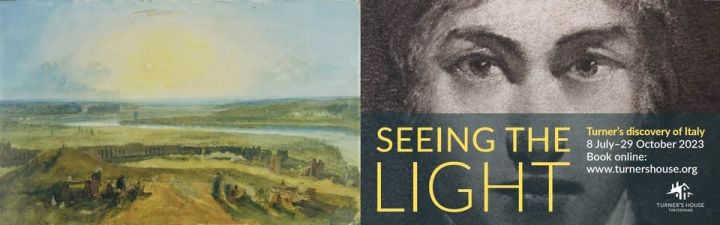
Left: J. M. W. Turner, The Roman Campagna from Monte Testaccio, Sunset, 1819, gouache, graphite, and watercolour on paper, 25 × 40 cm
(London: Tate, accepted by the nation as part of the Turner Bequest 1856, D16131).
◊ ◊ ◊ ◊ ◊
Closing this month at Turner’s House:
Seeing the Light: Turner’s Discovery of Italy in 1819
Turner’s House, Twickenham, 7 July — 29 October 2023
In the summer of 1819, the landscape artist J.M.W. Turner (1775–1851) set off on a journey to Italy that would have a profound impact on his life and work. Visitors to Turner’s House will be able to enjoy an exhibition of evocative watercolours capturing some of the painter’s first impressions of the place he was to later call the “land of all bliss,” and which provided inspiration for the rest of his career. Seeing the Light provides an exciting opportunity for the public to see some of Italy’s most well known and loved sites—Venice, Rome, Naples—through Turner’s eyes, in the unique setting of his then rural retreat in Twickenham. Visitors to this tightly-focussed exhibition will also be able to appreciate Turner’s evolving use of colour and light before and after 1819, thanks to generous loans from Tate, the Guildhall Art Gallery, and a private collection.










leave a comment