Exhibition | Crafting Freedom: Thomas W. Commeraw

Thomas W. Commeraw, Jug, detail, ca. 1797–1819, salt-glazed stoneware, cobalt oxide, 12 inches (30 cm) high
(New-York Historical Society, purchased from Elie Nadelman, 1937.820).
◊ ◊ ◊ ◊ ◊
From the press release (6 October 2022) for the exhibition:
Crafting Freedom: The Life and Legacy of Free Black Potter Thomas W. Commeraw
New-York Historical Society, 27 January — 28 May 2023
Fenimore Art Museum, Cooperstown, New York, 24 June — 24 September 2023
Curated by Margi Hofer, Mark Shapiro, and Allison Robinson, with Leslie M. Harris
The New-York Historical Society presents Crafting Freedom: The Life and Legacy of Free Black Potter Thomas W. Commeraw, the first exhibition to bring overdue attention to Thomas W. Commeraw, a successful Black craftsman who was long assumed to be white. Formerly enslaved, Commeraw rose to prominence as a free Black entrepreneur, owning and operating a successful pottery in the city. Over a period of two decades, he amassed property, engaged in debates over state and national politics, and participated in New York City’s free Black community. The exhibition explores Commeraw’s multi-faceted history as a craftsman, business owner, family man, and citizen through approximately 40 pieces of stoneware produced by Commeraw and his competitors between the late 1790s and 1819, in the largest presentation of his work to date. Alongside these pieces are the primary documents that enabled historians to reconstruct the arc of his professional career and personal life, and through them convey a deeper understanding of free Black society in New York in the years between the Revolutionary and Civil Wars.
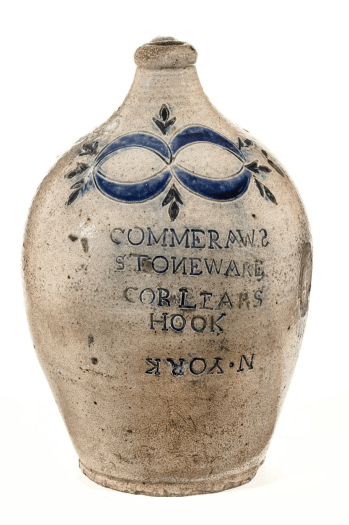
Thomas W. Commeraw, Jug, ca. 1797–1819, salt-glazed stoneware, cobalt oxide, 12 inches (30 cm) high, (New-York Historical Society, purchased from Elie Nadelman, 1937.820).
“Crafting Freedom continues the tradition at New-York Historical of presenting groundbreaking exhibitions that reveal the complex dimensions of race in the early years of New York City and our nation,” said Dr. Louise Mirrer, president and CEO of New-York Historical. “Through this exhibition of Thomas W. Commeraw and his work, we gain an in-depth understanding of a Black artisan’s life in New York, while also seeing how our understanding of history continues to evolve to give us greater insight into issues that affect our society today. This exhibition will transform our visitors’ perspective on New York’s free Black community, challenging long-held myths about post-revolutionary race relations in northern states.”
“This exhibition illuminates the story of a man who was emancipated as a child, went on to own and operate his own business, and advocated for the rights of full citizenship for his fellow Black Americans,” said Margi Hofer, New-York Historical’s vice president and museum director, who co-curated the exhibition. “While Commeraw’s distinctive pottery has been admired and collected for over a century, his true story has been obscured for far too long. It is incredibly meaningful that we are able to bring to light a true portrait of the man, both as a citizen and as a craftsman.”
The New York City directories first list Thomas “Commerau” working as a potter in 1795, living near Pot Baker’s Hill in the vicinity of today’s City Hall. By 1797, he had established his own workshop at Corlears Hook on the East River. There, he produced vessels in the local tradition, often decorated with distinctive flourishes of swags, tassels, and bowknot motifs filled with vivid cobalt. Stoneware vessels were essential kitchenware in that era and stored everything from milk, butter, salted meat, and preserves, to molasses, cider, and beer. Commeraw also manufactured oyster jars for the city’s oystermen, who were predominantly from the free Black community. His crocks and jugs traveled on ships to ports along the eastern seaboard and as far afield as Guyana and Norway. Most of the Commeraw vessels that survive today are boldly stamped with his name and the location of his pottery at Manhattan’s Corlears Hook. In addition to signaling pride in his work, Commeraw’s prominent branding helped him attract and retain customers.
In addition to revealing Commeraw’s successes and struggles as a pottery owner in a city riven by racism, the exhibition explores his commitment to securing a better future for the Black community through his work with abolitionist, political, religious, and mutual aid organizations. In 1790, the majority of Black New Yorkers were enslaved. By 1810, 6 out of 7 were free. Businessmen like Commeraw faced daunting challenges, not just raising capital but building civic and religious organizations to support the Black community. Free Black men had voted in New York since the Revolution, but in 1811, the state legislature passed a law to suppress Black voters, requiring them to submit a Certificate of Freedom that included a sworn statement from a third party attesting to the voter’s free status and residency and to pay a filing fee. A highlight of the exhibition is the 1813 Certificate of Freedom held by New-York Historical’s Patricia D. Klingenstein Library that bears Commeraw’s confident signature as witness. It is the only confirmed manuscript in his hand. The exhibition also examines how Black New Yorkers responded to economic and political oppression by developing a lively cultural and artistic community.
The final chapter in Commeraw’s story concerns his effort to promote the emigration of Black settlers to Sierra Leone, as the prospect of full citizenship for Black New Yorkers dimmed. Commeraw traveled there with his extended family in 1820 on the first voyage of the American Colonization Society. He arrived full of optimism and plans to found a Black republic; instead, he experienced unimaginable hardship and tragedy. What began as a venture for political rights ended as a struggle for survival. Many of the settlers died of malaria, including Commeraw’s wife and niece. He returned to the U.S. in 1822 and died the following year in Baltimore. The exhibition closes with a coda that describes future generations of the Commeraw family carrying forward the potter’s entrepreneurial energy and political engagement.
Additionally, Queens-based ceramic artist and activist Sana Musasama has created a new work that reflects on Commeraw’s life as a New York potter, his transatlantic odyssey of two centuries ago, and her own artistic journey. Passages will be installed in New-York Historical’s grand lobby, the Robert H. and Clarice Smith Gallery, to introduce the exhibition and encourage visitors to contemplate how Commeraw’s story continues to resonate today.
Crafting Freedom is co-curated by New-York Historical’s Vice President and Museum Director Margi Hofer, potter and Commeraw researcher Mark Shapiro, and Mellon Foundation Postdoctoral Fellow in Women’s History and Public History Allison Robinson. Leslie M. Harris, professor of history and African American studies at Northwestern University, served as scholarly advisor. The exhibition next travels to the Fenimore Art Museum, where it will be on view from June 24 until September 24, 2023.
Major support for Crafting Freedom: The Life and Legacy of Free Black Potter Thomas W. Commeraw is provided by the Decorative Arts Trust and Emily and James Satloff.
Leslie Harris in Conversation with David Rubenstein, The Shadow of Slavery and the History of African Americans in New York City, from the Settling of New Amsterdam to the Civil War
New-York Historical Society, 10 April 2023

“Test of Patriotism,” Commercial Advertister (20 August 1814)
(Patricia D. Klingenstein Library, New York Historical Society)
◊ ◊ ◊ ◊ ◊
A. Brandt Zipp, Commeraw’s Stoneware: The Life and Work of the First African-American Pottery Owner (Sparks, Maryland: Crocker Farm, 2022), 311 pages, ISBN: 979-8218002909, $95.
 Presented here for the first time in two centuries is the lost story of New York City potter Thomas W. Commeraw, a key early African American figure whose identity slipped through the fingers of history. Rediscovered by the author in the first years of this century, Commeraw stands as one of the most fascinating of all historic American decorative artists: an abolitionist, activist, highly influential craftsman and, ultimately, the hopeful founder of a new African republic. Topics include: Commeraw’s fascinating life story, from childhood to death; a comprehensive discussion and illustration of Commeraw’s pottery, made from the mid-1790s to late 1810s; Commeraw’s abolitionism, political activism, and role as an important local free black figure; a thorough history of New York City stoneware; an in-depth breakdown of the work of other New York City stoneware manufacturers including Clarkson Crolius Sr., John Remmey III, and David Morgan; and Commeraw’s harrowing experiences on the west coast of Africa.
Brandt Zipp is a founding partner of Crocker Farm, Inc., the nation’s premier auction house specializing in historic American utilitarian ceramics. A graduate of Johns Hopkins University, Brandt’s research regularly breaks important new ground, no greater example being his serendipitous discovery of Thomas Commeraw’s heritage. Commeraw’s Stoneware represents the culmination of almost two decades of research, writing, and lecturing.
Exhibition | Flora Danica: The World’s Wildest Dinnerware

From the Royal Danish Collection:
Flora Danica: The World’s Wildest Dinnerware / Verdens Vildeste Stel
Library Hall, Koldinghus, Kolding, 7 October 2022, ongoing
With 1,530 intact pieces, the Flora Danica dinnerware is not only the best-preserved luxurious porcelain service from the 18th century but also undoubtedly the world’s wildest dinnerware in terms of splendour, storytelling, and decorations. This grand exhibition of the Flora Danica dinnerware at Koldinghus offers a close look at the magnificent set and tells the story of the fascinating ideas and myths associated with it and their connections to national and international politics. With its numerous pieces and painstaking reproductions of wild Danish botany on fragile white porcelain, the service offers an important key to understanding Denmark during the Enlightenment. Like the Danish crown jewels, the dinnerware is still in use today for very special occasions in the Royal House.
The Origins of Flora Danica
The exhibition explores the origins of this historic porcelain service, which is inextricably linked with Flora Danica, the world’s most ambitious reference work on wild plants, which took more than 122 years to complete and features beautiful copperplate prints and precise descriptions of more than 3,240 plant species. The goal of the project was to collect knowledge and facilitate the use of wild plants, lending lustre to the absolute monarchy. Around 1789, it was decided to transplant this prestigious project to precious porcelain. No specific information has been preserved about when this wild idea first arose, who came up with the almost absurd notion of decorating porcelain with wild plants, or for whom this lavish service was intended. Indeed, our knowledge about the early chapters in the story of this magnificent service is as limited as the myths about it are numerous!
Wild Rumours and International Drama
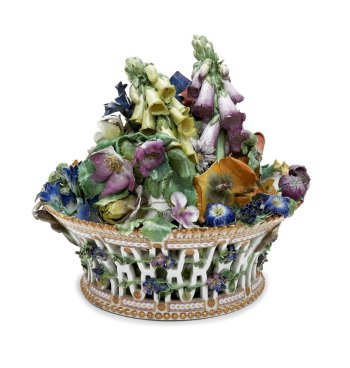
Flower Basket from the Flora Danica set (Photo by Iben Kaufmann).
Even while the service was in production, rumours abounded about the purpose of this lavish dinnerware decorated with wild plants. Rumor spread like wildfire throughout Europe, and there was persistent speculation that it was intended for the Russian Empress Catherine the Great, a porcelain enthusiast. Indeed, the Flora Danica service may have been intended for her, as a diplomatic gift in a time of international tension. Or perhaps, the dinnerware with the wild plants were created for the table of the Danish king as a wild act of political nudging to promote a particular policy.
At the time, the dramatic state of international politics was easily matched by the drama surrounding the political direction of the monarchy in the Danish realm, where a fierce political battle was playing out between pro- and anti-reformists. The exact role and position of the Flora Danica service in the cross-fire of reforms, diplomacy, and wild rumour remain a mystery to this day. Around 1879, that mystery put forth an outstanding flower in the form of this stunning service, unparalleled in scale and wondrous decorations.
Poisonous Mushrooms and Sophisticated Advertising
Each of the many pieces of the Flora Danica service features images from one of the copperplate prints from the reference work, carefully reproduced in full scale. Tureens, wine coolers, and plates are covered in wild flora: from humble algae on Norwegian rocks to poisonous mushrooms in Danish forests and long grasses on the moors of Holstein.
While the copperplate images were easily transferred to the larger pieces, such as tureens and serving dishes, the porcelain painters needed all their skill and ingenuity when it came to the smaller pieces. Long stalks were cut, grasses were laid horizontally, and leaves were twisted to fit the floral decorations onto round and curvy small dishes, custard cups, and salt cellars. The mantra was accuracy above all else, with correct representations taking precedence over beauty. Thus, despite its impressive volume and splendour, the service was mainly conceived as PR for the underlying publication. In fact, it is so inextricably linked to the reference work that the service should not be seen as an independent artistic achievement by the Royal Danish Porcelain Factory but rather as a sophisticated advertising stunt.
The World’s Wildest Dinnerware
Since the large exhibition about the Flora Danica dinnerware in 1990 at Christiansborg Palace, it has not been possible to stage a comprehensive presentation of this wild service, which is almost as storied as it is voluminous. The upcoming exhibition will shed light on the wild myths surrounding the service and offer the audience an up-close look at the unusual decorations and the use of the historical service, which was first used in 1803 at the birthday banquet for Christian VII. Since then, it has been used on very special occasions in the Royal House. Most recently, it was in use at the golden jubilee of HM Queen Margrethe II in January 2022. No other Danish service can boast as long a legacy or a presence at such historic banquets as the Flora Danica service, which remains the world’s wildest dinnerware—in terms of history, storytelling, and decoration.
The exhibition is made possible by loans of items from the State Inventory and contributions from Royal Copenhagen and Georg Jensen Damask. It opened at Koldinghus on 7 October 2022 and will be followed up by events and communication initiatives to shed light on the history, use, and continued relevance of the porcelain service.
Jesper Munk Andersen, Flora Danica: The World’s Wildest Dinnerware (Copenhagen: Kongernes Samling / The Royal Danish Collection, 2022), 104 pages, ISBN: 978-8789542256. Also available in Danish.
More information is available here»
Exhibition | Johann Gottfried Schadow: Embracing Forms

Johann Gottfried Schadow, Double Portrait Statue of Princesses Luise and Friederike of Prussia, detail, 1795–97, marble
(Staatliche Museen zu Berlin, Nationalgalerie)
◊ ◊ ◊ ◊ ◊
From the Staatliche Museen zu Berlin:
Johann Gottfried Schadow: Embracing Forms / Berührende Formen
Alte Nationalgalerie, Berlin, 21 October 2022 — 19 February 2023
Curated by Yvette Deseyve
The life-size double statue of Princesses Louise and Frederica of Prussia, known as the Princess Group, is the magnum opus of Johann Gottfried Schadow (1764–1850). Seen as the founder of the Berlin School of sculpture, Schadow came to epitomize German neoclassicism, with this work being emblematic of the movement. As the first sculpture depicting two female historical figures, this work wrote art history, and continues to be a highlight for visitors to Berlin from around the world. The first retrospective in some 30 years, this exhibition presents Schadow’s major sculptural, graphic, and art-theoretical works, arranged into 11 thematic sections. Following extensive conservation and restoration work, the original plaster model of the Princess Group (from 1795) is exhibited alongside the original marble rendering (1797) for the first time ever.
 With more than 150 works, the collection of the Nationalgalerie is home to the world’s largest selection of Schadow’s sculptural works, including both originals of the Princess Group. Since the last retrospective almost 30 years ago (which was first exhibited at the Alte Nationalgalerie), a great deal has been uncovered about the artist, his oeuvre, the functioning of his workshop, and his working methods. This knowledge comes in large part from the major research and restoration project focused on the original plaster model of the Princess Group, the findings of which are here presented to the public for the first time. Numerous international loans of sculptures, paintings, and graphic works, as well as art-theoretical writings, offer insights into the genesis and critical reception of the Princess Group. The exhibition also features works by some of Schadow’s contemporaries, including Gainsborough, Tischbein, Weitsch, Chodowiecki, and Begas.
Johann Gottfried Schadow: Embracing Forms is curated by Yvette Deseyve and is accompanied by catalogues in both English and German. The exhibition was made possible by the Freunde der Nationalgalerie, the Ernst von Siemens Kunststiftung, and the Cultural Foundation of the German Federal States. The three-year conservation and restoration project on the original plaster model of the Princess Group was funded by the Hermann Reemstma Stiftung, the Rudolf-August Oetker-Stiftung, and the Cultural Foundation of the German Federal States. The Bern University of Applied Sciences and the Bern Academy of the Arts supported the project as cooperation partners.
Yvette Deseyve, ed., with contributions by Sintje Guericke, Johann Gottfried Schadow: Embracing Forms (Munich: Hirmer Verlag, 2023), 304 pages, ISBN: 978-3777440873, $65.
Exhibition | Ridolfo Schadow: The Judgment of Cupid

Ridolfo Schadow, Cupid, detail, 1821/22, marble
(Berlin: SPSG Skulpt.slg. 2800, photo by Daniel Lindner)
◊ ◊ ◊ ◊ ◊
Now on view at Charlottenburg Palace:
Ridolfo Schadow: The Judgment of Cupid / Das Urteil des Amor
Schloss Charlottenburg, Berlin, 28 May 2022 — 31 December 2023
Special presentation on the 200th anniversary of the death of Ridolfo Schadow
On the occasion of the 200th anniversary of the death of the sculptor Ridolfo Schadow (1786–1822) an idea of the artist will be realized for the first time within a presentation in the vestibule of the New Wing in Charlottenburg Palace. Three young girls sit opposite Cupid, the winged god of love. Engrossed in their respective activities, they don’t appear to have noticed his presence. Cupid is undecided: on whom should he bestow the floral wreath in his hand? This arrangement of four marble sculptures awakens associations with the ‘Judgement of Paris’, the story from Greek mythology in which Zeus, the father of the gods, assigned Paris, the son of the Trojan king, the task of deciding who is the most beautiful of the goddesses: Hera, Athena, or Aphrodite.

Ridolfo Schadow, Girl Spinning, 1818, marble (SPSG Skulpt.slg. 5579).
Schadow, however, presents viewers with sensitively observed adolescents in poses capturing everyday situations: the young Cupid, the Girl with Doves (Innocence), the Girl Tying Her Sandal, and the Girl Spinning. King Frederick Wilhelm III of Prussia purchased the four sculptures produced by Ridolfo Schadow in Rome. Three of them stood in the Royal Palace (Kronprinzenpalais), while the fourth was displayed in the Berlin Palace. Thus, with this presentation, the original intention of the sculptor—arranging the four figures as a group—has been fulfilled for the first time.
What real circumstances could have inspired this idea of the prematurely deceased Ridolfo Schadow? Living in the Casa Buti, a type of artists’ guesthouse in Rome, the sculptor not only met fellow artists such as Bertel Thorvaldsen (1770–1844) and Antonio Canova (1757–1822), but also the three daughters of the Buti household. They were probably the models for the charming genre scenes, which were very popular at the time. This small exhibition addresses the origin, interpretation, and later influence of the figures.
Visitors can find additional details of Ridolfo Schadow’s work and life in Rome on the SPSG website, as well as information on further works acquired by the Prussian ruling house through the mediation of Ridolfo’s father and teacher, the famous Berlin sculptor, Johann Gottfried Schadow (1764–1850)—himself the subject of considerable attention in 2022 and 2023 with exhibitions at the Alte Nationalgalerie SMB PK, the Gipsformerei SMB PK (Replica Workshop), the Schadow Gesellschaft Berlin e.V., and the Stiftung Stadtmuseum Berlin.
Exhibition | Sketching among the Ruins

Louise-Joséphine Sarazin de Belmont, The Roman Theater, Taormina, 1825, oil on paper, mounted on board, 42 × 58 cm
(New York: Thaw Collection, jointly owned by the Metropolitan Museum of Art and the Morgan Library & Museum, 2009.400:102)
◊ ◊ ◊ ◊ ◊
Now on view at The Morgan:
Sketching among the Ruins
The Morgan Library & Museum, New York, 25 October 2022 — 12 November 2023
By the mid-eighteenth century, the practice of sketching outdoors with oil paint had become popular among landscape artists. Furthermore, a study trip through Europe, often centered on a stay in Italy, had evolved as a customary part of artists’ training. Italy’s cities and countryside, filled with remnants of ancient monuments, offered artists stimulating subject matter, and the portability of oil sketching facilitated the firsthand study of ruins and their surroundings. While some painters carefully recorded these structures’ textures and colors, as well as how light fell upon them, others invented scenes by reimagining remains of the past or by envisioning the future deterioration of the present. Whether real or fictional, ruins and their surrounding landscape offered poignant juxtapositions—at once testimonies to the majesty of human achievement and to the inevitable triumph of time over our endeavors.
Sketching among the Ruins highlights oil sketches given jointly to the Morgan and the Metropolitan Museum of Art by Eugene V. Thaw, a trustee of both institutions.
◊ ◊ ◊ ◊ ◊
Thaw died in January of 2018 at the age 90. For an overview of his wide-ranging career as a dealer and collector, see Steven M. L. Aronson, “Celebrating Eugene Thaw’s Legacy,” Architectural Digest Pro (25 November 2018).
Exhibition | In and around Piranesi’s Rome

Charles-Louis Clérisseau, Travelers in the Interior of the ‘Temple of Mercury’ at Baiae, ca. 1761, opaque watercolor, 27 × 47 cm
(NY: The Morgan Library & Museum, 1985.62)
◊ ◊ ◊ ◊ ◊
Now on view at The Morgan:
In and around Piranesi’s Rome: Eighteenth-Century Views of Italy
The Morgan Library & Museum, New York, 10 January — 4 June 2023
By the mid-eighteenth century, the Grand Tour, a study trip through Europe with a period of residence in Italy, had become a fixture in the education of European aristocrats and the training of artists. These young travelers were eager to return home with reminders of their experience, which contributed to a demand for paintings, prints, and drawings of Italian views, or vedute. Rome and the vestiges of its ancient past were especially popular subjects, as is also reflected in the nearby display of oil sketches. The burgeoning genre spawned specialized artists (vedusti), particularly at the French Academy in Rome, a center of creative exchange for not only academy members but also other artists active across the city.
Artists took various approaches to vedute. Some adopted a documentary route, recording archeological and architectural sites, occasionally enlivened with figures. Others altered elements of an existing view or invented an entirely fictive scene, known as a capriccio. In both real and imagined modes, a powerful influence and creative force was the Italian Giovanni Battista Piranesi (1720–1778), who for some time maintained a workshop across the street from the French Academy and interacted with many of its artists.
Exhibition | Fortune and Folly in 1720

Installation view of Fortune and Folly in 1720
The New York Public Library, 2022
◊ ◊ ◊ ◊ ◊
At the NYPL (and on view during this year’s CAA conference) . . .
Fortune and Folly in 1720
New York Public Library, 23 September 2022 — 19 February 2023
Curated by Nina Dubin, Meredith Martin, and Madeleine Viljoen
In 1720, everyday citizens converged on the banking streets of Paris, London, and Amsterdam, speculating in New World trading companies and other maritime ventures. By the close of that year, an unprecedented bull market would culminate in the world’s first international financial crash. Orchestrated by the insolvent governments of France and England, and fueled by illusions of colonial wealth, these investment bonanzas—henceforth known as the Mississippi and South Sea Bubbles—have remained synonymous with the temptations of get-rich-quick schemes and the dangers of herd behavior. Three centuries and many booms and busts later, their imprint is indelible. Not only did the bubbles accelerate the growth of a financial system overflowing with stock shares, newly created banknotes, and other mysterious paper devices imbued with financial alchemy—they also illustrated the power of trust and dread, faith and fear, as drivers of market volatility.
The works on display draw from the collections of The New York Public Library and include a trove of caricatures from a Dutch volume known as The Great Mirror of Folly (Het groote tafereel der dwaasheid). Published as the crisis was unfolding, these prints portray the bewildering forces of modern economic life. Loaded with jokes, often of a scatological nature, The Great Mirror of Folly lifts the curtain on a farcical political theater whose stars include bankers and statesmen—and that’s just for starters. Offering tragicomic depictions of malevolent traders, hoodwinked investors, and villainous seductresses, the prints hold up a mirror to our own age, with its ever more complex monetary instruments and periodic meltdowns. They also reflect on the intersections between art and finance, reminding us that both are products of human imaginings.
Madeleine Viljoen, Nina Dubin and Meredith Martin, Meltdown! Picturing the World’s First Bubble Economy (Turnhout: Harvey Miller, 2020), 157 pages, ISBN: 978-1912554515, $65 / €50.
Online Salon | Promenades on Paper: 18th-C. French Drawings
From AHNCA:
Virtual Salon on The Clark’s Exhibition of Eighteenth-Century French Drawings from the BnF
Online, Wednesday, 1 February 2023, 7pm ET
The Association of Historians of Nineteenth-Century Art and the Dahesh Museum join with the Clark Art Institute for a Virtual Salon on the Clark’s current exhibition Promenades on Paper: Eighteenth-Century French Drawings from the Bibliothèque nationale de France. Focusing on select drawings from the exhibition, curators Esther Bell, Anne Leonard, and Sarah Grandin will offer a varied and lively picture of artistic practices in the years leading up to and just after the French Revolution. This event is free and open to the public, but registration is required. Please register here.
Esther Bell is Deputy Director and Robert and Martha Berman Lipp Chief Curator at the Clark Art Institute. Prior to joining the Clark, Bell was the curator in charge of European paintings at the Fine Arts Museums of San Francisco. Bell has published essays and organized exhibitions on a range of subjects, from seventeenth-century genre painting to eighteenth-century theater to nineteenth-century millinery.
Anne Leonard is Manton Curator of Prints, Drawings, and Photographs at the Clark Art Institute. In addition to curating numerous exhibitions of works on paper, she is co-editor of The Routledge Companion to Music and Visual Culture (2014) and author/editor of Arabesque without End: Across Music and the Arts, from Faust to Shahrazad (2022).
Sarah Grandin is Clark-Getty Paper Project Curatorial Fellow at the Clark Art Institute. She specializes in French works on paper and the material culture of the ancien régime. She has published essays on typography, drawing, and Savonnerie carpets, and is preparing a monograph on issues of scale in the graphic and decorative arts under Louis XIV.
Exhibition | Looking Up: Studies for Ceilings, 1550–1800
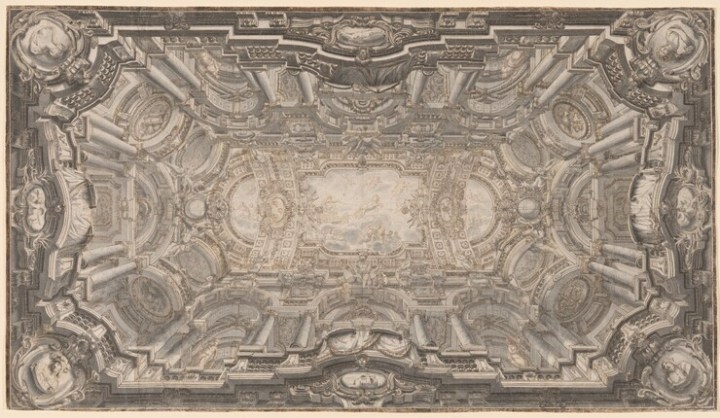
Ferdinando Galli Bibiena, A Grand Illusionistic Ceiling, 1720/1740, pen and brown ink with gray and brown washes over graphite on laid paper
(Washington, DC: National Gallery of Art, 1994.73.1)
◊ ◊ ◊ ◊ ◊
From the NGA:
Looking Up: Studies for Ceilings, 1550–1800
National Gallery of Art, Washington DC, 29 January — 9 July 2023
Curated by Jonathan Bober
In modern architecture and contemporary interior design, ceilings have lost much of their original, complex meaning, becoming neutral fields or featuring generic decoration. However, in the European tradition that spanned nearly four centuries, ceilings were where the most ambitious, compelling, and meaningful painted compositions appeared.
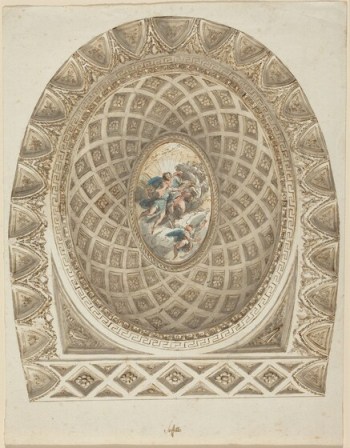
Felice Giani, A Coffered Dome with Apollo and Phaeton, ca. 1787, pen and brown ink with gray, blue, and pink washes over black chalk on wove paper (Washington, DC: National Gallery of Art, 1991.81.1).
Looking Up: Studies for Ceilings, 1550–1800 presents some 30 examples of the evolution of ceiling decoration. These works move from architectural frameworks housing conventional paintings to the illusion of a single, soaring space teeming with figures and dynamic movement during the baroque, and then on to the geometric organization and idealized form associated with neoclassism. Some of the drawings are vibrant preliminary studies; others are large-scale models that give a sense of the experience of the intended final composition. Studies of single motifs and individual figures reveal how these grand projects enticed viewers to pause and look up.
The exhibition is curated by Jonathan Bober, Andrew W. Mellon Senior Curator of Prints and Drawings, National Gallery of Art.
Display | Print and Prejudice: Women Printmakers, 1700–1930

Dorothea Knighton (1780–1862), Landscape, early nineteenth century, lithograph, 6.4 × 9 cm
(London: V&A, E.343-2017)
◊ ◊ ◊ ◊ ◊
From the V&A:
Print and Prejudice: Women Printmakers, 1700–1930
Victoria & Albert Museum, 5 November 2022 — 1 May 2023
This display charts the development of women artists’ remarkable but overlooked engagement with printmaking from the 18th to early 20th centuries—from picturesque landscapes, to intimate portraits and vibrant botanical works.










 Enfilade
leave a comment