Exhibition | Louis XV: Passions of a King
Opening this month at Versailles:
Louis XV: Passions of a King / Passion d’un roi
Château de Versailles, 18 October 2022 — 19 February 2023
Curated by Yves Carlier and Hélène Delalex
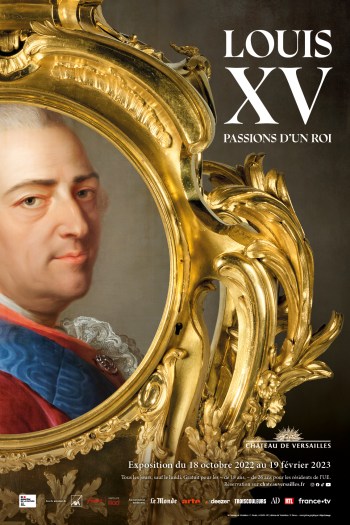 For the 300th anniversary of King Louis XV’s coronation, Palace of Versailles is paying homage with an exceptional exhibition. Through more than 400 works, visitors can discover Louis XV (1710–1774) beyond his function as monarch, learning more about his passions, his family life, and his influence on the arts of his time.
Born in 1710 in Versailles, Louis XV was the son of the Duke of Burgundy and Marie-Adélaïde of Savoy, as well as the great-grandson of Louis XIV. Heir apparent after the death of his father, he became king at the tender age of five after the death of the Sun King on 1 September 1715.
A Private Man
The exhibition opens with an introduction to Louis XV as a man, looking back on his relations with his family and his entourage. His childhood, marked by grief, contrasts with his later life with his large family, where he delighted in his role as a father. Women also occupied a central place in the King’s life, such as his wife Marie Leszczynska, not to mention his many mistresses (some of whom made their mark on the period). The exhibition also explores Louis XV’s discreet, melancholy nature, a man who preferred the intimacy of his private apartments. There, he received his inner circle, who enjoyed his every confidence.
The King’s Tastes and Passions
The tour continues with the Louis XV’s passion for sciences, botany, and hunting, as well as his love of buildings, and the influence of all these fields on his reign. His curiosity and insatiable thirst for knowledge drove him to fund long sea voyages, transform Trianon into a garden full of botanical experiments, commission cutting-edge scientific tools, and order the mapping of the kingdom.
Louis XV and the Arts of His Time
The final section of the exhibition shows how the arts flourished during the reign of the ‘Well-Beloved’ (Bien-Aimé). Multiple masterpieces of rococo art introduced the public to the foundations of this style, which, free of symmetry and formal rules, shook up artistic creation in the 18th century.
Meet the Favourites
For this exhibition, the apartment of Madame de Pompadour, as well as that of Madame du Barry, freshly restored after eighteen months of work, will be opened to the public for guided tours, offering a unique experience at the heart of Louis XV’s private Versailles.
The exhibition is curated by Yves Carlier, Chief Heritage Curator at the Musée National des Châteaux de Versailles et de Trianon; and Hélène Delalex, Heritage Curator at the Musée National des Châteaux de Versailles et de Trianon.
Yves Carlier and Hélène Delalex, eds., Louis XV: Passion d’un roi (Château de Versailles / In Fine éditions d’art, 2022), 496 pages, ISBN: 978-2382030769, 49€.
S O M M A I R E
Introduction
Louis XV
L’Homme Privé
Une enfance de cimetière. Louis XV et la mort
Louis XV aux Tuileries, 1715–1722
1722, le retour à Versailles
Le sacre de Louis XV
Le mariage de Louis XV
Louis XV et ses enfants
Amis et amies du roi : les intimes
Les sœurs Mailly-Nesle ou la guerre des Nattier
Madame de Pompadour : l’amie nécessaire
Jeanne du Barry et le roi : une conspiration du silence
Les soupers des cabinets
Louis XV et la religion
Le Parc aux Cerfs : mythe révolutionnaire ou réalité historique ?
L’attentat de Damiens
Gôuts et Passions du Roi
L’esprit des livres : les bibliothèques personnelles de Louis XV
Louis XV, les livres et la reliure : la naissance de la bibliophilie moderne ?
Les expériences d’électricité sous le règne de Louis XV : un succès foudroyant
Le cabinet de Physique et d’Optique de Louis XV au château de La Muette 222
Louis XV « dans son particulier » : les tours du roi
Louis XV et la chasse
Louis XV et le théâtre
Louis XV et l’architecture
Les Arts sous le Règne de Louis XV
Rocaille : la forme et la force
Pour un art de cour ? Louis XV face aux arts de son temps
Boîtes et tabatières à la cour de France sous Louis XV
La Saxe en or moulu. Le goût pour les porcelaines de Meissen montées à la cour de Louis XV
L’importance des Gobelins et de la Savonnerie
Louis XV et la manufacture de porcelaine de Vincennes-Sèvres
Louis XV : une peinture pour le quotidien
Louis XV et la sculpture
La marquise de Pompadour et les arts : une « Apologie du luxe »
Madame Du Barry à la cour : l’affirmation d’un goût
Le Roi se meurt
« Qui nous délivrera de Louis XV et de son perpétuel recommencement ? » Le retour des lignes rocaille dans les arts décoratifs français du XIXe siècle
Bibliographie
Online Lecture | Andrew Rudd on Print Philanthropy

Jonas Hanway, Thoughts on the Plan for a Magdalen-House for Repentant Prostitutes, second edition (London, 1759). The first edition was published anonymously in 1758.
◊ ◊ ◊ ◊ ◊
From Yale’s Lewis Walpole Library, in connection with the exhibition From ‘Knight Errant of the Distressed’: Horace Walpole and Philanthropy in Eighteenth-Century London:
Andrew Rudd | Print Philanthropy in the Age of Horace Walpole
Online, 28 October 2022, 12.00pm EST
Eighteenth-century England witnessed a remarkable flowering of philanthropic activity as society wrestled with problems such as poverty, disease, mental illness, vice, and suffering caused by war. Walpole boasted in 1760 of what he called “our noble national charity.” While many aspects of philanthropy remain similar today, this lecture will explore how the print culture of Walpole’s era was central in driving charitable behaviour, particularly in terms of creating philanthropic networks and framing relationships between donors and beneficiaries. The talk will showcase the sheer range of printed text and images—fundraising prospectuses, sermons, topographical views of hospitals, tickets to benefit concerts and dinners, and celebratory odes—mobilised in service of good causes during this period, as well as highlight examples of Walpole’s own support for, and portrayals of, philanthropic causes during his lifetime.
Andrew Rudd is Senior Lecturer in the English Department at the University of Exeter. He researches and teaches British literature of the eighteenth century and Romantic period. His monograph Sympathy and India in British Literature 1770–1830 (Palgrave Macmillan) was published in 2011, and he is currently writing a cultural history of charity in the eighteenth century. This builds on experience he acquired as Parliamentary Manager at the Charity Commission for England and Wales before joining Exeter in 2013. Dr. Rudd holds a PhD from the University of Cambridge, and he has studied at the University of Durham, Trinity College, Cambridge, and Yale University. He has held numerous fellowships—most recently at Yale’s Lewis Walpole Library and the School of Advanced Studies in English, University of Jadavpur. Since 2015, he has been a member of the Arts and Humanities Research Council’s Peer Review College.
Exhibition | Elegance, Drama, and Nature

Marie-Gabrielle Capet, Studio Scene (Adélaïde Labille-Guiard Portrays Joseph-Marie Vien), exhibited at the Salon of 1808
(Munich: Bayerische Staatsgemäldesammlungen)
◊ ◊ ◊ ◊ ◊
From the Alte Pinakothek:
Elegance, Drama, and Nature / Eleganz, Schauspiel und Natur
Alte Pinakothek, Munich, 7 May — 23 October 2022
The presentation of 18th-century painting at the Alte Pinakothek consists above all of pictures by French and Venetian artists such as François Boucher, Canaletto, Francesco Guardi, and Giovanni Battista Tiepolo whose work was already much in demand throughout Europe during the artists’ lifetime. Paintings by Nicolas Lancret and Jean-Baptiste Pater, meanwhile, testify to the influence of Antoine Watteau. The extraordinary wealth and diversity of 18th-century European art, however, becomes clear only when we look beyond France and Venice. In the current collection presentation, rarely shown works by German and Dutch artists enter into an intriguing dialogue with paintings from France and Italy.
The current exhibition focuses on three themes that offer insights into the conditions governing artistic production and the evolving discourse and cultural climate of the Age of Enlightenment:
• Portraiture, especially self-portraits
• Festivities and themes of love
• City and landscape views
The sustained engagement with the idea of humankind’s rational and emotional competence, personal freedoms and the relationship to society, a new awareness of history, the rediscovery of the natural world, and exploration of the laws of nature—all these aspects shaped the 18th century and are reflected in the paintings shown here. As part of a collection accumulated over a long period of time, they vividly convey the parallelism of the numerous, sometimes contradictory approaches that characterised European 18th-century art.
More information about each section of the exhibition is available here»
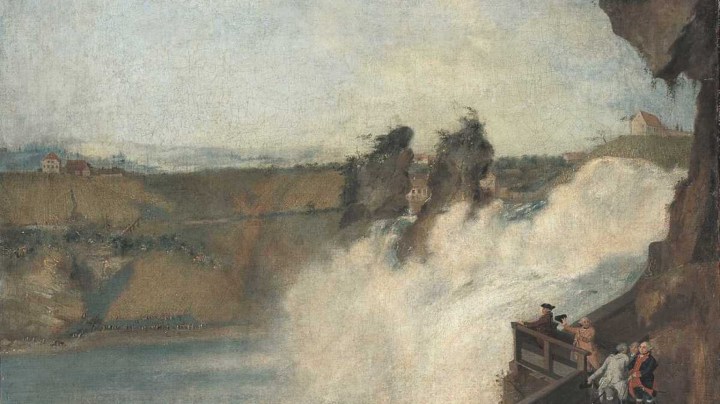
Philipp Hieronymus Brinckmann, The Rhine Falls near Schaffhausen, with Elector Karl Theodor of the Palatinate and Entourage, ca. 1759
(Munich: Bayerische Staatsgemäldesammlungen)
Exhibition | Vive le Pastel!
On view for a few more weeks at the Alte Pinakothek:
Vive le Pastel! Pastel Painting from Vivien to La Tour / Pastellmalerei von Vivien bis La Tour
Alte Pinakothek, Munich, 7 May — 23 October 2022
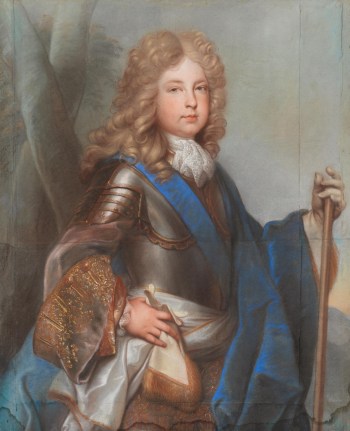
Joseph Vivien, Portrait of Charles, Duke of Berry (1686–1714), 1700, pastel on paper, 100 × 81 cm (Staatsgalerie im Neuen Schloss Schleißheim).
Often seen in art galleries or palaces, in magnificent ornamental frames and behind glass, their powdery surface making them seem as delicate as they are exquisite: pastels. They enjoyed considerable popularity in the 18th century when many works were created, especially in France. The colours are applied dry, using pastel sticks and covering the whole surface. The pastel painting technique was frequently used for lively, sensitively composed portraits in particular. But what are the reasons for the technique’s blossoming at the time? What advantages did pastels have over oil paintings? Who had their portraits painted in pastel? And how exactly were pastels created? These questions are explored in this special exhibition presented by the Bayerische Staatsgemäldesammlungen at the Alte Pinakothek.
The focus is on the two collections’ own holdings, in which such important names as Joseph Vivien, Maurice Quentin de La Tour, Rosalba Carriera, and Jean-Étienne Liotard are represented. For the first time pastel paintings from the Alte Pinakothek are shown together with those from the state gallery in Neues Schloss Schleißheim. In addition, some rarely displayed works from the depot by anonymous artists, as well as a few selected loans are also exhibited. This unique combination of works makes it possible to compare artists and their approaches and invites visitors to discover the variety of different effects realised in these works.
 There are two further reasons for this exhibition. Generous support provided by the Corona Fund of the Ernst von Siemens Kunststiftung has made it possible for urgently needed conservation and restoration work to be carried out on the Schleißheim pastels by a specialist. As a result, and due to examinations being carried out as part of a current research project on the French paintings, the works are temporarily in Munich. Before their return to the gallery in Schleißheim the opportunity is being taken to exhibit them in the Alte Pinakothek and, as such, within a larger context. At the same time, the presentation also celebrates a new acquisition—Portrait of Jean-Baptiste Philippe by Maurice Quentin de La Tour—donated by Mr Fritz Lehnhoff as a loan from the Museumsstiftung zur Förderung der Staatlichen Bayerischen Museen, that entered the collection in 2021.
A guide to the collection, covering the complete holdings of pastels from the late 17th and 18th centuries in the Bayerische Staatsgemäldesammlungen, accompanies the exhibition.
Elisabeth Hipp, ed., with an introduction by Bernhard Maaz and contributions by Bernd Ebert, Ulrike Fischer, Elisabeth Hipp, Xavier Salmon, and Herbert Rott, Pastellmalerei vor 1800 in den Bayerischen Staatsgemäldesammlungen (Berlin: Deutscher Kunstverlag, 2022), 136 pages, ISBN: 978-3422989009, 15€.
Exhibition | The Eveillard Gift
From The Frick:
The Eveillard Gift
The Frick Madison, New York, 13 October 2022 — 26 February 2023
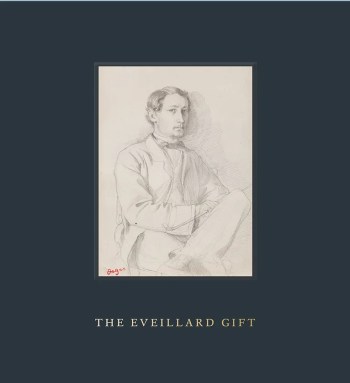 In the summer of 2021, The Frick Collection announced the largest and most significant acquisition of drawings and pastels in its history, the generous promised gift of Elizabeth ‘Betty’ and Jean-Marie Eveillard. This promised gift of twenty-six works (eighteen drawings, five pastels, two prints, and one oil sketch) has inspired the museum’s major fall 2022 exhibition, which will be accompanied by a lavishly illustrated catalogue and complementary public programs.
Over the past forty-five years, the Eveillards have assembled an outstanding collection of works on paper, ranging in date from the end of the fifteenth century to the twentieth century and representing artists working in France, Britain, Italy, Spain, the Netherlands, and the United States. The Eveillards’ landmark promised gift draws upon some of their finest European acquisitions. Along with preparatory figurative sketches, independent studies, and portraits are two vivid landscape scenes. Fittingly for the Frick, artists represented in the gift include François Boucher, Edgar Degas, Jean-Honoré Fragonard, Francisco de Goya y Lucientes, Thomas Lawrence, and Jean-François Millet. The group also introduces to the Frick’s holdings works by artists not previously represented in the museum’s permanent collection, including Gustave Caillebotte, Maurice Quentin de La Tour, Jan Lievens, John Singer Sargent, and Elisabeth Vigée Le Brun.
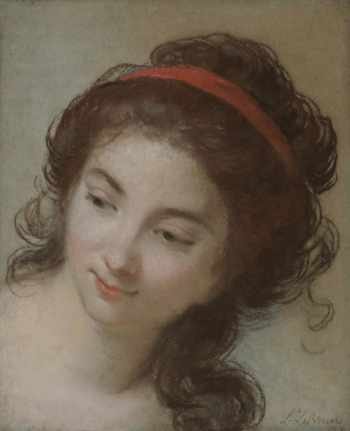
Elisabeth Vigée Le Brun, Head of a Woman, 1784, pastel on paper, 12 × 10 inches (New York: Frick Collection, promised gift from the Collection of Elizabeth and Jean-Marie Eveillard; photo by Joseph Coscia Jr.).
Each of the twenty-six works—selected for their beauty, quality, and condition—either appreciably deepens the Frick’s current holdings of familiar artists or brings to the institution a work by an artist who is not—but should be—represented within the museum’s core areas of European Old Master art. In adding five pastels and an oil sketch, the gift also strengthens the Frick’s holdings in these media. Betty and Jean-Marie Eveillard have been deeply involved with the Frick for many years, both having served as Trustees. Betty is currently the Board’s Chair.
Giulio Dalvit, Aimee Ng and Xavier F. Salomon, The Eveillard Gift (London: Paul Holberton Publishing, 2022), 168 pages, ISBN: 978-1913645281, £35 / $45.
Giulio Dalvit is the Frick’s Assistant Curator of Sculpture. He is a specialist of fifteenth-century Italian sculpture and painting, but his publications also span modern and contemporary art. Dalvit has held various lecture and research positions, most recently as an Associate Lecturer at the Courtauld Institute of Art, London.
Aimee Ng is a Curator at the Frick, where she is a specialist in Italian Renaissance art. She has held academic and curatorial and positions at Columbia University and the Morgan Library & Museum, where, before joining the Frick, she served as Post-Doctoral Fellow at the Morgan’s Drawing Institute.
Xavier F. Salomon is the Frick’s Deputy Director and Peter Jay Sharp Chief Curator. A noted scholar of Paolo Veronese, he has curated many exhibitions and written or contributed to countless publications. Previously, he was Curator in the Department of European Paintings at the Metropolitan Museum of Art and, before that, the Arturo and Holly Melosi Chief Curator at Dulwich Picture Gallery.
Exhibition | A Splendid Land: Paintings from Royal Udaipur

Sunrise in Udaipur, ca. 1722–23, detail (Udaipur: The City Palace Museum, The Maharana of Mewar Charitable Foundation, 2012.20.0015).
◊ ◊ ◊ ◊ ◊
From the press release (29 August) for the exhibition:
A Splendid Land: Paintings from Royal Udaipur
Sackler Gallery, National Museum of Asian Art, Washington DC, 19 November 2022 — 14 May 2023
Cleveland Museum of Art, 11 June — 10 September 2023
Curated by Debra Diamond and Dipti Khera
The National Museum of Asian Art, in collaboration with The City Palace Museum in Udaipur, presents A Splendid Land: Paintings from Royal Udaipur, an exhibition that brings together 63 works on paper, cotton, and scrolls from collections across the world to reveal how artists sought to convey the sensory and lived experience of the lake city of Udaipur in Rajasthan, India. Many of the paintings have never been publicly exhibited or published. Curated by Debra Diamond (Elizabeth Moynihan Curator for South Asian and Southeast Asian Art at the National Museum of Asian Art) and Dipti Khera (associate professor at New York University), A Splendid Land will be on view in the museum’s Arthur M. Sackler Gallery. It is the first in a series of exhibitions that celebrate the National Museum of Asian Art’s centennial in 2023.
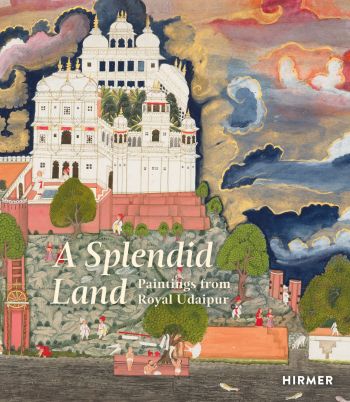 In the 18th century, the artists of Udaipur shifted their focus from small poetic manuscripts to large-scale paintings of the city’s palaces, lakes, mountains, and seasons. They sought to convey the bhava, the emotional tenor and sensorial experiences, that make places and times memorable. This was unlike anything else in Indian art. The paintings express themes of belonging and prosperous futures that are universal. A Splendid Land explores the environmental, political, and emotional contexts in which the new genre emerged. Udaipur’s economy depended on annual monsoons, extensive water harvesting, and securing the loyalty of nobles and allies. By celebrating regional abundance and courtly refinement, the paintings strengthened friendships in the changing political landscapes of early modern South Asia.
“The National Museum of Asian Art has a rich history of connecting visitors with South Asian arts and cultures,” said Chase Robinson, Dame Jillian Sackler Director of the Arthur M. Sackler Gallery and Freer Gallery of Art. “Built upon a long-standing collaboration with Indian colleagues, the exhibition will allow the museum to bring extraordinary but little-known pieces to a global audience, enriching its understanding of a fascinating moment in India’s past.”
The National Museum of Asian Art has more than 1,200 objects in its South Asian collections. Sculpture, paintings, and manuscripts illuminate the subcontinent’s many religious and courtly traditions; photography is at the center of the contemporary Indian holdings. A Splendid Land includes 13 paintings from the National Museum of Asian Art; paintings from Udaipur are a strength of the collection.
The artworks featured in the exhibition reveal how painters developed a new genre centered upon the lived experience of local landscapes, lake systems, and palaces. The atelier became an incubator; over some 200 years, artists found ever-new ways to evoke ambience, trigger memories, and create feelings of connection. This departure in subject matter differs from the body-focused visual traditions of Indian art over two millennia. A Splendid Land is the first exhibition to examine closely this shift and how it expands people’s understanding of emotions and sensorial experience, as well as climate and natural resource management, in early modern India.
A Splendid Land is organized as a journey that begins at Udaipur’s center and continues outward: first the lakes and lake palaces, then to the city, the countryside, and finally to the cosmos. An ambient soundscape by the renowned experimental filmmaker Amit Dutta (b. 1977, Jammu, India) underscores the sensorial elements in the paintings, inviting contemporary audiences to sense—and not just see—the moods of these extraordinary places and paintings. The installation will include 51 works on paper (roughly 3 feet by 4 feet), five monumental works on cotton (ranging in height from 5 feet to 10 feet), one scroll (9 feet in length) from the 17th through 19th centuries, and six photographs from the 19th and 20th centuries.
“The exhibition structure directly responds to the visuality of the paintings and the historical goals of the artists,” said Diamond, who is a specialist in Indian court painting. “Each gallery centers upon the emotions engendered by a particular place or season. The sequence of immersive moods will heighten the sensorial experience of place for museum visitors. I am grateful to the City Palace Museum for their partnership on this exciting project that allows our visitors to get a sense of Udaipur and its cultural heritage, and to co-curator Dipti Khera, whose groundbreaking work on historical emotions is central to the exhibition.”
Debra Diamond has curated numerous exhibitions with the National Museum of Asian Art, including Garden & Cosmos (2008–09), Yoga: The Art of Transformation (2013–14), and Body Image: Arts from the Indian Subcontinent, currently on view in the museum’s Freer Gallery of Art. Dipti Khera, associate professor in New York University’s Department of Art History and Institute of Fine Arts, has published extensively, foregrounding art that challenges colonial perspectives and global histories of the 18th and 19th centuries.
A Splendid Land will be accompanied by a robust program of public events, most notably a public symposium on the monsoon, past and present, and the ways that art reveals cultural attitudes towards natural resources and speaks to climate crises in South Asia that will bring perspectives of the past together with insights of the future. Additionally, the traditional Rajasthani music band Raitila Rajasthan will present Music of Splendid Land, featuring songs inspired from themes of Udaipur paintings showcased at the exhibition.
A Splendid Land: Paintings from Royal Udaipur is organized by the Smithsonian’s National Museum of Asian Art in collaboration with The City Palace Museum, Udaipur administered by The Maharana of Mewar Charitable Foundation.
Debra Diamond and Dipti Khera, eds., A Splendid Land: Paintings from Royal Udaipur (Munich: Hirmer Verlag, 2022), 400 pages, ISBN: 978-3777439440, $60.
Exhibition | Horace Walpole and Philanthropy
Now on view at The Walpole Library, with a rich and engaging online component:
‘Knight Errant of the Distressed’: Horace Walpole and Philanthropy in Eighteenth-Century London
The Lewis Walpole Library, Farmington, CT, 11 May — 22 December 2022
Curated by Andrew Rudd
 ‘Knight Errant of the Distressed’: Horace Walpole and Philanthropy in Eighteenth-Century London uses images, manuscripts, artefacts, and extracts from publications and correspondence to situate Walpole within the burgeoning philanthropic culture of his age. It reveals Walpole’s secret giving to prisoners and other good causes and examine the principles which underlay his philanthropy. A main aim of the exhibition is to stimulate discussion about philanthropy today.
Horace Walpole (1717–1797) lived in an age that prided itself on the extent of its philanthropy. His friend Hannah More described the era as the “age of benevolence.” Yet while Walpole was familiar with many leading philanthropists, he is not known as a supporter of good causes himself; indeed, after his death, he was accused of being uncharitable and even blamed for the suicide of the young poet Thomas Chatterton, who had sought Walpole’s financial assistance in vain.
This exhibition seeks to situate Walpole in the context of eighteenth-century British philanthropy. An array of philanthropic organizations, fundraising initiatives, and ad hoc giving formed part of everyday life in Britain under the reigns of George II and III. The rich were expected to support the poor and needy in order to supplement the overstretched parish-based welfare system. Walpole frequently dispatched anonymous donations to victims of misfortune he read about in his daily newspaper.
Walpole was drawn personally toward outlandish cases, and this exhibition portrays his active involvement in several high-profile campaigns, including the ill-fated encounter with Chatterton. Walpole could be disparaging in his remarks about philanthropy, but visitors are encouraged to weigh his private generosity. Walpole regarded philanthropy as a means to cultivate the curious and eccentric, a discernibly queer philanthropic vision in which he himself played the role of “knight errant of the distressed.”
Andrew Rudd, of the University of Exeter, researches and teaches British literature of the eighteenth century and Romantic period. His monograph, Sympathy and India in British Literature 1770–1830 (Palgrave Macmillan), was published in 2011, and he is currently writing a cultural history of charity in the eighteenth century. He has held numerous fellowships (most recently at Yale’s Lewis Walpole Library and the School of Advanced Studies in English, University of Jadavpur) and speaks regularly at conferences, seminars, and public events. Since 2015, he has been a member of the Arts and Humanities Research Council’s Peer Review College.
In addition to the online exhibition, a 24-page exhibition brochure by Dr. Rudd is available for download.
◊ ◊ ◊ ◊ ◊
Andrew Rudd | Horace Walpole and Philanthropy in Eighteenth-Century England
Lewis Walpole Library, Farmington, Tuesday, 20 September 2022, 7.00pm
In partnership with the Farmington Libraries, Dr. Rudd will explore the rich and exciting world of philanthropy in eighteenth-century England. The talk will focus on the collector and man of letters Horace Walpole (1717–1797), who was a generous, if sometimes eccentric, supporter of the era’s good causes. Walpole’s giving habits illuminate a thriving culture of charitable relief which still finds echoes in philanthropy today.
Registration is available here»
◊ ◊ ◊ ◊ ◊
The Charitable Impulse: Philanthropic Values from the Eighteenth Century to Today
Dwight Hall at Yale, Wednesday, 21 September 2022, 4.00–6.00pm
A conversation jointly organized by The Lewis Walpole Library, Yale University and Dwight Hall at Yale: Center for Public Service and Social Justice
In the eighteenth century, charitable acts and societies in England and the American colonies were motivated by an understanding of moral and ethical obligations of the ‘better off’ to do good works on behalf of the ‘needy’. Philanthropic organizations from this time reveal historical attitudes toward the benefit to the individual and the public of charitable activities. This panel will explore how views on privilege, agency, status, and the responsibilities of members of society to others have evolved over time, and the ways in which certain implicit understandings of why and how people should care for others remain unchanged.
Exhibition | Threads of Power
 Opening this week at BGC:
Threads of Power: Lace from the Textilmuseum St. Gallen
Bard Graduate Center, New York, 16 September 2022 — 1 January 2023
Curated by Emma Cormack, Ilona Kos, and Michele Majer
“I love lace for evening dresses … for a cocktail frock … or for a blouse… . When a fabric is fancy in itself it needs simplicity of design to show it to its best advantage.” —Christian Dior
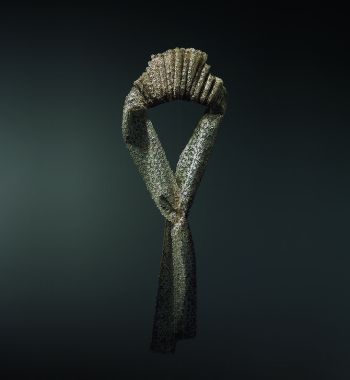
Point de France needle-lace frelange with lappets, Orne, France, ca. 1695, linen (Textilmuseum St. Gallen, acquisition from the John Jacoby Collection, 1954,01246; photo by Michael Rast).
Lace—delicate, sumptuous, enigmatic—takes over the Bard Graduate Center Gallery this fall. Trace the development of European lace from its sixteenth-century origins to the present day. See more than 150 examples of lace from the renowned collection of Switzerland’s Textilmuseum St. Gallen, including some of the world’s finest examples of handmade needle and bobbin lace that were favored by the wealthy and powerful of Bourbon France and Habsburg Spain. Learn about the women who crafted this sought-after status symbol by hand and about the evolution of Swiss chemical lace, known as guipure lace, made on embroidery machines. Explore new innovations in lace production, like laser-cut and 3D-printed lace, used in contemporary haute couture.
Curated by Emma Cormack, associate curator, Bard Graduate Center; Ilona Kos, curator, Textilmuseum St. Gallen; and Michele Majer, assistant professor, Bard Graduate Center. Threads of Power: Lace from the Textilmuseum St. Gallen is organized by Bard Graduate Center and the Textilmuseum St. Gallen. The exhibition will open at Bard Graduate Center Gallery in New York in September 2022 and will be available to tour after closing in January 2023.
◊ ◊ ◊ ◊ ◊
Emma Cormack and Michele Majer, eds., Threads of Power: Lace from the Textilmuseum St. Gallen (New York: Bard Graduate Center, 2022), 432 pages, ISBN: 978-0300263497, $75.
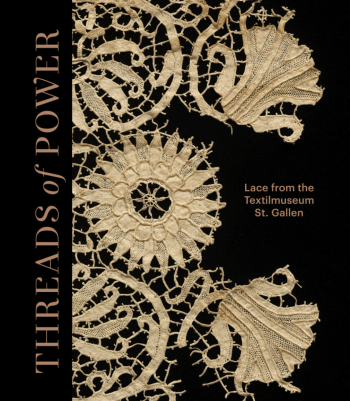 Tracing the history of lace in fashion from its sixteenth-century origins to the present, Threads of Power: Lace from the Textilmuseum St. Gallen offers a look at one of the world’s finest collections of historical lace. The book explores the longstanding connections between lace and status, addressing styles in lace worn at royal courts, including Habsburg Spain and Bourbon France, as well as lace worn by the elite ruling classes and Indigenous peoples in the Spanish Americas. Featuring new research, the publication covers a range of topics related to lace production, lace in fashion and portraiture, lace revivals, the mechanization of the lace industries in the nineteenth and twentieth centuries, and contemporary innovations in lace. With a focus on lace techniques, women lace makers, and lace as a signifier of wealth and power, this richly illustrated book includes wide-ranging contributions by curators and experts from major museums and academic institutions.
C O N T E N T S
Director’s Foreword, Susan Weber
Editor’s Note
Introduction, Emma Cormack and Michele Majer
The Emergence of Lace in Early Modern Europe
1 Barbara Karl — Lace and Status: Luxury, Power, and Control in Early Modernity
2 Femke Speelberg — Putting a Name to Lace: Fashion, Fame, and the Production of Printed Textile Pattern Books
3 Paula Hohti Erichsen — ‘Monstrous’ Ruffs and Elegant Trimmings: Lace and Lacemaking in Early Modern Italy
4 Frieda Sorber — Antwerp, A Center of Lace Making and Lace Dealing, 1550–1750
Lace in Spain and the Americas, 1500–1800
5 Amalia Descalzo Lorenzo — The Triumph of Lace: Spanish Portraiture of the Sixteenth and Seventeenth Centuries
6 Mariselle Méléndez — ‘A desire of being distinguished by an elegant dress is universal’: Clothing, Status and Convenience in Eighteenth-Century Spanish America
7 James Middleton — A Prodigious Excess: Lace in New Spain and Peru, ca. 1600–1800
8 Laura Beltrán-Rubio — ‘Covered in much fine lace’: Dress in the Viceroyalty of New Granada
The Dominance of France, 1660–1790
9 Denis Bruna — Lace and Economy under Louis XIV
10 Lesley Miller — Lace à la Mode, ca. 1690–1790
Mechanization and Revivalism: The Nineteenth Century Lace Industries
11 Emma Cormack and Michele Majer — Fashion and the Lace Industries in France, Belgium, and England, 1800–1900
12 Annabel Bonnin Talbot — Ahead of the Curve: A. Blackbourne & Co. and the Late-Nineteenth Century British Lace Industry
13 Emily Zilber — Italy to New York: Making Historic Textiles Modern at the Scoula d’Industrie Italiane
14 Anne Wanner-JeanRichard and Ilona Kos — Imitation and Inspiration: The Leopold Iklé Collection in St. Gallen
Innovations in Lace, 1900 to Today
15 Catherine Örmen — Fashion and Lace since 1900
16 Annina Dosch, Interview with Tobias Forster, Hans Schreiber, and Martin Leuthold — Lace in St. Gallen Today: Tradition and Innovation at Forster Rohner and Jakob Schlaepfer
Illustrated Checklist of the Exhibition
Glossary, compiled by Kenna Libes
Bibliography
Contributors
Index
The Burlington Magazine, August 2022
The August issue of The Burlington is rich for the eighteenth century, including Karin Wolfe’s obituary for Christopher Johns (details for his memorial service, on 17 September, are emerging here).
The Burlington Magazine 164 (August 2022)
 A R T I C L E S
• Gauvin Alexander Bailey, “A Borromini-Inspired Church Plan in Eighteenth-Century Lima,” pp. 740–51.
Built in 1758–66, the Church of Los Huérfanos, Lima, is unique in Spanish South America for its oval plan. Its designer is her identified as a master builder, Cristóbal de Vergas, who was inspired by prints of Francesco Borromini’s S. Carlo alle Quattro Fontane, Rome, exemplifying the revival of interest during the Rococo perios in Roman Baroque precedents.
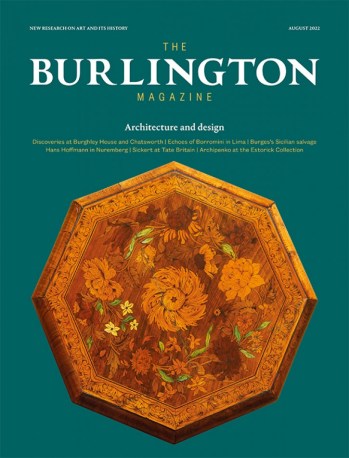
• Adam Bowett, “The Floral Marquetry Floor at Burghley House,” pp. 752–59.
The possibility that five pieces of eighteenth-century furniture at Burghley House, Stamford, incorporate maquetry made for a floor in the house c.1685 is here confirmed by references in inventories. The marquetry can be linked to furniture in the Royal Collection, raising the possibility that the floor was mdade by Gerrit Jensen incorporating marquetry supplied by Jasper Braems.
• François Marandet, “A Modello by Louis Laguerre and the Programme of the Painted Hall at Chatsworth,” pp. 760–67.
With the help of a recently discovered modello, the subject of Louis Laguerre’s monumental painting on the east wall of the Painted Hall, Chatsworth, is here identified as Augustus Ordering the Closing of the Doors of the Temple of Janus. This allows the political allegory of the room’s decoration, completed in 1694, to be fully understood for the first time.
R E V I E W S
• Neil Jeffares, “Pastels in the Pandemic,” pp. 780–87.
The notoriously fragile medium of pastel has not been out of the public eye during the difficult circumstances of the past two years. Exhibition in San Francisco and Munich and a biography of Rosalba Carriera invite comparisons between the major pastellists of the eighteenth century: Joseph Vivien, Maurice-Quentin de La Tour, and Jean-Étienne Liotard, as well as Carriera.
• Reinier Baarsen, Review of Calin Demetrescu, Les ébénistes de la Couronne sous le règne de Louis XIV (La Bibliothèque des Arts, 2021), pp. 818–19.
• Daniel Fulco, Review of Andreas Schumacher, ed., Venezianische Malerei: Staatsgalerie in der Residenz Würzburg (Schnell & Steiner, 2021), pp. 819–21.
• Howard Coutts, Review of Patricia Ferguson, ed., Pots, Prints, and Politics: Ceramics with an Agenda, from the 14th to the 20th Century (British Museum Press, 2021), pp. 821–22.
• Sophie Rhodes, Review of Tessa Murdoch, Europe Divided: Huguenot Refugee Art and Culture (V&A Museum, 2021), pp. 827–28.
• Patrick Bade, Review of Charles Dellheim, Belonging and Betrayal: How Jews Made the Art World Modern (Brandeis University Press, 2021), p. 828.
O B I T U A R I E S
• Karin Wolfe, Obituary for Christopher M.S. Johns (1955–2022), pp. 829–31.
Professor of History of Art at Vanderbilt University, Nashville, since 2003, Christopher M.S. Johns published widely on Italian art of the seventeenth and eighteenth centuries. His determination to demonstrate the falsity of the belief that the settecento was a period of cultural decline had a substantial influence on both scholarship and academic curricula.
Exhibition | Dare to Know

Alexandre-Evariste Fragonard, A Centurion Begging for Protection from Marc Antony during a Seditious Revolt, ca. 1800, black ink and black and gray wash, probably over graphite, framing lines in black ink, on off-white antique laid paper (laid down), 20 × 48 cm (Harvard Art Museums, 2018.210).
◊ ◊ ◊ ◊ ◊
Opening this week at Harvard:
Dare to Know: Prints and Drawings in the Age of Enlightenment
Harvard Art Museums, Cambridge, MA, 16 September 2022 — 15 January 2023
Curated by Elizabeth Rudy and Kristel Smentek
See how the graphic arts inspired, shaped, and gave immediacy to new ideas in the Enlightenment era, encouraging individuals to follow their own reason when seeking to know more.
 What role did drawings and prints play during the Enlightenment era, from roughly 1720 to 1800? Dare to Know explores many nuances of this complex time—when political and cultural revolutions swept across Europe and the Americas, spurring profound shifts in science, philosophy, the arts, social and cultural encounters, and our shared sense of history. Indeed, the Enlightenment itself has been described as a “revolution of the mind.” Novel concepts in every realm of intellectual inquiry were communicated not only through text and speech, but in prints and drawings that gave these ideas a visual, concrete form. They made new things visible—and familiar things visible in powerful new ways. They wielded the potential to visually articulate, reinforce, or contradict beliefs as well as biases, while also arguing for social action and imagining new realities.
In 1784, in response to a journal article asking “What Is Enlightenment?,” German philosopher Immanuel Kant argued that the Enlightenment’s main impulse was to “dare to know!”: to pursue knowledge for oneself, without relying on others to interpret facts and experiences. But is this ever truly possible?
Bringing together 150 prints, drawings, books, and other related objects from Harvard as well as collections in the United States and abroad, this exhibition offers provocative insights into both the achievements and the failures of a period whose complicated legacies reverberate still today. Dare to Know asks new and sometimes uncomfortable questions of the so-called age of reason, inviting visitors to embrace the Enlightenment’s same spirit of inquiry—to investigate, to persuade, and to imagine.
Curated by Elizabeth M. Rudy, Carl A. Weyerhaeuser Curator of Prints, Harvard Art Museums, and Kristel Smentek, Associate Professor of Art History, Massachusetts Institute of Technology. With special thanks to Heather Linton, Curatorial Assistant for Special Exhibitions and Publications, Division of European and American Art, and Christina Taylor, Associate Paper Conservator, Straus Center for Conservation and Technical Studies. Research contributions by Austėja Mackelaitė, Stanley H. Durwood Foundation Curatorial Fellow (2016–18), and by PhD candidates in Harvard’s Department of History of Art and Architecture and former graduate interns in the Division of European and American Art: J. Cabelle Ahn, Thea Goldring, and Sarah Lund.
This project is supported in part by an award from the National Endowment for the Arts. Support for the exhibition is provided by the Melvin R. Seiden and Janine Luke Fund for Publications and Exhibitions, the Robert M. Light Print Department Fund, the Stanley H. Durwood Foundation Support Fund, the Catalogues and Exhibitions Fund for Pre-Twentieth-Century Art of the Fogg Museum, and the Gladys Krieble Delmas Foundation. The accompanying catalogue was made possible by the Andrew W. Mellon Publication Funds, including the Henry P. McIlhenny Fund. Related programming is supported by the M. Victor Leventritt Lecture Series Endowment Fund.
The catalogue is distributed by Yale UP:
Edouard Kopp, Elizabeth Rudy, and Kristel Smentek, eds., Dare to Know: Prints and Drawings in the Age of Enlightenment (Cambridge: Harvard Art Museums, 2022), 334 pages, ISBN: 978-0300266726, $50.
Are volcanoes punishment from God? What do a fly and a mulberry have in common? What utopias await in unexplored corners of the earth and beyond? During the Enlightenment, questions like these were brought to life through an astonishing array of prints and drawings, helping shape public opinion and stir political change. Dare to Know overturns common assumptions about the age, using the era’s proliferation of works on paper to tell a more nuanced story. Echoing the structure and sweep of Diderot’s Encyclopédie, the book contains 26 thematic essays, organized A to Z, providing an unprecedented perspective on more than 50 artists, including Henry Fuseli, Jean-Honoré Fragonard, Francisco Goya, Jean-Baptiste Greuze, William Hogarth, Giovanni Battista Piranesi, and Giambattista Tiepolo. With a multidisciplinary approach, the book probes developments in the natural sciences, technology, economics, and more—all through the lens of the graphic arts.
Edouard Kopp is the John R. Eckel, Jr., Foundation Chief Curator at the Menil Drawing Institute in Houston; Elizabeth M. Rudy is the Carl A. Weyerhaeuser Curator of Prints at the Harvard Art Museums, Cambridge, MA; and Kristel Smentek is associate professor of art history in the Department of Architecture at the Massachusetts Institute of Technology, Cambridge, MA.
With contributions by J. Cabelle Ahn, Elizabeth Saari Browne, Rachel Burke, Alvin L. Clark, Jr., Anne Driesse, Paul Friedland, Thea Goldring, Margaret Morgan Grasselli, Ashley Hannebrink, Joachim Homann, Kéla Jackson, Penley Knipe, Edouard Kopp, Ewa Lajer-Burcharth, Heather Linton, Austėja Mackelaitė, Tamar Mayer, Elizabeth Mitchell, Elizabeth M. Rudy, Brandon O. Scott, Kristel Smentek, Phoebe Springstubb, Gabriella Szalay, and Christina Taylor.
R E L A T E D E V E N T S
Dare to Know: An Introduction
15 September 2022, 5.30pm
Join us for a series of brief presentations and a discussion about the special exhibition Dare to Know: Prints and Drawings in the Age of Enlightenment, with curators Elizabeth Rudy and Kristel Smentek, along with several contributors to the exhibition catalogue.
Exhibition Tours by Elizabeth Rudy
18 September, 2 and 23 October, 11 December, and 15 January, noon
Join exhibition co-curator Elizabeth Rudy for a tour of the exhibition. She will share insights about how works on paper played a critical role in the 18th century, wielding the power to visually articulate, reinforce, or contradict beliefs as well as biases.
Gallery Talk by Morgan Grasselli
22 September 2022, 12.30pm
Join Margaret Morgan Grasselli for a discussion about the 18th-century invention of the multicolor, multiplate printing technique that laid the foundation for today’s CMYK process.
Gallery Talk by Sam Nehila
30 September 30, 2022, 12.30pm
Join Sam Nehila, curatorial assistant in the Division of European and American Art, for a discussion of William Hogarth’s print series The Four Stages of Cruelty.
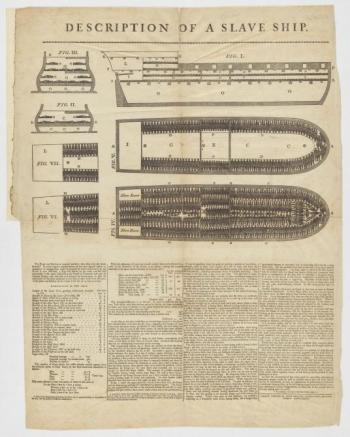
Printed by James Phillips, Description of a Slave Ship, 1789, engraving (Harvard University, Houghton Library, Gift of O. Peck, 1845, p EB75 A100, TL42422.5).
Gallery Talk by John Overholt
25 October 2022, 12.30pm
Join Houghton Library curator John Overholt for a discussion of one of the most important and consequential prints of the 18th century, Description of a Slave Ship.
Gallery Talk by Joachim Homann
27 October 2022, 12.30pm
Join curator Joachim Homann for a discussion about a rare, intact example of French inventor Louis Carrogis de Carmontelle’s multi-sheet drawings on translucent paper. The work was originally attached to rollers, lit from behind with candles, and unfurled for a captive audience.
Gallery Talk by Horace Ballard
3 November 2022, 12.30pm
Join curator Horace Ballard for an exploration of the observation and documentation of astronomical events in the 18th century as exemplified in a drawing by British artist Paul Sandby.
Gallery Talk by Ben Sibson
5 November 2022, 12.30pm
Join Ben Sibson, PhD candidate in Harvard’s Department of Human Evolutionary Biology, for a discussion about the depiction of the human body in selected works on view in the exhibition.
Gallery Talk by Paris A. Spies-Gans
6 November 2022, 12.30pm
Join art historian Paris A. Spies-Gans, of the Harvard Society of Fellows, for a discussion about works of art made by women in the exhibition. Spies-Gans will examine objects by a range of artists, with particular attention given to Marguerite Gérard and Marie-Gabrielle Capet.
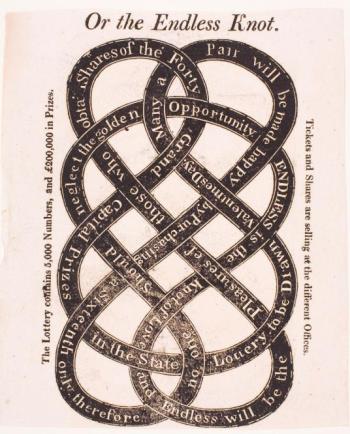
Unidentified artist, American, Lottery Ticket: The Endless Knot, ca. 1785–95, woodcut (Harvard Art Museums/Fogg Museum, Gift of Walter S. Poor, Class of 1905, M20297).
Gallery Talk by Casey Monahan
8 November 2022, 12.30pm
Join curatorial assistant Casey Monahan for a discussion of a dynamic display of ball invitations, advertisements, trade cards, and currency notes in the exhibition. Monahan will share insights about the acquisition of these small prints and the story behind their creative installation.
Gallery Talk by Joachim Homann
10 November 2022, 12.30pm
Join curator Joachim Homann for a discussion of Jean-Honoré Fragonard’s drawing The Girls’ Dormitory.
Gallery Talk by Sarah Mallory
20 November 2022, 12.30pm
Join Sarah Mallory, PhD candidate in Harvard’s Department of History of Art and Architecture, for a discussion of the emergence of the modern notion of ecology in the 18th century as articulated in selected works in the exhibition.
Gallery Talk by Yi Bin Liang
6 December 2022, 12.30pm
Join conservation technician Yi Bin Liang for an exploration of 18th-century methods and techniques of book binding in a close examination of works on view.










 Enfilade
leave a comment