Exhibition | Louis Gauffier’s Journey to Italy
Now on view at the Musée Fabre:
Le Voyage en Italie de Louis Gauffier (1762–1801)
Musée Fabre, Montpellier, 7 May — 4 September 2022
Musée Sainte-Croix de Poitiers, 14 October 2022 — 12 February 2023
Curated by Pierre Stepanoff
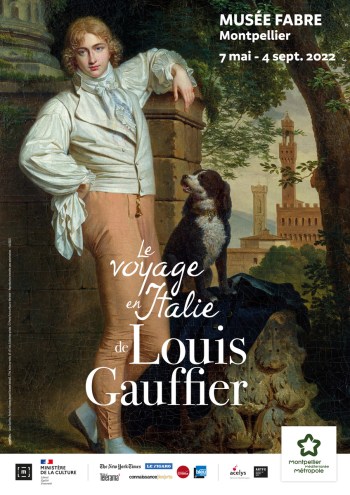 Cette exposition d’été au musée Fabre, organisée en collaboration avec le musée Sainte-Croix de Poitiers—où elle sera présentée du 14 octobre 2022 au 12 février 2023—est la première consacrée à la carrière de Louis Gauffier, peintre de la fin de XVIII e siècle.
Né à Poitiers en 1762, Louis Gauffier est de ces artistes européens pour qui l’Italie fut une terre d’élection. Vainqueur du Prix de Rome en 1784, il découvre la Ville Éternelle et ses vestiges, puis Florence et la Toscane à partir de 1793, jusqu’à son décès précoce en 1801.
Le peintre déploie son art aussi bien dans les sujets mythologiques que bibliques, les portraits et le paysage. À l’orée du XIX e siècle, il propose des formules nouvelles d’une grande originalité, intimes et poétiques, qui le distinguent de ses contemporains. Le charme singulier de ses toiles explique la riche représentation du peintre dans les musées français et internationaux, qui soutiennent par leur prêts l’exposition du musée Fabre : musée des Offices à Florence, Kenwood House à Londres, National Gallery of Scotland à Edimbourg, Nationalmuseum à Stockholm, Philadelphia Museum of Art, Minneapolis Art Institute, Fine Art Museums à San Francisco, National Gallery of Victoria à Melbourne.
C’est en Italie, à Rome puis à Florence, que Louis Gauffier et François-Xavier Fabre devinrent camarade et amis. Le soin avec lequel Fabre recueilli des œuvres de son ami après son décès précoce explique aujourd’hui la très belle représentation de Gauffier au musée de Montpellier, dont l’exposition permettra de découvrir la richesse de sa carrière.
L’exposition montre à travers des sections chronologiques et thématiques l’évolution de la carrière de Gauffier, aussi bien dans le langage néoclassique qu’il développe dans ses peintures d’histoire, marquées par une grande curiosité archéologique comme par un sentimentalisme doux, ou encore dans son goût novateur pour le paysage, mettant en scène l’aristocratie européenne du Grand Tour partant à la découverte de la Toscane.
Cette rétrospective mettra également l’artiste en perspective avec ses contemporains, qu’il s’agisse de ses camarades français, Drouais, Gagneraux et surtout Fabre, mais également avec le contexte artistique italien profondément marqué par des peintres issus de toute l’Europe et dans lequel s’inscrit Gauffier, notamment dans ses portraits et ses paysages. C’est à une véritable découverte de l’Italie du Grand Tour que le visiteur sera convié.
Pierre Stepanoff,, ed., Le voyage en Italie de Louis Gauffier (Ghent: Éditions Snoeck, 2022), 408 pages, ISBN: 978-9461615831, €39.
Exhibition | Renoir: Rococo Revival
I’m sorry to have missed notice of this exhibition earlier. There is an excellent ‘digitorial‘ component, and the catalogue is still available. –CH
Renoir: Rococo Revival
Städel Museum, Frankfurt am Main, 2 March — 19 June 2022
Curated by Alexander Eiling, Juliane Betz, and Fabienne Ruppen
Pierre-Auguste Renoir (1841–1919) was one of the outstanding painters of French Impressionism—and far more than that. For the first time the Städel Museum addressed the surprising references in his art to Rococo painting in a large-scale special exhibition. Whereas Rococo painting was considered frivolous and immoral after the French Revolution, it underwent a revival in the nineteenth century and was widely visible in Renoir’s lifetime.
Having trained as a porcelain painter, Renoir was intimately acquainted with the imagery of artists such as Antoine Watteau, Baptiste Siméon Chardin, François Boucher, and Jean-Honoré Fragonard. He shared the Rococo’s predilection for certain subjects, among them promenaders in the park and on the riverbank, moments of repose in the outdoors, and the garden party. Renoir also frequently devoted himself to the depiction of domestic scenes and family life as well as intimate moments such as bathing, reading, or making music. Yet he not only took orientation from the motifs of the Rococo, but also particularly admired its loose and sketchy manner of painting as well as its brilliant palette, aspects that would have a formative influence on him and many other artists in the Impressionist circle.
Trenchant juxtapositions of Renoir’s art with works of the eighteenth century as well as his own contemporaries—Edgar Degas, Édouard Manet, Claude Monet, and Berthe Morisot—provided an overview of Impressionism’s intense artistic examination of the Rococo. The exhibition showed a total of some 120 outstanding paintings, works on paper and handcrafted objects from international museums such as the National Gallery in Washington, D.C., the Musée d’Orsay in Paris, the National Gallery in London, the Metropolitan Museum of Art in New York, the J. Paul Getty Museum in Los Angeles, as well as private collections.
Curators
Dr. Alexander Eiling (Head of Modern Art, Städel Museum), Dr. Juliane Betz (Deputy Head of Modern Art, Städel Museum), Dr. Fabienne Ruppen (Research Assistant, Modern Art, Städel Museum)
Alexander Eiling with Juliane Betz and Fabienne Ruppen, eds, Renoir: Rococo Revival (Stuttgart: Hatje Cantz, 2022), 328 pages, ISBN 978-3775751346 (English edition), ISBN 978-3775751339 (German edition), €50. Text by Michela Bassu, Juliane Betz, Alexander Eiling, Guillaume Faroult, Marine Kisiel, Matthias Krüger, Mary Morton, Astrid Reuter, and Fabienne Ruppen.
Exhibition | Fantastically French! Design and Architecture in Prints
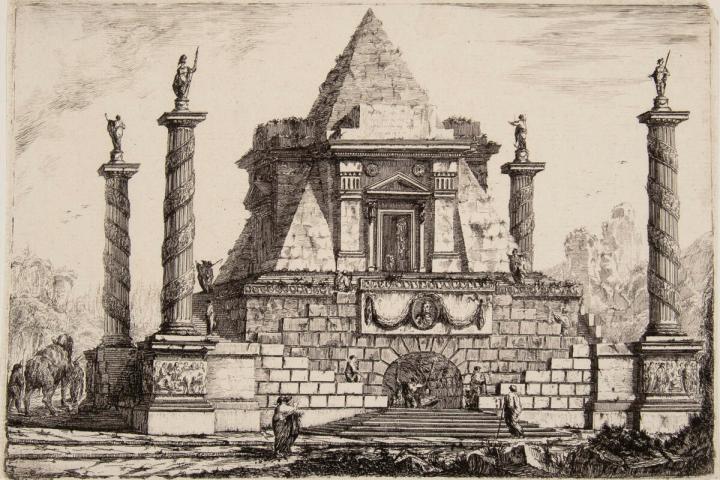
Pierre Moreau, Mausoleum, 1730, etching, approximately 5 × 8 inches
(Blanton Museum of Art, The University of Texas at Austin)
◊ ◊ ◊ ◊ ◊
Now on view at the Blanton Museum of Art:
Fantastically French! Design and Architecture in 16th- to 18th-Century Prints
Blanton Museum of Art, The University of Texas at Austin, 5 March — 14 August 2022
From arabesques to grotesques and from sphinxes to snails, French printmakers combined ancient decorative motifs with newly invented ones to create designs for everything from jewelry to architectural façades. Beginning in the mid-sixteenth century with ornamentation for the royal hunting lodge of Fontainebleau, through garden designs at the palace of Versailles, to patterns for eighteenth-century home furnishings, prints were important sites of invention and served as vehicles for the proliferation of decorative motifs across a variety of media. Drawing primarily from the Blanton’s extensive holdings of French prints, this exhibition invites visitors to look closely at exquisite details, marvel at fantastic forms, and take delight in ornate embellishments that celebrate the creativity of artistic imagination across three centuries.
Exhibition | Japan—Arts and Life: The Montgomery Collection
Japan—Arts and Life: The Montgomery Collection
Museo delle Culture, Lugano, 10 February 2022 — 8 January 2023
 Japan—Arts and Life, a major exhibition dedicated to the Jeffrey Montgomery Collection, is now on view at the Museo delle Culture in Lugano. At home in Lugano for over fifty years, it is one of the largest and best-known collections of Japanese art outside Japan. With this project, MUSEC celebrates a passion for collecting and a heritage of great artistic and cultural value—a heritage that brings prestige to Lugano, consolidating the Ticino city’s historic ties with Swiss and international private art collecting.
Installed throughout two floors of the Villa Malpensata, home of MUSEC, the exhibition presents 170 works dating from the 12th to the 20th centuries—including textiles, furniture, paintings, religious and everyday-objects—each carefully selected from the over one thousand objects collected over a lifetime by Jeffrey Montgomery.
Known worldwide, the Montgomery Collection displays an extraordinary richness and a singular substance. The experience and sensitivity of the collector are at the heart of the project developed by MUSEC and mark its originality, compared to the way in which the collection has been interpreted until now. As Francesco Paolo Campione, director of MUSEC, writes in his introduction to the exhibition catalogue, “art collections can only have meaning and deep value if they are linked to an existential dimension and the human experience of those who wanted, planned, and consolidated them around themselves. The collector is indispensable to the collection: not only because he created it, but also because he guarantees its originality, interpreting the spirit of the times.”
Paolo Campione teaches Cultural Anthropology at the University of Insubria and is the Director of MUSEC. Moira Luraschi, anthropologist, is curator of the Japanese collections and the photographic collection of the Yokohama School at MUSEC.
Francesco Paolo Campione and Moira Luraschi, eds., Japan—Arts and Life: The Montgomery Collection (Milan: Skira, 2022), 288 pages, ISBN: 978-8857247724, $54.
Essays
• Francesco Paolo Campione — An Impermanent Journey between Art and Life
• Matthi Forrer — Collecting Japanese Art Objects
• Rossella Menegazzo — The Other Side of Japan: The Jeffrey Montgomery Collection between Art, Crafts, and Folklore
• Giorgio Amitran — Japan, the Beautiful, and Ourselves
• Imogen Heitmann — The Museographical Display as a Creative ‘Meta-work’
Catalogue Entries
• Paintings
• Woven Objects
• Hooks and Counterweights
• Ceramics
• Fabrics
• Lanterns
• Masks
• Furniture
• Signs
• Kettles and Pourers
• Sculptures
• Lacquers
Bibliography
Author Biographies
Online | Hogarth’s Topographies: ‘The Five-Day Peregrination’
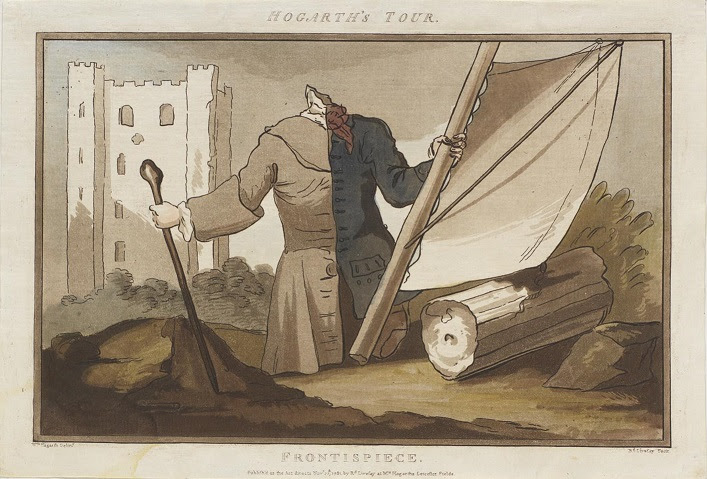
Hogarth’s Tour / Frontispiece, An Account of What Seemed Most Remarkable in the Five Days Peregrination, 27 November 1781, etching and aquatint in sepia ink with hand coloring on laid paper; sheet 23.6 × 34.5 cm (Lewis Walpole Library H67).
◊ ◊ ◊ ◊ ◊
From The Lewis Walpole Library, Yale Library:
Jacqueline Riding and Caroline Patey | ‘The Five-Day Peregrination’: A Dizzy Journey through the Topographical History of Kent
William Hogarth’s Topographies: A Series of Conversations
Online, The Lewis Walpole Library, Wednesday, 20 July 2022, noon (EDT)
Topography is central to William Hogarth’s canonical progress series in which London settings play a decisive narrative role. Lesser-known works by the artist, however, also engage with topographical representation. Pierre Von-Ow’s online exhibition William Hogarth’s Topographies considers the artist’s illustrations of national and colonized geographies beyond the metropole. The county of Kent is the site of a tour undertaken in May 1732 by Hogarth and a group of friends who collectively memorialized the adventure as The Five-Day Peregrination. The exhibition presents the peregrination as both a jesting imitation of the Grand Tour of the landscapes and monuments of Europe and as a satire of the British antiquarians who, since at least the sixteenth century, had minutely inventoried the country’s history and antiquities as a means of reclaiming a glorious past.
Jacqueline Riding and Caroline Patey will discuss the textual and visual representations recorded by Hogarth and his fellow travelers of their tour of Kent, first in manuscript (now in the British Museum) and later published as An Account of What Seemed Most Remarkable in the Five Days Peregrination (1782, etc.). The event seeks to explore the connections between this little-known project and the broader literature of actual and invented travels, as well as the history of Kent and its ties to the global expansion of the British Empire. Dr. Riding has structured her recent biography Hogarth: Life in Progress (2021) with eight interludes that address different aspects of The Peregrination. Dr. Patey is currently working on a translation of The Peregrination into Italian. Riding and Patey will share their thoughts about why the tour of Hogarth and his friends continues to demand attention bringing to this program insights from their recent and current work.
This program is organized by The Lewis Walpole Library, Yale University, in conjunction with the online exhibition William Hogarth’s Topographies curated by Pierre Von-Ow, PhD candidate in Yale’s Department of The History of Art.
This is an online event, and registration is required. Register here»
Professor Caroline Patey has studied English and Comparative literature in Paris (Paris III), Dublin UCD, and the Università degli Studi, Milan, where she was Chair and Professor of English Literature until 2018. Her interests and fields of research include Renaissance literature, late Victorian culture and Modernism with a special focus on intermediality, the intersection between art, museums and literature, and the cross-border circulation of cultures and aesthetic forms. She has edited and co-edited the outcome of various collective explorations of these topics and has published numerous book-length studies on subjects as diverse as Proust and Joyce (1991), Mannerism (1996), Shakespeare and history (1998), and Henry James (2004). Together with Cynthia Roman (Yale) and Georges Letissier (Nantes), she has recently co-edited the two volumes of Enduring Presence: William Hogarth’s Afterlives in British and European Culture (2021). Since her retirement in late 2018, Caroline has taught specialist seminars in Italy and Germany (Bard College, Berlin, 2020). She co-directs a collection of critical essays on British and Anglophone literature, Prismi, Classici nel tempo, Mimesis, Milano, and sits on the board of the journal of comparative literature, Letteratura e Letterature.
Dr Jacqueline Riding specializes in British history and art of the long eighteenth century. She is the author of Jacobites: A New History of the ’45 Rebellion (2016), Peterloo: The Story of the Manchester Massacre (2018), and Hogarth: Life in Progress (2021), which has been awarded the Sunday Times Art Book of the Year 2021 and a Times and Sunday Times Paperback of 2022. Former curator of the Palace of Westminster and director of the Handel House Museum, London, she is a historical adviser on feature films including Mike Leigh’s Mr. Turner (2014) and Peterloo (2018), a consultant for museums and historic buildings including Tate Britain and Historic Royal Palaces, and Books Editor for The Art Newspaper. Jacqueline is a fellow of the Royal Historical Society, the Society of Antiquaries of Scotland, the Paul Mellon Centre for Studies in British Art, the Department of the History of Art, University of York, and trustee of the Jacobite Studies Trust and [JMW] Turner’s House, London.
Exhibition | The Revolutionary Landscape
From the Museum of the French Revolution:
The Revolutionary Landscape / Le paysage révolutionnaire
Musée de la Révolution française, Vizille, 1 July — 3 October 2022
Curated by Alain Chevalier
 The landscape genre experienced incredible success and significant development during the 1790s. Under the cross influences of several factors, whether philosophical (Rousseau), literary (Bernardin de Saint-Pierre) or artistic (Dutch painting of the 17th century century), this enthusiasm is manifested in the annual Salons as well as in the art trade and allows artists greater freedom, far from the political concerns that they nevertheless sometimes integrate in an allusive way. Deviating from the pleasant and pleasant landscapes of the reign of Louis XV, the revolutionary landscape by its descriptive realism anticipates the future of the genre in the 19th century century and satisfies a very large clientele wishing to rediscover Nature in their interiors. From the picturesque to the invitation to a distant journey, the landscape then plays on a wide range of emotions that the exhibition reveals.
The press kit (in French) is available here»
Exhibition | Grand Tour: The Two Horaces and the Court of Florence

Thomas Patch, A Caricature Group in Florence, ca. 1765–66, oil on canvas, 84 × 119 cm
(Exeter: Royal Albert Memorial Museum)
◊ ◊ ◊ ◊ ◊
From the press release (via London Art Week) for the exhibition:
The Grand Tour: The Two Horaces and the Court of Florence
Strawberry Hill House & Garden, Twickenham, 27 March — 24 July 2022
Curated by Silvia Davoli
The third In Focus display at Strawberry Hill House was inspired by a survey of the architecture of Florence, richly illustrated by the renowned Italian architect Ferdinando Ruggeri in 1722, which has now returned to the house 300 years after its publication.
The display is dedicated to the Italian Grand Tour, in particular the friendship between Strawberry Hill creator Horace Walpole (1717–1797) and the British Envoy to Florence, Horace Mann (1706–1786). Both men were infatuated with Florence and the Medici family. “I can truly say that I never was happy but at Florence,” wrote Horace Walpole in his correspondence (vol.19, p.486).
Strawberry Hill contained a conspicuous number of Florentine works of art received as gifts or acquired thanks to the intervention of Horace Mann—Walpole’s library included biographies, festival books, catalogues of the Medici’s collections, and books dedicated to Florence. Walpole even contemplated writing a history of the Medici Family, starting to prepare for it in 1759, but eventually dropped the project due to a lack of archival material.
The exhibition is inspired by three volumes of Studio d’architettura civile sopra gli ornamenti di porte, e finestre .. tratte da alcune fabbriche insigni di Firenze, which had been illustrated by the renowned Italian architect Ferdinando Ruggieri (1691–1741) and produced exactly 300 years ago in 1722. The volumes, which represent a rare survey of Florentine architecture, are illustrated with exquisite plates showing the works by the leading Mannerist architects active in Florence between the end of the 16th and the beginning of the 17th century, including Ammanati, Buontalenti, Dosio, Vasari, Michelangelo, and Cigoli.
Originally part of Walpole’s Library, they were dispersed at auction in 1842 along with the rest of the collection. It is thanks to the Acceptance in Lieu Scheme, administered by the Arts Council, that these three volumes have finally returned home. The purpose of the show is to place Ruggeri’s volumes at the centre of a dense network of relationships and works of art that resonate with Walpole’s infatuation with Florence and the Medici.
Mann, who arrived in Florence in 1737, was a leading figure at the Court of Florence, not only from a diplomatic point of view but also for his indefatigable promotion of the arts. Highly esteemed by the Florentine intelligentsia, he became a point of reference for all the British Grand tourists. Some of the most iconic objects in the Walpole collection were received thanks to Mann’s mediation, from the portrait of Bianca Capello—the unfortunate wife of Francesco I de Medici—to the famous marble Roman Eagle, one of Walpole’s most treasured trophies.
After Walpole’s departure, the two men were never to meet again. However, their correspondence, which covers over 40 years, constitute a lively and invaluable source of information about the cultural and artistic life of Florence at that time, while simultaneously illustrating in detail the artistic relations, antiquarian interests, and dissonances in taste of the two friends.
“Their letters not only provide us with invaluable information about contemporary collecting, the Italian art market and British taste, but also about political matters and diplomatic conundrums,” notes Dr Silvia Davoli, Strawberry Hill’s Curator.
The three volumes will be displayed together with a series of important paintings and objects coming both from public and private collections that tell us more about the passion of the two Horaces for Florence and their antiquarian pursuits. These include some of Thomas Patch’s most distinctive paintings and engravings; various extraordinary portraits such as Walpole as a young grand tourist by Venetian painter Rosalba Carriera (Lord Cholmondeley’s Collection) and Horace Mann by Anton Van Maron (private collection); a splendid trompe-l’oeil or inganno by Caterina della Santa with a dedication to Cavaliere Orazio Mann; along with the typical grand tourist paraphernalia including antique gems, ancient coins, drawings, and engravings.
Strawberry Hill House & Garden has been open to visitors for over 250 years. Created by renowned writer Horace Walpole (1717–1797), Strawberry Hill is internationally famous as Britain’s finest example of domestic Georgian Gothic revival architecture. Walpole was a pivotal figure in 18th-century society, literature, art and architecture. The third son of Sir Robert Walpole, Britain’s first Prime Minister, Horace Walpole was a man of many talents with a large network of influential friends. From 1739 to 1741, Walpole embarked on a Grand Tour and European influences can be seen in the design of Strawberry Hill House and the works that formed its vast collection of treasures. He was author of the world’s first Gothic novel, The Castle of Otranto.
Conference | Portrait Miniatures
From the Tansey Miniatures Foundation and the conference programme:
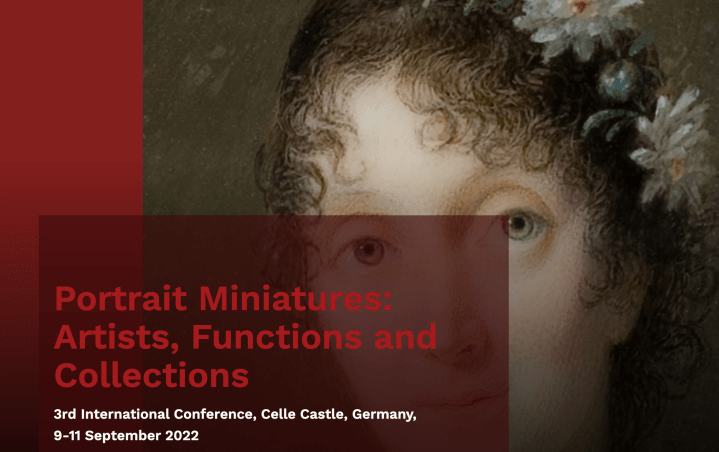
Portrait Miniatures: Artists, Functions, and Collections
Celle Castle, Tansey Miniatures Foundation, Celle Castle (near Hanover), 9–11 September 2022
This conference will take place in conjunction with the seventh exhibition of the Tansey Miniatures Foundation and the publication of the accompanying catalogue Miniatures from the Time of Napoleon in the Tansey Collection. 23 speakers from 11 different countries will address a range of topics related to portrait miniatures:
• Individual miniaturists, specific workshop contexts, and places of production
• Use and functions of both court and private types and their protagonists
• Iconographic aspects in the context of representation or intimacy
• Evolution of techniques and materials
• Private and public collections
The conference will be in English. The presentations will subsequently be published in a richly illustrated book. Admission is free. Both conference venues are within walking distance (20 minutes) from the railway station. Trains from Hannover take approximately 25 to 45 minutes (Deutsche Bahn, Metronom, and S-Bahn). For registration, please contact Juliane Schmieglitz-Otten, The Tansey Miniatures Foundation, juliane.schmieglitz-otten@tansey-miniatures.com. For more information, please contact Bernd Pappe, The Tansey Miniatures Foundation, bernd.pappe@tansey-miniatures.com.
F R I D A Y , 9 S E P T E M B E R 2 0 2 2
16.00 Registration
18.00 Welcome and Opening Lectures
• Juliane Schmieglitz-Otten, Realism and Modernism in the Likenesses of a New Epoch: Highlights of the Exhibition Miniatures from the Time of Napoleon
• Bernd Pappe, Making a Small Man Great: Miniatures of Napoleon I
• Birgitt Schmedding, Two Views: The Power of Seeing
S A T U R D A Y , 1 0 S E P T E M B E R 2 0 2 2
9.00 Objects, Agencies, and Social Practices
• Gerrit Walczak (Berlin), Icons of Intimacy: Sex, Agency, and the Portrait Miniature
• André and Anne-Marie Regnard-Denis (Belgium), Gestures and Their Meaning in Portrait Miniatures
• Karin Schrader (Bad Nauheim), ‘Telling Objects’: Miniatures in 18th-Century Courtly Portraits
• Lea C. Stephenson (Philadelphia), Racial Capital: Peter Marié’s Miniatures and Gilded Age Whiteness
• Jann Matlock (London), The Museum of Lost Portraits: Paris, 1794–1805
• Damiët Schneeweisz (London), Shipped, Worn, or Carried: Portrait Miniatures in the Atlantic Ocean World
13.00 Lunch
14.15 Politics and Representation
• Juliane Schmieglitz-Otten (Celle), Pictorial Family Ties: Series of Portrait Miniatures Serving Political Networks
• Martin Miersch (Ulm), Fashion and Political Statement: Portrait Miniatures from the Time of the French Revolution
• Maxime Charron (Paris), Examples of Intimate Portraits from the Royal and Imperial Courts of France during the First Half of the 19th Century
• Agnieszka Fulińska (Krakow), A Reputed Portrait Miniature of the King of Rome and Images of Children from Napoleon’s Entourage
• Marina Vidas (Copenhagen), Portrait Miniatures Set in Jewellery and Objects of Personal Adornment Connected to Queen Louise of Denmark and Her Daughter, Maria Feodorovna, Empress of Russia
17.30 Special Techniques and Materials
• David Hradil, Janka Hradilová, and Olga Trmalová (Prague), Benefits of Non-Invasive Macro X-Ray Fluorescence Scanning for the Analysis of Materials in Portrait Miniatures
S U N D A Y , 1 1 S E P T E M B E R 2 0 2 2
9.00 Special Techniques and Materials
• Christine Slottved Kimbriel, Paola Ricciardi, and Flavia Fiorillo (London), Unlocking the English Portrait Miniature: The Materiality of Isaac Oliver’s Oeuvre
• Alan Derbyshire and Lucia Burgio (London), The William Wood Manuscripts
10.00 Miniature Painters
• Martin Spies (Giessen), In Search of Charles Townley, Painter of Miniatures and Engraver to the King of Prussia
• Luise Schreiber Knaus and Peter Knaus (Bodelshausen), The Miniature Painter Jeremiah Meyer: His Life and Career during the Reign of King George III
• Sonja Remensberger (Winterthur), Pierre-Louis Bouvier (1765–1836): Life and Work of a Geneva Miniature Painter whilst Working Abroad
• Nathalie Lemoine-Bouchard (Paris), Ambroise Charlemagne Victor Le Chenetier: When a 19th-Century Artist Hides Another One
13.00 Lunch
14.15 Collections of Portrait Miniatures
• Stephen Lloyd (Liverpool), Horace Walpole’s Recently Discovered Plan for Displaying His Miniatures and Enamels in the Cabinet of the Tribuna at Strawberry Hill
• Maria Dunina (Moscow), The Collection of Miniatures of the State Pushkin Museum of Fine Arts, Moscow
• Tatiana Udras (Moscow), Portrait Miniatures of the Romanoff Family in Russian and Foreign Collections
• Cecilia Rönnerstam (Stockholm), On Origins and Originals: The History of a Collection
• Blythe Sobol (Kansas City), An Outsized Passion for Miniatures: The Starr Collection of Portrait Miniatures at the Nelson-Atkins Museum of Art
Exhibition | Miniatures from the Time of Napoleon
From the Tansey Miniatures Foundation:
Miniatures from the Time of Napoleon / Miniaturen der Zeit Napoleons
Tansey Miniatures Foundation, Bomann-Museum, Celle, from 26 June 2020
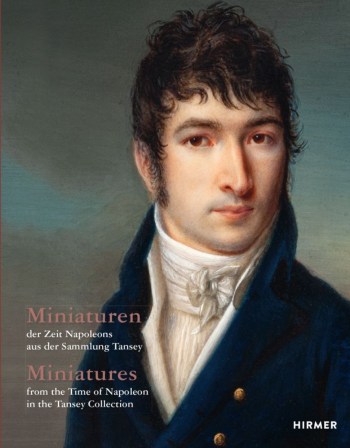 The Tansey miniatures, now held by the Bomann Museum in Celle, represent one of the most significant collections of European miniature paintings. This exhibition showcases a total of 150 works from the time of Napoleon I (1795–1815). These tiny portraits, which were generally intended for personal use, date from the ‘golden age’ of miniature painting. They exhibit a high degree of artistic skill and refined craftsmanship. Unlike the staged, theatrical portraits of absolutism, now for the first time we see realistic likenesses of people who appear ‘modern’—a gallery of women, men, and children from a period of political upheaval dominated by wars.
The accompanying bilingual catalogue (in German and English) provides comprehensive insight into the art of miniature painting in this magnificent era. Specialists have contributed detailed and richly illustrated introductory essays. This volume joins earlier entries in the series, exploring the collection in key periods and presenting new photographic reproductions of the miniatures at actual size.
Bernd Pappe and Juliane Schmieglitz-Otten, with photography by Birgitt Schmedding, Miniatures from the Time of Napoleon in the Tansey Collection (Munich: Hirmer Verlag, 2022), 452 pages, ISBN: 978-3777436098, €58 / $65.
Exhibition | Design around 1800

Staatliche Kunstsammlungen Dresden:
Design around 1800 / Gestaltung um 1800
Schloss Pillnitz, Dresden
The Kaiserzimmer (imperial rooms) in Pillnitz Palace, still known to many as the Weinlig-Rooms, were reopened to the public in 2020 after several years of restoration. In the future, the new permanent exhibition Design around 1800 will be on display in the rooms steeped in history, showcasing outstanding arts and crafts pieces from the classicism period.

Centerpiece, French, ca. 1800, cast bronze, patinated and gilded, 49.7 cm high (Dresden: Kunstgewerbemuseum, 30982).
The time around 1800 was one of enormous dynamism: social, scientific, technological—the signs pointed everywhere to change, a new dawn, progress. Paradoxically, in the decorative arts the path to the future of design led back to classical antiquity. The excavations in Herculaneum and Pompeii from the middle of the 18th century and the beginning of intensive research triggered a new enthusiasm for antiquities. A decisive impulse for this came from Dresden. Johann Joachim Winckelmann (1717–1768) shaped the ideas of German classicism with his writings like no other. After the organically growing, wildly bizarre play of forms of the Rococo, ancient art offered new starting points, not only because of its clear structure and the ornamental and decorative world that was completely contrary to the Rococo. According to Winckelmann, Greek art had reached an aesthetic perfection that now had to be imitated.
The permanent exhibition Design around 1800 makes this spirit of classicism tangible on two levels. On the one hand, the lavishly restored imperial rooms, together with the preserved original interior, are themselves a splendid example of classicist interior design. The window and door crowns alone, finely proportioned in individual fields, illustrate the wealth of antique formal language: rams’ heads and sphinxes from ancient Egypt, scenes from Greek and Roman mythology, and ornaments such as urns, mascarons, palmettes, lotus blossoms, and acanthus foliage used in a quotation-like manner speak a clear picture.
The exhibition uses this early classicist interior, which is so important for Saxon art history, to illuminate various facets of applied art around 1800 on a second level. Here, the Kunstgewerbemuseum presents outstanding pieces of Classicist design from its own collection, including ceramics, textiles, glass and metalwork, furniture, paper wallpaper and clocks. Special attention is paid to the Saxon developments, the players acting in the environment of the Dresden court and the local craftsmanship of the time. For this purpose, the exhibits of the Kunstgewerbemuseum are additionally supplemented by loans from the Porcelain Collection, the Green Vault, the Numismatic Collection, and the Sculpture Collection.
After the first quarter of the 19th century, ancient art lost its primacy as a model. However, it never fell into oblivion again. In the stylistic melting pot of historicism, numerous classicist elements can be found, impressively seen, for example, in the works of the late Karl Friedrich Schinkel (1781–1841) and Gottfried Semper (1803–1879). Certain forms and ornaments also have a firm place in design, architecture and arts and crafts right up to the present day. In the exhibition, a separate room is dedicated to this classicist afterlife.
The archduke of Austria and Holy Roman Emperor Leopold II (1747–1792) was the name sponsor. On the occasion of the meeting with the Prussian King Frederick William II (1744–1797) in August 1791, the emperor took up residence in Pillnitz for a few days. The talks were later to go down in history as the Pillnitz Monarchs’ Meeting. As honored host for this event of European magnitude, the Saxon Elector Friedrich August III (1750–1827) had the wing buildings of the Bergpalais, which had been completed only a few months earlier, splendidly decorated. Just two years later, the palace inventory referred to the rooms in the west wing as ‘kayserliche Zimmer’.
The Imperial Rooms with their original wall paneling and carvings, mirrors, stove and fireplace are the only example of Early Classicist interior decoration around the Dresden court that has been preserved largely in its original state. During the extensive restoration of the rooms, the wall coverings in the two main rooms were also reconstructed with silk atlas fabric in the original color scheme, making the original design concept much more tangible again.
 So far, there is no archival evidence of who designed the rooms. The attribution to and corresponding naming of the architect Christian Traugott Weinlig, which was valid for a long time due to stylistic analogies, is no longer supported by today’s research. Also in view of the approximation to the state of 1791 achieved during the restoration by the Sächsisches Immobilien- und Baumanagement (SIB), the name ‘Kaiserzimmer’, which was valid for a good 180 years, is now used again.
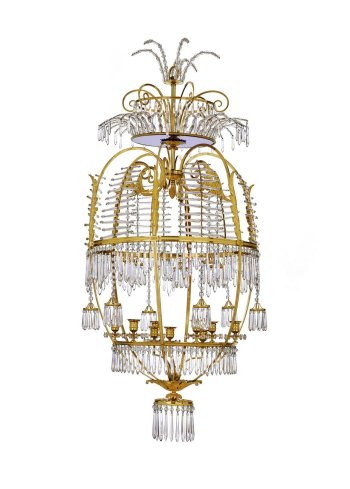
As the only object without a historical room reference, but with an all the stronger stylistic reference to Weinlig’s decorations, a new acquisition will be presented this fall, which the Kunstgewerbemuseum was able to realize with the support of the Ernst von Siemens Art Foundation: an early classicist chandelier in the shape of an egg. The chandelier is documented as a product of the Chursächsische Spiegelfabrik by a detailed review with accompanying pictorial plate in the March 1800 issue of the Journal des Luxus und der Moden. The piece is of outstanding quality, both in terms of design and technology. Its unconventional basket or egg shape is also a great unusual feature for the period of early classicism. The interplay of the gilded bronze frame with the richly varied Bohemian glass hanging is superb and testifies to the high level of Saxon craftsmanship of the time. In particular, the Chursächsische Spiegelfabrik was one of the leading Central European manufacturers of brass-mounted glassware and candlesticks around 1800.










 Enfilade
leave a comment