Exhibition | Bernardo Bellotto at the Court of Saxony
From the Staatliche Kunstsammlungen Dresden:
Enchantingly Real: Bernardo Bellotto at the Court of Saxony
Zwinger, Gemäldegalerie Alte Meister, Dresden, 21 May — 28 August 2022
Royal Castle, Warsaw, 23 September 2022 — 8 January 2023
 Coinciding with the 300th anniversary of his birth, the Gemäldegalerie Alte Meister is holding a major monographic exhibition in celebration of the work of Venetian painter Bernardo Bellotto (1722–1780). The artist—who, like his uncle and teacher Antonio Canal, also called himself Canaletto—ranks as one of the most important 18th-century painters of city views or vedute. The Dresden retrospective is the culmination of a years-long conservation project and results from a cooperation with the Royal Castle in Warsaw. It features the Gemäldegalerie’s own collection of Bellotto’s paintings, itself the largest in the world.
The show presents Bellotto’s life and work by tracing the most important phases and milestones of his career. After formative years in Venice, he came to Dresden in 1747 and painted large-scale vedute for the Saxon elector and Polish king, Augustus III, as well as for his prime minister, Count Heinrich von Brühl. Bellotto’s paintings continue to offer unique insights into the architecture and life of the royal capital of Saxony as well as the nearby town of Pirna and the fortresses of Sonnenstein and Königstein. After working briefly at the courts of Vienna and Munich, in 1766 Bellotto took up residency in the royal city of Warsaw, painting numerous views of that city until his death in 1780.
Several etchings by the master present another side to Bellotto as printmaker and entrepreneur. The prints stem from Dresden’s Kupferstich-Kabinett, which boasts a remarkably complete collection of the artist’s printmaking oeuvre. Further enriched with drawings loaned from Warsaw and Darmstadt, the survey show reveals the range of Bellotto’s lively pictorial innovations. Also on view are books, porcelain objects, sculptures, and scientific instruments that together create a vivid snapshot of an era that Bellotto, as an artist, helped define.
Stephan Koja and Iris Yvonne Wagner, Zauber des Realen: Bernardo Bellotto am sächsischen Hof (Dresden: Staatliche Kunstsammlungen Dresden, 2022), 256 pages, ISBN: 978-3954986774, €48.
Exhibition | The Key to Life: 500 Years of Mechanical Amusement

From the press release (30 May 2022) from the Staatliche Kunstsammlungen Dresden:
The Key to Life: 500 Years of Mechanical Amusement
Kunsthalle im Lipsiusbau, Dresden, 3 June — 25 September 2022
Automatons, androids and robots—they now dominate our professional and private environments and are expressions of the human desire to create artificial life. The Mathematisch-Physikalischer Salon and the Museum für Sächsische Volkskunst and Puppentheatersammlung of Staatliche Kunstsammlungen Dresden (SKD) are presenting roughly 70 of these artefacts in the exhibition The Key to Life: 500 Years of Mechanical Amusement on view from 3 June to 25 September 2022 in the Kunsthalle im Lipsiusbau.
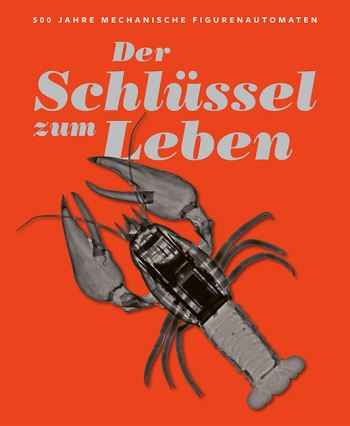 For the first time, the SKD is showing the full range of its unique collection of mechanical figurines and amusements in one exhibition, supplementing them with constructions of artificial life. Beside the unique wealth of mechanical objects spanning from the Renaissance to the present day from the inventory of the Mathematisch-Physikalischer Salons, the Grünes Gewölbe, and the Puppentheatersammlung, the exhibition also features selected loans from the Bayerisches Nationalmuseum, the Maximilianmuseum in Augsburg, and the Roentgen-Museum Neuwied, among others. Through several exhibition chapters on the mechanical figurines and tableaux from the period around 1600, 18th-century-androids and mechanical amusements in the 19th century, to the nickelodeons and slot machines of the early 20th century and contemporary moving art, the exhibition showcases how the mechanical has fascinated people for 500 years.
The items on display include complicated mechanical tableaux from the late 16th century that feature not only agile figurines and playing drummers, but also movements on the tableau itself. A fur-covered bear beats its drum every hour on the hour. The replica ‘iron hand’ of knight Götz von Berlichingen is an excellent example of early modern prosthetics. Contemporary research is also represented: the prototype ‘mika²’ from Dresden University of Technology’s historical acoustic and phonetic collection is a mechanical simulation of the main parts of the human vocal tract, which was developed at the Chair of Speech Technology and Cognitive Systems. The exhibition’s interactive design allows visitors to bring the amusements to life themselves and understand their movements. There will be a varied program of tours and workshops, including some during the school holidays and the Dresden Night of Museums.
Peter Plaßmeyer, Hagen Schönrich and Igor A. Jenzen, eds., Der Schlüssel zum Leben: 500 Jahre mechanische Figurenautomaten (Dresden: Sandstein Verlag, 2022), 224 pages, ISBN: 978-3954986828, €38.
Exhibition | A Taste of One’s Own Medicine
Now on view at the Royal College of Physicians:
A Taste of One’s Own Medicine: Medical satire at the Royal College of Physicians
Royal College of Physicians, London, 3 May — 2 December 2022
We see countless satirical images in our everyday lives, from commercial advertisements and newspaper cartoons, to magazine covers and humorous internet memes. Graphic satire has saturated all levels of society since it emerged as a skilled artform in the 17th century. It developed into a thriving industry in the 18th century, becoming a powerful tool for expressing political and social opinions.

A Consultation of Physicians, unknown artist (Royal College of Physicians, photography by John Chase).
The enduring appeal of satirical images encompassed the wealthy and poor alike. Reproduced in their tens, hundreds or even thousands, prints could be bought, viewed in shop windows and later newspapers, and put up in public places such as barber shops, billiard rooms, and brothels. Like many public figures, medical professionals such as doctors, apothecaries, and surgeons were targeted by satirists and caricaturists. These artists used public opinion and personal agendas to ridicule, reprimand and malign their subjects and the work they were involved in.
The Royal College of Physicians (RCP) cares for a unique collection of medical satire prints from the mid-18th century to the 1980s, selected and given by doctors and members over its 500-year history. Like all satire, these prints are closely tied to a particular time and place. They responded to contemporary events and were consumed by audiences who understood the circumstances of their creation. Join us as we explore the diverse social, political, and historical contexts in which our satirical prints were produced and seek to decipher the complex narratives they contain.
satire, n. A work of art which uses humour, irony, exaggeration or ridicule to expose and criticise prevailing immorality or foolishness, especially as a form of social or political commentary.
caricature, n. Grotesque or ludicrous representation of persons or things by exaggeration of their most characteristic and striking features.
lampoon, n. A virulent or scurrilous satire upon an individual.
Exhibition | The Clamor of Ornament
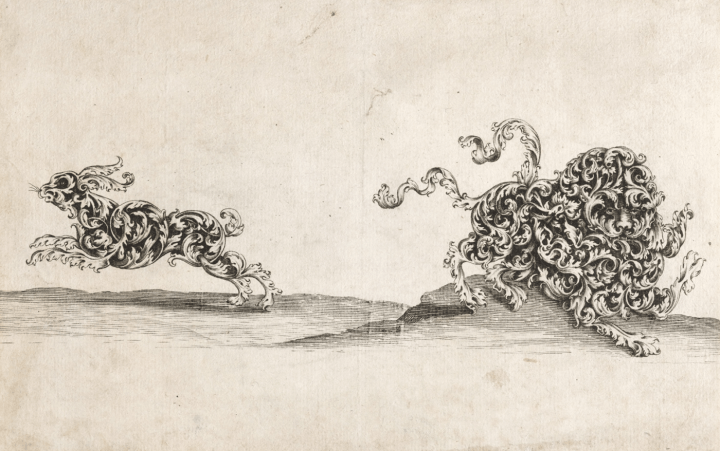
Wolfgang Hieronymus Von Bömmel, Lion and Hare Composed of Ornamental Leaf-Work, from Neueersonnene Gold-Schmieds Grillen (New Designs for Ornaments in Gold), 1698, engraving on off-white laid paper, 12.7 × 20 cm (Cooper Hewitt, Smithsonian Design Museum, Smithsonian Institution, museum purchase through gift of the Estate of David Wolfe Bishop).
◊ ◊ ◊ ◊ ◊
From the press release for the exhibition:
The Clamor of Ornament: Exchange, Power, and Joy from the Fifteenth Century to the Present
The Drawing Center, New York, 15 June — 18 September 2022
Organized by Emily King, with Margaret Anne Logan and Duncan Tomlin
Bringing together more than 200 objects from across the globe, The Clamor of Ornament explores ornament in architecture, art, and design through the lens of drawing. Spanning all three of The Drawing Center’s galleries, the exhibition features a broad range of drawings, prints, books, textiles, and photographs dating from the fifteenth century to the present. Foregrounding ornament’s potential as a mode of communication, a form of currency, and a means of exchange across geographies and cultures, The Clamor of Ornament both celebrates and interrogates ornament’s fluidity by making connections between motifs, methods, and intentions.
“The Drawing Center’s mission is to produce exhibitions and scholarship on drawing of all kinds with the broader goal of promoting drawing as an essential medium in art history, as well as in the contemporary moment,” said Laura Hoptman, The Drawing Center’s Executive Director. “While the majority of shows in our forty-five-year history have focused on fine art, our brief also includes illustration, comics, vernacular and commercial drawing, architecture, and design. The Clamor of Ornament is our first design exhibition in many years and the most ambitious omnibus exhibition The Drawing Center has undertaken in decades.”

Unknown artist, Northern Coromandel coast, India Tree-of-Life Palampore, ca. 1730–50, painted and resist dyed cotton, 318 × 212 cm (Courtesy of Prahlad Bubbar, London, Todd-White Art Photography).
The exhibition’s title is a play on that of Owen Jones’s magnum opus The Grammar of Ornament. First published in 1856, Jones’s compendium sought to establish a set of universal design rules and principles that would apply to ornament in every instance, regardless of its inspiration or application. Rather than seeking to establish new parameters and rules, The Clamor of Ornament celebrates ornamental profusion and welcomes its ability to disrupt canonical form and taste. In swapping ‘Grammar’ for ‘Clamor’, the exhibition’s curators seek to emphasize ornament’s ability to not only communicate but also to embellish and to complicate.
Ornament moves within and between communities and cultures, and throughout the exhibition are examples of ornamental communication as contextual and mutable. This makes for surprising pairings and juxtapositions, such as a woodblock knot print by Albercht Dürer—whose intricate composition was inspired by a design by Leonardo da Vinci, which in turn was influenced by geometric ornament of the Ottoman Empire. Dürer’s well-known knot image is exhibited alongside London-based designer Martin Sharp’s iconic poster of Bob Dylan from 1968, which includes the Ottoman/da Vinci/Dürer design transformed into a psychedelic mandala.
This broad approach to the subject of ornament encompasses objects ranging from eighteenth-century Indian palampores and Pennsylvania Dutch Fraktur drawings to Kosode cut paper designs and Navajo textiles. The history of architectural ornament is explored through drawings by Louis Sullivan and David Adjaye, and contemporary ornament is represented by designs from luxury fashion brands, examples of digital ornament, and even present-day designs for patisserie.
The Clamor of Ornament is organized by Dr. Emily King, Guest Curator, with Margaret Anne Logan and Duncan Tomlin.
The catalogue is available to read for free online:
Laura Hoptman, Emily King, Margaret Anne Logan, Farshid Moussavi, Duro Olowu, Shola Von Reinhold, and Duncan Tomlin, The Clamor of Ornament: Exchange, Power, and Joy from the Fifteenth Century to the Present (New York: The Drawing Center, New York, 2022), 242 pages, $33.
Exhibition | Herrnhut Turns 300

On this day (17 June) in 1722, building began at Herrnhut; information on events marking the 300th anniversary can be found here. From the Staatliche Kunstsammlungen Dresden:
Departure–Network–Remembrance: 300 Years of Herrnhut
Aufbruch–Netz–Erinnerung: 300 Jahre Herrnhut
Völkerkundemuseum Herrnhut, 9 April — 27 November 2022
 Founded in 1722 as a settlement for Protestant religious refugees from Moravia, Herrnhut quickly developed into an important center for crafts and trade, whose best-known product today is arguably the Herrnhut Star. Through the expansion and missionary activities of the Moravian Church, the town also became the center of a worldwide network of church renewal movements. Global exchange and commitment to the common good still characterize Herrnhut society today. For the anniversary year 2022, we are displaying insights and outlooks into 300 years of history and stories of Herrnhut and its people. This special exhibition was created in cooperation with the Moravian Church of Herrnhut, the Moravian Archives, and with Herrnhut‘s local history museum.
In the museum’s inner courtyard, a work by Dresden artist Su-Ran Sichling invites visitors to participate proactively. The museum foyer exhibits 3D prints of selected objects, inviting visitors to a ‘hands-on’ overview of the topic. The 3D prints were created in cooperation with the open workshop Geistesblitz in Löbau, where students train in the use of modern technologies. In addition, to mark the anniversary, various installations on the history of the Herrnhut mission will complement our permanent exhibition. They already offer insight into the design of a new exhibit, which is scheduled to open in 2023. Among them, visitors will find an intervention on Winti religion in Suriname, created by Rotterdam artist Jaasir Linger.
Exhibition | Faith and Fortune: Art across the Global Spanish Empire

Attributed to Manuel Chili, known as Caspicara, Four Fates of Man: Death, Hell, Purgatory, and Heaven, ca. 1775
(New York: The Hispanic Society of America)
◊ ◊ ◊ ◊ ◊
From the press release (18 May 2022) for the exhibition:
Faith and Fortune: Art across the Global Spanish Empire
Art Gallery of Ontario, Toronto, 8 June — 10 October 2022
Curated by Adam Harris Levine, with Tahnee Ann Macabali Pantig
This summer, the Art Gallery of Ontario (AGO) presents Faith and Fortune: Art across the Global Spanish Empire, an eye-opening exhibition of sumptuous paintings, maps, textiles, jewels, rare daguerreotypes, and religious objects from Europe, the Americas, and the Philippines from the collection of the Hispanic Society Museum & Library of New York.
Curated by the AGO’s Assistant Curator of European Art, Adam Harris Levine, the exhibition presents artworks by revered and unknown Latin American, Filipino, and Spanish artists and explores the colonial frameworks that shaped their production and reception. A consultation panel of Toronto-based Latinx and Filipinx scholars and artists worked with the curator to help shape an exhibition that both highlights the beauty of these objects and the reality of their creation. Their voices are heard throughout the exhibition as part of the exhibitions extensive audio guide.
For nearly four centuries, between 1492 and 1898, the kings and queens of Spain controlled large parts of the world. Their pursuit of gold, gemstones, and natural resources created an empire that for a time spanned both oceans. Art, books, and religious imagery were a powerful means of unifying their vast and varied empire, and the Spanish empire encouraged artistic production across its territories. Painters, sculptors, printers, and other artisans travelled extensively, creating a rich and complex visual culture.
“These sumptuous and stirring works reveal cross-cultural exchange—of ideas, of people, of materials—on a global scale. As historic as these artworks were, embedded in their creation are issues that we continue to confront today: the persistence of anti-Indigenous stereotypes, of racial categories, of flawed legal systems, of pollution from resource extraction. In them, and in the context of their making, we better understand our present condition,” says Levine. “These four centuries of art provide a unique perspective on the lasting legacies of colonization and the role of art.”
Filipino-Canadian artist and designer Tahnee Ann Macabali Pantig joins the exhibition as guest curator, overseeing the installation of 15 never before exhibited daguerreotypes from the Philippines, dating from ca. 1840–45. Only recently rediscovered, these significant images offer says Pantig “a rare window into the Philippines at a critical time of political and cultural change and an opportunity for those in the Filipinx community to reclaim these images as our own and to consider how colonialism has shaped how we see our history.”
◊ ◊ ◊ ◊ ◊

Anonymous Spanish artist, The Silver Mine at Potosí, ca. 1585, watercolor on parchment, 28 × 22 cm (New York: The Hispanic Society of America). More information is available here»
Organized chronologically, the exhibition begins with the earliest episode of colonization: Columbus’s arrival in the Americas. Illustrating the formation of the Empire is a selection of ceramics, textiles, and religious paintings—objects all made in Spain with materials from the Americas and Asia, reflecting the dominant styles and techniques of European art. A gold pendant in the shape of a centaur made of sapphires, rubies, and pearls (ca. 1580–1620) and a disc of gold bullion, dated 1622, from the Thomson Collection of European Art are just a few of the glittering examples of the gold trade that fueled the Spanish Empire’s expansion.
Impassioned representations of Saint Jerome (1600) and Saint Sebastian (1603–07) by El Greco and Alonso Vázquez highlight a section dedicated to Catholic imagery and its role in empire building. From Peru, a processional shield from ca. 1620–50 depicting the Virgin Mary and the Nativity, of oil on copper and wrought iron, demonstrates the local adoption of and market for religious icons.
Anonymous Spanish artist, The Silver Mine at Potosí, ca. 1585, watercolor on parchment, 28 × 22 cm (New York: The Hispanic Society of America). More information is available here»
Sculpture, ranging from gilded wooden figures to a lacquered portable writing desk and elaborately carved wooden boxes, features prominently in the exhibition. Ecuadorean Indigenous sculptor Manuel Chili’s striking series of four wood carvings The Fates of Man (ca. 1775) presents in feverish detail the potential rewards and pains of the afterlife.
A section dedicated to seafaring and map-making features some of the oldest objects in the exhibition, including a series of five charts illustrating the Atlantic Ocean from Iceland to Port of Good Hope from 1558. Diego Velázquez’s full sized portrait of Gaspar de Guzmán, Count-Duke of Olivares (1625–26), is one of many works showcasing the Spanish Empire at the height of its power in the 17th century.
Pottery and lacquer ware from Mexico and Columbia exemplify how Indigenous artisans working for settler patrons and drawing upon examples and artistic traditions imported from across Asia, the Americas, and Europe created their own recognizable styles. These works reflect the importance of the Spanish trade routes between Acapulco and Manila.
The exhibition concludes with a selection of never-before exhibited daguerreotypes dating from ca. 1840–45. An early form of photography using silvered copper plates, daguerreotypes were popular in the mid-19th century. Guest curated by Filipino-Canadian artist and designer Tahnee Ann Macabali Pantig, these images offer stunning views of Manila and its surroundings, including the Marikina River and Laguna province, and are thought to be the work of Jules Alphonse Eugene Itier (1802–1877), a French government official whose career took him around the world.
Programming Highlights
• On Saturday, June 11, exhibition curators Adam Harris Levine and Tahnee Ann Macabali Pantig join interpretive planner Gillian McIntyre for a free conversation about Faith and Fortune: Art across the Global Spanish Empire. For more details and to register, visit ago.ca/events/faith-and-fortune-curators-talk.
• Celebrate the sounds of the Americas and Philippines! Beginning Friday, June 17 and continuing on select Fridays through July, Small World Music presents free live musical performances by Latinx and Filipinx performers in Walker Court from 5 to 9pm.
• On Thursday, June 23 at 4pm, exhibition curator Adam Harris Levine joins Florina Capistrano-Baker, a curator and expert on the art history of the Philippines, in conversation. The two will highlight objects from Faith and Fortune: Art across the Global Spanish Empire, addressing the Philippines’ era of Spanish colonisation and local hybrid art forms. Free via Zoom. For more details about this free Zoom talk, visit ago.ca/events.
• Opening on 25 June 2022, on level 1 of the AGO, also from the Hispanic Society Museum & Library, comes Treasures of Ancient Spain, a selection of 28 objects from three important periods in Spanish history, dating as far back as 2500 BCE. Featuring, metalwork, rare Bell Beaker ceramics, Celtic jewellery, and marble sculpture, these artifacts attest to Spain’s long history as a home to many cultures. Archer M. Huntington, the founder of the Hispanic Society Museum & Library was a passionate collector of ancient Spanish artifacts, funding numerous archeological digs.
Exhibition | Paintings from South America
Now on view at the Nelson-Atkins:
Paintings from South America: The Thoma Collection, 1600–1800
Nelson-Atkins Museum of Art, Kansas City, 12 February — 4 September 2022
Organized by the Thoma Foundation

Unidentified artist (Perú), The Mystical Winepress, 18th century, oil and gold on canvas, 49 × 43 inches (Collection of the Carl & Marilynn Thoma Foundation, 2019.71; photo by Jamie Stukenberg).
This exhibition presents fifteen works made by artists in present-day Ecuador, Peru, and Bolivia during Spanish colonial rule. One of the largest and longest-lasting European empires, the Spanish realms spanned from South Asia to South America and lasted nearly 500 years. Spanish South American art is a dynamic, unique combination of styles and influences from visiting Italian artists and imported European prototypes translated and adapted by local hands. The works on view represent primarily Roman Catholic subjects. Paintings and sculptures adorned churches and convents across Spanish America, but most of the paintings in this exhibition originally hung in private homes where they both gave pleasure and invited contemplation and prayer. The works belong to the Carl & Marilynn Thoma Foundation, which is committed to promoting the art of the Spanish Americas through scholarship and exhibition of its extensive collection from South America and the Caribbean.
New Exhibition | Governing the Nation from Fraunces Tavern, 1785–88
From the press release from the Fraunces Tavern Museum:
Governing the Nation from Fraunces Tavern, 1785–88
Fraunces Tavern Museum, New York, opening 22 June 2022
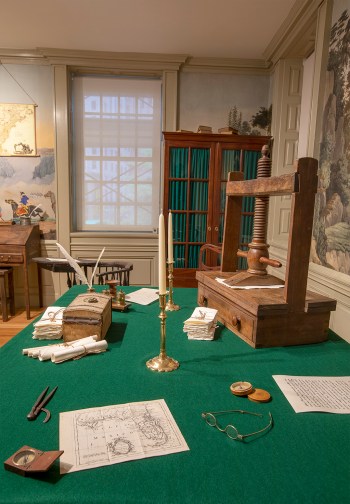
View of the negotiation table inside the Department of Foreign Affairs at Fraunces Tavern with map of east and west Florida in the foreground. Photo: Courtesy of Fraunces Tavern® Museum.
While Fraunces Tavern in New York City is one of the 18th century’s best-known taverns and the site of General George Washington’s famous farewell to his officers at the end of the American Revolution, it is less known that in the late 1700s, the site at 54 Pearl Street in lower Manhattan was also home to the nation’s first executive governmental building that housed three offices of the Confederation Congress. (Although Congress met in City Hall, the space was too small for the government’s departments and other office space had to be leased.) In 1785, the Department of Foreign Affairs, Department of War and offices of the Board of Treasury leased space at the Tavern and remained tenants there until 1788. Thanks to an extraordinary document—a cashbook that detailed the purchases for the Department of Foreign Affairs during its time at the Tavern that is now housed at the National Archives—the Department’s office will be recreated in a new permanent exhibition, Governing the Nation from Fraunces Tavern, set to open on June 22, 2022. Featuring approximately 60 objects, most of which are authentic to the period and many of which have never before been on public display, including tables, chairs, desks, maps, newspapers and other items, visitors will have the opportunity to travel back to post-colonial New York City and enter the Department of Foreign Affairs office as it appeared during a fascinating period in the nation’s history when John Jay was the first Secretary of Foreign Affairs. Visitors will learn about the diplomatic, military and financial challenges that all three departments faced after the Revolutionary War and how those challenges affected the formation of the U.S. Constitution.
“We are in the unique position of having access to a rare, surviving cashbook from the Department of Foreign Affairs,” explains Craig Hamilton Weaver, co-chairman of the Museum and Art Committee at Fraunces Tavern Museum. “We diligently researched each object in the cashbook and acquired authentic items to create an accurate setting that allows the visitor to step back into history. This is indeed a magnificent gift to the nation.”
 After an exhaustive search to locate objects that would have been found in the original office, visitors will not only see an extraordinary assemblage of fine American and British decorative arts, many pieces of which have been donated from private collections, but they will also gain insights into an often-overlooked period in American history. Objects such as A New and Accurate Map of East and West Florida Drawn from the best Authorities, a circa 1700s map engraved by J. Prockter, London, highlighting Spanish-controlled West Florida; a rare copy of the French-language newspaper Courier de L’Europe published in London on 29 September 1786, reporting on America’s diplomatic activities with Prussia and Spain; and an array of directional and mapping compasses will help to illustrate the Department’s first two pressing matters. The Barbary Pirate Crisis, which led to the 1787 diplomatic treaty with Morocco to end pirate seizures of American vessels in the Mediterranean Sea, and negotiations with Spain regarding control of the Mississippi River will be examined in the exhibition to offer visitors insights into what it took to form a new government as well as a deep appreciation for those individuals who rose to the challenge to do so.
“We want visitors to have an immersive experience,” said Scott Dwyer, director of Fraunces Tavern Museum. “The exhibition room was designed and will be arranged to give the sense that John Jay, his under secretary, diplomats, translators, clerks and messengers might enter and resume work at any moment.”
Additionally, the office’s furnishings will illuminate the socioeconomic stratification of the staff who worked in the room. From Henry Remsen, Jr., Jay’s undersecretary for foreign affairs, to the two clerks, a part-time French translator and a messenger, the hierarchy of those employed there will be clearly seen through the caliber of each staffer’s work space in his desk, chair and even desk set; the seniority of the employee’s position correlated to the finery of his work area and accoutrements. For example, Under Secretary Remsen’s desk has a full writing set made of late 18th-century fused Sheffield plate while the clerk’s desk has a pewter inkstand and the messenger’s station has a simple stoneware inkwell. The under secretary’s desk also features examples of Chinese porcelain that would have come to New York aboard the Empress of China, the first American ship to trade with China. The ship returned to New York Harbor and distributed its cargo for local merchants the same year the Department of Foreign Affairs office opened at Fraunces Tavern. Aboard was Samuel Shaw, who would become America’s first Consul to Canton (now Guangzhou), China.

Tea Table, New York, 1770–85, mahogany (New York: Fraunces Tavern Museum, 2022.01.007, gift of Craig Hamilton Weaver; photo by John Bigelow Taylor).
Assembling as many New York- or mid-Atlantic-made furnishings as possible to be seen in Governing the Nation from Fraunces Tavern was another goal in organizing the exhibition to ensure that the room would be authentic to what would likely have been in the original space. One example to be seen at the messenger’s station is a circa 18th-century, brace-back Windsor chair made by Walter MacBride, who worked at 63 Pearl Street in the vicinity of the Tavern. Another such object is a circa 1770–85, mahogany tilt-top tea table, which was likely made in the vicinity of lower Manhattan where many furniture makers were known to have worked at the time. The table features details characteristic of New York style, such as a flat top (rather than the dish top that was popular in other regions), a vase-form pedestal with a cup and square, webbed feet, all of which are typical of New York-made furniture. Although made later than the time period for the office (circa early 19th century), a pair of brass andirons with the rare mark of New York City craftsman David Phillips is included in the exhibition to exemplify other common, locally produced objects during that period. Phillips may have been working earlier as an apprentice near the neighboring South Street Seaport. In a small yet authentic homage to the important document that guided the reconstruction of the office, a leather-bound account book with entries dating from 1765 at the Garret Abel Company of South Street in lower Manhattan, will be seen placed on the clerk’s desk, representing the Foreign Affairs cashbook that informed the object selection for the exhibition. In addition, a facsimile of a page from the actual Foreign Affairs cashbook from 1785 will hang on the wall near the visitor area.
Other featured objects in the exhibition include the negotiation table, made in New York of mahogany and pine in the Chippendale style, circa 1780. The table has carved knees and claw-and-ball legs and is composed of three heavy, solid boards. The strongly carved, original legs have fully developed shells and robust feet. Placed centrally in the room, this is where much of the official business would have been conducted, maps examined and debate likely to have occurred. Another highlight of Governing the Nation from Fraunces Tavern will be found hanging above the clerk’s desk: British engineer Bernard Ratzer’s engraved map, Plan of the City of New York in North America, published in 1776 by Jeffreys & Faden, London, commonly referred to as the ‘Ratzer Map’. One of the best depictions of the city before the Revolutionary War, it was originally issued in 1770 and was heavily influenced by a 1767 map of New York by British engineer John Montresor. The map offers a bird’s-eye view of lower Manhattan Island, eastern New Jersey, and western Brooklyn and includes the city’s important landmarks, many of which are listed in the legend or key. Additionally, an excellent example of a late-18th-century book press with the rare feature of a built-in drawer will also be seen in the office. Such pieces of equipment were used to copy the multitude of correspondence and documents generated by the office.
Governing the Nation from Fraunces Tavern is made possible through a major gift from Stanley and Elizabeth Scott who are longtime supporters of the Museum.
Fraunces Tavern Museum’s mission is to preserve and interpret the history of the American Revolutionary era through public education. This mission is fulfilled through the interpretation and preservation of the Museum’s collections, landmarked buildings, and varied public programs that serve the community. Visit the rooms where General George Washington said farewell to his officers and where John Jay negotiated treaties with foreign nations. Explore six additional galleries focusing on America’s War for Independence and the preservation of early American history.
Exhibition | 25 Artists Fascinated by Piranesi
Opening next week in Dublin; from Hélène Bremer’s website:
For the Love of the Master, 25 Artists Fascinated by Piranesi
The Coach House Gallery, Dublin Castle and the Casino Marino, 17 June — 18 September 2022
Curated by Hélène Bremer
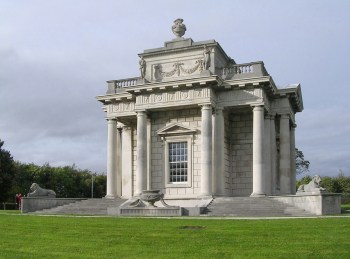
William Chambers, Casino Marino in Dublin, designed for James Caulfeild, the 1st Earl of Charlemont, starting in the late 1750s and finishing around 1775.
2020 marked the tricentenary of the birth of Giovanni Battista Piranesi (1720–1778). The Italian architect, antiquarian, etcher, vedutista, designer, and writer was one of the foremost artistic personalities of 18th-century Rome. His interpretation of the classical world was of great significance not only during his lifetime, but also long after his death. Ireland’s Office of Public Works presents the international exhibition For the Love of the Master: 25 Artists Fascinated by Piranesi to celebrate his legacy in the 21st century, with work from a group of international artists including Emily Allchurch, Pablo Bronstein, Léo Caillard, and Michael Eden. Many of the pieces on display were made specifically for this occasion. One of the show’s locations, the Casino Marino, an important 18th-century neo-classical building, serves to link Piranesi and Ireland, present and past.
Exhibition | Copy-Cat
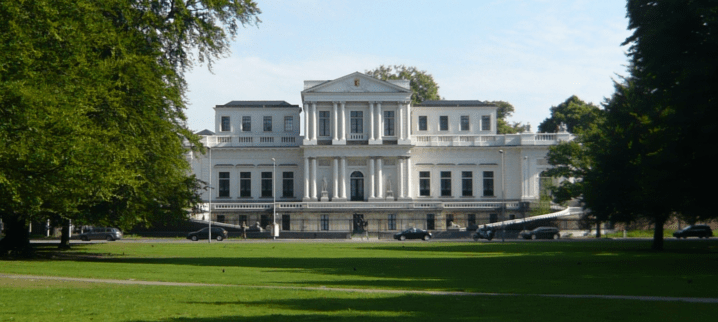
Villa Welgelegen, Haarlem, following the 2009 restoration, view from Haarlemmerhout park (Wikimedia Commons, August 2009). Designed by Abraham van der Hart, the house was commissioned by Henry Hope of the banking family and constructed between 1785 and 1789.
◊ ◊ ◊ ◊ ◊
Now on view in Haarlem:
Copy-Cat
Paviljoen Welgelegen, Haarlem, 8 April — 24 June 2022
Curated by Hélène Bremer
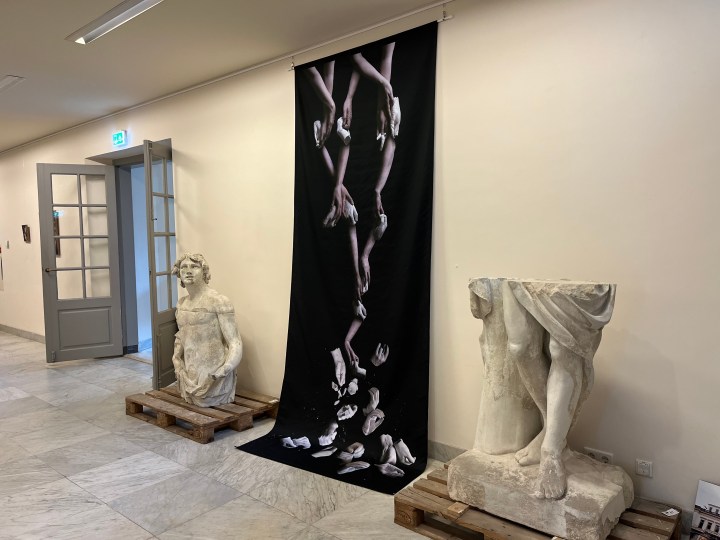
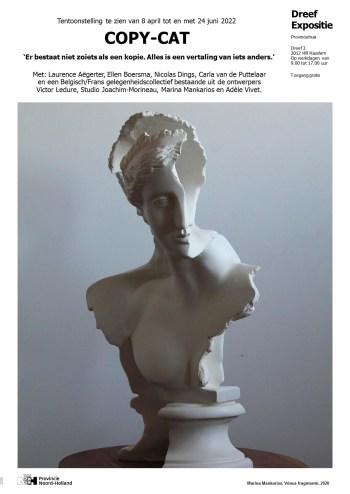 De tentoonstelling Copy-Cat stelt de vraag centraal wat de grenzen van reproductie zijn en wanneer een kopie een zelfstandig kunstwerk met een eigen betekenis wordt. Geïnspireerd door dit thema selecteerde curator Hélène Bremer werk uit diverse kunstdisciplines. Er zijn foto’s, keramiek, beeldhouwkunst en design te zien allemaal geïnspireerd door de beeldhouwwerken van Paviljoen Welgelegen, zorgvuldig gemaakte 21e -eeuwse replica’s. Kopieën dus. Bezoekers kunnen werken bekijken van Laurence Aëgerter, Ellen Boersma, Nicolas Dings, Carla van de Puttelaar en een Belgisch/Franse gelegenheidscollectief bestaande uit de ontwerpers Victor Ledure, Studio Joachim-Morineau, Marina Mankarios en Adèle Vivet.
And from Bremer’s website:
“There is no such thing as a copy. Everything is a translation of something else.”*
The 18th-century building, Paviljoen Welgelegen, the seat of the King’s commissioner of the province of Noord-Holland in Haarlem, stages every three months a contemporary art exhibition under the name Dreef exposities, produced by a guest-curator. Copy-Cat presents art inspired by the classical sculpture that is part of the fabric of the house. The original 18th-century sculptures commissioned in Rome by Henry Hope from Francesco Righetti are now part of the collection of the Rijksmuseum in Amsterdam. There they are prominently displayed in the central hall. In Haarlem they are not missed, though; the sculptures are replaced by bronze copies made in 2009. This theme of copying classical art has been the red threat in selecting artists for this project. However, the cycle of copying literally is broken by the participating artists. Each in their own way appropriate the classical idiom. On view are a selection of photographs, ceramics, and sculpture.
Participating artists: Laurence Aëgerter, Ellen Boersma, Nicolas Dings, Carla van de Puttelaar, and a Belgian/French design collective consisting of Victor Ledure, Studio Joachim-Morineau, Marina Mankarios, and Adèle Vivet.
* David Hockney in Spring Cannot Be Cancelled, with Martin Gayford (London: Thames & Hudson, 2020).










 Enfilade
leave a comment