Exhibition | Traveling in Style: A Coach Restored

Beekman Family Coach, ca. 1770, made in England; wood (ash and spruce by analysis), iron, and leather. 8 feet × 13 feet × 52 inches
(New-Historical Society, Gift of Gerard Beekman 1911.25)
◊ ◊ ◊ ◊ ◊
Now on view at the New-York Historical Society:
Traveling in Style: A Coach Restored
New-York Historical Society Museum & Library, 2 July 2021 — 20 February 2022
The Beekman Family Coach returns to the New-York Historical Society on 2 July 2021. Over the past year, this rare coach—one of only three horse-drawn vehicles used in 18th-century America to survive in original condition—was painstakingly restored to its 1790s appearance through a generous grant from the Institute of Museum and Library Services.
New York merchant James Beekman purchased the coach in 1771 for £138. An expensive luxury that became the crown jewel in his fleet of carriages, the coach was repainted at least five times between 1771 and the 1790s.
Conservator Brian Howard and his team meticulously restored the coach, beginning with the removal of a thick layer of old varnish applied during the mid 20th century. Underneath lay five layers of historic paint, including a light celadon green color from the 1790s that is again visible today. Among other surprises, conservators discovered that the interior of the cab retained most of its original fixtures and materials—wood benches and storage lockers, wool wall coverings, carpeting, and coach lace, enameled Russian leather trim, and flax insulation.
Conservation and display of the Beekman Family Coach is being supported in part by a Federal Save America’s Treasures grant administered by the Institute of Museum and Library Services.
Exhibition | France and Russia: Ten Centuries Together

Pierre-François Drais, snuffbox, made in Paris between 1776 and 1789, with portraits added sometime between 1814 and 1830; gold, enamel, and lapis lazuli, mounted with miniatures in watercolour on ivory (London: V&A, 905-1882). The portraits depict Marie Antoinette and her children Marie-Thérèse-Charlotte (1778–1851), the Dauphin Louis (1781–1789), and Louis-Charles the future Louis XVII (1785–1795), along with a sculptured bust of Louis XVI.
◊ ◊ ◊ ◊ ◊
From the press release for the exhibition:
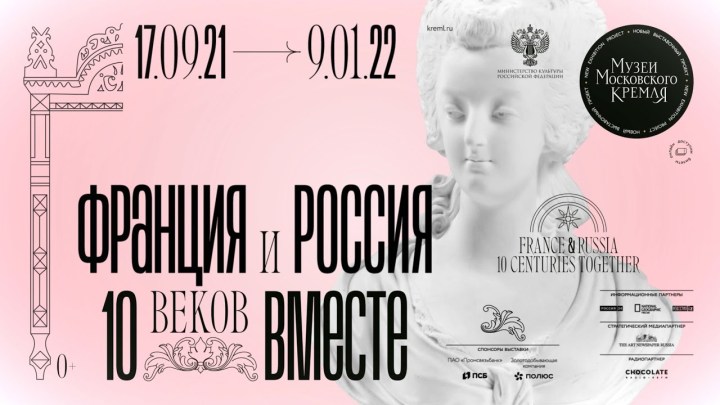
France and Russia: Ten Centuries Together / Франция и Россия: 10 веков вместе
Exhibition Halls of the Patriarch’s Palace and the Assumption Belfry, Moscow, 7 September 2021 — 9 January 2022
The Moscow Kremlin Museums present the exhibition France and Russia: Ten Centuries Together as part of the cross-cultural year between Russia and France, highlighting their interregional cooperation. The project, dedicated to the centuries-long history of cultural and diplomatic relations between the two countries, showcases over two hundred artifacts: memorial objects, archival documents, and artworks from national Russian and European museums. The exhibition explores the history of Russian-French relations through intertwining fates of outstanding personalities including prominent statesmen, scientists, writers, artists, and craftsmen. The chosen approach aims at reconstructing the character of the relationship between the two countries as an immediate, multifaceted, somewhat contradictory, but an ultimately fruitful process for both parties.
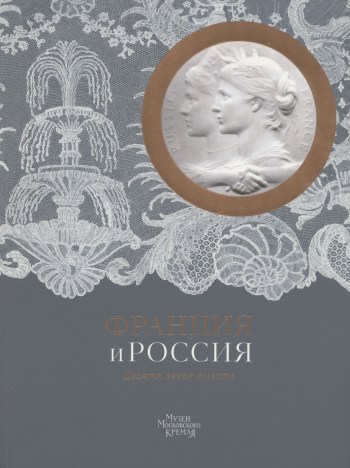 The show opens with a unique charter, dating back to 1063 and recalling the important political event of the 11th century: the dynastic marriage of Princess Anna Yaroslavna, daughter of the Great Prince Yaroslav the Wise, to King Henry I of France. The charter, provided by the National Library of France, is believed to be the only surviving document that bears the handwritten sign of the cross and monogram of King Philip I with his mother’s authentic signature ‘ANA RHNA’ (Queen Anne) placed underneath in Cyrillic letters. Visitors are also afforded the rare opportunity of seeing the Reims Gospel—a unique illuminated manuscript of great cultural and historical significance. Generously offered for the exhibition by the Municipal Library of Reims, it will take centre stage among the key objects on display.
Among the later period pieces featured in the exhibition is a drawing by artist J. Desmarets capturing Peter I and Louis XV in Paris on 11 May 1717 and presented to the Soviet leaders as a diplomatic gift in 1944 to commemorate the visit of Charles de Gaulle, the Chairman of the Provisional Government of the French Republic, to Moscow. The development of the 18th-century political dialogue between Russia and France is chronicled through paintings and sculptures, weapons, textiles, and jewellery commissioned for the Russian Imperial Court from famous French masters or created by prominent French artists invited to Russia. The passion for French art is evidenced by luxurious tapestries, the ceremonial dress of the young Emperor Peter II, the exquisite lacework adorning the gowns of Russian monarchesses, the pieces from the silver Paris set owned by Empress Elizaveta Petrovna, and magnificent weapons, including a pair of pistols belonging to Emperor Peter II and made by the Arquebusier du Roi (royal gunmaker) Jean-Baptiste Laroche.
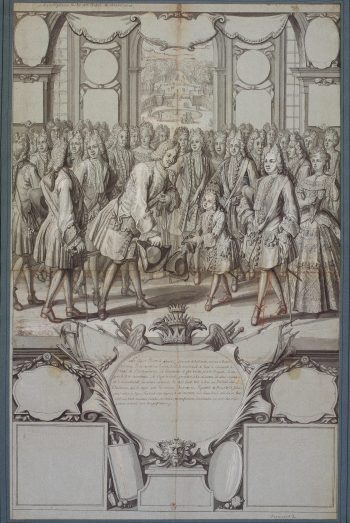
J. Desmarets, Peter I and Louis XV in Paris on 11 May 1717, 1717, ink, watercolour, red chalk, and gouache on tinted paper (Moscow Kremlin Museums)
Portraits from the collection of the Pushkin State Museum of Fine Arts recreate a gallery of outstanding political and cultural figures from the reigns of Empresses Elizaveta Petrovna and Catherine the Great. The section on Catherine the Great’s reign showcases pieces from the legendary Orlov porcelain service executed by the Parisian silversmiths Jacques and Jacques-Nicolas Roettiers along with the precious desk clock with inkstand—the work of a Parisian master—that belonged to the Empress. Unique pieces from the collection of the Pavlovsk Museum and Heritage Site will hark back to Grand Duke Pavel Petrovich and Grand Duchess Maria Feodorovna’s tours of Europe. The years preceding the Great French Revolution are epitomised by the rare memorial objects and are captured in the portraits painted by Élisabeth Vigée-Le Brun, Queen Marie-Antoinette’s favourite artist.
A special section of the exhibition is devoted to relations between Russia and France during the reign of Emperor Alexander I. Here, visitors will see a magnificent cased set of weapons made by the famous French gunsmith and bladesmith Nicolas-Noël Boutet—the gift presented to the Russian governor-general of Paris, Baron Fabian Gottlieb Fürst von der Osten-Sacken from the grateful Parisians. Another highlight is the Olympic porcelain service produced at the Sèvres porcelain factory and presented in 1807 by Napoleon to the Emperor Alexander I in commemoration of the Treaty of Tilsit. The star of the Order of the Holy Spirit, awarded to Alexander I by King Louis XVIII after the former’s victory over Napoleon and the restoration of the monarchy in France, is another showpiece not to miss! The exhibition introduces visitors to the history of ‘Russian Nice’ and feature stories of the World Exhibition that took place in Paris in 1867. It also offers insights into the process of strengthening of Franco-Russian friendship and formation of the Franco-Russian Alliance at the turn of the 19th century.
Participating Institutions
The Moscow Kremlin Museums, the Palaces of Versailles and Trianon, Victoria and Albert Museum, the National Museums of Castles Malmaison and Bois-Préau, National Library of France, the Reims Municipal Library, the State Tretyakov Gallery, the Pushkin State Museum of Fine Arts, the Shchusev State Museum of Architecture, the State Hermitage, Museum and Heritage Site ‘Pavlovsk’, the Russian State Library, the Archive of the Russian Academy of Sciences, the Russian State Archive of Ancient Documents
Svetlana Amelekhina et al. Frantsiia i Rossiia: Desiat’ vekov vmeste / Франция и Россия: 10 веков вместе (Moscow: Muzei Moskovskogo Kremlia, 2021), 383 pages, ISBN: 978-5886783872. Available here»
Exhibition | Les Adam: La Sculpture en Héritage
Now on view at the Musée des Beaux-Arts de Nancy:
Les Adam: La Sculpture en Héritage
Musée des Beaux-Arts de Nancy, 18 September 2021 — 9 January 2022
Curated by Pierre-Hippolyte Pénet and Guilhem Scherf
 Originally from Nancy, the Adam family is the largest dynasty of French sculptors of the 18th century. Over three generations, its members worked in Rome, Paris, Versailles, and Berlin in the service of the Pope and European monarchs such as Louis XV, Louis XVI, Frederick II of Prussia, and Catherine II of Russia. This the first retrospective devoted to them brings together one hundred masterpieces from national and international institutions as well as from private collections, bearing witness to the Adam family’s virtuosity at the heart of Europe during the Enlightenment.
Originaire de Nancy, la famille Adam est la plus grande dynastie de sculpteurs français du XVIIIe siècle. Sur trois générations, ses membres déploient leurs talents auprès des plus grands mécènes et participent à plusieurs chantiers majeurs. Formés en Lorraine dans le contexte d’essor artistique des règnes des ducs Léopold et Stanislas, Jacob Sigisbert Adam, ses trois fils Lambert Sigisbert, Nicolas Sébastien et François Gaspard ainsi que leurs neveux Sigisbert François, Pierre Joseph et Claude Michel dit Clodion, œuvrent à Rome, Paris, Versailles ou Berlin au service du pape et des monarques européens comme Louis XV, Louis XVI, Frédéric II de Prusse ou Catherine II de Russie. Première rétrospective à leur être consacrée, l’exposition réunit cent chefs-d’œuvre issus d’institutions nationales, internationales mais aussi de collections particulières. Permettant de dévoiler plusieurs sculptures prestigieuses inédites qui témoignent de la virtuosité de la famille Adam au cœur de l’Europe des Lumières, elle est accompagnée d’un catalogue de référence sur le sujet.
Commissariat: Pierre-Hippolyte Pénet, conservateur du patrimoine chargé des collections du XVe au XVIIIe siècle, palais des ducs de Lorraine – Musée lorrain, et Guilhem Scherf, conservateur général du patrimoine, adjoint au directeur du département des Sculptures, musée du Louvre.
The full press packet is available here»
Pierre-Hippolyte Pénet and Guilhem Scherf, eds., Les Adam: La Sculpture en Héritage (Paris: Snoeck Édition, 2021), 343 pages, ISBN: 978-9461616234 35€.
British Art Studies, November 2021
The latest issue of BAS:
British Art Studies 21 (November 2021)
Redefining the British Decorative Arts, Guest Edited by Iris Moon

Michelle Erickson, Cauldron, from the series Ply-MYTH, 2019, wheel thrown with lifecast shell and industrial artifacts, made from indigenous North Carolina woodfired stoneware with copper wash, 16 × 19.5 inches (Collection of the artist). Additional information is available here»
“Decorative arts place pressure upon the hierarchies inherent in British aesthetics, and by extension British culture, from the enlightenment to the present day. The specters of history and the possibilities of the future haunt in equal measure this special issue of British Art Studies, which challenges readers to rethink the British decorative arts. Through a series of thought-provoking articles by artists, curators, scholars, and a scientist, the issue asks readers to question their assumptions about the decorative arts, and by extension, the notions of belonging, possession, and home that such arts have helped to shape in British culture. Issues of race and identity, empire and nation, and collective and subjective desires, far from being alien aspects of the decorative arts, have long gestated within the discourses of taste and aesthetics that emerged in tandem with Britain’s rise as a center of capitalism. Many of the articles have as their touchstone the eighteenth century, when London became the finance capital of the world . . . ” (from Iris Moon’s introductory article).
A R T I C L E S
• Unhomely: Redefining the British Decorative Arts, by Iris Moon
• England Am I? Elizabethan Clothing, Gender, and Crisis in Virginia Woolf’s Between the Acts, by Sarah Bochicchio
• Microorganisms, Microscopes, and Victorian Design Theories, by Ariane Varela Braga
• Tarnished Silver: Interpreting the Material Culture of the Atlantic Slave Trade Negotiations of 1715, by Max Bryant
• Cherokee Unaker, British Ceramics, and Productions of Whiteness in Eighteenth-Century Atlantic Worlds, by R. Ruthie Dibble and Joseph Zordan
• Defining a New Femininity? Josiah Wedgwood’s Portrait Medallions of Sarah Siddons and his Femmes Célèbres by Patricia F. Ferguson
• Classical Histories, Colonial Objects: The Specimen Table Across Time and Space, by Freya Gowrley
• Serving as Ornament: The Representation of African People in Early Modern British Interiors and Gardens, by Hannah Lee
• Ruth Ellis’s Suit, by Lynda Nead
• Colonial Trash to Island Treasure: The Chaney of St. Croix, by Jessica Priebe
• In the Flesh at the Heart of Empire: Life-Likeness in Wax Representations of the 1762 Cherokee Delegation in London, by Ianna Recco
F E A T U R E S
• The Chelsea Porcelain Case, British Galleries, The Metropolitan Museum of Art, convened by Iris Moon
• Unpacking Wedgwood: An Interview with Roberto Visani, by Caitlin Meehye Beach
• Wild Porcelain, cover collaboration with Michelle Erickson
• What’s in a Label? Revising Narratives of the Decorative Arts in Museum Displays, convened by Iris Moon
• Another Crossing: Artists Revisit the Mayflower Voyage, by Glenn Adamson
• In Sparkling Company: Presenting Eighteenth-Century Britain in Western New York State, by Christopher Maxwell
Iris Moon is an assistant curator of European ceramics and glass in the European Sculpture and Decorative Arts Department at the Metropolitan Museum of Art, where she recently participated in the reinstallation of the British Galleries. She has taught at Pratt Institute and The Cooper Union and her research on European decorative arts and architecture has been supported by fellowships from the Metropolitan Museum of Art, the Clark Art Institute, and the Getty Research Institute. Her new book, Luxury after the Terror, will be published in spring 2022 by Penn State Press.
Online Roundtable | The Animation of Decorative Arts in 18th-C France
From The Met:
The Animation of Decorative Arts in Eighteenth-Century France
Online, 14 December 2021, 6.00pm (Eastern Time)
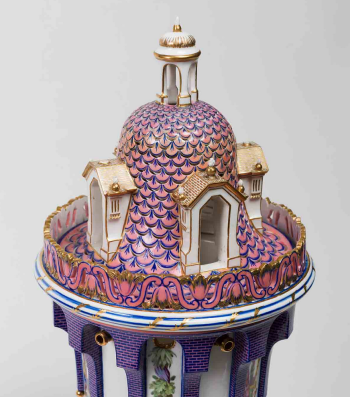 Presented in conjunction with the exhibition Inspiring Walt Disney: The Animation of French Decorative Arts, on view at The Metropolitan Museum of Art from 10 December 2021 until 6 March 2022, this live event takes place online. Watch on YouTube or Facebook (no login required).
Discover how furniture and decorative arts came to life in the literature, dance, and theater of eighteenth-century France, a theme later explored and elaborated by Disney in the classic animated film Beauty and the Beast.
• Wolf Burchard, Associate Curator, European Sculpture and Decorative Arts, The Met
• Alicia Caticha, Assistant Professor, Department of Art History, Weinberg College of Arts and Sciences, Northwestern University
• Sarah Lawrence, Iris and B. Gerald Cantor Curator in Charge, European Sculpture and Decorative Arts, The Met
• Meredith Martin, Associate Professor of Art History, Department of Art History, and Institute of Fine Arts, New York University
• David Pullins, Associate Curator, European Paintings, The Met
Reimagining the Ballet des Porcelaines
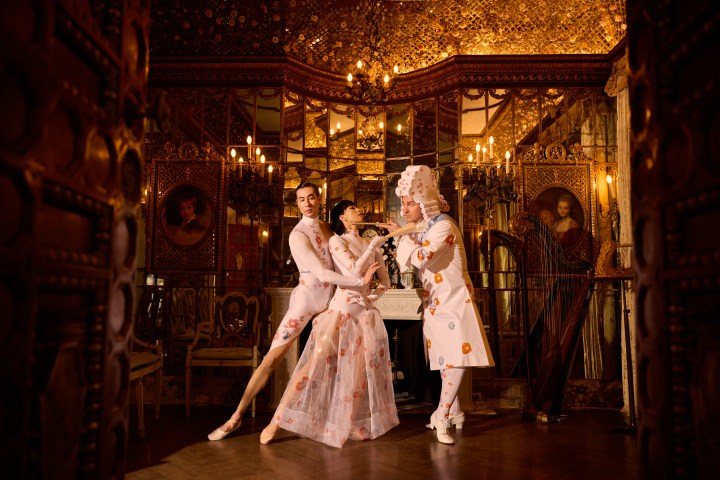
The Ballet des Porcelaines cast in the Venetian Room, Albertine Headquarters, Cultural Services of the French Embassy, NYC. From left to right: Daniel Applebaum (Prince); Georgina Pazcoguin (Princess); Tyler Hanes (Sorcerer). Photo by Joe Carrotta.
◊ ◊ ◊ ◊ ◊
As part of the media preview of the exhibition Inspiring Walt Disney: The Animation of French Decorative Arts at The Metropolitan Museum of Art, guests were given a special chance to see the first performance in centuries of the Ballet des Porcelaine. A publication, noted below, is forthcoming. Additional information about the performance, including credits, is available here.
The original Ballet des Porcelaines, written by the comte de Caylus and staged around 1740 at a château outside of Paris, was based on an Orientalist fairy tale in the same literary milieu as Beauty and the Beast (1740). The story tells of an Asian sorcerer who lives on a ‘Blue Island’ and transforms anyone who dares to trespass into porcelain cups, vases, and other wares. When the sorcerer turns a captive prince into a teapot, a princess comes to rescue her lover by stealing the sorcerer’s wand and turning him into a pagod, an eighteenth-century version of a porcelain bobblehead. Displayed today in museums like The Met, pagods were collectible trinkets that inspired Oriental caricatures in the performing arts. European choreographers mimicked the features and gestures of these porcelain figures, which persist in such iconic, problematic productions as The Nutcracker’s “Chinese Tea” dance.
Scheduled Performances
6 December 2021, The Metropolitan Museum of Art, New York
2–3 March 2022, The University of Chicago
18–19 March 2022, Princeton University
16–17 June 2022, Waddesdon Manor
19–21 June 2022, Royal Pavilion, Brighton
25–26 June 2022, Capodimonte, Naples
28–29 June 2022, Palazzo Grassi, Venice
2–3 July 2022, Sèvres Museum, Paris
Meredith Martin, with contributions by Phil Chan and Charlotte Vignon, Reimagining the Ballet des Porcelaines (Turnhout: Harvey Miller/Brepols, 2022).
In addition to the performance and the book, many readers will find this recorded conversation fascinating as well:
Phil Chan and Meredith Martin, hosted by the Center for Ballet and the Arts at NYU, “Reimagining the Ballet des Porcelaines: A Story of Magic, Desire, and Exotic Entanglement,” YouTube, posted 9 November 2021, 63 minutes.
Phil Chan and Meredith Martin have reimagined this lost Baroque work with an all-Asian American creative team, aiming to make it meaningful and relevant for a multiracial and contemporary audience. This talk explores their process and performance plans and features performances by Martha Graham Principal Dancer Xin Ying and actor, singer, dancer, choreographer Tyler Hanes.
◊ ◊ ◊ ◊ ◊
Note (added 15 December 2021) — The posting has been updated to include the cast photo by Joe Carrotta.
Exhibition | Bordeaux-les-Bains: Les bienfaits de l’eau
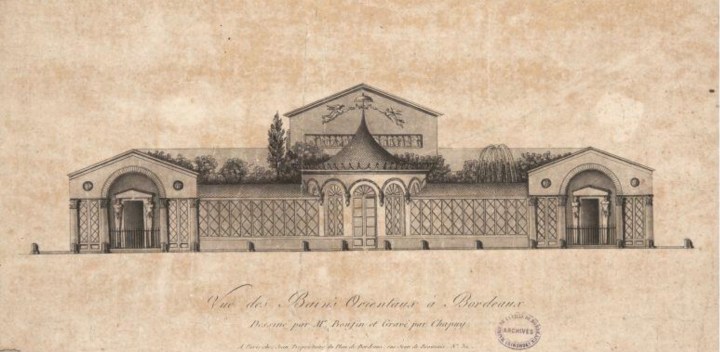
Chapuy after Bonfin, Vue des Bains Orientaux à Bordeaux, ca. 1798, engraving
(Archives Bordeaux Métropole)
◊ ◊ ◊ ◊ ◊
Now on view at the Bordeax Archives, along with this online component:
Bordeaux-les-Bains: Les bienfaits de l’eau, 18e–20e siècle
Archives Bordeaux Métropole, 19 May 2021 — 25 February 2022
Tour à tour convoitée, redoutée, maltraitée, domestiquée, l’eau—un des quatre éléments naturels de la culture occidentale—redevient au XVIIIe siècle un élément fondamental de l’hygiène. Ce bien naturel précieux multiplie les usages au fil du temps : l’eau qui lave, l’eau qui soigne, l’eau qui fortifie, l’eau qui délasse. Et si l’histoire de Bordeaux est intimement liée à celle de son fleuve, c’est bien l’eau qui en constitue l’essence même.
Depuis l’Antiquité, les Bordelais se baignent dans la Garonne. Au XVIIIe siècle, les pratiques évoluent et les techniques se développent : des bains flottants sur le fleuve aux bains-douches dans les quartiers, des établissements d’hydrothérapie à la natation en piscine. C’est à la découverte de cette histoire méconnue que vous invitent les Archives Bordeaux Métropole autour d’une sélection de documents de toutes natures, témoignages d’une incroyable aventure humaine et collective. L’artiste Laurent Valera propose un contrepoint contemporain avec une nouvelle série d’œuvres en dialogue avec les documents d’archives.
Frédéric Laux and Jean-Cyril Lopez, Bordeaux-les-Bains: Les bienfaits de l’eau, XVIIIe–XXe siècle (Archives Bordeaux Métropole, 2021), 96 pages, ISBN: 978-2360622870, 12€.
Print Quarterly, December 2021
The eighteenth century in the latest issue of Print Quarterly:
Print Quarterly 38.4 (December 2021) . . .
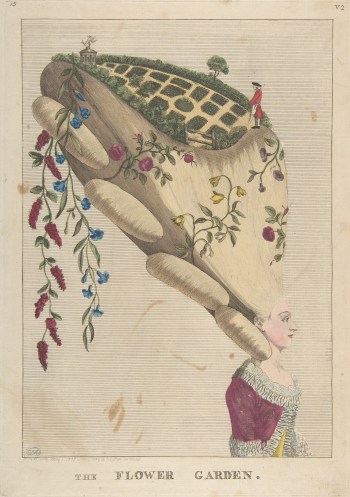
Matthew Darly, The Flower Garden, 1777, etching and engraving with watercolour, 35 × 25 cm (New York: The Metropolitan Museum of Art).
Elizabeth L. Block, Review of Luigi Amara, The Wig: A Hairbrained History, translated by Christina MacSweeney (Reaktion Books, 2020), p. 436.
Elizabeth Block gives an overview of the 33 brief chapters of Luigi Amara’s The Wig: A Hairbrained History. The chapter “Towering Hairdos” looks at the expensive and impractical styles of wigs in the years before the French Revolution, whilst “Dressing Up Justice” focuses on William Hogarth’s The Bench, 1758–64, an engraving depicting bewigged magistrates. Block praises this work for its entertaining and enjoyable qualities, but highlights its lack of academic rigour, suggesting at the end works to turn to for a more scholarly treatment of the subject.
Richard Taws, Review of the exhibition catalogue William Blake, edited by Martin Myrone and Amy Concannon (Tate, 2019), p. 438.
Reviewing the catalogue for the exhibition William Blake, held at Tate Britain in 2019–20, Richard Taws discusses the book’s five chapters covering the artist’s early artistic milieu, his career as printmaker, his relationship with patronage and display, and his reclamation by a younger generation of artists. It is noted that in the authors’ attempt to demythologise Blake, they are successful in creating a “Blake for all,” who satisfies both a specialist and popular audience.
Exhibition | Dressing with Purpose in Scandinavia

From left to right: Eva Aira and Inga Lajla Aira Balto in gávttit from Jåhkåmåhkke and Kárášjohka; Sven Roos in Gagnefsdräkt and Lars-Erik Backman in Leksandsdräkt; Fatima Aakhus and Randi Myrum in Setesdalsbunader. (Photos by Carrie Hertz).
◊ ◊ ◊ ◊ ◊
From the Museum of International Folk Art:
Dressing with Purpose: Belonging and Resistance in Scandinavia
Museum of International Folk Art, Santa Fe, 12 December 2021 — 19 February 2023
Dress helps us fashion identity, history, community, and place. Dress has been harnessed as a metaphor for both progress and stability, the exotic and the utopian, oppression and freedom, belonging and resistance. Dressing with Purpose examines three Scandinavian dress traditions—Swedish folkdräkt, Norwegian bunad, and Sámi gákti—and traces their development during two centuries of social and political change across northern Europe.
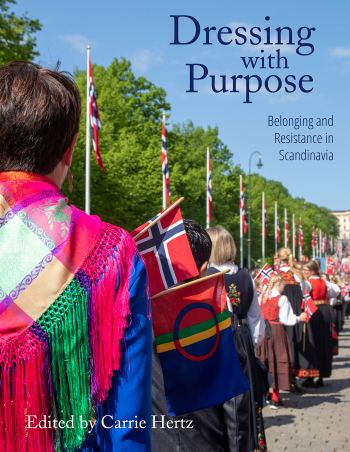 By the 20th century, many in Sweden worried about the ravages of industrialization, urbanization, and emigration on traditional ways of life. Norway was gripped in a struggle for national independence. Indigenous Sami communities—artificially divided by national borders and long resisting colonial control—rose up in protests that demanded political recognition and sparked cultural renewal. Within this context of European nation-building, colonial expansion, and Indigenous activism, traditional dress took on special meaning as folk, national, or ethnic minority costumes—complex categories that deserve reexamination today. In this exhibition, visitors will be introduced to individuals who adapt and revitalize dress traditions to articulate who they are, proclaim personal values and group allegiances, strive for sartorial excellence, reflect critically on the past, and ultimately, reshape the societies they live in.
This project is supported in part by the National Endowment for the Arts. Additional support comes from Barbro Osher Pro Suecia Foundation and Swedish Council of America.
Carrie Hertz, ed., Dressing with Purpose: Belonging and Resistance in Scandinavia (Bloomington: Indiana University Press, 2021), 258 pages, ISBN: 978-0253058577, $30.
Dedication
Acknowledgements
Map of Scandinavia
A Note on Terms and Place Names
Foreword, Khristaan Villela
Introduction: Can We Talk about Traditional Dress?, Carrie Hertz
Part I. Folkdräkt in Sweden
1 Swedish Folkdräkt, Carrie Hertz
2 They Are at Peace Here, Like Old Friends in Their Caskets: Traditional Dress Collections as Heritage-making, Lizette Gradén
Part II. Bunad in Norway
3 Norwegian Bunad, by Carrie Hertz
4 Headdress and Hijab: Bunad in Multicultural Norway, Camilla Rossing
5 The Transnational and Personalized Bunad of the Twenty-First Century, Laurann Gilbertson
Part III. Gákti in Sápmi
6 Sámi Gákti, Carrie Hertz
7 The Legacy of Ládjogahpir: Rematriating Sápmi with Foremother’s Hat of Pride, Eeva-Kristiina Harlin and Outi Pieski
Conclusion: The Future of Traditional Dress, Carrie Hertz
Bibliography
List of Contributors
Index
Exhibition | Anna Dorothea Therbusch
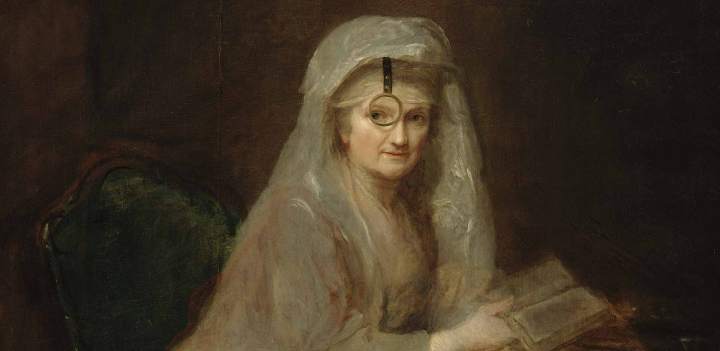
Anna Dorothea Therbusch, Self-Portrait, detail, ca. 1782, 154 × 118 cm
(Berlin: Gemäldegalerie)
◊ ◊ ◊ ◊ ◊
Now on view at the Gemäldegalerie:
Anna Dorothea Therbusch: A Berlin Woman Artist of the Age of Enlightenment / Eine Berliner Künstlerin der Aufklärungszeit
Gemäldegalerie, Berlin, 3 December 2021 — 10 April 2022
Born in Berlin three hundred years ago, Anna Dorothea Therbusch (1721–1782) went on to become one of the most important women artists of the eighteenth century. To mark the tercentenary of her birth (23 July), the Gemäldegalerie is honouring this extraordinary artist and forerunner of women’s emancipation with a special exhibition featuring key works from the Staatliche Museen zu Berlin’s own collections.
 The daughter of the Prussian court painter Georg Lisiewsky, Anna Doroethea received her initial artistic instruction from her father, alongside her siblings. As the wife of an innkeeper and mother of five children, however, her artistic abilities lay idle for decades. In her forties, though, she dedicated herself to painting with great vigour, and in 1767 she was one of the few women to be accepted into Europe’s most important art school of the time, the Académie Royale de Peinture et de Sculpture in Paris. After returning to her hometown, she became a highly sought-after portrait painter, producing likenesses of figures such as Henriette Herz, Frederick the Great, and the doctor Christian Andreas Cothenius, one of the most important chroniclers of the Age of Enlightenment.
Two branches of the Staatliche Museen zu Berlin—the Gemäldegalerie and the Alte Nationalgalerie—boast works by this great local artist, and each has provided museums across the city with permanent loans, with Therbusch’s work on display at the Bode-Museum, the Kunstgewerbemuseum, and at the Jewish Museum Berlin.
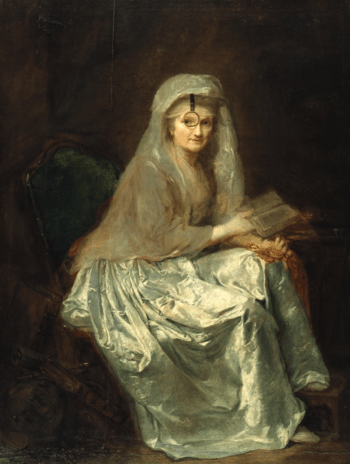
One of the painter’s best-known works is a large-format self-portrait from around 1782 in which Therbusch presents herself as a scholar and elegant figure of note. She appears as an approachable and intelligent interlocutor, interested in both objects and her conversation partner, as indicated by the book in her hand and her frontal gaze. Centred around this important painting, the exhibition presents nearly all of Therbusch’s works from the Staatliche Museen zu Berlin. Complemented by key works from her contemporaries, the show provides a comprehensive overview of her oeuvre, her professional milieu, and more broadly the age in which she lived.










 Enfilade
leave a comment