Exhibition | Thomas Gray

The exhibition closes soon, but I note it here particularly to draw your attention to the online component, mounted by Daniel McKay: it’s the most compelling virtual book exhibition I’ve ever seen.
Thomas Gray: An Anniversary Exhibition
Ward Library, Peterhouse, Cambridge, 8 November — 13 December 2021
Curated by Scott Mandelbrote
To mark the 250th anniversary of Thomas Gray’s death, the 270th anniversary of the publication of “Elegy Written in a Country Churchyard,” and the 305th anniversary of his birth.
Thomas Gray was born on 26 December 1716 and died on 30 July 1771. On 15 February 1751, one of the leading contemporary publishers of literary works, Robert Dodsley, hurried into print an edition of an Elegy wrote in a Country Church Yard, which subsequently became one of the most reprinted, anthologised, translated, and imitated poems in any language. It was one of barely more than a dozen poems that Gray allowed to be printed in his lifetime.
This exhibition considers Gray’s life and work from the perspective of the holdings of the two Cambridge Colleges with which he was associated from 1734, when he entered Peterhouse, until his death, which occurred shortly after he was taken ill at dinner in Pembroke. The exhibition focusses on three defining themes in Gray’s life and reputation: his relationship with Cambridge and the effect on him and on his work of the friends and enemies he made at the University; his activity as a reader, in particular as a user of the libraries of his two Colleges; and the publishing phenomenon of the “Elegy,” his most significant poem and one steeped in his appreciation and emulation of classical tradition, as well as his sense of place and of English history and the history of English poetry.
Exhibition | Afro-Atlantic Histories
From the press release (21 October 2021) for the exhibition:
Afro-Atlantic Histories
Museu de Arte de São Paulo, 28 June — 21 October 2018
Museum of Fine Arts, Houston, 24 October 2021 — 17 January 2022
National Gallery of Art, Washington, DC, 10 April — 17 July 2022
Los Angeles County Museum of Art, TBD
U.S. Tour Curated by Kanitra Fletcher
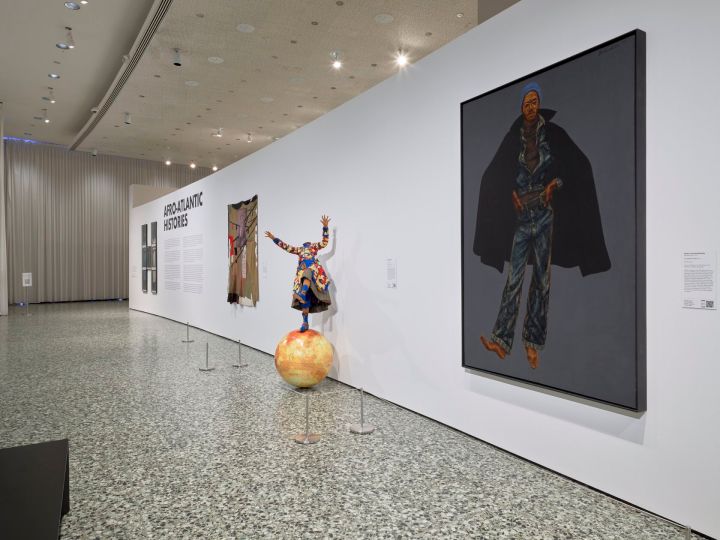
This fall the Museum of Fine Arts, Houston, will debut the U.S. tour of Afro-Atlantic Histories, an unprecedented exhibition that visually explores the history and legacy of the transatlantic slave trade. Initially organized and presented in 2018 by the Museu de Arte de São Paulo (Histórias Afro-Atlânticas), the exhibition comprises more than 130 artworks and documents made in Africa, the Americas, the Caribbean, and Europe from the 17th to the 21st centuries.
 In collaboration with MASP and the National Gallery of Art in Washington, DC, the MFAH will present Afro-Atlantic Histories at its Caroline Wiess Law Building from Sunday, 24 October 2021, through Monday, 17 January 2022. The exhibition will then travel to the National Gallery of Art to be on view in its West Building from Sunday, 10 April, through Sunday, 17 July 2022, with the Los Angeles County Museum of Art and additional venues confirmed to follow.
“Afro-Atlantic Histories recasts the traditional telling of the colonial history of the Western hemisphere within the vast web of the transatlantic slave trade over three centuries,” commented Gary Tinterow, Director, Margaret Alkek Williams Chair, MFAH. “It is an essential reexamination, one that the MFAH and the National Gallery have distilled from its expansive, original presentation in Sao Paulo in 2018 to focus on forgotten perspectives under the theme of histórias.”
“The National Gallery is honored to partner with the Museu de Arte de São Paulo and the Museum of Fine Arts, Houston, to bring Afro-Atlantic Histories to the United States. In the nation’s capital, this exhibition will shed light on the many histories that are crucial to our understanding of the legacy of slavery across the Americas,” said Kaywin Feldman, Director of the National Gallery of Art. “Through works made by artists across five centuries, Afro-Atlantic Histories will also celebrate the ongoing influence of the African diaspora on both sides of the Atlantic.”
Afro-Atlantic Histories dynamically juxtaposes works by artists from 24 countries, representing evolving perspectives across time and geography through major paintings, drawings and prints, sculptures, photographs, time-based media art, and ephemera. The range extends from historical paintings by Frans Post, Jean-Baptiste Debret, and Dirk Valkenburg to contemporary works by Ibrahim Mahama, Kara Walker, and Melvin Edwards.
The U.S. tour further builds on the exhibition’s overarching theme of histórias—a Portuguese term that can encompass both fictional and non-fictional narratives of cultural, economic, personal, or political character. The term is plural, diverse, and inclusive, presenting viewpoints that have been marginalized or forgotten.
The exhibition unfolds through six thematic sections that explore the varied histories of the diaspora:
• Maps and Margins illustrates the beginnings of the slave trade as it unfolded across the Atlantic between Africa, the Americas, and Europe. Highlights include artworks that reference the widely reproduced British Abolitionist document Description of a Slave Ship (1789), an illustration that clinically detailed a slave ship’s cargo hold; Aaron Douglas’s painting Into Bondage (1936), a powerful portrayal of the moment when a group of Africans are taken to a slave ship bound for the Americas.
• Enslavements and Emancipations examines how the abuses of commercial slavery triggered rebellion, escape, and Abolitionist movements. Theodor Kaufmann’s On to Liberty (1867) portrays women and children fleeing through the woods—a scene that Kaufmann, who served as a Union Solider during the American Civil War, witnessed firsthand. Torturous practices are addressed in works that range from The Scourged Back, the widely published 1863 photograph by McPherson & Oliver, to the 2009 etching Restraint, a powerful image of a silhouetted figure in an iron brindle, by American artist Kara Walker. Samuel Raven’s Celebrating the Emancipation of Slaves in British Dominions, August 1834 (c. 1834) presents a romanticized tribute to emancipation; Ernest Crichlow’s portrait of Harriet Tubman honors the fearless liberator and ‘conductor’ of the Underground Railroad.
• Everyday Lives features images of daily life in Black communities during and after slavery, in realistic and romanticized views. Among 20th-century artists, American Clementine Hunter and Brazilian Heitor dos Prazeres depict field work and friendships. American Romare Bearden draws inspiration from the rhythmic and improvised staccato of jazz and the blues, using shifts in scale, breaks in color, and disarranged perspectives for his depiction of a sharecropper in the monumental collage Tomorrow I May Be Far Away (1967). The pastoral painting Landscape with Anteater (c. 1660), by the Dutch artist Frans Post, places enslaved laborers and indigenous peoples in an idyllic Brazilian landscape.
• Rites and Rhythms features works about celebrations and ceremonies in the Americas and the Caribbean. Often re-creating African traditions, these rites became channels for worship and communication. Twentieth-century Uruguayan artist Pedro Figari frequently portrayed his country’s Candombe dances, which originated with descendants of enslaved Africans. Dominican artist Jaime Colson’s lively Merengue (1938) pays homage to his country’s national dance and music, a blend of Afro-Caribbean rhythms and African movements. Other works in this section of the exhibition explore Carnival, African-based religions, and the historical Black presence in Christianity.

Dalton Paula, Zeferina, 2018.
• Portraits spotlights Black leaders of the 18th and 19th centuries who have not traditionally been memorialized in historical American and European portraiture. Dalton Paula’s Zeferina (2018), commissioned for the original presentation at MASP, provides a face to an influential slave rebellion leader who was arrested and sentenced to death before she could be commemorated. Other historical and more contemporary works feature ordinary people, invented figures, and the artists themselves, including Self-Portrait (as Liberated American Woman of the ’70s) (1997) by Cameroonian photographer Samuel Fosso, an unconventional work that challenges our understanding of self-portraiture.
• Resistances and Activism examines the continuing fight for freedoms. Banners, flags, and textiles referring to histories of resistance across the Afro-Atlantic invoke cultural, political, religious, and artistic identities. Me gritaron negra (They shouted black at me) (1978), a video by Venezuelan artist Victoria Santa Cruz, is a powerful renunciation of colorism and racism through poetry and dance inspired by the artist’s own history. Other works in this section draw attention to Black activism, including Glenn Ligon’s painting Untitled (I Am a Man) (1988), inspired by signs carried in the 1968 Memphis Sanitation Workers’ Strike, which protested unsafe working conditions and low wages; and March on Washington (1964), a rare figurative painting by Alma Thomas that recalls her experience attending the storied demonstration.
The U.S. tour is curated by Kanitra Fletcher, Associate Curator of African American and Afro-Diasporic Art at the National Gallery of Art. Adriano Pedrosa, Artistic Director; Ayrson Heráclito, Curator; Hélio Menezes, Curator; Lilia Moritz Schwarcz, Adjunct-Curator of Histories; and Tomás Toledo curated the exhibition at the Museu de Arte de São Paulo. At the National Gallery, the curatorial team also includes Molly Donovan, Curator of Contemporary Art, and Steven Nelson, Dean of the Center for the Advanced Study in the Visual Arts.
In Washington, DC, the curators are working closely with an external advisory group of local leading historians and art historians: Ana Lucia Araujo, Professor of History, Howard University; Nicole Ivy, Assistant Professor of American Studies, George Washington University; Kevin Tervala, Associate Curator of African Art, Baltimore Museum of Art; Kristine Juncker, Special Assistant to the Director, National Museum of African Art; and Michelle Joan Wilkinson, Curator, Smithsonian National Museum of African American History and Culture.
Adriano Pedrosa and Tomás Toledo, eds., with additional contributions by Ayrson Heráclito, Deborah Willis, Hélio Menezes, Kanitra Fletcher, Lilia Moritz Schwarcz, and Vivian Crockett, Afro-Atlantic Histories (New York: DelMonico Books / Museu de Arte de São Paulo, 2021), 400 pages, ISBN: 978-1636810027, $70.
Exhibition | The Abyss: Nantes and the Atlantic Slave Trade, 1707–1830

L’abîme: Nantes dans la traite atlantique et l’esclavage colonial, 1707–1830 as installed at the Musée d’histoire de Nantes (Photo by David Gallard). The graphic elements on the wall and the floor are taken from an eighteenth-century document, signed by participants in the slave trade, that depicts La Marie Séraphique, a slave ship that in 1769 transported 312 captives to Cap-Français.
◊ ◊ ◊ ◊ ◊
Now on view at the Musée d’histoire in Nantes (there is also a Google Arts & Culture site, “Nantes and the Atlantic Slave Trade,” with related objects from the museum).
The Abyss: Nantes’s Role in the Slave Trade and Colonial Slavery, 1707–1830
L’abîme: Nantes dans la traite atlantique et l’esclavage colonial, 1707–1830
Musée d’histoire de Nantes, Château des ducs de Bretagne, 16 October 2021 to 19 June 2022
Curated by Krystel Gualdé

Plan, Profile, and Layout of the Ship ‘The Séraphique Marie’ of Nantes, outfitted by Mr Gruel, for Angola, under the command of Gaugy, who dealt in Loango . . ., 1770 (Musée d’histoire de Nantes).
Still today, historians are unable to agree on the number of victims resulting from the transatlantic slave trade. With so many documents missing, it is impossible to arrive at an exact figure; and yet, the difference in final totals does not vary in terms of tens or hundreds or thousands—but in millions. How can a phenomenon so tragic and fundamental divide those who study it to such a degree? It would appear that the number, as staggering as it may be, does not explain the problem sufficiently. Moreover, what would we ultimately know if we arrived at a definite number? Would we know how many men, women, and children died during the wars and raids that led to their captivity? Would we have a better idea of how an entire city and its surrounding region could justify using the colonial system and slave trade as a means to accumulate unprecedented wealth? Would we be able to imagine the close ties between the transatlantic slave trade and the early Industrial Revolution? Would we understand, if only for an instant, how horrible it must have been to no longer be autonomous, to stop being considered human and be relegated to the status of a material good, to disappear without leaving any trace or memory? The exhibition provides an opportunity to hold the collections of the Musée d’histoire up to the light, revealing the invisible but ever-present traces of the men and women who were victims of the colonial system. Beyond the economic and commercial perspective commonly offered, this exhibition reveals the complex reality of a city so deeply involved in the slave trade.
Krystel Gualdé, est directrice scientifique du Musée d’histoire de Nantes et du Mémorial de l’esclavage. Spécialiste de la traite atlantique et de l’esclavage colonial, elle engage le musée dans de nombreux partenariats et réseaux scientifiques au niveau national comme international (Conseil d’orientation de la Fondation pour la mémoire de l’esclavage ; Projet SLAFNET – Slavery in Africa: A Dialogue between Europe and Africa). Elle est par ailleurs membre du Global Curatorial Project porté par le Center for the Study of Global Slavery at the Smithsonian’s National Museum of African American History and Culture (NMAAHC) et le Center for the Study of Slavery and Justice à l’université Brown aux Etats-Unis.
Krystel Gualdé, L’abîme: Nantes dans la traite atlantique et l’esclavage colonial, 1707–1830 (Rennes: Presses Universitaires de Rennes), 320 pages, ISBN: 978-2906519794, 30€.
A preview of the book is available here»
The dossier de presse is available here»
The Decorative Arts Trust Announces Failey Grant Recipients
From the press release (1 December 2021) . . .
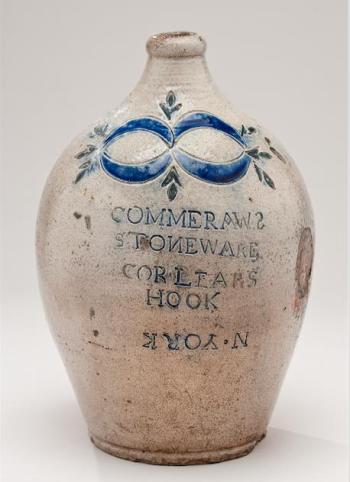
Thomas W. Commeraw, Jug, ca. 1796–1819, stoneware and cobalt oxide. Impressed on front: “COMMERAW’S/STONEWARE / CORLEARS / HOOK / N. YORK” (New-York Historical Society, 1937.820).
The Decorative Arts Trust congratulates author Caitlin Meehye Beach, Historic Rock Ford, and the New-York Historical Society on receiving Failey Grants. The Failey Grant program provides $25,000 in support for noteworthy research, exhibition, publication, and conservation projects through the Dean F. Failey Fund, named in honor of the Trust’s late Governor. Preference is given to projects that employ or are led by emerging professionals in the museum field.
Caitlin Meehye Beach, an assistant professor in the Department of Art History and affiliated faculty in the Department of African and African American Studies at Fordham University, will utilize grant funds for her forthcoming book Sculpture at the Ends of Slavery, which will be published by the University of California Press in 2022. The text will examine how a wide range of works of sculpture and decorative art—from antislavery medallions to statues of bondspeople bearing broken chains—gave visual form to narratives about abolition in the 18th and 19th centuries.
Historic Rock Ford in Lancaster, Pennsylvania, will use grant funding for further research and interpretation of the over 200 objects in their John J. Snyder, Jr. Gallery of Early Lancaster County Decorative Arts. Their goal is to uncover more about the shops, apprentices, laborers, indentured laborers, and enslaved workers who contributed to the Gallery’s collection of furniture, silver, clocks, and paintings from the mid-1700s to the early 1800s.
The New-York Historical Society receives grant funding for the groundbreaking exhibition Crafting Freedom: Uncovering the Life and Legacy of Free Black Potter Thomas Commeraw, to be presented January to June 2023 in their Pam & Scott Schafler Gallery. Crafting Freedom will be the first exhibition focused solely on Commeraw, a free Black craftsman descended from enslaved people, who was active as a master potter from the 1790s through 1819.
The Decorative Arts Trust is a non-profit membership organization that promotes and fosters the appreciation and study of the decorative arts through exchanging information through domestic and international programming; collaborating and partnering with museums and preservation organizations; and underwriting internships, research grants, and scholarships for graduate students and young professionals.
Exhibition | Antoine Watteau: Art — Market — Trade
Now on view at Schloss Charlottenburg:
Antoine Watteau: Art — Market — Trade
Schloss Charlottenburg, Berlin, 9 October 2021 — 1 January 2022
Curated by Christoph Martin Vogtherr
 2021 marks the 300th anniversary of the death of the French painter Antoine Watteau (1684—1721). The fame of the artist, who was already celebrated during his lifetime, continues to have an effect today, and his works are coveted collector’s items. After the Louvre in Paris, the Prussian Palaces and Gardens Foundation Berlin-Brandenburg owns the most important collection of paintings by this artist. Under the motto ‘Art—Market—Trade’, a special exhibition at Charlottenburg Palace pays tribute to this outstanding painter of the 18th century. The focus of the show is one of Watteau’s major works: the Shop Sign of the Art Dealer Gersaint (L’enseigne du marchand d’art Gersaint). Acquired by Frederick the Great (1712—1786) in 1746, the painting has been considered a masterpiece ever since it was painted. Originally created as a medium of business advertising and as a ‘figurehead’ of the Parisian art trade, the painting continues to stimulate contemporary questions concerning marketing, trade, but also collecting and intellectual engagement with art.
Two protagonists of Parisian art life are presented: Edme-François Gersaint (1694—1750) and Jean de Jullienne (1686—1766). Gersaint, a young up-and-coming art dealer, used his shop on the Pont Notre Dame in Paris to market the artist’s works throughout Europe through new advertising media and formats after Watteau’s death. Together with Jullienne, a collector and patron of Watteau, they realized the idea of reproducing all of the painter’s drawings and paintings in print. This edition, the Recueil Jullienne, was the prototype of a modern illustrated collection of works, which in its aftermath was to trigger a veritable fashion wave: throughout Europe, collectors, manufactory owners, and tradesmen acquired the prints created after Watteau’s works. Watteau’s imagery also inspired court painting and arts and crafts in Prussia. Motifs á la Watteau can be found not only in painting, but also on screens, wallpaper, fans, porcelain, and tapestries of the Frederician period.
As a source of inspiration, Watteau continues to have an impact right up to the modern age. Contemporary artists such as the Swiss painter Thomas Huber (b.1955) and the British fashion designer Vivienne Westwood (b.1941) are represented in the exhibition with one work each. Their artistic positions show that Watteau is still perceived today as an innovative artist and that his work stimulates creative debate. The exhibition, under the patronage of the French ambassador Anne-Marie Descôtes, paints a multifaceted picture of Watteau as an artist and style icon, whose posthumous fame was established with the shop of the art dealer Gersaint on Notre Dame in Paris.
C. Alff, S. Evers, P. Fuhring, A. Moulinier, D. Ranftl, C. Vogtherr, F. Windt, E. Wollschläger, Antoine Watteau: Kunst — Markt — Gewerbe / Art — Marché — Commerce (Munich: Hirmer Verlag, 2021), 272 pages, ISBN: 978-3777437866 (German edition) / ISBN: 978-3777437842 (French edition), 40€.
Exhibition | The Expressive Body, 1400–1750
From the press release for the exhibition:
The Expressive Body: Memory, Devotion, Desire (1400–1750)
Norton Simon Museum, Pasadena, 15 October 2021 — 7 March 2022
Organized by Maggie Bell
The Norton Simon Museum presents The Expressive Body: Memory, Devotion, Desire (1400–1750), an exhibition that examines the ways in which the human form has provoked powerful responses, from the physiological to the mystical. In the early modern period—that is, the centuries following the Middle Ages—works of art were thought to have such power that they affected the viewer physically. From erotic paintings produced for wealthy patrons to venerated statues of the wounded Christ installed in local chapels, representations of the body stimulated visceral and often self-reflexive reactions of desire, compassion, or aversion.

Francesco Trevisani, Apelles Painting Campaspe, 1720, oil on canvas, 75 × 60 cm (Pasadena: The Norton Simon Foundation).
Culled from the Norton Simon’s collections, the more than 60 artworks presented in the exhibition include paintings, drawings, prints and sculptures from throughout Europe and Latin America, some of which have rarely been exhibited. The exhibition is on view in the Norton Simon Museum’s exhibition galleries on the lower level from 15 October 2021 through 7 March 2022.
The Expressive Body is organized around two major themes: “Love and Suffering” and “Accessing the Divine.” Within these sections are art objects that were created to be experienced in multisensory ways, including sculptures meant to be caressed, prints that were handled, and even sacred images that were kissed (although not permitted today in a museum setting). Indeed, medical theory during this era suggested that even gazing at representations of beautiful lovers could have physical consequences, leading to the conception of handsome and healthy children, whereas spiritual practice could involve meditating on the portrayal of a tortured martyr in order to empathetically feel his or her torment.
The exhibition’s introductory section explores the notion of “The Body and the Senses,” providing context for the role of the body in perceiving art in the period. Included is Jusepe de Ribera’s fascinating painting The Sense of Touch from c. 1615–16. Seated at a wooden table, a blind man uses his hands to thoughtfully observe a carved head; a painting rests beside him, unexamined. By depicting the sense of touch in this way, Ribera engages with a major debate in the period over the merits of sculpture versus painting. Sculpture seems to be the victor here, since it can be perceived by both touch and sight, and is therefore the more accessible and verifiable of the arts. Ribera’s naturalistic rendering of the sculpture, however, also makes a case for the virtuosity of painting. The artist uses paint to create the effects of texture and weight, emphasizing the man’s wrinkled hands as they hold the bust. Through vision the painting appeals to the sense of touch, inviting viewers to imagine the sculpture’s smooth contours under their own fingertips.
The theme of love and suffering has long been explored by artists. In Francesco Trevisani’s Apelles Painting Campaspe from 1720, the artist blurs the line between real and represented bodies in his depiction of Apelles, the favorite painter of Alexander the Great, who painted a beautiful portrait of Campaspe, the ruler’s mistress. As the apocryphal story goes, the artist’s representation was so flattering that Alexander chose the painting over Campaspe herself. This clever interpretation, which would have amused 18th-century Roman patrons, makes an argument for the beguiling power of painting.
Also in this section is Guercino’s dramatic Suicide of Cleopatra from around 1621. This large painting depicts a moment of despair for the powerful queen, but like many images of this subject, the painting has erotic undertones. Guercino emphasizes the drama of the moment through the dynamic pose of the Cleopatra’s body, and he highlights her beauty with strong contrasts of light and dark. The soft lushness of her garments adds to the tactile nature of the painting, and contrasts with the perception of the sharp pain of the asp’s bite.

Unknown artist, Mexico, Head of Christ, 18th century, polychrome wood, 43 × 38 cm (Pasadena: Norton Simon Museum, Gift of Mrs. Henrietta S. Cecil).
Religious images likewise had palpable effects, but to devotional ends. In the “Accessing the Divine” section, visitors will encounter the Head of Christ from 18th-century Mexico, a sculpture that invites worshippers to meditate on the physicality of Christ’s pain, brutally represented by his lacerated flesh and his lips parted in agony, subtly exposing delicately carved teeth. These details become all the more arresting in their three-dimensionality, mimicking the scale and appearance of a human head, and making the representation of the suffering Christ feel inescapably real. Polychrome sculptures like this one were common, but they caused anxiety among some religious reformers who feared that the sculptures would prompt too much empathy in viewers, leading them to treat the inert representations as living idols.
A more tender representation of Christ can be found in Baciccio’s Saint Joseph and the Infant Christ from around 1670–85. The artist represents the strong familial bond between the baby Jesus and his earthly father, Joseph, which was unusual, since such scenes of parental affection typically involved the Madonna and Child. Baciccio brilliantly portrays the recognizably human gesture of a baby reaching up to the face of his parent. The act of touching is a central component of this image—we can imagine the scratchiness of Joseph’s beard in Christ’s hands, or the weight of the baby in Joseph’s arms. Though the painting depicts a human moment between father and child, the monumentality of the figures reminds the viewer of the baby’s divine nature.
When presented together, the objects in The Expressive Body: Memory, Devotion, Desire (1400–1750) reveal the historical potency of the represented body to move the mind through the flesh, and they invite us to examine our own responses to these works today. The exhibition is organized by Assistant Curator Maggie Bell and is on view in the Museum’s lower level exhibition galleries.
Exhibition | In American Waters

Unknown artist in New England, Contemplation by the Sea, 1790, oil on board 37 × 59 inches
(Salem, MA: Peabody Essex Museum, Museum purchase with funds from anonymous donor, 1994 137681)
◊ ◊ ◊ ◊ ◊
Now on view at Crystal Bridges:
In American Waters: The Sea in American Painting
Peabody Essex Museum, Salem, Massachusetts, 29 May — 3 October 2021
Crystal Bridges Museum of American Art, Bentonville, Arkansas, 6 November 2021 — 31 January 2022
Curated by Austen Bailly and Daniel Finamore
 For over 200 years, artists have been inspired to capture the beauty, violence, poetry, and transformative power of the sea in American life. Oceans play a key role in American society no matter where we live, and still today, the sea continues to inspire painters to capture its mystery and power. Be transported across time and water on the wave of a diverse range of modern and historical artists including Georgia O’Keeffe, Amy Sherald, Kay WalkingStick, Norman Rockwell, Hale Woodruff, Paul Cadmus, Thomas Hart Benton, Jacob Lawrence, Valerie Hegarty, Stuart Davis, and others.
highlights American art historical and cultural traditions associated with the sea, deepening our understanding of it as a symbol of American ambition, opportunity, and invention. While histories of American art have long privileged ways of imagining American culture that tell only a partial story and that overlook marine narratives of national and individual experience past and present, this ambitious exhibition reveals the sea as an expansive way to reflect on American culture and environment and to question what it means to be “in American waters.”
The exhibition is co-created by Austen Bailly, chief curator, Crystal Bridges Museum of American Art, and Daniel Finamore, The Russell W. Knight Curator of Maritime Art and History, Peabody Essex Museum in Salem, Massachusetts.
Daniel Finamore and Austen Barron Bailly, eds., with additional contributions by Mindy N. Besaw, Sarah N. Chasse, and George H. Schwartz, In American Waters: The Sea in American Painting (Fayetteville: University of Arkansas Press, 2021), 240 pages, ISBN: 978-1682261705, $60.
The Burlington Magazine, October 2021
The eighteenth century in October’s issue of The Burlington . . . Rado’s article is not an eighteenth-century essay, but she is a HECAA member (!), and she briefly frames the material in terms of a longer history; the theme for the October issue is ‘art in twentieth-century China’. –CH
The Burlington Magazine 163 (November 2021)
 E D I T O R I A L
• “Art History in the Anthropocene” p. 883.
A R T I C L E S
• Mei Mei Rado, “The Empress Dowager Cixi’s Japanese Screen and Late Qing Imperial Cosmopolitanism,” pp. 886–97.
R E V I E W S
• Arthur Bijl, Review of the exhibition catalogue Kjeld von Folsach, Joachim Meyer, and Peter Wandel, Fighting, Hunting, Impressing: Arms and Armour from the Islamic World, 1500–1850 (Copenhagen: David Collection / Strandberg Publishing, 2021), pp. 946–47.
• Kee Il Jr Choi, Review of John Finlay, Henri Bertin and the Representation of China in Eighteenth-Century France (Routledge, 2020), pp. 966–67.
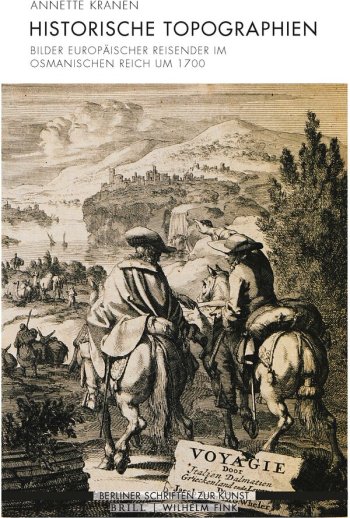
• Mirjam Hähnle, Review of Annette Kranen, Historische Topographien: Bilder europäischer Reisender im Osmanischen Reich um 1700 (Brill, 2020), pp. 971–72.
Exhibition | Hogarth and Europe

William Hogarth, The March of the Guards to Finchley, 1749–50
(London: The Foundling Museum)
◊ ◊ ◊ ◊ ◊
From the press release (1 November 2021) for the exhibition:
Hogarth and Europe
Tate Britain, London, 3 November 2021 – 20 March 2022
Curated by Alice Insley and Martin Myrone
Few artists have defined an era as much as William Hogarth (1697–1764), whose vivid, satirical depictions of 18th-century England continue to capture the imagination today. Tate Britain’s major exhibition Hogarth and Europe presents his work in a fresh light, seen for the first time alongside works by his continental contemporaries. It explores the parallels and exchanges that crossed borders and the cosmopolitan character of Hogarth’s art. Hogarth’s best-known paintings and prints—such as Marriage A-la-Mode (1743), The Gate of Calais (1748), and Gin Lane (1751)—are shown alongside works by famed European artists, including Jean-Siméon Chardin in Paris, Pietro Longhi in Venice, and Cornelis Troost in Amsterdam. Together they reveal how changes in society took art in new directions, both in Britain and abroad.
 Featuring over 60 of Hogarth’s works, brought together from private and public collections around Europe and North America, the exhibition draws decades of research to show Hogarth in all his complexity—whether as staunch patriot or sharp critic, bawdy satirist or canny businessman. It also examines the shifting status of artists in the 18th century, from workshop artisans and court painters to independent freelancers enjoying prominence alongside actors, musicians, and writers. The rapid expansion of urban centres like London, Paris, Amsterdam, and Venice also saw the city itself become a major subject in art for the first time. Tate Britain juxtaposes these metropolitan scenes from across Europe, showing the bustling London streets of Hogarth’s Southwark Fair (1733) and The March of the Guards to Finchley (1749–50) together with vibrant depictions of Étienne Jeaurat’s Paris and Longhi’s Venice.
This was an age of opportunity and innovation, but also materialism, self-delusion, exploitation, and injustice. In Europe, new heights of luxury emerged with extreme poverty, while growing cities saw overcrowding and disease. The rising demand for consumer goods at home came at the expense of the labour and lives of enslaved and colonised people overseas. Against the backdrop of this changing world, artists like Hogarth pioneered a new painting of modern life, revealing its pleasures and dynamism but also its dangers and stark inequalities. In the 1730s he began his ‘modern moral series’: frank and engaging narratives charting the rise and fall of everyday characters corrupted by immorality and vice. Hogarth and Europe includes these celebrated series, including A Rake’s Progress (1734), which were immediately popular and widely circulated through print. At Tate Britain they are shown alongside paintings by the Italian Giuseppe Crespi, including The Flea (1707–09), and the Parisian Nicolas Lancret, to show how this new artistic genre of urban storytelling developed across Europe.
The 18th century also saw greater informality and ease in portraiture, expressing the new ideas emerging around individuality and personal freedom that remain familiar today. The exhibition culminates in a room focussing on such pictures, including Miss Mary Edwards (1742)—a painting not seen in the UK for over a century—depicting the eccentric, wealthy patron who commissioned many of Hogarth’s best-known works. Additional highlights include paintings of his sisters Mary and Anne Hogarth, as well as Heads of Six of Hogarth’s Servants (c.1750–55). Through juxtapositions with European artworks, the exhibition looks afresh at these and many other works by one of Britain’s most important artists, giving visitors a chance to see Hogarth’s position on the international stage in a new light.
Hogarth and Europe is curated by Alice Insley, Curator, British Art c 1730–1850 and Martin Myrone, former Senior Curator, pre-1800 British Art, Tate Britain (now Convenor, British Art Network at the Paul Mellon Centre). The exhibition is accompanied by a fully illustrated catalogue featuring essays by eminent scholars and artists including Lubaina Himid and Sonia E. Barrett.
Martin Myrone and Alice Insley, eds., Hogarth and Europe (London: Tate, 2021), 208 pages, ISBN: 978-1849767682, £40 / $55.
The exhibition guide is available here»
Lecture | Frédéric Ogée, Pleasures of the Senses and the Imagination
From the conference series Sociabilité et libertinage au siècle des Lumières, organized at the Cognacq-Jay Museum in conjunction with this year’s summer exhibition Realm of the Senses, from Boucher to Greuze / L’ Empire des sens, de Boucher à Greuze (19 May — 18 July 2021), curated by Annick Lemoine . . .
Frédéric Ogée | Plaisirs des sens, plaisirs de l’imagination dans l’art et la littérature anglaise du 18ème siècle
Online and In-Person, Musée Cognacq-Jay, Paris, 26 November 2021, 17.00
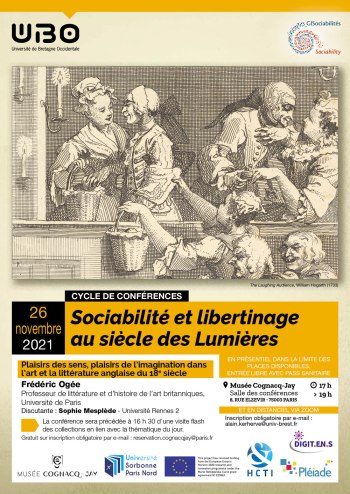 Dans le sillage de sa « Glorieuse Révolution » de 1688, l’Angleterre inaugura le siècle des Lumières en découvrant le plaisir d’un certain nombre de libertés : « régler le pouvoir des rois en leur résistant » (Voltaire), publier sans entrave, ré-évaluer l’héritage des Anciens, regarder la Nature à travers le prisme de Newton plutôt que celui des prêtres, entreprendre à crédit, célébrer la sensibilité et l’imagination. Les Anglais ont ainsi cherché de nouveaux équilibres entre la liberté de l’individu—son goût, sa subjectivité, sa perception du monde, son « progrès » —et les nécessités de la sphère collective, qu’elle soit publique ou privée. Ecrivains et artistes se sont vite employés à représenter cette nouvelle sociabilité, pour la modéliser et la polir autant que pour la promouvoir, au travers de remarquables expériences littéraires et picturales où les personnages se meuvent et s’émeuvent sous l’œil complice du spectateur-lecteur. Influencés par la philosophie empiriste ils font l’expérience du plaisir des sens pour accéder à la connaissance, d’eux-mêmes et du monde. La présente conférence permettra d’évoquer cette remarquable période de créativité qui, de Daniel Defoe et William Hogarth à Jane Austen et Thomas Lawrence, contribua au triomphe de la Grande-Bretagne sur la scène du monde.
Discutante: Sophie Mesplède (Université Rennes 2)
Frederic Ogee est professeur de littérature et d’histoire de l’art britanniques à l’Université de Paris. Ses principaux domaines de recherche sont l’esthétique, la littérature et l’art au cours du long 18ème siècle (1660–1815), sur lesquels il a souvent donné des conférences dans des universités européennes, nord-américaines et asiatiques. Commissaire de l’exposition sur le peintre anglais William Hogarth au Musée du Louvre en 2006, il est l’auteur de plusieurs ouvrages, notamment Diderot and European Culture, un recueil d’essais (Oxford: 2006, réédité 2009), J.M.W. Turner : Les paysages absolus (Hazan, 2010), et Jardins et Civilisations (Valenciennes, 2019), suite à une conférence organisée à l’Institut Européen des Jardins et Paysages de Caen. Il écrit actuellement une série de quatre monographies sur quelques grands artistes anglais (Thomas Lawrence, J.M.W. Turner, Thomas Gainsborough et William Hogarth) pour les éditions Cohen & Cohen (Paris), à paraître entre 2022 et 2025. De 2014 à 2017, il a été membre du conseil scientifique du musée Tate Britain à Londres et, depuis 2014, est membre du Conseil Scientifique de la Ville de Paris.
Conférence en présentiel dans la limite des places disponibles, entrée libre avec pass sanitaire ET en distanciel via Zoom. Participation libre sur inscription obligatoire: reservation.cognacqjay@paris.fr et alain.kerherve@univ-brest.fr. La conférence sera précédée à 16h30 d’une visite flash des collections en lien avec la thématique du jour.
Emmanuelle Brugerolles, Marine Carcanague, Marie-Anne Dupuy-Vachey, Guillaume Faroult, Yuriko Jackall, F. Joulie, É. Kerner, A. Laing, C. Le Bitouzé, A. Le Brun, A. Lemoine, N. Lesur, H. Meyer, L-A. Prat, S. de Saint-Léger, M. Szanto, L’ Empire des sens, de Boucher à Greuze (Paris Musées / Musée Cognac-Jay, 2020), 152 pages, ISBN: 978-2759605002, €30.










 Enfilade
leave a comment