Exhibition | Fan Leaves: Between Europe and Japan
From the press release for the exhibition:
Feuilles d’éventail entre Europe et Japon
Musée d’art et d’histoire, Geneva, 1 October 2021 — 30 January 2022 (extended until 29 May 2022)
Curated by Bénédicte De Donker
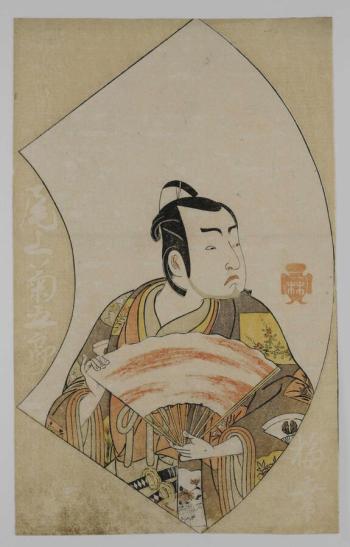
Katsukawa Shunshō 勝川 春章, Ippitsusai Bunchō 一筆斎 文調, Kariganeya Ihei 雁金屋 伊兵衛, The Actor Onoe Kikugorō, also called Kobaikō, 1770, woodblock print (Musée d’art et d’histoire de Genève, Inv. E 2013-0032). In 1770, Katsukawa Shunshō and Ippitsusai Bunchō published an illustrated book, in three volumes, of actors’ portraits on fans, introducing a new genre of portraiture known as nigao-e.
Cet automne, l’éventail est au cœur d’une présentation inédite déployée dans les trois cabinets consacrés aux arts graphiques au deuxième étage du musée. Accessoire de mode apparu dès l’Antiquité dont l’usage se retrouve de par le monde, l’éventail a également intéressé les artistes qui se sont plu à le représenter dans leurs œuvres, voire à réaliser des feuilles pour l’habiller. Feuilles d’éventails, entre Europe et Japon fait écho à la grande exposition proposée au même moment dans les salles palatines, Pour la galerie: Mode et portrait.
Cette présentation revient sur les influences croisées de l’art de l’éventail entre Europe et Asie, qui atteint son apogée au XIXe siècle avant son déclin irrémédiable. Elle témoigne surtout de l’engouement européen pour cet accessoire, dont les formes les plus répandues (brisé et plié) proviennent d’Extrême-Orient. Certains exemplaires, par le choix de matières précieuses ainsi que par la finesse et la qualité de leur travail sont de véritables œuvres d’art. Car au-delà de son utilité, un éventail présente également une dimension artistique, et même parfois politique, selon ses créateurs et les sujets représentés. Sans surprise, il rejoint le panthéon des objets avec lesquels l’on aime—et doit—se montrer. Accessoire de mode, il arbore des formes variées (brisé, plié, ballon, plein vol…) et des matériaux divers, au gré des tendances (plumes, dentelle, parchemin…).
Feuilles d’éventails, entre Europe et Japon puise sa sélection dans le fonds d’arts graphiques du MAH, ainsi que dans sa collection d’arts appliqués. Autour de quelques splendides éventails, se déploie une sélection de feuilles d’éventails provenant elles aussi d’Europe et du Japon. Dessinées ou gravées, celles-ci étaient destinées à être montées ou à servir de modèle. Cet ensemble inclut une série exceptionnelle de huit feuilles peintes au XVIIIe siècle, dévoilée pour la première fois au public. Enfin, une quinzaine de représentations de leur usage en Europe, du XVIe à l’aube du XXe siècle, côtoie des gravures japonaises mettant en scène des personnages hauts en couleurs munis d’éventails.
◊ ◊ ◊ ◊ ◊
Coordinating with the exhibition To Play to the Gallery: Fashion and Portrait, the Prints and Drawings Department has chosen to focus on a fashion accessory that is both an artistic medium and the subject of numerous representations: the fan. The three cabinets on the first floor show fan mounts, drawn or engraved, to be mounted or used as models, representations of their use in Europe from the 16th to the early 20th century, as well as a collection of Japanese engravings and fans. This presentation includes an exceptional series of eight sheets painted in the 18th century, unveiled to the public for the first time.
The full press release is available here»
Exhibition | To Play to the Gallery: Fashion and Portrait
Opening this fall at the MAH in Geneva:
Pour la Galerie: Mode et Portrait
Musée d’art et d’histoire, Geneva, 17 September — 14 November 2021
 Longtemps réservé à l’élite, aujourd’hui à portée de téléphone mobile, le portrait est le lieu de la projection et de la fabrication de l’image de soi par excellence. Le vêtement, des somptueux drapés des portraits d’apparat à la variété du vestiaire contemporain, en constitue un élément clé : il est un moyen de distinction, entre conformisme et quête d’originalité. Et au-delà de tout ce qui caractérise une époque, les codes traversent les modes comme autant de signes d’un statut affirmé ou rêvé. En confrontant les peintures et les objets du MAH à la collection d’histoire de la mode de la Fondation Alexandre Vassiliev, du XVe siècle à la période contemporaine, cette exposition invite à s’élancer dans un tourbillon de matières et de couleurs, un grand défilé déployé dans les salles palatines du musée transformées en galerie des miroirs. Instruments de pouvoir, de séduction ou d’évasion, vêtements et portraits nous entraînent dans une foire aux vanités où trouve à s’exprimer, de manière éblouissante ou dérisoire, toute la gamme des aspirations et des émotions humaines.
Exhibition | Geneva and Greece: Friendship and Independence
Opening this fall at the MAH in Geneva:
Genève et la Grèce: Une amitié au service de l’indépendance
Musée d’art et d’histoire, Geneva, 15 October 2021 — 30 January 2022
 A l’occasion du bicentenaire de la déclaration d’indépendance de la Grèce (25 mars 1821), la Fondation Hardt pour l’étude de l’Antiquité classique (Vandœuvres) et le MAH rappellent les relations d’amitié unissant la Grèce et Genève au début du XIXe siècle. Un Grec, Jean Capodistrias, et deux Genevois, Charles Pictet de Rochemont et Jean-Gabriel Eynard, ont joué un rôle clé pour l’intégration de Genève à la Confédération helvétique et pour l’indépendance de la Grèce. Eynard fut, en outre, co-fondateur de la Banque nationale de Grèce.
L’exposition met en valeur la collection du MAH ainsi que celles d’institutions genevoises et de musées suisses. Elle bénéficie également d’importants prêts venant de Grèce, accordés notamment par le Musée d’histoire nationale et le Musée Philhellénique d’Athènes, le Musée Capodistrias de Corfou ainsi que par des collectionneurs privés.
Exhibition | A Taste for the Antique: Anna and Jean-Gabriel Eynard
Opening this fall at the MAH in Geneva:
Le goût de l’antique: Anna et Jean-Gabriel Eynard
Musée d’art et d’histoire, Geneva, 15 October 2021 — 2 January 2022
 Le banquier et philhellène genevois Jean-Gabriel Eynard (1775–1863) s’est acquis une renommée internationale en soutenant la guerre d’indépendance grecque. Mais quel était donc son rapport à l’antique ? Nombre de philhellènes, fascinés par la littérature et l’art grecs, s’engagèrent ainsi en faveur de la liberté de la Grèce.
L’anticomanie des époux Eynard est manifeste. Elle transparaît au travers des édifices qu’ils bâtissent (Palais Eynard, Athénée). Elle imprègne aussi leur cadre de vie comme en témoignent les aquarelles d’Alexandre Calame : outre le mobilier de style néoclassique, de nombreuses peintures et sculptures renvoient à la mythologie gréco-romaine. La statue d’Anna Eynard, réalisée par Bartolini, en est un très bel exemple. L’exposition, où les représentations figurées font écho aux objets, dévoile en outre une partie de la collection de vases antiques du couple Eynard, récemment redécouverte.
Exhibition | Bellotto: The Königstein Views Reunited

The National Gallery acquired Bellotto’s The Fortress of Königstein from the North (1756–58) in 2017. This exhibition unites it with four other paintings of the site by the artist—paintings from the Manchester Art Gallery, Knowsley Hall, and The National Gallery of Art in Washington D.C.
◊ ◊ ◊ ◊ ◊
Now on view at the National Gallery:
Bellotto: The Königstein Views Reunited
National Gallery, London, 22 July — 31 October 2021
Bernardo Bellotto (1722–1780) painted this historic site—a stronghold located approximately 25 miles south-east of Dresden, in the picturesque Elbe valley—not just once, but five times. In this exhibition, we reunite these five monumental views, which includes our recently acquired view from the north, for the first time in more than 250 years.
 Painted at the height of Bellotto’s career, when he was court painter to August III, Elector of Saxony and King of Poland, these views were commissioned as part of a larger series of 30 views of Dresden and its surroundings. The five paintings of Königstein show the ancient fortress from outside its forbidding walls as well as from within. Bellotto succeeds in capturing both the drama and detail of this commanding site, on canvases measuring more than two metres wide. Stand back and you can see the sharp, angular forms of the fortress, but look closely and you can make out the crumbling stone walls, tiny soldiers on the ramparts and women hanging washing in the courtyard.
For many years Bellotto was overlooked, in favour of his more famous uncle and master, Canaletto, but today he is recognised as one of the most distinctive artistic personalities of the 18th century. Applying what he had learnt in Venice to his highly original panoramic depictions of northern Europe, Bellotto took the tradition of view painting in an entirely new direction.
Letizia Treves, with Lucy Chiswell, Stephen Lloyd, and Hannah Williamson, Bellotto: The Königstein Views Reunited (London: National Gallery, 2021), 88 pages, ISBN: 9781857096743, £15 / $20.
Exhibition | Table Delights: Historical Linen Damasks
Press release for the exhibition, via the European Textile Network (‘Tafelfreuden’ is my new favorite word! -CH).
Tafelfreuden: Historische Leinendamaste / The Delights of Dining: Historical Linen Damasks
Abegg-Stiftung, Riggisberg, 25 April — 7 November 2021

Linen Damask with Grapevines, United Provinces, 1660–80 (Abegg-Stiftung, inv. no. 3573; photograph by Christoph von Viràg). White-in-white patterned table linen was generally more expensive than fine glassware, exquisite porcelain, and cutlery in the seventeenth century.
Patterned table linen has adorned festive dining tables since the Late Middle Ages. These pure white tablecloths, napkins, and hand towels are patterned with discreet, artfully-drawn pictorial compositions and coats of arms. Used in conjunction with fine silverware, linen damasks served as a status symbol in both princely and bourgeois households. The textiles that have survived are valuable testimony to historical dining culture. Among the many pleasures of dining, besides indulging the palate, is the spectacle of fine glassware, exquisite porcelain, and silver. And since the early sixteenth century, table linen made of white linen damasks has also been a common part of festive banquets. Often it was the most expensive item on the table.
White-in-white patterned table linen? Is there anything to see at all? Most definitely. For concealed within these seemingly plain white cloths are hitherto unimagined visual worlds and experiences. Their subtlety prompts us to ponder our sense of sight and optical phenomena generally, since depending on the fall of light—and unlike on perfectly illuminated photographs—the woven designs are not always clearly visible. But anyone ready to engage with them will soon discover motifs drawn from seafaring or everyday life, mythological and Biblical scenes, portraits of rulers, historical events, and the patrons’ coats of arms. The Abegg-Stiftung in Riggisberg possesses one of the world’s most important collections of historical linen damasks. These monumental tablecloths, napkins, and hand towels are normally kept in storage. This year’s special exhibition, however, will feature a selection of exceptionally fine examples dating from the sixteenth to eighteenth century. These will be flanked by texts and short films explaining their manufacture, place of origin, and use.
Related publication from the museum:
Cornelis A. Burgers, White Linen Damasks: Heraldic Motifs from the Sixteenth Century to circa 1830 (Riggisberg: Abegg-Stiftung, 2014), 2 vols, 564 pages, ISBN: 978-3905014563, CHF 280.
The Abegg-Stiftung’s collection of white linen damasks ranks amongst the foremost in the world. With tablecloths, banquet napkins, handtowels, and napkins, it covers a wide range of patterns, including heraldic and historical motifs, biblical and mythological stories, flowers, hunting scenes, views of towns, etc. With emphasis on heraldic motifs all such patterns feature in this catalogue. Occasionally clients also had their names and a date woven in. Most of this napery originates from weaving centres in the Southern and Northern Netherlands, Germany, Scotland, Ireland, and Russia.
Exhibition | Family & Friends: Reynolds at Port Eliot

Joshua Reynolds, Portrait of the Eliot Family, 1746, oil on canvas, 85 × 112 cm (Plymouth: The Box, A16; acquired from the Trustees of Port Eliot Estate through the acceptance in lieu scheme, 2007).
◊ ◊ ◊ ◊ ◊
Press release for the exhibition, via Art Daily. . .
Family & Friends: Reynolds at Port Eliot
The Box, Plymouth, 24 July — 5 September 2021
Curated by Emma Philip
Family & Friends: Reynolds at Port Eliot is a new, free exhibition that draws on The Box’s extensive collection of paintings by Sir Joshua Reynolds (1723–1792)—the UK’s single largest public collection of the artist’s work outside of London—to explore the enduring connection between the Plymouth-born master painter and the Eliot family of Port Eliot in St Germans, Cornwall. On view from 24 July until 5 September, the exhibition paints an intimate picture of how a rare fusion of patronage and genuine friendship supported Plymouth’s most famous portrait painter throughout his life, from budding local artist to founding president of the Royal Academy. Intimate in scale and subject matter, the exhibition is a precursor to a major celebration in 2023 which will mark the 300th anniversary of Reynolds’ birth.
It was Reynolds’s early portraits of naval officers living around Plymouth Dock (Devonport) that caught the attention of Captain John Hamilton, a man Reynolds would paint three times over the course of his life and a close friend of the Eliots who later married into the family.
The Eliot connection proved both lucrative and personally fulfilling as Edward Eliot—later the first Lord Eliot—was one of Reynolds’s repeat patrons and acted as one of the pallbearers at his funeral at St Paul’s Cathedral in 1792. The close bond between the Eliots and Reynolds endured even after his death, with the family continuing to purchase his work when it became available, such as Hope Nursing Love, acquired in 1835.

Joshua Reynolds, Portrait of Lady Anne Bonfoy, née Eliot (1729–1810), oil on canvas, 125 × 101 cm (Plymouth: The Box, A18; acquired from the Trustees of Port Eliot Estate through the acceptance in lieu scheme, 2007).
Perhaps it was Reynolds’s exceptional ability to capture the individual characters of his sitters that first attracted the Eliot family, or perhaps it was this close relationship that gave rise to some of Reynolds’ most eye-catching work. Many of the pieces within the exhibition speak to this mastery, in particular a rare example of an early group portrait in The Eliot Family (1746), which remarkably shows children actually playing and foreshadows Captain John Hamilton’s future role as part of the family, and Lady Anne Bonfoy (née Eliot) (1755), a stunning portrait which depicts the young woman—whom Reynolds had known for a number of years—in the type of dynamic stance previously reserved for portraits of men.
Family & Friends: Reynolds at Port Eliot is an opportunity for the visitors to see 14 of the 23 paintings that were accepted by Plymouth City Council in lieu of inheritance tax in 2007, and which now form part of The Box’s permanent collection. The Box owns a total of 18 autograph works by Reynolds, plus three attributed to or after Reynolds, as well as a number of his personal items.
After visiting the exhibition, visitors can explore additional gallery spaces at The Box displaying work by and objects belonging to Reynolds. The collection features his 1746 Self-Portrait, his 1755 sitter’s book, palettes, mahl sticks, paint box, and sketchbook from 1750–52. Four works are also on display in the Cottonian Research Room: portraits of Reverend Samuel Reynolds (his father), Frances Reynolds (his sister), Charles Rogers, and a further self-portrait.
Emma Philip, Senior Curator at The Box said: “We’re delighted to display these important Reynolds paintings from our collections for our audiences to enjoy this summer. Now, more than ever, we all feel the importance of our family and friends, and of our images of them. This exhibition offers the opportunity to see an intimate, historic set of portraits and examine the relationship between Reynolds and the Eliot family from a new perspective.”
Councillor Mark Deacon, Cabinet Member for Customer Services, Culture, Leisure and Sport said: “Sir Joshua Reynolds is an artist of immense local significance as well as national and international importance and so it’s wonderful to see this intimate celebration of his portraiture of people who meant a great deal to him staged here in Plymouth. The works you’ll see at the exhibition offer a glimpse into those accepted in lieu by Plymouth City Council in 2007 ahead of a more substantial celebration of Reynolds in 2023.”
The Box is Plymouth’s new £46 million cultural destination, proudly led by Plymouth City Council in Britain’s Ocean City. A museum, gallery, and archive. A cafe, shop, and bar. A place that you can make your own, and where there’s always something new to discover. The opening of The Box was one of the most significant cultural events in the UK in 2020. Plymouth’s former Museum and Art Gallery, Central Library and St Luke’s church buildings have been completely transformed with a series of new galleries and exhibition spaces.
Exhibition | Iron Men: The Artistry of Iron in Samurai Armor

From the press release for the exhibition:
Iron Men: The Artistry of Iron in Samurai Armor
The Ann & Gabriel Barbier-Mueller Museum, The Samurai Collection, Dallas, 1 May — 3 October 2021
Curated by Jessica Liu Beasley
On May 1, The Ann & Gabriel Barbier-Mueller Museum: The Samurai Collection will unveil its newest exhibition, Iron Men: The Artistry of Iron in Samurai Armor. The exhibition will be on display through October 3. The show examines the vital role that iron played in Japanese warrior culture and technology from the third century, when the knowledge of ironworking arrived in Japan, to the end of the samurai era in the nineteenth century. Over eighty artworks, including several masterpieces and many objects that have never before been on display, will be showcased in Iron Men. An array of samurai ironworks—full suits of armor, helmets, accessories, weapons, and horse tack—have been assembled to highlight the ways in which this seemingly unyielding metal gave way to works of protective art.
“It’s interesting to think about the common uses of iron and how, with the samurai and our collection, iron is the medium the Japanese artisans used to create the amazing pieces on display,” said Niña Barbier-Mueller Tollett, Director of Cultural Affairs for The Samurai Collection. “In the new exhibition, I think Iron Men is really referring to the craftsmen, as well as the samurai. We are excited to be bringing this aspect of samurai history to light.”
Samurai were the warriors of premodern Japan who shaped the country’s history for centuries. Their culture was one of pageantry, violence, beauty, and honor, and their spectacular armor was worn during epic battles and glorious ceremonies. The exhibition is a testament to the peerless craftsmanship of the metalworkers and reveals how they mined, smelted, and ultimately forged iron into lifesaving armor. Transcending utility, components were often meticulously inlaid with gold and silver, adorning high-ranking samurai, the daimyo, in wearable art that skillfully merged artistic form and protective function. Suits of armor from the powerful Ikeda and Date families show how these expertly crafted iron suits gave the warriors a distinguished identity and prominent appearance.
“It is remarkable to see these masterworks of iron from the collection presented together,” said Jessica Liu Beasley, curator of Iron Men and curator of The Samurai Collection. “Samurai armor is often coated in layers of lacquer that conceal the quality of the iron beneath, hiding any flaws, mistakes, or carelessness. In Iron Men, the plates are exposed, revealing every texture and lustrous finish. The virtuosity of the armorers is clearly displayed for the visitors to experience.”
The sections of the exhibition follow the story of Japanese ironworking from its introduction throughout the age of the samurai. Armorers harnessed the protective powers of iron technology to formulate their own distinct type of armor. Examples of medieval samurai armor from the thirteenth to fifteenth centuries illustrate the innovative construction that used hundreds of tiny scales (sane), which enabled superior flexibility and range of motion. Schools of armorers emerged, and the exhibition presents the work of several master armorers, providing an opportunity for side-by-side comparisons of some of the finest ironwork produced for the samurai.
Following further evolution of Japanese armor, the exhibition looks at how the introduction of firearms in the sixteenth century influenced armor fabrication. The country was in the midst of large-scale civil warfare and, in response to the new weapons, larger, more solid plates of iron had to be incorporated into the armor to protect warriors from bullets. Several components in Iron Men were bullet tested (tameshi teppo) to prove that the iron structure was strong enough to take the impact. Later, during the Edo period (1615–1868), to accommodate the changing roles of the samurai, another innovative style of armor emerged that was created with chainmail and smaller plates of iron. In this section, visitors will learn how this streamlined armor was built for ease of wear, transport, and storage.
The final sections of the exhibition show additional works from the Edo period, a time of relative peace in Japan that occurred under the unification imposed by the Tokugawa family. No longer embroiled in constant warfare, the need for battle armor decreased, and armorers had the opportunity to elevate their craft to new heights. Sumptuous creations gleam with fine metal details and decorative fittings. Sculptural iron helmets and masks were molded into fantastic three-dimensional shapes of creatures and deities. Objects of this caliber were greatly important during the many ceremonies and processions where the daimyo used the armor to demonstrate their wealth and status. Though the armor grew in beauty and refinement, the armorers to the samurai were mindful that conflict could arise again at any time. Balance had to be maintained between the elegance of their craft and the responsibility they burdened to protect the fates of their clients.
◊ ◊ ◊ ◊ ◊
The Ann & Gabriel Barbier-Mueller Museum: The Samurai Collection presents armor that once protected and adorned these fierce warriors. Established in Dallas’s Harwood District in 2012, The Samurai Collection is the only museum of its kind in the U.S. and is now one of the largest in the world. Ann and Gabriel Barbier-Mueller began acquiring art of the samurai over thirty years ago. The family has selectively built the collection with an intense focus on artistic detail and sculptural quality. The objects, which range in date from the fifth to nineteenth century, are presented in a variety of rotating exhibitions—each exploring an intriguing aspect of Japanese warrior culture. Additionally, a large exhibition of the samurai armor is currently touring through the U.S., Canada, South America, and Europe. Its upcoming exhibition at Bernisches Historisches Museum will debut 4 November 2021. The Samurai Collection is housed in the historic St. Ann’s School building, originally constructed in 1927.
Exhibition | Samurai: Armor from the Barbier-Mueller Collection
Touring since 2011 when it opened in Paris, the exhibition opens this November in Bern—its twelfth venue. Writing about the collection in 2017 for Apollo, Susan Moore noted that it then had been seen by 1.3million visitors.
Samurai: Armor from The Ann and Gabriel Barbier-Mueller Collection
Musée du quai Branly – Jacques Chirac, Paris, 8 November 2011 — 29 January 2012
Musée de la civilisation, Québec City, 4 April 2012 — 17 February 2013
Museum of Fine Arts, Boston, 14 April — 4 August 2013
Portland Art Museum, 5 October 2013 — 12 January 2014
Kimbell Art Museum, Fort Worth, 16 February — 17 August 2014
Los Angeles County Museum of Art, 19 October 2014 — 1 February 2015
Centro Cultural La Moneda, Santiago, 13 October 2015 — 8 February 2016
Denver Art Museum, 6 March — 5 June 2016
Phoenix Art Museum, 1 March — 16 July 2017
Bellagio Gallery of Fine Arts, Las Vegas, 3 November 2017 — 29 April 2018
Kunsthalle München, Munich, 1 February — 30 June 2019
Bernisches Historisches Museum, Bern, 4 November 2021 — 5 June 2022
Visitors are immersed in the multifaceted history and culture of the Japanese samurai. The exhibition presents spectacular armour, helmets, and masks from the renowned private collection of Ann and Gabriel Barbier-Mueller, along with priceless weapons from the collection of the Bernisches Historisches Museum. In addition to the familiar figure of the mythical fighter, the samurai manifest themselves as civil servants and scholars whose aesthetics, philosophy, and values endure to the present day.
J. Gabriel-Mueller, ed., with essays by Morihiro Ogawa, John Stevenson, Sachiko Hori, Stephen Turnbull, John Anderson, Ian Bottomely, Thom Richardson, Gregory Irvine, and Eric Meulien, catalogue text by Bernard Fournier-Bourdier, Art of Armor: Samurai Armor from the Ann and Gabriel Barbier-Mueller Collection (New Haven: Yale University Press, 2011), 360 pages, ISBN: 978-0300176360, $65.
 This extraordinary publication presents, for the first time, the samurai armor collection of the Ann and Gabriel Barbier-Mueller Museum in Dallas. The Barbier-Mueller has selectively amassed these pieces of armor over the past twenty-five years, ultimately forming one of the largest and most important collections of its kind in the world. It is composed of nearly three hundred objects, several of which are considered masterpieces, including suits of armor, helmets, masks, horse armor, and weaponry. The objects date from the 12th to the 19th century, with a particularly strong focus on Edo-period armor. Offering an exciting look into the world of the samurai warrior, the book begins with an introduction by Morihiro Ogawa. Essays by prominent scholars in the field highlight topics such as the phenomenon of the warrior in Japan, the development of the samurai helmet, castle architecture, women in samurai culture, and Japanese horse armor. The book’s final section consists of an extensive catalogue of objects, concentrating on 120 significant works in the collection. Lavishly illustrated in full color, each object is accompanied by an entry written by a scholar of Japanese armor.
L. John Anderson is an independent scholar and collector of samurai armor. Sachiko Hori is vice president of Sotheby’s Japanese Works of Art department in New York. Morihiro Ogawa is special consultant for Japanese arms and armor in the Department of Arms and Armor at The Metropolitan Museum of Art. Thom Richardson is keeper of armour and Oriental collections at the Royal Armouries in Leeds. John Stevenson is lecturer on Japanese art and history at the University of Washington. Stephen Turnbull is visiting lecturer in South East Asian religious studies at the University of Leeds.
Exhibition | 1821: Before and After

Kozis Desyllas, Portrait of Athanasios Diakos, detail, ca. 1870
(Athens: Benaki Museum)
◊ ◊ ◊ ◊ ◊
Now on view at the Benaki Museum:
1821: Before and After
Benaki Museum, Athens, 3 March — 7 November 2021
Curated by Maria Dimitriadou and Tassos Sakellaropoulos
The Benaki Museum—in cooperation with the Bank of Greece, the National Bank of Greece, and Alpha Bank—presents a major anniversary exhibition to celebrate the bicentenary of the pivotal year in modern Greek history, 1821, the year when the revolution which resulted in the country’s independence was declared. 1200 objects unfold more than a century of history, from the 1770 ‘Orlov Revolt’ until the 1880s.

Map of Greece, late 17th or early 18th century, tempera on wood (Athens: Benaki Museum)
Paintings, sculpture, personal items belonging to key revolutionaries, historic documents, and heirlooms are arranged in three sections. The first part (1770–1821) brings to life the progress towards a national revolution. Section two (1821–1831) showcases the events of the War of Independence and its conclusion, and section three (1831–1870) addresses the creation of the modern Greek state and its development during its first half-century.
The show presents objects held in the collections of the three banks and the Benaki Museum, itself a rich repository created on bonds of trust with the families of those who held centre-stage in the Greek Revolution. Loans have also been secured from important museums and private collections in Greece, France, and the United Kingdom.
The exhibition is included in the National Program of Bicentennial Celebrations coordinated by the ‘Greece 2021’ Committee.
An online preview is available here»
Maria Dimitriadou and Tassos Sakellaropoulos, eds., 1821 Πριν και Μετά / 1821 Before and After (Athens: Benaki Museum, 2021), 1218 pages, ISBN: 978-9604762828 (Greek) / ISBN: 978-964762835 (English), 45€.
 More than 1200 objects gathered in the exhibition and spread across the 1218 pages of the accompanying catalogue showcase one hundred years of modern Greek history, between 1770 and 1870. The period begins with the moral and economic preparations for the liberation of the Greeks, reaches an apex with the 1821 Revolution, and concludes with the first decades of the operation and development of the new Greek state. The catalogue offer a fascinating journey of history and art, revealing why this adventurous century remains so deeply engaging, even now. These works create a meaningful assemblage that traces the enchanting story of modern Greeks and brings to the fore the reasons of their very existence, their perseverance, and how far they have travelled: all the positive elements that have shaped modern Hellenism.
Copies are available here»










 Enfilade
leave a comment