Painting Edo: Japanese Art from the Feinberg Collection
The exhibition Painting Edo: Japanese Art from the Feinberg Collection opened briefly at Harvard, before the museum was forced to close due to the pandemic. The catalogue of the collection, however, is scheduled to be published next month, and online programming continues, including a discussion of the film Edo Avant Garde.
Film Discussion: Edo Avant-Garde
Online, Tuesday, 9 February 2021, 7pm (EST)
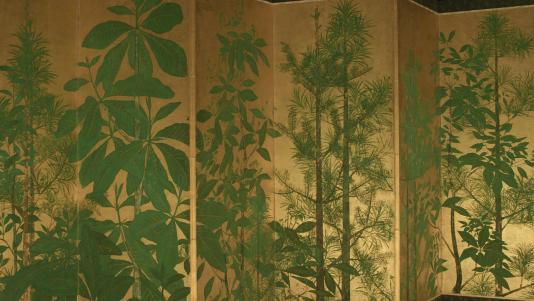
Still from ‘Edo Avant-Garde’ (2019). Master of the I’nen Seal (1600–1630), Sōtatsu school, Trees, Japanese, Edo period, mid-17th century; pair of six-panel folding screens; ink, colors, and gold on paper (Washington, D.C.: Freer Gallery of Art, F1962.30).
Join us on Zoom for a discussion of the film Edo Avant-Garde with curator Rachel Saunders and director Linda Hoaglund, presented in conjunction with the special exhibition Painting Edo: Japanese Art from the Feinberg Collection.
Edo Avant-Garde (2019) reveals the story of how Japanese artists of the explosively creative Edo period (1615–1868) pioneered innovative approaches to painting that many in the west associate most readily with so-called modern art of the 20th century. Through groundbreaking interviews with scholars, priests, art dealers, and collectors in Japan and the United States, the film explores how the concepts of abstraction, minimalism, and surrealism are all to be found in Edo painting. The film’s exquisite cinematography and outstanding original soundtrack, composed in response to individual paintings, present a remarkable immersive experience of some of Japan’s most celebrated and yet least-filmed paintings, many of them outside traditional museum and gallery settings. Simultaneously dynamic and mesmerizing, at its heart Edo Avant-Garde offers a unique opportunity to look closely and see differently.
This conversation will take place online via Zoom. Free admission, but registration is required. To register, please complete this online form.
Edo Avant-Garde will be available to stream for free through the Harvard Art Museums from Friday, February 5 to Friday, February 12. Upon registration, you will receive a link and password to access the film. We encourage you to view the film in advance of the discussion! The film is also available to rent through the Pacific Film Archive at the Berkeley Art Museum (BAMPFA). Please click here for further details.
If you have any questions, please contact am_register@harvard.edu.
◊ ◊ ◊ ◊ ◊
Distributed by Yale University Press:
Rachel Saunders, ed., Catalogue of the Feinberg Collection of Japanese Art (Cambridge: Harvard Art Museums, 2021), 264 pages, ISBN: 978-0300250909, $65.
 The sophistication and variety of painting in Japan’s Edo period, as seen through a preeminent US collection.
Over more than four decades, Robert and Betsy Feinberg have assembled the finest private collection of Edo-period Japanese painting in the United States. The collection is notable for its size, its remarkable quality, and its comprehensiveness. It represents virtually every stylistic lineage of the Edo-period (1615–1868)—from the gorgeous decorative works of the Rinpa school to the luminous clarity of the Maruyama-Shijo school, from the ‘pictures of the floating world’ (ukiyo-e) to the inky innovations of the so-called eccentrics—in addition to sculpture from the medieval and early modern periods. Hanging scrolls, folding screens, handscrolls, albums, and fan paintings: the objects are as breathtaking as they are varied. This catalogue’s twelve contributors, including established names in the field alongside emerging voices, use the latest scholarship to offer sensitive close readings that bring these remarkable works to life.
Rachel Saunders is the Abby Aldrich Rockefeller Associate Curator of Asian Art at the Harvard Art Museums.
Exhibition | Goya’s Graphic Imagination

Francisco de Goya y Lucientes, Giant Seated in a Landscape (detail), by 1818, burnished aquatint with scraping and strokes of ‘lavis’ added along the top of the landscape and within the landscape; plate: 28.4 × 20.8 cm (New York: The Metropolitan Museum of Art, 35.42).
◊ ◊ ◊ ◊ ◊
Opening next month at The Met:
Goya’s Graphic Imagination
The Metropolitan Museum of Art, New York, 12 February — 2 May 2021
Regarded as one of the most remarkable artists from the late eighteenth and early nineteenth centuries, Francisco Goya (1746–1828) is renowned for his prolific activity as a draftsman and printmaker, producing about nine hundred drawings and three hundred prints during his long career. Through his drawings and prints, he expressed his political liberalism, criticism of superstition, and distaste for intellectual oppression in unique and compelling ways. This exhibition will explore Goya’s graphic imagination and how his drawings and prints allowed him to share his complex ideas and respond to the turbulent social and political changes occurring in the world around him. The broadly chronological presentation will follow Goya’s evolution and different phases as a graphic artist as well as his approaches to his subjects. Around one hundred works on display will come mainly from The Met collection—one of the most outstanding collections of Goya’s drawings and prints outside Spain—with other works coming from New York, Boston, and Madrid’s Museo Nacional del Prado and the Biblioteca Nacional.
The catalogue is distributed by Yale University Press:
Mark McDonald, with contributions by Mercedes Ceron-Pena, Francisco J. R. Chaparro, and Jesusa Vega, Goya’s Graphic Imagination (New York: The Metropolitan Museum of Art , 2021), 320 pages, ISBN: 978-1588397140, $50.
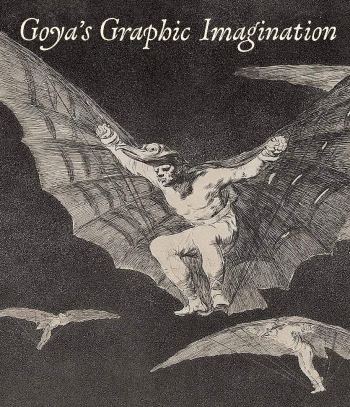 This book presents the first focused investigation of Francisco Goya’s (1746–1828) graphic output. Spanning six decades, Goya’s works on paper reflect the transformation and turmoil of the Enlightenment, the Inquisition, and Spain’s years of constitutional government. Two essays, a detailed chronology, and more than 100 featured artworks illuminate the remarkable breadth and power of Goya’s drawings and prints, situating the artist within his historical moment. The selected pieces document the various phases and qualities of Goya’s graphic work—from his early etchings after Velázquez through print series such as the Caprichos and The Disasters of War to his late lithographs, The Bulls of Bordeaux, and including albums of drawings that reveal the artist’s nightmares, dreams, and visions.
Mark McDonald is curator in the Department of Drawings and Prints at The Metropolitan Museum of Art.
New Book | Meltdown!
◊ ◊ ◊ ◊ ◊
Accompanying the exhibition Fortune and Folly in 1720 (scheduled to open at the New York Public Library in September), the related publication is now available from Brepols:
Madeleine Viljoen, Nina Dubin and Meredith Martin, Meltdown! Picturing the World’s First Bubble Economy (Turnhout: Harvey Miller, 2020), 157 pages, ISBN: 978-1912554515, $65 / €50.
Meltdown! focuses on the depiction of the first international financial crisis following the 1720 collapse of stock market bubbles in England, France and the Netherlands.
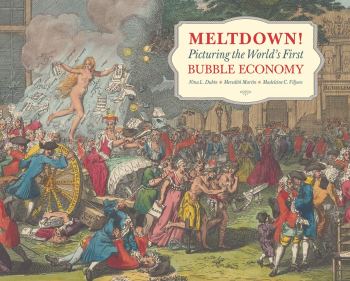 This book tells two parallel stories: one of the spectacular rise and fall of the world’s first bubble economy, and another of the enterprising art industry that chronicled its collapse. The Mississippi and South Sea Bubbles, spawning the invention of French banknotes as well as joint-stock companies built on fantasies of New World trade, imposed on everyday Europeans a crash course in new financial products. In turn, a bubbling print market relentlessly caricatured the meltdown of 1720, offering viewers an entertaining primer on the otherwise bewildering realities of modern economic life. Such satirical works—most notably a Dutch compendium titled The Great Mirror of Folly (Het groote tafereel der dwaasheid )—helped to demystify the disaster by deploying familiar theatrical characters and tragic-comic motifs. Likening the speculative mania to an infectious disease, and spoofing the ‘herd behavior’ of a money-crazed public, its prints portrayed malevolent traders, hoodwinked investors, and a chorus of heroes and villains both real and legendary, from the rakish financier John Law to the foolish Harlequin to the goddess Fortuna. Three hundred years later, our current moment offers a uniquely fitting vantage point from which to reconsider the significance of the bubbles and of the artworks that channeled the fears and desires they unleashed.
Nina L. Dubin is an associate professor of Art History at the University of Illinois at Chicago. Specializing in European art since 1700, she has published widely on the production of art within an economy of risk.
Meredith Martin is an associate professor of Art History at New York University and the Institute of Fine Arts. Specializing in European art of the long eighteenth century, she has published widely on gender and architectural patronage as well as maritime art, mobility, and exchange in the early modern world.
Madeleine C. Viljoen is Curator of Prints and the Spencer Collection at The New York Public Library. Responsible for the Library’s collection of prints and rare illustrated books, she has published widely on early modern printed images, with special attention to the goldsmith-engraver, the reproductive print, and ornament.
Exhibition | DeWitt Clinton’s Broadsides of the Early Republic
From the Albany Institute of History & Art:
Fellow Citizens! DeWitt Clinton’s Broadsides of the Early Republic
Albany Institute of History & Art, 1 August 2020 — 14 March 2021
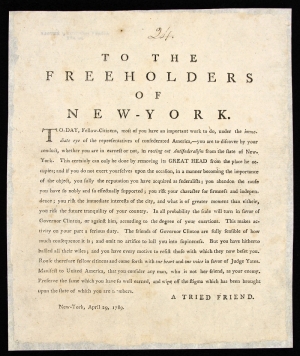
To the Freeholders of New-York, April 29, 1789, DeWitt Clinton Broadside Collection, GR 78-10.24
The Albany Institute of History & Art is home to what is likely the earliest collection of political material specifically assembled as a political collection—the DeWitt Clinton Broadside Collection, which encompasses over one hundred broadsides ranging in date from 1775 to 1813.
A broadside is a single sheet of paper printed with information on one side. Donated to the Albany Institute by Theodoric Romeyn Beck (1791–1855), the broadsides collection would be tucked away and forgotten about, rediscovered and acclaimed, and stored once more, hidden to the world at large, until a local political memorabilia collector learned about the Institute’s collection in 2018, and was thrilled by the discovery. Historically, broadsides were ephemeral sources of information created to serve specific, temporary purposes. After serving their purpose they were either thrown away or repurposed and since paper was a scarce commodity in early America, their survival today is rare.
Fellow Citizens! DeWitt Clinton’s Broadsides of the Early Republic exhibition focuses on five New York State gubernatorial elections, the context of American life at the time the broadsides were written, and the life and legacy of DeWitt Clinton. It will include a selection of nearly twenty political broadsides, along with contemporary paintings, artifacts from the era, and a rare map of New York from 1796.
Program and exhibition support is made possible in part by the New York State Council on the Arts with the support of Governor Andrew M. Cuomo and the New York State Legislature. Season exhibition and program support is provided by Phoebe Powell Bender, Mr. and Mrs. George R. Hearst III, Charles M. Liddle III, Lois and David Swawite, and the Carl E. Touhey Foundation, Inc.
Exhibition | Women Painters, 1780–1830

Elisabeth Louise Vigée Lebrun, Peace Bringing Back Abundance, detail, 1780
(Paris: Musée du Louvre)
◊ ◊ ◊ ◊ ◊
From the Musée du Luxembourg:
Peintres femmes, 1780–1830: Naissance d’un combat
Musée du Luxembourg, Paris, 3 March — 4 July 2021
Curated by Martine Lacas
Le Musée du Luxembourg met les femmes à l’honneur à l’occasion d’une exposition ambitieuse consacrée à celles qui ont ouvert la voie aux artistes féminines au XIXe siècle. L’exposition se concentre sur une période unique d’effervescence historique et culturelle, de 1780 à 1830, où les salons de peinture se multiplient et où les femmes gagnent progressivement en visibilité sur la scène artistique.
De grands noms d’artistes de l’époque viennent à l’esprit, à l’instar d’Elisabeth Vigée Le Brun. Grande portraitiste de l’Ancien Régime, elle fut peintre de la cour de France, de Marie-Antoinette et de Louis XVI. Mais l’exposition met aussi en avant des artistes moins connues, qui profitèrent des basculements politiques pour se faire une place dans le milieu artistique. En outre, cette mise en lumière est l’occasion d’en apprendre davantage sur les conditions sociales de l’époque et de voir comment ces femmes se sont aussi battues pour le droit de se former aux arts ou d’exposer leurs toiles. Les artistes présentées font ainsi figure d’actrices des mutations de l’art mais aussi des évolutions de la société du XIXe siècle.
Martine Lacas, ed., Peintres femmes, 1780–1830: Naissance d’un combat (Paris: Gallimard, 2021), ISBN: 978-2072906640. Details forthcoming
◊ ◊ ◊ ◊ ◊
An interview from December 2020 with curator Martine Lacas is available at Femmes d’Art Magazine.
Exhibition | Beethoven Moves

Installation view of the exhibition Beethoven Moves, with John Baldessari’s Beethoven’s Trumpet (with Ear) Opus #132, 2007, resin, fiberglass, bronze, aluminum, electronics. Photo by Mark Niedermann for Tom Postma Design.
◊ ◊ ◊ ◊ ◊
Press release, via Art Daily (26 December 2020) for the exhibition:
Beethoven Moves / Beethoven Bewegt
Kunsthistorisches Museum Wien, 29 September 2020 — 24 January 2021
Curated by Andreas Kugler, Jasper Sharp, Stefan Weppelmann, and Andreas Zimmerman
The Kunsthistorisches Museum Vienna, in cooperation with the Archive of the Gesellschaft der Musikfreunde in Vienna, presents Beethoven Moves, an unusual homage to Ludwig van Beethoven (1770–1827), the great representative of the First Viennese School. Beethoven’s popularity remains unbroken, even 250 years after his birth. Beyond the music, his humanistic messages have influenced the history of art and culture. His early deafness shaped his image as a tragic genius.
 Beethoven’s universal and unique reception, the epochal significance of his music, and the perception of his deified persona create numerous points of entry. High and popular culture, commerce, and politics all form an inexhaustible reserve of inspiration and appropriation. The exhibition brings together paintings by Caspar David Friedrich, sketchbooks by William Turner, graphic works by Francisco de Goya, Anselm Kiefer and Jorinde Voigt, sculptures by Auguste Rodin, Rebecca Horn and John Baldessari, a video by Guido van der Werve, and a new work developed for the exhibition by Tino Sehgal—all of which are brought into dialogue with the music and persona of Beethoven. The exhibition thus provides a poetic reflection of the composer and his work, as masterpieces of fine art form connections with music and silence.
The elaborately staged exhibition does not present any artworks from the Kunsthistorisches Museum collection. However, it is shown in the Picture Gallery in the context of the art and culture of many centuries, hundreds of works that precede Beethoven’s lifetime and in some ways also lead up to it.
Beethoven is one of the great influential figures in the history of music and culture, not only in Vienna but also internationally. As the largest museum in Austria, the Kunsthistorisches Museum addresses the anniversary of his 250th birthday. Museums are treasure houses, part of the cultural consciousness and tourist magnets; but beyond that, they are also discursive spaces for reflection and confrontation, laboratories for fantasy and the connection of ideas. These aspects become particularly clear in this exhibition project curated by Andreas Kugler, Jasper Sharp, Stefan Weppelmann, and Andreas Zimmerman.
The sequence of rooms in the exhibition relates to Beethoven’s life only in a very general sense. Divided according to themes, they are conceived as a series of tableaux, each based on distinct compositional principles. Indeed, the interplay between the various architectural settings is rather like that between the movements of an orchestral work. And this diversity in the rooms is matched by the variety of the listening experiences on offer, the media of the artworks, and the approaches taken by the artists. Accordingly, visitors will not find any directions telling them how they should move through each room. For a true experience of Beethoven depends on paying heed to one’s inner voice—as when listening to music in general. As we strive to emotionally relive the relations between music, words, imagery, and movement, we should just let our body find its place within the surrounding space. Beethoven Moves is thus intended as an invitation to enter into a very personal encounter with the great composer.
In Room 1 Beethoven’s powerful music immediately captures the imagination of visitors to the exhibition: they hear two of the piano sonatas written by the composer, himself an accomplished concert pianist until he lost his hearing: the Waldstein Sonata (C major, op. 53) and his final Piano Sonata in C minor, op. 111. Beethoven’s original autographs of these compositions are also on show. All of Beethoven’s thirty-two piano sonatas are present in this room, albeit in two very different artworks; in her thirty-two complex drawings, Jorinde Voigt analyzes Beethoven’s compositions, while Idris Khan’s monumental work compiles the scores of all his piano sonatas to create a menacing block-like structure. In the centre of the room, two more contrary sculptures have entered into an equivocal dialogue: Auguste Rodin’s human figure (The Bronze Age in plaster) and Rebecca Horn’s enigmatic grand piano (Concert for Anarchy). The composer’s character, too, was contradictory and highly complex, something that clearly functioned as a source of his creativity: his temperament allowed him to produce works that continue to move people from all parts of the world.
Room 2 is dedicated to silence and stillness, Beethoven’s increasing hearing loss and the associated pain, isolation and reflectiveness. However, we also learn about his admirable ability not to resign himself to his fate but through his art to triumph over his affliction. Los Caprichos, the engravings by Francisco de Goya (1746–1828)—another great artist who lost his hearing—are like pictorial equivalents of the inner fragmentation experienced by the ailing Beethoven. Strictly speaking, all that remains of Beethoven’s thoughts and his art are pages covered with scores and words. Other objects can only serve a superficial cult of remembrance, things like his ear trumpet or a piece of the parquet floor from the house in which he died in 1827. This plain surface, however, also resembles a stage, reminding us that Beethoven and his music have been used for the most varied ends.
To this day, his personality and oeuvre continue to be reinterpreted in politics and propaganda; some worship Beethoven as a revolutionary innovator while for others he is a genius in whose reflected glory nationalist mindsets of all kinds may bask. A work by Anselm Kiefer bears witness to the fact that cultural achievements are still prone to be injected with political content. The reception of Beethoven ranges from the banning of his music to the numerous quotations from his works in popular culture.
In Room 3 we look at Beethoven and his attitude towards nature, which for him was a source of inspiration and strength, offering an escape from his cramped lodgings and the freedom of long country walks regardless of the weather. He would often stop abruptly to jot down some musical idea in one of the sketchbooks he always carried in his pocket. In this room, the colour tones of Caspar David Friedrich and William Turner engage with Beethoven’s tonal colours. They all belong to a generation who witnessed the French Revolution, a radical new awakening whose promises and hopes were quickly scotched by the subsequent Restoration period.
Two symphonies can be heard in this room, both of which are linked in contrasting ways to Napoleon. Beethoven’s anger at Napoleon crowning himself Emperor of the French in 1804 led the composer to scratch out Bonaparte’s name from the title page of his Third Symphony (Eroica). His Seventh Symphony premiered in 1813, just a few weeks after the Battle of Leipzig in which the allied armies of Austria, Prussia, Russia, and Sweden had decisively defeated the emperor. Contemporaries often associated Napoleon with the mythical Prometheus, and Beethoven too was frequently linked with the titan who brought fire to mankind. Prometheus is very much present in a painting by Jan Cossiers, but Guido van der Werve’s video can be read as a complementary reflection of this figure prepared to take a high risk to liberate man: it is the artist himself who walks towards us across the ice, a huge icebreaker in his wake. Threatened with failure, his solitary and heroic actions nonetheless bring forth beauty.
Room 4 brings us full circle to individual, personal encounters with Beethoven. A new work by Tino Seghal, created especially for this exhibition, is permanently installed and on show in this room.
Andreas Kugler, ed., Beethoven Moves (Berlin: Hatje Cantz, 2020), 224 pages, ISBN: 978-3775747493 (Engish edition), $55.
Exhibition | Devoted: Art and Spirituality in Mexico and New Mexico

The Ascension of Christ, detail, late 18th–early 19th century, Mexico, oil on canvas with metal milagros (Dallas Museum of Art, The Cleofas and Celia de la Garza Collection, 1994.37.6).
◊ ◊ ◊ ◊ ◊
From the DMA:
Devoted: Art and Spirituality in Mexico and New Mexico
Dallas Museum of Art, 21 February 2021 — 22 January 2022
Historically, as well as in the present day, depictions of Christ, the Virgin Mary, and numerous saints and other figures have played a vital role in the ceremony and pageantry of Catholicism, acting as visual representations of beliefs and ideas, and serving as a focal point for devotion and prayer. Devoted: Art and Spirituality in Mexico and New Mexico features devotional works drawn from the DMA’s Latin American collection, exploring interrelated artistic traditions in the two regions. The exhibition spotlights the complexity and artistic qualities of these objects, which embody the active spiritual relationship between their creators, patrons, and communities.
New Galleries of American Art to Open in Philadelphia
Looking ahead to next year at the Philadelphia Museum of Art:
New Galleries of American Art
Philadelphia Museum of Art, opening early 2021
A major re-installation devoted to the presentation of the museum’s extensive holdings of American Art spanning 1650 through 1840 will inaugurate the museum’s new 10,000 square foot suite of galleries for American Art, a distinctive feature of Frank Gehry’s Core Project of the Facilities Master Plan, which also includes new galleries for Contemporary Art, together adding more than 20,000 square feet of gallery space within the museum’s footprint.

Coffeepot, 1750–53, made by Philip Syng, Jr. (1703–1789) for Joseph Galloway (1731–1803), silver with wood handle, 12 inches high (Philadelphia Museum of Art, purchased with the John D. McIlhenny Fund, 1966).
The opening of these galleries in early 2021 will represent the first major expansion and reinterpretation of the museum’s renowned collection of American Art in over 40 years. Arranged chronologically and thematically, this new installation will showcase the rich diversity of cultures and creative traditions that contributed to the formation of early American artworks. New interpretations of this collection explore the artistic ties linking the Americas to Asia; the role of enslavement in the production and financing of art throughout the period; Philadelphia’s role as an influential cultural capital; and the stories and works of Black, women, and Indigenous artists, promoting the museum’s vision to bring the collection to life and advancing scholarship in the field.
The galleries begin by exploring how trade and colonization forcibly brought together Indigenous people, Europeans, and Africans, creating new cultures in the Americas. The first gallery contrasts the English Quaker culture of William Penn’s colony, as an outpost of the British empire, to the cultural traditions of the Lenape people in the Delaware Valley and the Spanish viceroyalty in Mexico. Another gallery explores how global connections were made and shaped by a network of trade that linked the Western hemisphere to Europe, Africa, and Asia. Further in, a gallery shows how some American artists developed a visual language based on the traditions of their European homelands. This gallery introduces painters John Singleton Copley, Charles Willson Peale, and Benjamin West, who demonstrated ambition, originality, and persistence in rising to international stature from provincial roots.
One gallery compares and contrasts the English and German cultures that thrived in both Philadelphia and southeastern Pennsylvania environs. Special displays highlight groups of miniatures, fraktur, and textiles to evoke the diversity and richness of domestic life.

Charles Willson Peale, Portrait of Yarrow Mamout (Muhammad Yaro), 1819, oil on canvas, 24 x 20 inches (Philadelphia Museum of Art, 2011-87-1).
The museum’s collection of the work of the Peale family—the most comprehensive in the country—includes a remarkable series of family portraits and representative works by America’s earliest professional women painters. The story of the Peale Museum, the country’s first public collection of art and natural history, will be told in portrait and still-life paintings and in cut silhouettes made by Moses Williams, an artist enslaved by the Peales.
One gallery explores Philadelphia’s role as the capitol of the new nation from 1790 to 1800, when Philadelphia led the country not only politically, but also through contributions to the development of a new and distinctively American sense of artistic style. Described as the Athens of America, the city reinterpreted the ancient classical past in its architecture and arts, drawing upon the legacy of democratic Greece and republican Rome to create a compelling visual language representative of the aspirations of the new nation.
Presidential China from 1780 to 1980 is displayed in new and beautifully-lit casework. Made for and used by United States presidents from George Washington to Ronald Reagan, the museum’s collection illustrates changes in national symbolism, the role of the presidency, and different modes of dining across three centuries.
The re-installation also addresses transformational changes beginning in the 19th century sparked by territorial expansion (and subsequent Indigenous displacement) industrialization and immigration. Serving this spirit of national ambition, a robust style of late classicism shaped the decorative arts, while technological developments made affordable production possible on a large scale. Philadelphia, with the largest free Black community in the country, was home to many Black artists. The natural world, seen as emblematic of American promise, sparked a new landscape tradition in Philadelphia in work by Thomas Doughty and Thomas Cole, fathers of the Hudson River School. The last section explores how European cultural traditions took on new forms in the young United States, especially through works created by the Pennsylvania Germans from about 1800 through 1850. On view will also be Edward Hicks’s Peaceable Kingdom, with its depiction of Penn’s treaty with the Indians, which revisits the mythology of Pennsylvania’s founding.
The reinstallation was planned by a cross-departmental curatorial team that has worked closely on the selection of works and contemporary understanding.
Curatorial Team
Kathleen A. Foster, Robert L. McNeil, Jr. Curator of American Art; Director, Center for American Art; David Barquist, Curator of American Decorative Arts; Alexandra Kirtley, The Montgomery-Garvan Curator of American Decorative Arts; Carol Soltis, Project Associate Curator; John Vick, Collections Project Manager; Rosalie Hooper, Collections Interpreter and Project Curatorial Assistant; with Jessica Todd Smith, Susan Gray Detweiler Curator of American Art and Manager of the Center for American Art; Elisabeth Agro, The Nancy M. McNeil Curator of American Modern and Contemporary Crafts and Decorative Arts.
Exhibition | Old Ways New Roads: Travels in Scotland, 1720–1832
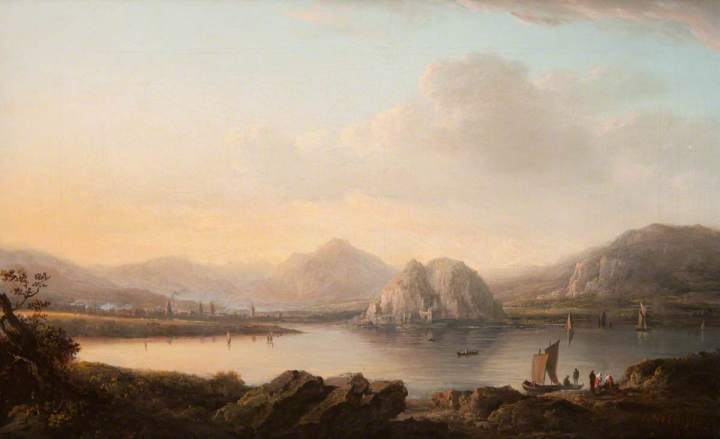
Alexander Nasmyth, Dumbarton Castle and Town with Ben Lomond, 1816, oil on canvas, 33 × 55 cm
(Glasgow: The Hunterian Art Gallery, University of Glasgow GLAHA_51732)
◊ ◊ ◊ ◊ ◊
Scheduled to open in January, the exhibition will instead be moved online with related programming soon to be announced (stay tuned); from The Hunterian:
Old Ways New Roads: Travels in Scotland, 1720–1832
(Online) The Hunterian Art Gallery, Glasgow, 29 January — 9 May 202
Curated by John Bonehill, Anne Dulau Beveridge, and Nigel Leask
Old Ways New Roads: Travels in Scotland 1720–1832 addresses the impact of Scotland’s new transport infrastructure on the development of travel, tourism and topographical descriptions of the nation between 1720 and 1832. Old Ways New Roads features paintings, prints, drawings, maps, manuscript tours, and other associated objects from The Hunterian and other public and private collections.
The laying out of new routes in the aftermath of the 1707 Act of Union and the 1715 Jacobite Uprising opened up Scotland (and especially the Highlands) not only to military occupation, but to the forces of commerce and trade and philosophical and scenic tourism. As a recent war zone, Scotland became imbued with aesthetic and topographical significance. Sites and places, old and modern, ruinous and thriving, were brought into view by travel along the military roads constructed by General George Wade and Major William Caulfield. Later, those designed by Thomas Telford under the aegis of the Commission for Highland Roads and Bridges, as well as canals and steam-boat routes, further opened up Scotland’s more inaccessible regions in the Romantic period. Old Ways New Roads traces how these dramatic ‘improvements’ to the Scottish landscape were variously documented, evaluated, planned, and imagined in word and image and more especially ‘framed up’ in terms of the experience of travel.
From Birlinn:
John Bonehill, Anne Dulau Beveridge, and Nigel Leask, eds., Old Ways New Roads: Travels in Scotland 1720–1832 (Edinburgh: Birlinn, 2021), 240 pages, ISBN: 978-1780276670, £20.
 In 1725 an extensive military road and bridge-building programme was implemented by the British crown that would transform 18th-century Scotland. Aimed at pacifying some of her more inaccessible regions and containing the Jacobite threat, General Wade’s new roads were designed to replace ‘the old ways’ and ‘tedious passages’ through the mountains. Over the next few decades, the laying out of these routes opened up the country to visitors from all backgrounds. After the 1760s, soldiers, surveyors, and commercial travellers were joined by leisure tourists and artists, eager to explore Scotland’s antiquities, natural history, and scenic landscapes and to describe their findings in words and images. Here, a number of acclaimed experts explore how the Scottish landscape was variously documented, evaluated, planned, and imagined in words and images. As well as a fascinating insight into the experience of travellers and tourists, the book also considers how they impacted on the experience of the Scottish people themselves.
C O N T E N T S
Foreword
Notes on Contributors
Acknowledgements
Introduction
1 Writing the Scottish Tour 1720–1830, Nigel Leask
SECTION 1 | The Theatre of War, John Bonehill
2 The Ethnology of the ‘Old Ways’ in Gaelic Scotland, Hugh Cheape
SECTION 2 | Antiquities, Nigel Leask
3 Natural History, Fredrik Albritton Jonsson
SECTION 3 | Custom and Improvement, John Bonehill
4 Roads, Bridges and Designed Landscapes on the Highland Circuit, Christopher Dingwall
5 Scotland’s Prospects, John Bonehill
SECTION 4 | Picturesque Prospects and Literary Landscapes, John Bonehill and Nigel Leask
6 Portable Knick-knacks or the Material Culture of Travel, Viccy Coltman
7 Panoramas and Landscape, Christina Young
8 Picturesque Tours of Wales and Ireland, Mary-Ann Constantine and Finola O’Kane
Bibliography
Photograph Credits
Index
◊ ◊ ◊ ◊ ◊
Note (added 6 January 2021) — The original posting did not include the contents.
Exhibition | Sublime on the Small Scale
From The Morgan:
Sublime on the Small Scale
The Morgan Library & Museum, New York, 29 September 2020 — 12 September 2021

Gustaf Söderberg, The Grotto of Posillipo, Naples, 1820, oil on paper, irregularly cut, mounted to Masonite (Thaw Collection, Jointly Owned by The Metropolitan Museum of Art and The Morgan Library & Museum, Gift of Eugene V. Thaw, 2009).
In 1757, the British statesman and philosopher Edmund Burke published A Philosophical Enquiry into the Origin of Our Ideas of the Sublime and Beautiful, an aesthetic treatise that profoundly influenced artists across Europe well into the nineteenth century. Burke understood the Sublime as deriving from “whatever is fitted in any sort to excite the ideas of pain, and danger, that is to say, whatever is in any sort terrible…or operates in a manner analogous to terror.” He emphasized the powerful, even pleasurable, emotional response that could arise from the contemplation of such possibilities, particularly when considered from a place of safety.
Many artists turned to the natural world as their principal source of the Sublime, emphasizing its magnitude and power. While the Sublime is mostly associated with large-scale oil paintings intended to engulf and overwhelm viewers, artists frequently worked on a smaller scale to develop and experiment with their representations. They endeavored to render nature and its effects faithfully by sketching en plein air, particularly on their travels through dramatic landscapes. The oil sketches displayed here engage with a range of Sublime effects, from the impressive vastness of a mountain range and the thrill of rushing water to the terror of a raging storm.
Sublime on the Small Scale highlights works from the collection of oil sketches given jointly to The Morgan and The Metropolitan Museum of Art by Trustee Eugene V. Thaw.










 Enfilade
leave a comment