Exhibition | Cut and Paste
◊ ◊ ◊ ◊ ◊
Now on view at Edinburgh’s Modern Two; for the earlier period, see the catalogue essay by Freya Gowrley:
Cut and Paste: 400 Years of Collage
Scottish National Gallery Of Modern Art (Modern Two), Edinburgh, 29 June — 27 October 2019
 A huge range of approaches is on show, from sixteenth-century anatomical ‘flap prints’, to computer-based images; work by amateur, professional and unknown artists; collages by children and revolutionary cubist masterpieces by Pablo Picasso and Juan Gris; from nineteenth-century do-it-yourself collage kits to collage films of the 1960s. Highlights include a three-metre-long folding collage screen, purportedly made in part by Charles Dickens; a major group of Dada and Surrealist collages, by artists such as Kurt Schwitters, Joan Miró, Hannah Höch, and Max Ernst; and major postwar works by Henri Matisse, Robert Rauschenberg, and Peter Blake, including the only surviving original source photographs for Blake’s and Jann Haworth’s iconic, collaged cover for the Beatles’ album Sergeant Pepper’s Lonely Hearts Club Band.
The importance of collage as a form of protest in the 1960s and 70s will be shown in the work of feminist artists such as Carolee Schneemann, Linder, and Hannah Wilke; Punk artists, such as Jamie Reid, whose original collages for the Sex Pistols’ album and posters will feature; and the famously subversive collages of Monty Python founder Terry Gilliam. The exhibition also features the legendary library book covers which the playwright Joe Orton and his lover Kenneth Halliwell doctored with collages, and put back on Islington Library’s shelves—a move which landed them in prison for six months. In addition, the exhibition also demonstrates how collage remains important for the practice of many artists working today. Owing to the fragility of much of the work, the exhibition will not tour: it can only be seen at the Scottish National Gallery of Modern Art in Edinburgh.
Patrick Elliott, ed., with essays by Freya Gowrley and Yuval Etgar, Cut and Paste: 400 Years of Collage (Edinburgh: National Galleries of Scotland, 2019), 184 pages, ISBN: 978-1911054313, £25.
Exhibition | America’s First Veterans
From The American Revolution Institute:
America’s First Veterans
The American Revolution Institute of the Society of the Cincinnati, Washington, D.C., 8 November 2019 — 5 April 2020

John Neagle, A Pensioner of the Revolution, 1830 (Washington, DC: The American Revolution Institute of the Society of the Cincinnati, museum purchase, 2017).
The tens of thousands of men who fought for American independence suffered extraordinary privations in the war and risked their lives and livelihoods to help establish the United States. They had gone unpaid for much of the war, and many of them returned home with little more than the honor of having served the nation and the satisfaction that comes from duty faithfully performed. The new republic, which struggled to pay its wartime debts, thanked them for their service but offered them scant compensation or reward.
America’s First Veterans brings together paintings, artifacts, prints and documents to address the post-war experiences of the men who won the Revolutionary War—not the famous generals and leading officers whose names appear in histories of the war, but rather the junior officers and enlisted men whose stories are less often told. The exhibition focuses on their return to civilian life, their reception by a country torn and bankrupted by eight years of war, and the nation’s gradual realization of its vast debt to the men who won our independence. A centerpiece of the show is John Neagle’s arresting portrait of a pensioner of the Revolution, painted in 1830 in the midst of the fight for comprehensive federal pensions for the remaining Revolutionary War veterans.
Conference | The American Revolution

From the Museum of the American Revolution:
2019 International Conference on the American Revolution
Museum of the American Revolution, Philadelphia, 3–5 October 2019
The Museum of the American Revolution, the Pritzker Military Museum & Library, and the Richard C. von Hess Foundation are pleased to present the 2019 International Conference on the American Revolution. This event will bring noted historians, writers, and curators from Ireland, Scotland, England, and the United States together to explore military, political, social, and artistic themes from the Age of Revolutions.
The conference will coincide with the opening of Cost of Revolution: The Life and Death of an Irish Soldier, the Museum’s first international loan exhibition. With more than one hundred works of art, historical objects, manuscripts, and maps from lenders across the globe, Cost of Revolution will explore the Age of Revolutions in America and Ireland through the life story of an Irish-born artist and officer in the British Army, Richard Mansergh St. George (1750s–1798).
Program highlights include an opening keynote by Dr. Eliga Gould, speaking on “Making Peace in Britain, Ireland, and America: 1778 to 1783,” and a closing keynote by Martin Mansergh, noted historian and former Irish diplomat and Fianna Fáil politician who played a key role in the Northern Ireland peace process. In addition to two days of engaging talks, panel discussions, and tours of Cost of Revolution, conference guests may register for an optional one-day guided bus trip to follow the footsteps of Richard St. George through the Philadelphia Campaign of 1777.
The full conference packet is available here»
Note (added 29 September 2019) — The posting has been updated to reflect the change in keynote speakers; originally Linda Colley was scheduled to speak but was forced to cancel due to unforeseen circumstances. The museum hopes to host her in the future.
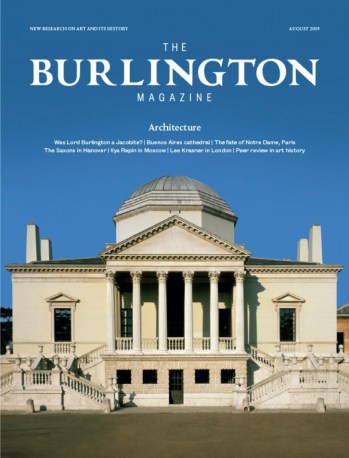
The Burlington Magazine, August 2019
The August issue of The Burlington was especially rich for the eighteenth century; apologies for not posting it much sooner, but it’s worth noting. –CH
The Burlington Magazine 161 (August 2019)
 E D I T O R I A L
• “At the Yale Center for British Art,” p. 619. At the end of June Amy Meyers stepped down as Director of the Yale Center for British Art, New Haven, after seventeen years.
A R T I C L E S
• Sam Rose, “Peer Review in Art History,” pp. 621–25. A more recent development than is often realized, and historically imposed in a variety of ways, peer review is a fundamental but rarely discussed aspect of academic life. What impact does it have on publishing in art history?
• Alexander Echlin, “Was Lord Burlington a Jacobite?,” pp. 626–37. A thesis first put forward thirty years ago that Lord Burlington was a Jacobite, who used buildings and gardens to express his clandestine views, has won a measure of support. However, the biographical evidence is circumstantial and the architectural evidence is so ambiguous that it cannot sustain the argument.
• Gauvin Alexander Bailey, “Buenos Aires Cathedral in the Eighteenth Century,” pp. 638–47. Greatly altered in the early eighteenth century, the original appearance of the interior of Buenos Aires Cathedral, designed by Antonio Masella and completed by Manuel Álvarez de Rocha in 1771, is here reconstructed from newly identified visual sources, a watercolour of c.1830 and nineteenth-century photographs.
• Alexandra Gajewski and Michael Hall, “The Fate of Notre-Dame, Paris,” pp. 648–52. The first at Notre-Dame in April destroyed its largely medieval roof and the flèche designed by Violeet-le-Duc as well as badly damaging the vaults. Plans for repairs depend on an assessment of the long-term structural damage to the cathedral, despite which a five-year timetable for the restoration has been imposed by President Macron and a competition for a replacement flèche initiated.
• Giovan Battista Fidanza, “New Evidence for the ‘Barberini Apostles’ by Andrea Sacchi and Carlo Maratti,” pp. 653–59. Unpublished documents in the Barberini Archives in the Vatican Library clarify the patronage, authorship, and dating of a celebrated series of nine paintings of the Apostles commissioned from Andrea Sacchi and Carlo Maratti by Cardinals Antonio Barberini the Younger and Carlo Barberini.
R E V I E W S
• Simon Lee, Review of the exhibitions The Majesties’ Retiring Room and A Painting for a Nation: The Execution of Torrijos (Prado, 2019), pp. 673–76.
• John Bold, Review of Matthew Walker, Architects and Intellectual Culture in Post-Restoration England (Oxford University Press, 2017), pp. 688–89.
• Anthony Colantuono, Review of Claire Farago, Janis Bell and Carlo Vecce, The Fabrication of Leonardo da Vinci’s ‘Trattato della pittura’ (Brill, 2018), pp. 693–95.
• Sandra Miller, Review of Valerie Steele, ed., Pink: The History of a Punk, Pretty, Powerful Colour (Thames & Hudson, 2018), pp. 701–02.
Exhibition | George Stubbs: ‘All Done from Nature’
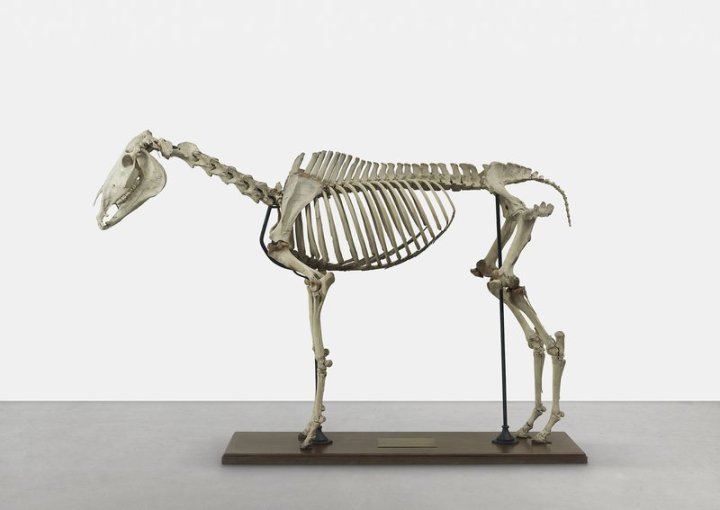
Skeleton of Eclipse (Collection of the Royal Veterinary College, University College London). Eclipse died in 1789 at the age of 25. The Veterinary College was built in 1791, with its first students enrolling in January of 1792.
◊ ◊ ◊ ◊ ◊
Opening next month at MK Gallery:
George Stubbs: ‘All Done from Nature’
MK Gallery, Milton Keynes, 12 October 2019 — 26 January 2020
Mauritshuis, The Hague, 20 February — 1 June 2020
George Stubbs: ‘All done from Nature’ presents the first significant overview of Stubbs’s work in Britain for more than 30 years and brings together 100 paintings, drawings, and publications—from the National Gallery’s Whistlejacket to pieces that have never been seen in public.
 Born in Liverpool in 1724, Stubbs was a quintessential product of the Enlightenment and embodied all of its core principles, questioning traditional authority and embracing the notion that humanity could be improved through the application of reason. Rather than trust to history and the untested example of his artistic and scientific precursors, Stubbs championed doing as a way of thinking and deployed pictorial representation as a form of knowledge and understanding. Today, he is recognised as one of the most original artists of the eighteenth century. His wide-ranging subjects included portraits, conversation pieces, and pictures of exotic and domestic animals—horses included—and his obsession with scientific exactitude has drawn comparison with the work of Leonardo da Vinci.
A major theme of the exhibition is anatomy. The show includes Stubbs’s contributions to a pioneering treatise on midwifery and his preliminary work on A Comparative Anatomical Exposition of the Structure of the Human Body with that of a Tiger and a Common Fowl. It also includes the detailed studies and drawings that led to The Anatomy of the Horse—the greatest coming together of art and science in British art—alongside the actual skeleton of the legendary racehorse Eclipse, which Stubbs depicted on several occasions.
A version of the show will tour to the Mauritshuis in The Hague where it will be the first-ever exhibition on the artist in the Netherlands. The exhibition is accompanied by a fully illustrated catalogue with major contributions from Alison Wright, Jenny Uglow, Martin Myrone, Martin Postle, and Nicholas Clee as well as new and existing poetry by Roger Robinson.
Anthony Spira, Martin Postle, and Paul Bonaventura, George Stubbs: ‘all done from Nature’ (London: Paul Holberton Publishing, 2019), 224 pages, ISBN: 978-1911300687, £35.
More information on the skeleton of Eclipse is available from this article by Mark Brown for The Guardian (6 July 2019).
Exhibition | Rescuing Horace Walpole
This fall at the Lewis Walpole Library:
Rescuing Horace Walpole: The Achievement of W.S. Lewis
Lewis Walpole Library, Farmington, CT, 20 September 2019 — 24 January 2020
Curated by Stephen Clarke
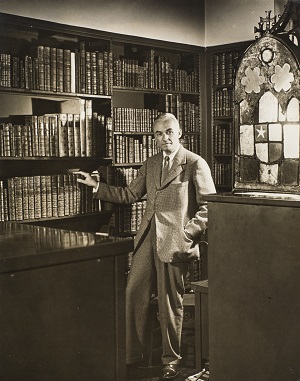 Wilmarth S. ‘Lefty’ Lewis (Yale Class of 1918) devoted the better part of his life to building the world’s greatest collection relating to Horace Walpole (1717–1797), the British writer, collector, and historian. He also championed Walpole’s importance as a figure in English eighteenth-century life, doing so most effectively as general editor and guiding spirit of the Yale Edition of Horace Walpole’s Correspondence (Yale University Press, 1937–83), whose 48 volumes are widely acknowledged to this day as a model of scholarship in historical editing.
This fall’s exhibition, Rescuing Horace Walpole: The Achievement of W.S. Lewis, pays tribute to Lewis’s life and legacy as a scholar-collector, on the 40th anniversary of his bequest of the Lewis Walpole Library to his alma mater, Yale University. Drawing heavily on the recently cataloged Lewis archives, the exhibition shows how the total dedication of the collector resulted in a collection of extraordinary range and depth, and expressed itself in some surprising ways. It also evolved into a monumental achievement of scholarship in the Yale-Walpole edition and, in the process, transformed perceptions of Walpole and his age.
A related symposium, Scholarly Editing of Literary Texts from the Long Eighteenth Century, on September 21st, in New Haven, will explore the past, present, and future of scholarly editions of the collected works and correspondences of early modern British writers, ranging from the Yale Horace Walpole (1717–1797) and Samuel Johnson (1709–1784) editions, via the Burney and Boswell papers to new editions now being planned for Alexander Pope (1688–1744) and Aphra Behn (1640?–1689).
Curator Stephen Clarke will give a talk on the exhibition at the Lewis Walpole Library on October 28 beginning at 7pm.
Exhibition | Trial by Media: The Queen Caroline Affair
From the Lewis Walpole Library:
Trial by Media: The Queen Caroline Affair
The Lillian Goldman Law Library, Yale Law School, New Haven, 9 September — 19 December 2019
Curated by Cynthia Roman and Mike Widener
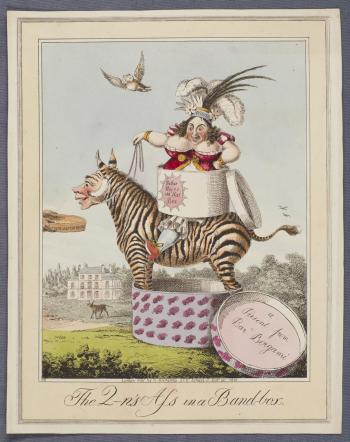
Attributed to Theodore Lane, The Q-n’s ass in a band-box, 22 January 1821; hand-colored etching with stipple (Lewis Walpole Library).
Trial by Media: The Queen Caroline Affair exhibition marks the bicentennial of the Queen Caroline divorce proceedings and focuses on the prolific media coverage around the 1820 trial. The trial is famous among cultural historians as a media event; in law it is remembered for Lord Brougham’s argument that a lawyer’s only duty is “to save that client by all means and expedients.”
There will be an online component following the physical exhibition. For the online exhibition, Cynthia Roman and Mike Widener have invited several scholars from diverse disciplines, at Yale and beyond, including many former research fellows, to contribute a short note focused on an object or group of objects of their choice from the Queen Caroline-related collections.
Trial by Media: The Queen Caroline Affair will enable visitors to explore the rich resources at Yale on the topic of Queen Caroline (1768–1821) and many scholarly perspectives from cultural and legal historians on this fascinating story. A mini-conference, in connection with exhibition, will be held on the afternoon of October 4.
The exhibition is curated by Cynthia Roman, Curator of Prints, Drawings and Paintings at the Lewis Walpole Library; and Mike Widener, Rare Book Librarian, Lillian Goldman Law Library.
Carlo Dolci’s Saint Agatha Returns to Osterley
From the press release (15 August 2019) . . .

Carlo Dolci, Saint Agatha, oil on canvas, ca. 1665–70 (Osterley, National Trust 2900293).
The return of Saint Agatha to Osterley has provided the opportunity to stage a special winter exhibition for visitors, beginning in November, which will explore the rise to fame and fortune of the Child family who acquired the painting and showcase the art and design that they commissioned and collected from around the globe.
The Child family were goldsmiths and bankers who patronised the fine and decorative arts. The wealth they acquired was used to create the luxurious Robert Adam interiors still seen at Osterley today, and which were filled with Old Master paintings, lacquer furniture, Indian fabrics, and East Asian ceramics. The painting of Saint Agatha, purchased by art lover Sir Robert Child (1674–1721) at the beginning of the 18th century, became one of the works in a great picture collection at Osterley and was recorded in a 1782 inventory. However, it was later sold along with other family heirlooms in the 1930s.
Saint Agatha is a dramatic depiction of Agatha of Sicily, a Christian martyr, who suffered dreadful torture at the hands of the Romans. It is an example of the work of the Baroque master Carlo Dolci (1616–1687), a leading figure of 17th-century Florentine art, whose passionate depictions of holy figures aimed to inspire reverence and empathy for the divine. It captures the miraculous moment when Saint Peter the Apostle appeared to Saint Agatha in a vision and healed her wounds.
John Chu, National Trust Assistant Curator of Pictures and Sculpture explains: “Although an extraordinary number of original furnishings remain at Osterley, its once-famous picture collection has been almost completely dispersed or destroyed. We are lucky to have a number of paintings on loan from the Jersey family, but it is fantastic when a rare opportunity arises to purchase one for the property, especially one as moving and profound as this. The homecoming of Saint Agatha provides the chance to look more closely at the importance of pictures to the story of the house. She will be the highlight of our exhibition exploring the Child family’s meteoric rise and what these precious objects meant to them at a remarkable moment in British history. Saint Agatha will be displayed alongside other European and Asian works of art and design, including furniture and ceramics, bought by the family. We also want to give our visitors a sense of the special meaning that each object held for the people and cultures that created them. Dolci’s Saint Agatha, for instance, held powerful spiritual resonances for its Roman Catholic maker and his first Florentine patrons, but it was seen in a much more secular light when it entered the collection at Osterley and was displayed alongside family portraits. We are very grateful to Art Fund and our other generous donors and supporters for enabling us to acquire Saint Agatha and hope the exhibition will inspire all those who enjoy discovering examples of the highest quality art and design.”
Saint Agatha was purchased for £248,750 at the Christie’s Old Masters Evening Sale [Lot 39] in London on 5 July 2018 thanks to a grant of £85,000 from Art Fund, support from private donors, Trust members, and visitors to Osterley Park, along with support from a fund set up by the late Simon Sainsbury to support acquisitions for the historic houses of the National Trust.
Since the acquisition, the painting has undergone two phases of conservation treatment.
Eleanor McGrath, Head of Grants at Art Fund, said: “It is wonderful to see this striking work return to its home at Osterley Park and House where it will be the highlight of the exhibition, helping visitors imagine the wider historic collections and life of the Child family.”
Treasures of Osterley: Rise of a Banking Family runs from 4 November 2019 until 23 February 2020.
Print Quarterly, September 2019

James Gillray, New Morality; – or – The Promis’d Installment of the High-Priest of the Theophilanthropes, with the Homage of Leviathan and his Suite, 1798, hand-colored etching, 8 × 24 inches (New Haven: Yale Center for British Art, Paul Mellon Collection, B1981.25.1001).
◊ ◊ ◊ ◊ ◊
The eighteenth century in the current issue of Print Quarterly:
Print Quarterly 36.3 (September 2019)
A R T I C L E S
Allison M. Stagg, “William Cobbett, James Gillray and the Market for Caricatures in 1790s Philadelphia,” pp. 263–74.
In the decades immediate following the American Revolution (1775–83), caricature prints were imported from London to cities along the east coast of North America. Evidence of a transatlantic transfer of British satirical imagery can be found in the numerous advertisements published in American newspapers from this period. Despite the frequency with which caricatures are mentioned in newspapers, few details can readily be discerned from them. The advertisements primarily reference the general arrival of collections of British caricature prints, usually as an addendum to other imported items such as books, stationery and even clocks, and provide little to no mention as to what specific caricatures crossed the Atlantic (263) . . . Details found in documents dating from the last decade of the eighteenth century, however, allow for a more thorough examination of the availability of and interest in imported and American caricatures in Philadelphia in the late 1790s. The primary source is an account book in the collection of the American Antiquarian Society in Worcester, MA, of the famous British radical, polemicist and publisher William Cobbett (1763–1835), who took refuge in American in 1793 (264).
N O T E S A N D R E V I E W S
 Truusje Goedings, Review of Wolf Eiermann, Claudia Steinhardt-Hirsch and Eckhard Leuschner, Prachtvoll illuminirt: Das Handkolorit in der Druckgrafik, 1493–1870 (Hirmer Verlag, 2018), pp. 304–06.
Neglected for a long time, the hand-colouring of prints, book illustrations and maps has been the subject of serious research during the last three decades, resulting in major exhibitions with comprehensive catalogues. . . [The present] catalogue, edited by Wolf Eiermann . . . is another effort to make the picture of 400 year of handcolouring more complete . . . The Sammlung Frank, a private collection in Stuttgart focused on German art and formed in the previous century, served as the main source, supplying about 110 of the 134 catalogued items (304) . . . The period from c. 1760 to 1880 is well represented with about one hundred items, mainly topographical, but also on costumes and natural history, including a rare example of Christian Gottlieb Ludwig’s Ectypa vegetabilium . . . / Nach der Nature verfertigte Abdrucke der Gewachse (nature-printed prints of plants; Halle and Leipzig, 1760–64) with 200 nature prints in contemporary colouring” (306).
Peter Fuhring, Review of Thomas Wilke, Innendekoration: Graphische Vorlagen und theoretische Vorgaben für die wandfeste Dekoration von Appartements im 17. und 18. Jahrhundert in Frankreich, 2 volumes (Scaneg Verlag, 2016), pp. 308–10.
The study of prints related to the decoration of secular interiors in France from the seventeenth and eighteenth centuries, in association with theoretical guidelines, . . . reveals an ambition that is difficult to fulfill. . . So far not a single catalogue or study encompasses the entire French print production of wall decorations, mantelpieces and ceilings made during both centuries. . . Further research is necessary to complete the still lacunar state of our knowledge. This is what Wilkie strives to do. His study is composed of two parts: the first volume offers a presentation of the issues as set out in the title, while the second consists of a catalogue of prints that form the basis of the author’s demonstration (308).
Véronique Meyer, Review of Katie Scott, Becoming Property: Art, Theory, and Law in Early Modern France (Yale University Press, 2018), pp. 313–15.
[Scott’s] recent book . . . examines the relationship between intellectual property and the visual arts in France from the sixteenth century to the beginning of the nineteenth . . . It traces the history of this relationship, highlighting key moments with exemplary case studies as well as citing regulations and legal texts, (313) and examines the role of the parties involved, including booksellers, publishers, engravers, draughtsmen and authors. Although the sixteenth and seventeenth centuries occupy and important place in the book, which shows how the definition of privilege and copyright evolved over the years, it is above all France of the Enlightenment and Revolution that lies at the heart of this study (314). . . [It] is a must for all who are interested in the history of printmaking, the decorative arts and artistic theories and institutions such as the Académie Royale (315).
David Bindman, Review of Cynthia Roman, ed., Hogarth’s Legacy (Yale University Press, 2016), pp. 315–16.
Hogarth’s enormous and long-lasting influence on art and popular imagery is the subject of a series of essays, largely by scholars of eighteenth-century art, including . . . Douglas Fordham, Dominic Hardy, Brian Maidment, Patricia Mainardi, Ronald Paulson, Mark Salber Philips, and Michael Printy. . . Collections of essays inevitably fall somewhere on the spectrum between the tightly focused, based on a close conversation between the authors, and the loose and baggy, in which the connections between the essays are more informal. Although the quality of the essays is uniformly excellent, this volume tends more toward the baggy . . . The main and entirely commendable purpose of the volume seems to have been to make scholarly use and draw further attention to the relatively little-known and underused, and in some areas quite spectacular, collections of Hogarth engravings and late eighteenth-century caricature in the Walpole Library (315).
Roger Paas, Review of Josef Biller, Calendaria Bambergensia: Bamberger Einblattkalender des 15. bis 19. Jahrhunderts von der Inkunabelzeit bis zur Säkularisation, 2 volumes (Anton H. Konrad Verlag, 2018), pp. 317–19.
Biller has dedicated over four decades to the collecting and studying of broadside (316) calendars published for the bishopric of Bamberg, and the results of his in-depth research have now been published in a detailed and richly illustrated two-volume catalogue (318).
Daniel Godfrey, Review of Anke Fröhlich-Schauseil, Schenau (1737–1806): Monografie und Werkverzeichnis der Gemälde, Handzeichnungen und Druckgrafik von Johann Eleazar Zeißig, gen. Schenau (Michael Imhof Verlag, 2018), pp. 319–23.
The son of a damask weaver from Großschönau in Saxony, Schenau fled the outbreak of the Seven Years’ War in 1756 to Paris. There he Frenchified his name and established a reputation as an artist of ‘society paintings’ focused on liaisons between the sexes, coiffure and the texture of material. The mentorship of Johann Georg Wille (1715–1808), engraver, print publisher and art dealer, must have motivated Schenau to execute a set of twelve etchings in 1765, six of children acting as adults and six of heads . . . These were to remain Schenau’s only autograph prints (319) . . . Yet, Schenau’s career developed in symbiosis with the print.
Mark Bills, Review of John Ford, Rudolph Ackermann and the Regency World (Warnham Books, 2018), pp. 323–25.
Although Ackermann belongs to and epitomizes the Regency Period (1788–1830), one cannot help but think that he would be a very useful figure in the art and design world of today (323) . . . John Ford has absorbed an enormous body of material and given us a fascinating chronological account of Ackermann as well as adding important new research and insights (324).
P U B L I C A T I O N S R E C E I V E D
• Joachim Jacoby, Guillaume Jean Constantin (1755–1816): A Drawings Dealer in Paris (Ad Ilissum for the Fondation Custodia, 2018), p. 339.
• Peter Stoll, Französische Buchillustration des 18. Jahrhunderts in der Oettingen-Wallersteinschen Bibliothek (Universität Augsburg Bibliothek, 2018), p. 339.
• Thora Brylowe, Romantic Art in Practice: Cultural Work and the Sister Arts, 1760–1820 (Cambridge University Press, 2019), p. 339.
• Helen Rosslyn, A Buyer’s Guide to Prints (The Royal Academy of Arts in association with the London Original Print Fair, 2018), p. 342.
Exhibition | Lansyer, Canaletto, & Piranesi
Now on view at the Lansyer House Museum:
Lansyer, Canaletto, and Piranesi: Images of Italy
Maison-Musée Lansyer, Loches, 1 May — 11 November 2019
 Après plus d’un an de travaux, la Maison-Musée Lansyer de Loches redevient le théâtre d’une exposition d’envergure mettant en évidence les richesses de ses collections. Du 1er mai au 11 novembre 2019, l‘exposition Lansyer, Canaletto & Piranèse : images d’Italie invite le visiteur au voyage en Italie, à Rome et à Venise, dans les pas du peintre paysagiste Emmanuel Lansyer (1835–1893). Ce circuit au temps du chemin de fer conduit sur les lieux de travail de l’artiste, dans la Rome Éternelle et au cœur de la Sérénissime Venise. Lansyer livre ses impressions sur ces deux villes, mais aussi les difficultés qu’il rencontre pour les représenter. Ainsi, les toiles de l’artiste font visiter la campagne romaine et les quartiers de Venise.
« Portraitiste de ville », Lansyer s’inscrit dans les pas de deux maîtres italiens du siècle précédent : Piranèse et Canaletto. Lansyer acquiert des séries exceptionnelles de gravures à l’eau-forte de ces grands védutistes qui célèbrent la grandeur de Rome et de Venise. Cette collection lochoise constitue l’un des ensembles les plus complets à l’échelle mondiale. Ces œuvres sont le résultat d’un travail artistique d’une extrême précision, dont on pourra admirer les détails, du tracé architectural de Piranèse au geste léger de Canaletto.
Enfin, Lansyer convie à un voyage au temps de la photographie naissante. Cet art en plein essor offre une autre image d’Italie, celle de son peuple et de ses richesses patrimoniales. Les photographies de Rome donnent à voir de très beaux points de vue sur la basilique Saint-Pierre et le forum romain. Celles de Venise s’intéressent aux lieux les plus emblématiques de la reine de la lagune : la place Saint-Marc, le Grand Canal et ses palais. On chemine également à travers des ruelles étroites et autour des puits dans lesquels s’approvisionnent Vénitiens et Vénitiennes en habits traditionnels. Autant de souvenirs de voyage et d’outils de travail pour l’artiste.Au total, une centaine d’œuvres, tableaux, photographies et gravures de la collection d’Emmanuel Lansyer, sont dévoilés au public de manière inédite. Une collection d’une richesse exceptionnelle, léguée à la Ville de Loches par l’artiste, pour l’agrément de tous. Guide de voyage en poche, montez dans le train et devenez un touriste du XIXe siècle le temps de la visite de l’exposition…
The catalogue is available from In Fine éditions d’art:
Lansyer, Canaletto & Piranèse : Images d’Italie (Paris: In Fine éditions d’art, 2019), 112 pages, ISBN: 978-2902302192, 18€.
Sous la direction de Véronique Lourme, responsable du Service Patrimoine de la Ville de Loches; Gilles Bertrand, professeur d’histoire moderne à l’Université de Grenoble; Manuel Royo, professeur d’archéologie et d’histoire de l’art à l’Université François-Rabelais de Tours; Annie Gilet, conservateur en chef honoraire du patrimoine; et Benjamin Bulte, étudiant en histoire de l’art, Université François-Rabelais de Tours.
S O M M A I R E
• Emmanuel Lansyer : un peintre paysagiste en Italie
Le Voyage en Italie au XIXe Siècle
• Lansyer et la tradition du voyage en Italie
• Les conditions et le temps du voyage
Le Voyage à Rome
• Lansyer à Rome ou l’histoire d’une déception
• Les vues de Rome par Piranèse
Le Voyage à Venise
• Le regard de Lansyer sur la Sérénissime
• Canaletto, graveur à l’eau-forte
Le Portrait de Ville
• Résonances entre Canaletto, Piranèse et Lansyer : trois portraitistes de villes
• La photographie : un nouvel outil de travail pour le portrait de ville
• Un voyage dans le temps, dans les pas d’un artiste collectionneur
Catalogue des Oeuvres
• La collection de peintures
• La collection de gravures
• La collection de photographies
Bibliographie










 Enfilade
leave a comment