Exhibition | 2000 Years of Organ Building and Playing
Press release (via Art Daily) for the exhibition now on view at MK&G:
Manufacturing Sound: 2000 Years of Organ Building and Organ Playing
Manufaktur des Klangs: 2000 Jahre Orgelbau und Orgelspiel
Museum für Kunst und Gewerbe, Hamburg, 5 July — 3 November 2019

Johannes Rusch (1728‒1791) / Hermann Seyffarth (1846–1933), Positive Organ, 1777 / 1898 (Musikinstrumentenmuseum der Universität Leipzig; photo by Christina Körte).
With over 300 organs, Hamburg is home to a unique and widely varied organ landscape. In addition to those in the city’s churches, there are numerous other instruments located in schools, in the Elbphilharmonie, in the studio of the NDR public broadcasting station, in the State Opera House, at the University, and even in the prisons. To mark the 300th anniversary of the death of Arp Schnitger (1648–1719), one of the world’s most famous organ builders, the city of Hamburg has declared 2019 the Year of the Organ, with the motto ‘Hamburg Pulls Out All the Stops’. Concerts and events through-out the city, along with a major exhibition at the Museum für Kunst und Gewerbe Hamburg, are arousing public curiosity about this impressive instrument and its history. The exhibition Manufacturing Sound: 2000 Years of Organ Building and Organ Playing invites visitors to learn more about the design, construction, and technical finesse of the marvellous invention that is the organ. The show is centred around organ construction and organ music, which UNESCO added to its List of the Intangible Cultural Heritage of Humanity in 2017. Over 30 exhibits, including 14 historic instruments and reconstructions, allow visitors to immerse themselves interactively into the cosmos of the organ. How does an organ actually work? Where does the ‘organ wind’ come from? What are stops? What do the different organ pipes sound like? The exhibition answers these and many other questions by means of models, interactive displays, media presentations, and films that make the mysterious technology of the instrument visible. Using a model constructed especially for the exhibition, guests can try out the interplay of bellows, windchest, and pipes and produce sounds for themselves. An organ simulator allows them to operate organ keys and pedals and experiment with ‘registration’ techniques. Using photographs of spectacular organ constructions as inspiration, visitors can even design their own unique organs with the help of virtual reality glasses.
Gladiator Battles and Court Ceremonies
Over 2000 years ago, the Greek mathematician Ctesibius invented a vertically adjustable mirror for his father’s barber shop in ancient Alexandria. Its technical highlight was a pressure pump. This stroke of genius was the precursor to the construction of an instrument called the organon hydraulikon, which was capable of producing sounds. As part of the exhibition, a reconstruction of an ancient water organ (hydraulis) from the third century demonstrates how this hydraulic pump system worked. At a height of up to 2 metres, the organs of this period were comparatively small and transportable. Historical sources and archaeological findings from antiquity attest to the instrument’s great popularity. Whereas in ancient Greece, this often took the form of musical organ-playing competitions, in ancient Rome, the organ more often served as musical accompaniment to sports events—such as the famous gladiator fights—and was heard in the villas of wealthy Romans at social receptions and banquets. After the fall of the Roman Empire in the fifth century, knowledge of organ construction was preserved in the Byzantine Empire. There, instruments such as the double organ—a replica of which can be seen in the exhibition—accompanied public events such as horse races and was played at court ceremonies.
The Move to the Cathedrals
Only in the Middle Ages, thanks to the influence of educated clergy, did organs enter into Christian cathedrals, where they were put to use for the musical elaboration of the liturgical programme. The still relatively small, movable organs of this period were transportable instruments—so-called ‘positive’, or even smaller ‘portative’ organs which players could hold on their knees or hang around their shoulders with a strap. The exhibition demonstrates what such a portative organ might have looked like with a reconstructed portativ organetto, built according to plans written by the polymath Arnaut de Zwolle (ca. 1400–1460). For the reconstruction, the Dutch organ builder Winold van der Putten also referred to depictions in paintings by Flemish masters such as Jan Van Eyck (1390–1441), and Hans Memling (1433–1494). The pipes of medieval organs were generally all equal in diameter. Another reconstructed organ in the exhibition, which followed a ‘pigeon’s egg scale’, illustrates a type of objects that were used to measure them at that time.
The Organ as Status Symbol
During the baroque period, large-scale organ-building projects served as demonstrations of wealth and power, even within the church. Increasingly lavish and imposing instruments were constructed. In Europe, regional building styles also emerged during this period. In addition to the monumental church organs, smaller types of organs continued to spread in popularity. They were prized by the nobility and the bourgeoisie as prestigious additions to their homes. Examples of these from the exhibition include a processional organ, which ranks among the most valuable transportable organs of the Italian baroque period, and a cabinet organ from the workshop of Johannes Stephanus Strümphler (1736–1807) in Amsterdam. A truly eye-catching piece from the rococo period is a positive organ adorned with gilded carvings, built by the Bohemian instrument-maker Johann Rusch (1728‒1791). Rare historical sources document the development of organ construction during this period. On display are the Spiegel der Orgelmacher und Organisten, a treatise on organ building and organ playing by Arnolt Schlick (before 1460–after 1521), of which only a few copies exist worldwide; the baroque-era book on music theory and instruments, Syntagma musicum, by Michael Praetorius (1571‒1621); the comprehensive work on music theory, Musurgia universalis, by the polymath Athanasius Kircher (1602–1680); and the standard eighteenth-century text on organ construction, L’Art du facteur d’orgues, by Dom François Bedos de Celles (1709–1779), illustrated with detailed engravings.
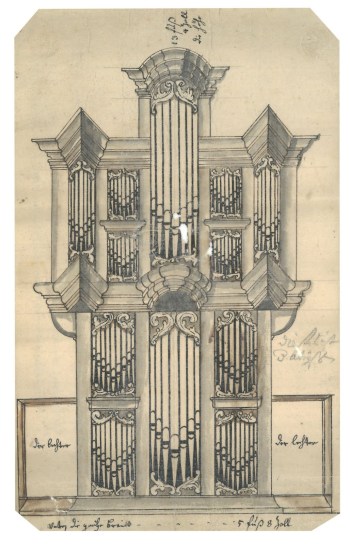
Arp Schnitger (1648–1719), Design of an Organ for the Reformed Church in Altona, ca. 1686, watercolour and pen drawing (Staatsarchiv Hamburg).
Arp Schnitger and North German Organ Building
It was in this period that Hamburg grew to be one of the most important organ-building cities in Europe. Wealthy merchants commissioned the best organ builders and treated themselves to veritable luxury organs. With his sophisticated, tonally powerful instruments, Arp Schnitger represented the zenith of the baroque North German organ-building tradition. His workshop produced a total of 170 organs, of which 47 survive to this day. At its completion in 1687, his organ in Hamburg’s St. Nikolai Church—with 67 stops and more than 4000 pipes—was the largest in the world and made Schnitger famous well beyond his home region. The organ was destroyed in a fire that swept the city in 1842. Today, the organ in Hamburg’s St. Jacobi church, completed in 1693 and restored multiple times, is the largest functioning baroque organ of the North German type, with 43 stops. An early console, whose stop knobs are decorated with carved portraits of famous organ lovers of the period, bears witness to part of its eventful history.
Hans Henny Jahnn and the ‘German Organ Movement’
Prior to the First World War, Albert Schweitzer (1875–1965), who was a trained organist, campaigned for a re-orientation in organ building, and in the 1920s, Hamburg became the centre of an effort at reform that later became known as the ‘German Organ Movement’. The head of this movement was the Hamburg author Hans Henny Jahnn (1894–1959), who also designed several organs and who successfully campaigned for the preservation of the Schnitger organ in Hamburg’s St. Jacobi Church. For Jahnn, this baroque organ, with its ‘honest’, clear tone, was the counter-design to the ‘symphonic’ organ type that predominated at the time, and whose romantic sound he perceived as excessively ornate, dark and opulent. Thanks to a film produced expressly for the exhibition, an organ designed by Jahnn—located at the Heinrich-Hertz School in Hamburg-Winterhude—can be heard playing in the MKG.
The Allure of Organ Design
To this day, the organ has lost none of its fascination: all over the world, organ builders, architects, and designers continue to create spectacular instruments. A photo wall in the exhibition presents selected organ constructions of the past and present which illustrate the close relationship between the craft of organ building and the disciplines of design and architecture. The best-known example of this may be the thrilling design by star architect Frank Gehry (b. 1929) for the organ in the Walt Disney Concert Hall in Los Angeles, which was completed in 2004. Whether they are traditional or futuristic, the varying methods of construction serve as inspiration to exhibition visitors, who are invited to try their hand at building their own organs with the help of virtual reality glasses. The fact that nearly every organ is one of a kind—conceived for a specific space as part of its unique architecture—means that there are (almost) no limits to what present-day organ builders can do. Proof of this can be seen in the spectacular organ constructions of the recent past—such as the organ built for Hamburg’s Elbphilharmonie (opened in 2016) with its approximately 5000 pipes. A media presentation allows exhibition visitors to discover the fascinating instrument in Hamburg’s most famous concert hall.
The exhibition is a collaboration between the MKG and the Hochschule für Musik und Theater Hamburg, in cooperation with Orgelstadt Hamburg e. V. and the Musikfest Bremen. The project receives additional support through the close cooperation with Rudolf von Beckerath Orgelbau, Hamburg; Johannes Klais Orgelbau GmbH & Co. KG, Bonn; the MultiMediaKontor Hamburg GmbH; and the Evangelisch-Lutherischen Kirche in Norddeutschland.
Lenders to the exhibition: Catalina Vicens, Basel | Staatsbibliothek zu Berlin, Preußischer Kulturbesitz, Berlin | Johannes Klais Orgelbau GmbH & Co. KG, Bonn | Marienbibliothek Halle, Halle an der Saale | Staatsarchiv der Freien und Hansestadt Hamburg | Elbphilharmonie Hamburg | Hans Henny Jahnn Verein e. V., Hamburg | Hauptkirche St. Jacobi Hamburg | Orgelstadt Hamburg e. V. | Römerkastell Saalburg, Bad Homburg | Georg Ott, Kirchensittenbach | Musikinstrumentenmuseum der Universität Leipzig | Römisch-Germanisches Zentralmuseum, Leibniz-Forschungsinstitut für Archäologie, Mainz | Evangelisch-Lutherische Kirche in Norddeutschland | Aug. Laukhuff GmbH & Co. KG, Weikersheim | Winold van der Putten, Winschoten
Exhibition | Freedom! The Eternal Reconquest
The exhibition is now on view in Bordeaux:
Liberté ! L’éternelle reconquête
Archives Bordeaux Métropole, 24 June 2019 — 24 April 2020
 Gravée au fronton des édifices publics et placée en tête de la devise nationale, solennellement affirmée en 1789 dans la Déclaration des droits de l’homme et du citoyen, la liberté semble une évidence. Pourtant, elle demeure un bien fragile qu’il a fallu conquérir et, parfois, reconquérir. Une pièce exceptionnelle prêtée par les Archives nationales, la plaque originale de la Déclaration de 1789, visible pendant les 3 premiers mois de l’exposition en donne une vision frappante. Ce texte fondamental de la Révolution française, gravé sur une plaque d’airain en 1792, fut rangé dans un coffre de bois de cèdre pour être placé dans la première pierre de la colonne de la Liberté imaginée sur les ruines de la Bastille. Mais la chute de la monarchie et l’avènement de la Convention en septembre 1792 rend ce texte obsolète : la plaque est pilonnée le 5 mai 1793. Pourtant, elle est conservée, en l’état, et déposée aux Archives nationales « pour l’édification des générations futures ». La déclaration de 1789 réapparaît et éclipse les deux versions postérieures, à telle enseigne qu’elle constitue le fondement de la déclaration universelle des droits de l’homme de 1948 et le préambule de la Constitution de la Ve République.
Autour de ce symbole unique, les Archives Bordeaux Métropole proposent d’explorer des fragments d’histoire bordelaise de quelques lieux emblématiques de l’espace public. Construits, détruits, malmenés ou préservés, ces monuments témoignent de l’appétence des Bordelais pour la liberté sous toutes ses formes. Le cadre chronologique couvre une large période, de 1789 au début du XXIe siècle.
À partir de la très symbolique Déclaration des Droits de l’Homme et du Citoyen est évoqué le contexte révolutionnaire, inscrit dans l’espace public bordelais : attribution de nouveaux noms de rues particulièrement évocateurs, fêtes de la liberté, projets architecturaux ambitieux en lieu et place de l’ancien Fort de la Révolution, le Château Trompette.
L’expression de cette liberté se fait l’écho des changements de régimes politiques et se montre destructrice : du dépeçage de la statue équestre de Louis XV en 1792 à la disparition de la statue de Napoléon III le 4 septembre 1870, jusqu’à la fonte de la statuaire particulièrement imposante de la IIIe République dans les années 1940. Les statues de la Liberté de Bartholdi, de Vercingétorix de Mouly ou du président de la République Sadi Carnot de Barrias sont ainsi sacrifiées. L’emblématique Monument aux Girondins échappe quant à lui à la destruction totale, mais, amputé de ses fontaines en 1943, il fait l’objet d’une restauration d’envergure en 1983.
Cette incarnation vigilante d’une liberté fragile se poursuit encore en ce début du XXIe siècle, du Mémorial de l’Armée des Ombres érigé en 1988 au buste de Toussaint Louverture inauguré le 10 juin 2005… Illustration parfaite d’une éternelle reconquête.
Exhibition | Antoine-Jean Gros: Drawings from the Louvre
Now on view at the Louvre:
Antoine-Jean Gros (1771–1835): Dessins du Louvre
Musée du Louvre, Paris, 27 June — 30 September 2019
Curated by Laura Angelucci
 One of Jacques-Louis David’s (1748–1825) most famous pupils, and known as the painter of the Napoleonic epic, Antoine-Jean Gros is rightly considered a forerunner of Romanticism. Early on, his drawings, more so than his paintings, began to reveal a gradual shift away from David’s teachings, leading to a definitive break with neoclassical aesthetics and a distinct style heralding the new artistic movement. In his most dramatic drawings, executed in pen and ink, Gros’s free, impetuous style and liberal use of wash accentuate the strength and originality of his art, which led Delacroix to single the artist out from David’s other pupils and consider him the first painter of the new school.
Organized to accompany the publication in June 2019 of the Inventaire général des dessins d’Antoine-Jean Gros (1771–1835) au Louvre, this exhibition features about forty drawings, as well as paintings from the museum’s collection and the Musée Delacroix. It offers an overview of Gros’s career, from his training to the peak of his artistic maturity, and highlights his draftsmanship, of which the public knows very little.
Organized by Laura Angelucci, documentary researcher, Department of Prints and Drawings, Musée du Louvre.
Exhibition | Goya: Visions and Inventions
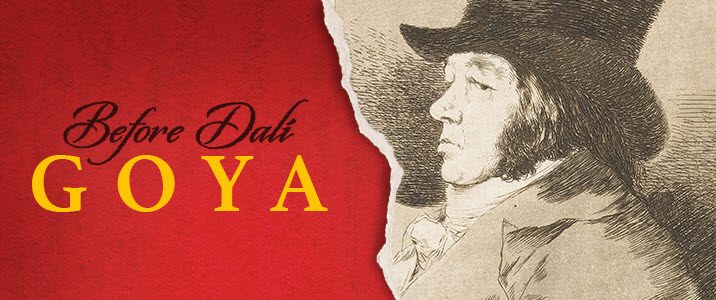
Now on view at The Dalí Museum in Florida:
Before Dali — Goya: Visions and Inventions
The Dalí Museum, St. Petersburg, 15 June — 1 December 2019

Francisco José de Goya y Lucientes, Portrait of Francisco Sabatini, ca. 1775–79, oil on canvas, 33 × 25 inches (Dallas: Meadows Museum at SMU, MM.67.03).
Francisco José de Goya y Lucientes (1746–1828) is one of the most important Spanish artists of the late eighteenth and early nineteenth centuries, celebrated for his revolutionary paintings, drawings, and engravings. Goya’s life and works deeply influenced Salvador Dali in his early years and are considered by many scholars to be the basis for ‘modern’ art, bridging classicism and romanticism. Before Dali: Goya: Visions & Inventions, sponsored by Tampa International Airport, features two alternating suites of first-edition prints, published in Goya’s lifetime, alongside three significant paintings representing unique themes of Goya’s works. The works are on loan from the Meadows Museum in Dallas, home of one of the most substantial collections of Goya.
Los Caprichos
The Dalí Museum, 15 June — 15 September 2019
One of Goya’s most famous works, Los Caprichos (1799) is a series of 80 satirical prints exploring his visions of the superstitions and societal ills of his time. Goya sought to illustrate “the innumerable foibles and follies to be found in any civilized society, and from the common prejudices and deceitful practices which custom, ignorance, or self-interest have made usual.” Witchcraft and other superstitious beliefs were a prevalent subject matter in this series that meant to ridicule and critique the arrogance of the noble class and the corruption of human virtue. Because of their sensitive subjects—including anticlerical scenes—few people saw these works during Goya’s lifetime.
La Tauromaquia
The Dali Museum, 21 September — 1 December 2019
La Tauromaquia (1816) is a suite of prints depicting the evolution and history of bullfighting on the Iberian Peninsula. Goya created La Tauromaquia between 1815 and 1816, at the age of 69. Unlike the targets of Goya’s previous satirical series Los Caprichos, bullfighting was not politically sensitive, and La Tauromaquia was published in an edition of 320—for sale individually or in sets—without incident. The latter series, however, did not meet with critical or commercial success. The artist focuses on the violent scenes that take place in the bullring and the daring movements of the bullfighters. The events are not presented as they are viewed by a viewer in the stands, but in a more direct way.
Exhibition | Stubbs (1724–1806): Anatomist
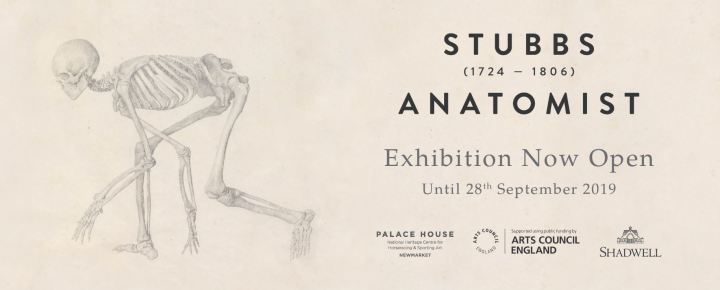
Now on view at Palace House in Newmarket:
Stubbs (1724–1806): Anatomist
National Heritage Centre for Horseracing and Sporting Art, Newmarket, 27 June — 28 September 2019
In summer 2019, Palace House, The National Heritage Centre for Horseracing and Sporting Art will display a set of unique drawings by Britain’s most renowned animal painter, George Stubbs (1724–1806). The ten works, on loan from the Yale Center for British Art, have not been seen in the UK for many years. The drawings form the core of an exhibition that illuminate aspects of Stubbs’s life and interest which have previously been underexplored and highlights the exceptional nature of his painting and drawing techniques.
Stubbs was one of the most original and pioneering artists of the 18th century. His prowess as a painter of horses is well known, but his later study of the anatomy of a wide variety of animals to compare with the human figure is less widely documented.
His great reputation as an extraordinary painter of horses was forged in a remote Lincolnshire farmhouse. In his early thirties, Stubbs relocated from York to Horkstow, near Hull and spent the next 18 months (1756–58), unflinchingly and painstakingly dissecting up to a dozen horses, documenting their musculature, veins, and skeletons. The sheer effort it took to suspend the horses by a system of hooks, ropes, and planks attached to the farmhouse’s ceiling and then injecting their veins with wax in order to preserve them can only be imagined.The result was his celebrated book, The Anatomy of the Horse—a copy of which (from the Palace House collection) will be on display in the exhibition.
Following The Anatomy of the Horse, Stubbs moved to London, where he continued his interest in dissection and anatomy, alongside his increasingly successful career as a painter. He was 71-years old when he started working on Comparative Anatomical Exposition, a study reflecting ideas about fundamental structural characteristics shared by all living things.
Stubbs didn’t seek to make direct comparisons between species, as the title might suggest, but to apply empirical methods of observation and draftsmanship among dissimilar creatures—fowl, tiger, and man—to analyse a core set of similarities from which to make key conclusions. Just as his huge undertaking at Horkstow, this was another highly ambitious project, with the aim of a major publication with sixty plates. Stubbs sadly did not complete this as he died in 1806.
Acquired by the sporting art enthusiast, Paul Mellon, the completed Comparative Anatomical Exposition drawings underpin Mellon’s collecting habits and his deep passion for this subject. The display of comparative anatomy drawings joins numerous works at the National Heritage Centre which were donated by him to the National Horseracing Museum and British Sporting Art Trust collections.
Exhibition | Deconstructed: The NSLM Sporting Screen
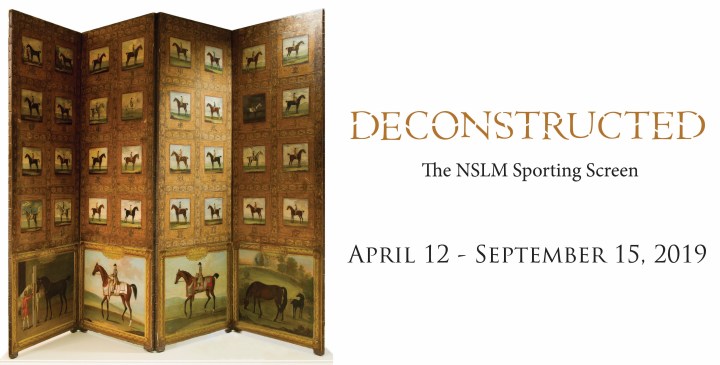
From the NSLM:
Deconstructed: The NSLM Sporting Screen
The National Sporting Library & Museum, Middleburg, Virginia, 12 April — 15 September 2019
Deconstructed: The NSLM Sporting Screen centers on a unique decorative object from the NSLM’s permanent collection. Recently conserved, the four-panel screen is comprised of paintings and prints showing 18th-century racing portraits on one side and manège training (an early form of dressage) on the other. The exhibit will cast light on a captivating era in British sport, art, and literature.
As noted in the Summer 2019 bulletin for the YCBA:
The exhibition features seven works from the Yale Center for British Art by John Vanderbank, including the painting A Young Gentleman Riding a Schooled Horse (1728–29).
Exhibition | A Tea Journey

Richard Collins, The Tea Party, 1727
(London: Goldsmiths’ Company)
◊ ◊ ◊ ◊ ◊
From Compton Verney:
A Tea Journey: From the Mountains to the Table
Compton Verney Art Gallery & Park, 6 July — 22 September 2019
Visitors will follow the tea leaf from plant to pot, beginning with its roots in Chinese culture through to its adoption and appropriation into British society. A Tea Journey raises questions about what the humble cup of tea has evolved to represent in international, social, philosophical, and visual cultures. The exhibition combines rare, historic teaware from China, Japan, and India with responses by contemporary artists including Robin Best, Adam Buick, Phoebe Cummings, Charlotte Hodes, Takahiro Kondo, Ian McIntyre, Bruce Nuske, Selina Nwulu, Bouke de Vries, Hetain Patel, Paul Scott, Julian Stair, and Edmund de Waal. Visitors are also invited to explore The Tea Sensorium, which offers a multi-sensory appreciation of tea, from the leaf itself and art inspired by tea, as well as becoming a sight for artist-led workshops and discussions.
Exhibition | Cost of Revolution: The Life and Death of an Irish Soldier
Press release (15 May 2019) for the exhibition:
Cost of Revolution: The Life and Death of an Irish Soldier
Museum of the American Revolution, Philadelphia, 28 September 2019 — 17 March 2020
Exploring the toll of war and revolution through the eyes of Irish soldier Richard St. George

Thomas Gainsborough, Portrait of Richard St. George, 1776 (Melbourne: National Gallery of Victoria).
Tickets are now on sale for the upcoming special exhibition Cost of Revolution: The Life and Death of an Irish Soldier, which opens on 28 September 2019 and runs through 17 February 2020 at the Museum of the American Revolution, the exhibition’s exclusive venue. Based on new discoveries made by the Museum’s curators, Cost of Revolution presents the untold story of Richard St. George, an Irish soldier and artist whose personal trauma and untimely death provide a window into the entangled histories of the American Revolution and the ensuing Irish Revolution of 1798.
“You may not have heard the name Richard St. George before, but you’ll be astonished by what his life can tell us about America and Ireland in the Age of Revolutions,” said Dr. R. Scott Stephenson, President and CEO of the Museum of the American Revolution. “This exhibit extends the Museum’s internationally acclaimed story-driven approach onto the global stage to examine the broader influence of the American Revolution through St. George’s remarkable personal journey.”
As a young officer in the British Army, Richard St. George crossed the Atlantic in 1776 to try and stop the growing American Revolution. He returned home to Ireland after surviving a severe head wound at the Battle of Germantown, near Philadelphia, in 1777. Back in Ireland, he found his native country roiled by the effects of the revolutionary spirit sweeping across America and Europe. St George became an outspoken critic of the growing movement to establish an Irish republic independent from the British Empire in the 1790s. A few months before the outbreak of the Irish Revolution of 1798, St. George’s tenants ambushed and killed him.
The 5,000-square-foot exhibition will chronicle St. George’s dramatic journey with more than 100 artifacts, manuscripts, and works of art from Australia, Ireland, England, and the United States, many of which will be on display in America for the first time. It will also present one of the largest collections of objects from Ireland’s 18th-century revolutionary history and war for independence ever displayed in Philadelphia.
Five portraits of Richard St. George—created over the span of 25 years—are known to survive and will be reunited in this exhibit for the first time since they left the possession of St. George’s descendants more than a century ago. Every known piece of surviving artwork by St. George himself—including cartoons, sketches from his military service in America, and a self-portrait—also will be assembled for the first time in this exhibit. Together, the portraits, cartoons, and sketches reveal the physical and emotional toll of revolution.
Key Artifacts

Xavier della Gatta, Painting of the Battle of Germantown, 1782 (Philadelphia: Museum of the American Revolution).
• A portrait of Richard St. George by Thomas Gainsborough (1776) depicting him just before he shipped out for New York to fight against the growing American Revolution, on loan from Australia’s National Gallery of Victoria (Melbourne).
• Three portraits of Richard St. George by Irish artist Hugh Douglas Hamilton (1790s) that show St. George as he struggled to manage the pain of the traumatic headwound he received during the American Revolutionary War. One of the portraits, on loan from the National Gallery of Ireland in Dublin, depicts him grief-stricken, mourning at his wife’s tomb. Hamilton painted this portrait as a movement for Irish independence, which St. George opposed, was on the rise.
• A signed self-portrait of Richard St. George, recently donated to the Museum, that depicts him in a forlorn landscape wearing a silk head wrap to cover the scars of his head wound. This portrait is a rare example of art created by a veteran of the American Revolutionary War that refers to personal pain sustained during the War.
• Paintings of the Battles of Paoli and Germantown by Italian artist Xavier della Gatta that St. George helped to create in 1782 to reflect on his participation in those battles. The paintings are in the Museum’s permanent collection.
• The British Army uniform coat and pistol that belonged to Richard St. George’s grandfather, on loan from the National Army Museum in London.
• The 1775 bound maps of the estate of Richard St. George in County Galway, on loan from the Galway County Council Archives in Galway, Ireland.
• A trephine, or skull saw, of the type that was used to operate on Richard St. George’s head following the Battle of Germantown, on loan from the Mütter Museum of the College of Physicians of Philadelphia.
• American illustrator Howard Pyle’s 1898 painting The Attack upon the Chew House, which depicts the carnage of the Battle of Germantown, on loan from the Delaware Art Museum.
• The red uniform coat worn by British Army Lieutenant Ely Dagworthy on loan from Dumbarton House and the National Society of The Colonial Dames of America.
• The August 24, 1776 Leinster Journal, one of the first printings of the American Declaration of Independence in an Irish newspaper, on loan from the National Library of Ireland in Dublin, Ireland.
• A green uniform coat worn by Irish Revolutionary Henry Joy McCracken and a pike head carried by the United Irishmen during Ireland’s fight for independence from Great Britain in 1798, on loan from the National Museums of Northern Ireland (Ulster Museum) in Belfast.
• A rare silk flag carried by the Delaware militia that the British light infantry captured during the Philadelphia Campaign of 1777, on loan from the Delaware Historical Society.
• Richard St. George’s personal sketches from the American Revolutionary War, on loan from a private collection. One sketch depicts St. George being carted off the battlefield following his wounding at the Battle of Germantown in 1777.
• Lord Edward Fitzgerald’s ribbon and Theobald Wolfe Tone’s membership certificate from the United Irishmen, on loan from the National Museum of Ireland in Dublin. Both Fitzgerald and Wolfe Tone died while helping to lead the United Irishmen in their struggle for Irish independence from Great Britain in 1798. The ribbon, taken from Fitzgerald’s body after his death, served as a memento of the Irish Revolution and was used to inspire later Revolutionaries in South America.
Programming Highlights
• Saturday, September 28 and Sunday, September 29, the exhibit’s opening weekend, the Museum’s flagship living history event, Occupied Philadelphia, will bring together dozens of costumed interpreters to recreate the 1777–78 British occupation of Philadelphia on the Museum’s outdoor plaza.
• Tuesday, October 1, the Museum will host an evening lecture by Martin Mansergh, a collateral descendant of Richard St. George and a noted historian who is a former Irish Fianna Fáil politician and played a key role in the Northern Ireland peace process.
• Friday, October 3 through Sunday, October 5, the Museum will host the 2019 International Conference on the American Revolution in partnership with the Pritzker Military Museum and Library. This event will bring noted historians, writers, and curators from Ireland, Scotland, England, and the United States together to explore military, political, social, and artistic themes from the Age of Revolutions.
• The exhibition will come to life with special events and daily programs exploring the artistic and cultural traditions of Richard St George’s world. Highlights include musical and theatrical performances, artisan workshops and demonstrations, talks by noted historians as part of the Museum’s Read the Revolution series, and tours of the exhibition.
Deborah Sampson, Her Diary, and Women in the American Revolution
As reported this week by in The New York Times:
Alison Leigh Cowan, “The Woman Who Sneaked into George Washington’s Army,” The New York Times (2 July 2019). A rediscovered diary, now at the Museum of the American Revolution, sheds light on the life of Deborah Sampson, who fought in the Continental Army.
Hers has always been one of the more astonishing, if little-known, tales of the American Revolution: a woman who stitched herself a uniform, posed as a man and served at least 17 months in an elite unit of the Continental Army. Wounded at least twice, Deborah Sampson carried a musket ball inside her till the day she died in 1827.
While historians agree that Sampson served in uniform and spilled blood for her country, gaps in the account have long led some to wonder whether her tale had been romanticized and embellished — possibly even by her.
Did she fight in the decisive Battle of Yorktown, as she later insisted on multiple occasions? And how did she keep her secret for the many months she served in Washington’s light infantry?
Now, scholars say the discovery of a long-forgotten diary, recorded more than 200 years ago by a Massachusetts neighbor of Sampson, is addressing some of the questions and sharpening our understanding of one of the few women to take on a combat role during the Revolution.
“Deb Sampson, her story is mostly lost to history,’’ said Dr. Philip Mead, the chief historian and director of curatorial affairs of the Museum of the American Revolution in Philadelphia. “So, finding a little piece of it is even more important than finding another piece of George Washington’s history.”
The museum bought the diary for an undisclosed sum after Dr. Mead spotted it at a New Hampshire antiques show last summer. He plans to showcase it next year with other items about the role American women played in the Revolution, as part of a larger celebration of the 100th anniversary of the 19th Amendment. . . .
The full article is available here»
Exhibition | Three Centuries of Chinese Reverse Glass Painting
Now on view in Switzerland at the Vitromusée Romont:
Reflets de Chine: Trois siècles de peinture sous verre chinoise
Vitromusée Romont, 16 June 2019 — 1 March 2020
 As a museum entirely dedicated to the glass arts, the Vitromusée Romont houses a collection of more than 1300 reverse glass paintings—in addition to stained glass, glass containers, graphic works and tools related to glass arts. No museum in Switzerland or abroad, nor any private collection, holds such an important collection of this particular art in terms of quality, variety and quantity.
For its next temporary exhibition, the museum will highlight a form of artistic production little known to date, that of Chinese reverse glass painting. This will be the first exhibition in Switzerland devoted exclusively to this art created in China between 1750 and 1950, retracing its long history: from its conception in the 18th century with the successful artistic encounter between Chinese painting and that of Europe, to its subsequent ‘globalization’ before becoming a widespread popular art within China.
More information is available as a PDF file here»










 Enfilade
leave a comment