Terra Foundation for American Art Research Travel Grants
With more information available through CAA:
Terra Foundation for American Art Research Travel Grants
Applications due by 15 January 2020
The College Art Association is pleased to announce its administration of the Terra Foundation for American Art Research Travel Grants, which provide support to doctoral, postdoctoral, and senior scholars from both the US and outside the US for research topics dedicated to the art and visual culture of the United States prior to 1980. The grants foster firsthand engagement with American artworks and art-historical resources; build networks for non-US-based scholars studying American art; and expand access to artworks, scholarly materials, and communities for US-based scholars studying American art in an international context.
Now administered and juried by CAA, this grant program was initiated by the Terra Foundation in 2003 to fund European candidates. It was expanded to reach candidates worldwide in 2012 and opened to US-based researchers in 2017 to travel abroad, developing American art scholar networks around the world with a total of 173 grantees since its inception.
“We are excited to expand our partnership with the Terra Foundation to provide continued support for scholars of American art,” said David Raizman, interim executive director of CAA. “Research funding for domestic and international scholars is essential to the vitality of the field, and these generous grants from the Terra Foundation will facilitate the advancement of their work. The inclusion of international scholars for these grants is especially gratifying, as it promotes new perspectives and engages the wider scholarly community.”
Awards of up to $9,000 will be granted on a per project basis by a jury formed by CAA. The first awards will be announced in March of 2020.
CAA’s administration of the Terra Foundation for American Art Research Travel Grants continues a long history at CAA of supporting travel and scholarship for professionals and students in the visual arts and design. Other grants offered by CAA include the Professional Development Fellowships for Graduate Students, the Terra Foundation for American Art International Publication Grant, the Wyeth Foundation for American Art Publication Grant, the Millard Meiss Publication Fund, the CAA Getty International Program, Travel Grants to the CAA Annual Conference, and introduced last year, the Art History Fund for Travel to Special Exhibitions.
The Digital Piranesi

Along with highlighting the project generally, this posting also aims to publicize a related two-year post-doc position (May 31 is the application due date).
The Digital Piranesi is a developing digital humanities project that aims to provide an enhanced digital edition of the works of Italian illustrator Giovanni Battista Piranesi (1720–1778). This project aims to make Piranesi’s views, maps, and texts accessible in a complete digital collection and, in an interactive digital edition, to make them visible, legible, and searchable in ways that the original works are not. The scale and breadth of Piranesi’s works require innovative methods of presentation, discovery, and analysis. By digitally illuminating and enacting many of the graphic features of his designs, this project will provide new ways of seeing this rare and complex historical material.
The University of South Carolina is one of fewer than ten institutions to hold a complete set of Piranesi’s posthumous Opere (1837–39), a set of twenty-nine elephant-folio volumes, housed in the Irvin Department of Rare Books and Special Collections, that assembles all of his individual publications (such as Views of Rome and Imaginary Prisons). Alternatively historical and imaginative, Piranesi’s representations of ruins are exercises in rigorous archeological investigation as much as they are fanciful experiments in urban imagination. The Digital Piranesi aspires to appeal to these two elements of Piranesi’s own works—the historical and the imaginative—and to explore the ways that Piranesi’s works seem to predict many elements of digital design. His illustrations of ruins and crypts are immersive, his architectural studies often consist of multiple layered images, and his maps and ruins include detailed alphabetic keys. His indexed maps, annotated architectural studies, immersive interiors, and multi-image views push the limits of the printed page. While his earliest works were individual engravings of Roman ruins marketed towards visitors on the grand tour, he quickly began producing increasingly larger images and adding not only textual keys but also indices, prefaces, and dissertations. Pushing against the limits not only of the printed page but also of the bound book, his multi-plate engravings become elaborate foldouts in bound volumes, and the references in his maps and indices direct users through unnumbered pages and between different publications. His works are rare—his complete works are exceedingly so—and they constitute a colossal corpus with expansive pedagogical and scholarly potential lacking in any comprehensive searchable index. The Digital Piranesi aims to make the content and connections in this rich body of work easily accessible and searchable.
Piranesi’s architectural views and his referential networks require complex interactions with the spaces of the printed, illustrated book. These ways of interacting with print—tracing cross-references, ‘reading’ an image through its explanatory key—call for specific methods of preservation and display beyond producing digital images. The Digital Piranesi heeds this call by performing the links that Piranesi forges between maps, indices, and images; across unnumbered pages in multiple volumes; and within heavily-annotated engravings. Piranesi’s images are most frequently viewed individually, divorced from their original larger networks of cross-referencing. The digital environment, although it is unable to reproduce the materiality of his original works, offers a way of experiencing Piranesi’s works that is complementary to his vision. Digitally representing not only Piranesi’s images but also their interconnections, composite layers, and verbal references promises to reveal new insights about eighteenth-century Rome, the birth of art history as a discipline, and the graphical representation of knowledge.
With the support of a grant from the National Endowment for the Humanities’ Division of Preservation and Access for 2019–21, the University of South Carolina is able to hire a postdoctoral fellow, who will contribute to the digital project’s ongoing development and assist in curating an exhibit to commemorate the tricentennial of Piranesi’s birth in the fall of 2020. The application deadline is 31 May 2019. More information is available here.
Clark Fellowship in Digital Art History, Fall 2020
From H-ArtHist:
Clark Fellowship in Digital Art History
Clark Art Institute, Williamstown, Massachusetts, Fall 2020
Applications due by 15 October 2019
This fellowship supports a residency at the Clark Art Institute of one semester for a scholar at any stage of their career involved in a project that is either born-digital or has a substantial component that exists outside the publishing model of the monographic book. The project should contain not only a digital component but also a critical awareness of the methodological possibilities, problems, and questions in applying digital methods to art history today. This fellowship is particularly aimed at scholars working on material that is pre-1900.
The Clark Art Institute combines a public art museum with a complex of research and academic programs, including a major art history library. The Clark is an international center for discussion on the nature of art and its history. Fellowships are awarded every year to established and promising scholars with the aim of fostering a critical commitment to inquiry in the theory, history, and interpretation of art and visual culture. In addition to providing an opportunity for sustained research for fellows, outside of their usual professional obligations, the Clark encourages them to participate in a variety of collaborative and public discussions on diverse art historical topics as well as on larger questions and motivations that shape the practice of art history. For more information please visit the website. Applicants are required to complete an online application form. All materials must be submitted in English.
Mary D. Sheriff Travel and Research Award for 2019
The Mary D. Sheriff Travel and Research Award
Applications due by 15 January 2019
The Mary D. Sheriff Travel and Research Award supports feminist topics in eighteenth-century art history and visual culture. The award will be given every other year, beginning in 2019 with $2000.
Doctoral candidates, early career scholars, and contingent faculty who are current members of the American Society for Eighteenth-Century Studies (ASECS) and the Historians of Eighteenth-Century Art and Architecture (HECAA) are eligible to apply. Applicants should submit a 750-word description of the proposed project and a CV (as a pdf or MS Word doc) to Melissa Hyde, mhyde@arts.ufl.edu by 15 January 2019. The award will be presented at the 2019 ASECS business meeting.
Award money will be drawn from an endowed account managed by ASECS. Donations to this account are tax-deductible.
Early Career Fellowships | Göttingen Institute for Advanced Study
Early Career Fellowships
The Lichtenberg-Kolleg, the Göttingen Institute for Advanced Study, October 2019 — July 2021
Opening its doors in 1737 Göttingen quickly established itself as one of Europe’s leading Enlightenment universities. Named after one of the most important and versatile representatives of the Göttingen Enlightenment, the Lichtenberg-Kolleg is an interdisciplinary research institute with a strong focus not only on religion in the modern world, the Enlightenment(s) as well as the history of political thought/intellectual history but also on ‘bridges’ between the human and natural sciences. For the period October 2019 to July 2021 we are inviting early career scholars to join one of the following research groups:
• Globalising the Enlightenment: Knowledge, Culture, Travel, Exchange and Collections
• Human Rights, Constitutional Politics and Religious Diversity
• European Intellectual History / History of Political Thought
• Moritz Stern Fellowships in Modern Jewish Studies: Cultural, Intellectual and Literary History (in cooperation with the Göttingen Academy of Sciences and Humanities)
Please find more information here.
Research Fellowships at the Warburg Institute, 2019–20
From H-ArtHist:
Research Fellowships at the Warburg Institute, 2019–20
Warburg Institute, London
Applications due by 10 December 2018
The Warburg Institute is offering four long-term Fellowships for the 2019/20 academic year for either nine or twelve month periods and ten short-term Fellowships available for two, three or four month periods. These awards enable scholars to undertake a period of research in intellectual, cultural or art history at the Warburg Institute. Applicants must already have a PhD in hand at the time of applying in order to be eligible.
The Warburg Institute is one of the world’s leading centers for studying the interaction of ideas, images and society. It is dedicated to the survival and transmission of culture across time and space, with special emphasis on the afterlife of antiquity. Fellows are given a space to work and access to the Institutes open-stack Library, Photographic Collection and Archive as well as being paid a stipend to assist with the cost of living in London whilst they undertake their research. Further information and the links to apply can be found on our website. The deadline to apply for both the long and the short-term Fellowships is Midnight, Monday, 10 December 2018.
Rijksmuseum Fellowship Programme, 2019–20
Rijksmuseum Fellowship Programme, 2019–20
Applications due by 20 January 2019
The Rijksmuseum welcomes international, independent research proposals that open new perspectives on the museum’s collection, its history, and activities. The purpose of the Rijkmuseum Fellowship Programme is to encourage and support scholarly investigation, and to contribute to academic discourses while strengthening bonds between the museum and universities. The programme enables highly talented candidates to base part of their research at the Rijksmuseum, and offers access to the museum’s expertise, collections, library and laboratories. Furthermore, the programme facilitates opportunities for Fellows to engage in workshops and excursions to encourage exchange of knowledge—both among themselves and the broader museum audience.
Please review the eligibility, funding, and application requirements by visiting the Rijksmuseum website. For the 2019–20 academic year, candidates can apply for
• Andrew W. Mellon Fellowship for art historical research – apply here
• Johan Huizinga Fellowship for historical research – apply here
• Migelien Gerritzen Fellowship for conservation research – apply here
• Anton C.R. Dreesmann Fellowship for art historical research – apply here
The closing date for all applications is 20 January 2019, at 6:00pm (Amsterdam time/CET). No applications will be accepted after this deadline. All applications must be submitted online and in English. Applications or related materials delivered via email, postal mail, or in person will not be accepted. Selection will be made by an international committee in February 2019. The committee consists of eminent scholars in the relevant fields of study from European universities and institutions, and members of the curatorial and conservation staff of the Rijksmuseum. Applicants will be notified by 15 March 2019. All Fellowships will start in September 2019.
Further information and application forms are available here. For questions concerning the application procedure, contact Roos Staats, Coordinator of the Fellowship Programme (r.staats@rijksmuseum.nl).
Fellowships | Tyson Scholars in American Art
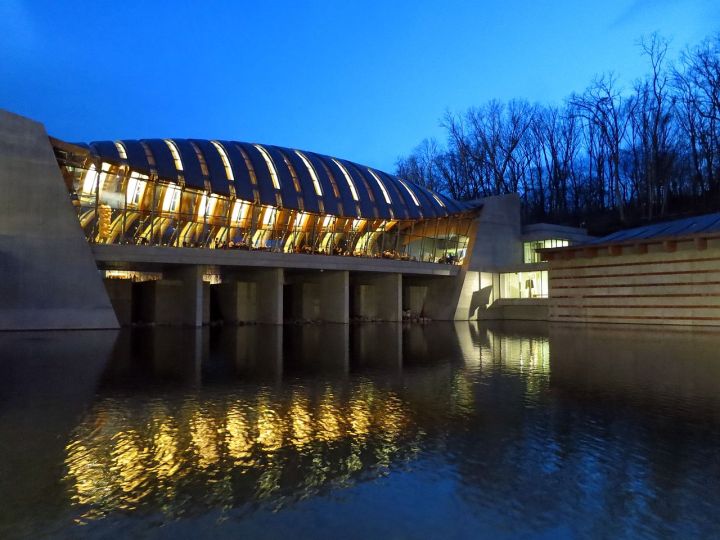
Crystal Bridges Museum of American Art, Bentonville, Arkanasas, designed by Moshe Safdie; it opened in November 2011.
(Photo: Wikimedia Commons, March 2013, Stefan Krasowski)
◊ ◊ ◊ ◊ ◊
From the flyer for the Tyson Scholars Program:
Tyson Scholars Program: Fellowships in American Art
Crystal Bridges Museum of American Art, Bentonville, Arkansas, 2019–20
Applications accepted between 1 November 2018 and 15 January 2019
The Tyson Scholars program, established in 2012, supports scholarship in the full range of subjects related to American art and visual and material culture. Crystal Bridges welcomes ambitious and cross-disciplinary projects in a variety of disciplines, including art history, architecture, visual culture, Indigenous art, American studies, and contemporary art. Applicants with innovative and genre-bending topics are encouraged and both pre- and post-doctoral candidates are eligible.
Crystal Bridges is located in Bentonville, Arkansas, in the beautiful Ozark Mountains. Scholars will be within easy reach of both the lively college-town nightlife of Fayetteville and the rugged natural beauty of the Buffalo National River and other parks. Bentonville is within a 5-hour drive of Dallas, St. Louis, and Memphis; and is 3 hours from Kansas City and Little Rock. The Tyson Scholars Program offers the ideal opportunity to focus on research and writing, with first-hand access to American art and architecture.
The Tyson Scholars Program offers
• Free housing in a quiet, secluded residence near the museum
• Flexible scheduling: from six weeks to an academic year
• Stipends of $15,000 to $30,000 per semester Relocation allowance
• Access to the extensive art reference holdings of the Crystal Bridges Library and the University of Arkansas Libraries
• Access to the Crystal Bridges collection, which spans five centuries of American art
Tyson Scholars are afforded work space in the curatorial wing of the Crystal Bridges Library and work with museum curators and staff, as well as scholars from the University of Arkansas in Fayetteville. The period of residency may be spent in active research or dedicated to the completion of a dissertation or book manuscript. Scholars have opportunities to share their work with one another and with the public through lectures and gallery talks. Apply for the 2019–20 season in November and join a community of scholars at Crystal Bridges Museum of American Art.
Winterthur Research Fellowship Program, 2018–19
Winterthur Research Fellowship Program
Wilmington, Delaware, 2018–19
Applications due by 15 January 2018
Winterthur invites scholars, graduate students, artists, and craftspeople to apply to submit applications to the 2018–2019 Research Fellowships! Fellowships include a 4-month postdoctoral fellowship, 1–2 semester dissertation fellowships, and 1–3 month short-term fellowships.
Winterthur is once again offering short-term ‘Maker-Creator’ Fellowships. These short-term fellowships are designed for artists, writers, filmmakers, horticulturalists, craftspeople, and others who wish to examine, study, and immerse themselves in Winterthur’s vast collections in order to inspire creative and artistic works for general audiences.
Fellows have full access to the library collections, including more than 87,000 volumes and one-half million manuscripts and images, searchable online. Resources for the 17th to the early 20th centuries include printed and rare books, manuscripts, period trade catalogues, auction and exhibition catalogues, printed ephemera, and an extensive reference photograph collection of decorative arts. Fellows may conduct object-based research in the museum’s collections, which include 90,000 artifacts and works of art made or used in America to 1860, with a strong emphasis on domestic life. Winterthur also supports a program of scholarly publications including Winterthur Portfolio: A Journal of American Material Culture.
Fellows may reside in a furnished stone farmhouse on the Winterthur grounds and participate in the lively scholarly community at Winterthur.
At Winterthur, Fellows experience:
• Unparalleled Collections: Printed and rare books, manuscripts and ephemera, images, museum and garden collections
• A Broad Range of Scholarly Topics and Academic Disciplines: Topics in social and cultural history, art history, religion, literary studies, American studies, design history and decorative arts, material culture, and conservation studies, and topics related to the colonial Americas and United States from the seventeenth to the twentieth centuries
• A Collegial Atmosphere: Access to the expertise of librarians, curators, conservators, and research fellows, and graduate students with related interests
• A Material Culture Perspective: Gain experience in seeking new knowledge from the study of the material world
Fellowship applications are due January 15, 2018. For more details and to apply, visit the Research Fellowship web page or email researchapplication@winterthur.org.
Funding Opportunities | Terra Foundation for American Art
Terra Foundation for American Art Academic Awards, Fellowships and Grants
Applications due by 15 January 2018 (some extended to 29 January)
R E S E A R C H A N D T E A C H I N G
Research Travel Grants to the United States
These grants enable scholars outside the United States to consult resources and visit collections within the United States. The foundation accepts proposals from doctoral students and postdoctoral and senior scholars working on American art and visual culture prior to 1980. More
International Research Travel Grants for US-based Scholars
These grants offer US-based scholars working on American art and visual culture prior to 1980 the opportunity to conduct research abroad. Grant funding is available for doctoral students, and postdoctoral and senior scholars, whose projects require the study of materials outside the United States. More
Terra Summer Residency
The Terra Summer Residency brings together doctoral scholars of American Art and emerging artists worldwide for a nine-week residential program in the historic village of Giverny, France. The program encourages independent work while providing seminars and mentoring by senior scholars and artists to foster reflection and debate. More
Terra Foundation Visiting Professorships at the John F. Kennedy Institute, Freie Universität Berlin
Three eight-month visiting professorships will aim at fostering the cross-cultural, trans-disciplinary scholarly engagement with North American Art at the John F. Kennedy Institute for North American Studies, Freie Universität Berlin and the art history departments of Freie Universität and Humboldt Universität, respectively. Visiting professors will offer two specialized seminars per semester in American Art History (B.A. and M.A. levels) and participate in the larger academic community of the Kennedy Institute for the duration of their stay. More
Terra Foundation Postdoctoral Teaching Fellowships at Université Paris Nanterre and Université Paris-Diderot, 2018–22
A new postdoctoral teaching fellowship program, hosted jointly by the Université Paris Nanterre and the Université Paris-Diderot, will begin in fall 2018. Fellows will be nominated for a two-year period (2018–20 and 2020–22) and will instruct American art history and visual culture to graduate students in art history and American cultural history in combination with personal research. More
P U B L I C A T I O N S
Digital Publication Initiatives
Terra Foundation for American Art Digital Publication Initiatives are innovative projects that promote the use and application of computational technology and data in the study of the visual arts of the United States and the dissemination of the resulting research. More
The editors of the online journal Nineteenth-Century Art Worldwide are currently accepting proposals for articles addressing art and visual culture of the Americas in the long nineteenth century, from the American Revolution to World War I as part of the series “American Art History Digitally”. More










 Enfilade
leave a comment