Vidal Award Results
Warm congratulations to this year’s recipients of the Mary Vidal Award!
Lauren Cannady (New York University) to present a paper, “The Garden Landscape and the French Interior” at the HECAA New Scholars session at CAA
Amanda Strasik (University of Iowa) to present a paper, “Portraying the (Future) Queen: Le Portrait de Marie-Josèphe de Saxe et le duc de Bourgogne,” at the HECAA New Scholars session at ASECS
Art, Agency, Empire: India in Global Contexts
From the YCBA:
Art, Agency, Empire: India in Global Contexts — Graduate Student Symposium
Yale Center for British Art, New Haven, 11 February 2012

Edward Lear, "Kangchenjunga from Darjeeling," detail, 1879 (New Haven: Yale Center for British Art)
This one-day graduate student symposium is informed by the recent proliferation of projects on India’s visual and material culture, including two exhibitions that opened at the Center in the fall of 2011: Johan Zoffany RA: Society Observed (October 27, 2011– February 12, 2012), which includes a substantial section devoted to the works the artist produced during his residence in India, between 1783 and 1789; and Adapting the Eye: An Archive of the British in India, 1770–1830 (October 11–December 31, 2011), which concentrated on the complex networks of British and Indian artists, patrons, and scholars in the late eighteenth and early nineteenth centuries.
Art, Agency, Empire: India in Global Contexts explores how, in a postcolonial period, it has become increasingly pressing to reevaluate India as a site of multifarious cultural (indeed intercultural) production, which has provoked global responses across media. The symposium is free and open to the public; registration is required. Online registration is available from January 16 to February 9, 2012. Onsite registration is available on February 11 from 8:30 am.
The program will include papers by graduate students (listed here) as well as breakout sessions in the Johan Zoffany exhibition and Center’s collections.
◊ ◊ ◊ ◊ ◊
Keynote Lecture, 5:30 pm
Gillian Forrester (Curator of Prints and Drawings Yale Center for British Art)
In the Cock-Pit: Zoffany and the Performance of Empire in India
Wiebenson Prize Deadline Approaching Soon
Each year HECAA awards the Wiebenson Prize for an outstanding graduate student paper presented during the previous calendar year at a scholarly conference or as a sponsored lecture. Announced at HECAA’s annual luncheon (each spring at ASECS), the prize includes modest remuneration.
The prize is named for Dr. Wiebenson, Professor Emerita at the University of Virginia School of Architecture.
By 15 February 2012, each applicant should submit an electronic copy of the paper for consideration – as read, without notes, but with illustrations – to Julie Plax, who will then forward the submissions to an ad hoc committee responsible for selecting the winner. Honorable mention is also an option for papers of distinction not chosen for the prize. Recipients must be HECAA members in good standing.
Curatorial Fellowship at the Indianapolis Museum of Art
Allen Whitehill Clowes Curatorial Fellowship
Indianapolis Museum of Art, 2012-2013
Applications due by 30 March 2012
The Indianapolis Museum of Art is pleased to announce a nine-month curatorial fellowship. The fellowship supports scholarly research related to the Clowes Collection at the IMA and provides curatorial training in the field of European painting and sculpture. The Clowes Fellow is fully integrated into the curatorial division of the Museum and has duties comparable to those of an assistant curator, ranging from collection research and management to exhibition development and the preparation of interpretive materials and programs.
To be eligible for the fellowship, the applicant must be enrolled in a graduate course of study leading to an advanced degree in the history of art or a related discipline, or be a recent degree recipient (within the last two years). Applicants must demonstrate scholarly excellence and promise, as well as a strong interest in the museum profession. U.S. citizenship is not required.
The Clowes Fellow will receive a stipend of $18,000 and an educational travel allowance of $2,000. Housing is provided in a scholar’s residence on the grounds of the museum. The nine-month fellowship period will begin September 4, 2012. The appointment is renewable. (more…)
Meet Our New Intern: Ashley Hannebrink
I’m happy to introduce Enfilade’s current intern, Ashley Hannebrink, who already has lots of great ideas in store for the next couple of months. -CH
◊ ◊ ◊ ◊ ◊
Note (added 5 May 2025) — The full postings for interns have been archived offline.
Fellowships in American Art and Visual Culture
Smithsonian American Art Museum Research Fellowships
Washington, D.C.
Applications due by 15 January 2012
The Smithsonian American Art Museum and its Renwick Gallery in Washington, D.C., invite applications for research fellowships in art and visual culture of the United States. A variety of predoctoral, postdoctoral, and senior fellowships are available. Fellowships are residential and support independent and dissertation research. The stipend for a one-year fellowship is $30,000 for predoctoral fellows or $45,000 for senior and postdoctoral fellows, plus generous research and travel allowances. The standard term of residency is twelve months, but shorter terms will be considered; stipends are prorated for periods of less than twelve months.
Contact: Fellowship Office, American Art Museum, (202) 633-8353, AmericanArtFellowships@si.edu. For information and a link to the online application, visit the museum’s website.
From Student to Art Historian: Transitioning into Professionalism
As Enfilade’s internship program continues to develop and finds its way, I’m happy to give a large public word of thanks to Amanda Strasik as her two-months with us draws to an end. She’s done a fantastic job tracking down material — much of which was posted under her name (though plenty of things appeared generically under the ‘editor’ label). Even more, she patiently put up with my hectic fall schedule. Here, in her final posting, she, as a first-year Ph.D student, contemplates what the end of her graduate training might bring — all with the help of Amber Ludgwig, whom she interviewed for the essay. Many thanks, Amanda! -CH
◊ ◊ ◊ ◊ ◊
In ruminating over the development of academic identity, I’m grateful to Dr. Amber Ludwig for her insights. — AS
 s a new Ph.D. student immersed in the world of the classroom, I’ve already noticed that it’s easy to become absorbed in my own research and neglect greater thought to the existence of the professional world of art history—the very world I’m striving to join. While the completion of my graduate work lies in the distant future, I’ve begun to consider the evolution of my own identity as a young scholar, progressing toward the “transitional phase” that all successful graduate students eventually face, the period when one looks to the job market but still has not entirely shed the identity of a student. In an effort to help demystify the “transition” from student to professional in terms of the development of scholarly identity, Dr. Amber Ludwig, a 2011 doctoral graduate of Boston University, kindly volunteered to share some of her experiences as she went from a “deferential graduate student to a commanding ‘doctor.’” Currently a Curatorial Assistant at the Honolulu Academy of Arts and the Interim Co-Director of the University of Hawaii Art Gallery, Dr. Ludwig has, through her own insights, encouraged me to conjoin, rather than separate, my identity as a student-professional, in the course of pursuing my own career as a young art historian.
During our interview, Amber mentioned that the dissertation writing process was a period of time when she felt very much alone with her thoughts. As a student, she worked independently on topics of her choosing, and she was really responsible only to the professors on her dissertation committee. In addition to the personal enjoyment she found in her subject matter, the notion of introducing new ideas to the field of eighteenth-century art history was inspiring in itself. Now as a museum professional, she’s been forced to adapt to a more “team-like” setting that is constrained by budgetary restrictions and the specific interests of the university audience. While this framework alleviates much of the “what comes next” pressure, it’s a very different working environment than graduate school.
Amber notes, for instance, that whereas her audience was previously dominated by her adviser, it’s now large and varied in terms of scholarly backgrounds — and she adds, “surprisingly more critical!” She credits the dissertation defense as an “incredibly helpful exercise” for instilling confidence in one’s work. She also stresses that the dissertation process is the beginning of one’s career, not the end. Thus, the dissertation is not simply about exhibiting expertise on a particular subject; rather, one is expected to “use the lessons learned throughout the process to improve one’s scholarship and professional practice.” In Amber’s case, she found herself constantly evaluating and re-evaluating how she could improve both her argument and the process itself in order to transition into the professional world more confidently confidently.[i]

As I evaluate my own development of scholarly identity and moments of academic self-discovery, I asked Amber if she had any advice that might make the transition from grad student to professional a little less intimidating. In response, she emphasized the value of presenting at conferences. The experience not only builds students’ confidence to speak authoritatively about their work, but also facilitates networking among others with similar interests.
She concluded our interview with a thought that has made a real impression me: don’t take criticism too personally. For a quasi-sensitive graduate student like me, criticism of one’s academic performance is both necessary and terrifying. And so I’m going to do my best to keep her words in mind: “if you were already perfect, there would be no need for education. Think of it as money well spent.”
◊ ◊ ◊ ◊ ◊
[i] For an interesting take on the dissertation as the beginning of one’s academic career, see Karen Kelsky’s article, “Dissertation Limits,” from InsideHigherEd.com (12 September 2011). Kelsky explains how little, in her opinion, the dissertation itself matters in the bigger picture for a prospective academic job candidate. It’s an intriguing perspective when thinking about the formation of a graduate student’s scholarly identity.
Call for Papers: Graduate Student Symposium in Vancouver
Graduate Student Symposium in Vancouver: The Unseen
University of British Columbia, Vancouver, 30-31 March 2012
Proposals due 6 January 2012
The Unseen proposes a blind engagement with the visual. While traditional art historical practice assumes the task of making the art object or artifact whole through observation, description, and interpretation, this symposium instead sets out to embrace a trace that may be fractured, destroyed, moved, translated, historicized, censored, extolled or ignored. The 31st annual University of British Columbia Art History, Visual Art and Theory Graduate Symposium will attend to a critical reassessment of what resists representation, description, articulation or documentation. We seek innovative submissions that investigate and conceptualize the notion of the unseen as it intersects with historical, perceptual, political and philosophical claims concerning the production and circulation of meanings and forms of knowledge.
Unseeing describes both a category of historical analysis and a critical action. Recent studies on visuality and visual culture have asserted the primacy of the visual as a “social fact” constituting historical and contemporary modes of perception and lived experience. By challenging what is or has once been at the boundaries of visuality and visibility, the unseen alternately aims to grasp the unseizable and its potentiality as a form of non-knowledge. This methodological reevaluation further underscores the historiographical problematic of the unwritten or the unwriteable, discerning what has been occluded from or has escaped being written into histories of the visual, or what has become embedded in and normative of others.
Current and recently graduated Master of Arts, Masters of Fine Arts, Doctoral and Post Doctoral scholars are encouraged to submit an abstract of no more than 300 words by January 6, 2011. Include your full name, affiliation and contact information and send your abstract to gradsymp@interchange.ubc.ca.
The 31st Annual AHVAT Graduate Symposium includes a two-day symposium on March 30 and 31, 2012, and a concurrent exhibition, dates to be confirmed. For more information please visit: http://www.ahva.ubc.ca.
Call for Papers: Cleveland Symposium
Cleveland Graduate Student Symposium — Things Fall Apart: Fragmentation in Visual Culture
Cleveland Museum of Art, 23 March 2012
Proposals due 15 December 2011
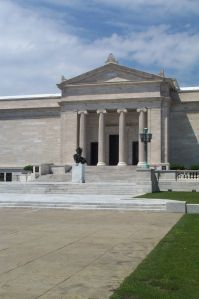 The 2012 Cleveland Symposium invites graduate submissions exploring the theme of fragmentation in the visual arts. This trope has manifested itself in a variety of ways in response to political, social, ideological, or aesthetic trends of a particular epoch. Students are encouraged to interpret this theme broadly, through avenues such as iconoclasm, revolution, political upheaval, physical fragmentation of materials, or particular aesthetic movements.
We welcome submissions from graduate students in all stages of their studies and from all fields and geographic regions, ranging from ancient through contemporary art. We will also consider papers from a wide range of methodologies and approaches. A monetary prize will be awarded to the speaker who presents the most innovative research in the most successfully delivered paper.
Please send an abstract of no more than 300 words for papers of no longer than 20 minutes, along with a curriculum vitae or résumé, to clevelandsymposium@gmail.com by December 15, 2011. Please include “Cleveland Symposium Submission” in the subject line of your email. Selected presenters will be notified by January 1, 2012.
Call for Papers: Material Matters for Emerging Scholars
From the University of Delaware:
Tenth Annual Material Culture Symposium for Emerging Scholars: Material Matters
Winterthur Museum, Garden & Library, Delaware, 14 April 2012
Proposals due by 16 November 2011
Focus: Object-based research has the potential to expand and even reinvent our understanding of culture and history. In honor of the tenth anniversary of the MCSES, we seek a broad range of papers from emerging material culture scholars. Whether exploring the latest theories, viewing existing material through a new lens, or reinterpreting standing historical conversations with an object-based focus, proposed papers should exemplify the possibilities in material culture research. In exploring these material matters, we hope to promote an interdisciplinary discussion on the state of material culture studies today. Disciplines represented at past symposia include American studies, anthropology, archaeology, consumer studies, English, gender studies, history, museum studies and the histories of art, architecture, design and technology. We welcome proposals from graduate students, postdoctoral scholars, and those just beginning their teaching or professional careers.
Format: The symposium will consist of nine presentations divided into three panels. Each presentation is limited to twenty minutes, and each panel is followed by comments from established scholars in the field. There will be two morning sessions and one afternoon session, with breaks for discussion following each session and during lunch. Participants will also have the opportunity to tour Winterthur’s unparalleled collection of early American decorative arts and to engage in a roundtable discussion on Friday, April 13. Travel grants of up to $300 will be available for presenters.
Submissions: The proposal should be no more than 300 words and should clearly indicate the focus of your object-based research, the critical approach you take toward that research, and the significance of your research beyond the academy. While the audience for the symposium consists mainly of university and college faculty and graduate students, we encourage broader participation. In evaluating proposals, we will give preference to those papers that keep a more diverse audience in mind. Send your proposal, with a current c.v. of no more than two pages, to emerging.scholars@gmail.com.
Deadline: Proposals must be received by 5 p.m. on Wednesday, November 16, 2011. Speakers will be notified of the vetting committee’s decision in January 2012. Confirmed speakers will be asked to provide symposium organizers with digital images for use in publicity and are required to submit a final draft of their papers by March 5, 2012.










 Enfilade
leave a comment