Call for Papers | The [After]Lives of Objects
From ArtHist.net:
The [After]Lives of Objects: Transposition in the Material World
(Online) University of Virginia Art & Architectural History Graduate Symposium, 18–19 March 2021
Proposals due by 15 December 2020
Transposition involves the movement of people, objects, and ideas from one context to another. The reverberating impacts of such regional and transregional exchanges have shaped artistic expressions, systems of knowledge, and relationships among polities. Recently, scholarship has turned to the object as a material manifestation of cross-cultural, transregional, and imperial encounters. [After]Lives is an interdisciplinary symposium that explores how transposition has materialized throughout history. How are objects changed when they are activated as mediums of encounter? In what ways do makers and users negotiate their positionality between and within societies through objects? How have artists and other creators problematized binary ideas of encounter and exchange in their works? When should adaptations be considered cultural appropriation instead of cross-cultural connectors? Can they be both? What is at stake when materials, artistic techniques, and/or technologies originating from one region are duplicated outside of that region?
Possible topics include, but are not limited to:
• Mediation of transcultural encounters through visual and material objects
• Processes of adaptation and assimilation in visual and material culture
• History of looting, collecting, and the art market
• Role of institutions in the (re)contextualization of objects
• Studies that problematize notions of influence, exchange, and reception across social, cultural, and artistic hierarchies
• Imperial and colonial networks of collection, trade, and exchange
We welcome submissions from graduate students at all stages and areas of study. Papers should be 20 minutes in length and will be followed by a Q&A plenary session. Papers must be original and previously unpublished. Graduate students are invited to submit a CV and an abstract (250 words) in a single PDF file by 15 December 2020 to the symposium committee at uvaartandarch@gmail.com. Applicants will be notified of decisions by 15 January 2021. Limited funds will be available to cover expenses associated with presenting at the symposium.
Keynote Speaker: Kristel Smentek, Associate Professor of Art History, Department of Architecture, MIT | Author of Mariette and the Science of the Connoisseur in Eighteenth-Century Europe (2014) and Objects of Encounter: China in Eighteenth-Century France (forthcoming).
Call for Papers | New Directions in 18th- and 19th-Century Art, Season 3
From NDENCA:
New Directions in Eighteenth- and Nineteenth-Century, Art Season 3
Digital Seminar Series
Abstracts due by 30 November 2020
This digital seminar series seeks to showcase new and innovative research being undertaken on eighteenth- and nineteenth-century art and its histories. We invite contributions for papers investigating any aspect of the artistic, visual, and material cultures of this period, and produced across the globe. Sessions will be hosted via video conferencing software and will take the form of a 40-minute seminar, with time following for questions.
We welcome proposals from PhD researchers, early career academics and museum professionals, particularly those from underrepresented groups. Please send your abstracts to ndencaseminar@gmail.com.
Fellowships | Tyson Scholars in American Art, 2021–22

From Crystal Bridges:
Tyson Scholars Program: Fellowships in American Art
Crystal Bridges Museum of American Art, Bentonville, Arkansas, 2021–22
Applications due by 15 January 2021
The Tyson Scholars of American Art Program supports full-time scholarship and an expansive approach to American art and visual and material culture from the colonial period to the present. The program was established in 2012 through a $5 million commitment from the Tyson family and Tyson Foods, Inc. Since its inception, the Tyson Scholars Program has supported the work of 46 scholars, attracting academic professionals in a variety of disciplines nationally and internationally.
Crystal Bridges and the Tyson Scholars Program invites PhD candidates (or equivalent), post-doctoral researchers and senior scholars from any field who are researching American art to apply. We encourage and support scholarship that seeks to expand boundaries and traditional categories of investigation into American art and visual culture. Applicants may be focusing on art history, architecture, visual and material culture, American studies, craft, Indigenous art, Latin American art, and contemporary art. Applications will be evaluated on the originality and quality of the proposed research project and its contribution to a more equitable and inclusive history of American art.
The Tyson Scholars Program looks for research projects that will intersect meaningfully with the Museum’s collections, library resources, architecture, grounds, curatorial expertise, programs and exhibitions; and/or the University of Arkansas faculty broadly; and applicants should speak to why residence in the Heartland will advance their work. The applicant’s academic standing, scholarly qualifications, and experience will be considered, as it informs the ability of the applicant to complete the proposed project. Letters of support are strongest when they demonstrate the applicant’s excellence, promise, originality, track record, and productivity as a scholar, not when the letter contains a commentary on the project.
Crystal Bridges is dedicated to an equitable, inclusive, and diverse cohort of fellows. We seek applicants who bring a critical perspective and understanding of the experiences of groups historically underrepresented in American art, and welcome applications from qualified persons of color; who are Indigenous; with disabilities; who are LGBTQ; first-generation college graduates; from low-income households; and who are veterans.
Fellowships are residential and support full-time writing and research for terms that range from six weeks to nine months. While in residence, Tyson Scholars have access to the art and library collections of Crystal Bridges as well as the library at the University of Arkansas in nearby Fayetteville. Stipends vary depending on the duration of residency, position as senior scholar, post-doctoral scholar or pre-doctoral scholar, and range from $15,000 to $30,000 per semester, plus provided housing. Additional funds of $1,500 for relocation are provided, and research funds are available during the residency upon application. Scholars are housed at one of the Crystal Bridges residences, within easy walking distance from the Museum via wooded trails and approximately 1.5 miles from downtown Bentonville. Scholars have private bed and bathrooms in the house, and share comfortable indoor and outdoor common spaces including an expansive yard and patio. Scholars are provided workspace in the curatorial wing of Crystal Bridges’ library. The workspace is an enclosed area shared with other Tyson Scholars. Scholars are provided with basic office supplies, desk space, an office chair, space on a bookshelf, and a locking cabinet with key for personal belongings and files.
Further information about the Tyson Scholars Program, application instructions, and application portal can be found here. Applications for the 2021-2022 academic year open October 19, 2020 and close January 15, 2021.
HECAA Emerging Scholars Showcase

George Lambert, Classical Landscape, 1745, oil on canvas, 41 × 46 inches
(London: Tate)
◊ ◊ ◊ ◊ ◊
HECAA Emerging Scholars Showcase
Online, Saturday, 7 November 2020, 2:00–3:30pm (EST)
Please mark your calendars for the first HECAA Emerging Scholars Showcase on Saturday, November 7, from 2:00 to 3:30pm EST. We will hear from our first seven emerging scholars present their research in 3– to 5–minute presentations, after which we will open up the floor to questions and comments. The intention of these showcases is to create networking opportunities, and we look forward to your audience participation in support of our emerging scholars.
We received an overwhelming number of applications, ranging geographically from China, India, and Australia, to Brazil, Europe, and across the USA. The topics likewise range in their geographical origin, theoretical approach, materials, techniques, and methods. We will also hold two additional showcases on 6 February 2021 and 17 April 2021.
Registration is not required. A Zoom link will be sent out to all HECAA members the week before November 7. If you have any questions or concerns, please contact Dani Ezor (dezor@smu.edu). Thank you!
Decorative Arts Trust Awards 13 Research Grants
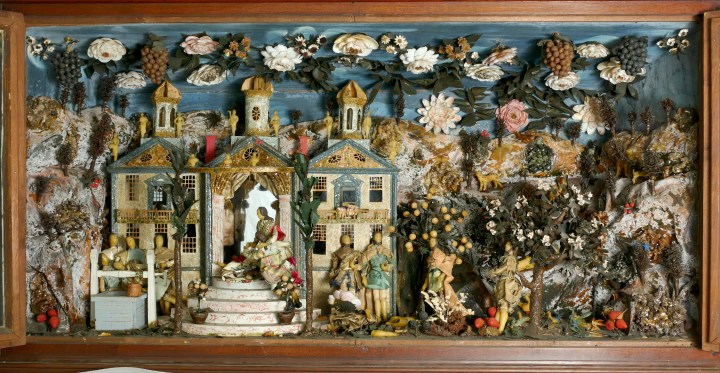
Grant recipient Isabella Rosner will research Quaker makers of shell and wax work boxes. Mary Morrison, wax and shellwork shadow box, 1769, Philadelphia (Chester County Historical Society).
◊ ◊ ◊ ◊ ◊
Press release (27 May 2020) from the Decorative Arts Trust:
The Decorative Arts Trust is pleased to announce the thirteen recipients of their 2020 Summer Research Grants, representing diverse cultures, materials, time periods, and geographies. Each year the Trust awards research grants to graduate students working on a Master’s thesis or PhD dissertation in a field related to the decorative arts. The Trust encourages projects that advance diversity in the study of American decorative arts. The word ‘summer’ may be a misnomer this year, as the Trust extended the terms of the grants to include travel through spring of 2021 due to potential restrictions related to the COVID-19 pandemic. The Trust also partners with other organizations to offer grants sponsored by the Marie & John Zimmermann Fund, the Decorative Arts Society of Orange County, and the Center for American Art.
The deadline to apply for Decorative Arts Trust Summer Research Grants is April 30 annually. For more information, visit decorativeartstrust.org or email thetrust@decorativeartstrust.org.
Kayle R. Avery
Winterthur Program in American Material Culture, Winterthur, University of Delaware
Avery will examine the digitization of modernist American concepts through the incorporation of Art Deco aesthetics in the BioShock video game franchise. His plans to study collections at the Metropolitan Museum of Art, the Cooper Hewitt Smithsonian Design Museum, and the New-York Historical Society’s Print Ephemera Collection.
Elizabeth S. Browne
Massachusetts Institute of Technology
Browne will travel to examine the archives of the Manufacture Nationale de Sèvres in France to study 18th-century French sculptor Clodion (Claude Michel) and the Sèvres’ serialization called the ‘Vases Clodion’.
Christina L. De León
Bard Graduate Center
De León will study the reinterpretation of the butaca by 20th-century designers Josef Albers and Clara Porset at the Albers Foundation in Bethany, Connecticut. Marie Zimmerman Grant.
Catherine Doucette
The Courtauld Institute of Art
Doucette will continue her study of a 19th-century tilt-top table, veneered with Jamaican woods and bearing images of the British Empire, made in Jamaica by the colony’s leading craftsman, Ralph Turnbull by visiting the Museum of Fine Arts, Boston, and the Yale Center for British Art.
Lamar Gayles
University of Illinois Chicago
Gayles will research the fabrication techniques and material mnemonics in the work of 20th-century Black American craftspersons by visiting collections in Alabama, Georgia, Chicago, and Washington, D.C.
Robert Gordon-Fogelson
University of Southern California
Gordon-Fogelson plans to research the work of mid-century designers Dave Chapman, George Nelson, and Walter Dorwin Teague as well as the Industrial Designers Society of America at the Research and Design Institute at Syracuse University’s Special Collections Research Center.
Cecilia Gunzburger
University of Virginia
Gunzburger will continue her study of the traditions and ornamental function of 16th-century European lace and related textiles at the Cleveland Museum of Art.
Cynthia Kok
Yale University
Kok will travel to the Museum of Fine Arts, Boston, and the Walters Art Museum in Baltimore to research snuffboxes made of mother-of-pearl, shell, and imitative materials and decorative styles.
Kayli Rideout
Boston University
Rideout will visit Richmond and Petersburg, Virginia to study ecclesiastical windows that Tiffany Studios was commissioned to create in memory of the Confederacy in the years between 1889 and 1925.
Isabella Rosner
King’s College London
Rosner will visit several collections in the Philadelphia region to understand more about Quaker women who made shell and wax work boxes.
Cambra Sklarz
University of California, Riverside
Sklarz will travel to Winterthur to examine ways that artists from approximately 1750 to 1860 incorporated waste or discarded goods into their decorative arts and practices. DARTS Grant.
Paige Weaver
University of South Carolina
Weaver will explore The Metropolitan Museum of Art’s Costume Institute and American Wing to evaluate a wide range of clothing, silver, and metalwork from the Reconstruction Era.
Xiaoyi D. Yang
Bard Graduate Center
Yang aims to continue her investigation of the circulation and consumption of Zhangzhou porcelains in Tokugawa-era commercial and cultural centers by visiting ceramic collections in Tokyo and Kyoto.
Call for Papers | Ma thèse en histoire de l’art en 180 secondes
From ArtHist.net:
Ma thèse en histoire de l’art en 180 secondes
Festival de l’histoire de l’art, Fontainebleau, 5–7 June 2020
Proposals due by 15 March 2020
La 10e édition du Festival de l’histoire de l’art aura lieu à Fontainebleau les vendredi 5, samedi 6 et dimanche 7 juin 2020 avec le Japon comme pays invité. Le thème fédérateur choisi cette année est le Plaisir. Dans le cadre de cette édition, il est proposé aux doctorants de participer au concours « Ma thèse d’histoire de l’art en 180 secondes ».
Chaque candidat disposera de trois minutes (180 secondes) pour réaliser un exposé clair et concis de son projet de recherche. Les présentations réalisées par les candidats retenus devront convaincre deux jurys composés d’historiens de l’art et de professionnels. A l’issue du concours, trois prix seront attribués aux trois meilleurs orateurs.
Premier prix: 1000€
Deuxième prix: 500€
Troisième prix: 500€
Les frais de transport et d’hébergement des participants hors région parisienne seront pris en charge sur présentation de justificatifs (jusqu’à 150€).
Call for Papers | Inside the Temporary Exhibition
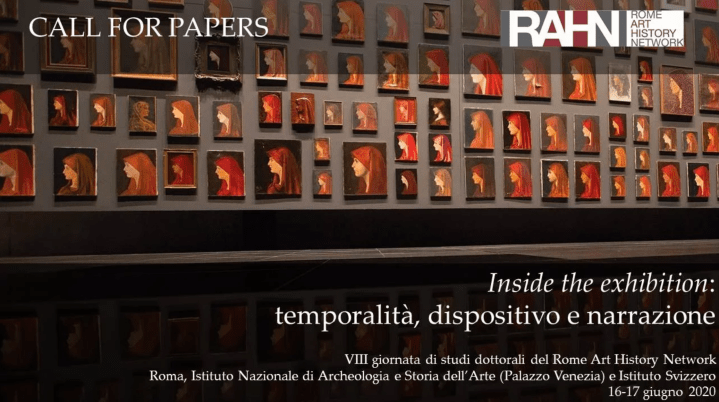
From the Call for Papers for this graduate student symposium, the full version of which includes Italian and French versions, via ArtHist.net:
Inside the Exhibition: Temporalità, Dispositivo e Narrazione
Swiss Institute and Istituto Nazionale di Archeologia e Storia dell’Arte (Palazzo Venezia), Rome, 16–17 June 2020
Proposals due by 19 April 2020
Now more than ever, temporary art exhibitions saturate museum spaces worldwide, shaping the discourse between public institutions and academia, and implicating an ever-growing and ever-changing international audience. The eighth doctoral study day organised by RAHN intends to reflect on the research opportunities afforded by the temporary display of artworks, from the early modern period to present day (15th–21st century).
In this wide time frame, temporary exhibitions have acquired multifarious meanings, shaping art-historical discourse. For example, the first public displays of paintings organised in the pronaos of the Pantheon, or in the cloisters of Roman churches for the festivals of patron saints, were tied to the religious context in which they took place. However, these displays were also key in the development of another ‘cult’, that of the artist, favouring the commercial interests of private collectors or of ante litteram curators, such as Giuseppe Ghezzi (1634–1721). With the formation of modern states, public exhibitions’ narratives were informed by different ideological programmes, which were inspired by, and in turn influenced contemporary art-historical debate. In this light, the temporary display of artworks offers an insight into the exhibition’s producing culture itself, and a unique opportunity for research.
The study day intends to focus on the ephemerality of art exhibitions, following a diachronic and interdisciplinary methodological approach inspired by Francis Haskell’s pioneering work on the subject (2000). When an artwork is put on display, its physical shift corresponds to a process of intellectual de- and re-contextualisation, through which the object acquires new meaning(s), imparted by the other objects with which it is put in dialogue, the space in which it is placed, and its audiences. With this in mind, we invite applicants to consider the following questions:
What affects such processes of de- and re-contextualisation? What happens when an art work is placed on temporary display? How does this influence the intellectual discourse surrounding the object and / or the exhibition? What interests are at stake in the organisation of artistic displays? What are their audiences, intended message and reception?
We welcome papers engaging with such questions, including, but not limited to the following contexts:
• the origins of art exhibitions and their cultural context (public, private, religious, secular, etc.)
• the artwork, its display, and fruition in the museum space
• the relationship between artistic historiography and exhibitions
• the art market: galleries, art fairs, and their exhibition spaces
• reception and critical discourses, the exhibition’s audiences and ‘verbal contexts’ (Pomian, 1986)
The application is open to doctoral students in the history of art and architecture enrolled in Italian and international institutions. We welcome 20-minute long papers focusing on methodological questions through a specific case study or proposing a theoretical approach to the subject. The proposals can be submitted in Italian, English, or French. To apply, please send a 250-word abstract and a 1-page academic CV by 19 April 2020 to the organisers: giornatadottorale.rahn@gmail.com.
Essential Bibliography
• Francis Haskell, The Ephemeral Museum: Old Master Paintings and the Rise of the Art Exhibition (New Haven: Yale University Press, 2000).
• Krzysztof Pomian, “Pour une histoire des semiophores. À propos des vases des Médicis,” Le Genre humain 14 (1986): 17–36.
Seminar | How to Write Articles for Publication

From ArtHist.net:
How to Write Articles for Publication
The Morgan Library & Museum, New York, 22 April 2020
Applications due by 2 March 2020
Join the editorial board of Master Drawings journal to learn strategies for translating your research into an article. A series of presentations will be followed by an interactive session in which participants will be divided into smaller groups to work closely with one of the journal’s editors. The seminar is open to 20 recent Ph.D. recipients and advanced graduate students in the history of art whose work focuses on drawings. The course takes place at The Morgan Library & Museum on Wednesday, April 22nd. The application deadline is March 2nd and should be submitted electronically with the subject header ‘Writing Seminar’ to administrator@masterdrawings.org. Participants will be notified by 1 April 2020. More information, as well as the online application form is available here. The seminar is made possible through the generous support of Baymeath Art Trust.
Immanuel Kant PhD Scholarship
From ArtHist.net:
Immanuel-Kant-Promotionsstipendium der Beauftragten der Bundesregierung für Kultur und Medien (BKM), July 2020 — June 2022
Applications due by 31 December 2019
Die Kulturstaatsministerin fördert mit dem Immanuel-Kant-Stipendium den hervorragend qualifizierten wissenschaftlichen Nachwuchs in den Geschichts-, Kultur- und Gesellschaftswissenschaften. Das Stipendium richtet sich an Doktorandinnen und Doktoranden, die sich mit transnationalen und transkulturellen Bezügen oder Verflechtungen im östlichen Europa vom Mittelalter bis in die Gegenwart unter besonderer Berücksichtigung der deutschsprachigen Bevölkerung befassen. Dazu gehören auch die Themenkomplexe Flucht, Vertreibung und Aussiedlung sowie die Integrationsprozesse nach 1945.
Gefördert werden u. a. Vorhaben aus den Bereichen Geschichte und Politik, Europäische Ethnologie/Volkskunde, Kunstgeschichte, Literatur- und Sprachgeschichte, Migrationsforschung und Sozialwissenschaft. Der regionale Fokus liegt auf den historischen preußischen Ostprovinzen (Schlesien, Ostbrandenburg, Pommern, Ost- und Westpreußen) in den heutigen Staaten Polen und Russland sowie den früheren und heutigen Siedlungsgebieten von Deutschen in Ost-, Ostmittel- und Südosteuropa (vornehmlich in Tschechien und der Slowakei, in der ehemaligen Sowjetunion und in den baltischen Staaten sowie in Ungarn, Rumänien und dem ehemaligen Jugoslawien).
Das für zwei Jahre gewährte Grundstipendium beträgt monatlich 1.300 Euro. Dazu können Zuschläge für Verheiratete, für Kinder sowie für einen Forschungsaufenthalt kommen. Eine Verlängerung ist möglich. Anträge können von in- und ausländischen Bewerbern und Bewerberinnen oder den sie betreuenden Hochschullehrerinnen und Hochschullehrern an einer Universität in der Bundesrepublik Deutschland gestellt werden.
Zu den Antragsunterlagen gehören:
• Lebenslauf und Zeugnisse,
• Thema, Fragestellung, Forschungsstand, Ziel und Zeitplan der geplanten Arbeit,
• Nachweis der Zulassung als Doktorand/in an einer deutschen Universität oder der Anbindung an eine deutsche Universität bei bi-nationalen Promotionsverfahren (Cotutelle-Verfahren),
• Gutachten der die Dissertation betreuenden Hochschullehrenden, Zweitgutachten eines weiteren Hochschullehrenden.
Stipendienanträge sind bis zum 31. Dezember 2019 digital im pdf-Format an die Geschäftsstelle des Imma-nuel-Kant-Stipendiums im Bundesinstitut für Kultur und Geschichte der Deutschen im östlichen Europa zu richten: bkge@bkge.uni-oldenburg.de
Stipendienbeginn ist der 1. Juli 2020. Die Entscheidung über die Stipendienvergabe trifft ein von der Beauftragten der Bundesregierung für Kultur und Medien berufener wissenschaftlicher Auswahlausschuss. Förderrichtlinien, Angaben zu Antragsunterlagen, zu Auswahl- und Bewilligungskriterien sowie eine Übersicht über die geförderten Dissertationsvorhaben (ab 2013) sind über die Homepage des Bundesinstituts unter http://www.bkge.de/Foerderungen-Stipendien-BKM/Immanuel-Kant-Stipendium/ abrufbar.
Kontakt
Bundesinstitut für Kultur und Geschichte der Deutschen im östlichen Europa
Geschäftsstelle des Immanuel-Kant-Stipendiums
Dr. Cornelia Eisler
Johann-Justus-Weg 147 a
D-26127 Oldenburg
+ 49 (0) 441 961 95-0
bkge@bkge.uni-oldenburg.de
Call for Essays | Oxford Art Journal Essay Prize 2019
From ArtHist.net (9 September 2019) . . .
Oxford Art Journal Essay Prize 2019
Submissions due by 1 December 2019
The Oxford Art Journal Essay Prize for Early Career Researchers is now open for submissions until 1st December 2019. The annual Essay Prize seeks to further enhance Oxford Art Journal’s international reputation for publishing innovative scholarship, and can be on any topic relevant to art history. Submissions are encouraged from British and international doctoral students, as well as early career researchers who are within five years of gaining their PhD.
The winner will receive:
• Publication of the winning essay in Oxford Art Journal
• £500 worth of Oxford University Press books
• A year’s free subscription to Oxford Art Journal
Find out more by visiting the journal’s website.










leave a comment