Call for Articles | Queerness in 18th- and 19th-C. European Art
From ArtHist.net and Arts:
Queerness in 18th- and 19th-Century European Art and Visual Culture, 2nd Edition
Special issue of the journal Arts, guest edited by Andrew Shelton
Abstracts due by 15 January 2025; final manuscripts will be due by 1 July 2026
Essays regarding a wide variety of topics that subvert or disrupt heteronormative interpretations of the art and visual culture of this period are welcome, including the works of art produced by or under the auspices of personages who can plausibly be identified as attracted to members of the same sex; works or creative situations that can be construed as expressing or eliciting same-sex sexual desire or attraction; works or creative situations in which the heteronormative polarity of the processes of identification and desire can be perceived as having been collapsed or scrambled; works or creative situations that involve gender-bending or gender fluidity; works or creative situations that either deepen or complicate our understanding of sexuality and/or sexual identity during the 18th and 19th centuries; and works that eroticize individuals or situations that are normally regarded as lying outside the realm of the erotic.
Arts is an international, peer-reviewed, open access journal promoting significant research on all aspects of the visual and performing arts, published bimonthly online by MDPI.
Submission Planning
• Abstracts due by 15 January 2025, submission link for abstracts.
• Final manuscripts due by 1 July 2026, submission link for full articles.
Submission Criteria
• Abstract and a short biography should be sent to Andrew Shelton (shelton.85@osu.edu) and Sylvia Hao (sylvia.hao@mdpi.com).
• Final articles, in English only, should be at least 4000 words long; a 150-word abstract and 5 keywords should also be submitted.
• Authors can include image files (tables, maps, graphs, photographs …) in ..jpg; they should ensure that images are free of rights (or that rights have been obtained).
• Each article will be peer-reviewed by at least two anonymous referees.
For inquiries, please contact: Sylvia Hao (sylvia.hao@mdpi.com) and Editorial Office of Arts (arts@mdpi.com).
Print Quarterly, September 2025
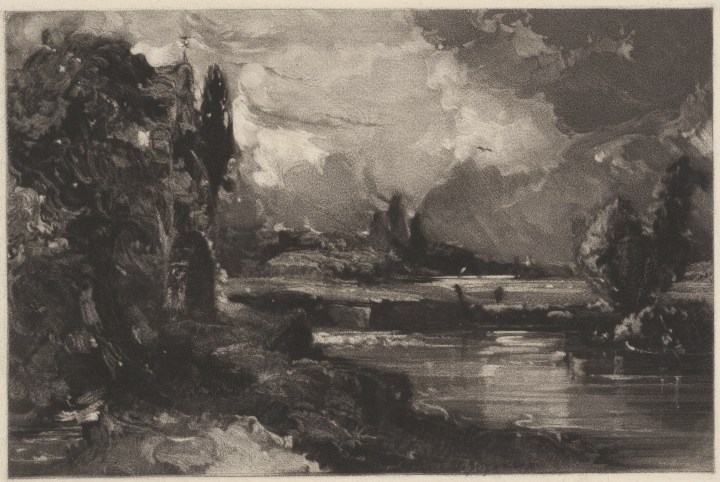
David Lucas, after John Constable, A Mill, 1829, mezzotint, 182 × 250 mm
(Cambridge, Fitzwilliam Museum, inv. P.145-1954)
◊ ◊ ◊ ◊ ◊
The long eighteenth century in the latest issue of Print Quarterly:
Print Quarterly 42.3 (September 2025)
a r t i c l e s
• Elenor Ling and Harry Metcalf, “John Constable’s Working Relationship with David Lucas on the English Landscape Series,” pp. 272–85. This article examines the collaborative partnership between John Constable (1776–1837) and his engraver David Lucas (1802–81) using the mezzotint print series English Landscape as a case study, based particularly on the technical examination of various impressions and plates.
• Niklas Leverenz, “Lithographs from Shanghai of the East Turkestan Engravings, 1890,” pp. 301–06. This short article examines the popularity of the East Turkestan engravings depicting the 1755–60 Qianlong Emperor’s conquest. Leverenz specifically discusses a set of 34 photolithographs printed in 1890 by the photographer Herman Salzwedel (active c. 1877–1904) in Shanghai.
n o t e s a n d r e v i e w s
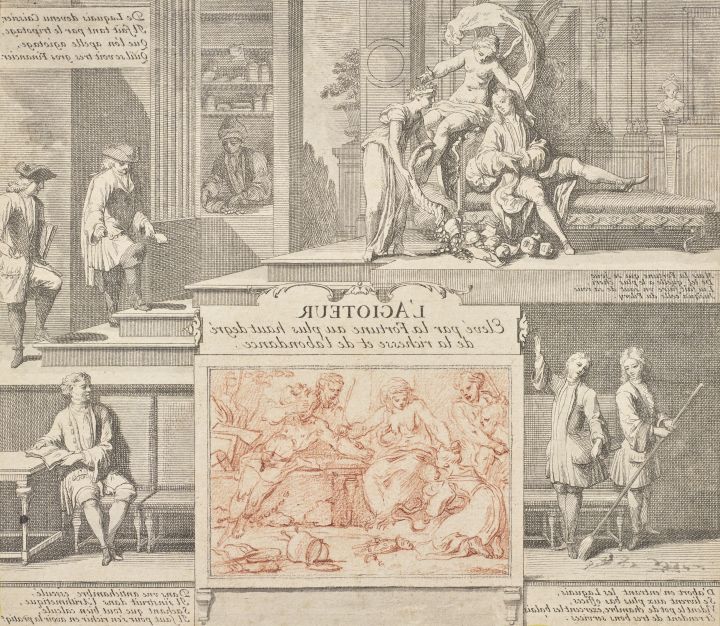
Claude Gillot, The Speculator Raised by Fortune to the Highest Degree of Wealth and Abundance, 1710–11, counterproof of engraving, with additions in red chalk, 255 × 220 mm (Paris, Private collection).
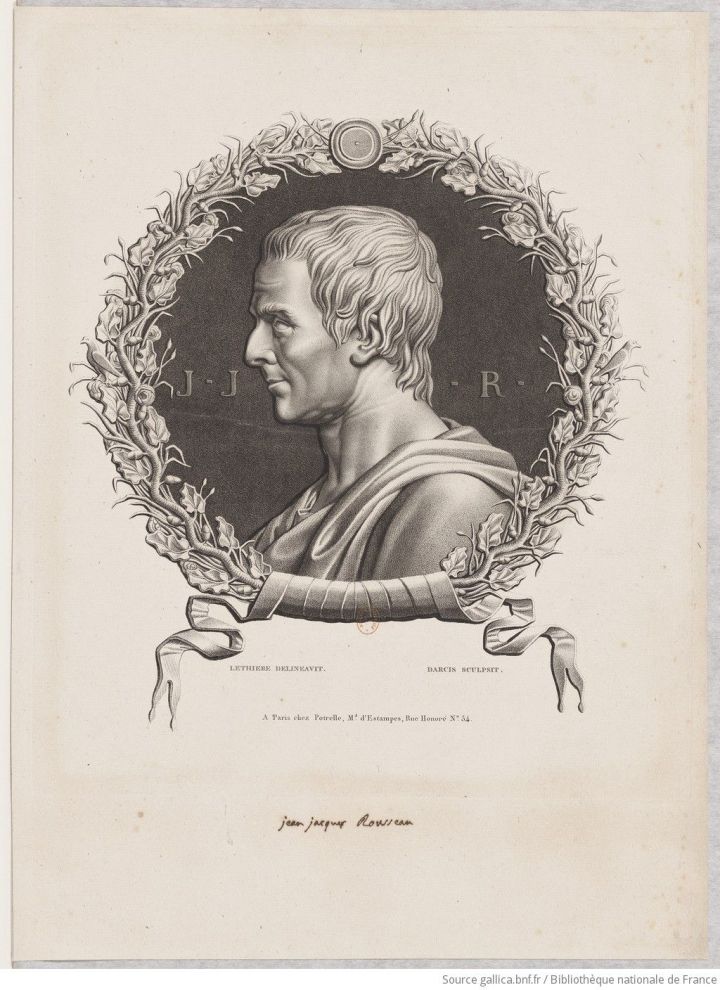
J.-Louis Darcis, after Guillaume Lethière, Portrait of Jean Jacques Rousseau, 1795, engraving, platemark 355 × 305 mm, page 440 × 320 mm (Paris, Bibliothèque Nationale de France).
• Dagmar Korbacher, Review of Andaleeb Badiee Banta, Alexa Griest and Theresa Kutasz Christiensen, eds., Making Her Mark: A History of Women Artists in Europe, 1400–1800 (Goose Lane Editions, 2023), pp. 307–10.
• Daniel Godfrey, Review of Gwendoline de Mûelenaere, Early Modern Thesis Prints in the Southern Netherlands: An Iconological Analysis of the Relationship between Art, Science, and Power (Université Catholique de Louvain, 2022), pp. 310–12.
• Meredith M. Hale, Review of Julie Farguson, Visualising Protestant Monarchy: Ceremony, Art and Politics after the Glorious Revolution, 1689–1714 (The Boydell Press, 2021), pp. 313–15.
• Rena M. Hoisington, Review of Jennifer Tonkovich, Claude Gillot: Satire in the Age of Reason (Paul Holberton, 2023), pp. 315–17.
• Michael Snodin, Review of Orsola Braides, Giovanni Maria Fara, and Alessia Giachery, eds., L’arte di tradurre l’arte: John Baptist Jackson incisore nella Venezia del Settecento (Leo S. Olschki, 2024), pp. 317–19.
• Benito Navarrete Prieto, Review of Ana Hernández Pugh and José Manuel Matilla, Del lapicero al buril. El dibujo para grabar en tiempos de Goya (Museo del Prado, 2023), pp. 320–24.
• Giorgio Marini, Review of Ilaria Miarelli Mariani, Tiziano Casola, Valentina Fraticelli, Vanda Lisanti, and Laura Palombaro, eds., La storia dell’arte illustrata e la stampa di traduzione tra il XVIII e il XIV secolo (Campisano Editore, 2022), pp. 324–28.
• Julie Mellby, Review of Roberta J. M. Olson, Audubon as Artist: A New Look at The Birds of America (Reaktion Books, 2024), pp. 328–29.
• Thea Goldring, Review of Esther Bell and Olivier Meslay, eds., Guillaume Lethière (Clark Art Institute, 2024), pp. 347–52.
Journal of the History of Collections, July 2025
The long eighteenth century in the latest issue:
Journal of the History of Collections 37.2 (July 2025)
a r t i c l e s
• Christian Huemer and Tom Stammers, “Perspectives on the Study of the Art Market,” pp. 215–20.
As interest in art-market studies continues to grow, the editorial team of the Journal of the History of Collections decided to interview Christian Huemer, director of the Belvedere Research Center in Vienna, and editor of the Brill series Studies in the History of Collecting & Art Markets; and Tom Stammers, who is leading the new MA in Art and Business at the Courtauld Institute of Art in London, to find out more about the subject and how it does and does not overlap with the study of collecting.
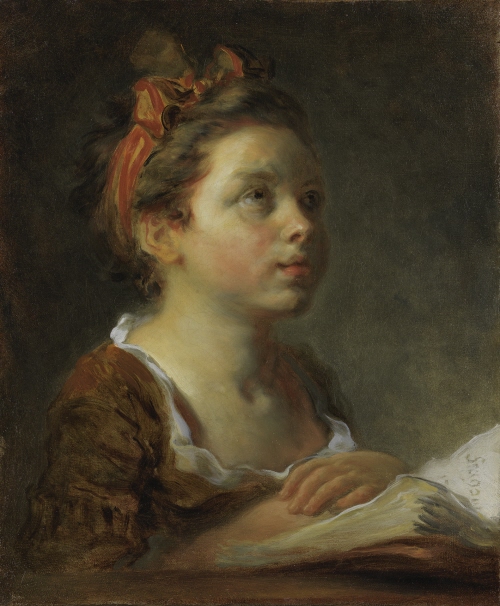
Jean-Honoré Fragonard, Girl Reading a Book, ca. 1770s, oil on canvas (London: The Wallace Collection).
• Yuriko Jackall, “French Art / English Taste: Richard Wallace’s Fragonards,” pp. 269–82.
Although an active collector of a broad range of objects, Sir Richard Wallace is more commonly known for his taste in nineteenth-century pictures, arms and armour, Renaissance maiolica and Kunstkammer objects than for his interest in eighteenth-century French painting. Nonetheless, he did add two significant works by Jean-Honoré Fragonard, Girl Reading a Book and A Boy as Pierrot, to the large and distinguished collection of rococo art that he had inherited from his supposed father, the 4th Marquess of Hertford. This paper focuses on these two acquisitions, and suggests that their purchase represents a calculated move by Wallace to enhance the existing holdings of his collection. By adding these two paintings, he sought not only to augment the art-historical value of the collection that it was now his responsibility to shepherd, but also to improve its appeal within the context of late nineteenth-century British taste.
• Ollie Croker, “The Architect as Agent: Charles Heathcote Tatham at Woburn Abbey and Castle Howard,” pp. 359–72.
The acquisition of Classical antiquities by the British nobility in the late eighteenth and early nineteenth centuries occurred within a complex social network. While the activities of prominent figures within this network have been well documented, those of lesser-known agents remain overlooked. This discussion focuses on Charles Heathcote Tatham (1772–1842), an architect involved in acquiring vases and sculptures for display at Woburn Abbey and Castle Howard. Acquisitions for both houses coincide with Tatham’s work designing galleries for these two estates. This suggests a means of collecting that has been less often studied: an architect is commissioned to acquire objects specifically for the interior decoration of his own architectural creations. Tatham’s dual role as architect and agent raises questions about the nature of these acquisitions, and the cultural associations his clients aimed to establish.
r e v i e w s
 • Wu Yunong, Review of Becky MacGuire, Four Centuries of Blue and White: The Frelinghuysen Collection of Chinese and Japanese Export Porcelain (Ad Ilissvm, 2023), pp. 391–92.
• Adriana Turpin, Review of Ulrike Müller, Private Collectors in Brussels, Antwerp, and Ghent, ca.1780–1914: Between Public Relevance and Personal Pleasure (Brepols, 2024), pp. 392–94.
• Marjorie Schwarzer, Review of Jonathan Conlin, The Met: A History of a Museum and its People (Columbia University Press, 2024), pp. 394–96.
• Jonathan Conlin, Review of Erica Ciallela and Philip Palmer, eds., Belle da Costa Greene: A Librarian’s Legacy (DelMonico Books, 2024) and Vanessa Sigalas and Jennifer Tonkovich, eds., Morgan―The Collector: Essays in Honor of Linda Roth’s 40th Anniversary at the Wadsworth Atheneum Museum of Art (Arnoldsche Verlagsanstalt, 2023), pp. 396–97.
Call for Articles | Sequitur (Fall 2025): Currents
◊ ◊ ◊ ◊ ◊
From the Call for Papers:
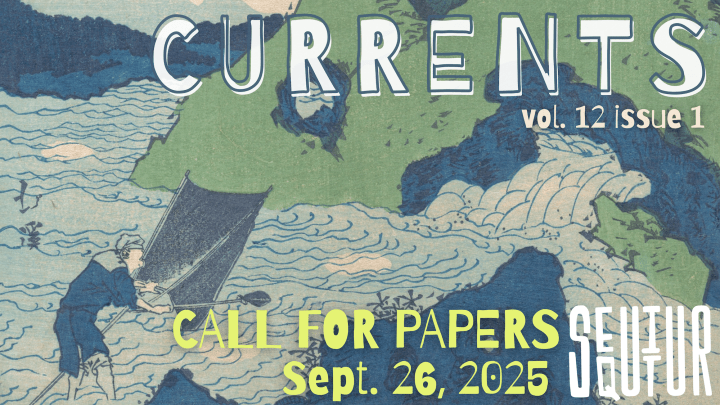
Sequitur, Fall 2025 | Currents
Submissions due by 26 September 2025
The editors of SEQUITUR, the graduate student journal published by the Department of History of Art & Architecture at Boston University, invite current and recent MA, MFA, and PhD students to submit content on the theme of “Currents” for our Fall 2025 issue.
This issue invites submissions that consider how artistic activity and material culture make visible, help detect, and even resist the invisible forces at work in our world. When used in the scientific fields of meteorology or hydrology, currents describe the perpetual motion of air and water. In the study of the humanities, the term might connote a prevailing trend or the zeitgeist of a particular historical moment.
Furthermore, scholarship in the blue humanities frames oceanic and cultural currents as part of an assemblage, suggesting that the ocean’s liquid perpetual motion and heterogeneous material composition are more than just a backdrop for human culture. At its surface, the ocean has served as a site of imperial conquest, extractivism, and militarization, but is also a site of migration, diaspora, and resistance. Scholars Kimberley Peters and Philip Steinberg even use the concept of the ocean, and all that it intermingles with, as a “Hypersea” to describe how the ocean exceeds its liquid form, perpetual cycles, or a specific body of water by permeating and shaping physical matter, such as the atmosphere and our bodies, but especially our imaginations. Peters and Steinberg’s work provokes further consideration of what art historical scholarship might look like when informed by natural and social currents that exceed their boundaries and inscribe one another.
From 17th-century Dutch still life painters’ fascination with the products of colonial and transoceanic trade to contemporary work such as Hito Stereyl’s Liquidity Inc. (2014), which draws parallels between liquid currents and the fluidity of financial assets, identities, and borders in a digital world, artists, architects, and collectors have responded to the questions and conditions shaped by natural and social currents. This issue seeks to collect scholarship spanning antiquity to the present that grapples with such currents as complex, historical assemblages and asks where art might serve as a tool to interrogate them.
Possible subjects may include, but are not limited to:
• Currents, Movement, and Temporality: Flow; perpetual motion; flux; swell; direction; circulation; pushing and pulling; present; contemporary; prevailing; instant; prediction; ongoing; trends
• Currents and Systems: Weather patterns; transoceanic drift; mapping; hydrocommons; oceanic and atmospheric ecologies; rivers; oceans
• Currents and Culture: (Un)intended distribution (shells, marine salvage, etc.); spirituality and religion (ritual, baptism, purification, etc.); contact zones; migration; undercurrents
• Currents and Scholarship within the Oceanic Turn: transoceanic imaginaries (Elizabeth DeLoughrey); a “poetics of planetary water” (Steve Mentz); tidalectics (Kamau Brathwaite); the Undersea, and other theoretical methods (including works of Stacy Alaimo, Hester Blum, John R. Gillis, Epeli Hau’ofa, Melody Jue, Astrida Neimanis, Serpil Oppermann, or Philip Steinberg, among many others)
SEQUITUR welcomes submissions from graduate students in the disciplines of art history, architecture, archaeology, fine arts, material culture, visual culture, literary studies, queer and gender studies, disability studies, memory studies, and environmental studies, among others. We encourage submissions that take advantage of the digital format of the journal.
Founded in 2014, SEQUITUR is an online biannual scholarly journal dedicated to addressing events, issues, and ideas in art and architectural history. SEQUITUR, edited by graduate students at Boston University, engages with and expands current conversations in the field by promoting the perspectives of graduate students from around the world. It seeks to contribute to existing scholarship by focusing on valuable but often overlooked parts of art and architectural history. Previous issues of SEQUITUR can be found here.
We invite full submissions in the following categories. Please submit your material in full for consideration in the publication:
Feature essays (1,500 words)
Content should present original material that falls within the stipulated word limit (1,500 words). Please adhere to the formatting guidelines available here.
Visual and creative essays (250 words, up to 10 works)
We invite M.Arch. or M.F.A. students to showcase a selection of original work in or reproduced in a digital format. We welcome various kinds of creative projects that take advantage of the online format of the journal, such as works that include sound or video. Submissions should consist of a 250-word artist statement and up to 10 works in JPEG, HTML, or MP4 format. All image submissions must be numbered and captioned and should be of good quality and high resolution.
We invite proposals for the following categories. Please write an abstract of no more than 200 words outlining your intended project:
Exhibition reviews (500 words)
We are especially interested in exhibitions currently on display or very recently closed. We typically prioritize reviews of exhibitions in the Massachusetts and New England area.
Book or exhibition catalog reviews (500 words)
We are especially interested in reviews of recently published (1–3 years old) books and catalogs.
Interviews (750 words)
Please include documentation of the interviewee’s affirmation that they will participate in an interview with you. Plan to provide either a full written transcript or a recording of the interview (video or audio).
Research spotlights (750 words)
Short summaries of ongoing research written in a more casual format than a feature essay or formal paper. For research spotlights, we typically, but not universally, prioritize doctoral candidates who plan to use this platform to share ongoing dissertation research or work of a comparable scale.
To submit, please send the following materials to sequitur@bu.edu:
• Your proposal or submission
• A recent CV
• A brief (50-word) bio
• Your contact information in the body of the email: name, institution, program, year in program, and email address
• ‘SEQUITUR Fall 2025’ and the type of submission/proposal as the subject line
All submissions and proposals are due 26 September 2025. Please remember to adhere to the formatting guidelines available here. Text must be in the form of a Word document, and images should be sent as .jpeg files. While we welcome as many images as possible, at least one must be very high resolution and large format. All other creative media should be sent as weblinks, HTML, or MP4 files if submitting video or other multimedia work. Please note that authors are responsible for obtaining all image copyright releases before publication. Authors will be notified of the acceptance of their submission or proposal the week of 15 October 2025, for publication in January 2026. If you have any questions, please do not hesitate to contact the SEQUITUR editors at sequitur@bu.edu.
The SEQUITUR Editorial Team
Ada, Emma, Hamin, Isabella, Jenna and Megan
The Burlington Magazine, August 2025
The long 18th century in the August issue of The Burlington:
The Burlington Magazine 167 (August 2025) | Decorative Arts
e d i t o r i a l
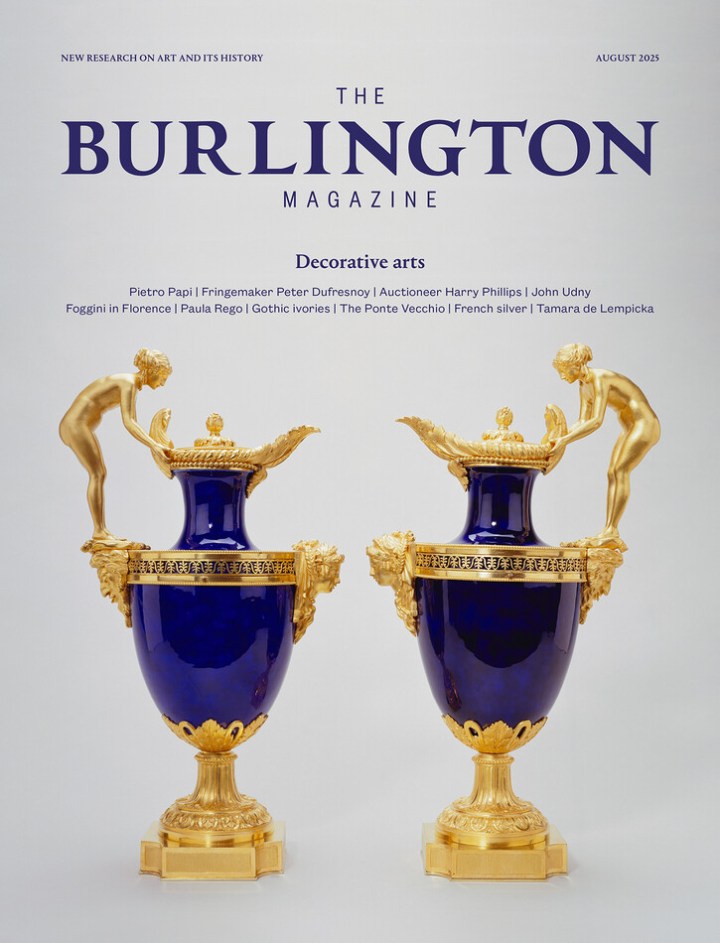 • Studying the Decorative Arts, p. 755.
The serious study of the decorative arts and the pleasures that derive from it have been an important feature of The Burlington Magazine since the early twentieth century. But how healthy is this field of research today? Arguably, it remains a specialised endeavour rather than holding a very prominent place in the mainstream of art-historical studies; and although there are some brilliant advocates for it and encouraging developments, an uncertain future is the key concern, as is the case with so many areas of scholarship in universities, museums and the market.
l e t t e r
• Philip McEvansoneya, “Lefèvre in Ireland,” pp. 756–57. Response to Humphrey Wine’s article in the May issue, “Napoleon Crossing the Alps: British Press Reaction to the London Exhibitions of David, Lefèvre, Wicar, and Lethière,” pp. 450–59.
a r t i c l e s
• Annabel Westman, “Peter Dufresnoy, Fringe and Lacemaker Extraordinaire,” pp. 758–75.
The French fringe and lacemaker Peter Dufresnoy excelled at his craft and trade in Restoration London. A close study of written sources and surviving works by him facilitates a reconstruction of his brilliant career. His patrons included the Duke of Lauderdale (Ham House), Mary Howard, Duchess of Norfolk and 7th Baroness Mordaunt (Drayton House), the Earl of Exeter (Burghley House) and the Dowager Queen Catherine of Braganza.
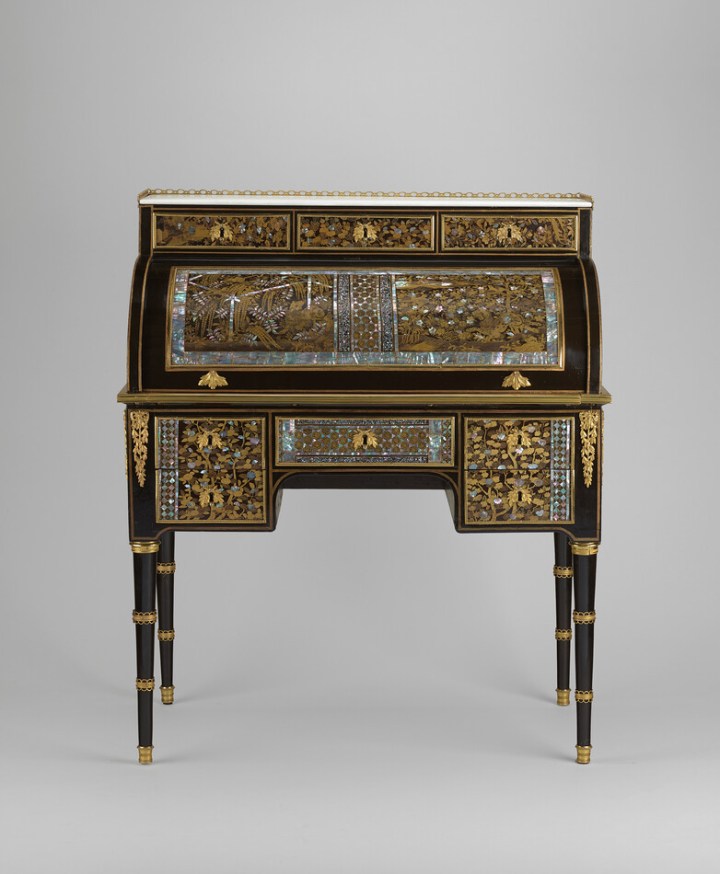
Roll-top desk. France, ca.1790, mounted with 16th-century Japanese lacquer, wood, black lacquer, gold and silver lacquer, mother of pearl, leather and gilt metal mounts, 110 × 95 × 55 cm (Royal Collection Trust; © His Majesty King Charles III 2025). The desk was acquired by the Prince of Wales (the future George IV) from Harry Phillips.
• Helen Jacobsen, “Harry Phillips and the Development of the London Decorative Art Market, 1796–1839,” pp. 776–91.
Analysis of sale catalogues assists in an assessment of the career of Harry Phillips, the least known of London’s significant Regency auctioneers. He specialised in decorative arts sales and his clients included William Beckford, the Prince of Wales and the Earl of Yarmouth. Notable works acquired at his auctions are now in the Royal Collection and the Wallace Collection, London.
• Brendan Cassidy, “John Udny and the ‘Battle of Pavia’ Tapestries, 1762–74,” pp. 792–99.
To commemorate Emperor Charles V’s victory at the Battle of Pavia in 1525, a set of seven tapestries illustrating key moments in the conflict were presented to the emperor by the Netherlands in 1531. They are now in the Museo di Capodimonte, Naples, and their provenance between 1762 and 1774 is established here by connecting them to John Udny, a Scottish diplomat, art collector and dealer.
• Romana Mastrella, “Two Monumental Maiolica Amphoraefrom the Papi Workshop: New Insights and Contexts,” pp. 800–05.
Recently acquired by the Metropolitan Museum of Art, New York, two large ‘istoriato’ maiolica vases [1670] featuring scenes from Torquato Tasso’s poem ‘Gerusalemme Liberata’ illustrate the continued presence of pottery workshops in seventeenth-century Urbania. Two previously unpublished documents help to contextualise their maker, Pietro Papi, as well the Papi family workshop, within the social and economic dynamics of central Italian ceramic production.
r e v i e w s
 • Christopher Baker, “New Collection Displays at the National Gallery, London,” pp. 806–15.
In May 2025, as the final part of its bicentenary celebrations, the National Gallery, London, unveiled extensive new displays of its paintings. Juxtaposing the familiar and the unexpected, they provide fresh perspectives on its outstanding and expanding collection.
• David Pullins, Review of the newly renovated Frick Collection in New York, pp. 816–19.
• Nicola Ciarlo, Review of the exhibition Giovan Battista Foggini: Architetto e scultore granducale (Palazzo Medici Riccardi, Florence), pp. 824–27.
• Charles Saumarez Smith, Review of the new V&A East Storehouse in London, pp. 837–39.
• Kirstin Kennedy, Review of Peter Fuhring, The French Silverware in the Calouste Gulbenkian Collection (Calouste Gulbenkian Foundation, 2023); and Charissa Bremer-David, with contributions by Jessica Chasen, Arlen Heginbotham, and Julie Wolfe, French Silver in the J. Paul Getty Museum (J. Paul Getty Museum, 2023), pp. 840–42.
• Humphrey Wine, Review of Nicolas Lesur, Pierre Subleyras (1699–1749) (Arthena, 2023), pp. 848–49.
• Françoise Barbe, Review of Marco Spallanzani, Otto studi sul vetro a Firenze, Secoli XIV–XVIII (Edifir Edizioni, 2024), pp. 849–50.
• Marika Sardar, Review of Sonal Khullar, ed., Old Stacks, New Leaves: The Arts of the Book in South Asia (University of Washington Press, 2023), 850–51.
Huntington Library Quarterly, Summer 2024 | Exhibitions in London
This special issue of HLQ arises from a conference held at the Huntington Library in September 2023:
Huntington Library Quarterly 87.2 (Summer 2024)
Paintings, Peepshows, and Porcupines: Exhibitions in London, 1763–1851
Edited by Jordan Bear and Catherine Roach
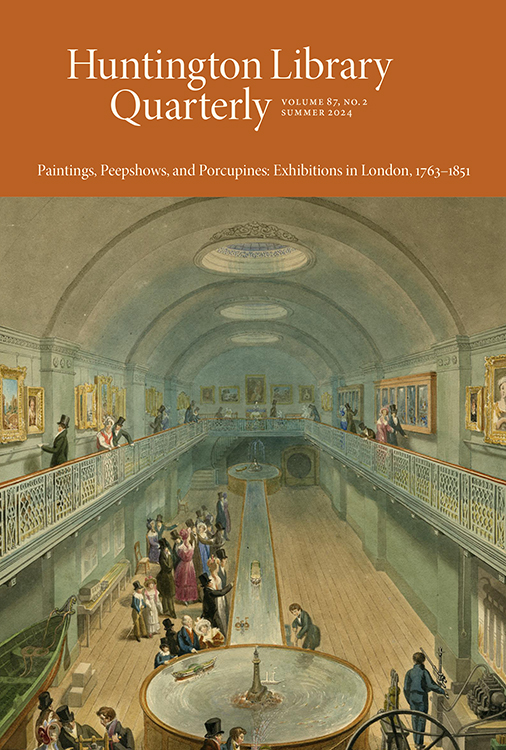 Dazzling variety characterized exhibitions in eighteenth- and nineteenth-century Britain: boxing matches, automata, contemporary art shows, panoramas, dog beauty contests, and menageries all contributed to a flourishing display culture. Despite their differences, these attractions shared both techniques for engaging audiences and widely reverberating themes. All of the essays in this volume work across multiple sites of display. By examining the varied terrain of exhibitions collectively, this issue illuminates cultural preoccupations of the time, including the multifarious impact of empire and the productively ambiguous boundaries between the cultural expressions that were deemed low and those that were deemed high.
c o n t e n t s
• Jordan Bear and Catherine Roach, “Introduction: Exhibitions in London, 1763–1851,” pp. 153–63.
• Adam Eaker, “The Art of Marring a Face: Exhibiting Boxers in Georgian London,” pp. 165–82.
• Nicholas Robbins, “The Circumference of the Subject: Figuring Race at Egyptian Hall,” pp. 183–205.
• Rosie Dias, “Making Space for Empire: India in Panoramas and Dioramas, 1830–1851,” pp. 207–31.
• Holly Shaffer, “Provisioners, Cooks, Coffeehouses, and Clubs: Exhibiting Taste in Calcutta and London in the Early Nineteenth Century,” pp. 233–54.
• Jordan Bear, “The Sea Serpent of Regent Street: On the Evidentiary Strategies of Nineteenth-Century Exhibitions,” pp. 255–71.
• Catherine Roach, “Dog Shows: Porcelain Pugs and Pre-Raphaelite Painters in Thomas Earl’s Art and Nature,” pp. 273–90.
• Alison FitzGerald, “Centers and Peripheries: Exhibiting London’s ‘Marvels’ in Britain’s ‘Second City’,” pp. 291–311.
• John Plunkett, “An Early Moving Picture Industry? Exhibition Networks and the Panorama, 1810–1850,” pp. 313–35.
The Magazine of the Decorative Arts Trust, Summer 2025
The Decorative Arts Trust has shared select articles from the summer issue of their member magazine as online articles for all to enjoy. The following articles are related to the 18th century:
The Magazine of the Decorative Arts Trust, Summer 2025
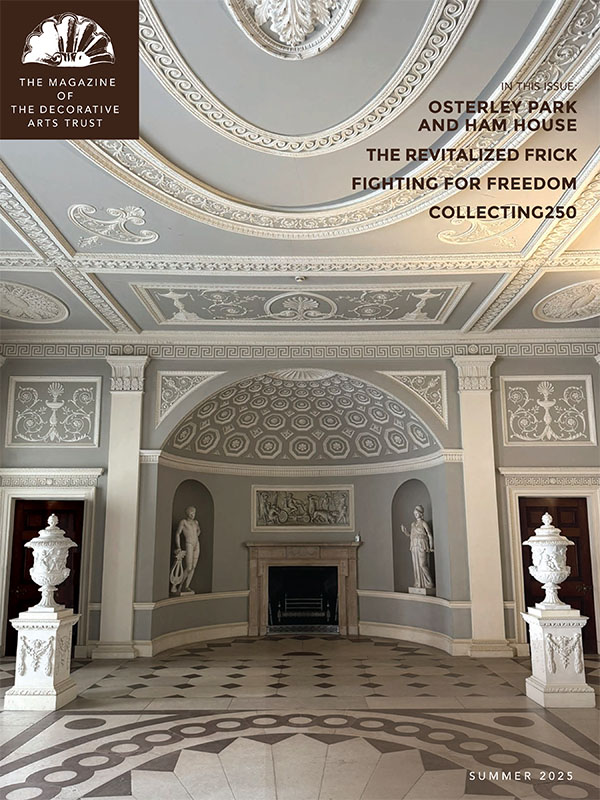 • “Time Travel in the Thames Valley: Ham House and Osterley Park” by Megan Wheeler Link»
• “Whose Revolution at the Concord Museum” by Reed Gochberg Link»
• “Fighting for Freedom: Black Craftspeople and the Pursuit of Independence” by William A. Strollo Link»
• “Decorative Arts Shine at the Reopened Frick” by Marie-Laure Buku Pongo Link»
• “A Room of Her Own: New Book Explores the Estrado” by Alexandra Frantischek Rodriguez-Jack Link»
• “Luster, Shimmer, and Polish: Transpacific Materialities in the Arts of Colonial Latin America” by Juliana Fagua Arias Link»
The printed Magazine of the Decorative Arts Trust is mailed to Trust members twice per year. Additional membership information is available here.
Pictured: The magazine cover depicts the Entrance Hall at Osterley Park showcasing Robert Adam’s signature Neoclassical style. The apsidal end features plasterwork by Joseph Rose and contains statues of Apollo and Minerva. The marble urns are attributed to Joseph Wilton. Decorative Arts Trust members visited the house during the Thames Valley Study Trip Abroad tours in May and June 2025.
The Burlington Magazine, July 2025
The long 18th century in the July issue of The Burlington:
The Burlington Magazine 167 (July 2025)
e d i t o r i a l

Maria van Oosterwijck, Vanitas stilleven, ca. 1675, oil on canvas (Amsterdam: Rijksmuseum).
• “The Gallery of Honour,” p. 635. The gallery of honour in the heart of the Rijksmuseum, Amsterdam, has recently welcomed an impressive painting to its walls: Vanitas still life by Maria van Oosterwijck (1630–93). In a compelling sense the artist has long had a place in galleries of honour, as works by her were acquired by Emperor Leopold I, Louis XIV of France, and Cosimo III de’ Medici of Tuscany.
r e v i e w s
• Christian Scholl, “Germany’s Celebration of Caspar David Friedrich’s 250th Anniversary,” pp. 694–701.
In Germany, the 250th anniversary of Caspar David Friedrich’s birth was celebrated with a series of exhibitions. Key among them were those organised by the three museums with the most extensive holdings of the artist’s work: the Hamburger Kunsthalle, the Alte Nationalgalerie, Berlin, and the Staatliche Kunstsammlungen, Dresden. All three focused on stylistic, iconographic and technical aspects of the artist’s work rather than on Friedrich’s life, and each in its own way has thrown fresh light on his complex and enigmatic art.
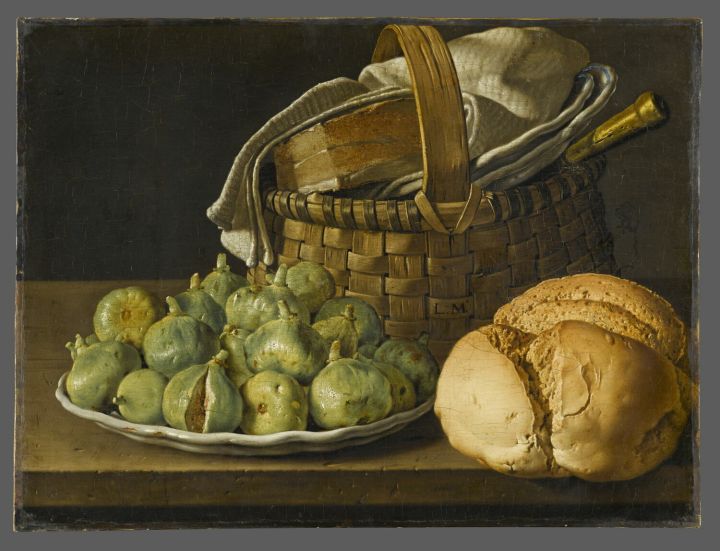
Luis Egidio Meléndez, Still Life with Figs, ca. 1760, oil on canvas (Paris: Musée du Louvre, on view at the Musée Goya, Castres).
• Robert Wenley, Review of the exhibition Wellington’s Dutch Masterpieces (Apsley House, London, 2025), pp. 713–15.
• Christoph Martin Vogtherr, Review of the exhibition Corot to Watteau? On the Trail of French Drawings (Kunsthalle Bremen, 2025), pp. 715–18.
• Elsa Espin, Review of the exhibition Le Louvre s’invite chez Goya (Musée Goya, Castres, 2025), pp. 718–20.
• John Marciari, Review of the exhibition Picturing Nature: The Stuart Collection of 18th- and 19th-Century British Landscapes and Beyond (Museum of Fine Arts, Houston, 2025), pp. 720–22.
• Kee Il Choi Jr., Review of the exhibition Monstrous Beauty: A Feminist Revision of Chinoiserie (The Metropolitan Museum of Art, New York, pp. 722–25.
• Deborah Howard, Review of Mario Piana, Costruire a Venezia: I mutamenti delle tecniche edificatorie lagunari tra Medioevo e Età moderna (Marsilio, 2024), pp. 732–33.
• Isabelle Mayer-Michalon, Review of Christophe Huchet de Quénetain and Moana Weil-Curiel, Étienne Barthélemy Garnier (1765–1849): De l’Académie royale à l’Institut de France (Éditions Faton, 2023), pp. 737–39.
Call for Submissions | Metropolitan Museum Journal
Metropolitan Museum Journal 61 (2026)
Submissions due by 15 September 2025
The Editorial Board of the peer-reviewed Metropolitan Museum Journal invites submissions of original research on works of art in the Museum’s collection. The Journal publishes Articles and Research Notes. Works of art from The Met collection should be central to the discussion. Articles contribute extensive and thoroughly argued scholarship—art historical, technical, and scientific—whereas Research Notes are narrower in scope, focusing on a specific aspect of new research or presenting a significant finding from technical analysis, for example. The maximum length for articles is 8,000 words (including endnotes) and 10–12 images, and for research notes 4,000 words (including endnotes) and 4–6 images. Articles and Research Notes in the Journal appear in print and online, and are accessible in JStor on the University of Chicago Press website.
The process of peer review is double-anonymous. Manuscripts are reviewed by the Journal Editorial Board, composed of members of the curatorial, conservation, and scientific departments, as well as scholars from the broader academic community. Submission guidelines are available here. Please send materials to journalsubmissions@metmuseum.org. The deadline for submissions for Volume 61 (2026) is 15 September 2025.
The Art of the Ephemeral in 18th-Century France
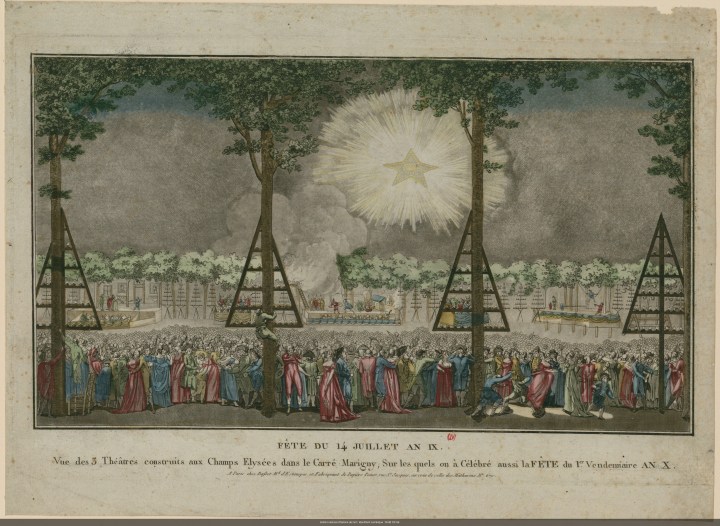
Paul-André Basset, Fête du 14 Juillet An IX, ca. 1801, hand-colored engraving, 28 × 44 cm (Paris: Bibliothèque de l’Institut National d’Histoire de l’Art). The print depicts the national holiday, as celebrated on the Champs-Élysées and organized by Chalgrin, commemorating the storming of the Bastille in 1789.
◊ ◊ ◊ ◊ ◊
All contents from this special issue of Status Quaestionis are available as free downloads:
Here Today, Gone Tomorrow?
The Art of the Ephemeral in Eighteenth-Century France
Status Quaestionis: Language, Text, Culture 28 (2025)
Edited by Elisa Cazzato
This monographic issue of Status Quaestionis explores the notion of ephemerality in French artistic culture during the long eighteenth-century. The volume is highly interdisciplinary, featuring articles from art and theatre history, costume-making, and performance studies, extending the notion of the ephemeral to a wide range of examples. The authors investigate how, in order to exist, ephemerality needs materiality, since any creative process intersects with the material requirement that both artworks and performances need: materials, locations, settings, scripts, costumes, and bodies. This dichotomy enables historians to further analyse the cultural and political meanings of the ephemeral, connecting artworks to social contexts, dance costumes to movements, and public festivals to human reception. Rather than focusing solely on aesthetics, the volume interrogates how the ephemeral was experienced, recorded, and remembered and how its traces persist in artworks, texts, and collective memory. The contributions question the boundary between presence and absence, visibility and oblivion, reflecting on the long-term cultural implications of transience. In seeking what remains of the ephemeral, the volume challenges dominant narratives and reconsiders the politics of cultural memory.
This special issue was inspired by the intellectual discussions that took place during the international conference organised at Ca’ Foscari University of Venice in June 2023. The conference was part of the research project SPECTACLE, funded by the European Union’s Horizion 2020 research and innovation programme under the Marie Skłodowska-Curie grant agreement no. 893106.
t h e m a t i c a r t i c l e s
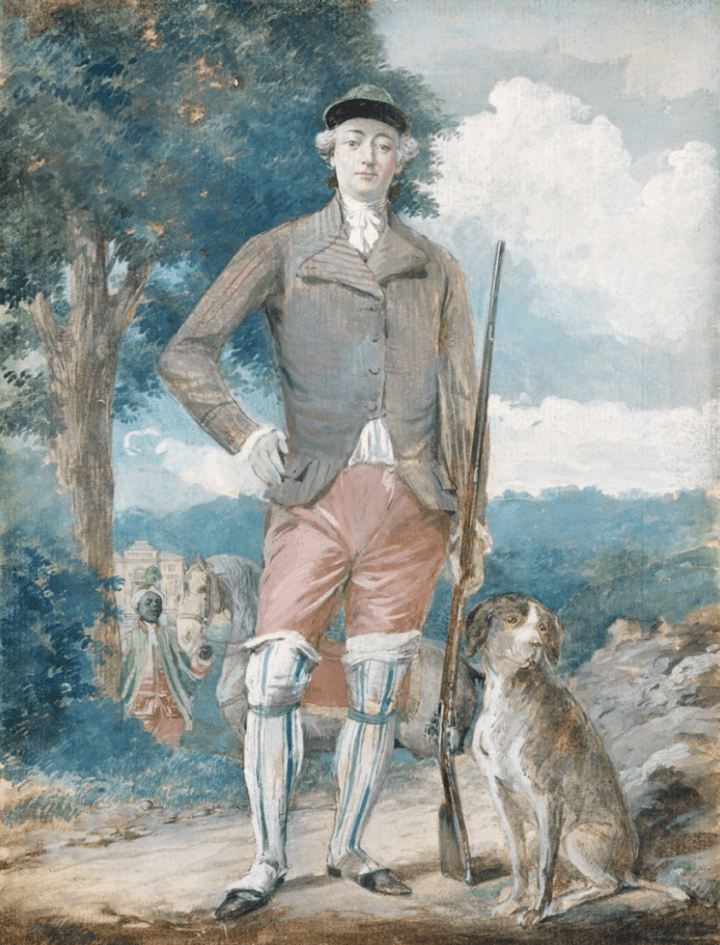
Jean-Baptiste-Philibert Moitte, The Comte d’Artois as a Hunter, ca. 1777, gouache on paper, 22.9 × 30 cm (Amiens, Musée de Picardie). Figure 1 from the article by Noémie Étienne and Meredith Martin.
• Introduction: Here Today, Gone Tomorrow? The Art of the Ephemeral in Eighteenth-Century France — Elisa Cazzato
• ‘Mais, le lendemain matin’: Residues of the Ephemeral in Eighteenth-Century French Art — Mark Ledbury
• Spectacular Blindness: Enslaved Children and African Artifacts in Eighteenth-Century Paris — Noémie Étienne and Meredith Martin
• L’art du comédien au tournant des Lumières: Conscience de l’éphémère et sensibilité mémorielle — Ilaria Lepore
• L’expérience éphémère d’Ériphyle (Voltaire, 1732): Matériaux tangibles et réécritures d’une dramaturgie passagère — Renaud Bret-Vitoz
• Un événement unique: Le théâtre de la Révolution entre surgissement et disparition — Pierre Frantz
• Ephemeral Emblem: Jacques-Louis David and the Making of a Revolutionary Martyr — Daniella Berman
• Les feux d’artifices des frères Ruggieri à l’intérieur d’un théâtre: L’autonomie de l’éphémère dans le Paris du XVIIIe siècle — Emanuele De Luca
• Tra utopia e ricerca del consenso: Fuochi e apparati effimeri di epoca napoleonica a Milano tra il 1801 e il 1803 — Alessandra Mignatti
• Witnesses of the Past: Costumes as Material Evidence of the Ephemeral Performance — Petra Zeller Dotlačilová
• Noverre’s Lament: Inscription, Posterity, and the Ephemeral Art of Dance — Olivia Sabee
• Ephemerality on the Fringe: Exploring the Venues Hosting Power Quadrilles in Brussels on the Eve of Waterloo and Beyond (1814–1816) — Cornelis Vanistendael
Miscellaneous articles and reviews are available here»
◊ ◊ ◊ ◊ ◊
Elisa Cazzato is research fellow at the University of Naples Federico II. She holds a PhD in art history from the University of Sydney, and she is a former Marie Skłodowska-Curie Global Fellow. For her project SPECTACLE she was a visiting scholar at the CELLF of the Université Sorbonne and in the New York University’s Department of Art History. Her publications include articles in the peer-review journals Studi Francesi, Dance Research, Humanities Research Journal, and RIEF. She is currently writing her first book on the life and career of Ignazio Degotti.










 Enfilade
leave a comment