Eighteenth-Century Studies 46 (Summer 2013)
Eighteenth-Century Studies 46 (Summer 2013)
A R T I C L E S
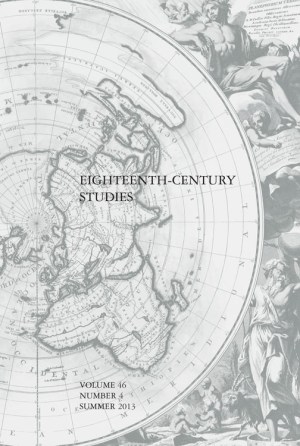 Patrick C. Fleming, “The Rise of the Moral Tale: Children’s Literature, the Novel, and The Governess,” pp. 463–77.
Sarah Fielding’s The Governess has been called the first children’s novel. But by conflating two separate genres, critics risk oversimplifying both the novel and children’s literature. This article brings together children’s literature studies and novel studies in order to address the narrative form of The Governess, and to suggest that the term “moral tale” better captures the complex origins of the eighteenth-century children’s novel.
Mark Koch, ” ‘A Spectacle Pleasing to God and Man’: Sympathy and the Show of Charity in the Restoration Spittle Sermons,” pp. 479–97.
In the 1670s the long-standing Spittle sermons became almost exclusively charity sermons, many of which argued that almsdeeds are accompanied with a sensual pleasure and articulated principles of sympathetic response involving an affective theatricality. This paper considers the place of these sermons and their ancillary children’s processions in the London public sphere, how they worked as spectacle to evoke pity from spectators, and how, despite the Latitudinarian tendency toward rationalism, they often contained elements of what was deemed an empirically nebulous “show” or “fiction.”
Catherine Packham, “Cicero’s Ears, or Eloquence in the Age of Politeness: Oratory, Moderation, and the Sublime in Enlightenment Scotland,” pp. 499–512.
This paper argues that Hume’s essay, “Of Eloquence,” should be read as part of a Scottish Enlightenment attempt to accommodate the sublime to commercial modernity. Hume inherits the sublime of ancient oratory not as a matter for narrow stylistic regulation—to be rejected in a new age of politeness, as some have argued—but as a moral problem at the heart of modern subjectivity. Hume looks to taste to regulate and contain the sublime, but it is Adam Smith who solves the problem of the sublime by recouping its excess as a mark of the possibilities for virtue in the modern age.
Lisa T. Sarasohn, ” ‘That Nauseous Venomous Insect’: Bedbugs in Early Modern England,” pp. 513–30.
Bedbugs were perceived as a new entry in the rich range of vermin that plagued eighteenth-century England, and the way they were viewed and treated reveals much about the mentality, prejudices, assumptions and aspirations of society at that time. Their presence increasingly elicited repugnance and even hysteria. The reaction to bedbugs during the eighteenth century serves as an indicator of modernity and emerging attitudes towards the body, class, nature and science.
Ryan Whyte, “Exhibiting Enlightenment: Chardin as tapissier,” pp. 531–54.
This essay addresses the work of Jean-Baptiste Chardin as tapissier to show his design of the Salon du Louvre functioned as an ideological system that derived meaning from Enlightenment discourses of epistemology and taxonomy. First, this essay explores how the Salon design answered the Académie’s need to represent its structure to the Salon public, and to guide the public in judging the individual works comprising it. Second, this essay examines points of contact between Chardin, the Académie, Carl Linnaeus and the authors of the Encyclopédie of Diderot and Jean le Rond d’Alembert as intellectual context for the Salon design.
Abigail Zitin, “Thinking Like an Artist: Hogarth, Diderot, and the Aesthetics of Technique,” pp. 555–70.
In The Analysis of Beauty, William Hogarth advocated an unusual kind of formalism based in artistic practice: not form distilled into a rule for judgment but rather derived from the artist’s techniques for perception and composition. Denis Diderot, too, embraced an aesthetics of technique, particularly in the Paradoxe sur le comédien, in which he contends that what appears impassioned in an affecting dramatic performance is in fact calculated. Diderot, however, had the extra burden of reconciling the ideal of illusion with his demystification of the practitioner’s perspective, a reconciliation he could only conceive as a paradox.
R E V I E W S
Mark K. Fulk “Travel And/As Enigma: Review of Ian Warrell, ed., Turner Inspired in the Light of Claude (National Gallery Company, 2012) and Yaël Schlick, Feminism and the Politics of Travel After the Enlightenment (Bucknell University Press, 2012),” pp. 571–73.
Recent work on travel by scholars Nicola Watson (The Literary Tourist: Readers and Places in Romantic and Victorian Britain [2008]), Zoë Kinsley (Women Writing the Home Tour, 1682–1812 [2008]), and Ann C. Colley (Victorians in the Mountains [2010]) has added markedly to our understanding of British travel in the latter eighteenth and the nineteenth centuries through its foregrounding of issues of class, gender, and the changing understanding of landscape aesthetics and theories of the sublime. The books in this review supplement this discussion by their emphasis on Anglo-French experiences of travel in the period. . .
Jennifer Milam, “Review of Michael Yonan, Empress Maria Theresa and the Politics of Habsburg Imperial Art (The Pennsylvania State University Press, 2011),” pp. 575–77.
. . . Thanks to Yonan’s interpretive approach, Empress Maria Theresa and the Politics of Habsburg Imperial Art is a ground-breaking study in the history of Austrian art and architecture. His book is a substantial contribution to the study of women as powerful agents in the production and reception of visual culture in European court circles during the eighteenth century. Moreover, Yonan’s wide-ranging choice of material—portraiture, decorative objects, architecture, interior decoration, and garden sculpture—provides the reader with a comprehensive understanding of Maria Theresa’s individualized approach to the representation of her personal authority in the visual arts. This is complemented by a number of quality illustrations that allow readers to consider the details of many works that are rarely discussed in depth. . .
Mark K. Fulk, “Review of Adrian J. Wallbank, Dialogue, Didacticism and the Genres of Dispute: Literary Dialogue in an Age of Revolution (Pickering and Chatto, 2012),” pp. 578–79.
In his postscript, Adrian J. Wallbank explains that his project was meant to “open up multiple avenues for further research . . . into this seriously neglected literary genre” of the written dialogue, gesturing toward the beginnings of a history of “dialogic didacticism” in the Romantic era (217). The book meets these expectations well by revealing in elaborate detail this overlooked genre, and suggesting ways that Wallbank’s readings can help complement our approach to already canonical markers of the period. . .
Christopher Gibbs and a Remarkable Georgian Sofa
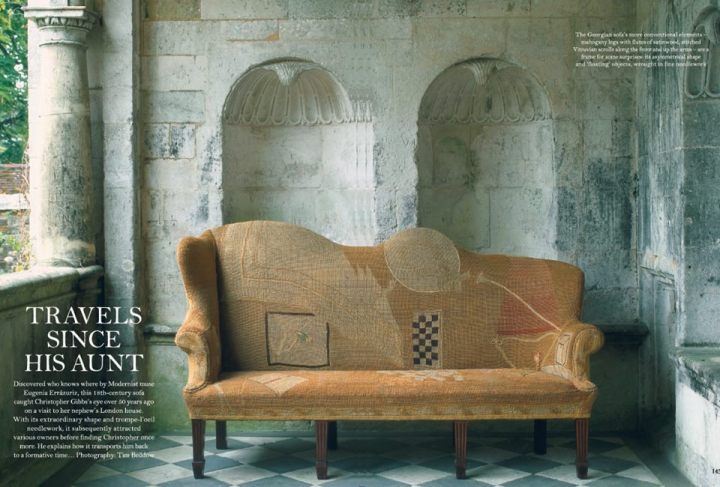
With its trompe-l’oeil needlework, this sofa is extraordinary (items depicted include a gameboard and cards, a box, a basket of yarn, a bird on a branch, and a bag). The one-page essay in The World of Interiors by the antiques dealer Christopher Gibbs, accompanied by stunning photographs, underscores just how compelling an object can be as a subject. -CH
◊ ◊ ◊ ◊ ◊
Christopher Gibbs, “Travels Since His Aunt,” The World of Interiors (June 2013): 144-49.
Discovered who knows where by Modernist muse Eugenia Errázuriz, this 18th-century sofa caught Christopher Gibbs’ eye over 50 years ago on a visit to her London home. With its extraordinary shape and trompe-l’oeil needlework, it subsequently attracted various owners before finding Christopher once more [via the antique dealer Edward Hurst]. Gibbs explains how it transports him back to a formative time, in the June issue of The World of Interiors. Photography: Tim Beddow.
Exhibition and Book | The Art of Living, Augsburg ca. 1780
The June 2013 issue of The World of Interiors features a remarkable album from the 1780s, believed to the the work of Balthasar Cornelius Koch. It was the subject of a 2010-11 exhibition in Augsburg; the catalogue is available in German.
◊ ◊ ◊ ◊ ◊
Michael Huey, “A Cabinet Curiosity,” The World of Interiors (June 2013): 150-57. The stuff of life, c1780, is laid bare in a handmade album documenting the décor and possessions of a prosperous goldsmith, and his family of servants, in 18th-century Augsburg. From watercolour to scraps of fabric, the enchanting tour, from pantry to salon, literally opens the doors on inner courtyards and armouries. The June issue of The World of Interiors uncovers shoes, nightcaps and lace — but no skeletons — in the closets.
. . . Part pen/ink and watercolour, part découpage (it incorporates copperplate engravings), part scrapbook (it also uses real historical fabrics and papers) and, in a sense, part diary, it records the everyday functions of the rooms of the house in full colour and significant detail. Included are a dining room; five salons (chose from green, white, ladies’, music and tea); five bedrooms (including those for the maids, the maternity room and one for a child); and five public or service spaces (halls, kitchen, pantry), with all their particular floorings, textiles, furnishings and other accoutrements. . . (156).

◊ ◊ ◊ ◊ ◊
From the museum’s website:
Die Kunst zu Wohnen: Ein Augsburger Klebealbum des 18. Jahrhunderts
Deutsche Barockgalerie im Schaezlerpalais, Augsburg, 24 November 2010 — 20 February 2011
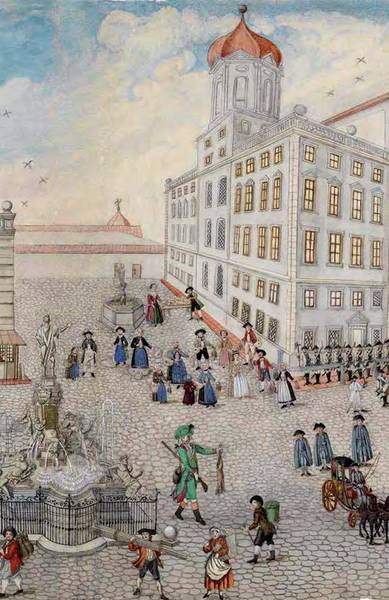 Augsburg war seit dem 16. Jahrhundert nicht nur eine Hochburg für den Buchdruck und die grafischeProduktion, hier entstanden ebenfalls sogenannte “Klebealben”. Diese wurden angelegt, um Kindern und Heranwachsenden aus bürgerlichen Familien die Welt zu erklären.
Die Jugendlichen schnitten aus eigens zu diesem Zweck herausgegebenen Bögen historische oder biblische Figuren, Tiere oderberühmte Bauwerke aus und klebten sie in gedruckte Vorlagen ein. Auch andere Druckgrafiken, Buntpapiere oder sogar Stoffe wurden zerschnitten und in die Klebealben eingefügt.
Das hier ausgestellte Klebealbum wurde nach 1780 für die Juwelierstochter Regina Barbara Waltherangelegt. Teile des Albums wie gezeichnete und kolorierte Figuren und Raumsituationen wurdenvermutlich bei dem Zimmerpolier Balthasar Cornelius Koch in Auftrag gegeben. Auf den Seiten blieb aber genügend Platz, so dass Regina Barbara selbst Figuren ausschneiden und einkleben konnte. Das Album stellt “die Kunst zu Wohnen” vor und verschafft den Betrachtern so bis heute einen Einblick in das Leben des Augsburger Bürgertums im
18. Jahrhundert. . .
More from the museum’s website»
◊ ◊ ◊ ◊ ◊
From the publisher:
Georg Haindl, Die Kunst zu Wohnen: Ein Augsburger Klebealbum des 18. Jahrhunderts (Berlin: Deutscher Kunstverlag, 2010), 240 pages, ISBN: 978-3422070400, 40€.
 Als beliebte Alternativen zu den Puppenhäusern wurden in Augsburg als wichtiger Verlagsstadt des 18. Jahrhunderts so genannte „Klebealben” von liebenden Eltern für ihre Kinder angelegt. Sie zeigen neben zentralen Plätzen Augsburgs auch die Räume idealtypischer Bürgerhäuser, in die ausgeschnittene Darstellungen von Figuren, Möbeln oder Geschirren eingeklebt werden konnten. Als Ressource hierfür dienten nicht nur die Augsburger „Ausschneidebögen”, wie sie von den Verlagen Johann Martin Wills oder Martin Engelbrechts extra für diesen Zweck herausgegeben wurden, sondern auch Modejournale, Buntpapiere, Textilien oder alte Bücher, die zerschnitten wurden.
In der Publikation widmen sich mehrere Autoren einem besonders qualitätsvollen und gut erhaltenen Album, bei dem nicht Kinder, sondern Heranwachsende die Adressaten waren, um ihnen einen perfekt funktionierenden Haushalt vor Augen zu führen. Das Album wurde in den 1780er Jahren vermutlich von dem Zimmerpolier Balthasar Kornelius Koch gefertigt und zeigt durch seine additive Darstellungsweise wichtige Aspekte des bürgerlichen Lebens dieser Zeit in Augsburg – eine unschätzbare kulturhistorische Quelle.
The Historical Journal, March 2013
From The Historical Journal:
David Gilks, “Attitudes to the Displacement of Cultural Property in the Wars of the French Revolution and Napoleon,” The Historical Journal 56 (March 2013): 113-43.
 Abstract: The French state expropriated an enormous quantity of cultural property from across Europe during the Wars of the Revolution and Napoleon, but much was returned in 1815 after the fall of the Empire. This article examines contemporary attitudes to the displacement of works of art, antiquities, scientific specimens, and rare books. The seizures were controversial: since they occurred at a time when plundering the vanquished was already considered questionable behaviour, they attracted opposition and needed to be justified. The article identifies the resulting repertoire of attitudes, arguing that this repertoire evolved with changing circumstances and was more varied than hitherto maintained. By situating this repertoire in a larger historical context, the article also reassesses the extent to which attitudes were derivative and innovative. It contends that the disputation as a whole did not amount to a decisive rupture in the treatment of foreign cultural property during wartime, but that it was nevertheless remarkable in two respects: concepts from hitherto unrelated subjects were applied to considerations about cultural property; and the perceived conditions under which cultural property could be legitimately transferred were revised.
2012-13 Clifford Prize | Messbarger on the Florentine Anatomical Venus
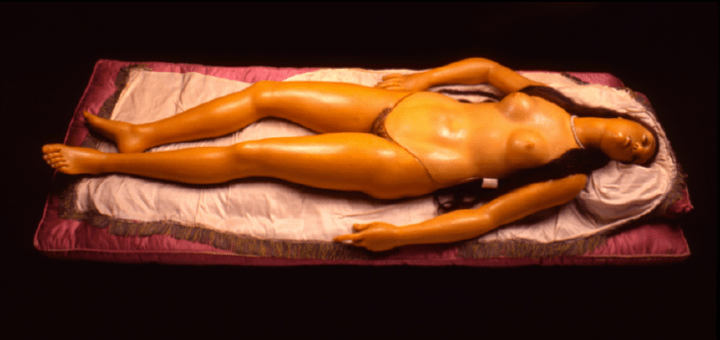
Anatomical Venus, ca. 1780, wax, Museum of Natural History in Florence
(Photo: Saulo Bambi)
◊ ◊ ◊ ◊ ◊
ASECS recently announced that the 2012-13 James L. Clifford Prize was awarded to Rebecca Messbarger for her article “The Re-Birth of Venus in Florence’s Royal Museum of Physics and Natural History” published by the Journal of the History of Collections (May 2012): 1-21.
Messbarger is the author of The Lady Anatomist: The Life and Work of Anna Morandi Manzolini (Chicago: University of Chicago Press, 2010).
The Burlington Magazine, March 2013
The eighteenth century in The Burlington:
The Burlington Magazine 155 (March 2013)
E D I T O R I A L
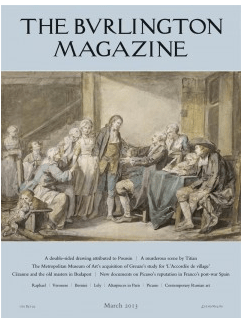 • “Mind Your Language,” p. 151. The incorrect and exaggerated use of language in the art press.
. . . A recent article in the Guardian [Andy Beckett, “A User’s Guide to Artspeak,” The Guardian (27 January 2013)] reported on a private initiative by two Americans, an artist and a critic/sociologist, who have investigated the language of contemporary art description, culled from wall labels and gallery press releases from 1999 onwards [David Levine and Alix Rule, “International Art English,” Triple Canopy 16 (July 2012)]. Their survey is analytic rather than satiric, and they trace the origins of what they call ‘International Art English’ to much French post- structuralist theory. They make excellent, deadpan fun of the commercial gallery press release which now goes well beyond its earlier professional constituency to reach a broad emailed audience. At the Burlington, where we receive thousands of such releases each year from many countries, we can testify to the universality of this artspeak obscurantism. But even in the more comprehensible releases, for exhibitions or books, the clichés mount up: the works are ‘brand new’; the exhibits are ‘iconic’; the paintings are ‘vibrant’ (and also, of course, ‘masterful’); the artist is never less than ‘award winning’; and the new book (invariably a ‘comprehensive overview’) is ‘groundbreaking’, ‘lavishly illustrated’ and ‘thought-provoking’. These all accumulate into a prose of deadly conformity. . . Keep reading here»
A R T I C L E S
• Perrin Stein, “Greuze’s L’Accordée de Village: A Rediscovered Première Pensée,” pp. 162-66. The rediscovery of a watercolour study (c.1761) of Jean-Baptiste Greuze’s L’Accordée de Village.
R E V I E W S
• Antony Griffiths, Review of Ad Stijnman, Engraving and Etching 1400–2000: A History of the Development of Manual Intaglio Printmaking Processes (London: Archetype Books, 2012), p. 177.
This monument book is the result of twenty-five years’ work on the part of the author who has produced a text far ahead of anything yet written on this aspect of printmaking. . . His conclusions have an authority that immediately makes this a standard work, and it can confidently be recommended to any reader. . .
• Claudia Nordhoff, Review of the exhibition Johann Christian Reinhart (1761–1847): Ein deutscher Landschaftsmaler in Rom,” pp. 199-200.
Chrisman-Campbell, “When Fashion Set Sail” at Worn Through
It’s been too long since I’ve noted offerings at Worn Through, a blog that addresses apparel from an academic perspective. In addition to a Call for Papers for the Annual Meeting of the Costume Society of America (Midwest Region) on the theme of Uncommon Beauty, recent postings include an interesting contribution from Kimberly Chrisman-Campbell on maritime headdresses: “When Fashion Set Sail.” -CH
◊ ◊ ◊ ◊ ◊
Kimberly Chrisman-Campbell, “When Fashion Set Sail,” Worn Through (20 March 2013).

Anonymous, Coëffure à l’Indépendance ou le Triomphe de la liberté, ca. 1778, Musée franco-américain du château de Blérancourt
One of the most iconic images of eighteenth-century extravagance is a fashion plate depicting a lady wearing a miniature ship in her powdered and pomaded hair.
But this much-misunderstood hairstyle was not just an eye-catching novelty. It was one of many ship-shaped headdresses that celebrated specific French naval victories and, more importantly, advertised their wearers’ patriotism and political acumen.
Far from being the whimsical caprice of bored aristocrats, these maritime modes were directly inspired by one of the defining political and philosophical issues of the day: America’s struggle for independence, in which France was a key military and political ally.
The full posting is available here»
Spring 2013 Issue of ‘Renaissance Quarterly’
The eighteenth century in the current issue of Renaissance Quarterly:
Paula Findlen, “The 2012 Josephine Waters Bennett Lecture: The Eighteenth-Century Invention of the Renaissance: Lessons from the Uffizi,” Renaissance Quarterly 66 (Spring 2013): 1-34.
 This essay explores the role that the eighteenth-century Uffizi gallery played in the invention of the Renaissance. Under the Habsburg-Lorraine rulers, and especially during the reign of Grand Duke Peter Leopold (r. 1765–90), changes to the Medici collections and the gallery’s organization transformed an early modern cabinet of curiosities, paintings, and antiquities into a space in which a historical narrative of art, inspired by rereadings of Giorgio Vasari’s Lives, became visible in a building he designed. A succession of Uffizi personnel was increasingly preoccupied with how to see renaissance, and more specifically Tuscan rinascita, in the collections. The struggles between the director Giuseppe Pelli Bencivenni and his vice-director Luigi Lanzi highlight how different understandings of the Renaissance emerged in dialogue with antiquarianism and medievalism. At the end of the eighteenth century the Uffizi would definitively become a museum of the Renaissance to inspire new forms of historical writing in the age of Michelet and Burckhardt.
From the ‘Journal of the History of Collections’ March 2013
The eighteenth century in the March 2013 issue of the Journal of the History of Collections:
A R T I C L E S
Linda Bauer and Nello Barbieri, “Forming a Collection of Paintings in Late Baroque Siena,” Journal of the History of Collections 25 (2013): 45-57.
 By the time of his death in 1727, the Cavaliere Marcello Biringucci possessed some 600 paintings. A group of unpublished documents, mainly forty-two sheets in the Archivio di Stato in Siena offers unusual insight into this Sienese nobleman’s collecting activities. The papers – memoranda, lists, invoices, orders for payment, receipts, accounts of expenses – many in the Cavaliere’s own hand, illustrate the range of sources he drew upon, not only geographical but those in the secondary art market. He employed agents, purchased from the estates of other collectors, acquired art at auctions, and even redeemed the pawn of a debtor. The documents include the names of artists – many well known – with prices or values for some works, and by reference to the largely unpublished inventory of his estate, give some indication of which works in the documents Biringucci acquired and how his taste conformed to the prevailing trends of the period. Online appendices to the paper, at http://www.jhc.oxfordjournals.org, reproduce the 1727 inventory, working papers, and a selection of letters.
Ellen Adams, “Shaping, Collecting and Displaying Medicine and Architecture: A Comparison of the Hunterian and Soane Museums,” Journal of the History of Collections 25 (2013): 59-75.
Collections played a critical role as teaching tools for particular disciplinary doctrines in Enlightenment Britain, including medicine and architecture. The two protagonists examined here are the architect Sir John Soane and surgeon John Hunter, whose museums now face one another across Lincoln’s Inn Fields in central London. Skeletons, body parts and artistic models illustrated and explained the workings of the body, while architectural pieces and casts, together with interior design and furnishings, supplied inspiration for architects. These collections dissect, respectively, bodies and buildings in order to build new schools of thought. Hunter’s and Soane’s original house museums were both designed to promote particular disciplinary practices and to impress polite society, through various kinds of representations and methods. They differ, however, in the use of the classical tradition. Hunter strode forwards, leaving this legacy behind, while Soane stood Janus-like, interweaving past and present into a multi-layered narrative.
Elena Dmitrieva, “On the Formation of the Collection of Gem Impressions in the State Hermitage Museum,” Journal of the History of Collections 25 (2013): 77-85.
This article deals with the history of the State Hermitage Museum’s collection of gem casts [initiated in the eighteenth century by Catherine the Great}, with a focus on the dactyliotheca stored in the Department of Classical Antiquity containing over 25,000 pieces and currently kept in storage. This collection of plaster impressions has never been displayed to the public and its contents have not yet been published. Nevertheless, it forms a unique example of a collection of casts made from cameos and intaglios, both antique and modern. It is important in a number of ways, including its usefulness in studying the evolution of engraving techniques and its value in contributing to the repertoire of images encountered on gems. It is also an important resource for the study of gems that have not survived in original form to present day.
R E V I E W S
Christian Tico Seifert, Review of Christien Melzer, Von der Kunstkammer zum Kupferstich-Kabinett: Zur Frühgeschichte des Graphiksammelns in Dresden, 1560-1738 (Zurich: Georg Olms Verlag, 2010), 821 pages, ISBN: 978-3487143460, €75, Journal of the History of Collections 25 (2013): 140-41.
Melzer’s book is a major publication on the history of collecting prints and drawings in Central Europe. The results of her study, a Ph.D. dissertation written under the supervision of Bruno Klein (Dresden) and Michel Hochmann (Paris), go far beyond tracing the history of the Dresdner Kupferstich-Kabinett (Print Room) from the sixteenth to the mid-eighteenth centuries. She combines thorough research on a huge amount of graphic art, treatises and archival material (much of it hitherto unpublished) with theoretical reflection on collecting and the development of classifications and display of collections, a field that has received enormous attention over the past two decades. . .
Mia Jackson, Review of Abigail Harrison Moore, Fraud, Fakery and False Business: Rethinking the Shrager v. Dighton ‘Old Furniture Case’ (London and New York, Continuum, 2011), 224 pages, ISBN: 978-1441115751, £65, Journal of the History of Collections 25 (2013): 143-44.
Abigail Harrison Moore weaves together a rich variety of sources in this account of the infamous ‘Old Furniture Case’, which preoccupied the British media and antiques trade in 1923. Adolph Shrager, a Jewish immigrant from Germany, brought a case of fraud against a prominent London firm of antique furniture dealers, Dighton & Co., in regard to a large quantity of furniture purchased from them between 1919 and 1921. In these two years, Shrager bought over 500 pieces to furnish his new house in Kent. The pieces were largely purported to be English eighteenth-century, and he spent in excess of £111,000. Shrager ran into financial difficulty and ill-health in 1921, and, unable to settle his account with Dighton, who were also feeling the pinch, decided to sell some of his burgeoning collection. The first suspicion that all was not as it might have appeared was raised by Dighton’s pessimism in reply to Mrs Shrager’s suggestion that they sell at Christie’s a suite of furniture for which Mr Shrager had paid £3,000 cash. ‘There is little chance of selling your suite of Chippendale furniture’, came the reply, ‘as there is practically no business’. Shrager called in an expert, (later, and under duress, revealed to be Frederick Litchfield), to advise him on which pieces he could sell ‘so as not to spoil the collection’, and received the devastating judgement that ‘some ninety-eight or ninety-nine percent of them could not be described as genuine antique pieces of furniture of the highest class’. . .
In the Fall 2012 Issue of ‘American Art’
Ethan W. Lasser, “Selling Silver: The Business of Copley’s Paul Revere,” American Art 26 (Fall 2012): 26-43.
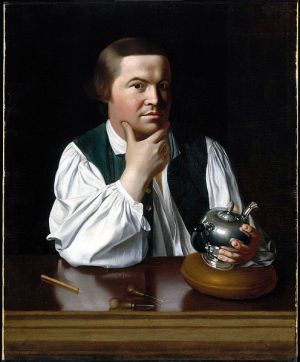
John Singleton Copley, Paul Revere, 1768. Oil on canvas, Museum of Fine Arts, Boston, Gift of Joseph W., William B., and Edward H. R. Revere (Photo: Wikimedia Commons)
. . . Few examples of colonial American painting have been studied as extensively as Copley’s Paul Revere. Scholars have argued that the portrait depicts Revere in his workshop as he pauses while engraving a silver teapot and have proposed a range of explanations to account for this subject matter. They have analyzed Copley’s sources, searched for (and ultimately uncovered little) information about the commission of the portrait, and speculated about the connection between the painting and Revere’s radical politics[note 2]. But interpreters have yet to consider seriously the connection between the portrait and the increasingly dire state of Revere’s financial affairs. Though Copley depicted the silversmith plying his trade, the bottom-line realities of this trade have been left out of the story of this iconic painting [p. 27]. . . .
My interpretation will draw on two different types of evidence. First is the portrait itself. Paul Revere is a far richer and more singular work than past scholars have acknowledged. While many writers have discussed the subject matter of the painting, few have seriously explored the portrait’s exceptional
composition. . . .
Since this is an image of a craftsman that emphasizes artisanal practice, questions about the processes of making, raising, and decorating silver teapots will also figure centrally in my account. In the period when Copley painted Paul Revere, elites grew increasingly interested in and familiar with artisanal materials and techniques [p. 28]. . . .
In proposing Paul Revere as such a strategic image, my argument locates the portrait within a broader field of eighteenth-century painting that functioned to promote the wares of particular retailers and artisans. This field includes genre paintings like Jean-Antoine Watteau’s iconic Shop Sign [p. 29] . . .
The full article is available here (J-Stor subscription required)










 Enfilade
leave a comment